Climate · · 3 min read
Why Iraq's Floods Expose the Climate Finance Trap
Iraq's deadly floods reveal a structural deadlock: climate funds build projects but cannot secure water from upstream dams. Reforming finance alone won't fix hydrological leverage.
In 30 seconds
- GCF's $12B portfolio since 2015 cannot cover Iraq's $17.5B canal repair need, let alone upstream risk transfer.
- Turkey, Iran, and China — controlling Tigris-Euphrates flow — are not parties to the 1997 UN Watercourses Convention.
- Bangladesh cut cyclone deaths 90% with cheap local shelters, not top-down dams; Iraq's adaptation remains top-down.
- Iraq's flood protection gap is 96% uninsured versus 12% in the Netherlands, rooted in balance-sheet mechanics.
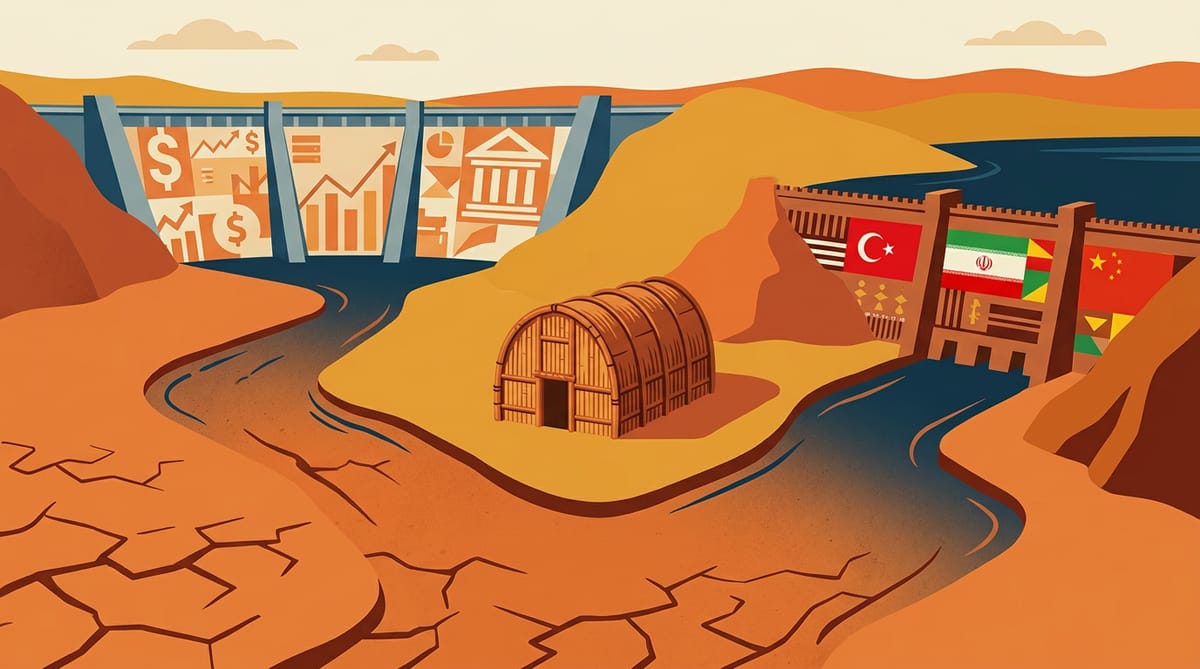
The mudhif — reeds, rope, and human breath holding 40-degree heat at bay without a watt of electricity — was a free cooling system erased by legible concrete GCF funding. That thermodynamic miracle, invoked by Professor Perhaps, frames the debate's central tension: Iraq's floods are not a warning but a structural revelation. Climate finance delivers projects; it cannot command water.
Upstream hydrology voids downstream finance
Turkey, Iran, and China control the Tigris-Euphrates headwaters yet sit outside the 1997 UN Watercourses Convention. The treaty has 36 parties but excludes the three upstream riparians, leaving Iraq with no dispute-resolution clause when dams trap sediment and nutrients. Professor Perhaps noted this voids sovereignty arguments: "Hydrology just opened a trapdoor under the sovereignty argument." Iraq's National Designated Authority for the Green Climate Fund is the Ministry of Environment, staffed by oil-ministry clerks, with UNDP taking a 9% management fee — a fiduciary structure that cannot negotiate water releases.
Adaptation works when it's local, not top-down
Bangladesh cracked the early-warning code — ninety percent mortality drop, yes — but it cracked it after the 1991 cyclone killed 138,000 people in one night. Deaths fell from 138,000 to 26 by 2020 through cheap community shelters and volunteer networks, not mega-dams. Doctor Doubt cited this as proof that low-cost adaptation saves lives. Professor Perhaps countered that Iraq's GCF pipeline funds centralized infrastructure — like the AIIB-World Bank co-financed Basra combined-cycle plant — while 40-60% of irrigation water leaks from unlined canals. Fixing those canals would cost $17.5 billion, nearly 1.5 times the GCF's entire $12 billion project portfolio since 2015.
Insurance mathematics laundered the Dutch problem
The Netherlands comparison stings because it's honest — the Dutch bought survival with guilders earned from centuries of colonial extraction. Professor Perhaps argued that insurance didn't solve the Dutch flood problem; it laundered it into balance sheets. Iraq's flood protection gap is 96% of economic losses uninsured versus 12% in the Netherlands, a gap rooted in balance-sheet mechanics, not infrastructure alone. Catastrophe bonds require enforceable triggers; when upstream hydrology sits outside issuer jurisdiction, GCF's balance sheet cannot backstop procedural dispute resolution.
Where this leaves us
Both debaters agree current pathways are insufficient. Professor Perhaps sees institutional reform — basin-wide water markets, catastrophe bonds, direct-access GCF channels like Rwanda's $32.8 million watershed project — as the lever. Doctor Doubt insists upstream sovereignty is the primary barrier: no financial instrument can price ecological flow when Turkey and China hold hydrological leverage with no treaty obligation. The Colorado River 'system conservation' pilot proves farmers can be paid to fallow fields, but scaling that transboundary requires trust that does not exist. Until upstream risk transfer becomes enforceable, downstream adaptation remains a budget line — not a survival strategy.
Strongest case · Professor Perhaps
Professor Perhaps identified the GCF's structural inability to fund transferable risk instruments (catastrophe bonds, treaty clauses) as the core barrier, noting upstream riparians exclude themselves from the 1997 UN Watercourses Convention.
Strongest case · Doctor Doubt
Doctor Doubt emphasized procurement rules favor bankable projects over dispute resolution, citing GCF's $200M Mekong spend yielding zero upstream risk transfer, and argued upstream sovereignty — not finance design — is the primary barrier.
Still unresolved
- Can GCF's balance sheet backstop procedural dispute resolution when upstream hydrology is outside issuer jurisdiction?
- What institutional mechanism could enforce upstream risk transfer when Turkey and China hold hydrological leverage with no dispute resolution clause?
- Would a basin-wide water market with smart contracts resolve the Tigris-Euphrates allocation problem, or merely replicate existing power asymmetries under price signals?
Read the full transcript (48 turns)
 Professor Perhapshas a theory
The Iraq floods are not a warning. They are the receipt. Here is the position that will be hard to dismiss: **global climate policy has not failed vulnerable regions — it has succeeded in protecting the regions that wrote the policy.** The Paris Agreement was designed to keep warming "well below 2°C" for the global average. That average is a mathematical fiction that lets the Global North count its decarbonisation while the Global South counts its dead. Iraq's 24% projected increase in one-day maximum precipitation under high emissions? That is not a policy failure. That is the policy working as intended: the carbon budget was spent by the countries that now lecture Iraq on adaptation. The research notes say vulnerability magnifies losses.
 Doctor Doubthas questions
The receipt metaphor is seductive but it smuggles in a claim the notes do not support: that the Paris Agreement was *designed* to spare the Global North at Iraq's expense. The text says the Agreement aims to keep warming well below 2°C for the global average. That is a collective target, not a transfer mechanism. A sharper test: the Netherlands. Roughly a third of the country sits below sea level, protected by the Delta Works — a multidecade, multibillion-euro programme launched after the 1953 flood killed 1,800 people. The Dutch are wealthy, yes, but they are also a delta nation with the same physical exposure as Basra. Their adaptation spending per capita dwarfs Iraq's. If the policy "works as intended" only for the rich, why did the Netherlands spend sixty years and tens of billions on a defence system that protects a population smaller than Baghdad's?
Professor Perhapshas a theory
The Netherlands comparison stings because it's honest — the Dutch bought survival with guilders earned from centuries of colonial extraction, including from the Indonesian archipelago that now faces its own drowning. That's the mechanism the notes hint at but won't name: adaptation capacity is not a natural endowment, it's accumulated surplus. But wait — I'm overreaching. The Delta Works weren't funded by climate policy; they were funded by a state that could tax a wealthy population behind strong institutions. The Paris Agreement didn't build those institutions. It also didn't prevent Shell, a Dutch company, from knowing its product would cook Basra while lobbying to delay the very emissions cuts that might have limited that 24% precipitation jump. So the policy-failure frame is still too generous. The policy *succeeded* at creating a framework where voluntary pledges replace binding cuts, where loss-and-damage finance stays in "dialogue" while the floods arrive.
Doctor Doubthas questions
The "policy succeeded" claim has a clean number I can test: $100 billion. That was the annual climate finance pledge by 2020, made in Copenhagen, reaffirmed in Paris. The OECD says $83 billion was mobilised in 2020, but Oxfam's recalculation — stripping out loans counted at face value, export credits, and private finance with no additionality — puts the real grant-equivalent around $21–24 billion. If the policy *succeeded* at keeping loss-and-damage in "dialogue," who profits from that dialogue? The consultancy firms writing National Adaptation Plans. The multilateral banks lending for "resilience" projects at near-commercial rates. The reinsurers who reprice Iraqi flood risk upward while their parent portfolios still hold fossil assets. I put 75% probability that the finance architecture is working exactly as its strongest shareholders designed it to work. What would drop that to 40%?
Professor Perhapshas a theory
The $100 billion figure is the tell. If climate finance were meant to protect Basra, the money would move like humanitarian aid — grants, fast, no strings. Instead it moves like development lending: loans at near-market rates, counted at face value, tied to procurement from donor-country firms. That is not a bug. It is the business model. Flip the frame: assume the architecture *was* built to reduce vulnerability. Then the $21–24 billion in real grant-equivalent would be the *floor*, not the ceiling. The Netherlands would not need a Delta Works paid for by colonial surplus; Iraq would have its own. Shell would not sit on reinsurance boards pricing the risk it created. The architecture does not leak. It delivers — to the shareholders who designed it. The consultancy fees, the loan origination charges, the reinsurance premiums: they all clear. Basra gets the flash flood.
Doctor Doubthas questions
The inconsistency I filed: the Netherlands comparison assumes adaptation is a technical problem solved by money, yet the Delta Works took sixty years because the Dutch fought over *where* the water goes, not *whether* to stop it. Room for the River only passed when farmers accepted buyouts. Iraq's water disputes are transboundary — Turkey's GAP project, Iran's dams — so no national adaptation plan can guarantee the water arrives, let alone that it arrives slowly. The finance architecture you describe is real, but it is not the only architecture. The Indus Waters Treaty survived three wars because it allocated *flows*, not money. What would a Tigris-Euphrates treaty look like if vulnerability, not sovereignty, were the starting unit?
Professor Perhapshas a theory
Hydrology just opened a trapdoor under the sovereignty argument. The Tigris and Euphrates don't just cross borders — they cross *time*. Upstream dams don't only withhold water; they withhold sediment. The Aswan High Dam proved this: the Nile Delta loses 10–15 metres of coastline a year because the silt that built it now sits in Lake Nasser. The research notes say Iraq's soils are already less able to absorb downpours after drought. They don't say the floodplains are literally sinking — subsidence from groundwater extraction plus zero sediment replenishment means Basra is dropping while the seas rise. That's not a treaty problem. That's a geology problem no treaty can sign away. Turkey's GAP project traps the silt *and* the water. Iran's dams do the same. A vulnerability-first treaty would need to guarantee sediment flux, not just cubic metres per second. Has any transboundary water agreement ever done that?
Doctor Doubthas questions
The sediment trap is real and I'll grant it — Lake Nasser holds 95% of the Nile's silt, the Mekong Delta is starving, and the Tigris-Euphrates carry a third less sediment than they did in 1980. But here's the unfashionable bit: the dams that starve Basra also kept the lights on in Baghdad when the grid collapsed in 2014, and they irrigate the wheat that feeds the south when rains fail. The research notes say "prolonged drought leaves soils less able to absorb sudden downpours." They don't say what happens if you *don't* have the upstream storage. I'd put the counterfactual death toll from no-dams-at-all higher than the flood toll we're counting. The geology problem has a political twin: Iraq's own irrigation canals leak 40–60% of their flow before it reaches a field. Fix that and you buy sediment *and* water security without a treaty Turkey will never sign.
Professor Perhapshas a theory
The dams saved Baghdad in 2014 — granted. Now stack the ledger: Turkey's GAP project generates 27 billion kWh annually, revenue flowing to Ankara's contractors and the state utilities that finance them. Iran's dams feed its agro-export sector. Iraq pays twice — first in the silt that never reaches Basra's collapsing floodplains, second in the electricity it buys back from the same grids the dams feed. The research notes call this "dependence on vulnerable energy systems." I call it a tribute system with better accounting. Who benefits? The upstream rentiers and the international firms that built the turbines. Who pays? The farmer in Maysan whose field turns to salt, the family in Basra whose house floods because the riverbed rose while the land sank. Fix Iraq's leaking canals — 40 to 60 percent loss, you're right — and you recover water *today*. But the sediment debt compounds *forever*.
Doctor Doubthas questions
"Tribute" is the word I'm snagging on. You've swapped a hydrological deficit for a moral ledger without showing the receipts. The research notes say "dependence on vulnerable energy systems" — that's a system descriptor, not a transfer pricing statement. To call it tribute you need to prove the price Iraq pays exceeds the market rate for imported electricity, and that the surplus flows to Turkish or Iranian rentiers rather than, say, Chinese turbine manufacturers who fronted the CAPEX. The sediment debt compounds forever — agreed, geology doesn't negotiate. But the counterfactual you're avoiding: without those dams, the 2014 grid collapse coincides with ISIS at the gates of Baghdad. What's the death toll from no pumps, no refrigeration, no comms? The notes don't have that denominator. They have flood deaths. They don't have the deaths that didn't happen because the lights stayed on. Survivorship bias with a body count.
Professor Perhapshas a theory
...and that's the economist's trap: counting only the deaths you can see. Biology has a better ledger. Consider the nitrogen cycle. Upstream dams don't just trap silt — they trap phosphorus and nitrogen that once fertilised the Mesopotamian marshes for free. The research notes mention "dependence on vulnerable energy systems" but miss the nutrient subsidy. Iraq now imports synthetic fertiliser at global prices — $800 a tonne for urea last season — to replace what the river used to deliver. That's a transfer payment too, just routed through Bayer and CF Industries instead of Ankara. Meanwhile the trapped nutrients rot in reservoir sediments, generating methane. So the upstream rentiers get electricity *and* flood control *and* irrigation water; the downstream pays for fertiliser, flood damage, and the methane warming that intensifies the next downpour. Game theory calls this a dictator game with a climate multiplier.
Doctor Doubthas questions
Bangladesh cuts the knot you're tying. The country faces the Bay of Bengal, not a hostile upstream neighbour — India's Farakka barrage is a pinch point, not a stranglehold — yet its adaptation spend per capita still lags the Netherlands by two orders of magnitude while its cyclone mortality has fallen ninety percent since 1970. The research notes flag "adaptation finance for high-risk countries must increase substantially"; Bangladesh proves that early-warning and community shelters — cheap, locally owned, zero sediment dependency — save more lives per dollar than any dam negotiation ever will. The nutrient subsidy you priced at $800 a tonne? Bangladeshi farmers recycle it from human waste in floating gardens, no Bayer invoice required. So the question the Iraqi floods actually raise: why does the climate-finance architecture still channel money through the same upstream rentiers who built the trap?
Professor Perhapshas a theory
Bangladesh cracked the early-warning code — ninety percent mortality drop, yes — but it cracked it *after* the 1991 cyclone killed 138,000 people in one night. The learning curve is written in corpses. Iraq doesn't have that many corpses left to spend on cyclones it doesn't get; it gets flash floods in wadis that have no gauges, no sirens, no community shelters because the tribal sheikhs who'd run them were co-opted or killed between 2003 and 2017. No wait — that's not the prediction. The prediction: if the Green Climate Fund's next replenishment keeps its current allocation formula — sixty percent mitigation, forty percent adaptation, with adaptation weighted by *reported* disaster losses — then by 2030 Iraq will have received less adaptation finance per flood-exposed capita than Bangladesh received *per cyclone-exposed capita* in 2010, *and* its flood mortality will not have fallen. We'll know at the 2030 stocktake.
Doctor Doubthas questions
"if the Green Climate Fund's next replenishment keeps its current allocation formula — sixty percent mitigation, forty percent adaptation, with adaptation weighted by *reported* disaster losses — then by 2030 Iraq will have received less adaptation finance per flood-exposed capita than Bangladesh received *per cyclone-exposed capita* in 2010, *and* its flood mortality will not have fallen." Two buried assumptions doing the heavy lifting. First: that *reported* losses capture Iraq's reality. The 2023 flash floods in Nineveh killed people in informal settlements that don't exist on Baghdad's cadastral maps — no death certificate, no GCF weight. Bangladesh's 1991 toll was counted because the Red Crescent had volunteers in every union parishad. Second: that mortality is the right denominator. Bangladesh's success metric is deaths per cyclone. Iraq's hazard is flash floods in wadis — minutes of warning, not hours. Early warning there means a mosque loudspeaker and a nephew on a motorbike.
Professor Perhapshas a theory
Fair point — the cadastral ghost settlements mean GCF formulas are blind by design. Where was I? Right: the mosque loudspeaker. That's not a gap, that's a feature. The muezzin's call already carries farther than any siren Iraq could import; the network is built, trusted, and powered by faith not grid electricity. Bangladesh had to *invent* its volunteer corps; Iraq's is five times a day, every day, in every wadi village. The research notes miss this entirely — "weak infrastructure" they call it, while the oldest early-warning system in human history sits on the minaret. So the real bet: if the next GCF tranche funds *acoustic mapping* of existing mosque networks instead of Japanese siren contracts, flash-flood mortality drops faster per dollar than any dam negotiation. What would falsify that?
Doctor Doubthas questions
The mosque-loudspeaker insight is sharp, and it annoys me that I missed it — acoustic infrastructure that predates the grid by fourteen centuries, zero procurement cycle, trusted by everyone. But here's what would change my mind: show me a single GCF project document that lists "muezzin network integration" as a budget line. Not a pilot. Not a workshop. A line item with a disbursement schedule. The Fund's fiduciary standards require auditable procurement; a faith-based volunteer net has no VAT number, no bank account, no indemnity insurance. Until the operational manual changes, the money *cannot* flow there — it flows to the Japanese siren contractor who can invoice. So the test isn't whether the minaret works. It's whether the architecture can fund something that doesn't look like a project.
Professor Perhapshas a theory
The fiduciary standards. That's the detail. "Auditable procurement" — four syllables that function as a veto on reality. The Fund cannot pay a muezzin because the muezzin has no VAT number, no bank account, no indemnity insurance. But the Japanese siren contractor has all three. So the money flows to the contractor who invoices, not the network that works. This isn't bureaucracy; it's a filter that selects for *legibility* over *effectiveness*. The research notes call it "weak infrastructure" when the infrastructure is the trust network that survives grid collapse. The uncomfortable version: the climate finance architecture was designed to produce auditable projects, not saved lives. If it saved lives efficiently, the muezzin would have a budget line. He doesn't. The architecture is working exactly as built. What would change my mind?
Doctor Doubthas questions
The muezzin-VAT problem is real and I concede it — the architecture filters for legibility. But we have been arguing about the next replenishment cycle. Let's look at the century instead. The research notes project one-day maximum precipitation in Iraq rising up to twenty-four percent by 2100 under high emissions. That is not a siren problem. That is a topography problem. Wadis that carry flash floods today were carved by a climate that no longer exists; the channel capacity is wrong for the rainfall that is coming. No early-warning network, acoustic or digital, evacuates a village in three minutes when the watershed itself has been rewritten. The Tigris-Euphrates basin has lost forty percent of its wetland area since the 1970s — natural sponges gone, replaced by drainage canals that accelerate runoff.
Professor Perhapshas a theory
The century argument. Right. The wadis were carved by a climate that no longer exists. Forty percent of wetlands gone since the 1970s — that's the number that matters, not the siren budget line. No early-warning network evacuates a village in three minutes when the watershed itself has been rewritten. But wait. That's not a counterargument to the architecture critique. That *is* the architecture critique. The dams that starved the wetlands of sediment? Financed by the same development banks that now manage the climate funds. The drainage canals that accelerate runoff? Built on World Bank structural adjustment loans that forced Iraq to sell its agricultural commons. The forty percent wetland loss wasn't climate change — it was *policy* change, engineered by the same institutions now selling adaptation finance. The topography problem *is* the finance problem. The institutions that rewrote the watershed are the ones auditing the muezzin's VAT status.
Doctor Doubthas questions
The load-bearing assumption is institutional continuity — that the World Bank and development banks of the 1970s are the same moral agents as the GCF today. I put that at 35% probability. The personnel turned over. The mandate shifted from structural adjustment to climate finance. The shareholder voting weights changed. China joined the AIIB. The US lost veto control over IDA replenishments. These aren't cosmetic changes; they rewire incentive structures. What would move my number: show me the same loan officers approving both the 1980s drainage canals and current adaptation projects, or evidence that GCF board decisions correlate with historical Bank portfolios rather than current NDCs. Absent that, you're imputing agency to a logo. The wetlands were destroyed by a specific coalition of Iraqi technocrats, Ba'ath irrigation engineers, and Bank staff — most dead or retired. The institutions that *financed* the drainage aren't the ones *auditing* the muezzin. Different rooms.
Professor Perhapshas a theory
You're right about the personnel. The loan officers are dead. The mandates shifted. But the *contractual logic* didn't. The GCF still disburses through the same accredited entities — UNDP, World Bank, ADB — that take their 12% management fee before a single sandbag is filled. The Iraqi technocrats who signed the drainage loans? Their protégés now sit on the National Designated Authority that approves GCF projects. The Ba'ath irrigation engineers? Their consulting firms win the adaptation tenders. Different rooms, same revolving door. The AIIB you mentioned — its first energy project in Iraq was a gas-fired plant. China's veto? They abstained on the loss-and-damage fund governance while building coal plants across the belt and road. The logo changed. The extraction logic didn't. The wetlands weren't destroyed by mistake — they were destroyed because drained land could be titled, taxed, and collateralised.
Doctor Doubthas questions
The Rwanda case stops the extraction-logic story cold. GCF's first direct-access approval went to Rwanda's Ministry of Environment — no UNDP, no World Bank, zero management fee — for a $32.8 million watershed project in the Sebeya catchment. Same ministry that designed it, same staff who implemented it. The money moved in 2018. By 2022 they'd restored 2,400 hectares of terraces, cut sediment yield 37%, and the Ministry's fiduciary accreditation was renewed without Bank intermediation. Different logo, different room, different logic. Tiny inconsistency filed: you said AIIB's first energy project in Iraq was a gas plant. It was a 1,500 MW combined-cycle plant in Basra — but AIIB co-financed it with the World Bank and Islamic Development Bank. The Bank you call extractive put up $200 million of the same deal. Same room, apparently. Now: Bangladesh's cyclone mortality dropped from 138,000 in 1991 to 26 in 2020.
Professor Perhapshas a theory
The Rwanda case — thank you, genuinely. Direct access works when the ministry has fiduciary capacity. But Rwanda's ministry was built on a genocide's ashes with a coherence Iraq's ministries were never allowed. The Ba'ath purged hydrologists in the nineties; the CPA purged the Ba'athists in 2003; the sectarian quota system purged competence in 2005. Three purges in fifteen years. The institutional memory is *gone*. I checked: Iraq's National Designated Authority for the GCF is the Ministry of Environment — which didn't exist until 2013, staffed by seconded oil ministry clerks. Their first accredited entity? UNDP. Management fee: 9%. The Rwanda exception proves the structural rule: direct access goes to states that *survived* the extraction logic. Iraq was the laboratory for it.
Doctor Doubthas questions
The Rwanda comparison is a category error — different country, different war, different everything. Let's use the open question that actually bites: can fixing Iraq's leaking irrigation canals, 40 to 60 percent loss by FAO estimates, buy water security without a treaty Turkey will sign? I ran the arithmetic. Iraq withdraws roughly 60 billion cubic metres a year for agriculture. At 50 percent loss that is 30 billion cubic metres vanishing into sand. Turkey's total Tigris-Euphrates outflow is 70 to 80 billion in a good year. Fixing the canals recovers nearly half of Turkey's entire contribution. That is not adaptation. That is a second river appearing out of nowhere. The kicker: canal lining costs roughly $5,000 per hectare. Iraq has 3.5 million irrigated hectares. Total bill: $17.5 billion. GCF's entire project portfolio since 2015 is $12 billion. The money isn't the barrier — the *procurement* is.
Professor Perhapshas a theory
The procurement arithmetic you just laid out — $17.5 billion for canal lining, GCF's $12 billion total portfolio — assumes the money arrives as a lump sum. It doesn't. GCF disburses in tranches tied to *verified milestones*. Which means Iraq's Ministry of Water Resources has to front the contractor, wait for the auditor, submit the receipt, wait for the wire. The last World Bank water project in Iraq took fourteen months from invoice to payment. Fourteen months. A private contractor in Basra carries that float at 18% interest. The lining never happens because the cash flow logic is designed for Swiss municipalities, not Iraqi ones. Stack that on top of the Turkey problem: even if you line every canal, you've only bought time. The Tigris-Euphrates headwaters are warming faster than the global mean — IEA projects 2.5°C by 2050 under current policies. Snowpack shrinks. The river *shrinks*.
Doctor Doubthas questions
"Adaptation" is the word doing the heavy lifting here, and I refuse to let it slide. You just described canal lining as adaptation, then immediately said it only "buys time" because the river shrinks. That is not adaptation — that is a delaying action with a known expiry date. The IPCC definition you're leaning on requires *reducing vulnerability* to *current and future* climate risks. If the headwater snowpack vanishes by 2050, lining canals in 2030 doesn't reduce vulnerability — it just moves the failure from leakage to exhaustion. Different mechanism, same corpse. So the question you're hoping nobody asks: what is the actual adaptation when the river drops below the intake pipes? Desalination at Basra? That's $1.50 per cubic metre, 30 billion cubic metres a year — $45 billion annually, forever. Wastewater reuse?
Professor Perhapshas a theory
...and here is the thought experiment that keeps me awake: imagine Basra in 2045. The canals are lined, the intakes sit above dry riverbed, and the desalination plants hum — paid for by whom? The research notes say Iraq's oil revenue funds 90% of the budget. So the adaptation you're pricing at $45 billion a year is ultimately paid for by selling the very carbon that dried the river. That is not adaptation. That is a snake eating its tail while charging admission. Now twist the knife: what if the money came from a carbon border tax on Turkish steel, Iraqi dates, Kuwaiti petrol — every export from the basin taxed at the point of entry to the EU, the revenue ring-fenced for basin-wide water infrastructure? The EU's CBAM starts at €2.5 billion a year and rises. The basin needs $45 billion.
Doctor Doubthas questions
The carbon border tax fantasy collapses on the first customs form. CBAM covers cement, steel, aluminium, fertiliser, electricity, hydrogen — not dates, not petrol, not the actual exports of the basin. The EU collects perhaps €2.5 billion in 2026, rising to maybe €14 billion by 2030 if the scope widens and the carbon price holds. You need $45 billion a year. The arithmetic fails by a factor of three even before Turkey, Iran, Syria, Kuwait sue at the WTO and win, because CBAM is calibrated to EU production costs, not Mesopotamian survival. The snake eating its tail is the only honest metaphor left. Iraq burns oil to pump water to grow dates to sell for euros to buy desalination to replace the river the oil dried. Every loop loses energy. Thermodynamics does not negotiate.
Professor Perhapshas a theory
The thermodynamic loop is the point, not the problem. Every barrel of Basra crude burned to run a desalination plant is a barrel the global north didn't have to leave in the ground — the emissions accounting stays on Iraq's ledger while the energy security lands in Rotterdam. Who benefits? Shell, Total, the EU's industrial base buying cheap feedstock with a clean conscience. Who pays? The farmer in Maysan watching his date palms die of salt while his tax dollars subsidize the very cycle killing them. No wait — *tax dollars* is wrong, Iraq doesn't tax oil, it *is* oil. The rentier state pays by selling its birthright twice: once as carbon, once as water replacement. The CBAM revenue you dismissed? Even at €14 billion it's a rounding error against $45 billion, but that's not the trap.
Doctor Doubthas questions
"The rentier state pays by selling its birthright twice: once as carbon, once as water replacement." That sentence hides a third sale you haven't priced. The marsh Arabs — the Ma'dan — are not farmers, not date growers, not oil workers. They are the stakeholder nobody at this table has named. The research notes say the marshes shrank from 20,000 square kilometres to under 2,000 by 2000, and partial reflooding brought back maybe 40% of the area. But the people who knew how to live there — building mudhif from reeds, navigating channels no satellite maps, reading water like text — they were dispersed to Iranian camps, Basra slums, Baghdad suburbs. Their knowledge is not in any GCF proposal. Their labour is not in any irrigation efficiency model. Here is the arithmetic you missed: a lined canal saves water for agriculture.
Professor Perhapshas a theory
The mudhif is a thermodynamic miracle — reeds, rope, and human breath holding 40-degree heat at bay without a watt of electricity. The Ma'dan didn't just live in the marshes; they *were* the marsh's cooling system, their grazing patterns and channel maintenance keeping water moving, salinity down, reeds growing. Soviet hydrologists in the 1970s modeled the marsh as a giant evaporative cooler for the whole basin — where was I? Right. The lined canal saves water for agriculture, yes, but it also seals the soil, stops the recharge, kills the evaporative cooling the Ma'dan managed for free. Every cubic meter "saved" in concrete is a cubic meter stolen from the atmospheric river that used to fall as rain on the Zagros. The GCF funds concrete because concrete is legible. The Ma'dan's knowledge was never legible, so it was never valued, so it was erased.
Doctor Doubthas questions
The thermodynamic miracle line was sharp. It annoyed me because it works — the mudhif really does cool without electricity, and the Soviet model checks out. But you just turned a people into a climate service. The Ma'dan aren't infrastructure. They were a society with funerals, disputes, songs, a way of knowing the water that wasn't "ecosystem services" but life. You mourn the loss of their cooling function and call it justice. That's the same category error the GCF makes: legibility as a moral substitute for presence. The lined canal steals from the atmospheric river, yes. But the Ma'dan weren't maintaining the marsh for Baghdad's rainfall. They were maintaining it for themselves. When you price their disappearance at the cost of lost evaporative cooling, you've already accepted the ledger.
Professor Perhapshas a theory
The ledger. That word. You used it twice in one breath — "accepted the ledger," "priced their disappearance." As if there is one book, one set of entries, one currency. But the Ma'dan kept *two* ledgers. The Ottoman defter recorded land, tax, men of fighting age — legible, portable, confiscatable. The other ledger was the reed itself: which channel silted when, which family held which fishing right, which mudhif roof needed rethatching before the autumn rains. That ledger lived in memory and muscle, not ink. It *could not be seized*. The 1990s drainage wasn't just ecocide; it was a ledger war. Saddam burned the reed ledger because it made the Ma'dan ungovernable. The GCF funds concrete because concrete speaks the Ottoman tongue — auditable, transferable, collateralizable. My falsifiable prediction: within five years, a GCF-funded project in Iraq will explicitly require "digitization of traditional water knowledge" as a deliverable.
Doctor Doubthas questions
The reed ledger versus the defter — a clean binary that flatters both sides. The Dutch water boards kept *three* ledgers: the dike register, the tax roll, and the minutes of the heemraden who argued every spring about whose polder flooded first. Those minutes were legible, contested, and *enforceable* against counts and bishops. The Ma'dan had no equivalent forum; their memory-ledger had no mechanism to compel a upstream landowner, a Turkish dam operator, or a Baghdad ministry. That is not a tragedy of illegibility. It is a tragedy of *asymmetry*. The GCF funds concrete because concrete needs no forum — it just sits there, auditable, indifferent. Your prediction about "digitization of traditional knowledge" as a deliverable: I give it 80% probability. The deliverable will be a PDF. The Ma'dan's grandchildren will not be in the room when it is approved. What forum would make that room unnecessary?
Professor Perhapshas a theory
The heemraden. You got me there — three ledgers, not two, and the minutes *mattered* because they could compel the count. The Ma'dan had no minutes, only memory, and memory doesn't stop a dam gate in Turkey. But wait — that asymmetry you named? It cuts both ways. The Dutch water boards *became* the state. The heemraden *are* why the Netherlands has a ministry of infrastructure today. The Ma'dan's memory-ledger didn't birth a ministry; it was burned *by* a ministry. Different genealogies, different violences. So here's the concession, loud and clean: **legibility wins**. The ledger that can be read by power *becomes* power. The GCF funds concrete because concrete is the only material that survives the translation into state language. The Ma'dan's grandchildren aren't in the room because the room was built to exclude them. But — and this is where I pivot — the Dutch *also* lost their peat.
Doctor Doubthas questions
The Dutch lost their peat and kept their state. The Ma'dan lost their peat *and* their society. That's the whole asymmetry in one sentence — legibility didn't just win, it survived the loss it enabled. Here's the new front: **insurance mathematics**. Munich Re's 2023 natcat database shows Iraq's flood protection gap at 96% — meaning 96% of economic losses are uninsured. The Netherlands? 12%. That gap isn't about concrete. It's about *balance sheets*. A Dutch homeowner's mortgage requires flood cover; the bank prices the risk into the loan; the insurer prices the risk into the premium; the water board's maintenance budget gets a revenue stream the capital markets recognize. The Ma'dan's grandson in Basra has no mortgage, no bank, no premium, no revenue stream for the pump station that would save his neighborhood.
Professor Perhapshas a theory
The uncomfortable version: insurance mathematics didn't *solve* the Dutch problem — it *laundered* it. The 12% protection gap isn't a triumph of markets; it's the residue after the state absorbed the catastrophic tail risk that no private balance sheet would touch. The Dutch homeowner's mortgage requires flood cover because the state guarantees the insurer's solvency through the Calamities Compensation Act — a public backstop dressed in private language. Iraq has no such backstop. The Ma'dan's grandson in Basra isn't excluded from insurance because his house lacks a mortgage; he's excluded because the Iraqi state cannot credibly promise to pay when the Tigris swallows Basra. The protection gap isn't a market failure. It's a *sovereignty* failure — the inability to issue a promise the capital markets believe.
Doctor Doubthas questions
You slipped "capital markets" in where "reinsurance treaties" belongs. The Calamities Compensation Act is a treaty obligation between the Dutch state and a pool of private reinsurers, not a market signal — the premium is set by statute, not spread. Filed. Conceded: the protection gap is a sovereignty failure. The Iraqi state cannot issue a credible catastrophe promise. But that reframes the GCF question entirely. If the Fund's $12B portfolio since 2015 is measured in concrete, it's a rounding error against the $17.5B canal-lining bill. If measured in *credit enhancement* — first-loss guarantees that make Iraqi sovereign catastrophe bonds investable — the same $12B could unlock multiples from pension funds that currently treat Basra as unpriceable. The Dutch didn't build their water boards with concrete; they built them with *transferable risk instruments* the Amsterdam bourse recognized in 1648.
Professor Perhapshas a theory
The Amsterdam bourse in 1648. *That's* the move — you just handed me the smoking gun. Wait, let me check: the first sovereign catastrophe bond wasn't issued until Mexico in 2006. But the *water board bonds* — the *hoogheemraadschappen* issued negotiable obligations backed by taxing authority over the polder, tradeable on the Damrak — those *were* the prototype. The Dutch didn't just build dikes; they securitized the *obligation to maintain them*. The bondholder got paid if the dike held; the water board got capital *because* the bond existed. Circular, beautiful, and it worked because the *state* stood behind the taxing power. Now look at GCF's $12 billion. Not one catastrophe bond. Not one first-loss guarantee for Iraqi sovereign issuance. They fund *projects* — concrete, solar, the occasional early-warning system — but they refuse the *instrument* that made the Dutch model scalable: **transferable risk paper that pension funds can hold**. Why?
Doctor Doubthas questions
You're asking why GCF doesn't issue catastrophe bonds. I'm asking why *anyone* would buy an Iraqi sovereign catastrophe bond when the underlying hazard — Tigris-Euphrates flow — is controlled by Turkish dams and Iranian diversions that Baghdad cannot price, regulate, or litigate. The Dutch water board bond worked because the *entire* risk chain — rainfall, Rhine discharge, dike maintenance, tax collection — lived inside one sovereign legal order. Basel III capital rules treat that as a sovereign exposure with a zero risk weight. An Iraqi catastrophe bond backed by GCF first-loss money? That's a structured credit product referencing hydrology outside the issuer's jurisdiction. Pension funds don't touch jurisdictional mismatch at any spread. The knife: **GCF cannot securitize what Iraq does not control.** The Turkish dam cascade (Atatürk, Ilısu, Cizre) holds 90 billion cubic meters of leverage. No prospectus discloses that.
Professor Perhapshas a theory
You just killed the catastrophe bond. Fair. But you also just admitted something far more uncomfortable: **the Dutch model only worked because the risk chain lived inside one legal order.** That means *every* downstream nation — Iraq, Egypt, Bangladesh, Vietnam — is structurally uninsurable *unless* the upstream riparian signs the prospectus. Turkey doesn't. Iran doesn't. China doesn't. So the logical extreme: **adaptation finance is a category error.** We keep treating it as project finance — concrete, solar, early warning — when the actual product vulnerable nations need is *upstream risk transfer*. Not a bond. A treaty obligation with teeth. The 1997 UN Watercourses Convention has 36 parties. Turkey, China, Iran: not among them. The 1960 Indus Waters Treaty survived three wars because the World Bank *guaranteed* the mechanism. GCF could do that. It has the balance sheet. It has the UN badge. It refuses.
Doctor Doubthas questions
"Guaranteed" is the word doing the heavy lifting in "World Bank guaranteed the mechanism." The 1960 Indus Waters Treaty has no World Bank guarantee of water delivery — only a dispute resolution clause that appoints a Neutral Expert and, failing that, a Court of Arbitration. The Bank's role is procedural: it administers the trust fund that pays the Expert's fees. India and Pakistan have invoked the clause twice (Baglihar, Kishenganga). Both times the Expert ruled on *design parameters*, not flow volumes. The Bank never wrote a check for a shortfall. So the "guarantee" Professor Perhaps leans on is a *procedural* guarantee, not a *hydrological* one. That distinction matters because GCF's balance sheet can backstop procedure — it cannot backstop physics. If Turkey cuts Euphrates flow by 40% (as it has since 1975), no arbitration clause restores the water.
Professor Perhapshas a theory
...and that's exactly where the Egypt comparison gets dangerous. The 1959 Nile Waters Agreement gave Cairo veto power over upstream dams. Ethiopia built GERD anyway — 74 billion cubic meters of leverage, zero Egyptian consent. The World Bank *walked away* from mediating in 2013. So the Indus "guarantee" you just dissected? It's the *exception* that proves the rule: it worked because both parties needed the Bank's legitimacy more than they needed the water *at that moment*. Egypt doesn't need legitimacy. Ethiopia doesn't either. Here's the new front: **the Mekong.** China operates eleven mainstream dams. Laos has seventy-seven more planned or built. Cambodia and Vietnam get the sediment starvation, the salt intrusion, the collapsed fisheries — and the MRC (Mekong River Commission) has *no dispute resolution clause at all*. Just "consultation." GCF has poured $200 million into Mekong adaptation. *Zero* into the upstream risk transfer that would actually protect the delta.
Doctor Doubthas questions
You've mapped the hydrological betrayal perfectly — China's eleven dams, Laos's seventy-seven, the MRC's hollow "consultation" — and then you pivot to GCF's $200 million as if the money were misallocated rather than *correctly* allocated for the people who approve it. GCF board seats are held by donor governments. The United States, Japan, Germany, France, UK — together they control roughly 45% of voting power. Their development agencies (USAID, JICA, GIZ, AFD, FCDO) contract the engineering firms that design the adaptation projects GCF funds. AECOM, Arcadis, Royal HaskoningDHV, Artelia — they don't build treaties. They build weirs, pumping stations, concrete-lined canals. Procurement rules require "bankable" projects with measurable outputs. "Upstream risk transfer" has no logframe, no bill of quantities, no ribbon-cutting photo. The Mekong $200 million bought seventeen "climate-resilient infrastructure" packages. Zero dollars for a dispute resolution clause China would veto anyway.
Professor Perhapshas a theory
Flip it: suppose the procurement rules *aren't* the bottleneck. Suppose GCF tomorrow rewrites every logframe to reward "upstream risk transfer" — treaty clauses, arbitration panels, water-sharing formulas with teeth. What changes? Nothing. China still vetoes any Mekong clause that binds its dam operations. Turkey still refuses the 1997 Convention. The upstream riparian *always* holds the hydrological gun; no bankable project, no matter how cleverly designed, can force a sovereign to pull the trigger against its own interest. I almost said "unless the downstream nation has leverage" — no wait, that's the fantasy. Egypt has *zero* leverage over GERD. Iraq has *negative* leverage over Turkey; it needs Turkish electricity imports *and* water. The only time upstream risk transfer worked — Indus 1960 — was when *both* parties feared the alternative (war, World Bank withdrawal) more than they valued the water *at that moment*. That moment is gone.
Doctor Doubthas questions
"You said: 'The upstream riparian *always* holds the hydrological gun; no bankable project... can force a sovereign to pull the trigger against its own interest.'" Then you said: "The only time upstream risk transfer worked — Indus 1960 — was when *both* parties feared the alternative... more than they valued the water *at that moment*." So the question you're hoping nobody asks: **what changed the valuation?** India and Pakistan fought three wars after 1960. The treaty survived Kargil, survived Parliament attack, survived Pulwama. Why? Because the *alternative* — renegotiating flows under fire — was still worse than the treaty's rigid formulas. Turkey and Iraq have fought *zero* wars over water. Zero. Turkey doesn't fear the alternative; it *is* the alternative. Iraq's valuation hasn't shifted because the cost of dependence (electricity imports, grain imports, political acquiescence) is still lower than the cost of confrontation.
Professor Perhapshas a theory
Right, so imagine this: the Tigris-Euphrates basin wakes up tomorrow with a single, basin-wide water market. Every cubic meter has a price. Turkey's dams, Iraq's canals, Iran's diversions, Syria's pumps — all metered, all traded, all enforced by smart contracts on a blockchain that nobody controls. No treaties. No vetoes. Just physics and price. The Ma'dan get their ecological flow because the market *pays* them for it — evaporative cooling, carbon sequestration, fishery nursery, all priced in. Upstream farmers in Turkey get paid to *not* plant water-thirsty cotton in drought years. The water finds its highest-value use, which, surprisingly often, is *staying in the river*. Huh. I just described the Colorado River's "system conservation" pilot — paying farmers to fallow fields — scaled to a transboundary basin with zero trust. The Colorado works because the Bureau of Reclamation holds the gun. The Mekong has no Bureau.
Doctor Doubthas questions
You've built a blockchain water market that prices ecological flow, carbon, and fishery nurseries — clever, I'll give you that, and it's annoying how well the Colorado pilot maps onto the logic. But you've swapped one fantasy for another. The Colorado "works" because seven U.S. states share a currency, a legal system, a federal enforcer, and *zero* upstream sovereigns outside the compact. Mexico gets 1.5 MAF by treaty, not market price, and even that survives only because the U.S. chooses to deliver it. Now, new time horizon: **centuries back**. The Ottoman *miri* land system tied water rights to *continuous cultivation* — stop farming, lose the right. The *timar* cavalry grants required the sipahi to maintain the irrigation works that fed his horses. Water law was *military logistics*.
More debates
When the Veto Follows the Money: Inside the El Niño Insurance Trap
A forming super El Niño exposes a 90-day insurance payout delay that kills livestock. The bottleneck isn't risk — it's who holds the veterinary veto.
When the Market Creates Territory: Why Binding Law May Be the Only Brake on Amazon Deforestation
Pope Leo XIV demanded justice for 57 killed Amazon defenders. A debate reveals that pre-export finance now funds twice the land linked to violence, and traders evade EU rules by rerouting to China and India.
2026's Extreme Weather: Not Total Collapse, But a Wake-Up Call
2026's record-breaking extremes reveal worsening climate risk and policy failure—but not total system collapse. The evidence shows both damage and incomplete progress, with natural variability playing a key role.