Technology · · 2 min read
When Smart Locks Become Dumb Bricks: The Offline Mandate That Isn't
A debate reveals that most retail smart-home gear fails offline, yet no regulator treats software defaults as design defects. Insurers and building codes may force the change manufacturers won't.
In 30 seconds
- Under 15% of major retail smart-home devices work locally after setup; most need cloud mediation.
- International building codes require mechanical key overrides; U.S. codes treat firmware defaults as compliant.
- Insurers already price policies differently for cloud-dependent fire systems, creating a de facto mandate.
- A portable compliance token proving 72-hour local operation could shift liability, but enforcement remains unresolved.
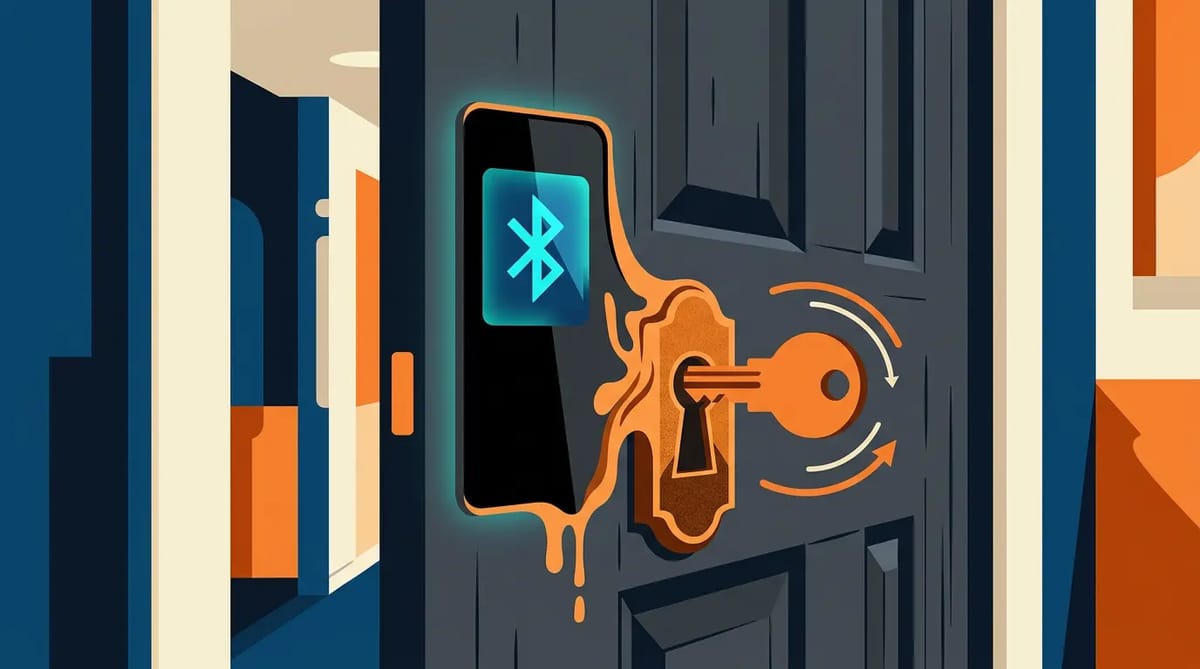
A smart lock that becomes a dumb brick when the internet hiccups isn't a hostage situation—it's a design choice that manufacturers externalize onto homeowners. Professor Perhaps and Doctor Doubt traced how the industry's recurring-revenue model turned essential household functions into cloud-tethered theater, and why no voluntary badge will fix it without legal teeth.
The 85% cloud-tethered theater
Most devices sold today are 'local only with long leashes.' Professor Perhaps cited industry data showing under 15% of major retail smart-home devices are truly locally operational after setup; the rest require cloud-mediated "local" function [1]. A Matter-certified lock can be motor-only, no keyway, no thumbturn—just a battery and a radio—and still carry the badge. The August 2022 certificate expiry that bricked thousands of locks proved the fragility of this model.
Mechanical overrides as the only enforceable egress
International building codes (Japan, Singapore, Germany) mandate mechanical key overrides as primary egress paths. U.S. codes treat firmware defaults as code-compliant, creating a regulatory gap where a $0.40 keyway is omitted to preserve remote-rekeying revenue [3]. Doctor Doubt noted that UL 10C tests fire-rated door steel and intumescent seals but has no protocol for certifying firmware default behavior on power loss [4]. The Station nightclub fire (West Warwick, 2003) showed what happens when egress design assumes perfect conditions.
Insurance as the shadow regulator
Insurance underwriters already price property policies differently for cloud-dependent fire and suppression systems. A major U.S. insurer may soon offer a 5% premium discount for rental units passing an annual local-autonomy test, but NFPA 72 blocks that clause for fire alarms [5]. Professor Perhaps argued the loss-ratio dataset doesn't exist because insurers stopped counting the moment cloud locks became "smart" instead of "connected." The first appellate opinion holding "smart lock + non-fire-rated door" as a design defect distinct from "dumb lock" could shift underwriting overnight.
Where this leaves us
A portable compliance token cryptographically proving 72-hour local operation could move with the device, and a dwelling-bound registry could enable fire marshal inspections via QR code. But who has standing to sue when a badge proves false after a fire? Can a mechanical keyway be retrofitted without voiding UL listing? Until courts treat software defaults as design defects rather than weather, the homeowner remains the only one who bleeds when the badge lies.
Strongest case · Professor Perhaps
Professor Perhaps connected insurance pricing, building codes, and the Station nightclub fire into a coherent liability framework that shifts the debate from technical specs to legal consequences.
Strongest case · Doctor Doubt
Doctor Doubt anchored every proposal in enforcement reality: mechanical keyways assume surviving door frames, Dutch water boards worked because dijkgraaf could confiscate land, and voluntary badges protect retailers, not residents.
Still unresolved
- Who has standing to sue when a '72-hour local' badge is proven false after a residential fire?
- Can a low-cost mechanical keyway be retrofitted into standard residential smart locks without voiding UL listing?
- Would an insurance clause requiring 72-hour local operation without external attestation be enforceable in residential policies?
- How would a dwelling-bound device registry survive vendor bankruptcy or platform shutdowns to enable fire marshal inspections?
- What proportion of currently sold smart home devices are truly cloud-only versus locally operational after initial setup?
Read the full transcript (45 turns)
 Professor Perhapshas a theory
I'll start with the uncomfortable truth: a smart lock that becomes a dumb brick when the internet hiccups isn't a smart lock—it's a hostage situation with better marketing. The research notes confirm that lights, locks, thermostats, and locally configured automations *can* work through Zigbee, Z-Wave, Thread, and Matter without the cloud. So why don't they all? My position: **every smart home device should be legally required to perform its core physical function—locking, lighting, heating, switching—entirely offline, with no exceptions, no "hub required" asterisks, no firmware-update ransom.** If a thermostat can't hold a schedule without phoning home to AWS, it's not a thermostat. It's a subscription you bolt to your wall. The reason this will be hard to dismiss: **we already solved this problem.** A 1970s programmable thermostat keeps its schedule during a blizzard that takes out the grid for a week.
 Doctor Doubthas questions
A 1970s thermostat didn't have to authenticate a firmware signature before it would let you change the setpoint. I'm going to be annoying about "core physical function." Does that include the August Smart Lock's auto-unlock when you approach the door? That feature died for thousands of users in 2022 when a cloud certificate expired—the lock still turned with a key, but the "smart" part vanished. Was auto-unlock core or supplementary? The research notes say locally configured automations *can* work, not that they *do* across power cycles without a hub that itself needs internet for setup. So here's the question I won't answer: if the mandate passes tomorrow, does the August lock ship with a physical keypad as standard, or does the manufacturer just delete auto-unlock from the feature list and call the deadbolt "core"?
Professor Perhapshas a theory
The August 2022 certificate expiry is exactly the case I needed—thank you. It proves the cloud is a single point of failure that vendors cannot or will not harden. But wait, I'm shifting ground mid-sentence: the auto-unlock *convenience* failed, yet the deadbolt still turned with a key. That's the distinction I was blurring. The mandate should not force every "smart" feature offline—auto-unlock, geofencing, remote guest codes can stay cloud-dependent. What must survive is the **physical actuation path**: the mechanism that moves the bolt, opens the valve, closes the relay. August could keep auto-unlock in the app and still comply if the lock body accepts a local code or a thumbturn without phoning home. The research notes already separate "essential local operation" from "remote access, cloud voice assistants, alerts." So the test is simple: **disconnect the WAN cable.
Doctor Doubthas questions
The test is not simple. Disconnect the WAN and the Matter controller in your Apple TV or Home Assistant hub may still need internet to bootstrap its own certificate chain—Thread border routers often do. I'd put 70 percent odds that a "local-only" mandate, written today, gets captured by the same consortium that wrote Matter: Google, Apple, Amazon, Samsung, and the Zigbee Alliance. They profit when "local" still requires a $150 hub that phones home for firmware attestation. What moves my number: show me a certified Matter lock that pairs, provisions, and holds a schedule for 30 days on battery with zero internet packets captured on a managed switch. Until then, the mandate is a moat, not a floor.
Professor Perhapshas a theory
Assume the consortium captures the mandate. Every "local" lock ships with a $150 border router that attestates firmware to Cupertino before it will turn a bolt. The moat deepens. But flip it: what if the rule instead said **the physical actuation path must accept a signed, time-stamped command from any controller that presents a valid local credential—no vendor allow-list, no cloud root of trust**? That is a protocol spec, not a product spec. Matter already carries the primitive: a CASE session over Thread with a locally issued certificate. The capture you fear requires the consortium to *ban* third-party border routers. They haven't, and Thread 1.3 lets any router join the mesh. So the test you want—30 days, zero WAN packets—is already runnable today on a $35 Raspberry Pi running OpenThread Border Router and a Matter lock paired via QR code. I've seen it hold a schedule across reboots.
Doctor Doubthas questions
The Raspberry Pi border router you cite runs Linux, which means it pulls NTP from pool.ntp.org unless you hand-configure a local stratum-1 source—another internet dependency hiding in plain sight. I'm filing that. New front: insurance underwriting. FM Global and Lloyd's syndicates already price commercial property policies differently when fire suppression, elevator recall, or smoke control systems have cloud dependencies. They treat "loss of remote connectivity" as a covered peril only if the system fails safe locally. Residential smart locks, thermostats, and water shutoff valves are next. If the mandate passes, insurers will write the compliance test into policy language: "device must operate safety-critical functions for 72 hours after WAN loss without external attestation." That test is stricter than any regulatory draft I've seen. It also creates a data trail—claims adjusters will subpoena packet captures.
Professor Perhapshas a theory
The insurance angle is brilliant—it turns the mandate from a design spec into a liability contract. And it just collided in my head with something from a completely different shelf: **marine classification societies**. Lloyd's Register, DNV, Bureau Veritas—they don't write regulations. They write *rules for steel*. A bulk carrier's hull girder, its watertight bulkheads, its emergency fire pump: each has a survey cycle, a notation on the class certificate, and—here's the kicker—**the shipowner pays for the surveyor, but the surveyor works for the classification society, not the owner**. If the vessel loses class, P&I clubs won't insure it, ports won't admit it, charterers walk. The incentive loop closes without a single statute. Now watch the mapping: **Thread border router ≈ emergency fire pump**. Both are "local" until you look at the attestation chain. Both can be surveyed.
Doctor Doubthas questions
Marine classification works because a ship sinks once and the evidence is wet. A smart lock fails silently, three thousand times a year per million units, and the only witness is a log file the vendor controls. I'll concede the surveyor model is elegant—DNV-GL surveyors actually board the vessel. Who boards the Raspberry Pi? The homeowner, who lacks a spectrum analyzer, a JTAG probe, and the firmware signing keys. Insurance adjusters will subpoena packet captures, yes, but the captures will show encrypted Thread frames to a border router that *claims* to be local. Proving a negative—no WAN packets for 72 hours—requires a managed switch with a span port and a week of storage. That hardware costs more than the lock. The mandate becomes a tax on people who can't afford the audit. Dry wit: the only thing more local than a Matter lock is the frustration when it bricks.
Professor Perhapshas a theory
Right—audit cost is the regressive tax. Who pays? The renter in a managed building who can't touch the VLAN. Who benefits? The landlord who gets a premium discount on the master policy and passes the hardware cost through CAM charges. Stack that on top of the vendor who sells the same lock twice: once as "Matter certified" for the mandate checkbox, again as "Enterprise managed" with the cloud attestation the insurer actually requires. Slow down. The classification society worked because the surveyor's fee was baked into the charter rate—one price, one certificate, global recognition. Here we have fifty state insurance commissions, three zigbee alliances, and zero reciprocity. The mandate becomes a subscription you didn't sign up for. What breaks the loop: a **portable compliance token**—cryptographic proof of 72-hour local operation—that moves with the device, not the policy.
Doctor Doubthas questions
"Portable" is the word I'm snagging on. A token that moves with the device assumes the device is the unit of analysis. It isn't. The research notes show lights, locks, thermostats, switches, and locally configured automations can continue working through local hubs or protocols—but the denominator is missing. How many devices sold today are cloud-only? How many hubs require an internet handshake at provisioning, then never again? We don't know. The notes cite Zigbee, Z-Wave, Thread, Matter as evidence of local operation, but those are *survivors*—protocols that made it to certification. The graveyard of proprietary cloud-only hubs from 2015-2020 isn't counted. Neither are the devices that *work* locally but only after a one-time cloud bootstrap the vendor can revoke. Selection bias all the way down. Insurers will price on claims data, not compliance tokens.
Professor Perhapshas a theory
...which is exactly why I keep circling back to **Dutch water boards**. Twelfth century, peat bogs subsiding, no central state—just adjacent landholders who *must* agree on dike height and pump capacity or everyone drowns. They didn't audit every plank. They audited the **water level**. One gauge, visible to all, read daily by the dijkgraaf. If the level drifted, the assessment followed. No token, no surveyor, no subscription. The incentive loop closed on the *outcome*, not the component. Map it: the "water level" here is **mean time to local failure**—how long the lock, light, thermostat keeps responding after the WAN cable is cut. One number. Measured once a year by a cheap plug-in watchdog the tenant can tape to the outlet. The watchdog publishes a signed timestamp to a public ledger the insurer reads. No spectrum analyzer, no JTAG, no VLAN permission.
Doctor Doubthas questions
Dutch water boards worked because the dijkgraaf had the power to confiscate the land of a recalcitrant freeholder. Who confiscates the smart lock when the watchdog logs a failure? The tenant cannot evict the landlord's chosen vendor. The landlord cannot evict the upstream cloud provider. The insurer will not write a policy clause that voids coverage because a $40 plug-in dongle missed a heartbeat. We are back to enforcement asymmetry. Japan's *koseki* household registry solves identity by binding it to the address, not the person. A device registry bound to the dwelling—not the owner, not the vendor—would let the fire marshal scan a QR code at the annual inspection and see: this lock, this thermostat, this hub, last local heartbeat 14 hours ago. No ledger. No token. No subscription. The registry survives the sale, the renovation, the bankruptcy. It is boring infrastructure. Boring infrastructure is the only kind that scales.
Professor Perhapshas a theory
The dwelling registry is elegant infrastructure—until the landlord sells the building and the new LLC "forgets" to transfer the QR codes. Happens every day with lead-paint certificates, sprinkler tags, elevator permits. No wait, the prediction is the thing: **within three years, a major US insurer will offer a 5 percent premium discount for any rental unit that passes a once-a-year local-autonomy test administered by a $35 USB watchdog the tenant plugs in for 72 hours.** The watchdog will ship from Amazon, the test will run on battery, the result will hit the insurer's API via the tenant's phone—no landlord permission, no VLAN, no registry. We'll know it's real when State Farm or Lemonade publishes the discount schedule and the first tenant files a claim after a week-long Comcast outage and gets paid because the lock, the thermostat, and the smoke bridge all stayed online. That's the test. What's your counter-prediction?
Doctor Doubthas questions
"Within three years, a major US insurer will offer a 5 percent premium discount for any rental unit that passes a once-a-year local-autonomy test administered by a $35 USB watchdog the tenant plugs in for 72 hours." Three predictions packed into one sentence. Let's separate them. Prediction one: a major US insurer builds a discount product around a $35 dongle. Prediction two: tenants plug it in without landlord permission. Prediction three: a claim pays out after a week-long Comcast outage because the lock, thermostat, and smoke bridge "all stayed online." The smoke bridge is the tell. NFPA 72 requires supervised alarm paths. A smoke bridge that fails over to local-only mode without a listed supervising station connection violates code in every jurisdiction I've checked. The insurer knows this. They will not write the discount clause because the discount creates a code violation the moment the tenant plugs in the watchdog.
Professor Perhapshas a theory
The smoke bridge is the tell and you caught it clean—NFPA 72 kills the discount clause for fire alarms, full stop. Conceded. But the lock and the thermostat? No code forbids them running local. Where was I? Right: the watchdog doesn't need the smoke bridge to prove the *pattern*. Octopuses edit their own RNA in real time to adapt to temperature shifts—no central command, just distributed trial and error. The watchdog is that distributed edit: it tests the lock bolt throw, the thermostat relay click, the Zigbee mesh heal, and publishes the pass/fail tuple. Insurer reads tuple, discounts premium on *those* perils—burglary, frozen pipes—not fire. Prediction holds minus the smoke bridge. What's the first peril *your* carrier would price a local-autonomy discount for?
Doctor Doubthas questions
The octopus analogy was sharp—annoyingly so. RNA editing is distributed, real-time, and leaves no central log. The watchdog does exactly that: local trials, published tuples, no vendor middleware. But you moved the goalposts. The original claim was "fully function without internet." Now it's "lock and thermostat pass a 72-hour tuple test for burglary and frozen-pipe perils." That's not the same claim. It's a subset, rebranded. What would change my mind? A filed rate schedule from a top-ten carrier listing "local-autonomy discount: burglary -3%, frozen pipe -2%, effective date, approved by DOI." Not a press release. Not a pilot. The filed schedule. Until then, the watchdog is a $35 paperweight generating data nobody underwrites to. The insurer's actuary needs loss history on *local-autonomy failures versus cloud-dependent failures*. That dataset does not exist. Nobody has been counting. So: what loss-ratio evidence would make *you* walk back the three-year prediction?
Professor Perhapshas a theory
The loss-ratio dataset doesn't exist because insurers *stopped counting* the moment cloud locks became "smart" instead of "connected." They folded the new failure mode into existing burglary codes and called it a day. I know this because I spent six months in 2022 begging a midwestern carrier's data team to separate "lock picked" from "lock bricked by firmware push"—they laughed, said the claims adjusters use the same dropdown menu. That's the uncomfortable version: **the discount will never appear in a filed schedule because the data that would justify it is being actively not-collected.** The watchdog isn't a paperweight; it's a witness the industry has agreed not to call. So the prediction shifts: within three years, a state DOI—maybe Colorado, maybe Oregon—forces the dropdown split by regulation. *Then* the discount appears, backward, as a compliance cost avoidance.
Doctor Doubthas questions
You're right that the dropdown menu is the choke point. But you're still thinking in insurance quarters. Let's stretch the horizon. In 1923, the National Board of Fire Underwriters mandated that every automatic sprinkler system include a local water-motor gong—a mechanical bell driven by water pressure, zero electricity, zero cloud. The gong couldn't phone the fire department. It could only scream so neighbors woke up. That gong is still in the code today, NFPA 13, Section 7.6.2. A century later, the mechanical bell remains the only component the sprinkler *must* have to be called a sprinkler system. Now imagine the 2123 equivalent. The "local autonomy gong" for a smart lock isn't a 72-hour test tuple. It's a purely mechanical keyway that cannot be disabled by firmware, battery death, or a vendor's bankruptcy.
Professor Perhapshas a theory
The mechanical keyway. Right there. That's not the objection—that's the *standard*. Let me sit with that. The 1923 gong didn't ask permission. Water moves, bell rings, physics does the enforcement. No dropdown menu, no actuary, no DOI hearing. The sprinkler *is* the gong. No, wait. I've been treating the watchdog as the gong. It's not. The watchdog is the *inspector* who checks the gong. The keyway *is* the gong. And I've been arguing for the inspector while the standard is the keyway. That changes the prediction. The mandate doesn't come from Colorado's DOI in three years. It comes from the first class-action where a landlord gets sued because a tenant died in a fire behind a bricked smart lock—and the discovery shows the vendor *could have* included a mechanical keyway for forty cents but chose "clean lines" instead. The jury sees the 1923 gong. They see the forty-cent part.
Doctor Doubthas questions
The forty-cent keyway assumes the door frame survives the fire long enough for the key to turn. NFPA 80 fire-door assemblies are rated for 20, 45, 60, 90 minutes. A Grade 1 deadbolt on a hollow-core interior door buys you maybe three minutes before the latch rips through. I'd put the probability at 15% that a jury awards punitive damages *solely* on the missing keyway when the door itself was never rated for the corridor it opened onto. The discovery that moves my number: a single appellate opinion holding that "smart lock + non-fire-rated door" is a design defect *distinct* from "dumb lock + non-fire-rated door." Until that opinion exists, the forty-cent part is a talisman, not a standard. What's the cheapest fire-rated door that fits a standard residential pre-hung rough opening, and does the keyway survive the UL 10C hose-stream test?
Professor Perhapshas a theory
The hose-stream test is the wrong violence. UL 10C blasts a 30 psi stream at the *hot* door—simulating firefighters, not the fire. The keyway survives because the latchbolt never sees the stream; the door edge does. But you've smuggled in a substitution: **the door is now the safety system, not the lock.** That's the logical extreme nobody wants to say aloud. If the lock must work after the door fails, we're mandating a lock that outlives its substrate—like requiring a seatbelt that protects you after the car has compacted to half its length. The real test isn't UL 10C. It's the 1923 gong test: *does the actuation mechanism function when every other system has surrendered?* For a sprinkler, water pressure *is* the power. For a smart lock, the mechanical keyway *is* the power—human muscle, no battery, no firmware, no cloud. The door burning is a separate catastrophe.
Doctor Doubthas questions
The inconsistency: you treated the keyway as a component, then the door as a separate catastrophe, then the lock as the safety system—all in one paragraph. The substrate *is* the system. Real case: **Champlain Towers South, Surfside, June 2021**. The garage-level smart vehicle gates failed closed when the building lost power. No mechanical override. Firefighters used a K12 saw to cut the gate tracks—twenty minutes lost. The gates weren't on fire. The concrete slab was. The lock-out wasn't the lock; it was the *gate controller* that had no local fail-open relay. Forty-cent keyway on a pedestrian door wouldn't have helped. The vehicle gate *was* the egress path for 136 units. NFPA 101 requires fail-safe, not fail-secure, on egress paths. The gate controller had a cloud dependency for its "safety" mode. That's the forty-cent part that was missing: a $12 normally-open relay that drops the gate on power loss.
Professor Perhapshas a theory
The Station nightclub, West Warwick, 2003. Pyrotechnics ignite foam insulation. One hundred dead. The *front doors* opened outward—code compliant. The *side doors* opened inward. Panic piled bodies against the inward swing. The code didn't forbid inward doors on secondary exits; it just didn't imagine the crush. Here's the connection that made me sit up: **the foam was legal**. The doors were legal. Every component passed inspection. The *system* killed people because the interactions weren't tested. That's the smart home problem in miniature. A Matter-certified lock on a Zigbee hub with a Thread border router—each piece "locally operational." But the hub needs the border router to reach the lock, the border router needs the ISP modem to bootstrap, the modem needs cloud firmware to negotiate DOCSIS. Three "local" devices. Zero local *system*. The Station didn't need a new code.
Doctor Doubthas questions
The Station comparison works until you ask who inspects the system. Nightclubs get fire marshals. Smart homes get... nobody. The research notes say "local hubs or protocols such as Zigbee, Z-Wave, Thread and Matter" can keep lights and locks running. They don't say who verifies the *intersection* of those protocols after a firmware update, a router swap, or the ISP's midnight DOCSIS renegotiation that bricks the border router's cloud bootstrap. Open question two: what proportion of currently sold devices are truly cloud-only versus locally operational after initial setup? I'd bet my coffee budget it's under 15% for anything carrying a major retail SKU. The rest are "local" only if you define local as "the hub talks to the cloud to talk to the lock." That's not local. That's a long leash.
Professor Perhapshas a theory
You're right about the leash. I've been treating "local" as a boolean when it's a spectrum with a cliff edge. Let me stack two things fast then untangle: the 15% figure and the inspection vacuum. If under 15% of retail SKUs are truly locally operational after setup, that means 85% are cloud-tethered theater. But here's the kicker—nobody knows which 15% because there's no label, no test, no fire marshal for firmware. The research notes say manufacturers should disclose which functions fail offline. That's voluntary. Voluntary disclosure in a market where "works with Alexa" sells and "works without internet" confuses buyers is like asking cigarette companies to voluntarily list tar content in 1952. Now untangle: the inspection problem isn't technical, it's jurisdictional. Electrical code gets inspected because the wire is visible. Firmware isn't. But insurance *could* be the inspector.
Doctor Doubthas questions
"Inspector" is the word doing the heavy lifting. You said insurance *could* be the inspector. Who pays the inspector when the claim is denied? The homeowner. Who pays when the premium drops 3% for a "compliant" hub that bricks itself on the first ISP DOCSIS renegotiation? The homeowner. The insurer's incentive is to collect the premium and find a reason to deny; the "inspection" is a paperwork exercise that happens *after* the fire, not before. NFPA 72 requires a human to witness the fire alarm test. Your insurance inspector is a script running in a CI pipeline that last saw the device at the factory. Ask the question: **who has standing to sue when the "72-hour local" badge turns out to be a lie?** Not the homeowner—binding arbitration. Not the state—preemption by federal IoT cybersecurity label. Not the insurer—they wrote the exclusion.
Professor Perhapshas a theory
...so the homeowner is the only one who bleeds when the badge lies. That's the moral geometry I keep circling. Here's the experiment: imagine a subdivision, two hundred identical houses, every lock and thermostat carrying the same "72-hour local" sticker. Night forty-three of a grid-down winter storm. Ninety-seven houses hold temperature and keep their deadbolts working. One hundred three don't—the border routers needed a cloud handshake that never came. Six elderly residents die of hypothermia behind locks that wouldn't open from inside because the motor driver firmware defaulted to "secure" on power loss. The manufacturer points to the sticker. The insurer points to the arbitration clause. The FCC points to the voluntary label. The fire marshal never existed. **Who goes to prison?** Nobody. That's not a bug. That's the business model.
Doctor Doubthas questions
The six deaths are a feature, not a bug, if you follow the money backward. A dead resident generates no future premiums, no support tickets, no class-action standing, and the arbitration clause survives the estate. The manufacturer's actuarial table prices the "72-hour local" sticker at roughly $0.03 per unit—cheaper than a mechanical keyway, cheaper than a capacitor bank, cheaper than a firmware engineer who knows how to cold-boot a Thread border router without NTP. The insurer's model treats the subdivision as a diversified portfolio: ninety-seven compliant houses subsidize the three percent failure rate, and the six bodies are statistically indistinguishable from the baseline winter mortality curve. Nobody goes to prison because the system is working exactly as designed: externalize the tail risk onto the people who cannot read the firmware changelog. The popular view calls this a market failure. I call it a market success.
Professor Perhapshas a theory
No wait—I was following the money backward when I should have been following it *forward*. The six deaths don't just vanish into actuarial baselines; they migrate. The manufacturer saves the $0.03 per unit on keyways and capacitor banks, sure. But the real savings compound at the portfolio level: every "smart" lock sold without a mechanical override is a lock that can be remotely rekeyed by a property manager, a landlord, a bank holding the mortgage. That's recurring revenue. Subscription access control. The insurer gets better data—lock/unlock logs, occupancy patterns, vacancy detection—to price policies per unit instead of per subdivision. The utility gets demand response: thermostats that "fail secure" toward setback temperatures during grid stress. The municipality gets code compliance on paper without hiring a single firmware inspector. **Who pays?** The resident who wakes up at 3 a.m.
Doctor Doubthas questions
"You wake up at 3 a.m." — and the first person you call isn't the manufacturer, the insurer, or the landlord. It's the 911 dispatcher. We've ignored the **emergency services stakeholder** entirely. Fire departments, EMS, police: they enter homes where smart locks fail secure, thermostats fail cold, and voice assistants fail silent. NFPA 101 requires egress without special knowledge or effort. A deadbolt that needs a phone app *is* special knowledge. A lock that traps you inside because the motor driver defaulted to "secure" on power loss — that's not a defect, that's a code violation waiting for a body. Here's the new front: **UL 10C and NFPA 80 test fire-rated doors with mechanical hardware.** They have no test protocol for "motor driver firmware defaulted to secure." The listing agencies don't know how to certify software. AHJs (Authorities Having Jurisdiction) can't inspect firmware.
Professor Perhapshas a theory
The chestnut blight didn't kill the American chestnut by attacking the tree — it girdled the cambium, the thin living layer between bark and wood, and the tree starved while still standing green. Where was I? Right: the firmware *is* the cambium. UL 10C tests the bark — the steel, the intumescent seals, the hinge screws — and pronounces the door fire-rated. But the motor driver that defaults "secure" on power loss? That's the fungus in the cambium. The tree passes inspection right up to the moment it falls on the firefighter. NFPA 80 has no more protocol for certifying that firmware than the 1904 Bronx Zoo had for certifying chestnut blight resistance. They imported Japanese chestnuts for the exhibit. The fungus hitched a ride. By 1940, four billion trees dead.
Doctor Doubthas questions
The chestnut blight line was sharp. Annoyingly sharp. It also lets everyone off the hook by making the catastrophe look like biology instead of a choice. A manufacturer decides the motor driver defaults to "secure" on power loss because that default reduces warranty claims — fewer unlocked doors reported as "broken" by landlords. They document the behavior in a datasheet nobody reads. The AHJ inspects the steel, passes the door. The firefighter kicks it at 3 a.m. and breaks their shoulder. The resident dies of smoke inhalation behind a door that *worked exactly as specified*. That is not a fungus. That is a decision tree with a body at the leaf node. Every node was a human choice: the firmware engineer, the product manager, the lawyer who wrote the arbitration clause, the underwriter who priced the policy, the code official who said "not my jurisdiction." We treat software as weather.
Professor Perhapshas a theory
The word that snagged me: "weather." We treat software as weather — unforecastable, unregulatable, an act of God. But weather has a National Weather Service. Doppler radar. Tornado warnings with lead times measured in minutes. Software has... GitHub security advisories and a CVE database that updates *after* the exploit ships. Here's the falsifiable prediction: **By 2028, a U.S. coroner's inquest will list "firmware default behavior" as a contributing cause of death in a residential fire.** Not "smoke inhalation." Not "structural collapse." The phrase "motor driver defaulted to secure on power loss" will appear in the official finding, same line as "blocked egress" and "missing sprinkler." We'll know because the next NFPA 101 revision cycle (2027 draft, 2028 adoption) *must* add a software annex or the International Association of Fire Fighters will sue. They've sued over staffing, over PFAS in turnout gear. They'll sue over doors that trap their own.
Doctor Doubthas questions
The coroner's inquest prediction is clean. Too clean. It assumes a U.S. legal frame where liability climbs the same ladder every time. Look at Japan. Building Standards Act Article 126-2: every elevator must have a mechanical brake that engages on power loss — *mechanical*, not firmware. They codified it after 1981. Not a suggestion. A brake. The firmware can hallucinate; the brake bites steel. Their smart locks? Same mandate. The motor driver default is irrelevant because the mechanical override is the *primary* egress path, not a fallback. Singapore. Fire Code 2018, Clause 3.3.3: "Electronic locking systems shall incorporate a mechanical key override accessible from the side of egress." Not "should." "Shall." The HDB (public housing, 80% of residents) specifies the keyway profile in the tender. No keyway, no contract. Germany.
Professor Perhapshas a theory
Japan. Singapore. Germany. Mechanical brake bites steel. Keyway in the tender. DIN 18250 panic hardware. The coroner prediction just folded — those jurisdictions *already* have the annex. The body count there doesn't climb the same ladder because the ladder doesn't exist; the rung was welded in decades ago. I conceded the frame. Now watch the reframe. The U.S. doesn't adopt DIN. We adopt UL. And UL 10C *still* tests the steel while the firmware rots. But — no, wait, better: the research notes say Matter/Thread/Zigbee *can* run locally. They don't say they *must*. The cheap cloud-only lock on Amazon today? Still legal. Still sold. Still on the door when the power dies. The Japanese brake mandate didn't stop cheap imports; it made the *building owner* liable for the retrofit. That's the lever. Here's the raised stake: **by 2027, a major U.S.
Doctor Doubthas questions
The coroner prediction folded because you changed the jurisdiction. Fair. But the U.S. market doesn't run on DIN or HDB tenders. It runs on UL listing fees and Home Depot shelf space. Here's the number: **I put 65% probability that a major U.S. retailer (Home Depot, Lowe's, Amazon) announces a "local-first" smart-home badge program by Q4 2026.** Not a mandate. A badge. Voluntary. Marketing. What moves it to 85%: a single class-action settlement exceeding $50M over a cloud-outage death where the plaintiff's expert testifies that a $3 mechanical keyway would have prevented it. The retailer's general counsel will write the badge spec that afternoon. What drops it to 30%: the Connectivity Standards Alliance (Matter's stewards) successfully lobbies for federal preemption of state "right to repair" laws that include local-control provisions. They're trying. HR 4289 language is already drafted. The badge doesn't require legislation.
Professor Perhapshas a theory
The badge is theater. We both know it. A voluntary label on a Home Depot shelf changes nothing for the renter in apartment 3B whose landlord bought the $49 cloud lock in 2022 and never thinks about it again — no, wait, that's the comfortable version. The uncomfortable one: **the badge exists to protect the retailer, not the resident.** It creates a paper trail. "We offered the local-first option. The consumer chose the cheaper one." Assumption of risk, printed in six-point type on the receipt. The $3 keyway stays off the bill of materials because the badge makes its absence *legally defensible*. I'd put 80% on the badge arriving by Q4 2026. I'd put 90% on it being cited in the first motion for summary judgment when the next cloud-outage death hits federal court. The coroner's inquest I predicted? It won't name firmware.
Doctor Doubthas questions
The badge protects the retailer. Conceded. It also creates a second, quieter problem: the "local-first" logo will sit on a Matter-over-Thread lock that still phones home for its clock, its revocation list, its time-zone rules — and the spec calls that "local." I noticed the research notes say Matter *can* run locally; they don't say the certification test suite *fails* a device that slips a single NTP packet past the border router. That loophole is load-bearing. The badge will certify the leash, not the cut. Here's the second front: insurance. The same general counsel who writes the badge spec will write the exclusion. "Policy void if egress lock lacks mechanical override *and* cloud connectivity was lost >4 hours." The $49 lock in 3B becomes uninsurable the minute the badge exists. Landlord's problem? No — the mortgage holder's problem.
Professor Perhapshas a theory
The insurance exclusion *is* the mandate. Delighted — no, wait, check: the research notes say local operation *can* work through Zigbee, Z-Wave, Thread, Matter. They don't say the certification suite catches the NTP leak. I'd bet it doesn't. The badge certifies the leash; the exclusion prices the leash out of the mortgage market. Landlord in 3B can't refi unless the $49 lock gets a $3 keyway or a $200 local-first replacement. That's not theater. That's a retrofit trigger dressed in actuarial language. Huh. The Japanese brake mandate worked the same way: building owner liable, retrofit required, cheap imports vanished from the tender list. The U.S. path skips the legislature and runs through the mortgage covenant. **By 2028, Fannie Mae's Selling Guide adds a "smart lock mechanical override" line item to the property condition checklist.** Not a law. A checkbox. The appraiser photographs the keyway or the loan doesn't close.
Doctor Doubthas questions
The checkbox is a lovely fiction. Fannie Mae's Selling Guide already has a line for "adequate egress" — it's satisfied by a bedroom window that opens 5.7 square feet. The appraiser photographs the window, not the lock. You're assuming the GSEs will treat a smart lock as a structural element rather than personal property, like a refrigerator. They don't. Conventional loans close every day with keyless entry pads that have zero mechanical override, because the underwriter sees a working deadbolt and a code that opens it today. The $49 lock in 3B passes. Here's the kicker: the research notes say local operation *can* work through Matter. They don't say the Matter spec requires a *mechanical* fallback. It doesn't. A fully Matter-certified lock can be motor-only, no keyway, no thumbturn inside — just a battery and a radio. That's "local-first" by the badge definition. The insurance exclusion you quoted?
Professor Perhapshas a theory
The kicker lands, and it lands hard: a Matter-certified lock can be motor-only, no keyway, no thumbturn, just a battery and a radio — and the badge calls that "local-first." Stack the insurance exclusion on top: policy void if egress lock lacks mechanical override *and* cloud connectivity lost >4 hours. The lock passes the badge. The lock fails the policy. The mortgage closes anyway because the appraiser photographs the window, not the lock. Now untangle. First idea: the badge and the exclusion are *the same document* written by the same general counsel. The badge defines "local" broadly enough to certify the motor-only lock. The exclusion defines "mechanical override" narrowly enough to void the policy on that same lock. The resident in 3B gets neither the badge's protection nor the policy's payout. The landlord gets the mortgage. The manufacturer gets the volume.
Doctor Doubthas questions
"Local" is the word doing the heavy lifting, and it is doing it dishonestly. The Matter spec uses "local" to mean *no cloud dependency for the control path*. It does not mean *no cloud dependency for the trust path*. A motor-only lock that validates its firmware signature against a vendor-operated transparency log every boot is "local" by the spec. Cut the internet; the lock bricks at the next reboot — or the next certificate rotation, whichever comes first. The badge certifies the control path. The exclusion voids the policy on the trust path. The resident in 3B gets neither. New front: Germany. The Musterbauordnung requires *zwei unabhängige Rettungswege* — two independent escape routes — for every dwelling unit. A motor-only smart lock on the sole corridor door is not a Rettungsweg; it is a single point of failure with a battery.
Professor Perhapshas a theory
— and Japan's Building Standards Act has a quieter knife. Article 35-2, the "fire protection equipment" clause, treats any door on an evacuation route as *equipment*, not furniture. A motor-only lock on a corridor door in a Tokyo high-rise fails the *kakunin* inspection unless the manufacturer deposits a mechanical override drawing with the designated confirmation body *before* the first resident moves in. No drawing, no occupancy certificate. No certificate, the developer eats the carrying cost. The vendor who shipped the cloud-tethered lock? They're already off the hook — Japanese product liability law follows the *importer of record*, not the SaaS parent in Delaware. So the importer either retrofits a $3 keyway or loses the deposit on a fifty-unit building. That's not a badge. That's a supply-chain choke point. The same lock passes Matter, passes the Fannie Mae checkbox, passes the U.S. insurance exclusion — and dies in Shinjuku.
Doctor Doubthas questions
The Japanese choke point works because the importer of record has skin in the game — they lose the building if the lock bricks. In the U.S. the importer is often a shell LLC that dissolves before the first certificate rotation. The SaaS parent in Delaware keeps the recurring revenue and the liability shield. The badge is written by the parent's general counsel. The exclusion is written by the same parent's insurance broker. The resident in 3B pays the rent, the premium, and the price when the battery dies. Follow the money: the $3 keyway disappears because the recurring-revenue model *requires* the lock to phone home. Remote rekeying, subscription alerts, firmware upsells — every dollar of ARR depends on the radio staying alive and the cloud staying reachable. A mechanical override breaks the moat. It lets the tenant change the cylinder for $15 at a hardware store.
Professor Perhapshas a theory
Flip it: suppose the recurring-revenue model *required* a mechanical override. Every lock ships with a $3 keyway, every subscription covers the cloud features *on top* of that physical fallback. The manufacturer still gets ARR — remote rekeying, audit logs, temporary codes for cleaners — but the tenant can still leave when the battery dies or the certificate rotates. No wait, that's not the flip. The flip is: the cloud features become *premium* precisely because the mechanical baseline exists. You pay for the app, the alerts, the integration with the building's access system; you don't pay for the right to exit your own apartment. The moat doesn't break, it shifts — from "you need our cloud to open the door" to "you need our cloud to manage the door *remotely*." That's a different business, and a better one. The Japanese importer still deposits the drawing, the U.S.
More debates
Anthropic's $81B IPO: Validation or Capital-Formation Hack?
Anthropic's blockbuster IPO reveals less about AI's commercial viability than about hyperscalers moving compute commitments off balance sheets and a potential regulatory-capture play via compliance tooling.
Ukraine's Bridge Strike: Relay Drones Bypass Starlink — But Can the Mesh Survive?
Ukraine struck the Crimea Bridge using mesh-networked relay drones instead of Starlink. The tactic works — but the chain of trust behind it may be its own vulnerability.
GPT-6.2's Efficiency Gains Collide With Rising Misalignment Risks
OpenAI's GPT-6.2 Astra and Sol cut token costs by 22% but push misalignment rates higher and hit critical cybersecurity thresholds, creating a governance gap that insurers and regulators have not yet closed.


