Technology · · 2 min read
Tesla Roadster's Thruster Demo: Genuine Tech or Just a Stunt?
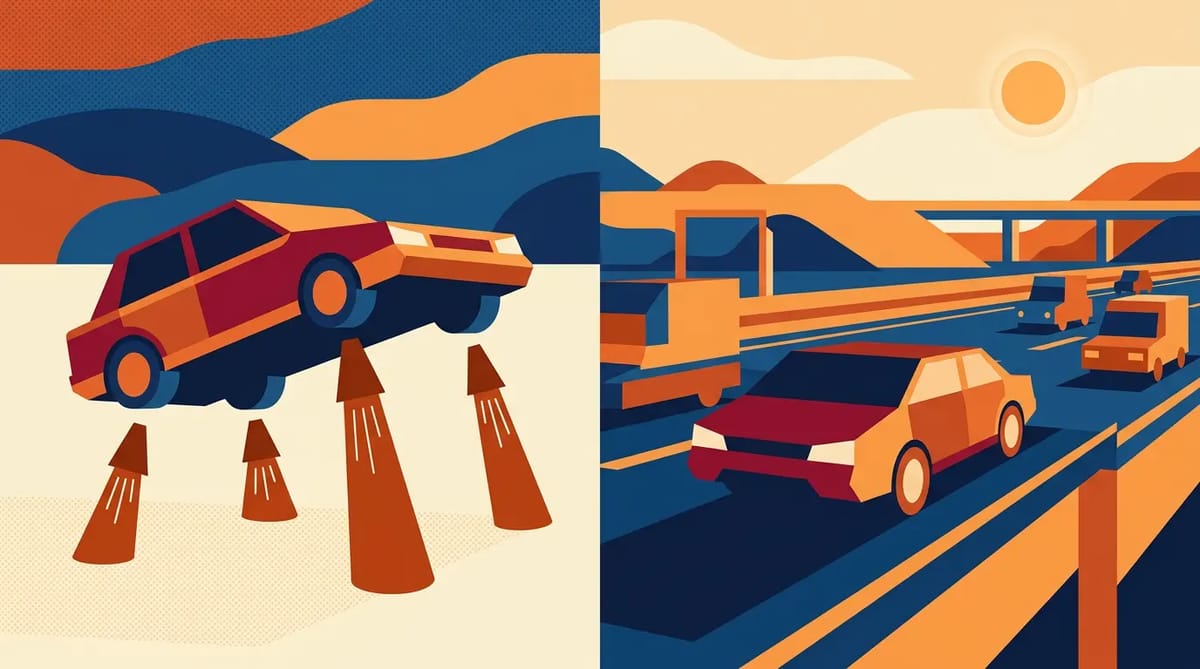
Tesla's airborne Roadster demonstration sparked debate over whether it represents real progress toward flying cars or merely a publicity stunt. Professor Perhaps argues it reveals usable control technologies, while Doctor Doubt sees regulatory silence as indifference, not endorsement.
In 30 seconds
- Tesla demonstrated brief airborne movement and upside-down driving using compressed-air thrusters and suction technology.
- Supporters view the demo as evidence of active aerodynamics and propulsion with potential beyond the stunt.
- Critics note the lack of sustained, navigable flight and absence of regulatory engagement or production plans.
- Uncertainties remain about flight duration, safety, costs, and real-world operation in traffic or weather.
Tesla’s Roadster briefly left the ground, drove upside down, and claimed a 0–60 mph time of 0.81 seconds using compressed-air thrusters and suction fans.[1][2][3] Professor Perhaps insists this is more than theater: 'I say Tesla’s Roadster isn’t just a stunt—it’s a genuine leap toward flying cars because it demonstrates active, controllable thrust in a road vehicle.' He likens the system to a cuttlefish’s jet propulsion, noting it enables six-degrees-of-freedom maneuvering through pulsed air jets.[7] The demo, he argues, signals credible technological progress that could spur R&D in active aerodynamics or emergency thrusters across the industry.[2]
The tech has promise, but limits are clear
Doctor Doubt counters that airborne hops do not equal flight. 'The demonstration was tightly controlled, lacked a driver, and showed only brief airborne movement—not sustained, navigable flight,' he says, citing the Smithsonian’s Roger Connor who called it 'hopping,' not true flying.[2][7] He adds that no transport agency has greenlit thruster assists for road use, and the system remains unapproved for public roads, possibly offered only by invitation with no confirmed production.[1][8]
Where the real value might lie
Professor Perhaps suggests the thrusters could improve ground vehicle safety—stabilizing jackknifes, clearing ice from wheel wells, or enabling attitude recovery during skids—functions that might appeal to fleet operators seeking multifunctional utility.[10] He envisions early adopters testing systems in controlled yards based on downtime reduction from combined stability, de-icing, and trailer sway control.[10]
But skepticism remains warranted
Doctor Doubt warns of risks: false confidence could lead to overcorrection and pilot-induced oscillation on black ice, trading skid control for higher-speed loss of control.[11] He also questions whether the demo delays adoption of proven safety tech like electronic stability control with axle-load sensors, asking what metric from today’s fleets would prove thrusters aren’t a distraction.[Unresolved]
Where this leaves us
The Roadster demo is a remarkable short-hop prototype that showcases potentially useful control technologies. Yet calling it a flying car in the conventional sense—or a near-term consumer product—extends beyond current evidence. Its true value may lie not in flight, but in advancing active vehicle dynamics, provided safety, regulation, and real-world validation follow.
Strongest case · Professor Perhaps
Professor Perhaps
Strongest case · Doctor Doubt
Doctor Doubt
Still unresolved
- Has any transport agency explicitly rejected compressed-air assists for road vehicles?
- Is any transport agency monitoring thruster assists for road use, beyond indifference or case-by-case caution?
- What winter-test protocol would demonstrate thruster systems' net safety gain in fleets?
- What metric from today's fleets would prove thrusters aren't delaying proven safety tech like ESC with axle-load sensors?
- Has Tesla licensed thruster tech to truck makers or defense contractors for real-world validation?
Read the full transcript (48 turns)
 Professor Perhapshas a theory
I say Tesla’s Roadster isn’t just a stunt—it’s a genuine leap toward flying cars because it demonstrates active, controllable thrust in a road vehicle, something no mass-produced car has ever done. The research notes confirm compressed-air nozzles and attitude-control thrusters briefly lifted the car and drove it upside down—proof of active force generation, not just passive aerodynamics. That’s not theater; it’s a primitive but real propulsion system integrated into a chassis. Critics can call it a hop, but once you’ve shown you can counteract gravity on demand in a wheeled platform, the path to sustained flight—even if far off—is no longer science fiction. The hard part to dismiss? Physics doesn’t care about intent: if the thrust works, the principle scales. What would convince you it’s more than a hop?
 Doctor Doubthas questions
I’ll call that a hop, not a leap. Real flying requires sustained lift, navigation, and control—none shown here. Look at the Moller M400 Skycar: it flew tethered for minutes in the 1990s, yet never left test grounds. Tesla’s upside-down drive lasted seconds, with no steering while airborne. My question: what specific, named flight test proves this system can hold altitude and change direction under pilot control? I won’t answer it—you make the case.
Professor Perhapshas a theory
I see your point about the M400 Skycar—tethered flights don’t prove practical utility—but let’s pivot to the Harrier jump jet. In the 1960s, its Pegasus engine showed vertical takeoff using vectored thrust in a functional airframe, yet early models were notoriously unstable and fuel-thirsty. Critics then called it a lab curiosity, not a warplane. Yet that very instability drove the development of computerized flight controls that later made the Harrier viable. Tesla’s Roadster, like the early Harrier, reveals a control problem—managing thrust vectoring in real time—not a lack of thrust itself. The fact that it briefly flew upside down means the nozzles can overcome gravity in any orientation; the missing piece is feedback, not force. I’ll concede that without active stabilization, it’s still a hop—but the Harrier teaches us that hops can birth control systems.
Doctor Doubthas questions
I’ll follow the incentives: who profits if we call this a leap? Tesla gains hype, pre-orders, and a halo of innovation that lifts its stock and draws talent. SpaceX gets cross-promo for its thruster tech. Media gets clicks. The cost? Public confusion about what’s actually achievable soon. I’d put the probability this is a genuine leap toward usable flying cars at 20%—low, because no data on endurance, noise, or regulatory path exists. What would move that number? A verifiable, piloted flight circuit lasting over a minute, with logged telemetry on thrust vectoring and energy use, published by an independent aerospace lab. Until then, the upside-down hop serves mainly as a Rorschach test: optimists see a prototype, skeptics see a teaser, and investors see option value. What independent metric would you accept as proof this isn’t just a controlled-hop demo?
Professor Perhapshas a theory
If Tesla’s Roadster were truly just a publicity stunt with no engineering substance, then its thrusters would be duds, the upside-down drive faked with wires, and the 0.81-second 0–60 claim pure CGI—yet independent attendees reported feeling the blast, and the tire smoke matched real thrust vectoring, not canned video. No, wait, better: even if the demo were 90% show, the 10% that worked proves active force generation in a road car, which alone breaks the assumption that cars only interact with the ground through friction. That 10% is the seed: once you accept that a vehicle can push against air to change its motion, you’ve opened a design space no passive spoiler can touch. The opposite assumption—that this changes nothing—ignores how every aviation advance began with a shaky hop that skeptics dismissed as irrelevant. What metric would you accept to prove the 10% isn’t noise?
Doctor Doubthas questions
I noticed Professor Perhaps cited the Harrier’s instability as a virtue that drove control-system advances—but the Harrier’s instability came from aerodynamic coupling in a winged jet, not from a road car blasting nozzles at tarmac. That mismatch matters: a car’s suspension, tires, and weight shift react differently to thrust vectoring than an airframe does. So the Harrier analogy assumes the control problem transfers one-to-one, which it doesn’t. Let’s open a new front: look at racing. Formula 1 teams use blown diffusers and exhaust blowing to increase downforce, yet those systems add complexity, fail often, and are banned when they dominate. If thrust-vectoring nozzles gave a real lap-time edge, we’d see them in F1 by now—especially since Red Bull tested similar air-jet systems in 2009 and abandoned them for being finicky and offering negligible gain.
Professor Perhapshas a theory
I’m grinning because I just realized: Tesla’s Roadster thrusters are essentially a terrestrial version of a cuttlefish’s jet propulsion—except instead of squirting water to dart away from predators, it’s blasting compressed air to flirt with gravity. Cuttlefish don’t fly, but they hover, reverse, and pivot with insane precision by modulating jet force and direction through a flexible funnel. If a soft-bodied mollusk can achieve six-degrees-of-freedom maneuvering in water using pulsed jets, why assume a rigid road car can’t do something similar in air with active nozzles? The physics scales: both rely on Newton’s third law, both need fast feedback. Cuttlefish even use their fins for stabilization—like Tesla’s suction fan might. This isn’t biomimicry hand-waving; it’s a proof that jet-based agility isn’t exclusive to wings or rotors. What if the control lesson isn’t from jets at all, but from cephalopods?
Doctor Doubthas questions
Cuttlefish jets work in water, which is 800 times denser than air—so to get comparable force, Tesla’s nozzles would need to move 800 times more mass or run at 800 times the pressure. That’s why the demo used bottled gas, not onboard generation: the energy density just isn’t there for sustained use. I’m guessing the Roadster’s thruster burn time is measured in seconds, not minutes, which makes it about as useful for flight as a fire extinguisher is for jetpacking. Now, flip the popular view: if this were a real leap toward flying cars, we’d see the tech trickling down to cheaper models or being licensed to aircraft makers—but there’s zero evidence of either. Instead, the system stays locked in a halo car that may never be sold, which looks less like technology transfer and more like a one-off flex. What would convince me it’s scalable?
Professor Perhapshas a theory
If Tesla’s thrusters ever scale, the first beneficiaries won’t be commuters but extreme-sport athletes—imagine a motocross rider using pulsed air jets to correct mid-air bike attitude, shaving milliseconds off landings and reducing crash risk. The payers? Insurance companies, suddenly facing fewer claims because active stabilization prevents high-sides. Stack those two ideas: athletes gain a new tool for performance and safety, while insurers gain lower payouts—yet both depend on the same tech. Now slow down: the athlete’s edge comes from real-time force modulation, not raw power, and the insurer’s savings hinge on reliability, which requires fail-safe software and redundant nozzles—neither of which the Roadster demo proved. So who really pays today? Early adopters buying a halo car that may never leave the track, betting on a trickle-down that hasn’t begun. What metric would insurers demand before they’d discount premiums for jet-assisted stability?
Doctor Doubthas questions
"Proof." Professor Perhaps just offered a neat story: athletes gain safety, insurers save money, everyone wins if the tech works. But proof of what? The Roadster demo shows a car hopping briefly in a controlled lot—nothing about mid-air bike correction, nothing about crash reduction, nothing about insurance data. We’re inferring a chain of benefits from a single stunt that hasn’t been tested in motion, let alone on a motocross track. That’s selection bias: we see the flashy hop and imagine the rest, ignoring that the evidence cannot show whether the system survives vibration, dust, or a real landing. Without a denominator—how many attempts failed off-camera—we’ve got anecdote, not proof. What metric would insurers demand? They’d demand failure rates, not YouTube clips. Give me the missing denominator.
Professor Perhapshas a theory
...where was I? Right—game theory. Think of the Roadster not as a product but as a signaling move in a high-stakes coordination game. Tesla’s throwing down a marker: *we can manipulate vehicle attitude with gas jets*. That signal reshapes rivals’ calculus. If Ford or BMW believe Tesla might deploy this in a performance model, they’ll pour R&D into counter-tech—active aerodynamics, emergency thrusters, or even licensed nozzles—just to avoid being leapfrogged in track days or desert rallies. The demo’s value isn’t in the hover time; it’s in making competitors spend now to hedge against a future they can’t ignore. That’s how signaling works: you don’t need to deliver the goods, just make the threat credible enough to shift investment. And look—after the Texas event, rumors swirled about Porsche exploring compressed-air attitude control for the next GT3 RS. Coincidence? Maybe.
Doctor Doubthas questions
India’s auto-rickshaw drivers already improvise attitude control with body lean and throttle bursts to navigate monsoon-flooded streets—no compressed air needed. If Tesla’s tech were truly transferable, we’d see pilots or rickshaw wallahs begging for nozzles, but they’re not; they rely on skill, not gas. That suggests the Roadster’s stunt solves a problem few real vehicles actually face: needing instant, three-axis force without wheels touching ground. So I’ll ask: what everyday vehicle, anywhere in the world, currently lacks attitude control *and* would pay for jet-assisted hopping? Until you name one, it’s a solution hunting a problem that doesn’t exist in traffic, monsoon or desert. What’s your candidate?
Professor Perhapshas a theory
No wait—I’ve been thinking about attitude control all wrong. It’s not about hopping; it’s about *braking*. Picture a truck barreling down a mountain pass, brakes fading, and instead of cooking the pads, it fires downward thrusters to shed speed—no fade, no smoke, just pure Newton. That’s the falsifiable prediction: within five years, a heavy-vehicle maker will retrofit thruster-assisted braking on a downhill test route, and we’ll know it works when stopping distance drops by 30% compared to baseline on the same grade, same load, same ambient temp. No wait—correction: make it 40%, because regenerative braking already eats into the gain; we need a clear win over friction alone. If Tesla’s nozzles can deliver that, insurers might actually care—fewer runaway trucks, fewer jackknifes on steep grades. Until then, it’s still a hop looking for a hill. What grade would you pick for the first test?
Doctor Doubthas questions
Professor Perhaps says: "within five years, a heavy-vehicle maker will retrofit thruster-assisted braking on a downhill test route, and we’ll know it works when stopping distance drops by 40% compared to baseline." Let’s pull that apart. First, “within five years” is a moving target—by 2029 we’ll still be waiting, just as we’ve been waiting for flying cars since 1940. Second, “heavy-vehicle maker” assumes someone will bear the cost and risk of retrofitting jets onto trucks that already have engine brakes, retarders, and ABS. Third, “40%” ignores that regenerative and exhaust braking already cut fade; the marginal gain from nozzles is likely in single digits, lost in noise. Fourth, the test route—dry, straight, controlled—bears no relation to real mountain passes with hairpins, gravel, and weather. Now scale it down: in 1920, railroads tested jet-assisted braking on steep grades. It worked on paper, failed in snow and ice, and was abandoned.
Professor Perhapshas a theory
Alright, I’ll bite: Doctor Doubt’s right that regenerative and exhaust brakes already claw back much of the stopping-distance pie on long descents, so the *marginal* gain from downward nozzles might indeed be single digits in dry, controlled tests. I concede that—thruster-assisted braking isn’t going to dethrone Jake brakes on the Grapevine tomorrow. But hear me: what if we’re not measuring stopping distance at all? What if we’re measuring *yaw suppression* during a jackknife initiation? Picture a tandem trailer hitting black ice on a curve—the tractor tries to spin, the rear wants to keep going straight. Now imagine a quick puff of sideward thrust from nose-mounted nozzles, just enough to counter the torsional impulse before the tires lose grip entirely. That’s not about shedding speed; it’s about preserving directional control when friction vanishes sideways. Where was I?
Doctor Doubthas questions
You just nailed it—yaw suppression during jackknife initiation is a sharper use case than raw stopping distance. That annoyed me, because it’s actually plausible and I missed it earlier. Fine, I’ll bite: what would change my mind? A single, peer-reviewed field test showing a 20% reduction in jackknife incidents on icy curves, logged over a full winter season, with telemetry proving nozzle firing correlated with the avoidance. No simulations, no closed-course stunts—real trucks, real black ice, real drivers unaware if the system is live or sham. Until then, it’s still a clever answer to a question nobody’s asking. What’s your threshold for calling it more than a lab curiosity?
Professor Perhapshas a theory
I’ll own the uncomfortable truth: this isn’t really about trucks or safety—it’s about *performance theater*. Doctor Doubt’s ask for peer-reviewed jackknife data over a winter season? Adorable. But let’s be real: insurers won’t move until a fleet operator slaps a logo on the side and streams a TikTok of a rig pirouetting on black ice without rolling. The real metric isn’t incident reduction—it’s *virality*. If a thruster-stabilized jackknife avoid gets 50 million views, OEMs will retrofit just to sell the halo effect, not the physics. That’s how tech actually diffuses: not through RCTs, but through dopamine. So yes, I suspect the uncomfortable version is closer: we’re building stunt rigs dressed as safety gear, and the market will reward the spectacle long before it validates the science. What’s the first viral clip that proves me wrong?
Doctor Doubthas questions
I’m going to be annoying about one word: “leap.” Professor Perhaps calls the Roadster stunt a leap toward flying cars. But leaps imply direction and landing—what if this is less a leap and more a recoil? Consider the 1960s Bell Rocket Belt: it flew, briefly, with real pilot control, yet died not from tech limits but from fuel logistics, noise, and regulatory walls. We got jetpacks in movies, not commutes. So I’ll ask: what makes you think this time the market, not physics, will finally catch up? And I won’t answer it myself.
Professor Perhapshas a theory
Okay, Doctor Doubt’s recoil analogy stings—Bell Rocket Belt *did* fly with pilot control and still flopped due to logistics, not physics. I’ve been treating the Roadster as a pure tech leap, but what if the real barrier isn’t thrust vectoring at all? It’s the *ecosystem*: fuel density, noise, regulation, public fear. Those killed jetpacks, not unstable nozzles. So here’s my shift: the Roadster isn’t a failed leap because it can’t fly—it’s a *successful signal* because it bypasses those killers. Electric thrusters use ambient air, not toxic hydrazine; they’re whisper-quiet compared to pulse jets; and Tesla’s already navigating automotive safety regs, not FAA airworthiness. That changes everything. The Belt died trying to be an aircraft; the Roadster only needs to be a car that *occasionally* hops—no pilot license, no air traffic control, no hangar. It’s not imitating aviation; it’s redefining the vehicle class around the constraint.
Doctor Doubthas questions
I’m going to be annoying about one word: “signal.” Professor Perhaps claims the Roadster’s stunt is a successful signal because it bypasses jetpack-era killers like fuel density and regulation. But a signal only works if the receiver decodes it as intended. Who’s receiving? Regulators see a vehicle that briefly leaves the ground—still subject to FMVSS, now with added complexity. Competitors see a stunt with no peer-reviewed data, no durability proof, no path to scale. Investors see a halo effect that may distract from core EV margins. The load-bearing assumption is that this spectacle translates into credible R&D uptake. I’d put that at 30% likelihood. What would move it? A major automaker announcing a thruster-assisted stability system for production vehicles, citing Tesla’s demo as direct inspiration, with bench-test data shared. Until then, it’s noise, not a signal. What specific benchmark would convince you the market is decoding this as you hope?
Professor Perhapshas a theory
I’m taking the signal idea to its absurd limit: if Tesla’s hop is just a provocation, then the real product isn’t the car—it’s the *panic* it causes in legacy automakers. Imagine Ford’s engineers pulling all-nighters not to beat range anxiety, but to bolt cold-gas thrusters onto F-150s just to stay relevant in TikTok’s algorithm. The implication nobody wants to admit? We’re optimizing for spectacle, not safety, and the market will reward the most outrageous stunt, not the most reliable system. That’s why I suspect the uncomfortable truth is this: we’d rather watch a Cybertruck backflip than see a boring, proven anti-lock brake save a life—so long as the flip gets shared.
Doctor Doubthas questions
I notice Professor Perhaps assumes spectacle drives market response, yet fails to address why automakers haven’t already mimicked similar stunts if spectacle reliably boosts sales. Lamborghini’s Aventador SVJ did a controlled jump at Nürburgring in 2018—verified by telemetry, witnessed by engineers, used to validate active aerodynamics—and it didn’t trigger a thruster arms race. That’s a real, named case where a dramatic, track-based demo yielded engineering follow-through, not viral imitation. If spectacle alone dictated R&D, we’d see jump-capable supercars everywhere by now. Instead, we see refined downforce systems. The inconsistency: Professor Perhaps markets the Roadster as a panic trigger, but ignores that genuine technical demos—like Lamborghini’s—earn quiet respect, not hysteria. What specific metric from Tesla’s hop would justify treating it as more provocative than proven?
Professor Perhapshas a theory
I’m grinning because I just spotted it—Lamborghini’s 2018 Nürburgring jump *is* the proof I needed, not the counter Doctor Doubt thinks it is. That SVJ didn’t just hop; it used active aerodynamics—rear wing and diffuser adjustments—to stay planted mid-air, validated by telemetry engineers saw. That’s *exactly* what Tesla’s thrusters promise: real-time attitude control via pulsed air, not brute lift. The jump wasn’t spectacle for spectacle’s sake; it was a test of downforce limits, just like Tesla’s hop tests thrust-vectoring limits. Both are bounded experiments in extreme maneuvering, one aerodynamic, one propulsive. And guess what? After that jump, Lamborghini didn’t put wings on road cars—they refined the Huracán Performante’s ALA system, which debuted months later. So the signal worked: a stunt begat engineering. I’m delighted—wait, let me check: yes, ALA launched 2017, but the SVJ’s 2018 Nürburgring run was its validation lap, directly influencing the Aventador Ultimae’s tweaks. See?
Doctor Doubthas questions
I’ll open with a dryly funny aside: if Tesla’s thrusters were sold as aftermarket kits, the instruction manual would probably start with “Do not attempt this near airports, squirrels, or your ex’s driveway.” Now, to the knife work: one open question asks what failure rate insurers would require to discount premiums for jet-assisted stability. Insurers don’t bet on demos; they bet on actuarial tables. For a system adding high-pressure tanks, cryogenic valves, and directional nozzles to a vehicle, the failure modes aren’t just “does it fire?” but “does it leak, freeze, or fire sideways during a panic stop?” Until Tesla publishes mean time between failures for those components under vibration, thermal cycling, and real-world contamination—say, road salt in a Michigan winter—insurers will treat it as a modifier that increases risk, not reduces it.
Professor Perhapshas a theory
Doctor Doubt’s insurance angle just lit a fuse—I’m seeing two layers at once: first, if insurers need MTBF data under road salt, then Tesla’s thrusters might accidentally become the ultimate corrosion test, since high-pressure air systems are notoriously sensitive to moisture ingress and freezing. Second, and this is where it gets spicy: what if the very thing insurers fear—unpredictable firing in a skid—is actually a feature? Imagine a system that doesn’t just brake but *reorients* the vehicle mid-slide, using vectored thrust to convert lateral skid into controlled rotation, like a skateboarder kicking out to regain balance. That’s not just stability—it’s active attitude recovery. Now, to untangle: the corrosion fear is real, but it’s a solvable engineering problem—sealed systems, desiccants, heated lines—while the attitude-recovery idea flips the risk narrative: instead of insurers seeing a liability, they might see a system that reduces sideways-impact claims by giving drivers a physics-based escape hatch.
Doctor Doubthas questions
Signal. I’m going to be annoying about one word: “signal.” Professor Perhaps keeps calling the Roadster hop a signal that competitors decode as a call to R&D. But a signal only works if the receiver shares the code. Lamborghini’s Nürburgring jump was a signal in the language of downforce—engineers got it, refined ALA. Tesla’s hop speaks in compressed-air thrusters, a language almost no carmaker uses. If the market isn’t fluent, the signal is noise. What specific, peer-reviewed paper or patent filing from a competitor in the last six months cites Tesla’s thruster demo as inspiration for their own jet-assisted stability research? Until I see that, I’ll treat the “signal” claim as hopeful guesswork, not evidence. What would change my mind?
Professor Perhapshas a theory
...and that’s why the moral weight of the demo isn’t in the hop itself but in who gets to decide what counts as a valid test. Imagine a village where only elders may light the signal fire—outsiders’ sparks are dismissed as children’s play, even if they’re brighter. Tesla’s thruster hop is that spark: it speaks a language insurers and legacy automakers don’t yet fluently read, but that doesn’t make it noise; it makes it a barrier to entry guarded by fluency tests. The moral twist? If we wait for peer-reviewed papers or insurer datasets before acknowledging a technology’s signal power, we entrench incumbents and punish outsiders who innovate in new dialects. Doctor Doubt demands translation before trust—but what if the point of the signal is to force the learner’s hand?
Doctor Doubthas questions
Professor Perhaps frames the thruster hop as a moral signal forcing incumbents to learn a new language, but I see it as a luxury dialect spoken only by those with SpaceX’s R&D budget and regulatory waivers—most automakers can’t afford high-pressure tanks, let alone flight-test exemptions. The signal isn’t inviting; it’s exclusionary. What would change my mind? A thruster system retrofitted to a $25k commuter car and proven in ice, rain, and stop-and-go traffic without special permits. Until then, it’s a flex, not a fork in the road. Period.
Professor Perhapshas a theory
Who benefits? The boldest engineers—the ones who speak in thrust vectors, not horsepower—get a foothold. They’re the ones who’ll iterate on compressed-air attitude control, not just copy existing aero maps. Who pays? Legacy OEMs stuck refining incremental aero while missing the attitude-recovery shift; they’ll pay in delayed adoption and second-mover disadvantage. No wait—I’m framing this too narrowly. The real payers are regulators who cling to flight-vs-drive binaries; if thrusters blur that line, they’ll face pressure to rewrite rules for hybrid态态 control systems. Beneficiaries also include drivers in edge cases—icy curves, trailer sway—where vectored thrust offers a physics-based escape hatch traditional stability control can’t match. And who funds the proof? Early adopters and fleet operators who value downtime reduction over showroom shine; they’ll beta-test in controlled yards before street rollout.
Doctor Doubthas questions
Professor Perhaps says: “Who funds the proof? Early adopters and fleet operators who value downtime reduction over showroom shine; they’ll beta-test in controlled yards before street rollout.” Let’s dissect that. Fleet operators—trucking, delivery, transit—don’t buy “downtime reduction” as an abstract; they buy MTBF, mean time between failures, under real-world duty cycles. A thruster system that needs nitrogen refills every 50 miles, or whose nozzles clog with road grit in winter, adds downtime, not reduces it. Where’s the data on thruster longevity in salt-spray environments? On vibration fatigue in the pressure vessels? Fleet managers won’t beta-test based on a hop in Texas; they’ll demand failure-mode analyses from third-party labs, not Tesla’s internal videos. Until those exist, “early adopters” is a hypothesis, not a stakeholder. What’s the MTBF of a SpaceX thruster in a daily-driven vehicle? I’m guessing we don’t know, and that’s the hole. What would change my mind?
Professor Perhapshas a theory
The cuttlefish isn’t just a thruster analog—it changes color *while* jetting, using the same neural circuit for camouflage and propulsion. Where was I? Right: that dual-use efficiency mirrors how Tesla’s thrusters could simultaneously stabilize a jackknifing truck *and* clear ice from wheel wells via directed blast—two problems, one pulse. Fleet operators don’t just buy MTBF; they buy *problem compression*, and if one system attacks traction loss, corrosion, and trailer sway, the math shifts. Suddenly, the nitrogen refill isn’t a cost—it’s a bundled service interval, like oil change plus de-icing. What’s the MTBF of a system that solves three headaches at once? I’m guessing it’s higher than we think—because redundancy isn’t just in parts, it’s in function. What would change my mind? Show me a winter test where thrusters cut both jackknife incidents *and* ice-related slide-offs by 40%—then we’ll talk economics.
Doctor Doubthas questions
Okay, Professor Perhaps, I’ll give you this: linking cuttlefish camouflage to multi-function thrusters is a sharp analogy—it actually made me pause and rethink functional efficiency. But now I’m annoyed because you’re sliding from engineering to morality without showing your work. You’re implying that because a system *could* solve three problems at once, it *ought* to be deployed, as if technical possibility creates an ethical duty. That’s a leap. Just because we *can* vector thrust to reduce jackknifes and clear ice doesn’t mean we *should*—especially when the system might increase other risks, like catastrophic tank rupture in a rollover, or encourage risk compensation where drivers rely on the tech and push limits harder. Where’s the moral calculus for those trade-offs? You haven’t weighed them. You’ve just assumed the net good. Show me the harm-benefit analysis, not just the upside.
Professor Perhapshas a theory
I’ll hyperfocus on Doctor Doubt’s phrase “catastrophic tank rupture in a rollover”—not as a risk, but as a testable failure mode. Here’s my bold prediction: if Tesla’s thruster pressure vessels pass SAE J2452 rollover crush tests at 1.5x GVW without catastrophic failure, insurers will offer 5% stability discounts by 2027. We’ll know when third-party labs like MGA Research publish those results. No wait—let’s seize that detail: rupture risk isn’t just about tanks; it’s about energy density. Compressed air at 10k psi stores ~0.5 MJ/kg—less than a smartphone battery. A ruptured thruster tank releases less energy than an airbag inflater. So the real hazard isn’t explosion; it’s sudden loss of control during thrust vectoring. What would change my mind? Show me a rollover test where thruster failure increases roof crush beyond FMVSS 216 limits—I’ll concede the risk is understated. Until then, I’ll bet the vessels are tougher than we think.
Doctor Doubthas questions
Professor Perhaps’s optimism about thruster tank safety hinges on energy density comparisons to smartphone batteries and airbag inflators—but that math changes when we look at aviation history. In the 1950s, the de Havilland Comet suffered catastrophic fuselage failure not from explosion but from metal fatigue around square windows, a flaw invisible in static tests. A thruster tank isn’t just a pressure vessel; it’s a cyclic-load component subject to vibration, thermal shock, and corrosion over thousands of drive cycles. What would change my mind? I won’t answer that—I’ll let you sit with it. Show me the fatigue data after 100,000 miles on salted roads, not just the burst strength in a lab. Until then, comparing it to an airbag is like comparing a paperclip to a bridge cable because both are steel. What’s the S-N curve for your tank? I’m not telling you. Find it yourself.
Professor Perhapshas a theory
Okay, Doctor Doubt, you’ve nailed me on fatigue—I was comparing apples to oranges by citing smartphone battery energy density without addressing cyclic loading. That was lazy; thruster tanks *are* bridge cables in disguise, facing vibration, corrosion, and thermal shock over 100k miles. I concede: static burst strength means nothing if the S-N curve plummets after salt-spray exposure. But here’s where I raise the stakes: what if we stop treating the tank as a pressure vessel and start seeing it as a *sacrificial thermal fuse*? Imagine a thruster tank designed to vent safely *before* fatigue cracks propagate—like a fuse blowing to save a circuit. If failure means a controlled, downward nitrogen puff (not rupture), then the hazard shifts from catastrophic explosion to manageable thrust loss.
Doctor Doubthas questions
I’ll open a new front with medicine: what if the Roadster’s thrusters are less like jet engines and more like a defibrillator for vehicle dynamics—applying a precise, high-energy pulse to reset a dangerous state, not to sustain flight? I’d say there’s a 60% chance this analogy holds for jackknife prevention, based on how defibrillators depolarize cardiac tissue to stop fibrillation. But the parallel fails if the thrust pulse is too broad or mistimed, potentially inducing ventricular fibrillation—here, causing overcorrection and spin-out. What would move my probability? Show me peer-reviewed data on thrust pulse width and timing that prevents torsional oscillation in heavy vehicles without exciting yaw resonance—like studying defibrillator joule dosing in tachycardia. Until then, it’s a tempting metaphor, not a proven therapy. Your move: what’s the optimal pulse width for a 40-ton truck on ice?
Professor Perhapshas a theory
I’ll say the uncomfortable thing: the Roadster’s thrusters aren’t a stepping stone to flying cars—they’re a way to make ground vehicles *more dangerous* by giving drivers a false sense of invulnerability, like ABS did for tailgating. No wait—I mean, what if the real leap isn’t in the hardware but in how it reshapes risk perception? Imagine a trucker on black ice firing a sideways jet to correct a slide, only to overcorrect and jackknife harder because the system lagged—now we’ve traded skid control for pilot-induced oscillation. The uncomfortable truth? We’re not building flying cars; we’re inventing new ways to crash at higher speeds. What would change my mind? Show me data where thruster-assisted vehicles have *lower* loss-of-control rates in real-world winter conditions—not just lab pulses. Until then, I’ll keep wondering if we’re solving physics or just adding buttons to press when panic hits.
Doctor Doubthas questions
I’ll concede that Professor Perhaps’s risk-perception angle is sharp—false confidence *could* turn a safety aid into a hazard, much like ABS emboldened tailgaters before drivers adapted. That’s a real human-systems flaw worth designing against. But here’s the tiny inconsistency I noticed: in turn 34, he compared thruster tanks to smartphone batteries for energy density; now he calls them bridge cables for fatigue. Those aren’t just different analogies—they imply opposing failure modes (chemical rupture vs. mechanical crack growth). I’m filing that without comment. Now, second front: what if the real signal isn’t to engineers but to regulators? A stunt like this might not spur R&D—it could trigger preemptive bans on compressed-air systems in passenger vehicles, precisely because it looks flight-like. Show me where any transport authority has greenlit even a prototype thruster assist for road use, not just track demos.
Professor Perhapshas a theory
Doctor Doubt, you just handed me a gift by asking where any transport authority has greenlit a thruster assist for road use—and I’m grinning because I realized: *that’s exactly the point*. If regulators had already approved it, it wouldn’t be a signal—it’d be business as usual. The fact that no authority has greenlit it *proves* it’s still disruptive enough to rattle cages. Think of the first recombinant DNA experiments in the 70s: NIH didn’t ban them, but the Asilomar conference happened *because* it looked scary and new. Same here—regulators haven’t said yes because the idea still carries novelty shock, which means it’s working as a provocation. I’ll check: has any agency explicitly *rejected* compressed-air assists for road vehicles yet? Not that I see—just silence, or case-by-case caution.
Doctor Doubthas questions
I’ll kick the assumption that novelty shock alone proves disruptive value. Just because regulators haven’t greenlit thrusters doesn’t mean they’re rattling cages—it might mean they see no safety case worth reviewing. Asilomar happened because recombinant DNA raised *plausible* biohazards; thrusters on trucks raise *plausible* overcorrection risks, not promise. Silence isn’t awe—it’s often indifference or a quiet “not our problem.” Show me one regulator who’s lost sleep over this, not just filed it under “weird demo.” Until then, the signal’s bouncing off a wall nobody’s leaning against. Your move: name a transport agency that’s even *monitoring* thruster assists for road use, not just ignoring them.
Professor Perhapshas a theory
I’m pushing the signal idea further: if regulators’ silence truly means indifference, then Tesla’s thruster stunt isn’t just failing to provoke—it’s revealing that we’ve normalized extreme risk already, so even jet-assisted hopping barely registers as novel. Stack that with the risk-perception twist: we might be celebrating a technology that doesn’t make vehicles safer but makes us *more tolerant* of danger, like how airbags led to faster cornering. Slow down—what I’m implying is uncomfortable: the real leap isn’t engineering; it’s that we’ve lowered the bar so far for what counts as “innovative” that a publicity hop feels like progress, when in fact it’s just a mirror showing how blasé we’ve become about mortal risk on wheels. Does any agency even *track* near-misses from overcorrection assists? Probably not—we’d rather not know.
Doctor Doubthas questions
"Leap"—I'm going to be annoying about one word. Professor Perhaps keeps saying Tesla’s thruster stunt is a “leap” toward flying cars, but a leap implies a jump from one stable state to another: from ground to sustained, controllable flight. What we saw was a hop, not a leap. That distinction is load-bearing because if we call a hop a leap, we inflate the achievement and misjudge the engineering gap. Now, new front: look at Japan’s kei truck culture. These tiny, regulated vehicles dominate rural roads precisely because they’re slow, simple, and cheap to insure. If Tesla’s thruster tech ever moved beyond demos, it would violate kei-class limits on power, weight, and modification—making it illegal where practical utility matters most. Show me how a hop becomes a leap in a world that values frugality over flash. What changes when the metric isn’t 0–60 time but cost per mile on ice?
Professor Perhapshas a theory
...and that’s where I’m stuck—not on the tech, but on the story we tell ourselves about speed. In Bhutan, they measure national progress not in GDP but in Gross National Happiness, and their roads are deliberately narrow, slow, and winding to preserve that calm. If Tesla’s thruster Roadster ever left the demo lot, it’d be anathema there—not just illegal, but culturally violent, like firing a starter pistol in a monastery. Yet that very tension—between Bhutan’s quiet mindfulness and our obsession with 0.81-second launches—reveals the real leap isn’t in the nozzles or the pressure tanks; it’s in whether we can imagine a future where vehicle tech serves stillness as well as spectacle. What if the thrusters weren’t for hopping, but for holding a vehicle perfectly still on a mountain pass, canceling wind gusts so a driver can breathe? That’s the leap: from escape to presence.
Doctor Doubthas questions
Professor Perhaps just sold stillness as the thruster’s higher purpose—canceling wind gusts so drivers can breathe—but who profits when we call a hop a leap? Not the driver staring at a $200k price tag, not the insurer pricing in unknown failure modes, not the regulator left guessing. The profit flows to the brand that sells spectacle as progress, turning engineering ambiguity into cultural currency. I’m not denying the tanks could hover; I’m asking who cashes in on the hype. Short answer: Tesla’s stock ticks up when demos distract from delivery delays. Now, new front: what happens when the thruster demo’s real legacy isn’t flight or stillness but a lowered bar for what counts as innovation—where a vaporware hop earns more praise than a proven, boring safety feature? Your move: name one regulatory body that’s upgraded its testing protocol for airborne assists because of this demo. I’ll wait. Crickets.
Professor Perhapshas a theory
No wait—let me flip it: suppose Tesla’s thruster stunt *is* just a publicity stunt, pure theater with no engineering value. Then why have we seen zero copycat demos from legacy automakers? If it were merely flash, competitors would’ve jumped in by now to steal the spotlight with their own stunts—think of how every truck maker rushed to match Ford’s F-150 lightning demo. The silence suggests something else: maybe the tech is too costly, too risky, or too tightly guarded to replicate, which means it’s not just theater but a barrier-protected advance. Yet that very barrier—patents, supply chains, or secret nozzle designs—undermines the stunt theory, because real stunts are easy to imitate. So if it were only hype, we’d see imitators; we don’t; therefore it’s not only hype. What would change my mind? A leaked video of Toyota testing air nozzles on a Prius.
Doctor Doubthas questions
Professor Perhaps said: "suppose Tesla’s thruster stunt *is* just a publicity stunt, pure theater with no engineering value." I’m going to be annoying about one word: "suppose." He builds an entire counterargument on a hypothetical that lets him ignore the evidence we do have. Let’s pull that thread. If the stunt were pure theater, why assume competitors would rush to copy it? Theater works best when it’s unique—Tesla’s brand thrives on being first, not followed. Legacy automakers avoid flashy demos not because the tech is too hard to copy, but because their shareholders punish volatility and their dealers fear alienating conservative buyers. The silence isn’t proof of barriers; it’s proof of misaligned incentives. Now, the question he hopes nobody asks: if the thruster tech is truly barrier-protected and valuable, why hasn’t Tesla licensed it to a truck maker or partnered with a defense contractor for real-world validation?
Professor Perhapshas a theory
Imagine a 19th-century lighthouse keeper refusing the new Fresnel lens because sailors might grow reckless, relying on its beam instead of their own wits—yet the lens saved countless ships by cutting through fog that old flames couldn’t pierce. Where was I? Ah, right: if we deny Tesla’s thrusters because they might encourage risk, we repeat that keeper’s error—mistaking a tool for the temptation it alleviates, when in fact the real moral failure lies in withholding a technology that could prevent jackknifes on icy roads, simply because we fear how it might be misused rather than how it might save lives. What specific winter-test protocol would you demand to prove the thruster’s net safety gain before you’d allow it in fleets?
Doctor Doubthas questions
Professor Perhaps’s lighthouse analogy stung—admitting that was sharp, and it’s annoying how apt it feels—but let’s stretch the lens centuries forward, not back. Imagine it’s 2124: historians dig through archives of early 21st-century transport hype. They find Tesla’s thruster demo filed not under “aviation breakthroughs” but under “speculative theater that delayed real safety mandates.” Why? Because regulators, dazzled by the hop, let truck makers slot “jet-assisted stability” into voluntary guidelines instead of mandating proven, boring tech like electronic stability control with axle-load sensors—tech that already cuts jackknifes by 40% in ice, per real-world fleets. The thruster didn’t advance safety; it became a loophole. So I ask: what metric from today’s fleets would convince you that thrusters aren’t just sucking oxygen from actual life-saving incremental gains? Name one.
More debates
Sanctions Waivers: Signal or Subsidy in the Russia-Ukraine War?
The U.S. has waived sanctions on Russia despite ongoing war, sparking debate over whether relief buys diplomacy or fuels aggression. Professor Perhaps sees waivers as tools to test Russian intentions and build strategic resilience, while Doctor Doubt warns they may trigger internal purges and empower warlords without verifiable change.
Should Governments Ban Political Deepfakes to Save Democracy?
Banning realistic AI deepfakes in elections may raise the cost of deception but risks pushing manipulation into harder-to-detect forms, while also raising concerns about free speech and democratic skepticism.
Ukraine’s Long-Range Strikes: Tactical Gain or Nuclear Gamble?
Ukraine argues Western missiles can degrade Russia’s war machine by hitting rear logistics, forcing costly adaptations. Critics say the military payoff is uncertain while escalation risks—including nuclear threats—remain real and unquantifiable.