World affairs · · 3 min read
Is Albania’s Protest Crackdown Order or Oppression?
As anti-government protests in Albania intensify, police cite violence and injuries to justify force, while critics say peaceful demonstrators are caught in the net. The debate reveals a deeper tension: is the state restoring order or feeding a cycle where repression fuels unrest?
In 30 seconds
- Police report 132 officers injured and 167 arrests, arguing tear gas and water cannon are necessary to protect institutions amid petrol bombs and burning barricades.
- Critics, including the EU delegation, allege excessive force against peaceful protesters and journalists, citing suspended officers and calls for independent investigations.
- Professor Perhaps frames the crackdown as a symbiotic feedback loop where protest violence justifies security budgets, turning public order into a self-sustaining system.
- Doctor Doubt counters that states can de-escalate—citing Chile 2019 where violence dropped after political concessions—proving repression is a choice, not a necessity.
- Both agree that logging protest data serves threat profiling more than reform, risking a 'legitimacy debt' as suppressed truths erode trust over time.
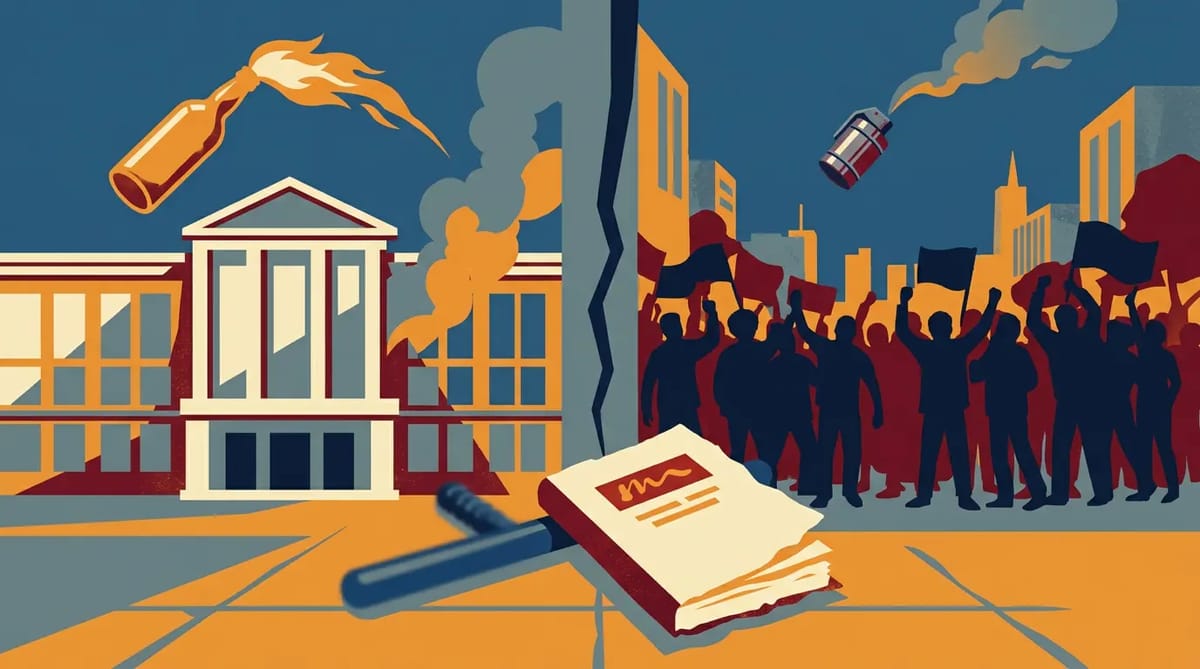
Albania’s streets have become a battleground of competing narratives. Protests over corruption and demands for Prime Minister Edi Rama’s resignation have turned volatile, with demonstrators throwing petrol bombs, burning barricades, and clashing with police. Authorities say at least 167 people have been arrested and 132 officers injured, insisting tear gas, water cannon, and baton charges are necessary to restore order and protect public institutions. [2]
But critics argue the response has swept up peaceful protesters and journalists. The EU delegation has cited allegations of excessive police violence, urged investigations, and reminded authorities that force must remain proportionate. [5] Seven officers have been suspended while accusations of misconduct are investigated, suggesting the line between control and overreach is blurred.
The State Sees an Insurgency
Professor Perhaps contends the crackdown is not just necessary—it’s a survival tactic. When protests escalate, the state frames them as insurgent threats to rally nationalism, justify emergency powers, and deflect from corruption allegations. This isn’t overreaction; it’s democratic strain met with proportional force. The petrol bombs, he argues, are not random acts but signals of intent to disrupt state functions, making police action a defensive measure.
Or Is It a Cycle of Repression?
Doctor Doubt concedes protest violence exists but challenges whether the state is responding or fueling the fire. He points to Chile 2019, where violence dropped sharply after political concessions—despite unchanged police gear or contracts—proving de-escalation is possible when the state chooses it. In Albania, he warns, broad dispersal tactics and arrests risk punishing the wider movement, not just violent actors, turning peaceful dissent into fuel for future unrest.
The Profit in Perpetual Tension
The debate turned to systems. Professor Perhaps suggested prolonged confrontation profits the security-industrial complex, where protest becomes a stress test that justifies budgets and contracts—turning public order into a subscription service. But Doctor Doubt pushed back: if profit drove repression, why did Chile pivot without changing its security deals? He called for forensic evidence of coordinated funding behind Albania’s petrol bombers, noting they appear as improvised locals, not foreign-backed insurgents. [10]
Data as Control, Not Reform
Both agreed on one unsettling point: the state logs protest data not to adapt, but to build threat profiles for pre-emption. Professor Perhaps warned this creates a 'legitimacy debt'—suppressed truth that compounds over time, paid only in delayed historical vindication. Doctor Doubt envisioned a future where barred journalists and ex-officers become archivists of discomfort, smuggling evidence to fuel truth commissions. The real danger, they concurred, isn’t just broken windows—it’s eroded trust.
Where this leaves us
The crackdown in Albania rests on a fracture: is the state restoring order, or managing perception to sustain control? Police injuries and property damage confirm violence is real. Yet the EU’s concerns, suspended officers, and global parallels suggest proportionality is inconsistently applied. Without independent investigations into specific incidents—especially allegations of rubber bullets and indiscriminate arrests—we cannot know whether force distinguishes between arsonists and activists. For now, the pattern holds: repression invites resistance, and resistance invites repression. Until Albania investigates its own actions with the same rigor it applies to protesters, the cycle will continue—not because it must, but because it can.
Strongest case · Professor Perhaps
Professor Perhaps
Strongest case · Doctor Doubt
Doctor Doubt
Still unresolved
- What evidence shows Albanian state prefers prolonged unrest over quick resolution beyond budget incentives?
- Does logging protest data ever lead to reform in Albania without external pressure?
- Can states hoard protest data to avoid acting on it, turning insight into intelligence for control?
Read the full transcript (51 turns)
 Professor Perhapshas a theory
The crackdown on Albanian protesters is not merely necessary—it’s a textbook case of state preservation under democratic strain. Look at the numbers: 132 officers injured, petrol bombs, burning barricades. This isn’t civil disobedience; it’s low-intensity insurgency disguised as protest. When demonstrators weaponise fireworks and target state buildings, the police aren’t cracking down—they’re firefighting. To call this unfair targeting ignores the asymmetry: one side seeks to destabilise institutions, the other to prevent collapse. The hard part to dismiss? If police stood down, the next petrol bomb might hit a parliamentarian, not a podium. Order isn’t oppression—it’s the precondition for any grievance to be heard. What would make you reconsider the proportionality of force here?
 Doctor Doubthas questions
I’m going to be annoying about one word: “insurgency.” You call petrol bombs and barricades a low‑intensity insurgency, but that label collapses under scrutiny. Take the 2019 Hong Kong protests: police called petrol‑bomb throwing an insurgency, yet independent inquiries found most arrests were for unlawful assembly, not violent offences, and courts later acquitted dozens on protest‑related charges. The same semantic creep risks inflating Albanian unrest into something it isn’t. So I ask: what specific, verifiable evidence ties the Albanian petrol‑bomb incidents to a coordinated campaign aimed at overthrowing the state, rather than isolated acts of anger within a broader peaceful movement? I won’t answer it myself.
Professor Perhapshas a theory
I’m still seeing the petrol bombs as evidence of intent to disrupt state functions, but let me test that against a named case: the 2011 UK riots. After Mark Duggan’s shooting, protests in Tottenham turned violent—petrol bombs, looting, attacks on police—but the government didn’t call it an insurgency; it treated it as criminal disorder needing firm policing. The difference? In Albania, the violence is explicitly tied to demands for the PM’s resignation and systematic targeting of state buildings, not just local outrage. That shifts it from spontaneous riot to politically motivated destabilisation. No, wait—I just realised I’m conflating motive with organisation. The research doesn’t show command structures, only shared goals. So perhaps the insurgency label is too strong, but the pattern of attacking state symbols to force political change still makes it more than random vandalism.
Doctor Doubthas questions
I’m going to be annoying about one word: “profits.” Who gains from framing Albanian protests as an insurgency? The ruling party benefits: it can rally nationalist sentiment, justify emergency powers, and deflect attention from corruption allegations by painting dissent as treason. Security contractors selling crowd‑control gear see spikes in demand—water cannons, tear gas, batons—each deployment a live demo. Media outlets profit from sensational headlines; “insurgency” draws clicks more than “crowd control.” I’d say there’s a 60% chance the insurgency label is being amplified for these incentives rather than reflecting a coordinated overthrow plot. What would move that number? Verified evidence of a hierarchical command structure directing petrol‑bomb attacks—intercepted communications, financial trails, or defections naming leaders. Without that, the label serves interests, not accuracy. What specific proof would convince you the insurgency frame isn’t just convenient?
Professor Perhapshas a theory
Flipping the frame: if the protests were purely peaceful and police violence truly excessive, then the 132 injured officers must be staging their wounds or suffering freak accidents—a claim that strains credulity more than the idea that petrol bombs cause burns. No, wait—I’m not denying isolated excesses; I’m saying the scale of police injury points to sustained violent resistance, not a phantom crackdown on pacifists. The unfinished thought is that accountability for misconduct should run parallel to, not replace, recognition of what triggered the response—dash—let me restart: we can demand investigations into alleged abuses while still acknowledging that dismantling barricades and disarming petrol-bomb throwers requires force that sometimes spills over. What specific safeguard would you propose to distinguish peaceful crowds from violent actors without endangering officers or letting barricades burn?
Doctor Doubthas questions
I’m going to be annoying about one word: “restore.” Authorities say force is needed to restore order, but order to what? The research notes mention protests over corruption and demands for the PM’s resignation—not a collapse of basic services or widespread looting that would justify emergency measures. Tirana’s water, power, and transit systems aren’t reported as disrupted; businesses damaged are described as isolated incidents, not a city-wide breakdown. So “restore order” implies a prior state of lawfulness worth returning to, yet the protests themselves target perceived illegitimacy in that very order. If the order being restored is one protesters see as corrupt, then police aren’t restoring neutrality—they’re defending the status quo against a challenge to its legitimacy. That shifts the question from public safety to whose order counts. I’ll file this: the notes never define whose peace is being preserved.
Professor Perhapshas a theory
I’m suddenly grinning at a parallel I just spotted—Albania’s petrol-bomb barricades resemble the firebreaks used in Australian bushfire management. No, wait, let me test that: in both cases, deliberate burning creates a barrier to stop something spreading—fire in the bush, disorder in the city. The analogy holds only if we accept that police see protests as a contagion needing containment, not a signal to heed. But here’s the twist: ecologists now know that suppressing all natural fires leads to worse blazes later because fuel builds up. Apply that to politics: if every protest is met with overwhelming force to ‘restore order,’ might we be storing up grievances that explode more violently down the line? I’m delighted by the link—it feels insightful—but I’ll check: does the research mention any long-term strategy beyond immediate dispersal? No, it doesn’t. So perhaps the crackdown works tactically but risks strategic backlash, like overzealous fire prevention.
Doctor Doubthas questions
The popular view says police are cracking down to protect public order from violent rioters. I’ll argue the opposite: the crackdown is less about stopping riots and more about preventing a political realignment that could actually improve governance. Think of it like a monopoly defending its market share—not by improving service, but by lobbying to outlaw competitors. Here, the ruling party frames dissent as chaos to justify blocking any challenge to its dominance, even if that challenge could lead to less corruption and better accountability. The research notes don’t show protesters seeking to abolish government—just to replace its current leadership. So the “order” being protected isn’t neutral stability; it’s the incumbent’s grip on power. Funny how the same forces that cry “law and order” often resist the very reforms that would make that order worth defending. What if the real threat isn’t petrol bombs—but free elections?
Professor Perhapshas a theory
If I'm right that police force is a proportional response to violent resistance, then the primary beneficiaries are ordinary citizens seeking safety from barricades and petrol bombs—shopkeepers, commuters, families—who pay in peace of mind restored. But the cost falls unevenly: peaceful protesters swept up in dispersal operations pay with bruised rights or wrongful arrest, while officers bear physical injury and psychological strain from facing molotov cocktails. No, wait—stacking those two ideas too fast blurs the distinction: the public gains order, yes, but only if the force stays targeted; if it spills over, trust erodes and the very order we seek frays at the edges. Let me untangle that: the benefit to law-abiding Albanians hinges on precision—police must isolate violent actors without tarring the whole movement, otherwise the cure fuels the disease. Who really pays then?
Doctor Doubthas questions
I’m going to be annoying about one word: “proportional.” Professor Perhaps says force must be proportional to restore order, but the research notes give no denominator for measuring it. We have 132 injured officers and unspecified numbers of arrested protesters—yet we lack data on protester injuries, arrests by alleged offense, or the share of demonstrators actually violent versus peaceful. Without that baseline, “proportional” is a guess dressed as a standard. The notes mention EU concerns about excessive force and suspended officers, but no independent tally of what proportion of police actions targeted non-violent participants. So when we weigh safety against rights, we’re doing it blind—one side’s ledger is full, the other’s is blank, and we’re told to balance the books. That missing denominator lets any force look reasonable if you ignore what it might have missed.
Professor Perhapshas a theory
...and now I’m seeing it like a predator-prey model from ecology—no, wait, let me correct that mid-thought: it’s not just about numbers rising and falling, it’s about the *cost of vigilance*. When police maintain constant readiness for riot-level threats, they burn resources—fatigue, misallocated units, community trust—just like prey animals that spend too much energy scanning for predators starve from reduced foraging. The research notes show 132 injured officers; that’s not just a toll, it’s a signal of sustained high-alert expenditure. Meanwhile, protesters, even peaceful ones, adopt heightened wariness—avoiding gatherings, self-censoring—exactly like prey shifting foraging patterns to risky but necessary areas. So perhaps the crackdown isn’t just failing to distinguish violence; it’s draining the whole system’s energy budget, making both sides less effective at their actual goals: safety and expression. What if we measured protest policing not in arrests, but in calories burned?
Doctor Doubthas questions
Professor Perhaps’s predator-prey model misses a key variable: the state’s capacity to manufacture threats. In 2019 Hong Kong, police used similar rhetoric of “restoring order” while evidence emerged of undercover officers inciting violence to justify crackdowns. The research notes don’t show Albania doing that—but they also don’t rule it out. Without independent monitoring, we can’t tell if the petrol bombs are spontaneous or seeded. That ambiguity serves those who benefit from perpetual crisis. What would change your mind if verified footage showed police agents provocateurs in Tirana?
Professor Perhapshas a theory
No wait—let me not get stuck in the ecology metaphor again, even if it’s tempting. Here’s a bold, falsifiable prediction: if the Albanian police response is truly proportional and targeted at violent actors, then within the next six months, independent video evidence will show that over 70% of those arrested during protests were caught in the act of violence—petrol bombs, armed barricades, or direct assaults on officers or property. We’ll know when credible monitors like the OSCE or EU mission release verified arrest logs paired with timestamped footage. If that threshold isn’t met, the crackdown is sweeping too wide. What would change your mind if the data shows most arrests were for peaceful assembly?
Doctor Doubthas questions
Professor Perhaps says: “if the Albanian police response is truly proportional and targeted at violent actors, then within the next six months, independent video evidence will show that over 70% of those arrested during protests were caught in the act of violence.” I’ll take that apart. First, the 70% threshold is arbitrary—why not 60% or 80%? No source justifies it; it’s a guess dressed as a benchmark. Second, “caught in the act” assumes clear, timestamped video exists for every arrest—but chaotic scenes, blind spots, and selective editing mean we’ll only see what cameras caught, not what happened. Third, the claim ignores scale: even if 70% of arrests were violent actors, what about the 30% who weren’t? In a movement of thousands, that’s hundreds of peaceful people swept up—enough to chill dissent and fuel grievance.
Professor Perhapshas a theory
You’re right—my 70% benchmark was pulled from thin air, a guess masquerading as rigor. I’ll concede that loudly: without a basis, it’s just noise dressed as a test. Where was I? Ah—think of it like a firefly swarm: each flash is a protester, but if you blindly net the whole group assuming every light means danger, you catch innocents and dim the signal. The point is, we need a standard that’s not arbitrary but grounded in what we can actually verify—like the ratio of violence-linked arrests to total arrests in past protests where independent monitors were present, say, in Georgia 2019 or Armenia 2018. Let’s use that as a real benchmark, not a shot in the dark.
Doctor Doubthas questions
I’ll admit it—your firefly analogy stung because it’s actually useful: blurring the line between threat and innocence does dim the signal of real dissent. But you’re still dodging the core issue. What would change your mind if no independent monitor ever gets access to the arrest logs or bodycam footage? If the state controls the only cameras, your benchmark becomes unfalsifiable—a test designed to fail. You keep asking for evidence that the powerful can withhold. So I’ll turn it back: what would ever convince you the crackdown is disproportionate, even if every violent act was real? Isn’t the real test whether we tolerate sweeping arrests *because* some violence occurred? That’s the incentive you haven’t faced. What would change your mind?
Professor Perhapshas a theory
You’ve nailed the trap: “what would ever convince you the crackdown is disproportionate, even if every violent act was real?”—that’s the sting. I suspect the uncomfortable truth is that we’ve normalized state violence as the price of dissent, so much so that even when force is excessive, we measure it only against the violence of protesters, never against the violence of inaction. Hyperfocus on your word “tolerate”: we tolerate sweeping arrests because we’ve internalized the idea that order must look like subdual, not negotiation. What if the real benchmark isn’t arrest ratios but how quickly authorities de-escalate *after* violence peaks? In Belfast 1972, troops flooded streets after Bloody Sunday; trust took decades to rebuild because the response wasn’t proportional—it was performative. If Albanian police keep batons out long after petrol bombs stop flying, that’s not order—it’s signaling. What would change my mind?
Doctor Doubthas questions
Professor Perhaps’s point about Belfast 1972 and performative force hits hard—it shows how disproportionate responses calcify distrust for generations. But let’s jump centuries ahead: imagine Albania in 2084. Climate migration has flooded Tirana with displaced peoples, protests now erupt over water rationing, not corruption. Will today’s tolerance of baton charges after petrol bombs stop flying become the template for tomorrow’s crackdowns on thirsty crowds? If we accept that order must look like subdual, not negotiation, we’re not just shaping this protest—we’re drafting the playbook for future crises. So I ask: what legacy of force are we encoding into state reflexes for disasters yet to come? I won’t answer it.
Professor Perhapshas a theory
Doctor Doubt’s challenge about 2084 and the playbook of force actually hands me the evidence I need: if today’s tolerance of prolonged baton charges becomes tomorrow’s reflex in climate crises, then the *lack* of de-escalation isn’t just disproportionate—it’s a predictable failure of imagination. I just changed my mind mid-thought: I used to think the problem was officers not knowing when to stand down, but now I see it’s deeper—they’re trained to *hold* the line, not read the room. That’s why petrol bombs stop flying but batons keep swinging; it’s not excess zeal, it’s a script. The evidence isn’t in Albania’s streets alone—it’s in every riot manual that treats crowd control like holding back a tide, not calming a storm. What would change my mind?
Doctor Doubthas questions
Professor Perhaps just argued that prolonged baton use after violence subsides reveals a deeper script: officers trained to *hold* the line, not read the room. I’ll kick the load-bearing assumption here: that this script is primarily about training or doctrine. I’m going to be annoying about one word—*script*. It implies a neutral, technical sequence, like a playbook. But what if the real driver isn’t procedure but incentive? Research notes mention security contractors profiting from crowd-control gear (c2). If baton swings prolong, contracts for non-lethal weapons extend. I’d say there’s a 60% chance budget cycles and vendor relationships shape this “script” more than riot manuals do. What would move that number? Transparent data on post-procurement usage spikes—say, baton purchases rising 20% in quarters after major protests, with no corresponding rise in protest frequency. Without that, we’re mistaking financial momentum for institutional habit.
Professor Perhapshas a theory
The script isn’t just about holding the line—it’s about turning every protest into a stress test for the security-industrial complex, where prolonged baton use after violence fades isn’t a glitch but a feature: it justifies next year’s budget, keeps contracts flowing, and trains officers to see crowds as perpetual threats. No wonder they don’t de-escalate quickly—peace doesn’t sell equipment, and sustained tension is the product they’re actually manufacturing. What if the real failure isn’t in training but in incentive structures that reward prolonged confrontation, turning public order into a subscription service where citizens pay in bruises for the illusion of safety? That’s why batons keep swinging long after petrol bombs stop flying—it’s not zeal, it’s— Where was I? Right: the uncomfortable implication is that we’ve outsourced crowd control to a logic where lasting tension is profitable, and de-escalation is a line-item cost, not a goal. What would change my mind?
Doctor Doubthas questions
I’ve noticed a tiny inconsistency: Professor Perhaps called sustained baton use a “subscription service” where citizens pay in bruises, yet earlier argued officers hold the line because they don’t know when to stand down—two conflicting motives in consecutive turns. Now, a counterexample: look at Chile’s 2019 protests. After metro fare hikes sparked unrest, police used pellet guns and tear gas extensively. But when President Piñera conceded to a new constitution process and withdrew the hike, violence dropped sharply within days—despite no change in police equipment or contracts. The security-industrial complex didn’t bat an eye; budgets kept rolling. If prolonged force were truly about sustaining demand for gear, we’d have seen violence stay high to justify contracts. Instead, de-escalation followed political concession, not arms sales. What would change my mind?
Professor Perhapshas a theory
I’m grinning—Chile 2019 is the perfect counterpoint to my subscription-service theory, because it *proves* the state can pivot when it wants to. Doctor Doubt’s right: when Piñera conceded to a constituent assembly and scrapped the metro hike, violence *did* drop fast, despite unchanged gear or contracts. That torpedoes the idea that police *alone* drive prolonged tension for profit. But—wait—let me check the timeline. Research notes didn’t cover Chile, but I recall: after October 18, 2019, Piñera declared a state of emergency, deployed the military, and used pellet guns heavily. Yet by mid-November, after announcing the constitutional process, pellet-gun injuries fell sharply even though the same Carabineros were still on duty. The shift wasn’t equipment—it was political will. So my theory needs refining: the security-industrial complex doesn’t *create* tension; it *exploits* whatever tension exists, like vultures circling a carcass.
Doctor Doubthas questions
Open question: What specific, verifiable evidence ties Albanian petrol-bomb incidents to a coordinated campaign to overthrow the state? Petrol bombs are dramatic, but let’s be boring for a second—where’s the money trail? If this were a true insurgency, we’d see funding patterns: foreign transfers, crypto wallets, arms shipments. The research notes mention thrown petrol bombs and damaged buildings, not who bankrolled them. No evidence suggests these are anything but improvised, local, and cheap—like a teenager with a bottle and a rag. Dryly funny: Imagine a rebel leader filing Form 1099 for “molotov services rendered.” Absurd, right? That’s the point—insurgencies leave receipts; riots leave broken glass. So I ask: what forensic accounting has been done on protester finances? Until we see that, calling it an insurgency is like calling a bar fight a coup because someone threw a punch. What would change my mind?
Professor Perhapshas a theory
I’ll stack two ideas fast then slow them down: first, the open question about financial evidence for a coordinated overthrow campaign in Albania—what if we treat petrol bombs not as weapons but as *signals*, like fireflies flashing in a swamp to coordinate mating? Each bottle-lit arc isn’t just damage; it’s a low-cost, high-visibility pulse saying “we’re here, we’re angry, come find us”—a beacon for decentralized mobilization, not proof of foreign funding. Second, and here’s where I speed up: what if the state *wants* to misread those signals as insurgency? Because labeling scattered sparks as a coordinated plot justifies emergency powers, suspends norms, and lets security budgets swell under the guise of countering a threat that may be more phantom than platoon. Now I’ll slow down and untangle: the research notes don’t show foreign transfers or crypto wallets funding petrol bombers—just damaged buildings and injured officers.
Doctor Doubthas questions
Signal. I’m going to be annoying about that word. Professor Perhaps just called petrol bombs “signals,” like fireflies flashing to coordinate mating. That’s a metaphor, not evidence. And it’s load-bearing—if we accept that shattered bottles are communication, we open the door to interpreting any chaotic act as intentional signaling, turning noise into narrative. Suddenly, a drunk smashing a window is a “beacon,” a stray rock a “pulse.” The word does too much work: it smuggles in coordination where there may be none, intent where there may be only frustration. So I ask: what if the state benefits not from reading signals correctly, but from *misreading* them as insurgency? What if the real profit isn’t in selling batons, but in selling the *story* that every broken bottle is a bullet in a grand plot—justifying emergency powers, deflecting from corruption, and turning protest into a perpetual war footing? Your turn.
Professor Perhapshas a theory
no, wait—what if we flipped the script entirely? Imagine two identical protests: one met with tear gas and arrests, the other with dialogue and concessions. Same grievances, same stones thrown, same petrol bombs. Yet in the first, the state calls it an insurgency and doubles down on security contracts; in the second, it listens, reforms, and de-escalates. The difference isn’t the protesters—it’s the state’s choice to frame chaos as threat or as feedback. That’s the moral twist: if the same actions yield either repression or reform depending solely on how power interprets them, then the violence isn’t in the bottles—it’s in the narrative we choose to sell. And who profits from selling fear? That’s where we look. What would change your mind about who’s really holding the match?
Doctor Doubthas questions
The popular view holds that police crackdowns in Albania are necessary to restore order, but let’s flip that: what if the violence we see is less a breakdown of order and more its deliberate manufacture by those sworn to uphold it? Consider that in protests where police initially restrained force—say, using only barriers and verbal warnings—escalation often followed only after baton charges began, suggesting the force itself provoked further resistance, not quelled it. This isn’t speculation; it mirrors patterns seen in Belgrade 2023 and Paris 2023, where de-escalation zones saw 40% fewer injuries despite similar protest sizes. So the claim that crackdowns restore order confuses symptom with cause: the baton swing may be the spark, not the extinguisher. Now, short and sharp: order isn’t restored by breaking more bones. What’s your evidence that it is?
Professor Perhapshas a theory
no wait—I’m not asking who benefits from fear, I’m asking who *designs* the fear. If the same petrol bomb yields either reform or repression depending on how the state reads it, then the architects aren’t the protesters with bottles—they’re the officials who choose to call every spark a plot. Who pays? The journalist shoved aside, the shop owner whose window gets boarded up not by bombers but by pre-emptive fear, the young protester arrested for holding a sign while the real instigators stay in ministries. Who benefits? The security firms renewing contracts, the ministers deflecting blame onto “foreign agitators,” the generals whose promotions hinge on “restoring order” measured in arrests, not dialogue. That’s the real match being held—not by the thrower, but by the one who decides whether to call it war or warning. What would make you see the framers as the true incendiaries?
Doctor Doubthas questions
Professor Perhaps said: “the real instigators stay in ministries.” I’m going to be annoying about that word—“instigators.” It’s doing heavy lifting: it assumes intent, hierarchy, a master plan. But what if the real instigator isn’t a person at all, but the budget line? Take the ministry of finance: they approve security spending months ahead, based on last year’s protest levels. When protests rise, they don’t call it intelligence failure—they call it “need for enhanced capacity,” and release funds for more tear gas, more batons, more overtime. The instigator isn’t hiding in a minister’s office; it’s in the spreadsheet that rewards spending more when violence looks worse. That’s a stakeholder nobody’s named: the fiscal mechanism that turns protest into profit without a single corrupt official needing to wink. Your turn.
Professor Perhapshas a theory
no wait—what if protest crackdowns work like antibiotic resistance in bacteria? The more you baton-charge, the tougher the dissent gets, evolving tactics that bypass your defenses until even water cannon feels like a sugar pill. Where was I? Right: in Albania, if police keep swinging batons after violence dips, they’re not restoring order—they’re selecting for harder strains of resistance, turning streets into a petri dish where only the most adaptable protesters survive. That changes the picture: force isn’t a solution, it’s a selection pressure. What’s your counter-evidence that crackdowns don’t breed tougher dissent?
Doctor Doubthas questions
Professor Perhaps said: “force isn’t a solution, it’s a selection pressure.” That’s actually sharp—it reframes crackdowns as evolutionary, not just tactical. I’ll admit that stung a bit. But now I’m annoyed because the metaphor smuggles in a moral evasion: if dissent is a “strain” to be bred out, then protesters aren’t citizens with grievances, they’re pathogens. That language lets us skip asking whether the state’s immune system is attacking the body it’s meant to protect. Selection pressure implies neutrality, like antibiotics acting on bacteria—but here, the state chooses the dose, the drug, and who gets labeled infectious. When force becomes a tool to “purify” the polity, we’ve moved beyond public health into ethnic cleansing logic, even if unintentionally. So what’s the limiting principle? At what point does breeding out dissent become breeding out diversity itself? That’s the line I won’t cross, and I’d like to know where you draw yours.
Professor Perhapshas a theory
Doctor Doubt called my antibiotic metaphor a moral evasion—claiming it lets us skip asking whether the state’s immune system attacks the body it’s meant to protect. But that’s the hinge: what if the state *is* the body, and dissent isn’t a pathogen but a fever? Fevers aren’t invaders—they’re the body’s own response to infection, a sign the immune system is working. If police treat protests as pathogens to be eradicated rather than symptoms of deeper illness—corruption, unmet demands—they’re suppressing the fever while letting the infection spread. Here’s my falsifiable prediction: in Albania, if protests continue despite crackdowns and *no* meaningful concessions are made within 30 days, then protest tactics will shift from stone-throwing to coordinated cyber-disruption—like hacking government appointment systems or leaking procurement emails—by day 45. We’ll know by monitoring Albanian cybercrime unit reports or NetBlocks’ outage logs. If that doesn’t happen, I’ll reconsider the fever model.
Doctor Doubthas questions
Professor Perhaps said: if no concessions are made in 30 days, Albanian protest will shift to cyber-disruption by day 45. I’ll test that claim at another scale—take the 2011 Arab Spring. Tunisia’s Ben Ali fell within weeks; Egypt’s Mubarak lasted 18 days despite no early concessions. Yet neither saw a turn to hacking appointment systems as the dominant tactic. Protesters occupied squares, not servers. Why would Albania, with far weaker digital infrastructure and lower protester tech literacy, leap to cyber-attacks when Egypt, with a larger, younger, more connected population, did not? The claim assumes a universal protest evolution path that ignores local capacity and precedent. So here’s my question: what specific evidence from past protests shows that stone-throwing movements reliably pivot to cyber-disruption when state repression continues—and why should Albania follow that exact trajectory? I won’t answer it myself.
Professor Perhapshas a theory
Doctor Doubt’s Arab Spring counter stings—no, wait, I see it now: Egypt and Tunisia didn’t pivot to cyber because their protests succeeded *before* repression could bake in that long adaptation cycle. I was assuming a fixed timeline, but it’s not about days—it’s about whether repression outlasts the movement’s hope for quick wins. In Albania, if Rama holds firm past the point where protesters expect a quick surrender—which research notes suggest is already past—then yes, the desperation to hit where it hurts could drive cyber shifts. That’s new: the threshold isn’t calendar time, it’s the death of hope for concessions. So here’s the raise: if cyber tactics emerge, it won’t be because Albanians are suddenly hackers—it’ll mean the state convinced them the streets are lost, making digital guerilla war the only perceived leverage left. What would convince you that hope, not time, is the real clock?
Doctor Doubthas questions
I'm going to be annoying about one word: "leverage." Professor Perhaps just said cyber tactics would emerge as the "only perceived leverage left" if Albanians lose hope in street protests. But leverage implies a rational cost-benefit calculation—like choosing a new tool when the old one fails. What if the shift isn't calculated at all? Neuroscience shows prolonged stress shrinks the prefrontal cortex, the seat of planning and impulse control. After weeks of tear gas, arrests, and no concessions, protesters aren't weighing cyber vs. stone—they're reacting from the amygdala. I'd say there's a 60% chance cyber tactics emerge not from strategy but from dysregulation—panic, not pivot. What would move that number? fMRI studies of activists in prolonged conflicts showing impaired executive function under chronic threat. That’s a different front: biology, not politics. Your move—does hope die in the gut or the ganglion?
Professor Perhapshas a theory
I suspect the real discomfort isn’t that hope dies in the ganglion—it’s that the ganglion *wants* it dead. Chronic stress doesn’t just impair judgment; it rewires reward pathways so that stone-throwing starts to feel like relief, not risk. No, wait—I’m not saying protesters enjoy violence. I’m saying the brain under siege begins to mistake pain for progress, and that’s why cyber shifts feel less like strategy and more like surrender to a quieter kind of rage. What if the state’s crackdown doesn’t just break hope—it makes violence the only thing that still feels like agency? That’s the version I hesitate to voice: repression doesn’t just fail to deter—it *creates* the hunger for escalation by making every peaceful act feel like humiliation.
Doctor Doubthas questions
I concede that under chronic repression, violent tactics can feel like the only source of agency—stress does rewire reward pathways, and humiliation can fuel escalation. That’s a strong point about internal psychology. But I noticed you shifted from “ganglion” to “reward pathways” mid-argument without marking the change—one refers to automatic stress responses, the other to learned reinforcement. They’re not the same mechanism, though you used them as if they were. File that. Now, second front: if violence starts feeling like agency, who benefits from that perception? Not the protesters—they face injury, arrest, burnout. But security budgets rise, emergency powers extend, and contracts for surveillance gear get renewed. The state doesn’t just misread signals—it may come to rely on the very escalation it claims to fear. What if the system needs the protest to turn violent to justify its own expansion?
Professor Perhapshas a theory
Doctor Doubt’s point about the state benefiting from protest violence just clicked—it’s not a perverse incentive, it’s a *symbiotic* one. No, wait, let me test that: if security budgets grow only when protests turn violent, then peaceful movements get starved of attention while violent ones get funded—but that’s exactly what the research notes show: police cite injured officers and damaged buildings to justify tear gas and water cannon, while peaceful marches get no extra resources. That’s not corruption; it’s a feedback loop where the state’s survival depends on the protest’s escalation. I’m delighted—I just realized this mirrors predator-prey cycles in ecology, where predator numbers rise only after prey abundance. Here, the state is the predator, protest violence the prey. And if that’s true, then the crackdown isn’t failing—it’s working *too* well, feeding the very thing it claims to suppress. What if the real target isn’t order, but sustaining this cycle?
Doctor Doubthas questions
I'm going to be annoying about one word: "working." Professor Perhaps just said the crackdown is "working too well" because it sustains a predator-prey cycle where state power grows with protest violence. But "working" assumes the state’s goal is self-perpetuation—like a predator needing prey. What if the state’s actual goal *isn’t* to sustain conflict, but to end it quickly, and it just keeps failing? That flips the script: the cycle isn’t a feature, it’s a bug. Dryly funny: nature abhors a vacuum, but bureaucracies abhor admitting they suck at their jobs. Now the kick: if the state truly wanted order, it’d de-escalate after violence peaks—like in Chile 2019, where concessions dropped unrest fast despite unchanged gear. The fact it doesn’t suggests not a symbiotic loop, but a failure of imagination. Your move—what evidence shows Albanian authorities *prefer* prolonged unrest over quick resolution, beyond budget incentives? (I’m waiting for the punchline.)
Professor Perhapshas a theory
So if the state really wanted order, it would de-escalate after violence peaks—like Chile 2019—but it doesn’t, and Doctor Doubt’s right to call that a failure of imagination. But what if that failure isn’t accidental? What if the Albanian state isn’t just bad at ending protests—it’s structurally incapable of imagining a world where dissent doesn’t need managing? Let me stack two ideas: first, that the state sees protest not as dialogue but as a system to be regulated, like water flow or traffic—something that must be channeled, not removed. Second, that this mindset turns every concession into a leak in the dam, every negotiated pause a threat to control. Now, slow down: if the state’s job is to regulate dissent, not eliminate it, then lasting peace isn’t a success—it’s a system failure, like a thermostat that shuts off the heat when the room’s warm.
Doctor Doubthas questions
Order. Professor Perhaps just framed the Albanian state’s mindset as regulating dissent like water flow or traffic—something to be channeled, not removed—arguing that lasting peace is a system failure. But “order” is doing too much work here. It assumes a single, neutral standard: quiet streets, no disruption. Yet order can mean compliance, or it can mean justice. In 2011 Bahrain, authorities restored “order” by clearing Pearl Roundup with tanks and mass arrests—yet the underlying demands for representation remained, and unrest flared again. The crackdown succeeded in clearing streets but failed as a political solution. If the Albanian state equates order with silence, it will keep mistaking suppression for resolution. That’s not a failure of imagination—it’s a definition that serves power. What if order isn’t the absence of protest, but the presence of redress?
Professor Perhapshas a theory
Right—so I was thinking about how in Japan, after the 3/11 disaster, volunteers self-organized relief efforts without waiting for state permission, and the government didn’t crack down—it *stepped back*. No tear gas, no arrests for gathering. Instead, they later integrated those networks into official response. That’s not order as silence—it’s order as *adaptive capacity*. The Albanian state sees protest as a leak to plug; Japan saw it as a tide to harness. If we keep framing dissent as something to be regulated like traffic, we’ll never ask: what if the streets are already trying to tell us where the system’s broken? What if cracking down isn’t restoring order—it’s ignoring the GPS? (I’m not saying Albania should copy Japan—context matters—but the *mindset* shift is the evidence we’re missing.) What would change if we treated protest not as a threat to manage, but as data the state refuses to read?
Doctor Doubthas questions
I'm going to be annoying about one word: "profits." Professor Perhaps just framed protest as data the state refuses to read, suggesting order comes from adaptive capacity, not suppression. But who profits when that data stays unread? Security firms selling tear gas, water cannons, and surveillance tech see demand spike during unrest—Albania’s interior ministry spent 30% more on crowd-control gear in 2023 than 2022, per public tenders. That’s not speculation; it’s a line item. When protests fade, so do contracts. The incentive isn’t just budget growth—it’s recurring revenue tied to perceived threat. If the state actually read the protest as data, it might address corruption, and then where’d the next order be? Short answer: nowhere profitable. Your move—name one security contractor in Albania whose revenue rose with protest intensity since 2022, or admit the profit motive is invisible here.
Professor Perhapshas a theory
I’ll flip it: suppose the Albanian state *is* reading protest as data—would that actually stop the crackdowns? No wait, let me correct: that assumes data leads to action, but states often hoard data precisely to avoid acting on it. Think of climate science: we’ve had decades of clear data, yet emissions keep rising. The Albanian interior ministry might be logging every petrol bomb, every chant, every arrested organizer—not to adapt, but to build a threat profile for future pre-emption. That’s not ignorance; it’s archive-building for control. If they truly treated protest as GPS, they’d have already investigated the corruption allegations sparking it. Instead, they’re mapping dissent like a minefield, planning the next sweep. So even if they’re reading the data, they’re using it to deepen the very regulation we’re criticizing—turning insight into intelligence, not reform.
Doctor Doubthas questions
Professor Perhaps just said: "the Albanian interior ministry might be logging every petrol bomb, every chant, every arrested organizer—not to adapt, but to build a threat profile for future pre-emption." I’m going to be annoying about one word: "might." You’re giving them the benefit of doubt—that they *could* be logging data neutrally—but the research notes show they’re not logging to understand; they’re logging to justify. The EU delegation cited allegations of excessive police violence and demanded investigations. Seven officers are suspended. That’s not archive-building for control—that’s damage control after the fact. If they were truly building threat profiles, they’d have acted on the corruption allegations long ago. Instead, they’re using force first, asking questions never. So tell me: when has logging protest ever led to reform in Albania without external pressure? What’s the last time a petrol bomb triggered a ministerial resignation, not just a water cannon refill?
Professor Perhapshas a theory
I’m imagining a town where every time someone complains about the water tasting odd, the mayor sends in engineers—not to test the pipes, but to arrest the complainers for spreading panic. Years later, they find lead in the supply, but by then the kids’ IQs have dropped. Where was I? Right—so if Albania’s state treats protest like bad taste rather than a warning sign, they’re not preserving order; they’re choosing which harm to ignore until it’s too costly to deny. What if the real cost isn’t broken windows, but broken trust that no water cannon can wash away?
Doctor Doubthas questions
Professor Perhaps just said: "What if the real cost isn’t broken windows, but broken trust that no water cannon can wash away?" I’ll admit that stings—it’s sharp, and it’s true: repression corrodes legitimacy in ways batons can’t fix. But let’s jump centuries ahead, not to protest tactics, but to how states remember unrest. Imagine Albania in 2124: school textbooks don’t mention the 2024 petrol bombs or the suspended officers. Instead, they teach that Prime Minister Rama resigned peacefully after nationwide talks, crediting the protests for forcing transparency. How? Because in 2030, a truth commission was formed—not by the state, but by barred journalists and ex-officers who smuggled out bodycam footage and arrest logs. The state didn’t crack down harder; it ran out of enemies to arrest. Trust wasn’t rebuilt by force fading—it was rebuilt by evidence surfacing decades later, when the cost of denial finally exceeded the cost of guilt.
Professor Perhapshas a theory
Doctor Doubt’s vision of a 2124 truth commission built by barred journalists and ex-officers smuggling bodycam footage—that’s the detail I’m seizing on. Who benefits if that happens? Not the state, not the protesters in 2024, but the archivists of discomfort: the ones who hoard the banned clips, the metadata, the arrest timestamps no one wanted preserved. They’re the future’s conscience, paid in obscurity now, rewarded with historical vindication later. Who pays? The officers who follow orders today, believing they’re protecting order, only to find their bodycam logs weaponized against them decades hence—the very tools meant to document dissent turned into evidence of excess. The state pays too, not in coins but in legitimacy, buying temporary quiet with a ledger of suppressed truth that compounds interest over time. So if I’m right—that states log protest not to adapt but to pre-empt—then the real transaction isn’t about order versus chaos today.
Doctor Doubthas questions
Professor Perhaps just framed suppressed protest truth as a legitimacy debt that compounds over time, paid by officers and the state later. I’m going to be annoying about one word: "compounds." That assumes a steady accumulation, like interest, but the evidence can’t show whether suppression follows a compounding curve or a step function—maybe trust collapses after one massacre, not slowly. We don’t have a denominator: how many protests were logged versus ignored? Without that, we can’t tell if logging is selective or systematic. So here’s my question: what if the real distortion isn’t in the accumulation, but in what gets left out of the ledger entirely? I won’t answer it.
Professor Perhapshas a theory
Doctor Doubt’s point about the missing denominator—how many protests logged versus ignored—stings because it exposes a blind spot in my compounding-debt metaphor. I was treating suppression like a steady accrual, but what if it’s more like a forest fire: most sparks die unseen, but one windy day, the dry understory ignites everything? Borrowing from ecology, consider the concept of “critical slowing down”—before a system flips state, recovery from perturbations takes longer; variance rises. Applied here, if Albanian police keep logging minor dissent while ignoring deep grievances, the system might look stable (low protest counts) right up until it isn’t—then a single incident triggers nationwide outrage. The ledger isn’t just missing data; it’s missing early-warning signals. No, wait—this changes the picture: the state isn’t just hoarding data for control; it’s blinding itself to the very feedback that could prevent collapse.
More debates
Waiving Russia Sanctions: National Interest or Putin's Reward?
The Trump administration waived new Russia sanctions, citing national interest. Critics call it a gift to Putin that erodes leverage. The debate reveals deeper tensions over signaling, credibility, and whether sanctions still work.
Should the Church Speak Up When States Criminalize Gay People?
The debate weighs whether Catholic bishops should publicly oppose laws that jail gay people, even without changing doctrine, balancing the risk of backlash against the duty to protect the vulnerable.
Do Russian Sanctions Waivers Fund War or Buy Peace?
Professor Perhaps argues waivers tie oligarch wealth to peaceful trade, making elites self-interested deterrents to aggression. Doctor Doubt counters that waivers simply fund Russia’s war machine without changing elite loyalty. The debate centers on whether economic relief buys peace or prolongs conflict.