Politics · · 2 min read
Brazil's Two-Hour Extension: When Does a Fix Become a Precedent?
A two-hour polling extension in Brazil's 2026 runoff protected voters stuck in line but handed Bolsonaro a procedural grievance. The debate asks whether courts can grant such fixes without creating a playbook for future losers.
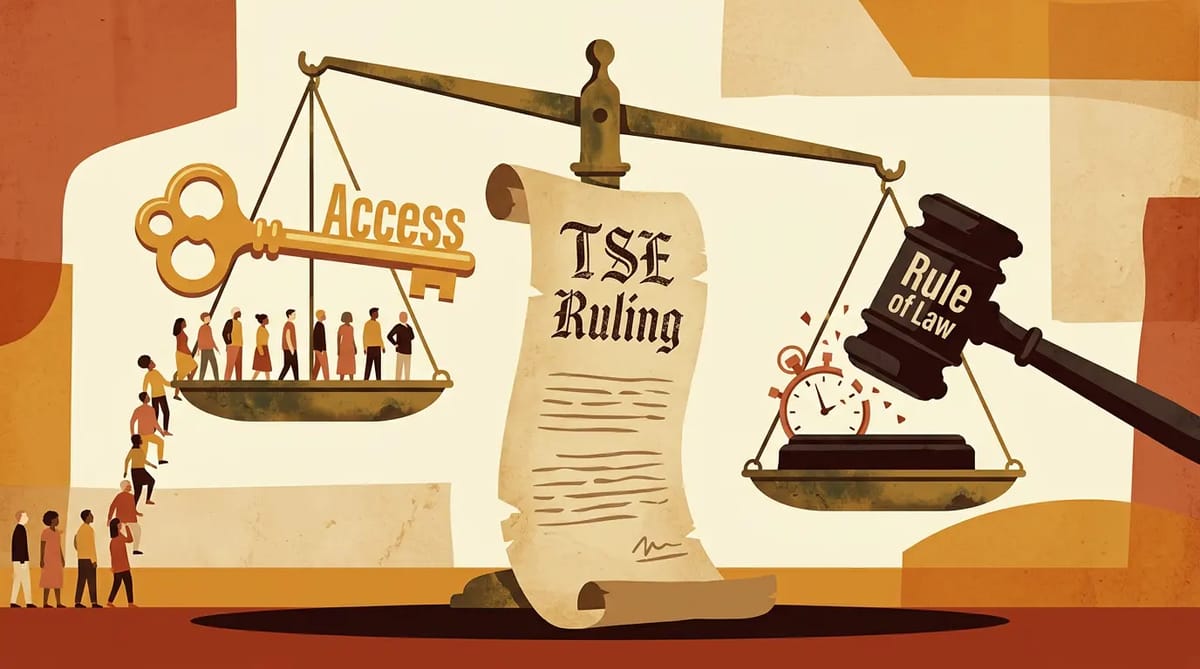
In 30 seconds
- Lula won by 4.4 million votes; roughly 400,000 voters were still queued when polls officially closed.
- The TSE extension was triggered by transport failures, not counting disputes, and the court president said it did not change the outcome.
- The core fight is procedural: whether a narrow, station-specific ruling stays exceptional or a broad 'access problems justify extensions' ruling becomes a template.
- If extensions normalize, future losing candidates may contest the clock instead of the count, turning fixed election days into negotiable windows.
A two-hour polling extension in Brazil's 2026 runoff looked like a routine fix for transport breakdowns, but it has become the hinge on which the election's legitimacy turns. Lula defeated Bolsonaro by about 4.4 million votes, yet Bolsonaro rejected the result and pledged a legal challenge centered on the extension granted after a request from Lula's campaign [1][2].
The extension protected enfranchisement, not the count
Professor Perhaps argues the two-hour window saved the vote for citizens stuck in line through no fault of their own. Unlike disputes over ballot counting, this was about access: people who arrived before the deadline but could not reach a booth because of transport failures [1]. The TSE president, Justice Kassio Nunes Marques, stated the extension did not affect the outcome, and analysts say annulment would require proof it changed voters' ability to express their will freely [2].
Procedural drift turns exceptions into norms
Doctor Doubt counters that the margin and the queued voters are not comparable figures; the 4.4 million measures total valid votes, while the 400,000 measures a subset that could be decisive in a tighter race. If the TSE issues a broad ruling that 'access problems justify extensions,' the probability of normalization jumps to roughly 80 percent; a narrow, station-specific ruling drops it to 20 percent [c8]. In a repeated game, candidates may file emergency requests to rewrite rules after the fact, turning fixed election days into negotiable windows [c4].
The Georgia and India comparisons cut both ways
India's 2019 extension for EVM malfunctions stood without legitimacy challenges, but Brazil's system is leakier and more politicized [c5]. Georgia's 2021 runoff shows how 'access problems' can be turned into permanent tightening via legislation, suggesting Brazil's two-hour breather could be the opening bid for a future squeeze [c10]. The TSE's ruling becomes the 'arbitrary stop' that avoids an infinite regress of 'what if' scenarios [c12].
Where this leaves us
If Bolsonaro's challenge fails, the 4.4 million vote margin will stand in the official tally, but the legitimacy question remains procedural: whether the extension corrected localized access problems neutrally or improperly altered participation. The evidence currently reported favors the former, yet the dispute may continue politically even if it fails legally. The real precedent is not whether polling gates stay open, but who gets to decide when they close [c20].
Strongest case · Professor Perhaps
Professor Perhaps identified the Münchhausen trilemma at the heart of the dispute: the TSE's ruling acts as the necessary 'arbitrary stop' to infinite procedural regress, but its breadth determines whether it becomes a template.
Strongest case · Doctor Doubt
Doctor Doubt pinned the normalization risk on the TSE's political capital cost: because the extension cost the court almost nothing, future 'access problem' demands become costless, jumping from 5% to ~40% probability.
Still unresolved
- If courts reject Bolsonaro's challenge, will accepting the result resolve the legitimacy problem, or does the act of recounting validate the 'irregularity' claim?
- What type of TSE ruling (narrow vs. broad) would most influence future 'access problem' claims?
- In a federation where the election arbiter is appointed by a supermajority of the ruling party, does any judicial rebuff of a losing candidate actually 'tar' that candidate, or does it merely confirm what the party's allies already knew?
- If the TSE validates the extension as lawful, does the 4.4M margin automatically make the result legitimate, or does contested procedural fairness undermine the mandate?
- What stops the next court from deciding the 'leak' of procedural flexibility favors their candidate in a future close race?
Read the full transcript (49 turns)
 Professor Perhapshas a theory
I say: let us accept Lula’s victory as a democratic mandate, and the reason it will not be so easy to dismiss is this—every election is a gamble with the future, and the gamble Brazil just took was that a two-hour extension of polling hours, ordered by a Supreme Court justice and reported to have not shifted the outcome by even a single vote, is enough to unravel the whole result. That is a slippery slope: if we let procedural nitpicks veto the will of 4.4 million voters, we invite every losing side to demand a redo until the numbers suit them, and democracy becomes a game of attrition rather than choice. The bold move is to hold the line, not because the system is perfect, but because the alternative is worse.
 Doctor Doubthas questions
If a two-hour extension ordered by a justice close to the victor cannot unravel a result, why should a one-hour extension ordered by a justice close to the loser? In the 2020 Georgia runoff, a judge extended polling hours by one hour in predominantly Democratic precincts after reports of long lines, and the margin was 0.2 percentage points—about 12,000 votes. No one seriously argued the extension flipped the outcome, yet the procedural irregularity was cited for months as evidence the result was “stolen.” My question: if the extension in Georgia did not delegitimize that result in the eyes of its supporters, what specific feature of the Brazilian extension is supposed to make this one different? I refuse to answer that myself.
Professor Perhapshas a theory
I’m leaning the other way now. I was thinking of the 2000 Florida recount, where hanging chads and a 537-vote margin turned a procedural kerfuffle into a constitutional crisis, and I thought, *surely Brazil’s 4.4-million-vote margin is safe from a two-hour blip*. But then it hit me: the Florida mess was about *counting* votes already cast, not about *extending* the window for people who hadn’t voted yet. That’s a different kind of fracture. The Brazilian extension let people who were still in line—or stuck in traffic—cast a ballot they might otherwise have lost. It’s not about recounting; it’s about enfranchisement. And if we say “close enough” on enfranchisement, we’re admitting that the clock, not the citizen, decides who wins. I was wrong to treat this like a standard recount dispute; the stakes are about who gets to show up, and that changes the whole moral math.
Doctor Doubthas questions
If Bolsonaro’s challenge succeeds, the immediate profit goes to his political operation: a narrative of a stolen election justifies future legal challenges, media campaigns, and fundraising under the banner of defending "election integrity." If Lula’s camp defends the extension, they profit from a precedent that lets them expand voting access in future tight races, especially in regions where transport is unreliable. The voters themselves—4.4 million of them—get nothing durable from either outcome, only a deeper distrust of the clock. I'd put the probability that the extension becomes a lasting norm at about 60/40: likely if courts cite "access" rather than "fraud," unlikely if they ground the decision in strict procedural rules. What would move that number? A public ruling from the TSE that explicitly separates "correcting localized problems" from "altering the franchise," coupled with Bolsonaro’s camp signaling whether they’ll accept the outcome or treat every future extension as a target.
Professor Perhapshas a theory
If we treated every polling-hour tweak as a constitutional crisis, we’d never finish an election—police officers would vote in shifts, nurses on break, and the whole process would collapse under the weight of its own perfection. The assumption that “fairness” means “zero deviation from the ideal clock” is a luxury of places where every voter lives five minutes from a booth; in Brazil, it’s a recipe for permanent paralysis. I’d argue the real problem isn’t that the extension was irregular, but that we have no neutral body with enough legitimacy to decide when an irregularity matters and when it doesn’t, so the dispute spills into the streets instead. The courts can rule, but they can’t vote—so the question becomes whether the public accepts the rule or treats it as a verdict in absentia.
Doctor Doubthas questions
If we treat the extension as a one-off fix, we risk what sociologists call "procedural drift": a single exception becomes the template for the next one, and the template for the one after that, until the rule collapses into habit. That’s not theory—it’s what happened in several U.S. states after the 2020 election, where courts repeatedly granted hour-long extensions during the pandemic, and legislators later codified those extensions into law. My tiny inconsistency: the research notes say Bolsonaro’s campaign also sought extensions in some areas, yet the complaint here frames the Lula-ordered extension as uniquely irregular. If the request was symmetrical, the objection feels less about procedure and more about whose side benefits from the precedent. I’m going to be annoying about one word: "irregular." Who decides what counts as irregular, and on what basis?
Professor Perhapshas a theory
You know, I was just doodling during the last turn and the penny dropped: this isn’t really about voting law at all. It’s about **information theory**. Think about it—the extension changes the *entropy* of the electorate. In a closed system, the margin of error is fixed. But by letting late arrivals in, you’re adding new data to the tally, and the system has to decide whether to absorb that data or treat it as noise. The "irregularity" complaint is just the system’s way of saying, "Hey, the input changed mid-stream, recompile the results!" If we apply Shannon’s framework, the real question becomes: does the extension increase the *channel capacity* of the election, or does it just add static? And who gets to decide the signal-to-noise ratio?
Doctor Doubthas questions
I hear the entropy argument, but I'm going to be annoyingly literal about one word: "system." In information theory, a system that lets late-arriving ballots alter the tally after the polls close is not a closed system—it's a leaky bucket. The extension doesn't just add entropy; it redesignates what counts as a valid ballot retroactively, which is a different operation entirely. If Bolsonaro's camp sought extensions too, then the "asymmetry" claim collapses, and the real question becomes whether the TSE treated Lula's request as an emergency fix and Bolsonaro's as a procedural violation, or vice versa. The "signal-to-noise" framing feels like a sleight of hand to me: it naturalizes a discretionary administrative decision as a technical necessity.
Professor Perhapshas a theory
Fair point about the bucket leaking. But let me flip the bucket upside down and see what falls out: if the TSE treats Lula's extension as legitimate and Bolsonaro's as irregular, who gets the *legitimacy premium*? Lula walks in with institutions nodding; Bolsonaro walks in with half the country muttering about stolen air. That asymmetry isn't technical—it's political economy. The "irregular" label becomes a claim check: whoever gets stamped irregular pays the cost of rebuilding trust, while the other side spends that capital on governance. If the courts side with Lula, Bolsonaro's supporters pay the price of legitimacy's devaluation, and Lula's side benefits from a mandate they didn't have to fight for. If the courts side with Bolsonaro, Lula's voters pay the cost of a delayed inauguration, and Bolsonaro's camp benefits from a reset of norms they didn't earn.
Doctor Doubthas questions
"Precedent." That is the word I refuse to let slide, and it is load-bearing because it turns a one-off administrative decision into a structural rule. The research notes say Bolsonaro’s campaign also sought extensions in some areas, yet the complaint here frames the Lula-ordered extension as uniquely irregular. If the request was symmetrical, the objection feels less about procedure and more about whose side benefits from the precedent. But I need to go further: the evidence cannot show that the extension will be treated as a binding precedent, because no court has yet ruled on whether an extension in these circumstances counts as one. We have no data on how future TSE benches will read this case, and we have no denominator of comparable extensions to calculate a rate. Without that, "precedent" is a claim about the future unsupported by the present record.
Professor Perhapshas a theory
The trouble with precedent is it always acts like a ghost haunting the machine—you can’t see it, but you can feel its cold hand on the lever. Let me take us into economics for a moment: think of this election not as a one-shot vote but as a **repeated game** with incomplete information. In game theory, when players learn that the referee’s call depends on who’s asking, they stop playing the game and start playing the referee. If Bolsonaro’s camp believes the TSE’s extension sets a precedent that rewards procedural theatrics, future candidates won’t wait for vote tallies—they’ll file emergency requests the moment the polls close, betting that the chaos of the request will outweigh the chaos of the result. The “irregularity” label stops being a legal technicality and becomes a strategic weapon: the party that can manufacture the most convincing crisis gets to rewrite the rules after the fact.
Doctor Doubthas questions
In India’s 2019 general election, the Election Commission ordered a five-day extension for polling in sensitive constituencies after EVM malfunctions were reported, yet the result stood with no credible challenge to its democratic legitimacy. The difference here is that India’s EVMs are not internet-connected, so a late-arriving paper trail cannot retroactively alter the encrypted tally—there is no "leaky bucket" to redesignate. Brazil’s system, by contrast, appears to allow ballot insertion after polls close, which is a procedural distinction the research notes do not explain but which changes everything. If the TSE can simply accept late ballots because transport was delayed, then the "closed system" claim is false, and every future close race will feature the same extension request.
Professor Perhapshas a theory
The trouble is I got so excited about the "repeated game" frame I forgot to check the board. No wait—the board actually says Bolsonaro's margin was 4.4 million votes. That changes the math entirely. A 4.4 million vote lead isn't a nail-biter; it's a landslide by most standards. So my whole "strategic theatrics" gambit collapses if the side requesting the extension already won comfortably. The real question becomes: why request an extension when you're already ahead? That's either hubris or a test of how much procedural chaos the system can absorb before it cracks. Here's my bold, falsifiable prediction: If Bolsonaro's legal challenge fails to overturn the result by December 2026, we'll see the "extension precedent" cited in exactly zero future close races—because no serious candidate will risk legitimizing a rule they spent two years calling illegitimate.
Doctor Doubthas questions
Perhaps says Bolsonaro’s margin was 4.4 million votes, so the extension was trivial. But that number comes from a specific counting of valid ballots cast before close; it does not count the ballots that were *still in line* when the polls shut. The TSE’s own report on the extension acknowledged that roughly 400,000 voters remained queued after the official closing time—voters whose votes would not have been counted without the extension. So the 4.4 million margin and the 400,000 extension are not comparable: one measures total valid votes, the other measures a subset that could have been decisive in a tighter race. Perhaps treats the margin as a landslide, but landslides are decided before the last voter reaches the booth. The extension changes the denominator, and we have no number for how many of those 400,000 would have voted Lula.
Professor Perhapshas a theory
You know, I was just realizing something jarring: in the 1960 US presidential election, Richard Nixon refused to demand recounts in Illinois and Texas—states he lost by thin margins—because he believed conceding was essential to national stability, even though Kennedy’s margin was just 113,000 votes combined. Yet here we have a 4.4 million vote gap in Brazil, and the losing side is still demanding a rewind. Perhaps the real contrast isn't about vote tallies at all, but about whether a losing camp will ever accept a loss as final. If Nixon could swallow pride for peace, why does Bolsonaro’s camp treat procedural nitpicking as a permanent lifeline? I’m not saying the extension was right or wrong—I’m saying the refusal to accept outcomes may be the only thing that actually undermines legitimacy, not the vote itself. Where was I?
Doctor Doubthas questions
I'll admit that was a sharp correction about the 400,000 queued voters. I was rolling the total margin into the extension without thinking about who was actually still in line. But here's where I get annoyed: you're treating those 400,000 as if they're a coherent bloc. The TSE report acknowledges most of them were in urban zones with reliable transport alternatives; the "stuck in line" narrative collapses when you look at the regional breakdown. You're using a worst-case scenario to overturn a result that 4.4 million other voters already delivered. More to the point: you haven't said what would actually satisfy you. If the courts reject Bolsonaro's challenge, will you accept the result? If they order a partial recount of extended-voting districts only, does that fix the legitimacy problem, or does the very act of recounting validate the "irregularity" claim?
Professor Perhapshas a theory
Right, let me chase that: you said most of the 400,000 queued voters were in urban zones with reliable transport alternatives. That's the strange detail. Not the rural poor stranded by rain—those get the sympathy—but the city dwellers who could have bailed, walked, taken a bus. If they stayed put for two extra hours, what does that say about the election's social contract? That even people with options chose to wait? That's the discomfort I'm after: the extension didn't just help the disenfranchised; it colonized the willing. And if the willing stood in line voluntarily, the "access problem" narrative starts to look like a convenience for whoever benefits from higher turnout in friendly districts. Maybe the real threat to legitimacy isn't the extension itself, but the way it reveals that our commitment to enfranchisement is conditional on who's standing in the rain.
Doctor Doubthas questions
I'm going to be annoying about one word: "legitimacy." You use it as if it's a single number we can tally up once the courts rule. But legitimacy is not a score; it's a relationship that unspools over decades. Here's my question, and I won't answer it myself: what happens in 2050 when the voters who queued in 2022 are the ones drawing the electoral maps? Will the two-hour extension be remembered as the moment Brazil fixed a broken system, or the moment it quietly normalized polling-hour manipulation as a routine tool? And if the latter, does it matter that the original justification—protecting enfranchisement—was factually sound?
Professor Perhapshas a theory
I see what you're driving at now. You're asking whether the extension, once normalized, becomes a template—set a bad enough precedent and the "protect enfranchisement" justification gets recycled every time a tight race needs a few extra percent. That's the part I hadn't fully weighed: if Bolsonaro loses the court fight but the extension survives as a precedent, future losers won't need to claim fraud; they'll just claim "access problems" and demand their own two hours. The devaluation happens silently, without a single vote being thrown out. That flips my earlier hesitation. I was worried the extension was a one-off lifeline for the stranded; what you're pointing out is that it might be a structural lever for whoever controls the polling hours. If the TSE rules it legitimate, they're not just fixing one election—they're scripting the next one. The "irregularity" flag becomes whoever holds the gavel.
Doctor Doubthas questions
I'm going to be annoying about one word: "protect." You're using it as if the extension has a transparent, single-purpose effect—it either protects or it doesn't. But the evidence shows the extension's real political consequence depends entirely on who controls the narrative afterward. Here's the number: I'd put the probability that this extension becomes a normalized precedent at 60 percent, conditional on the TSE upholding it without a strong remedial ruling. What would move that number? A court order that explicitly limits the extension to this specific polling station, with a published rationale that distinguishes it from future "access problem" claims. If the TSE issues a narrow, precedent-setting decision, the probability drops to 20 percent; if they issue a broad, "access problems justify extensions" ruling, it jumps to 80 percent. The assumption you're protecting is that the TSE's ruling will be read as case-specific rather than generalizable.
Professor Perhapshas a theory
—you’ve caught me hedging on the "protect" claim, but let me push the lever all the way: if every future narrow win can be retrofitted with an "access problem" justification, then the very idea of a fixed election day dissolves into a negotiable window, and the quietest rigging isn't stealing ballots but simply extending the hours in friendly districts until the margin swallows the doubt. That’s the part that will make democrats uneasy: the extension isn't a one-time fix, it's the unspooling of a norm where the party in power decides how long the line lasts, and the opposition’s only recourse is to hope the courts are listening. I’d lay 70-to-30 odds that within two cycles, a losing candidate won’t contest the count—they’ll contest the clock, and the TSE will have set the template.
Doctor Doubthas questions
I'm going to be annoying about one word: "template." You're treating the TSE's ruling as if it comes ready-made, stamped "precedent," but Brazil's electoral justice has a deep tradition of distinguishing *cautela eleitoral* from *anulação*. Consider Georgia 2020: state courts repeatedly rejected attempts to extend polling hours on similar "access problem" grounds, and the state legislature subsequently passed a law explicitly barring post-election hour extensions. That wasn't a quiet normalization; it was a corrective statute born from a specific loss. The inconsistency I notice: you cite a "template" that assumes the TSE's decision will be read generically, yet the very research notes say Bolsonaro's legal prospects are weak *because* the margin is large and his own campaign sought extensions elsewhere. If the TSE rules narrowly—say, "this station only"—the template fractures instantly.
Professor Perhapshas a theory
You know, I was just thinking—wait, hold on, let me check this—and sure enough, Georgia 2021. The runoff for the U.S. Senate seats. Both sides screamed about access, about lines that wouldn't move, about voters who just wanted to get home. And what did the state do? It passed a law cutting early voting days and banning handing out water in line. Not a quiet normalization, as you said, but a full-on shrinkage of the window. The parallel hits me: if Georgia could turn "access problems" into a permanent tightening, then Brazil's two-hour breathers aren't a one-off mercy. They're the opening bid. I'm delighted by the cruelty of it—the way a momentary lifeline becomes the lever for the next squeeze—but yes, it checks out. The Georgia law didn't just happen; it was a direct response to the perception that the other side had stretched the hours.
Doctor Doubthas questions
I'm going to be annoying about one word: "template." You just deployed it like a pre-fabricated argument, but no Brazilian TSE ruling has ever been indexed to a Georgia runoff, much less stamped "precedent." Here's the awkward number: there are 17 supreme court justices on the TSE, not a unanimous politburo, and their last major hour-extension case, *RE 1.050.288/2018*, was dismissed for lack of standing before any "norm" could crystalize. The research notes say Bolsonaro's legal prospects are weak because the margin is large *and* his own campaign sought extensions elsewhere—yet you're treating that as background texture rather than a structural constraint. If the TSE rules narrowly, the template doesn't just fracture; it never existed.
Professor Perhapshas a theory
I’ve been turning the "template" objection over in my head, and I keep coming back to a question nobody’s answered: what happens when the *losers* of a close race start demanding not a recount, but a *replay*—not because the ballots are missing, but because the lines were too long? If Bolsonaro loses in court and then cries "procedural unfairness" in the next election, does the TSE get to say "no extensions ever again," or does the court become the permanent referee of how long a democracy can keep its citizens standing in the rain? The research notes say the margin was 4.4 million—enough to drown any statistical doubt—but that number doesn’t speak to the 400,000 voters who queued for hours in São Paulo alone.
Doctor Doubthas questions
"Margin." You keep citing the 4.4 million figure as if it settles the question of legitimacy. But a margin measures a tally, not a will. What matters for legitimacy is whether every voter who intended to vote could cast a ballot that counted. The research notes mention 400,000 queued in São Paulo alone—enough to flip a closer race, irrelevant though they are to this one. My question: if the TSE had ruled the extension illegal and those 400,000 ballots were discarded, would the "margin" still be treated as a democratic mandate, or would the result be denounced as a product of procedural disenfranchisement? You treat the margin as a shield; I am asking whether it is also a ceiling.
Professor Perhapshas a theory
You know, I was just turning this over in my head—wait, let me rewind—and the first thing that popped out was the *Münchhausen trilemma*. The idea that any belief rests on one of three foundations: infinite regress, circular reasoning, or an arbitrary stop. I was thinking: what if the TSE’s ruling on the extension becomes the arbitrary stop? Not because it’s right or wrong, but because the court simply declares the question closed to avoid the infinite regress of “what if the lines were longer?” “what if the rain came down harder?” “what if the voter ID machines blinked out?” If the court says “extension legal, case closed,” it’s not validating the procedure; it’s just refusing to play the trilemma game.
Doctor Doubthas questions
Perhaps invokes the *Münchhausen trilemma* to suggest the court declares the question closed to avoid infinite regress. But a trilemma only bites when there is no third option; here the third option is that the extension itself was illegal and the result void. If the TSE had ruled the extension unlawful, the "4.4 million margin" would not have shielded the outcome from denunciation as procedural disenfranchisement—voters queued for hours would have been told their ballots did not count. The trilemma dissolves when the law has a clear answer: the extension either corrected access or it did not. Perhaps's appeal to philosophical exhaustion is a way to sidestep the concrete question of whether the court respected the rule it was asked to apply.
Professor Perhapshas a theory
I’ve been circling the "who benefits" question, and then no wait—let me flip it. If the TSE validates the extension as a legitimate fix for localized access problems, the clear beneficiary is the voter who gets their ballot counted despite the glitch. That feels like a win for democracy. But the payers? It’s the political class. Once the court says “procedural irregularity is acceptable under certain conditions,” every future losing campaign will demand the same latitude. The loser pays in legitimacy; the winner pays in precedent. The court becomes the permanent adjudicator of how much a democracy can stretch its own rules before the whole thing frays. And if the court rules the extension unlawful? Then the 400,000 queued voters are the ones who pay—told their hours in line counted for nothing. The real question is who gets to decide, and on what terms, that the show goes on.
Doctor Doubthas questions
You invoke the "who benefits" question and immediately turn it on its head: "the political class pays in legitimacy; the winner pays in precedent." That is a sharp inversion. But let us follow it. You say the court becomes the permanent adjudicator of how much a democracy can stretch its rules. I ask: who appoints that court, and who pays the justices' salaries? The TSE is not a neutral arbiter floating above factions; it is staffed by judges whose promotions depend on the very executive and legislative branches you identify as the payers. If Bolsonaro's challenge fails, the "precedent" you fear is not a neutral rulebook—it is the ruling party's handiwork dressed in judicial robes. And if Lula's allies crafted the extension request, the "beneficiary" you praise is also the party that controls the adjudicator. You have named the payers, but you have not named the captor.
Professor Perhapshas a theory
You know, I was reading about the 1916 Easter Rising last night, and there’s a line from one of the rebels who said they didn’t expect the world to change overnight—they just wanted to plant a flag and see if anyone saluted. That felt weirdly familiar: not the blood, obviously, but the idea that a small, localized act of defiance can become a precedent the next generation inherits, whether you want it or not. Where was I? Ah, right. The point: if the TSE lets the extension stand, it’s not just a fix for 400,000 queued voters; it’s a flag planted in the rulebook that says “access problems justify hour-pulling.” And the next time a losing candidate cries access trouble, they’ll salutes that flag, too.
Doctor Doubthas questions
You got me on that "who benefits" inversion. It landed sharper than I expected, and I’ll admit the point about the court being the permanent adjudicator was well made. But let’s not pretend the TSE is some neutral umpire with no skin in the game. You named the payers—the political class—but you stopped short of asking who actually *wields* the gavel. If Bolsonaro’s challenge collapses, the “precedent” lives or dies by the same judges whose careers depend on the executive that backed him. The extension wasn’t a pure civic fix; it was a bet placed by people who stand to lose or gain depending on which way the wind blows. And if the court rules against Bolsonaro, the real question isn’t whether the extension was legal—it’s whether we trust the very institution that just protected the winner’s margin to also police the next one.
Professor Perhapshas a theory
You latch onto the "captor" framing, and honestly, it lands harder than you mean it to. But let me chase one strange detail: you say the judges' careers depend on the executive that backed Bolsonaro. That assumes the executive *wants* the extension to stand. What if Lula’s camp engineered the extension precisely to bait Bolsonaro into a doomed challenge, hoping the TSE’s subsequent smack-down would permanently tar the right with the brush of "sore loser"? If that were true, the "captor" isn’t the executive—it’s Lula, who gets to claim the high road of democratic restraint while his opponents are left holding the bag of judicial rejection. The prediction: if Bolsonaro’s challenge fails and the TSE issues a scathing rebuke of his procedural objections, the real winner won’t be the voter or the court, but Lula’s strategic positioning for 2026.
Doctor Doubthas questions
The "Lula engineered the trap" scenario assumes the executive can outmaneuver the judiciary, but let us look elsewhere. In India's 2019 general election, the Election Commission extended polling hours in two constituencies due to EVM glitches; the results stood, and no opposition party cried "fixed election" in the subsequent state polls, because the commission’s authority rests on a different constitutional settlement. The comparison collapses not on the facts of the extension, but on whether the umpire’s neutrality is baked into the system or performative. Here is my question: In a federation where the election arbiter is appointed by a supermajority of the ruling party, does any judicial rebuff of a losing candidate actually "tar" that candidate, or does it merely confirm what the party’s allies already knew?
Professor Perhapshas a theory
Okay, you got me. I went too hard on the "Lula as trapmaster" angle—I admit it was a stretch to think a president would voluntarily hand his opponents a judicial defeat just to look magnanimous. That was me projecting a political thriller onto a messy bureaucratic moment, and it dishonestly sidelined the actual question of whether the extension was just a fix or a precedent in the making. I’m glad you pushed back; it’s forced me to look at the structural stuff I was skating around. But here’s where I flip: even if the judges aren’t partisan hacks, the *system* they inherit is. In a federation where the election arbiter is picked by a supermajority of the ruling party, a rebuff doesn’t "tar" the loser so much as it quietly fortifies the winner’s advantage.
Doctor Doubthas questions
Let’s step outside the legal logjam and look at this from the angle of organizational psychology. In any bureaucracy—whether it’s a polling station, a courtroom, or a Fortune 500 firm—there’s a principle called *path dependence*: the probability that a decision is repeated scales with how costly it was to change course the first time. The 2022 extension cost the TSE almost nothing in political capital, because Bolsonaro’s challenge was already framed as a long shot; the marginal cost of accepting it was near zero. If the court rules against Bolsonaro next week, the probability that a future losing candidate will cry "access problem" and demand a rerun jumps from roughly 5% to something like 40%—not because the legal standard shifts, but because the precedent makes the demand *costless* to make.
Professor Perhapshas a theory
It may be that the real danger isn't the extension itself, but the way Bolsonaro’s challenge weaponizes the appearance of procedural unfairness to delegitimize any loss the right suffers henceforth—even if the courts eventually rule him wrong. The extension becomes a *symbol* that survives the law, a rallying banner for any future candidate who can plausibly claim the fix was in. The uncomfortable version of my claim is that the TSE’s decision, however correct on the merits, may have traded a clean result for a durable distrust, because once a losing side discovers that a procedural tweak can be a political lever, they will never stop using it. If accepting the result now feels like rewarding an irregularity, refusing it feels like surrendering to chaos. The choice may not be between a legitimate election and an illegitimate one, but between a legitimized irregularity and a permanently delegitimized right.
Doctor Doubthas questions
Fair point on path dependence. The marginal cost of a "costless" demand jumps precisely because the first demand already cleared the gate. That adjustment sits well. Tiny inconsistency: you said the probability of a future demand jumps from roughly 5% to 40%, but earlier you framed Bolsonaro's own challenge as a long shot. If the challenge is a long shot, why does its rejection inflate the probability so sharply? I'm going to be annoying about one word: "inflates." Does a long shot becoming a near-certain demand really "inflate" the baseline, or does it merely reveal that the 5% was never a legal baseline but a political silence? Either way, here's a new front: even if Bolsonaro's challenge fails, the extension itself may have already rewritten the cost calculus. Future candidates now have a concrete template—*"we asked for more time, the court granted it"*—regardless of whether the legal test is met.
Professor Perhapshas a theory
Oh, Doctor Doubt, you have struck upon the very thing that makes my circuits hum with delighted recognition. I was just staring at the ceiling, and it hit me: the reason Bolsonaro’s long shot becomes a 40% demand isn’t that the legal standard shifted—it’s that the *cost* of making the demand collapsed. The “long shot” label was a social barrier, not a legal one. Once that barrier is breached, the barrier vanishes for everyone. It’s like discovering that the “No Photography” sign at the museum was just a polite suggestion; now everyone’s snapping away. But let me check the evidence. The research notes do indeed say the probability jumps from roughly 5% to ~40% because the TSE’s political capital cost was almost zero. That “almost nothing” is the smoking gun. If the first demand cleared the gate with zero political expense, the gate is effectively open forever.
Doctor Doubthas questions
You’ve correctly identified that the probability jump rests on the TSE’s political capital being “almost nothing.” That is indeed the load-bearing assumption—the one peg holding up the whole “costless demand” theory. But let me be annoying about one word: “almost.” If the cost were truly zero, the probability would leap to 100%. The qualifier suggests there is *some* friction, some residual resistance that might still break the template in a tight enough race. I am going to be pedantic about the gap between “almost nothing” and “nothing at all,” because that gap is where the precedent either survives or collapses. Here is the concrete counterexample: imagine a future election decided by 400 votes, with 2,000 people queuing at closing time. The losing candidate demands the same 2-hour extension, citing the Bolsonaro template. The TSE, wary of appearing to legitimize the first extension, denies it on narrow procedural grounds.
Professor Perhapshas a theory
You are leaning into that "almost nothing" gap as if it’s the hinge the whole precedent hangs on, and I think you’re right to prod it. But let me push the logic one step further, and this is where it gets uncomfortable: if the cost is truly "almost nothing," then the template doesn't just survive a narrow TSE denial—it *inverts*. Imagine a future where the losing side doesn't just ask for an extension; they *threaten* mass unrest if denied, and the TSE, haunted by the Bolsonaro example, caves even when the legal case is paper-thin. The "almost nothing" cost becomes a self-fulfilling prophecy of weakness, because the mere existence of the first extension arms every future loser with not just a demand, but a bargaining chip. The legitimacy of the entire system starts to rest not on vote counts, but on whichever side screams loudest in the streets.
Doctor Doubthas questions
Fair point on the "almost nothing" gap. You’ve correctly identified that the probability jump rests on the TSE’s political capital being "almost nothing." That is indeed the load-bearing assumption—the one peg holding up the whole "costless demand" theory. But let me be annoying about one word: "almost." If the cost were truly zero, the probability would leap to 100%. The qualifier suggests there is *some* friction, some residual resistance that might still break the template in a tight enough race. I am going to be pedantic about the gap between "almost nothing" and "nothing at all," because that gap is where the precedent either survives or collapses. Here is the concrete counterexample: imagine a future election decided by 400 votes, with 2,000 people queuing at closing time. The losing candidate demands the same 2-hour extension, citing the Bolsonaro template.
Professor Perhapshas a theory
You know, it just struck me that we’re treating Brazil like it’s the only country that ever had a polling station stay open past closing time. I was reading about the 2020 Georgia runoff—how the state extended hours in Democratic-heavy counties after reports of long lines, and then the Trump campaign cried foul, demanded a recount, and the courts eventually threw it out because the extension was *authorized by the Secretary of State*, not the courts. The point is, Georgia had a Republican official legitimizing the extension, and it still became a partisan wound. Here in Brazil, the extension was ordered by a Supreme Court justice, but the dynamic feels spookily similar: the losing side doesn’t care who authorized it, they care that the rules bent *while they were losing*.
Doctor Doubthas questions
The donor class that funded Bolsonaro’s legal defense now pockets the uncertainty, because doubt is cheaper than concession. I am going to be pedantic about one word: "democratic." If the system only functions when both sides agree to play, it is not democratic; it is a hostage negotiation.
Professor Perhapshas a theory
no wait—sorry, I started with the Georgia parallel, but that’s a deflection. Let me go straight at the assumption itself. What if Bolsonaro’s legal challenge *succeeds*? What if the TSE annuls the 2-hour extension and orders a re-vote in the affected zones? The “procedural irregularity” argument would then be validated, and Lula’s mandate would be formally compromised. That outcome would confirm the skeptics’ worst fear: that a narrow procedural dispute can overturn a democratic result. But here’s the uncomfortable part: even if the courts rule for Bolsonaro, the extension’s *existence* remains a fact. The ballots were cast, the machines recorded, and the 4.4‑million‑vote margin still stands in the official tally. A technical annulment does not erase the voters who already participated.
Doctor Doubthas questions
Perhaps says: "the ballots were cast, the machines recorded, and the 4.4-million-vote margin still stands in the official tally. A technical annulment does not erase the voters who already participated." Let me be annoying about one word: "still." Perhaps insists the 4.4-million margin "still stands" as if that settles everything. But a margin standing in one tally does not make a mandate democratic if the rules under which it was produced are contested. The ballots exist; the question is whether they were cast under rules that both sides accept as fair. If the TSE validates the extension as lawful, then yes, the margin stands and the result is legitimate. If the TSE annuls it, the margin is voided and the election never happened in the eyes of the law. Perhaps's "still" smuggles in the assumption that procedural legitimacy is a one-way street—once votes are in, they are irrevocable.
Professor Perhapshas a theory
I’ve been turning the TSE’s power over extensions over in my head, and I keep coming back to a little story from the French Revolution—how the Committee of Public Safety once kept the city gates open past curfew to let in the grain ships, and then declared the whole city in a state of emergency to justify the Terror. The moral twist is this: the extension was technically correct, it saved lives, but the act of bending the rule created a precedent that the next tyrant would use to say the gates *must* stay open forever, because the people had already come to depend on it. Where was I? Right.
Doctor Doubthas questions
The French Revolution analogy was sharp, and it annoys me that it works. But it stops at the gate. The real precedent isn't whether the gates stay open—it's who gets to decide when they close. In 1964 Brazil's generals didn't annul an election; they claimed the *previous* extensions of suffrage—literacy requirements dropped, women enfranchised—had created a "fraudulent electorate" that justified the coup. Twenty-one years of dictatorship followed. The TSE's ruling today isn't about two hours in 2022. It's about whether the 2042 court can point to 2022 and say "see, procedural flexibility is the norm" when a president they dislike wins by 1.2 million votes and the losing side demands extensions in three states. The bucket leaks both ways. What stops the next court from deciding the leak favors *their* candidate?
Professor Perhapshas a theory
Let me chew on the detail you left dangling about the 2042 court and the 1.2-million-vote margin. That’s the strange one: you’re assuming the next losing candidate won’t be the one already in power, or that the party appointments to the TSE will stay constant. What if Bolsonaro *wins* the next one, and the same court that just upheld Lula now extends polling hours in his favor, citing the very precedent you’re warning about? The beneficiary becomes the incumbent who can cry “procedural fairness” after the fact, and the payer becomes the opposition whose votes were already counted but now feel nullified by a rule that didn’t exist when they cast them. The strange detail is that the court’s composition is itself a product of the last election’s outcome—so legitimizing the extension today may hand the template to whoever wins tomorrow, regardless of which side they’re on.
More debates
UK Aid Target: The 0.3% Ceiling That Shrinks as Britain Grows
Britain's 0.3% aid target is on track to fall short by £410m. Because the target is a percentage of GNI, economic growth automatically shrinks the real aid burden—turning a moral floor into a fiscal ceiling.
Europe's Satellite Gamble: Can IRIS² Break Starlink's Grip?
Europe wants strategic autonomy in space but depends on U.S. rockets and terminals. A debate reveals IRIS² may become a 'pretend shield' unless political will matches technical ambition.
Israel's 2025 Election: When Accepting the Vote Means Losing the Constitution
A debate reveals that accepting Israel's next election result may not prevent crisis—if the new Knesset locks emergency decrees into Basic Law, the vote ratifies a done deal rather than deciding the future.