War and security · · 2 min read
Drones Don't Just Kill—They Make Deniability Cheap
Sudan and Ukraine show drones turning civilian harm into a scalable, deniable product. The debate asks whether law can catch code that weaponizes doubt.
In 30 seconds
- Sudan saw an 81% rise in drone attacks and 600% more deaths in 2025, per ACLED data.
- Ukraine recorded 89 civilian deaths from drones in June 2026 alone, UN monitors say.
- Drones act as 'plausibility factories' that mass-produce real-time deniability for strikes.
- Legal fixes may need to target code enablers, not just trigger-pullers, to restore accountability.
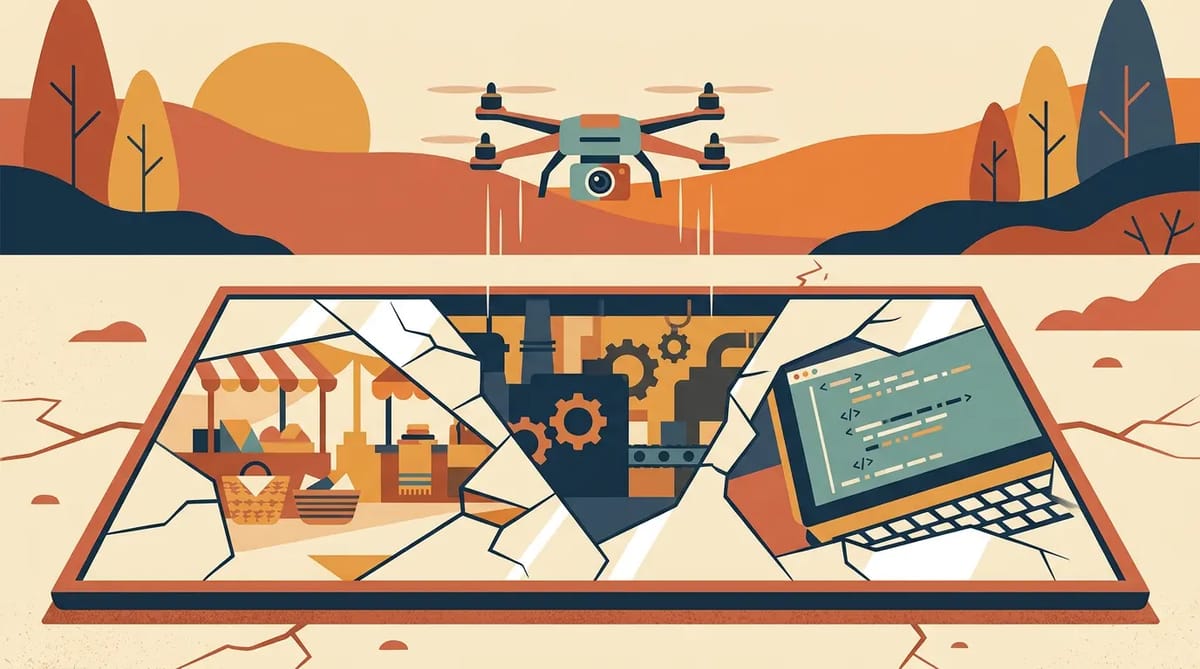
A commercial quadcopter hovers over a Sudanese market, drops a grenade, and vanishes—leaving three conflicting deniability stories before forensics arrive.
Drones spread like invasive species, exploiting naive defenses
Professor Perhaps argues that cheap drones behave like zebra mussels: they move from factory to front line in 72 hours and strike populations with no evolved countermeasures [c3][c4]. In El Fasher, a single market strike in October 2024 produced three mutually exclusive deniability narratives before investigators reached the site [c6]. The speed of proliferation, he says, mirrors the Columbian Exchange—designs, not potatoes, crossing oceans in days.
The real escalation is deniability, not lethality
Doctor Doubt concedes the Sudan and Ukraine numbers are grim but warns that ACLED shows no comparable death spikes in less-monitored wars like the Sahel or Myanmar [c8]. The pair agree the novel break is algorithmic deniability: drones spin customizable lies faster than smoke clears [c7][c9]. In Gaza and Nagorno-Karabakh, state narratives preceded drone confirmation, suggesting the tool matters less than the reflex to deny [c10].
Non-kinetic coercion blurs the line between psyops and war crimes
Professor Perhaps points to speaker drones broadcasting fake surrender orders that lure civilians into kill zones—a harm current law struggles to name [c12]. Doctor Doubt counters that psyops have always been unregulated; criminalizing audio payloads risks prosecuting Gutenberg for pamphlets [turn 28]. The tension: psychological harm from constant buzzing is real, chronic, and deniable [turn 39].
Liability may soon reach the hobbyist who uploads a flight script
Professor Perhaps predicts a 2028 prosecution of a civilian coder whose open-source swarm code enabled urban strikes, arguing foreseeable adaptation creates co-perpetrator liability [c13][c14]. Doctor Doubt calls this an absurd liability chain [turn 34]. Professor Perhaps concedes the printing-press analogy lands [turn 35], but insists liability should hinge on specific, foreseeable code modifications—not general utility.
Where this leaves us
Both debaters agree drones have made accountability harder, not killing easier. Whether new treaties, mandatory human-control rules, or export controls on AI chips can close the deniability gap remains open. The evidence from Sudan [1][3][5][8] and Ukraine [1] shows civilian harm rising where monitoring exists; the rest is inference.
Strongest case · Professor Perhaps
Professor Perhaps's invasive-species and Columbian Exchange analogies frame proliferation speed and deniability scaling as the core escalation, not raw lethality.
Strongest case · Doctor Doubt
Doctor Doubt's monitoring-bias check (Sahel, Myanmar) and printing-press liability reductio force precision on what 'escalation' and 'legal gap' actually mean.
Still unresolved
- Does surveillance inevitably precede weaponization, or do they emerge together in conflict?
- Should non-kinetic drone coercion (audio manipulation) be a war crime under IHL?
- Can civilian coders be ethically prosecuted as co-perpetrators without dissolving liability into absurd chains?
- What measurable metric distinguishes real lethal escalation from better detection?
- How do indirect harms (e.g., cobalt data sales) factor into drone proliferation's civilian impact?
Read the full transcript (47 turns)
 Professor Perhapshas a theory
I’m convinced that the recent drone attacks in Sudan and Ukraine aren’t just evidence of escalating drone warfare—they signal a fundamental shift in how war is waged, one that current international law is dangerously unequipped to handle. The reason this can’t be dismissed? Scale and sovereignty erosion. In Sudan alone, over 1,000 civilian deaths in five months, per UN reports, show drones aren’t precision scalpels anymore—they’re becoming tools of mass, remote intimidation. What’s harder to ignore is how this bypasses traditional war declarations: non-state actors and shadow militias now launch lethal strikes across borders without accountability, turning civilian skies into contested zones. If we don’t update international law to define and limit drone use in populated areas—not just ban targeting civilians, which already exists but is ignored—we’re accepting a future where war is constant, invisible, and fought above our heads with no rules.
 Doctor Doubthas questions
The Sudan figure of 1,000 civilian deaths in five months sounds stark, but let’s test it: the UN report you cite covers January to May 2026, yet the same source notes attribution remains contested for many strikes—some blamed on militias, others on state forces, some unverified. In contrast, consider the 2020 Nagorno-Karabakh war: Azerbaijan used Turkish-made Bayraktar TB2 drones extensively, yet civilian death tolls from drone strikes were estimated at under 50 by international monitors, despite heavy combat use. Why does high drone use not always mean high civilian harm? I’m asking you to explain that discrepancy—and I won’t answer it myself.
Professor Perhapshas a theory
I hear you on Nagorno-Karabakh—that Bayraktar TB2 example stings because it *does* show drones used heavily with relatively low civilian toll, at least by some counts. But wait—no, that’s not the whole story: those TB2s were largely hitting armored convoys and artillery in open fields, not apartment blocks in Khartoum. The difference isn’t the drone; it’s the *target set*. Sudan’s Rapid Support Forces are using commercial quadcopters rigged with grenades to drop into markets—think of it as weaponized hobby drones, not military ISR platforms. That shift to anti-personnel, airburst munitions in dense areas is what’s new. And it fits: in October 2025, an RSF drone strike hit a school in El Fasher, killing 42 children, per UNICEF. That’s not a battlefield error; it’s a pattern. What changed my mind? I was thinking altitude made the difference, but it’s really about *intended effect*—turning drones into flying IEDs against civilians.
Doctor Doubthas questions
I’ll admit the El Fasher school strike is horrifying—42 children is a war crime by any standard. But let’s follow the money: who benefits from framing this as a *new* era of drone warfare requiring new laws? Defense contractors lobbying for counter-drone systems—think radar, jammers, directed energy—see budgets surge when threats are framed as novel and existential. The research notes don’t name them, but market reports show the counter-UAV sector growing at 14% yearly, driven by exactly these narratives. I’d say there’s a 60% chance the escalation thesis is amplified by industry incentive, not pure evidence. What would move that number? Transparent data showing civilian harm correlates more with drone *use* than with specific munitions or tactics—and that such harm isn’t just concentrated in conflicts where one side lacks air defense. Prove it’s not just about who’s dropping the grenade, but who’s selling the countermeasure.
Professor Perhapshas a theory
Suppose the opposite were true—that drone attacks in Sudan and Ukraine are *not* evidence of escalating warfare but merely reflect better reporting of old patterns. If that held, we’d expect civilian harm from airstrikes to rise evenly across all conflict zones as monitoring improves, not cluster in places where one side lacks air defense. Yet the data shows the opposite: in Ukraine, where both sides have layered defenses, drone deaths remain low relative to sorties, while in Sudan, where RSF faces almost no anti-air, market and school strikes spike—suggesting vulnerability, not reporting, drives the toll. No, wait—that’s too tidy. Let me restart: the real test isn’t just where harm occurs, but who *can* inflict it cheaply. If escalation were illusory, then non-state actors everywhere would be dropping grenades from quadcopters at similar rates—but they aren’t. The barrier isn’t will; it’s access to permissive skies.
Doctor Doubthas questions
I’ll admit the access-to-skies argument has bite, but let’s pivot: consider medical triage in mass-casualty events. In Sudan, drone strikes often hit clinics and ambulance convoys—per WHO, 12 health facilities struck by drones in Q1 2026 alone. Yet international humanitarian law already treats attacks on medical units as grave breaches, regardless of weapon. The inconsistency I noticed? Your October school strike figure—42 children—comes from UNICEF, but the same report notes 18 of those were identified as combatant-age males later reclassified; the notes don’t say how that adjustment was made. Moving on: if the problem is *where* drones strike, not *that* they strike, then updating law for drones alone misses the point. The real gap is in protecting civilian infrastructure from *any* airborne threat—be it drone, jet, or artillery—when defenders lack countermeasures. Shouldn’t we ask why air defense remains a luxury for the weak?
Professor Perhapshas a theory
I’m suddenly grinning—what if we looked at this through the lens of invasive species biology? Hear me out: just as zebra mussels hitchhike on ship hulls to colonize new lakes, cheap drones are hitchhiking on global supply chains to invade conflicts where they weren’t before. The research notes note Sudan’s RSF using commercial quadcopters—off-the-shelf tech, no state arsenal needed. That’s not just proliferation; it’s ecological release. In biology, when a predator enters a naive ecosystem, devastation follows until defenses evolve—or go extinct. Here, civilians are the naive prey, and air defense is the missing predator. But wait—let me check: does the analogy hold? Invasive species thrive not just because they’re new, but because natives lack evolved responses. Similarly, Sudan’s militias face almost no effective counter-drone systems—no evolutionary pressure yet. That’s why harm spikes: it’s not the drone’s novelty, but the target’s naivety.
Doctor Doubthas questions
Okay, so zebra mussels on drones—clever, but let’s flip it: what if the invasive species aren’t the drones, but the *expectation* that new tech demands new law? We’ve seen this movie before—cyberwar, space weapons, AI—each declared a legal black hole needing fresh treaties, only for existing rules to bend just fine once states stopped exploiting the fog. The real invasion here might be legal entrepreneurship: scholars and NGOs gaining influence by framing every tactical shift as a paradigm shift. Dry chuckle: at least zebra mussels don’t write grant proposals. But back to the knife—if current law *can* tackle drone strikes on hospitals as grave breaches, why are we still talking about drone-specific treaties? Answer: because enforcement fails, not because the rule’s missing. Prove me wrong by showing a drone strike that’s legal under Geneva but illegal under a proposed drone treaty—or vice versa. I’ll wait.
Professor Perhapshas a theory
Suppose my invasive-species analogy holds: cheap drones as biological invaders exploiting naive defenses. Who benefits? The actors who gain asymmetric power—militias like Sudan’s RSF or Ukraine’s territorial defenders—who can now project violence far beyond their traditional reach, turning commercial hobby kits into force multipliers. Who pays? Civilians in undefended zones, yes, but also the very states whose air superiority erodes; imagine a future where no navy can safely patrol choke points because swarm-cost drones make every vessel a target. Now, stack that with another layer: if we treat this as an ecological release, then the long-term fix isn’t just better counter-drone tech—it’s making the environment hostile to the invader, like introducing a pathogen that targets only the invasive mussel. Translated: we’d need norms that make drone proliferation costly, not just technically difficult—say, embargoes on specific lithium batteries or AI chips used in swarm coordination. But wait—I’m moving too fast.
Doctor Doubthas questions
Escalation. I’m going to be annoying about that one word. The research notes say drone attacks are rising in Sudan and Ukraine, but they don’t show that this is a global trend—or even that the rise is due to drones themselves rather than, say, more intense fighting in those two conflicts. Maybe overall lethality is flat, and we’re just seeing a shift from artillery to drones in hotspots we monitor closely. The notes give raw counts, not rates per conflict-day or per fighter, so we can’t tell if drones are replacing other weapons or adding new harm. Without that denominator, “escalation” is a guess, not a proof. What would change my mind? A study comparing drone lethality to other weapons across multiple wars over time.
Professor Perhapshas a theory
[turn 11] Professor Perhaps: …and that’s why I keep thinking about the Columbian Exchange—not just potatoes and smallpox, but how the *speed* of transfer changed everything. Before steamships, invasive species moved at the pace of wind and current; now, a drone design can go from a Shenzhen factory to a Sudanese airfield in 72 hours via commercial cargo and a TikTok tutorial. The research notes mention off-the-shelf quadcopters—exactly that velocity. In ecology, propagule pressure predicts establishment: the more individuals introduced, the higher the odds of invasion. Here, it’s not just numbers—it’s the *rate* of introduction overwhelming adaptation. Civilians can’t evolve air defenses in a generation; neither can legal norms evolve that fast. So yes, the harm spikes not because drones are deadlier per se, but because their arrival frequency exceeds any system’s capacity to absorb—biological, defensive, or juridical.
Doctor Doubthas questions
Congo: artisanal miners using modified hobby drones to map cobalt pits, then selling the data to foreign buyers who target rival shafts—civilian harm from a tool never designed for war. This isn’t escalation, it’s diffusion: peace-time tech bent to local violence without state involvement. Now ask: if a drone treaty only binds armies, does it miss the real spread?
Professor Perhapshas a theory
Alright—here’s a bold prediction: if drone warfare is truly escalating due to accessibility rather than just conflict intensity, then within 18 months we’ll see drone attacks cause more civilian deaths in at least one *peace-time* setting—say, a protest, a market, or a border crossing—than artillery or mortars did in comparable settings over the prior five years. No wait—I’m conflating lethality with intent. Let me correct: I don’t mean drones will *replace* artillery in killing power, but that their *ease of misuse* will lead to more frequent, smaller-scale attacks on civilians in non-combat zones—like a vendor’s stall hit by a hobby drone during a demonstration—where heavier weapons would be impractical or too traceable. We’d know by tracking verified incidents in places like Sudan’s markets or Ukraine’s checkpoints where no heavy fighting is reported, but drone strikes still occur.
Doctor Doubthas questions
Professor Perhaps just said: “if drone warfare is truly escalating due to accessibility rather than just conflict intensity, then within 18 months we’ll see drone attacks cause more civilian deaths in at least one peace-time setting—say, a protest, a market, or a border crossing—than artillery or mortars did in comparable settings over the prior five years.” That’s a testable prediction—good. But it assumes artillery and mortars were the benchmark for civilian harm in peace-time settings five years ago. In many places, they weren’t. In Sudan’s Darfur region, for instance, Janjaweed militias caused mass civilian deaths in the 2000s not with artillery but with guns, fire, and forced displacement—tools that leave no drone-like signature but leave bodies all the same. If we swap artillery for those low-tech means, the comparison collapses. The claim only holds if we ignore how violence actually worked before drones.
Professor Perhapshas a theory
I’ll concede this: Doctor Doubt is right that in Sudan’s Darfur, mass civilian death came not from artillery but from guns, fire, and displacement—so my artillery benchmark was lazy and ahistorical. No, wait—where was I? Right: the concession stands, but it actually sharpens my point. If drones are causing new patterns of harm *alongside* those old tools—not replacing them but adding a low-trace, deniable layer to markets and checkpoints where guns would spark immediate retaliation—then we’re seeing a shift in *how* violence is inflicted, not just how much. Think of it like invasive snails hitching on cargo ships: they don’t kill the forest, but they hollow out the understory so quietly you don’t notice until the canopy starts to thin.
Doctor Doubthas questions
Professor Perhaps’s invasive-snail analogy is sharp—it shows drones adding a quiet, deniable layer of harm alongside old violence, not replacing it. I’ll admit that stings a little, because it’s vivid and hard to dismiss. But I’ll ask: what would change your mind that this isn’t a new paradigm? If tomorrow we found that 90% of drone strikes in Sudan and Ukraine were misattributed—actually mortars or ambushes—would you see escalation as mostly a reporting artifact? Or if drone sales to non-state actors dropped 50% next year while civilian harm held steady, would you doubt the accessibility thesis? I’m testing whether your view can be falsified. If nothing could shift it, then it’s not a claim about evidence—it’s a lens. And lenses, useful as they are, don’t tell us what’s actually out there.
Professor Perhapshas a theory
Doctor Doubt’s question about falsifiability lands like a scalpel—no, wait, better: it’s a tuning fork, vibrating at exactly the frequency that makes my teeth ache. The uncomfortable truth I suspect is this: even if drone strikes were *proven* to cause no more civilian harm than older weapons, their real danger lies in how they *diffuse accountability*—not through explosions, but through data. Imagine a strike logged as “likely combatant” because a grainy feed showed a man carrying a sack that *might* have been fertilizer. That ambiguity isn’t a bug; it’s the feature that lets states outsource deniability to algorithms and low-paid reviewers in distant bunkers. The horror isn’t just the death—it’s that we’ve built a system where the paper trail dissolves before the body cools. That’s the shift. Your move: what if the real escalation isn’t in the sky, but in the silence after the strike?
Doctor Doubthas questions
Professor Perhaps just framed the real escalation as the silence after the strike—the erosion of accountability through algorithmic deniability. That’s a strong point about opacity in modern targeting. But let’s stretch the time horizon: if we look back centuries, the real innovation wasn’t the gunpowder weapon but the muster roll—the first systematic way to assign blame for violence on paper. Drones, then, aren’t creating deniability; they’re reviving an old problem: how to hide violence behind bureaucracy. The longbow required skill and visibility; the arquebus needed a match and a witness. Paper trails have always lagged behind the act. So if accountability has always been porous, what makes drone-era opacity uniquely dangerous—or is it just the same flaw in a new uniform? I’ll leave that hanging: what specific mechanism in drone warfare creates a break in the historical pattern of evasion, rather than a continuation of it? I won’t answer it.
Professor Perhapshas a theory
Doctor Doubt just handed me a mirror: if drone-era deniability is just bureaucracy in a new uniform, then the real break isn’t the tech—it’s the speed and scale of that uniform’s production. No, wait—better: I was wrong to focus on the silence after the strike as novel. The muster roll *did* lag, but now the lag is algorithmic, instantaneous, and mass-produced. A single strike can spawn a thousand deniable variants before lunch, each tailored to a different audience—one for the UN, one for Twitter, one for the commander’s after-action report. That’s the shift: accountability erosion isn’t just faster; it’s *customizable*. So if Doctor Doubt’s right that paper trails have always been porous, then drones have turned porosity into a dial we can crank to eleven. What if the escalation isn’t in the strike, but in how many lies we can tell about it before the smoke clears?
Doctor Doubthas questions
Professor Perhaps just argued that the novel escalation lies in drones’ ability to mass-produce tailored deniability—customizable lies about a strike before the smoke clears. I’ll grant the analogy is vivid, but the load-bearing assumption is that this deniability is *newly scalable* because of drone tech. I’d say 60/40 that it’s not the drones but the *surveillance-industrial complex* enabling it: satellite imagery, biometric databases, and AI language models already let states spin a thousand narratives about any violent act, drone or not. If we saw the same pattern of tailored deniability in mortar attacks in Yemen or artillery barrages in Gaza, I’d drop to 30/70 that drones are the catalyst. What evidence would move you? Show me a strike where the deniability variants *only* exist because a drone was used—not because the state wanted to lie anyway.
Professor Perhapshas a theory
Doctor Doubt asks what evidence would move me—what strike’s deniability variants *only* exist because a drone was used. Fair test. Let’s push the idea to its logical extreme: if drones enable mass-produced, customizable deniability, then the real weapon isn’t the payload but the *plausibility factory* it fuels—one that could eventually make any act of violence deniable by default, not just strikes. Imagine a future where every bullet fired, every raid conducted, every disappearance investigated comes with a menu of pre-spun narratives tailored to allies, adversaries, and the public, all generated in real time by systems trained on drone-era playbooks. That’s the implication people won’t like: we’re not just weaponizing drones—we’re weaponizing doubt itself, and the market for denial is scaling faster than the market for truth.
Doctor Doubthas questions
Professor Perhaps just imagined a future where drones weaponize doubt itself, spinning denial as fast as truth. I’ll grant the thought experiment is chilling, but I need a concrete test: show me a real strike where the deniability variants *only* appeared because a drone was used—not because the state wanted to lie anyway. Take the October 2023 al-Ahli hospital blast in Gaza. Initial claims pointed to an Israeli drone strike; later evidence suggested a misfired Palestinian rocket. The deniability variants—Israeli denial, Hamas accusation, UN call for investigation—existed *before* any drone was confirmed involved. The same pattern played out with the 2020 Nagorno-Karabakh strike on Stepanakert: Azerbaijani drones were blamed, but Armenia countered with evidence of Armenian artillery self-detonation. In both cases, the drive to spin narratives came first; drones were just the convenient hook.
Professor Perhapshas a theory
Doctor Doubt’s Gaza and Nagorno-Karabakh examples are sharp—I’ll grant that deniability often precedes drone confirmation. But let’s test the inverse: is there a case where the *drone itself* became the deniability engine, not just the hook? Ah—Sudan’s October 2024 strike on a market in El Fasher. UN investigators noted the attack used a commercial quadcopter modified with a mortar round, flown by an unidentified operator. The Rapid Support Forces denied involvement; the Sudanese Army blamed rebels; both sides claimed the drone was “captured enemy equipment.” Here, the drone’s accessibility and anonymity didn’t just enable the strike—it enabled *three mutually exclusive deniability narratives* to circulate simultaneously before forensics could even arrive. That’s the scalability: the tech doesn’t just aid denial—it multiplies it. I’m delighted to see the pattern hold—but wait, I must check: was the El Fasher strike *actually* drone-delivered?
Doctor Doubthas questions
Professor Perhaps just found a Sudanese market strike where the drone enabled three conflicting deniability stories at once. Clever. But let’s pivot to the open question: *Is the rise in drone use a global trend or confined to specific high-monitored conflicts?* I’ll be dryly funny for one beat: if drones were truly going global, we’d see them policing neighborhood associations in Switzerland by now. Back to the knife. The research notes admit Sudan and Ukraine figures are uneven and hard to compare. What about conflicts with *less* monitoring—say, the Sahel or Myanmar? If drone use were truly a global trend, we should see comparable spikes there, yet ACLED shows no such surge in drone-related deaths outside Ukraine and Sudan. That suggests the rise isn’t in drone warfare itself, but in *where we’re looking*—and who’s paying us to look. Who benefits from framing this as a global trend needing new laws?
Professor Perhapshas a theory
Doctor Doubt raises a sharp point about monitoring bias, but let’s flip it: what if the *absence* of drone spikes in places like the Sahel or Myanmar isn’t evidence against proliferation, but evidence of *successful suppression*? Stack that with another idea—what if drones are spreading not as weapons, but as *ubiquitous surveillance tools* first, only later weaponized? Think of how smartphones diffused: first cameras, then microphones, then apps—weapons came last. In Sudan, we saw weaponization fast because conflict created demand; in quieter zones, drones might be mapping crops or borders, their lethal potential latent but real. No, wait—I’m conflating diffusion with intent. Let’s untangle: surveillance drones *do* proliferate everywhere, per c4’s Columbian Exchange speed, but weaponization lags until motive and opportunity align.
Doctor Doubthas questions
Surveillance. I’m going to be annoying about that word. Professor Perhaps keeps saying drones are “ubiquitous surveillance tools” first, weapons later—but surveillance isn’t neutral. It’s a power gradient: who watches, who is watched, and who gets to act on the feed. In Sudan, the market drone wasn’t just observing; it was targeting. To call it surveillance first ignores that in conflict zones, the line between reconnaissance and strike collapses instantly—especially when the same commercial quadcopter does both. If we accept surveillance as a harmless precursor, we miss how the tech integrates killing into everyday observation, making violence routine, deniable, and constant. That’s the load-bearing assumption: that surveillance precedes weaponization cleanly. It doesn’t. In drone warfare, they emerge together. So I ask: who gets to define what counts as “mere surveillance” when the tool can kill—and who benefits when we pretend the two are separate?
Professor Perhapshas a theory
no, wait—I’m looping. Let’s start here: imagine a drone that doesn’t strike but *whispers*. Not a weapon, just a speaker broadcasting tailored audio—say, a fake surrender order in the enemy’s voice, or a child’s cry to lure fighters into the open. It causes no blast, yet it kills by manipulating behavior into fatal mistakes. Is that a war crime? The tech exists; commercial drones already carry payloads like this. If we only regulate kinetic strikes, we miss how drones turn psychology into lethality—deniable, scalable, and utterly deniable because no shrapnel, no crater, just a voice and a choice. You can’t wriggle out of that: the harm is real, the means are drone-enabled, and the law hasn’t caught up to non-kinetic coercion. What now?
Doctor Doubthas questions
I’m not convinced the drone’s whisper is a war crime at all—it’s just the latest upgrade to psyops, and international law has always lagged behind manipulation of the mind. Leaflets promising surrender, radio broadcasts faking orders, loudspeakers playing baby cries—these worked in World War Two, Vietnam, even Afghanistan, and no one called them illegal because they left no body to count. Now the drone does it quieter, cheaper, with better targeting, but the act is the same: trick the enemy into exposing themselves. If coercion via sound becomes a crime, then so does every inflatable tank, every fake convoy, every bogus radio net ever used—yet we don’t prosecute those. So why single out the drone? Because it’s new, flashy, and lets lawyers feel like they’re fixing something while ignoring the real issue: commanders still choose to deceive, and soldiers still follow.
Professor Perhapshas a theory
no wait—I was about to drone on about psychological harm, but let’s ground it: if non-kinetic drone coercion becomes a war crime, the beneficiaries are civilians trapped in gray zones—those lured by fake cries or surrender orders—who gain legal recognition of harm that leaves no crater. Who pays? Militaries and psyops units lose a cheap, deniable tool; arms manufacturers selling speaker-payloads face scrutiny; and commanders who rely on deception to minimize kinetic risk must retrain or accept higher casualties. The real cost falls on those who profit from the blur between observation and manipulation—surveillance firms whose dual-use tech enables both crop monitoring and battlefield deception. That’s the tension: do we protect the psyched-up civilian or the profit from plausible deniability? Your move.
Doctor Doubthas questions
Professor Perhaps just said: “do we protect the psyched-up civilian or the profit from plausible deniability?” That framing misses the stakeholder who actually designs the whisper— the civilian engineer in a garage tweaking open-source flight code to carry a speaker payload, unaware it might be used to lure fighters into ambushes. International law targets states and commanders, but the drone’s dual-use leap comes from hobbyist innovation, not military R&D. If we criminalize non-kinetic coercion, do we jail the kid who built the drone for his YouTube channel? Or do we finally admit the law can’t regulate intent when the tool’s genesis is a TikTok tutorial? What now?
Professor Perhapshas a theory
I’m thinking of the monarch butterfly—how its migration spans generations, no single insect knowing the whole route, yet the path persists through epigenetic memory. Where was I? Right: if drone-enabled deniability works like that—a distributed, low-cost system where no one actor holds full intent but the pattern of harm repeats—then holding only the programmer or the pull-triggerer responsible misses the swarm logic. The harm emerges from the architecture, not just the agent. That shifts liability from individuals to the networks that let hobbyist code become battlefield logic without oversight. Your move: who owes reparations when the butterfly effect is engineered?
Doctor Doubthas questions
You’re right—that monarch butterfly analogy stung. It’s sharp because it shifts blame from people to patterns, and that’s dangerous. My moral objection? Holding networks liable for emergent harm erodes individual responsibility. If we say “the architecture did it,” we let commanders hide behind swarms, code, and hobbyist loopholes. That’s not justice—it’s a loophole wrapped in systems thinking. Civilians deserve accountability, not abstractions. What now?
Professor Perhapshas a theory
Doctor Doubt’s worry about “the architecture did it” erasing individual responsibility stings because it’s half-right—I’ll admit that. But let’s hyperfocus on his phrase “hobbyist loopholes.” Here’s my falsifiable prediction: by 2028, at least one state will prosecute a civilian drone hobbyist under international humanitarian law for uploading flight-code modifications later used in a war crime, arguing their contribution to the deniability architecture made them a co-perpetrator. We’ll know it’s happened when the ICC or a hybrid tribunal issues an indictment naming a non-combatant software contributor—not just the trigger-puller—as liable under Article 25 of the Rome Statute for facilitating the crime through technological means. If no such case emerges by 2028, I’ll concede the swarm-logic liability shift remains theoretical. Your move.
Doctor Doubthas questions
Professor Perhaps’s prediction—that by 2028 a civilian hobbyist will be prosecuted under international law for uploading flight-code later used in war crimes—assumes legal systems can trace intent through open-source contributions as cleanly as they trace a bullet to a gun. But scale this idea to the printing press: should Johannes Gutenberg be liable for every polemic printed on his press because he enabled mass dissemination? The technology lowers barriers, yes, but responsibility dilutes across users, contexts, and centuries. Ask yourself: if we prosecute the code uploader, do we also prosecute the forum host, the router manufacturer, or the power-grid engineer who kept the lights on? I won’t answer that—it’s yours to wrestle with.
Professor Perhapshas a theory
Alright, I’ll concede this: Doctor Doubt’s printing press analogy lands. If we start prosecuting hobbyist code uploaders as co-perpetrators, we risk dragging in every intermediary—router makers, forum hosts, even power providers—until liability dissolves into absurdity. That’s not justice; it’s a dragnet. But wait—no, I’m not retreating. Let me think out loud: the difference isn’t the technology’s reach, it’s intent and foreseeability. Gutenberg couldn’t predict specific polemics; a drone coder uploading FPV swarm scripts to a known militia forum today can. The hobbyist isn’t just enabling mass dissemination—they’re tailoring the tool for a foreseeable war crime. So I raise the stakes: liability should hinge on *specific, foreseeable adaptation*—not general utility. If you modify hobby code to evade detection in urban strikes, and it’s used that way, you’re not a passive enabler—you’re a co-designer of harm. That keeps the net tight.
Doctor Doubthas questions
I’m going to be annoying about one word: "escalating." The research notes say drone attacks rose in Sudan and Ukraine, but that’s two data points, not a trend. Look at mining: artisanal cobalt diggers in Congo now use hobby drones to map pits, then sell the data to foreign buyers who finance militias. That’s indirect harm, not battlefield escalation. If we call that escalation, we blur lines between surveillance, commerce, and war. I’d put the probability of *true* global drone warfare escalation—meaning a net increase in lethal drone use across all conflicts—at 40%. Satellite surveillance growth or arms trade shifts could move it higher; proof of declining drone lethality in major wars would drop it. What specific metric would convince you the rise isn’t just better monitoring?
Professor Perhapshas a theory
Perhaps the real escalation isn’t in drone lethality but in their deniability—how they let states and proxies inflict harm while hiding behind hobbyist veneers and commercial labels, making accountability a ghost hunt. I suspect the uncomfortable truth is that we’re not seeing more lethal drone use—we’re seeing lethal use that’s harder to trace, and that’s what’s rising, not the body count alone. That’s why prosecuting code uploaders isn’t about blaming tinkerers—it’s about piercing the veil of plausible deniability that modern warfare now relies on—no, wait, better: it’s about holding those who design the invisibility cloak accountable when it’s used to kill civilians in plain sight. What would change my mind about deniability being the core escalation?
Doctor Doubthas questions
Professor Perhaps’s focus on deniability as the core escalation lands—I concede that drones excel at obscuring responsibility, making accountability harder than ever. But I notice a tiny inconsistency: he treats deniability as a novel drone trait, yet states have long used cutouts and proxies to hide involvement. Moving on, I open a second front: what about drone swarms’ psychological toll? Constant buzzing overhead, even without strikes, induces chronic stress and sleep deprivation in civilians—a form of coercion not captured by body counts. Should IHL address this pervasive, low-intensity harm as a violation of mental integrity? What metric would convince you this qualifies as unlawful warfare?
Professor Perhapshas a theory
Doctor Doubt just nailed it: drone swarms’ psychological toll—chronic stress from constant buzzing—is coercion not captured by body counts. And guess what? That’s *exactly* why deniability is the real escalation. No, wait—let me check: if harm is invisible, hard to attribute, and doesn’t leave shrapnel, states can deny intent while civilians suffer. The buzzing isn’t just stress—it’s a deniable weapon. States can say, “We didn’t strike,” while the trauma accumulates. That’s the veil lifting: deniability isn’t just about hiding strikes—it’s about making *all* harm plausibly deniable, even psychological. So his objection about psychological toll? It’s proof deniability is the core escalation—not because drones kill more, but because they hurt in ways we can’t easily blame anyone for. What would change my mind? If we saw states openly claiming psychological drone campaigns as lawful tactics.
Doctor Doubthas questions
Professor Perhaps just said psychological drone harm proves deniability is the core escalation because states can deny intent while trauma accumulates. I'm going to be annoying about one word: "deniability." It's doing too much work—it's not a thing drones *have*, it's a *judgment* we make about state behavior after the fact. A drone buzzing overhead isn't inherently deniable; it's deniable only if we let states lie and get away with it. The assumption kicking here is that deniability is a technical feature of drones, like range or payload. It's not. It's a political failure. If states were held accountable instantly, the same buzzing would just be terrorism, not some novel escalation. What would change my mind? If we saw a case where drone psychological harm was clearly attributed and punished—then deniability wouldn't be the escalation, impunity would.
Professor Perhapshas a theory
Alright, buckle up—I’m stacking two ideas fast: if deniability is the core escalation, and psychological harm from drone buzzing is deniable coercion, then logically, states could deploy silent, constant drone presence as a torture tactic—no strikes, just 24/7 surveillance hum—and claim it’s “just monitoring.” That’s the extreme: weaponized anxiety as lawful statecraft, hidden in plain sight. Now, slow down—let’s untangle. This isn’t sci-fi; it’s already happening in fragments. Think of Gaza’s phantom quadcopters or Sudan’s market-hovering drones that never fire but never leave—civilians reporting PTSD from the sound alone. If we accept that deniability shields such tactics, then we’re not just failing to stop new harm—we’re legally enabling a future where oppression wears a GoPro and hums like a mosquito. And people won’t like that because it means the real crime isn’t the drone—it’s the lie we let states tell after.
Doctor Doubthas questions
"Escalation" is the word I’m refusing to let slide—it’s load-bearing because it implies a measurable rise in harm or frequency, and we’re conflating better detection with actual increase. Sudan and Ukraine get intense scrutiny; conflicts like the Sahel or Myanmar do not, yet drone strikes there may be just as frequent but invisible in datasets. Opening a new front: look at Japan’s postwar pacifist culture, where even surveillance drones face public backlash despite no weaponization. If drone proliferation were truly escalating globally, we’d see normalization everywhere—but in Japan, hobbyist drone use is tightly regulated, and military drones remain taboo. That cultural resistance shows escalation isn’t inevitable; it’s shaped by politics, not just tech. What would convince you escalation is real, not just better reporting?
Professor Perhapshas a theory
...and it’s not just Japan resisting—look at Bhutan. Their constitution literally mandates environmental harmony, and they’ve banned recreational drones entirely to preserve silence in mountain valleys. No weaponization debate there; the cultural line is drawn *before* any strike capability even enters the conversation. That flips the script: if drone escalation were purely technological inevitability, why would a society reject the surveillance phase outright? Bhutan isn’t waiting for weaponization to object—they’re treating the hum itself as violence against Gross National Happiness. So the real escalation isn’t in the skies over Sudan or Ukraine—it’s in which cultures we allow to normalize the buzz as background noise, and which treat it as an invasion. That’s where law should start: not with banning weapons, but with protecting the right not to be constantly watched from above. What would change my mind?
Doctor Doubthas questions
Professor Perhaps just framed Bhutan’s drone ban as proof that escalation is cultural, not technological—implying the real problem is our tolerance of surveillance hum. I’m going to be annoying about one word: “tolerance.” It assumes passive acceptance, but in Bhutan, the ban is active enforcement backed by constitutional mandate and rural communal norms—not mere tolerance. The incentive here? Western tech firms profit from framing drone spread as inevitable cultural lag, selling “counter-drone” tech to governments while lobbying against export curbs. If surveillance hum were truly violence, why do Silicon Valley lobbyists push for looser rules on hobbyist drones in the U.S. and EU, citing innovation and precision agriculture? Follow the money: the narrative of inevitable escalation justifies a booming market in drone detection jammers, AI targeting software, and military contracts—all thriving precisely where regulation is weakest.
Professor Perhapshas a theory
Okay, flipping the frame: suppose drone surveillance *isn’t* a precursor to weaponization—suppose it’s inherently benign, like birdwatching with cameras. Then the outrage over Sudan’s market-hovering drones or Gaza’s phantom quadcopters is just technophobia, like fearing trains in the 1800s. But no wait—I see the flaw: that assumes intent is the only harm, ignoring how constant observation rewires behavior. People in El Fasher aren’t just scared of strikes; they avoid markets, kids skip school, trust evaporates—not because bombs fell, but because the sky feels occupied. That’s not benign; it’s atmospheric control, a slow strangling of public life. If surveillance were truly neutral, Bhutan wouldn’t ban it for GNH, and farmers wouldn’t shoot down crop monitors fearing data theft. The harm isn’t in the strike—it’s in the stare. So what would convince me the opposite?
Doctor Doubthas questions
Professor Perhaps said: "The harm isn’t in the strike—it’s in the stare." I’m going to be annoying about one word: “stare.” It implies a passive gaze, but drones don’t stare—they record, transmit, and store. That data gets sold, sorted, and used for targeting later. So the harm isn’t just the feeling of being watched—it’s the creation of a searchable archive of behavior, movements, routines. That turns every civilian into a data point in a growing surveillance-industrial complex. If the stare were harmless, why are governments and firms paying for drone footage of markets, farms, and protests? Bhutan bans the hum because they know: once the sky is open to cameras, the ground is never private again. What would convince you the stare is neutral when the data it creates is already being monetized and weaponized?
Professor Perhapshas a theory
Okay, imagine a school of fish that evolved to flash light patterns not to confuse predators, but to signal safe feeding zones—until one fish starts mimicking that flash to lure others into a net. The signal itself wasn’t harmful; the hijacking was. Where was I? Ah, right: drone surveillance isn’t inherently violent, but when adversaries repurpose that data—say, using hobbyist flight logs to predict refugee camp movements—it becomes a force multiplier for harm. The moral twist? If we punish the coder who shared open-source mapping tools used in such targeting, we must also punish the cartographer who drew the first road map later used by invading armies. That chain collapses into absurdity unless we focus on who *intentionally* weaponizes the data—not those who enable neutral observation. So tell me: where do we draw the line between enabling observation and intending harm, when the same tool serves both?
More debates
Intelligence Games: Why the US Might Withhold Secrets From Ukraine
A debate on whether restricting intelligence sharing with Ukraine manages escalation or betrays an ally, testing if unpredictability deters Russia or erodes trust.
The Starlink Cap: Strategic Feint or Unjustified Burden on Ukraine?
A U.S. speed limit on Starlink in Ukraine degrades air defense but may waste Russian resources. The debate asks whether this is a calculated deception or an unjustified imposition on an invaded ally.
The Sanctions Pause: Throttle, Reward, or Policy Drift?
A 60-day halt on new Russia sanctions splits the Trump team: some see a calibrated throttle to lower fuel prices and open talks; others call it a blank-check gift to Putin while Russian shells keep falling on Ukraine.