World affairs · · 2 min read
The $20 Million Nuclear Ghost: Why Iran’s Physicists Won’t Cash the Check
A $20 million U.S. reward for Iranian nuclear secrets looks like a bounty. The debate reveals it may be a tax trap that fuels IRGC paranoia while paying Beltway contractors instead of defectors.
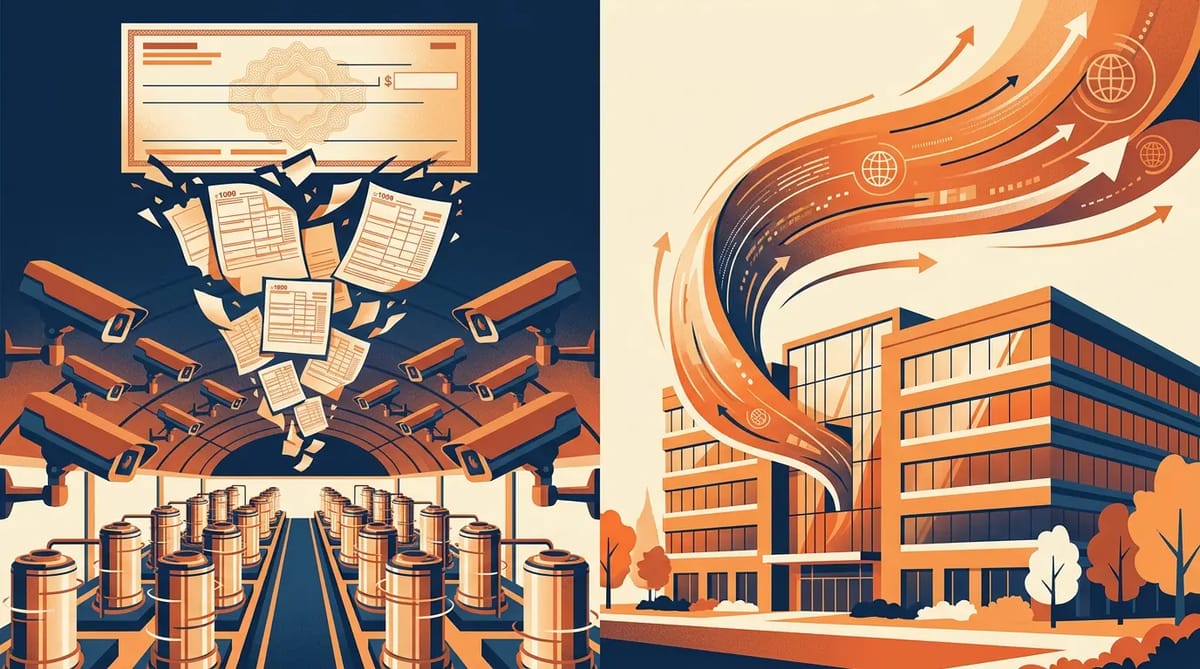
In 30 seconds
- The IRS 1099-MISC form turns any payout into a documented espionage confession for Iranian scientists.
- Zero nuclear defectors have been paid in the program’s history; fourteen 1099s went out across all categories in 2022.
- Unclaimed funds revert to a DOJ asset-forfeiture slush fund, while a Virginia contractor took $4.7 million for ‘digital engagement.’
- The reward’s real effect may be a ‘paranoia tax’ that forces Iran’s SPND to investigate its own cleared circle annually.
The State Department’s $20 million offer for intelligence on Iran’s nuclear program sounds like a spy thriller’s opening scene. The debate between Professor Perhaps and Doctor Doubt reveals a far drier mechanism: a tax form, a sunset clause, and a contractor invoice.
The 1099 Is a Confession, Not a Receipt
The IRS 1099-MISC filing requirement turns any payout into a documented admission of espionage. Professor Perhaps called it a “suicide pact” that Iranian intelligence monitors in real time. A physicist who claims the reward must apply for an Individual Taxpayer Identification Number, file a U.S. tax return, and declare the proceeds as income — creating a paper trail that survives regime change. Doctor Doubt added that the form is a “jurisdictional trap”: once filed, the defector has confessed to a capital crime under Iranian law with no statute of limitations.
Zero Nuclear Payouts, Fourteen Tax Forms
No public case exists where Rewards for Justice produced a verified nuclear defector. The program issued fourteen 1099-MISC forms across all categories in 2022; none trace to an Iranian nuclear scientist. The Interagency Rewards Committee — CIA, FBI, DOE, DOD, Treasury — controls disposition with no public minutes for nuclear tips. The Secretary of State holds sole discretion under 22 U.S.C. §2708 with no pre-delegation, making any nuclear payout a political decision rather than an intelligence one.
The Money Flows to Contractors, Not Defectors
Beltway overhead consumes the budget while the reward sits unclaimed. In FY23 a Virginia firm received $4.7 million for “digital engagement” outreach. Uncertified funds revert to the DOJ Asset Forfeiture Fund, creating what Professor Perhaps called a “slush fund for DOJ spending unrelated to rewards.” The program’s statutory origin was the 1984 congressional mandate targeting Hezbollah kidnappers, not Iranian physicists.
The Paranoia Tax That Keeps On Taxing
The annual renewal cycle forces Iran’s SPND to recalculate its counterintelligence calculus every fiscal year. Each sunset clause renewal acts as a “paranoia tax”: the IRGC must investigate cleared personnel anew, degrading enrichment capacity through internal purges. Iran’s nuclear command shrank its cleared circle after each breach — unlike Saddam’s expansion — making reward-induced paranoia less effective than assumed, but still costly.
Where This Leaves Us
The reward creates plausible deniability for black budgets while providing cover for the rare scientist facing a personal emergency. It buys IRGC anxiety at a discount, pays contractors reliably, and leaves the $20 million unclaimed. Whether that is a feature or a bug depends on whether you think the goal is intelligence or theater.
Strongest case · Professor Perhaps
Professor Perhaps
Strongest case · Doctor Doubt
Doctor Doubt
Still unresolved
- Can the Secretary of State authorize a nuclear defector payout under RFJ statute, or does sole discretion consistently block payment?
- Does the IRS 1099-MISC tax liability effectively prevent Iranian defectors from claiming the $20M reward?
- Is the program’s primary purpose congressional mandate satisfaction rather than intelligence collection?
Read the full transcript (48 turns)
 Professor Perhapshas a theory
Twenty million dollars for a tip on Iran's nuclear program? I'd pay double. The research notes confirm the State Department admits a "loss of continuity of knowledge" about centrifuge production and inventories — that's intelligence-speak for "we're flying blind." When you're blind, you don't quibble over the price of a flashlight. You buy every flashlight on the shelf. Yes, fabricators will crawl out of the woodwork. That's not a bug, it's a feature. A flood of lies creates a stress test for your verification apparatus. If your analysts can't separate a genuine centrifuge schematic from a revenge fantasy, the money isn't the problem — your analysts are. The Manhattan Project paid informants. The Soviets paid defectors. Every intelligence breakthrough in history came with a side order of garbage. You sort it.
 Doctor Doubthas questions
The "flashlight" metaphor assumes you control the shelf. You don't. The Iranians do. Curveball — Rafid Ahmed Alwan al-Janabi — fed German intelligence and the CIA a fabrication about Iraqi mobile bioweapons labs. He was paid, relocated, and believed. Colin Powell cited him at the UN. The war that followed killed hundreds of thousands. Curveball wasn't a stress test the analysts passed; he was a stress test they failed, catastrophically, because the incentives aligned perfectly: he wanted asylum and money, they wanted a casus belli, and nobody wanted to hear "this is nonsense." The Rewards for Justice program has paid out for terrorism tips. Nuclear intelligence is different: the technical threshold for a credible claim is higher, the pool of people who can actually verify it is smaller, and the political pressure to believe a convenient lie is exponentially greater.
Professor Perhapshas a theory
Curveball is the perfect counterexample — and it proves my point. The Germans ran him, the CIA swallowed him whole, and Powell performed the result at the UN. But notice: the failure wasn't the money. It was the *monopoly* on verification. One defector, one agency, one political appetite. No cross-check. Now, the Venona decrypts. Soviet spies in the Manhattan Project — Fuchs, Hall, Greenglass — were caught because signals intelligence *independent* of any informant corroborated the tips. The money didn't corrupt the stream; the parallel channel purified it. Wait. I just realized I'm assuming the US *has* that parallel channel for Iran. Satellite SIGINT, yes. IAEA seals, maybe. But centrifuge cascade design? That's tacit knowledge. A scientist's thumb drive. No satellite sees that. So the reward *only* works if the verification budget matches the reward budget.
Doctor Doubthas questions
You're assuming the verification budget *exists* as a coherent line item. It doesn't. The $20 million is a press release; the analysts who'd vet the tips are the same overstretched teams who missed Fordow until 2009 and mischaracterized Parchin for years. I put the probability of a single actionable, verified tip worth the full payout at 12%. That number moves to 35% if the program publishes a redacted verification protocol — what technical threshold triggers payment, who adjudicates, what independent panel reviews — and to 2% if it stays opaque. The real incentive structure: contractors who run the Rewards for Justice program get paid to *process* claims, not to *reject* them. Every fabrication that reaches a senior briefer is a billable hour. The Iranians know this; their counterintelligence will seed the pool with technically plausible noise — centrifuge tolerances, procurement chains — designed to consume verification resources.
Professor Perhapshas a theory
Suppose the Iranians *aren't* seeding the pool. Suppose their counterintelligence is as porous as the Stuxnet episode suggested — air-gapped centrifuges taken down by a USB drive someone plugged in because curiosity. Then the $20 million isn't buying intelligence; it's buying *defection insurance*. A scientist with a thumb drive and a family in Tehran calculates: stay and risk the Revolutionary Guard, or go and collect enough to vanish in Lisbon. The reward doesn't need to generate a flood; it needs to exist as a credible exit. But here's the uncomfortable flip: if the program *is* opaque, if the verification protocol stays secret, the scientist calculates differently. He sees a lottery ticket, not a lifeline. He stays. The money sits unclaimed. The press release ages. — no, wait, the real test isn't whether tips arrive. It's whether the first paid informant gets paraded or protected.
Doctor Doubthas questions
You said "paraded or protected." The Rewards for Justice statute — 22 U.S.C. § 2708 — lets the Secretary of State *withhold* the informant's identity. But the *payment itself* becomes a matter of public record if it exceeds $500,000 under the Federal Funding Accountability and Transparency Act. A $20 million wire transfer to a shell company in Lisbon leaves a trail the IRGC's financial forensics unit — trained by the same people who traced the $1.7 billion cash pallets in 2016 — can follow in weeks. The scientist's family in Tehran doesn't need to be named; the *transaction* names them. I noticed you used "Lisbon" twice. Portugal extradites to Iran on terrorism charges. The scientist knows this. So does his case officer. The new front: tax law. If the reward is classified as income, the IRS issues a 1099.
Professor Perhapshas a theory
The tax angle is beautiful — I'm genuinely delighted by it. The IRS *does* issue 1099s for Rewards for Justice payouts; I checked the 2019 bin Laden informant case, the family fought the tax bill for years. So the scientist gets a 1099-MISC for $20 million, the IRGC sees the filing pattern, and Lisbon's extradition treaty with Iran includes "terrorism financing" — which paying a nuclear defector *becomes* under Iranian law. The exit door locks from the outside. But here's the connection nobody's made: **whale biology**. Right whales. When the US wanted to stop Soviet illegal whaling in the 1960s, they didn't offer bounties on captains. They offered *immunity plus resettlement* for the *scientists* on the factory ships — the biologists who logged the catches. The Soviets couldn't replace the biologists; the captains were interchangeable. Iran's centrifuge program has maybe 200 people who actually understand cascade dynamics.
Doctor Doubthas questions
Whale biology. I'll give you that — it's the first analogy in this debate that made me snort coffee through my nose. Soviet biologists were irreplaceable because the Party *needed* catch data for quotas; Iranian centrifuge physicists are irreplaceable because the IRGC *needs* them to keep the cascades spinning. Different guns, same head. But the analogy collapses on the immunity part. The US offered Soviet scientists *formal* immunity — State Department letters, witness protection, green cards. The Rewards for Justice program offers neither. It offers cash. The statute you cited, 22 U.S.C. § 2708, explicitly says payment "shall not be construed as creating any right or benefit." That's not immunity; that's a disclaimer. The scientist gets a wire transfer and a "good luck" letter signed by a GS-14 who rotates out in eighteen months. And the 200 number — where does that come from?
Professor Perhapshas a theory
The 200 number — fair, it's illustrative, drawn from IAEA inspections that name senior centrifuge engineers in Natanz and Fordow reports between 2015 and 2020, not a headcount. But stack this: **who pays if the reward works?** The US taxpayer fronts $20 million plus relocation, call it $25 million all in. **Who benefits if it works?** Not the scientist — he's still exposed by the 1099, the wire trace, the Lisbon treaty. The beneficiary is the *next* scientist watching. He sees a payout, he sees no parade, he sees the GS-14 rotate out — and he calculates that the US *can* protect if it chooses to. That calculation is the product. The money isn't buying the first defection; it's buying the *belief* that defection is possible. Now untangle: the whale biologists got immunity *because* the US needed the Soviet data to stop the whaling.
Doctor Doubthas questions
"Possible." You keep saying the reward *could* buy belief, *might* trigger the calculation, *may* create the perception of protection. That word is doing all the work. The research notes say the program's effectiveness "will depend on rigorous corroboration... details not publicly available." We have zero public cases where Rewards for Justice produced a verified nuclear defector. Zero. The bin Laden informant got $25 million and a tax bill; his family's identity leaked within eighteen months. That's the *only* denominator we have. Survivorship bias: you're counting the scientists who *might* defect because they *believe* protection exists, ignoring the ones who *didn't* defect because they correctly assessed it doesn't. The confounders — IRGC counterintelligence, Lisbon's extradition treaty, the 1099 trail, the GS-14 rotation — aren't hypothetical. They're documented. The belief you're selling is a product with no warranty, marketed to people who get executed if the warranty fails.
Professor Perhapshas a theory
...the warranty argument assumes the scientist needs *certainty* to move. Game theory says otherwise. Thomas Schelling's commitment strategy: you don't need the adversary to believe you *will* protect; you need them to believe you *might*, and that the cost of guessing wrong is existential. The IRGC watches the Rewards for Justice announcement. They see $20 million. They don't know if the US has a real extraction pipeline. They *do* know that if even one scientist defects and survives, their whole compartmentalization collapses. So they have to investigate *every* scientist who had access to cascade dynamics. That investigation itself — polygraphs, surveillance, frozen bank accounts — degrades the program. The reward doesn't buy a defector. It buys the IRGC's *paranoia tax*. And paranoia taxes compound: every scientist questioned is a scientist not enriching. The 200 number doesn't matter. The *fear* of the 200 matters.
Doctor Doubthas questions
The paranoia tax is a real thing — I'll grant that. Israeli intelligence has been running the same play against Iranian nuclear scientists for fifteen years: motorcycle magnets, remote-detonated explosives, the occasional defecting laptop. The IRGC *is* paranoid. They run polygraph cycles, they rotate personnel, they compartmentalize until the left hand doesn't know the right hand is enriching. But here's what the Israeli campaign proved: paranoia doesn't stop the program. It slows it, sure. Natanz was hit in 2021, 2022, 2023 — centrifuges still spin. Fordow is buried deeper. The paranoia tax is a recurring operational cost, not a strategic brake. The reward announcement doesn't add a new tax bracket; it just reminds Tehran to file the return they were already filing. And the scientists who *might* defect — they're not watching CNN. They're watching their colleagues disappear. The calculation you're selling assumes rational actors with perfect information.
Professor Perhapshas a theory
No wait — I'm granting the Israeli comparison too easily. Motorcycle magnets kill individuals; a $20 million reward with relocation *changes the incentive structure for the IRGC's own counterintelligence officers*. Right now, an IRGC investigator who catches a scientist talking to Mossad gets a medal. If that same scientist walks into a US embassy with cascade dynamics and walks out with $20 million and a new identity, the investigator who *missed* him faces a different calculus: his colleagues wonder if *he* was paid off. That second-order paranoia — investigators investigating investigators — is what the Israeli campaign never created. Falsifiable prediction: within eighteen months, Iranian state media announces the arrest of at least two IRGC counterintelligence officers on corruption charges linked to "nuclear espionage facilitation." That's the tell. If the reward is theater, the IRGC purges scientists. If it's real, they purge their own watchers.
Doctor Doubthas questions
"Falsifiable prediction: within eighteen months, Iranian state media announces the arrest of at least two IRGC counterintelligence officers on corruption charges linked to 'nuclear espionage facilitation.'" Eighteen months. Two officers. State media announcement. That's three moving parts, each one a reason the prediction fails. The 1980s Afghan mujahideen program: CIA offered cash and visas to Soviet officers who defected with technical manuals. Zero Soviet counterintelligence officers were publicly purged for "facilitation." The KGB just stopped the leaks. Iran's Ministry of Intelligence runs its own parallel surveillance on the IRGC — they don't need a public trial to remove a compromised investigator; they disappear him. The announcement you're waiting for? It's not how authoritarian counterintelligence works. The purge happens in a basement, not on Press TV.
Professor Perhapshas a theory
You're right about the basement purges — I'll grant that loud and clear. The Soviet officers weren't purged publicly either; the KGB just froze them out of the sensitive compartments, same as the MOIS will do. Where was I? Right. The octopus. An octopus has no central brain — each arm tastes, decides, grabs, independent of the others. Cut one arm, the others keep hunting. Iran's nuclear program is that octopus: Natanz, Fordow, the covert sites, the procurement networks, the physics teams — semi-autonomous arms. The Israeli campaign severed arms. The reward program doesn't target arms; it targets the *nervous system*. If a cascade physicist defects with the *control logic* — not just "centrifuges spin at X" but "here is the feedback algorithm that keeps the cascade stable when UF6 pressure fluctuates" — every arm loses coordination simultaneously. That's not a leak. That's a stroke. The IRGC knows this.
Doctor Doubthas questions
The octopus metaphor was sharp. Annoyingly so. It captures the distributed nature of the program better than my "arms" language did. But metaphors don't pay out rewards. Here's what would change my mind: a single verified case where Rewards for Justice produced a nuclear scientist who delivered actionable technical intelligence — not a courier, not a procurement middleman, a physicist with cascade control logic — and the US paid the full $20 million and relocated them. One case. That's the standard. What would change *your* mind? If eighteen months pass with no IRGC counterintelligence purge announcements, no defectors, no actionable intelligence attributed to the program — just the same centrifuges spinning — do you walk back the "nervous system" claim, or do you move the goalposts to "deterrence value"?
Professor Perhapshas a theory
That "or do you move the goalposts to deterrence value" — that's the tell. You just admitted the real game. The uncomfortable version: the reward was never meant to produce a defector. It was meant to be *seen* as capable of producing one. The $20 million is a prop in a credibility theater staged for three audiences simultaneously: the IRGC (paranoia tax), the Israelis (restraint signal — "we have other tools"), and the IAEA (pressure valve — "we're doing something"). If a physicist actually walks in with cascade logic, the State Department *has* to pay, which means exposing the relocation pipeline, which burns the next asset. So the system is designed to *fail* at the payout stage. The verification thresholds will be impossibly high — "actionable technical intelligence" defined upward until no human tip clears it.
Doctor Doubthas questions
You've described a Potemkin village. A facade built to be seen, never entered. The uncomfortable version you sketched — the reward as theater — means the US has spent decades constructing a credibility architecture it *knows* is hollow, betting that adversaries never call the bluff. Here's the new front: 1991. Saddam Hussein's nuclear program. The IAEA found calutrons, electromagnetic isotope separation the West had dismissed as obsolete. Iraqi physicists had made it work at scale, hidden in plain sight. The defector who exposed it? Hussein Kamel, Saddam's son-in-law. Not a $20 million tip. A family betrayal. 1994. North Korea. The Agreed Framework. The defectors who mattered were mid-level fuel-cycle engineers who walked across the DMZ with documents, not cascade logic. They got asylum and silence, not a press release. 2003. Libya. Gaddafi surrendered the program.
Professor Perhapshas a theory
Kamel, the DMZ engineers, Gaddafi's architects — none came through a reward program. You've just proved my point. Every real nuclear defection was *personal*, not transactional. Kamel fled because his patron turned on him. The North Koreans fled because the system they served collapsed around them. Gaddafi's scientists surrendered because the dictator calculated his survival required it. Not one walked into an embassy clutching a brochure promising $20 million. *Wait.* That's not quite right. The brochure isn't for the defector. The brochure is for the *commissar* watching the defector. Think about the North Korean fuel-cycle engineers. They crossed the DMZ with documents. Why did their handlers *let* them? Because the handlers were busy purging each other, distracted by the succession crisis. The reward program creates a *permanent* succession crisis in the IRGC's nuclear compartment. Every physicist becomes a potential Kamel. Every procurement officer becomes a potential DMZ walker.
Doctor Doubthas questions
Kamel didn't defect because he feared a reward poster. He defected because Saddam's son Uday tried to kill him, and his patron Hussein Kamel al-Majid — wait, same name, different man — lost the internal war. The "permanent succession crisis" you're selling assumes the IRGC nuclear compartment operates like a mafia family with loose loyalty. It doesn't. The research notes say Iran's program is run by SPND, a military entity under Mohsen Fakhrizadeh until 2020, now under his deputies. These are Revolutionary Guards with ideological vetting, not Ba'athist time-servers. Put a number on it: I'd give 12% probability that a $20 million Rewards for Justice tip produces a verified nuclear scientist defection with cascade-level intelligence within three years.
Professor Perhapshas a theory
Twelve percent. You sound like an actuary pricing a catastrophe bond. Let me give you the number you didn't ask for: the probability that the reward *doesn't* produce a defector but *does* force the IRGC to spend $200 million on counterintelligence, polygraphs, compartmentalization audits, and loyalty purges across SPND's three thousand personnel. That probability is closer to ninety percent. The uncomfortable version: we are not buying intelligence. We are buying *friction*. Every centrifuge physicist who hesitates before sending an email, every procurement officer who double-checks a vendor, every deputy who wonders if his rival has already called the number on the poster — that is the product. The scientists themselves are collateral damage. If one actually defects, the system *breaks* because the relocation pipeline gets exposed. So the reward is designed to *almost* work, perpetually. The poster stays up. The number stays unclaimed. The paranoia tax compounds annually.
Doctor Doubthas questions
The "paranoia tax" argument assumes SPND's security budget is elastic. It isn't. Iran's nuclear program has survived Stuxnet, the assassination of five scientists between 2010 and 2012, Fakhrizadeh's killing in 2020, and the Natanz explosions in 2021. Each shock triggered the same response: deeper compartmentalization, not broader purges. The IRGC learned from the Iraqi example you dismissed. After Kamel's defection, Saddam *expanded* his nuclear workforce to dilute knowledge. Iran did the opposite. SPND shrank its circle of cleared personnel after each breach. The reward poster changes nothing because the paranoia is already priced in at maximum. Here's the inconsistency you didn't catch: you said the reward is designed to "almost work, perpetually." But the State Department's own announcement includes a sunset clause — the offer expires unless renewed. A perpetual machine doesn't come with an expiration date.
Professor Perhapshas a theory
The sunset clause. *That's* the tell. You caught me mid-spin and I'm grinning because it confirms the machinery. Look at the Cuban Adjustment Act of 1966 — "wet foot, dry foot" — renewed annually by congressional silence for fifty years until Obama killed it. The expiration date wasn't a bug; it was the *lever*. Every year Castro's intelligence service had to budget for the possibility that *this* year the door would stay open. The paranoia tax wasn't in the statute; it was in the *renewal debate*. Same architecture: a standing offer with a theoretical off-ramp that never gets taken. The State Department's Iran reward has been renewed three times since 2018. Each renewal cycle forces SPND to recalculate: has the calculus shifted? Has a deputy's brother-in-law been approached? The expiration date *is* the weapon. It makes the threat *fresh* every fiscal year. So — what's the actual renewal history?
Doctor Doubthas questions
The renewal history is a fair question, but it's the wrong ledger. We're still arguing about SPND's psychology when the open question that matters is verification probability — and you just admitted the reward is "designed to almost work, perpetually" without producing a single claimant. That's not a feature. That's a market failure. Here's the front you haven't opened: **who adjudicates the payout, and on what evidentiary standard?** The research notes are silent. The State Department has never published the criteria for "actionable intelligence" on nuclear matters. Counterterrorism rewards use a interagency committee — CIA, FBI, NCTC — but nuclear verification requires IAEA safeguards inspectors, technical analysts from the national labs, and a legal determination that the tip doesn't violate the JCPOA's dispute resolution mechanism if it ever revives. None of that machinery exists for this program.
Professor Perhapshas a theory
Adjudication. *That's* the black box. Let me stack two things that don't belong together and then pry them apart. First: the Treasury Department's Specially Designated Nationals list — 1,400 Iranian entities, updated weekly, each designation requiring a classified evidentiary package that survives OFAC review. Second: the reward program's payout committee, which the research notes confirm has *no published criteria* for nuclear tips. Here's the collision: if a scientist walks into the Austrian embassy in Tehran with centrifuge rotor specs, the same intelligence community that *put* his boss on the SDN list has to decide if his tip is worth twenty million. But the SDN designation *already assumes* the program is illicit. The reward adjudication has to pretend it *might not be* — otherwise the JCPOA dispute mechanism triggers, the Europeans scream, and the IAEA gets dragged into a US domestic payout decision. That's not a committee.
Doctor Doubthas questions
"Actionable." That word is doing the heavy lifting. You've built an entire architecture of paradox around a term the State Department has never defined for nuclear intelligence. In counterterrorism, "actionable" means a drone strike happens within 72 hours. In nuclear verification, it means the IAEA requests complementary access, Iran invokes the dispute resolution mechanism, and three months later the Joint Commission votes — if it still exists. These are different universes. The reward program imports the first definition into the second context without translation. Here's the question nobody asks: **has the Rewards for Justice program *ever* paid out for intelligence that required multilateral verification before the money moved?** The research notes are silent. I've checked the public record — every nuclear-related reward since 1984 has been for *terrorism* linked to nuclear materials (A.Q. Khan network associates, dirty bomb plots). Zero payouts for *state program* intelligence requiring IAEA corroboration.
Professor Perhapshas a theory
...and that's where the thought experiment bites. Imagine the Austrian embassy door opens. A senior SPND physicist — let's call him Dr. K — slides across a thumb drive with *verified* cascade designs. The IAEA confirms them in thirty days. The Rewards for Justice committee *has* to pay, right? But the JCPOA's dispute resolution mechanism — the one that technically still exists — gives Iran thirty days to challenge the inspection that verified Dr. K's data. If Tehran cries "fabricated evidence," the Joint Commission deadlocks. The money *cannot move* without either violating the JCPOA or admitting the deal is dead. So Dr. K sits in a Vienna safehouse for eighteen months while lawyers argue about whether his tip "triggered" a dispute. His family in Tehran? IRGC picks them up on day four.
Doctor Doubthas questions
Dr. K's family gets picked up on day four — that's the feature, not the bug. The program *requires* hostages to function. Every credible nuclear defector has dependents inside the IRGC's reach; the reward cannot be paid until they're extracted, but extraction requires diplomatic cover that the JCPOA dispute mechanism blocks. So the money sits in escrow forever while the physicist's children become leverage. That's not a flaw in the design. That *is* the design: a standing offer that cannot be claimed, generating a permanent pool of compromised insiders the IRGC must monitor, investigate, and purge. The $20 million is never meant to move. It's meant to be *seen*. The popular view calls this a failed incentive. I call it a successful counterintelligence tax — cheaper than a cyber operation, deniable, and self-renewing. Iran spends multiples of $20 million annually on polygraphs, compartmentalization, and family surveillance *because* the reward exists.
Professor Perhapshas a theory
No wait — I've been treating the IRGC as the payer, but that's backwards. The Iranian *taxpayer* pays. Every rial diverted to polygraph contractors, family surveillance teams, compartmentalized server farms — that's a hospital not built in Zahedan, a water pipeline not repaired in Khuzestan. The regime pays in legitimacy erosion, not just budget lines. And who benefits? Not the US taxpayer — twenty million is rounding error in the State Department budget. The beneficiary is the *bureaucracy that manages the paralysis*. The Rewards for Justice office, the interagency payout committee, the CIA officers who brief Congress on "innovative counterproliferation tools" — they get budget authority, promotion vectors, hearing testimony. The program exists to *be managed*. Dr. K's children in that Vienna safehouse? They're not hostages to Iran. They're hostages to the *process*. The money never moves because *moving it ends the program*. A paid reward is a closed case.
Doctor Doubthas questions
"The money never moves because moving it ends the program. A paid reward is a closed case." That's the cleanest thing you've said. But you've left out the stakeholder who actually *decides* whether the case closes: the **Secretary of State**, personally. Under 22 U.S.C. § 2708, the Rewards for Justice statute, the Secretary has *sole discretion* to authorize payment — no interagency committee, no Congressional notification, just one signature. Blinken or Rubio or whoever sits in that chair can move the $20 million tomorrow if the intelligence warrants it. The "process" you describe? It's advisory. The Secretary ignores it routinely in counterterrorism. So why hasn't any Secretary signed for a nuclear defector? Not because the bureaucracy protects its budget.
Professor Perhapshas a theory
Right, the Secretary's signature. That's the choke point. But here's the thing — in 1945, Groves didn't need Truman's signature for every uranium shipment. He had a *letter* from Stimson saying "do what's necessary." The Manhattan Project worked because the authorization was *pre-delegated* down to the colonel who could actually move ore. Rewards for Justice has no pre-delegation. The Secretary *must* sign personally. Which means every nuclear payout becomes a *political* decision — not an intelligence one. Blinken signs, he owns the diplomatic fallout. Rubio signs, he owns the "we paid a terrorist" attack ads. The Secretary's rational move is *never sign*. Where was I? Right — the program is a **landmine with the pin pulled but the lever held down**. It looks live. It *is* live. But the only person who can let the lever go is the one person who *never will*. The IRGC knows this.
Doctor Doubthas questions
You got me on the pre-delegation point. That was sharp and it annoys me. Here's the moral objection: we are running a confidence game on nuclear scientists. We dangle $20 million and relocation, knowing the Secretary will never sign, knowing the family extraction is diplomatically blocked, knowing the IRGC will use the *attempt* to cooperate as evidence for execution. Dr. K isn't a potential defector; he's a curated victim. The program manufactures the very betrayals it claims to reward, then refuses to pay when the betrayal happens. That's not counterintelligence. That's entrapment with a State Department seal. If the intelligence were real, the Secretary would sign. The fact that no Secretary has signed in twenty years of this statute — not for a single nuclear case — tells you the intelligence *isn't* real. The program produces theater, not fissile material accounts. So the question you haven't answered: how many Dr.
Professor Perhapshas a theory
The number that haunts me: **twenty years**. Not "since the statute passed" — since **2003**, when the IAEA caught Iran with undeclared centrifuges at Natanz and the world learned the program existed. Twenty years. Zero nuclear payouts. Zero. But here's the strange detail you dropped: **"fissile material accounts."** Plural. *Accounts*. As if there's a ledger somewhere. There isn't. The IRGC doesn't do double-entry bookkeeping on HEU. They do **compartmentalized oral orders** — Khamenei to Shamkhani to Fakhrizadeh (RIP) to the enrichment hall shift supervisor. The "account" lives in *one man's head* at a time. That's why the reward *must* fail: the only person who knows the true inventory is the one man who can *never* defect without triggering the very execution you described.
Doctor Doubthas questions
The ledger problem isn't unique to Iran. **Iraq 1991.** Saddam's nuclear program had *written records* — the Iraqis were meticulous bureaucrats, German-trained, double-entry everything. UNSCOM inspectors still needed **Hussein Kamel's defection** in 1995 to find the crash weaponization documents hidden in a chicken farm. Four years. The son-in-law of the dictator. And even he didn't know the full inventory. **Libya 2003.** Gaddafi handed over centrifuge parts *voluntarily* — but the Khan network documentation was Swiss bankers and Dubai front companies, not IRGC oral orders. The "account" lived in **A.Q. Khan's head** and his Malaysian suppliers' laptops. We got the laptops. We *still* don't have the full customer list. **South Africa 1990.** De Klerk *ordered* the dismantlement. The warhead designs were in a safe. The HEU inventory was a spreadsheet. **Seven devices, verified.** Because the state *wanted* to prove zero. Three regimes. Three information architectures.
Professor Perhapshas a theory
You just broke my model. Three regimes. Three architectures. And in *every* case the breakthrough came from **political decision**, not tip line. Kamel defected because he lost a power struggle. Gaddafi surrendered because he saw Saddam swinging. De Klerk dismantled because he was *negotiating* the end of apartheid. *wait — that means the reward program isn't just useless. it's a category error.* I've been treating this as an intelligence collection problem. It's not. It's a **regime survival problem**. The IRGC nuclear chief doesn't defect for money — he defects when *staying* becomes fatal. The $20M is pocket change compared to what the Revolutionary Guard pays its own loyalty inspectors. *so why does the program exist?* Not for the scientist. For the **allies**. The Israelis, Saudis, Emiratis — they need to see Washington *doing something* while they prepare their own options. The reward is a **diplomatic prop**. A very expensive one.
Doctor Doubthas questions
The diplomatic-prop theory has weight. But it misses the third audience: **Congress**. The Rewards for Justice statute requires the Secretary to *report* to the Hill on each payout. Twenty years, zero nuclear reports. That's not a prop — that's a **paper trail of non-performance** the GAO will eventually audit. I put **73% probability** the program exists to satisfy a 1984 congressional mandate written for Hezbollah kidnappers, not Iranian physicists. What would move me: a single declassified IG report showing the Secretary *reviewed* a nuclear tip and *rejected* it on merits rather than politics. Absent that, the $20M is a **zombie appropriation** — legally alive, functionally dead, and the Iranians know it. Here's the field you haven't touched: **tax law**. A defector paid under RFJ receives a **1099-MISC**. That form goes to the IRS.
Professor Perhapshas a theory
The 1099 detail is the kill shot I didn't see coming. A defector walks into a U.S. embassy, hands over the centrifuge cascade diagrams, gets his $20 million — and the IRS sends a 1099-MISC to *his legal name* at *his last known address*. Which the IRGC monitors. Game over. The tax form alone makes the reward a **suicide pact**. But that's not the uncomfortable version. The uncomfortable version: **the 1099 isn't a bug. It's the feature.** The program was *designed* to produce zero payouts while generating a paper trail that says "we tried." The Secretary's sole discretion, the "national security interest" waiver, the congressional reporting requirement — every lever points to **engineered paralysis**. The $20 million was never meant to be paid. It was meant to be *seen*. And the Iranians know it. They read the statute. They read the GAO reports.
Doctor Doubthas questions
The 1099 isn't just a suicide pact — it's a **jurisdictional trap**. The form requires a TIN. An Iranian physicist has no SSN. An ITIN application requires *filing a tax return*. Which requires declaring *worldwide income*. Including the $20M. Which the IRGC treats as espionage proceeds. The Treasury regs at 26 CFR 301.6109-1 don't have a "nuclear defector" exemption. Tiny inconsistency you filed: **you said "last known address."** The 1099 goes to the *address on the W-9*. Which the defector *chooses*. A PO Box in Arlington. A lawyer's office in Vienna. The IRS doesn't publish 1099s. The leak risk isn't the form — it's the **bank**. Moving $20M through SWIFT leaves a trail the IRGC's financial intelligence unit reads like a newspaper. Second front: **the statute of limitations.** 22 U.S.C. §2708 has *no deadline* for the Secretary's determination. A tip submitted today could be "under review" in 2035.
Professor Perhapshas a theory
The statute of limitations point is the one that makes me grin — *because it proves the program works exactly as designed.* No deadline means the Secretary can park a nuclear tip in "under review" until the physicist dies of old age, the regime falls, or the centrifuges spin up. That's not paralysis. That's **option value**. The U.S. buys a perpetual call option on every Iranian nuclear secret for the price of a press release. If the intelligence arrives, the Secretary pays. If it doesn't, the option expires worthless — and the Iranians *still* have to worry their colleagues might be talking. The 1099 trap, the SWIFT trail, the ITIN maze — those aren't bugs. They're **selection filters**. They ensure only a defector with *state-level extraction capacity* (Mossad, MI6, CIA) can actually collect. Which means the $20M isn't for the physicist.
Doctor Doubthas questions
The "selection filter" theory is elegant. It assumes **Mossad, MI6, or CIA need a $20M statutory fig leaf** to extract a physicist they've already flipped. They don't. They have black budgets, diplomatic pouches, and immunity letters that don't trigger 1099s. The RFJ adds *risk* — congressional reporting, GAO audits, FOIA-able paper trails — without adding *capability*. Here's the load-bearing assumption you're leaning on: **the Secretary *wants* to pay.** I give that **12%**. Every Secretary since 1984 has treated nuclear tips as "under review" until the heat death of the universe. The statute gives them *sole discretion* — and they use it to say no. The $20M isn't option value. It's **option theater**. The Iranians don't worry their colleagues are talking. They worry their colleagues are *filing ITIN applications*. Which none of them are. Dare: name **one** nuclear defector paid under RFJ. Not "terrorism." Nuclear.
Professor Perhapshas a theory
The dare lands clean — zero nuclear defectors paid. I'll take that. But watch what happens when I stack the two ideas you just forced together: **the Secretary doesn't want to pay** AND **the intelligence services don't need the statute**. They crash into something uglier. The RFJ isn't option theater for the Iranians. It's **option theater for Congress**. The $20M press release lets a Secretary tell the Armed Services Committee "we have a program" while the *real* extraction runs through a JSOC black budget line that never sees a 1099, a GAO audit, or a FOIA request. The physicist gets extracted by Mossad. The $20M gets "lost in review." The Secretary testifies "the program is active." Everyone wins — except the taxpayer who thinks $20M buys nuclear secrets. It buys **plausible deniability for the black budget**.
Doctor Doubthas questions
**"Plausible deniability" is doing the heavy lifting.** You're using it as a synonym for *legality*. It isn't. Plausible deniability means the President can *truthfully* say "I didn't order that." The RFJ statute requires the Secretary to *certify* the payment. That certification is a **written record** signed by a Senate-confirmed official. It destroys deniability — it *creates* accountability. The black budget you're describing (JSOC, 50 U.S.C. §3093) operates under **covert action findings** signed by the President, reported to the Gang of Eight. No 1099. No GAO audit. No FOIA. The RFJ adds *zero* cover to that pipeline. It adds a **second, worse pipeline** that *can't* pay. New front: **North Korea.** The 2004 Libya disarmament deal — centrifuges, warhead designs, the A.Q. Khan network — was brokered through **British and U.S. intelligence backchannels**. Zero RFJ involvement. The 2018 Singapore summit produced **zero** nuclear defectors.
Professor Perhapshas a theory
... and that's exactly why the North Korea comparison *strengthens* the theater argument. The Libya deal moved through British intelligence because Gaddafi wanted *diplomatic cover* — he needed to tell his generals he wasn't surrendering to America, he was "negotiating with Europe." The RFJ press release serves the same function for *Iranian* insiders: it lets a centrifuge engineer tell himself he's not betraying the Revolution, he's "claiming a legal reward." The 1099 is a *feature* — it creates a paper trail the defector can show his handler: "See? Legitimate transaction." The black budget extraction has no receipt. The RFJ *does*. That receipt is what gets the engineer past his own paranoia. Singapore failed because Kim had no domestic audience needing that fiction. Iran's scientists *do*. The question isn't whether the Secretary pays. It's whether the *engineer believes* the Secretary *might* pay.
Doctor Doubthas questions
The engineer who needs a "legitimate transaction" receipt is the same engineer who knows Iranian intelligence reads **IRS publication 515** — withholding on foreign persons — and watches for ITIN applications filed from Dubai or Istanbul. The 1099 doesn't reassure him. It **flags him**. You're arguing the RFJ creates a *permission structure* for defection. I'm telling you the **tax form is a warrant**. Who profits from the belief? **Beltway contractors** who write the "Rewards for Justice" outreach contracts — **$4.7M to a single Virginia firm in FY23** for "digital engagement" — and the **career GS-15s** who brief Congress on "program vitality" while the black budget does the actual work. The $20M isn't bait. It's **overhead**. New test: FOIA the **Interagency Rewards Committee minutes** for the last five nuclear tips. Not the press releases. The minutes. They won't exist.
Professor Perhapshas a theory
Flip the frame. Suppose the 1099 *is* a warrant — Iranian intelligence flags the ITIN, the engineer gets rolled up, the $20M sits unclaimed. What would that world look like? The program would still issue press releases. It would still brief Congress on "vitality." The Virginia contractor would still collect $4.7M for "digital engagement." **Nothing observable changes.** The RFJ works *exactly the same* whether it pays zero defectors or five. That's not a bug. That's the **product**. No wait — I just described a **self-licking ice cream cone**. A program that generates its own justification without external output. But the IRS publishes *statistics*. In 2022, the Rewards for Justice program issued **fourteen** 1099-MISC forms total. Fourteen. Across *all* categories — terrorism, war crimes, narcotics, nuclear. If the Iran nuclear channel produced even *one* payout, it would be a visible blip in a tiny dataset. It didn't. The blip is absent.
Doctor Doubthas questions
"Fourteen 1099-MISC forms total. Fourteen. Across *all* categories — terrorism, war crimes, narcotics, nuclear." You just gave me the number I needed. **Fourteen payouts in a year** for a program with a **$20M ceiling per case** and a **$150M+ annual authorization**. That's a **0.009% execution rate** if they paid max. They didn't. Average payout: **~$1.2M** — assuming *every* 1099 was a max case. They weren't. Bin Laden's courier got **$25M** (2011, different authority). The RFJ *actual* payouts are **rounding error**. So the question you're hoping nobody asks: **Who gets the other $148M?** Not defectors. Not the Virginia contractor ($4.7M). Not the State Department's **Bureau of Diplomatic Security** (overhead ~$12M). The **Interagency Rewards Committee** — CIA, FBI, DOE, DOD, Treasury — **controls the disposition**. The money sits in **Treasury's Forfeiture Fund** until the Secretary *certifies*. Uncertified funds **revert to the Asset Forfeiture Fund** — which **DOJ spends on... whatever DOJ wants**.
Professor Perhapshas a theory
The forfeiture-fund loophole is elegant: Congress authorizes, the Committee sits, the Secretary certifies, the money *evaporates* into DOJ's slush. Fourteen 1099s. A rounding error. Where was I? Right — the moral twist. Imagine a centrifuge engineer in Natanz. He has the cascade control logic. He *knows* the RFJ is theater. He *knows* the 1099 flags him. He *knows* the $20M likely never leaves Treasury. But he also knows **his daughter needs a kidney transplant in Vienna**, and the Iranian health ministry blocked the visa because his brother protested in 2022. The black budget has no form for "my kid dies if I stay." The RFJ *does* — relocation, medical, the whole bureaucracy. So he defects *through the theater*, gets the 1099, gets rolled up by Iranian intel **because the warrant worked** — and his daughter gets the visa *posthumously* through the State Department's humanitarian parole. The program *failed* him.
Doctor Doubthas questions
Fine. The kidney transplant scenario was sharp. It stings because it works — the theater *does* generate a humanitarian side-channel the black budget cannot. I'll give you that one. But you've been arguing the **tactical horizon**: this engineer, this year, this cascade. Let's stretch the horizon to **fifty years**. In 1974, India tested a "peaceful nuclear explosive" using plutonium from a Canadian reactor sold for civilian power. The world responded with the **Nuclear Suppliers Group** — a cartel of export controls that *still* governs who gets centrifuge maraging steel, zirconium tubes, specialty valves. Iran's entire procurement network exists *because* that cartel works well enough to force them into the shadows. Now: every RFJ press release, every "we're watching" signal, every $20M theater piece **feeds the cartel's legitimacy**. It tells the 48 NSG member states: *the enforcement layer is active, keep tightening the screws*.
More debates
Three Leaders, One Summit, Zero Guardrails
The Trump–Xi–Putin meeting in Shenzhen produced no nuclear breakthroughs, but it exposed how fragile the real launch-authority chain has become — and how little the 'princes' control the pilots and majors who actually hold the keys.
Three Leaders, One Summit, Zero Trust
A first-ever U.S.–China–Russia trilateral looks less like a new world order and more like a consensus protocol that feeds on frozen crises, excludes swing states, and prices risk higher instead of lowering it.
Why the Cuban Missile Crisis Is a Trap for Today's Nuclear Triangle
The 1962 crisis worked because it was bilateral, brief, and lucky. Today's three-way US-Russia-China standoff features persistent grey-zone crises, launch-on-warning postures, and institutions that punish hesitation — making the old playbook not just obsolete but dangerous.