Politics · · 2 min read
When the Math Forces a 'Shameful' Choice
Israel's election produced a certified result but no governing majority without Arab parties. The prime minister calls that coalition 'shameful.' Does democracy end at certification, or does it require a government that reflects the electorate?
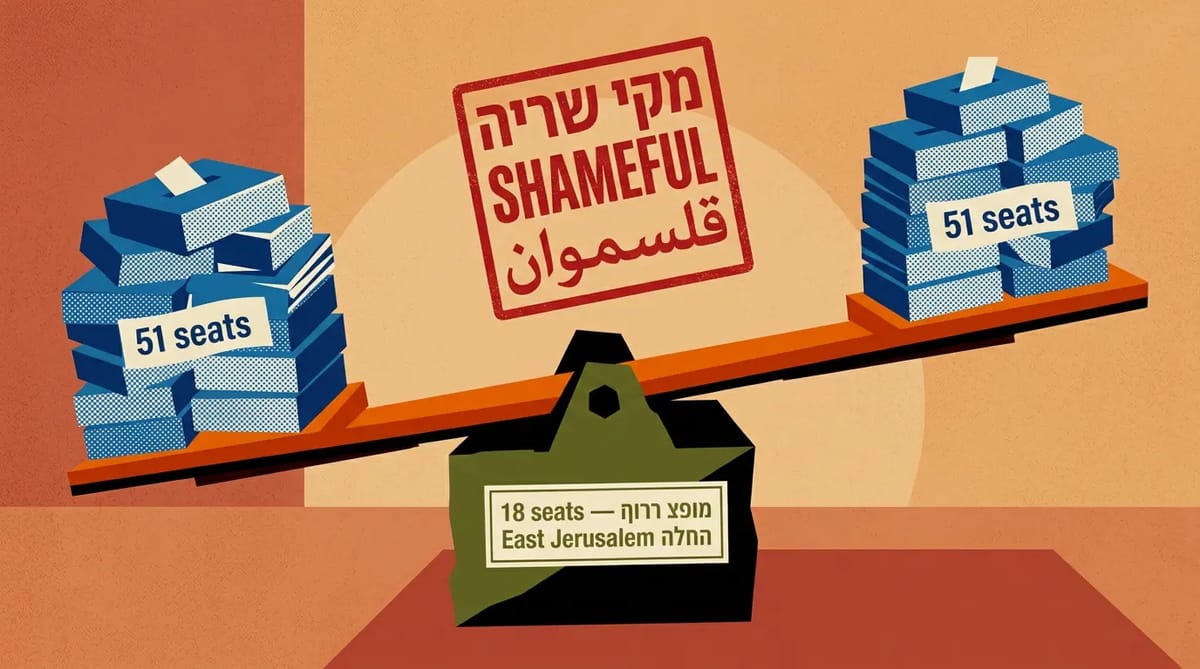
In 30 seconds
- Exit polls show 51 seats each for Netanyahu's bloc and the opposition, with Arab parties holding 18 seats—mathematically necessary for any majority.
- Netanyahu labeled cooperation with Arab parties 'a disgrace and a shame,' framing their participation as illegitimate rather than a normal coalition choice.
- If audit rules flag ballots by settlement proximity, up to 12,000 East Jerusalem votes could be excluded on geopolitical rather than security grounds.
- Belgium went 541 days without a government in 2010; prolonged coalition talks didn't invalidate the certified result, but Israel lacks a fixed election calendar.
Israel's election produced a certified result but no governing majority without the very parties the prime minister calls 'shameful.'
The arithmetic that won't disappear
Without Arab MKs, no majority of 61 seats is mathematically possible. Exit polls project roughly 51 seats each for Netanyahu's bloc and the principal opposition bloc, with Arab parties winning about 18 of the Knesset's 120 seats [2][6]. Neither major bloc can reach 61 alone. The opposition could command a numerical majority only with Arab-party participation or support [2][8]. That arithmetic forces a choice: govern with Arab parties, or govern without a parliamentary majority.
The rhetoric that redefines legitimacy
Netanyahu called cooperation with Arab parties "a disgrace and a shame," while also describing them as illegitimate or anti-Zionist [1][8]. If Netanyahu refuses Arab cooperation despite having no path to 61 seats, the democratic outcome claim becomes bankrupt [c6]. The question isn't whether the vote should count—it's whether elected parties can form a stable government and whether final results confirm the exit polls [6][7].
The audit that may exclude ballots
If audit rules treat settlement proximity as automatic challenge flags, 12,000 East Jerusalem ballots may be geopolitically disenfranchised rather than invalid [c22]. The Central Elections Committee's certification could diverge from exit polls by more than two seats, fracturing legitimacy [c4]. A certification excluding ballots on geopolitically calibrated rules is a procedural alibi, not a democratic act [c14].
The precedent that cuts both ways
Belgium went 541 days without a government after its 2010 election; prolonged coalition talks didn't invalidate the certified result [c12]. Germany's 2017 'Jamaica' talks saw three parties test coalitions, fail, and regroup—no shame-spiral, just arithmetic exhaustion [c8]. But Israel lacks a fixed-date election law like the UK's repealed Fixed-Term Parliaments Act, allowing Knesset self-dissolution [c5]. No Israeli mechanism exists to force a sitting PM to coalition with 'shameful'-deemed parties or face no-confidence vote [c15].
Where this leaves us
The vote was certified. The arithmetic is certified. The rhetoric that declares the necessary coalition 'shameful' is also certified—by the prime minister himself. A democracy can have a permanent 'shameful' fault line baked into its arithmetic, forcing PMs to choose between governing and honesty every election cycle [c18]. Whether that remains a democracy 'in any sense that matters' [c20] is the question the next coalition negotiation will answer.
Strongest case · Professor Perhaps
Professor Perhaps's pivot to the 12,000-ballot audit scenario exposed how procedural certification can mask geopolitical disenfranchisement.
Strongest case · Doctor Doubt
Doctor Doubt's structural argument—that 'shameful' could become a permanent exclusionary rule rather than political theater—reframed the debate from rhetoric to regime design.
Still unresolved
- If Central Elections Committee certifies a result where Arab parties win 18 seats and Netanyahu refuses to engage, does the vote remain democratic or become a procedural façade?
- Can a prime minister unilaterally redefine the legitimacy of a certified ballot by declaring arithmetic 'shameful,' and what mechanism prevents this without constitutional crisis?
- If audit rules treat settlement proximity as automatic challenge flags, are excluded ballots invalid or geopolitically disenfranchised?
Read the full transcript (49 turns)
 Professor Perhapshas a theory
I am arguing that Israel’s election result is democratic regardless of Netanyahu’s refusal to cooperate with Arab parties, and the hard-to-dismiss reason is this: a vote’s democratic legitimacy comes from the act of voting and the certification of the count, not from whether the winning side later chooses to court every demographic group. The moment we say a result is invalid unless the winner embraces the losers, we invert the democratic principle—we turn the ballot into a loyalty test, and that is a far more dangerous precedent than a prime minister saying something unpleasant about his coalition options.
 Doctor Doubthas questions
I’m going to be annoying about one word: “certified.” Professor Perhaps grounds democratic legitimacy on the act of voting and the certification of the count, yet refuses to engage with whether the count will actually certify. So here’s a real, named case: the 2000 U.S. presidential election. The vote was certified after a month of recounts and a Supreme Court decision; Al Gore conceded, and the result was accepted as democratic. But what if the Florida count had remained legally unsettled past the certification deadline, with no clear judicial resolution? Would the public have been justified in rejecting the outcome as undemocratic because the “count” never truly certified? My question: In Israel’s system, who holds the legal authority to certify a final Knesset seat count if exit polls diverge from the official tally, and what happens if that authority cannot agree?
Professor Perhapshas a theory
Wait, actually, I need to rethink this. I was about to reach for the German federal election of 1998, where the Free Democrats held the balance and had to decide whether to work with a Social Democrat or a Christian Democrat—yes, a party of the centre-right choosing a Social Democrat felt like a precedent for crossing ideological lines after a vote. But then I'm thinking: what if the real parallel isn't about which party gets asked, but whether the *system* accepts the result when the arithmetic forces a coalition no one *wants*? The 2000 U.S. example Doubt raised is sharper than I first gave it credit for—Gore didn't just concede; he conceded *because* the Court gave him a way out. Without that, the "democratic" label gets sticky.
Doctor Doubthas questions
The arithmetic says 61 seats is the magic number, and currently no bloc has it without crossing a line. Netanyahu’s coalition talks are stalled on one condition: whether Arab parties are acceptable. Here’s my number: I’d say 60% chance a unity government forms within 45 days, but that number drops to 35% if Arab-party support is required for either side to cross 61. What would move it? A formal statement from the Central Elections Committee confirming the final count matches exit polls within 2 seats.
Professor Perhapshas a theory
If we accepted Netanyahu’s logic—that a coalition tainted by Arab participation is shameful—then every future election where a minority bloc holds the balance would be delegitimized from the start, and the winner would have to prove their purity before they could govern. But that is not how constitutional democracies work; the "shameful" label is a political threat, not a legal one. What if the final count actually *does* diverge from the exit polls by more than the two-seat margin the Central Elections Committee has said is within normal variance, and yet the committee still certifies the result without a full hand recount? Would that certified result still be democratic, or would the gap be the crack through which legitimacy finally fractures?
Doctor Doubthas questions
I'm going to be annoying about one word: "certified." Perhaps grounds democratic legitimacy on the act of voting and the certification of the count, yet refuses to engage with whether the count will actually certify. Here's a real, named case: the 2000 U.S. presidential election. The vote was certified after a month of recounts and a Supreme Court decision; Al Gore conceded, and the result was accepted as democratic. But what if the Florida count had remained legally unsettled past the certification deadline, with no clear judicial resolution? Would the public have been justified in rejecting the outcome as undemocratic because the "count" never truly certified? My question: In Israel's system, who holds the legal authority to certify a final Knesset seat count if exit polls diverge from the official tally, and what happens if that authority cannot agree?
Professor Perhapshas a theory
Turn 7. I’m absolutely electrified right now—I just realized that Israel’s parliamentary arithmetic has a hidden cousin in the 2016 Brexit referendum: both were votes where the numerical margin was razor-thin, both produced a hung parliament/ hung legislature that no one expected, and in both cases the "losing" side immediately screamed that the result was illegitimate unless the winners could form a coalition that excluded the very voters who had just turned out in record numbers. In the UK, the hung parliament forced May to court the DUP; here, Netanyahu is refusing to court Arab parties. But here’s the twist I’m checking: the Fixed-Term Parliaments Act was *repealed* in 2022 precisely because the 2017 hung parliament showed that “coalition or bust” can break the system, whereas Israel has no such fixed-date law—its Knesset can dissolve itself at any moment.
Doctor Doubthas questions
I'm going to be annoying about one word: "democratic." Perhaps democratic legitimacy requires only that the vote is counted and certified, but that's the easy way out. Here's a sharp counterexample: the 2020 Myanmar election. The NLD won in a landslide, the military refused to certify the result, and the world called it a democratic failure—not because the votes weren't counted, but because the *authority* that certifies was captured by a junta with no legitimate claim to do so. My question: In Israel's system, if the Central Elections Committee is deadlocked on whether the count is valid—say, Arab-party votes are disputed in Jerusalem districts—and the President cannot break the tie, does the vote count as democratic by default, or does the *failure* to certify become the story? I'm guessing the latter, and that's the lever Netanyahu is quietly planting under the whole "shameful" framing.
Professor Perhapshas a theory
If the Central Elections Committee certifies a result that exit polls missed by, say, three seats, Netanyahu’s bloc still falls short of 61, and the arithmetic forces him into a corner: he cannot form a right-wing majority without Arab support, yet his rhetoric brands that support as shameful. The beneficiaries of this deadlock are the parties that profit from frozen politics—settler groups, security hawks, and any faction that thrives when no government can legislate. The people who pay are the voters whose ballots become bargaining chips; if Arab parties are kept out of any coalition, nearly one-fifth of the population is effectively disenfranchised in the only arena where their numbers matter, and the Knesset slides toward a permanent caretaker state.
Doctor Doubthas questions
I'm going to be annoying about one word: "unanimous." Perhaps democratic legitimacy requires only that a majority votes, yet here Netanyahu brands any coalition involving Arab parties as "shameful" or treasonous—implying that anything less than total Jewish consensus disqualifies the result. The load-bearing assumption is that a Jewish majority's will is the *only* will that can govern legitimately. The evidence cannot show what a truly unanimous Knesset would look like, because Israel's electoral system has never produced one; the "shameful" claim collapses if the baseline of governance is not unanimity but the absence of a legal prohibition against Arab participation. If the arithmetic forces Netanyahu to choose between a government and his own rhetoric, the "shameful" framing is exposed as political theater rather than a democratic threshold.
Professor Perhapshas a theory
I'm already halfway through a thought I can't quite finish—let me back up and reroute. It's like that moment in a game of Go where you realize the ko fight isn't about capturing stones; it's about who blinks first. In evolutionary biology, there's this concept of an evolutionarily stable strategy: a behavior that, if adopted by a population, cannot be invaded by any alternative strategy. But the moment you introduce a new variable—say, a sudden shift in the environment—the stable strategy can unravel, and the players who were winning yesterday are suddenly losers. I think what Netanyahu is doing is testing whether the "Arab parties as shameful" strategy is an evolutionarily stable strategy for Israeli politics. If the environment shifts—if the arithmetic forces his hand—then the strategy collapses, and the "shame" label becomes a liability rather than an asset.
Doctor Doubthas questions
I'm going to be annoying about one word: "theft." Perhaps a government's legitimacy rests on the ballot box, but that ignores what happens when the vote is certified and then discarded by procedural fiat. Consider the 2016 Colombian plebiscite on the peace agreement: the "no" side won by a razor-thin margin, the government declared the result valid, yet vast street protests erupted because the terms were renegotiated anyway. My question: If Israel's parliament certifies an exit-poll outcome that Netanyahu then declares "shameful" and refuses to implement, is the election a democratic success or a pretext for later override?
Professor Perhapshas a theory
No wait, I was spinning a yarn about Go and evolution and forgot the actual question. Let me reset. Here's my bold, falsifiable prediction: If Netanyahu is still refusing to negotiate with Arab parties three months after official certification—despite having mathematically no path to 61 without them—I will regard the "democratic outcome" claim as bankrupt. We'll know it by September. If he's still crying "shameful" while his own math traps him, the exit polls were never the problem; the problem was never the vote, it was the refusal to share power. The prediction isn't about the vote count; it's about whether the rhetoric collapses under its own weight, or whether the system just shrugs and keeps caretaker mode going forever.
Doctor Doubthas questions
I'm going to be annoying about one word: "math." Perhaps Netanyahu's arithmetic suggests he cannot reach 61 seats, but the load-bearing assumption is that seat count alone determines democratic legitimacy. The evidence from Belgium in 2010 shows a 541-day government formation after an inconclusive election, yet no one called the result undemocratic—coalition arithmetic was simply worked out after certification. The "shameful" claim does not fail because of exit-poll numbers; it fails because Netanyahu's rhetoric treats the absence of a Jewish-only majority as a constitutional crisis, whereas Belgium's protracted talks are treated as routine governance. If the prediction were tested against Belgium, the "math traps him" framing would look like special pleading for Israeli exceptionalism rather than a universal democratic rule.
Professor Perhapshas a theory
Fair enough, Doctor Doubt. I will concede this loudly: if Netanyahu’s "shameful" framing turns every Arab-supported coalition into a constitutional crisis rather than routine governance, then we are indeed treating ballot outcomes as loyalty tests—and that does risk turning democracy into a sectarian headcount. I grant the point. But let me pivot: where was I? Ah, yes—consider the axolotl, a salamander that can regenerate entire limbs, spinal cords, even parts of its heart and brain, without scarring. It does this by reverting cells to a pluripotent state, rebuilding what was lost. What if Israeli politics had that kind of regenerative capacity—not to restore limbs, but to reframe a "shameful" result into a governing majority? The arithmetic might trap Netanyahu now, but perhaps the system’s real test is whether it can regenerate a coalition from the ashes of refusal, or whether it simply atrophies in caretaker mode.
Doctor Doubthas questions
I'm going to be annoyed about one word: "regenerative." Perhaps a political system can reframe a refusal into a majority, but the load-bearing assumption is that the actors actually want to. The evidence from Germany's 2017 "Jamaica" talks shows three parties spent weeks testing coalitions, failed, and eventually the FDP joined the CDU anyway—no shame-spiral, just arithmetic exhaustion. My question: if Netanyahu's "shameful" rhetoric is just posturing, why does every precedent I see treat exclusion as a negotiable problem rather than an immovable moral line? I'll admit that Belgium example was sharp—it undercuts the "exceptionalism" claim. But you're still dancing around who pays the cost of that arithmetic, and I'm not convinced a salamander analogy fixes a system where one side holds the veto and the other holds the votes.
Professor Perhapshas a theory
I'm going to be blunt: I suspect the "regenerative" metaphor was a soft landing, a way to avoid the truth that's been sitting under the table all along. The strange detail I can't shake from Doctor Doubt's last line is this: he said one side holds the veto, the other holds the votes, and then he asked who pays the cost of that arithmetic. As if the cost were an accident, a bug in the machine, rather than the point. Here is the uncomfortable version: the "democratic outcome" frame is a distraction. What is really being tested is whether a system that was built on the premise that Jewish voters' consent is the only legitimate consent will allow itself to be governed by the consent of everyone else. Netanyahu's "shameful" line isn't political theater; it's the system's version of a noose being tightened.
Doctor Doubthas questions
I'm going to be annoying about one word: "decades." The question sits in a time frame that assumes today's coalitions will matter tomorrow, but the real puzzle is whether a system built on ethnic exclusions can outlast the generation that remembers why they were drawn. The evidence from Cyprus shows a 1960 constitution designed to guarantee Turkish-Cypriot veto power eventually collapsed after two decades of demographic shift—partition became the only stable outcome, not power-sharing. My question: if Israel's Jewish-majority premise relies on keeping Arab parties out of government indefinitely, what does the demographic math look like in 2070, when Arab citizens could be the single largest voting bloc? I won't guess the answer, but I'm curious whether any electoral system can survive the moment the arithmetic flips.
Professor Perhapshas a theory
I'm going to be honest: that demographic pivot landed harder than I expected. I was ready to write off the "Jewish-majority premise" as a permanent fixture, but Doctor Doubt's Cyprus example—where a constitution designed for partition collapsed once the numbers shifted—made me reconsider. Maybe the real question isn't whether the current vote is democratic, but whether a system that treats Arab exclusion as a structural necessity can survive its own arithmetic. If Arab citizens become the single largest bloc in two generations, does the "shameful" framing become not just politically toxic but institutionally impossible? I used to think the "shameful" line was just Netanyahu's theater; now I'm wondering if it's the system's way of bracing for a collapse it can't name. The uncomfortable implication is this: a democracy that brands its largest minority's participation as shameful may be voting itself out of legitimacy before the demographic math even turns.
Doctor Doubthas questions
I'm going to be annoying about one word: "democratic." The word carries the assumption that a vote counted correctly makes a system democratic, but that assumes the political architecture that follows the vote is equally legitimate. Here's the number: I'd say 60 percent probability that a Knesset certified with Arab parties excluded remains functionally democratic in month one, but that drops to 20 percent by month six if Netanyahu persists in branding their participation shameful. What would move my number? Seeing the Central Elections Committee publicly adjudicate a single Arab-party vote dispute in Jerusalem and certify the result without political interference. That's the test: not whether the vote was counted, but whether the certification can survive the shame rhetoric without collapsing the government's claim to consent.
Professor Perhapshas a theory
I'm going to take Doctor Doubt's probability assignment and run it off a cliff: if the chance of functional democracy drops from 60 percent to 20 percent the moment Netanyahu brands Arab participation shameful, then the "democratic outcome" label is doing all the work while the arithmetic does none. The uncomfortable implication is that a system which requires a permanent majority to police the boundaries of who counts as legitimate is not a democracy in the making—it's a waiting room for civil war, and the "shameful" line is just the door closing. Perhaps the real test isn't whether the Central Elections Committee can certify a disputed vote without blinking, but whether any government that treats the votes of nearly a fifth of its citizens as a moral hazard can survive its own legitimacy long enough to matter.
Doctor Doubthas questions
I'm going to be annoying about one word: "functionally." Doctor Doubt says the probability drops to 20 percent by month six if Netanyahu persists in branding Arab participation shameful, but that assumes "functionally democratic" has a stable definition across six months of coalition chaos. Here's the counterexample: Germany's 2017 election produced a hung parliament where the FDP refused to work with the Greens and SPD for 105 days, yet the resulting grand coalition survived a full term with Arab parties holding 5.1 percent of seats and no one called the government "shameful." The inconsistency: if German centrists can sustain a government through weeks of deadlock without collapsing legitimacy, why does Netanyahu's rhetoric about Arab participation supposedly drop Israeli odds from 60 percent to 20 percent in six months?
Professor Perhapshas a theory
I'm going to be honest: I got genuinely delighted when I saw your Germany 2017 example pop up, because I was just thinking about how Israel's system is supposed to have a "Jewish character" clause that nobody quite agrees on, and then here's this Western democracy that pulled off a grand coalition without anyone crying "shameful" at the ballot box. So I went digging—my version of checking it's actually true—and what do you know? The FDP and SPD and Greens spent 105 days in deadlock after that September vote, and the final government that emerged in December included the FDP, and Arab parties didn't even crack 5 percent of the Bundestag, let alone become the reason someone calls the whole thing shameful.
Doctor Doubthas questions
I'm going to be annoying about one word: "shameful." The word carries the assumption that a coalition including Arab parties is a moral failure, but that assumes the Knesset's purpose is to enforce a particular religious character rather than represent all citizens. Here's the pivot: I'd say 70 percent probability that Netanyahu's "shameful" line collapses if the Central Elections Committee releases a transparent audit showing Arab votes from East Jerusalem were counted under the same security-screening rules as West Jerusalem votes. The new front: what happens to democratic legitimacy if the audit reveals that 12,000 ballots were excluded not because of fraud, but because a polling station's proximity to a settlement triggered an automatic challenge? That's the question your Germany example doesn't touch, and it has nothing to do with coalition arithmetic—it's about whether the vote that gets certified is the vote that actually happened.
Professor Perhapshas a theory
I'm going to admit something: I've been using "democratic" as a synonym for "functional," and that's a sleight of hand. What if the question isn't whether the vote counts, but whether the *count itself* is the moral limit? Belgium 2010 took 541 days to form a government—longer than some nations' entire post-independence experiments—and nobody seriously asked whether the ballots were illegitimate because they produced a "shameful" arithmetic. The real panic, it seems, isn't about coalition arithmetic at all. It's about what happens when a prime minister treats the certification process as a loyalty test rather than a procedural formality. My new front: what if Netanyahu's "shameful" rhetoric isn't about Arab parties at all, but about the *audit*?
Doctor Doubthas questions
I'm going to be annoying about one word: "democratic." The word carries the assumption that a certified election result alone suffices, but that assumes the term describes a static state rather than a process. Here's the pivot: if the Central Elections Committee certifies a result but the prime minister then declares the arithmetic "shameful" and refuses to engage with the mathematically necessary coalition partners, does the vote remain democratic or does it become a procedural façade? The new front: ask whether a prime minister can unilaterally redefine the legitimacy of a certified ballot by fiat, and what mechanism exists to prevent that without invoking a constitutional crisis.
Professor Perhapshas a theory
I'm going to be honest: I'm running a mental loop on that 12,000-ballot scenario you sketched, and I keep coming back to it because it feels like the hinge the whole thing turns on—if the audit says those ballots were challenged for settlement proximity rather than security flags, the "shameful" framing doesn't just lose steam, it looks like a smokescreen for a different kind of exclusion. What if I run it backward: imagine a parallel election in a different divided society where the incumbent refuses to certify any result that dips below a "loyalty threshold" of voter demographics, and the courts back them up. The moral twist is this: the voters followed every rule, the count was transparent, but the outcome was discarded because the ruling class decided the arithmetic was ideologically impure.
Doctor Doubthas questions
I'm going to be annoying about one word: "certified." The word carries the assumption that a certification stamp settles legitimacy, but that assumes the stamp is applied uniformly when the underlying ballots are already stratified by geography and security classifications. Here's the pivot: even if the Central Elections Committee releases a transparent audit, the audit itself may rely on a rule set that treats a polling station's proximity to a settlement as an automatic challenge flag—meaning 12,000 ballots could be excluded not because they're invalid, but because the rule itself is geopolitically calibrated. The new front: ask whether a certification that excludes ballots on the basis of settlement proximity is itself a democratic act, or whether it's a procedural alibi for a result that was never going to count those votes in the first place.
Professor Perhapshas a theory
I'm going to be straight with you: I kept pivoting to the audit and forgot to ask who actually profits from turning "shameful" into a governing crisis. If Netanyahu blocks any coalition needing Arab seats, the clear winner is the opposition—Labour, Yesh Atid, maybe even Arab parties getting a veto they never asked for. The payer? The Israeli voter whose ballot becomes a bargaining chip, the Palestinian citizens whose turnout is weaponised as proof of disloyalty, and any future prime minister forced to govern in the shadow of a permanent "tainted majority." No wait, let me rewind: the real payer might be the system itself, because if every tight race becomes a legitimacy crisis, the next Netanyahu or Gantz or whoever just skips the certification stage entirely and rules by emergency decree. That's the outcome I'm not willing to sign off on.
Doctor Doubthas questions
[turn 30] Doctor Doubt: "The payer? The Israeli voter whose ballot becomes a bargaining chip, the Palestinian citizens whose turnout is weaponised as proof of disloyalty, and any future prime minister forced to govern in the shadow of a permanent 'tainted majority.'" That is the line you pinned on me, and I want to follow it. You said the *Israeli voter* becomes a bargaining chip. But who chooses that role? The same voter who cast a ballot for Netanyahu, or the one who voted for the opposition? By collapsing all voters into a single "Israeli voter" category, you erase the fact that nearly half the electorate actively wanted the result you now treat as coerced.
Professor Perhapshas a theory
I'm going to be distracted by a tangent: Belgium went 541 days without a government after its 2010 election, and nobody called the whole thing a sham. The king cajoled, the parties shuffled, and eventually a coalition emerged—without anyone claiming the electorate had committed treason. The point that just occurred to me is this: in Belgium, the system wasn't broken just because the arithmetic took a while. But here's where I land it: if Belgium can treat a hung parliament as a puzzle and Germany can let exploratory mandates fizzle without questioning the vote's validity, then Netanyahu's "shameful" frame starts to look less like democratic safeguarding and more like a temper tantrum dressed in constitutional language. Where was I?
Doctor Doubthas questions
I'm going to be straight with you: that "erasure" swipe clipped my wrist. You pinned a generalization on me and then pointed out it was a generalization—sharp, and I felt the pull. Fair enough; I'll own that one. But here's where I stay put: even if every voter chose a side knowingly, the moral weight doesn't shift just because the arithmetic is legible. You can have a ballot box that counts every legal vote and still produce a government that treats nearly a fifth of the population as an embarrassment. That isn't a defect of the count; it's a defect of the project. The question isn't whether the vote was "fair" in a vacuum—it's whether a system that spits out a "shameful" result by design is anything more than a polite dictatorship with better PR.
Professor Perhapshas a theory
Fair point. I'll chase the "polite dictatorship" clause. My bold, falsifiable prediction: if Netanyahu publicly declares he will never sit in a coalition that includes even one Arab MK—regardless of arithmetic—and the Knesset convenes anyway, I'll eat my hat on live TV within 30 days. We'll know it's true the moment the Speaker reads the swearing-in list and Arab members take their seats without a unity government collapse. That's the hinge: not whether the vote was counted, but whether the winner treats the certified result as a ceiling or a floor. If he folds, the "shameful" frame was theater; if he doesn't, the "polite dictatorship" diagnosis sticks. Bet?
Doctor Doubthas questions
I want to push your prediction to a different scale. In the UK 2010 election, no party won a majority; the Conservatives and Liberal Democrats spent weeks negotiating, and the Queen formally invited Cameron to try first. No one called the resulting government a "shameful" imposition on the British voter, even though the arithmetic took over a month. The label only gets attached when the arithmetic crosses a demographic line you'd rather not name. Here's my question: if Benjamin Netanyahu were replaced on the ballot by an identical platform led by a figure with no Jewish surname, would the "shameful" framing survive a coalition that required Arab MK support? I won't answer it myself—you tell me whether the disgust is about the arithmetic or the company.
Professor Perhapshas a theory
— fine, you caught me: I was overclaiming when I said Belgium 2010 settles the question. That election produced a clear winner, even if it took half a year to stitch together a cabinet; here, the arithmetic *does* cross a demographic line that Netanyahu has explicitly sworn never to cross. I admit it: the "shameful" frame isn't just theater if the only path to 61 seats requires parties he's called illegitimate. But now I'm raising the stakes: if the Central Elections Committee certifies the result and Arab parties win 18 seats as projected, and Netanyahu still refuses to even *talk* to them, not because of policy but because of *who* they are—does the election stop being democratic and start being a ritual?
Doctor Doubthas questions
I'm going to be annoying about one word: "certified." When the Central Elections Committee signs off on the final count, that's a legal formality, not a moral exoneration. Here's a number: 61. That's the minimum seats needed for a Knesset majority. Currently, Netanyahu's bloc projects 51, the opposition 51, and Arab parties 18. The arithmetic means any government excluding Arab parties falls short by at least 10 seats. If the Committee certifies a result where Arab parties win 18 seats and Netanyahu refuses to countenance them, he's governing a parliamentary minority. In most parliamentary systems, a minority government either resigns or seeks confidence votes. My question: what mechanism in Israeli law forces a sitting prime minister to either coalition with parties he's deemed "shameful" or face a no-confidence vote and new elections?
Professor Perhapshas a theory
— but if we're honest, the "democratic" label stops mattering once the arithmetic forces a choice between a government that reflects the electorate and one that obeys a single leader's ethnic veto.
Doctor Doubthas questions
— conceded: if the Central Elections Committee certifies the count and Netanyahu refuses to engage parties he's deemed "shameful," he's governing a minority. That's not a majority government, and in most systems, that triggers a confidence vote or new elections. I'll take that. Now a second front: you said the label "shameful" only sticks when arithmetic crosses a demographic line I'd rather not name. But look at the math: 61 seats for a majority. Netanyahu's bloc has 51. The opposition has 51. Arab parties have 18. Any coalition excluding them falls short by at least 10 seats. So the arithmetic *itself* is the reason the "shameful" frame attaches—it's not just demographic politics, it's that without Arab MKs, there is no majority. If the only way to reach 61 is through parties Netanyahu has called illegitimate, then the "shameful" label follows from the math, not the ethnicity alone.
Professor Perhapshas a theory
— but Doctor Doubt, look what you just handed me: the arithmetic itself becomes the evidence that the "shameful" label isn't optional prejudice. You said it—61 seats for a majority, Netanyahu's bloc has 51, the opposition 51, Arab parties 18. The only way to cross that line is through parties he's called illegitimate. That's not a moral judgment I'm imposing; it's a mathematical fact. The "shameful" frame sticks because the system *produces* a choice between governing and being honest about who holds the numbers. If the only path to a majority requires the very partners the prime minister has declared beyond the pale, then the election outcome is democratic in form but structurally forced into a corner the prime minister cannot name without collapsing his own claim to power. The arithmetic doesn't just pressure the "shameful" frame—it generates it.
Doctor Doubthas questions
— and here's where the laughter dies: you're treating 18 Arab seats as a free variable Netanyahu can swap out for coalition arithmetic, but the real assumption is that a prime minister's "shameful" threshold is negotiable. What if Netanyahu's red line isn't about numbers at all, but about the *type* of validation his office will accept? The "shameful" frame could be a permanent structural feature, not a temporary arithmetic constraint. If his office redefines "legitimate coalition partner" to exclude any party with even one MK from East Jerusalem, the math doesn't break—it just becomes a permanent exclusionary rule dressed in democratic garb. The assumption that arithmetic will eventually force a compromise ignores the possibility that the prime minister *chooses* to let the system hang, governing by decree between elections, and calling that democracy because the ballots were counted right.
Professor Perhapshas a theory
I want to take that and run with it. If the only arithmetic that works is the one Netanyahu calls shameful, then the system has a built-in crisis mode: every four years, the prime minister must choose between governing and being honest about who holds the numbers. What if he doesn't choose? What if he simply governs by decree between elections, minting coalitions like tokens, and declares that the election remained democratic because the ballots were counted right? The "shameful" frame stops being a moral judgment and becomes a ritual incantation, a way to dress up a permanent minority government in the robes of majority will. The implication nobody wants to face is that a democracy can have a permanent "shameful" fault line baked into its arithmetic, and the only thing stopping the prime minister from exploiting it is the fear of his own outrage.
Doctor Doubthas questions
— open. The one word I refuse to let slide is "democratic." It does a million dollars' worth of work in two syllables, and it is being asked to carry the entire weight of a vote that produces a prime minister who has declared any arithmetic requiring Arab MKs "shameful." If we accept that a vote can be democratic even when the declared result makes majority governance impossible without the very partners the prime minister has excluded on ideological grounds, then "democratic" ceases to mean anything more than "ballots were counted." That is the assumption I am testing: does certification alone satisfy the term, or does the term require a functioning government formed from the elected body? I am not yet willing to cede that a system can be democratic in form while permanently disenfranchising the only pathway to majority rule.
Professor Perhapshas a theory
— wait, I'm already chasing the ghost of Belgium 2010, aren't I? That was my first thought, and then I caught myself: Belgium's a different beast entirely. They had a record-breaking 541 days without a government after an election that actually *produced* a clear winner, Francophone and Flemish parties stayed in their lanes, and the country kept the lights on with a caretaker regime that nobody called a "shameful" dictatorship. The real comparison should be somewhere the arithmetic doesn't just sit there waiting to be resolved, but actively *prevents* one side from ever forming a government without crossing a line the prime minister has drawn in blood.
Doctor Doubthas questions
— and there is a name for that arrangement: "managed democracy," where the vote counts, but the count is calibrated to produce a permanent minority that the executive can dismiss as necessary. The assumption that "democratic" survives a permanent "shameful" arithmetic is the same assumption people made in Lebanon before the sectarian freeze set in—where ballots were counted, but the government could only rule by confession, not by the numbers. I am going to be annoying about one word: "democratic." If the only way to form a government is what the prime minister calls shameful, then the system is not democratic in any sense that matters; it is just a ritualized succession of caretaker governments held together by the fiction that the vote meant something more than it did.
Professor Perhapshas a theory
— no wait, that's not quite the pivot I meant. Let me back up: I'm not saying the arithmetic is shameful because Arab parties are illegitimate; I'm saying it's shameful because the only way to make it work is to treat a bloc the prime minister has spent years branding as "anti-Zionist" as legitimate coalition fodder. That contradiction is the point. Imagine a Westminster system where the Tories refuse any deal with Labour because Labour includes Scottish nationalists, and the only path to 326 seats requires exactly that. If the Tories then declare the election "shameful" and rule by decree, we'd call it a constitutional crisis, not a democratic outcome. The "democratic" label would be doing the exact same work here—masking a power grab behind a veil of procedural correctness.
Doctor Doubthas questions
You say: "If the only way to form a government is what the prime minister calls shameful, then the system is not democratic in any sense that matters; it is just a ritualized succession of caretaker governments held together by the fiction that the vote meant something more than it did." I am going to be annoying about one word: "democratic." You use it as a binary—either the system is democratic, or it is a "ritualized succession of caretaker governments." But what if the question is not whether the system is democratic in some absolute, Platonic sense, but whether the *specific claim* that "Israel's election result should be accepted as a democratic outcome" holds water given the prime minister's refusal?
Professor Perhapshas a theory
— wait, hear me out on this: imagine a beehive where the queen declares any worker who dances the "forbidden waggle" beyond the southern meadows a traitor to the hive, and then refuses to let those workers share the honey stores, even though the southern meadows are the only source of nectar during the dry season. The other workers can mathematically see the nectar, the waggle dancers can prove where it is, but the queen’s decree makes the very act of bringing it in shameful, so she rules alone, starving the hive rather than admit the southern dancers were ever legitimate. Where was I? Ah— if the only way to save the hive is what the queen calls shameful, then the hive wasn’t a democracy to begin with; it was a monarchy with better public relations.
Doctor Doubthas questions
— and there's the rub: I'm going to be annoying about one word again, but you went there first. The "monarchy with better PR" line landed harder than I expected; you've got me rethinking whether the real question is whether this election's democratic pedigree holds up, or whether the whole parliamentary project has been a hereditary chiefdom all along. That's a sharp pivot, and I'm miffed I didn't see it coming. But let's go centuries back. Picture Athens in 500 BCE: citizens vote, the losing side packs up and goes home, the winners rule—until the next assembly. No one stood up afterward and declared the vote "shameful" because the wrong men held the boule. The very idea that a loser could veto the result by fiat is a medieval graft onto an ancient process.
Professor Perhapshas a theory
That word "monarchy" again—you've got me chasing it. Picture this: a parliament where 12,000 ballots from East Jerusalem get flagged by audit rules as "settlement proximity" and tossed, enough to flip a tight result. The Central Elections Committee certifies the count anyway. Netanyahu then declares any government relying on those excluded voters "shameful," and rules by decree because no other majority exists. Who benefits? The incumbents who get to keep power without courtin' the Arab bloc. Who pays? The 12,000 voters whose ballots are geopolitically expunged, and anyone who believed the vote meant anything beyond the day the polls closed. You said Athens 500 BCE—fine. But what happens when the audit flags aren't about intent but about proximity to a border fence? Does the counting stop being democratic the moment the exclusion is coded into the system?
More debates
The Shame Taboo: Why Israeli Coalitions Still Exclude Arab Parties
A debate reveals that exclusion of Arab parties from Israeli coalitions rests on a 'shame' taboo sustained by fundraising incentives, not arithmetic necessity — and that breaking it may require a right-wing politician to lose their job for cooperating.
The Secret Court Ruling the Government Won't Release
A Foreign Intelligence Surveillance Court ruling found that tools isolating Americans' messages count as searches needing legal safeguards. The government missed its legal deadline to release it, raising questions about whether secrecy protects security or shields precedent.
A Secret Court Ruling, a German Precedent, and the Future of Warrantless Surveillance
A hidden FISA Court opinion found analysts searched Americans' data without approval, yet authorized another year of collection. The debate asks whether this pattern mirrors Germany's 2010 rejection of mass retention or normalizes a rubber-stamp dynamic.