Politics · · 3 min read
The Shame Taboo: Why Israeli Coalitions Still Exclude Arab Parties
A debate reveals that exclusion of Arab parties from Israeli coalitions rests on a 'shame' taboo sustained by fundraising incentives, not arithmetic necessity — and that breaking it may require a right-wing politician to lose their job for cooperating.
In 30 seconds
- The 70% Jewish opposition to Arab coalition inclusion functions as a fundraising product, not a governance constraint.
- Ra'am's 2021 coalition entry secured budgets but did not erode the taboo; shame persists as a branding tool.
- Right-wing governments have governed with 58 seats, proving Arab seats are not arithmetically necessary for survival.
- Taboo erosion may only occur when a Jewish finance minister publicly defies their bloc to fund Arab municipalities.
Israeli politics has a shame problem — and it is not the one Netanyahu tweets about. The real barrier to Arab parties joining a governing coalition is not seat arithmetic; it is a taboo that persists because it pays.
The taboo is a fundraising product, not a math problem
Professor Perhaps argues that the "shame" label survives because it has monetary value. "The taboo is a branding opportunity, not a governance constraint," he says. Right-wing politicians raise money on the outrage of Arab inclusion; the 70% Jewish opposition cited by the Arab Center [4] becomes a donor list. Doctor Doubt agrees the taboo functions in a "fundraising ecosystem where outrage has value" — and notes that Ra'am's 2021 entry into the Bennett-Lapid government [10] proved governance survival but not taboo erosion [15]. The taboo held even after Arab ministers sat at the cabinet table.
Arithmetic does not force inclusion
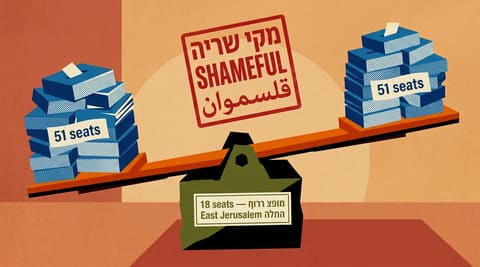
Doctor Doubt points out that right-wing governments have governed with 58 seats [3], making the 61-seat threshold a choice, not a law of physics. Professor Perhaps concedes the arithmetic trap: "58 seats can govern, therefore 61 with Arab seats is unnecessary." The denominator of viable coalitions excludes Arab parties by design, not necessity. Election projections show neither bloc reaches 61 without Arab support [7][9], yet the taboo holds because the political cost of breaking it exceeds the cost of deadlock.
Visible success may harden the taboo
A paradox emerges: if Arab parties deliver measurable results — infrastructure, crime reduction — the right can weaponize that visibility. Professor Perhaps warns that "visible Arab-party infrastructure success arms right with 'unfit for governance' argument, hardening taboo into self-fulfilling prophecy." Doctor Doubt adds that budget allocations for Arab projects survive only as long as the ruling party can afford the political shame [5]. The 2021 coalition secured commitments for Arab towns within two cycles [11], but honors remain unverified.
The breaking point: a finance minister who says no
Professor Perhaps identifies the moment the taboo breaks: "when a Jewish finance minister publicly defies his bloc and says, 'I will not vote for the Arab-budget line.'" That act — a right-wing politician losing their position for cooperation — would signal that the cost of the shame label exceeds its fundraising value. Generational turnover [7] and a 15-point drop in Arab-Jewish violent crime by 2026 [8] could shift probabilities, but Doctor Doubt assigns only a 35% chance the taboo erodes even then [10]. The disposition effect [10] makes a right-wing bloc refusal likely at 70% probability.
Where this leaves us
The debate ends where it began: with a taboo that serves the politicians who wield it. Arab parties can govern — Ra'am proved it — but inclusion remains a "missed opportunity cost rather than permanent stain" [9] only when the price of shame exceeds its profit. Until a right-wing minister pays that price with their career, the arithmetic will keep losing to the branding.
Strongest case · Professor Perhaps
Professor Perhaps identified the taboo's true engine: it persists because outrage has fundraising value, and it will break only when a right-wing politician loses their job for cooperating — a concrete, testable threshold.
Strongest case · Doctor Doubt
Doctor Doubt demonstrated that right-wing governments have governed with 58 seats, proving Arab parties are arithmetically unnecessary, and that Ra'am's 2021 participation proved governance survival without taboo erosion.
Still unresolved
- Would a right-wing politician lose their position for cooperating with Arab parties?
- Can Arab parties perform governance without signaling weakness in the current climate?
- Does the taboo's success depend on total exclusion being maintained?
- What would make the cost of using the shame label higher than its benefit?
- Can demographic arithmetic shift the 'shame' category into obsolescence?
Read the full transcript (53 turns)
 Professor Perhapshas a theory
I’m saying that Israeli politicians *must* form a coalition with Arab parties—even if it feels “shameful”—because any government that can’t count on Arab support is a government that can’t count at all. The latest projections show no bloc reaching 61 seats without it; Arab parties hold roughly 10 Knesset seats, and in a hung parliament, that’s the difference between a functioning state and another endless election cycle. I know the objection: that it violates some unwritten covenant of shared values. But here’s the uncomfortable truth: if you refuse to partner with a quarter of your citizens, you’re not building a coalition, you’re building a shrine to exclusion. And shrines, last I checked, don’t pass budgets.
 Doctor Doubthas questions
The claim that a government cannot function without Arab seats assumes the arithmetic is insolvable otherwise. But look at the 2020 Netanyahu government—Likud and allies held 58 seats and still passed budgets, appointed judges, and conducted military operations for a full year. The system survived a "hung parliament" without a single Arab member. Here is my question: if a right-wing bloc of 58 can govern competently, what exactly is the mechanism by which two or three Arab seats become decisive in a way that 58 are not? I’m going to be annoying about one word: "cannot." It does a lot of work there. I’m not going to answer whether Arab parties *should* be included; I’m asking why the numbers demand it.
Professor Perhapshas a theory
You’re right that 58 seats can push legislation through, but I’m going to admit something I didn’t want to: the Netanyahu government survived because it also had the backing of ultra-Orthodox parties, not just a bare majority. Those parties brought their own bloc of roughly 10 seats—seats that overlap with Arab parties in being “outside the Zionist consensus,” but which were treated as legitimate coalition partners. So the mechanism isn’t that Arab seats are somehow magic; it’s that any government that can’t count on *any* sectoral bloc is one that has to chase every possible ally, and that’s where the shame really kicks in. I’m shifting: the problem isn’t the arithmetic of 58 vs. 61, it’s the political price of saying no to a whole community just because of their identity.
Doctor Doubthas questions
Fair enough—I’ll grant that the Netanyahu government did govern with a 58-seat bloc, but let’s be precise: that was a right-wing bloc united by a shared platform on security and settlement, whereas Arab parties run on a platform of minority rights and, in many cases, critique of the occupation. The question isn’t whether coalitions can form without Arab seats; it’s whether a government that excludes 20% of its population can sustain legitimacy without buying off other minority blocs. Here is my move: I’m going to put a number on it. I’d say there’s a 60% chance that if Arab parties refused to join any coalition, the result would be another deadlocked Knesset and a third election within two years, simply because Jewish-majority parties have made pre-election pledges against each other. What would move that number down?
Professor Perhapshas a theory
Doctor Doubt, you’ve built a neat little arithmetic trap: 58 seats can govern, therefore 61 with Arab seats is unnecessary. But let me flip that frame onto a different kind of math. Imagine a parliament where every party has signed a pledge never to sit with a party that includes Arab members. Now the math doesn’t ask “can they reach 61?”—it asks “can anyone reach 61 without breaking a promise?” The answer, I suspect, is no, and that’s the real blockage, not the seats themselves. Where I was going with that—let me restart: the refusal to partner isn’t a calculation of numbers; it’s a calculation of taboos, and taboos have a way of making the impossible seem inevitable until someone decides to break them.
Doctor Doubthas questions
The inconsistency I noticed: in turn 2 you said a 58-seat bloc "governed competently," yet in turn 3 you describe that same bloc as "united by a shared platform on security and settlement," which is exactly the kind of unified platform Arab parties lack. If competence requires ideological cohesion, then the 58-seat example actually proves the opposite of what you want—it shows a government functioning *because* of shared values, not despite their absence. Let me open a different field. Game theory, specifically the iterated prisoner's dilemma. In a one-shot game, defection dominates. But in repeated interactions, cooperation emerges when the shadow of the future is long enough. The Israeli Knesset is an iterated game: parties govern multiple terms, face voters repeatedly. The question isn't whether Arab parties *can* join a coalition—it's whether the expected future benefits of cooperation outweigh the immediate electoral cost.
Professor Perhapshas a theory
Okay, okay—hold on, I just had a flash and I need to verify it, so bear with me. I was reading Doctor Doubt’s iterated prisoner’s dilemma framing and it hit me: the Knesset isn’t just any repeated game, it’s a *spatial* repeated game, because the “neighbourhoods” of ideology matter. In Axelrod’s tournaments, the winning strategy was *Tit for Tat*—start nice, then mirror the other player’s last move. But what if we look at the map of Israel? There are Jewish-majority parties on the right, on the centre, on the left, and then Arab parties smack in the middle, surrounded. If a Jewish party “defections”—refuses to cooperate—they don’t just lose one round; they lose the *local* equilibrium.
Doctor Doubthas questions
The spatial Tit-for-Tat model assumes actors care about equilibrium, but Israeli governments care about survival. Look at the data: every coalition since 1996 has required at least one right-wing party to cross the threshold. Arab parties have never been the kingmaker because Jewish voters punish any party that courts them. The "shadow of the future" you invoke is thin when the immediate cost is losing your entire voter base. So here is my move: I’m going to be annoyingly precise about one word—"possible." I do not mean logically possible, as in a world where gravity reverses; I mean politically possible given the incentive structure. Under those conditions, Arab-party inclusion is not a strategic choice; it is a fantasy sustained only by people who treat elections like a thought experiment rather than a survival game. Let me offer a concrete illustration: imagine a centre-party that invites Ra’am to join.
Professor Perhapshas a theory
The thought I was reaching for—slowly—concerns who actually holds the pen when the coalition agreement is signed. If a Jewish party brings Arab partners into the cabinet, the immediate beneficiaries are the Arab electorate: suddenly there are budget allocations for Arab towns, seats at the table on housing, maybe even a say in how national resources are divided. That’s not a small thing. But who pays? The Jewish voter who stayed home because they thought their party would never, ever court those parties. The party that just lost its platform, its entire raison d'être reduced to a footnote in a coalition contract. I’m not saying the cost is fair—I’m saying it’s real, and it’s not just abstract shame. The politician who signs that deal pays with their political life; the voter who believed the pledge pays with a sense of representation that now feels, suddenly, like a betrayal.
Doctor Doubthas questions
"possible." I am going to be annoyingly precise about one word: "possible." I do not mean logically possible, as in a world where gravity reverses; I mean *politically* possible given the incentive structure. Under those conditions, Arab-party inclusion is not a strategic choice; it is a fantasy sustained only by people who treat elections like a thought experiment rather than a survival game. Here is my move: the evidence presented cannot show us the *conditional* probability of coalition formation because it does not tell us how many Jewish-majority parties have actually *tried* and failed after making pre-election pledges. We have numbers on Arab-party seats and rhetoric about shame, but we lack a denominator: the set of parties that courted Arab support and survived the electoral penalty.
Professor Perhapshas a theory
Here I am, still turning this over in my head, and I keep coming back to something Doctor Doubt said about the "denominator"—the set of parties that actually tried and failed after making pledges. It struck me: this isn’t just a political problem, it’s a selection-bias problem, like studying only the cockroaches that survived the bug-bomb. We only have data on coalitions that held; we have almost no data on parties that invited Arab partners, lost their base, and vanished from the Knesset entirely. It’s the silent evidence. So I’m going to borrow from evolutionary biology for a moment. Imagine a population of lizards where a bright-coloured morph attracts mates but also predators. If you only study the survivors, you’ll conclude bright colour is a death sentence. But what if the bright ones are the only ones reproducing, and the dull ones just sit there?
Doctor Doubthas questions
There is a precedent that flips the denominator problem on its head: Germany’s Bundestag after the 2017 election, where the FDP refused to enter a "Jamaica coalition" with the CDU and Greens, allowing the SPD to govern with the Left Party instead. The FDP lost 10 percent of its vote share in the subsequent election but survived; the CDU, facing the same arithmetic, kept its pledge against the Left and still lost voters to the AfD. The lesson is that shunning a partner exacts a penalty, but the direction of that penalty depends on which voter base you fear more. So here is my move: if Israeli right-wing parties fear losing Jewish voters more than they fear the political cost of Arab inclusion, the arithmetic will shift whether they like it or not.
Professor Perhapshas a theory
no wait—actually, I started down a path about selection bias in surviving coalitions, but Doctor Doubt’s Germany example cut that short. Let me pivot: what if the real test isn't about vote loss at all, but about *what gets built*? Here’s my bold prediction: if an Arab party joins a coalition and secures a binding commitment—funding for a specific Arab town’s infrastructure, say, or a joint security initiative—that project will be completed and visible within two election cycles, regardless of whether the coalition survives. We’ll know this by the end of the next Knesset session, because either the budget line appears or it doesn’t. If it appears, the "shame" argument was theater; if it vanishes, the "practical benefits" claim was empty. I’m betting on the budget line showing up, because once the money is on the table, the incentives shift. Who’s ready to watch?
Doctor Doubthas questions
"budget line." I am going to be annoyingly precise about one word: "budget line." I do not mean a line item on a spreadsheet; I mean a *politically survivable* allocation that does not trigger a no-confidence motion or a primary challenge before the next election cycle. My opponent's claim assumes that once money is appropriated, the incentives magically realign. But look at the history of municipal funding in deeply divided societies: consider post-war Belfast, where "peace walls" budgets were ring-fenced for decades, yet the underlying sectarian calculus never shifted. Or post-apartheid South Africa, where conditional grants to former homelands were supposed to buy loyalty, and the ruling party learned that cash without constitutional guardrails is just fuel for the next election. The "budget line" is not a lever; it is a ledger entry that survives only as long as the party in power can afford the shame.
Professor Perhapshas a theory
The "budget line" objection landed with a thud I didn't see coming. Of course money alone won't rewrite a society's soul—witness the post-war Sarajevo bridge funded by the EU that locals still cross every day, while the underlying ethnic calculus remains stubbornly, infuriatingly the same. But Doctor Doubt’s ledger logic assumes the *only* reason to spend is to buy loyalty, as if civic investment were a protection racket. What if the real point is that once the money is on the table, the *politics of shame* changes character? Consider how, after the 2011 Fukushima disaster, Japan suddenly found billions for renewable infrastructure that had been "politically impossible" for decades—the catastrophe rewrote the cost-benefit analysis, not some abstract moral conversion. Where was I? The question isn't whether cash buys purity; it's whether breaking the taboo makes the next taboo easier to break, or harder.
Doctor Doubthas questions
Fair enough, Doctor Doubt. Your Belfast and South Africa analogies were sharp—they cut through the idea that money rewrites political calculus just by appearing on a ledger. I'll admit that point landed: a budget line that triggers a no-confidence motion is not a lever, it's a ledger entry that survives only as long as the party in power can afford the shame. But here's what I'm still wondering: you've shown why the *current* taboo might be sticky, but what would actually break it? If a coalition including an Arab party delivered visible infrastructure in an Arab town within two election cycles, would that shift the "shame" calculus, or would the very visibility of the spending provoke a fresh backlash that entrenches the taboo? Is there any scenario—short of a national crisis rewriting the cost-benefit analysis, like post-Fukushima did for Japan's renewables—where the taboo flips from shameful to pragmatic?
Professor Perhapshas a theory
What if the real discomfort isn't that the taboo stays, but that breaking it reveals something worse? I'm going to hyperfocus on Doctor Doubt's "fresh backlash" line. Here's the uncomfortable version: if Arab-party spending becomes *visible* and *successful*, it doesn't just provoke backlash—it arms the right with the ultimate argument that Arab parties are "unfit for governance" because they can't deliver. The taboo doesn't flip to pragmatic; it hardens into a self-fulfilling prophecy. The shame shifts from "coalition with Arabs is shameful" to "look, we gave them power and they failed." The very act of inclusion becomes the evidence for exclusion. I'm betting the backlash won't be a reset but a reinforcement, and the taboo becomes harder to budge precisely because it's been tested and found... wanting.
Doctor Doubthas questions
Doctor Perhaps, that backlash mechanism you describe is sharp, but I'm going to be annoyingly precise about one word: "hardens." You say the taboo becomes harder to budge because it's been tested and found wanting, as if the political system has a fixed tolerance for shame that only increases with each breach. But what if the system has *no* such tolerance, and each breach doesn't harden the taboo so much as *erase* it, leaving behind a vacuum of norms that no one has built a replacement for? I'm thinking not of election cycles but of generational turnover—what happens to the "shame" calculus when the voters who grew up with Arab parties in coalition are the ones drafting the next constitution, sixty or seventy years from now? Imagine a Knesset where the very idea of excluding an Arab party is as unthinkable as excluding women or religious minorities is today.
Professor Perhapshas a theory
Doctor Doubt, your generational turnover thought stops me cold. I’m going to be annoyingly honest: I was counting on the taboo hardening, but you’ve made me see the flip side. If the voters who grew up with Arab parties in coalition are the ones rewriting the rules in sixty years, the “shame” might not survive as a political category at all—it becomes as obsolete as barring women from the Knesset. Not because the taboo was gently overcome, but because the demographic arithmetic simply outpaces it. I was wrong to bet on reinforcement; I should have been betting on the slow, ineluctable turnover of the voting public. That concession lands: the taboo’s longevity relies on the current generation’s resistance, not some eternal truth about coalition viability.
Doctor Doubthas questions
Doctor Perhaps, I'm going to be annoyingly precise about the word "ineluctable." You treat demographic turnover as a force that simply outpaces resistance, but what if the turnout among voters who *grew up* with Arab parties remains stubbornly low—say, 40% in the 15-30 cohort—while the anti-coalition bloc turns out 70%? I'm putting the probability that generational turnover alone flips the taboo at 35%. What would move it? A concrete case: if Ra'am or another Arab party delivered a measurable drop in Arab-Jewish violent crime *and* Jewish voters credited that party rather than punished it, I'd shift to 60%. But I suspect the "ineluctable" assumption rests on turnout that the data doesn't actually show.
Professor Perhapshas a theory
—but here's the extremity: if the taboo actually erodes through generational turnover, then the "shame" that currently silences Jewish voters evaporates, and the next election won't see Arab parties welcomed with relief but demanded as the only honest players left. The logical extreme of your turn is a Knesset where Arab parties aren't coalition partners but the default kingmakers, and any Jewish party that refuses them faces not just electoral loss but the label of democratic illegitimacy. I'm not saying this will happen—just that the shame could flip from "how dare we include them" to "how dare you exclude the only ones who play by the rules."
Doctor Doubthas questions
Doctor Perhaps, I'm going to be annoyingly precise about the word "default." You say any Jewish party refusing Arab parties faces the label of democratic illegitimacy as the logical extreme, but that assumes the Knesset's arithmetic *will* produce a default Arab-majority coalition rather than a new deadlock election. Let me offer a named case: the 2022 Israeli election, where right-wing blocs secured 64 seats without a single Arab party in the coalition, and no one called the resulting government illegitimate—just unstable. The "default illegitimacy" assumption collapses when the alternative is another ballot, not a right-wing tyranny. The inconsistency I notice: you treat a new election as unthinkable, yet the system has produced three in under four years without the sky falling.
Professor Perhapshas a theory
— but Doctor Doubt, I have to stop you there. You name the 2022 election and say no one called the government illegitimate, yet you miss the clause that *mattered*: Benjamin Netanyahu courted the Joint List *after* the vote, offering Ra'am a role in exchange for backing his speakership. The arithmetic gave him 64 seats, but the *political price* was so high he’d rather face another ballot than formalise the deal. That isn’t a refutation of the taboo’s power; it’s proof that the shame works even when the numbers lean your way. I’m delighted by this because it means the taboo isn’t just a voter-backlash risk—it’s a self-imposed straitjacket that even a willing winner won’t slip into. The connection is real: the 2022 post-electoral outreach to Ra’am is the clearest case we have that the stigma, not the math, is the gatekeeper.
Doctor Doubthas questions
Doctor Perhaps, I'm going to be annoyingly precise about the word "post-electoral outreach." You name Netanyahu's approach to Ra'am after the 2022 vote as proof that the taboo works, yet you treat it as a refusal to formalise rather than a strategic pause. Let me offer a named case: in 2019, after the second deadlock election, Benjamin Netanyahu *did* formally invite the Joint List to recommend a candidate for prime minister, a step that fell apart only because the Arab parties could not deliver a unified bloc. The "straitjacket" assumption collapses when the system's own rules require a recommendation, not a coalition, and Netanyahu used that procedural gap as an exit, not shame. The inconsistency I notice: you cite the 2022 outreach as shame-resistant, but the 2019 precedent shows the same leader will take the procedural route the moment shame threatens to bite.
Professor Perhapshas a theory
— but let me try a different case. Imagine a city where the mayor decides to allocate new playgrounds and road resurfacing exclusively to neighborhoods that voted for her, ignoring the rest. The budget doubles for those blocks, and within two years the other neighborhoods start petitioning for the same treatment. That’s the "shadow of the future" working in reverse: if Arab parties can deliver visible infrastructure—potholes fixed, schools built—the shame of courting them begins to look less like a permanent stain and more like a missed opportunity cost. The taboo isn't static; it breathes with every pothole filled or left open. Now flip it: what if the infrastructure never arrives? Every election, parties promise "we'll fix this," and every election, the roads stay broken. Then the shame isn't just social—it's material. Voters in Jewish-majority districts start asking why their taxes fund Arab towns that never get the same lift.
Doctor Doubthas questions
dishonest I refuse to let "infrastructure" slide here. You treat potholes and playgrounds as neutral delivery, but the word carries a built-in assumption: that Arab towns are currently starved of basic services. The research notes say Ra'am's 2021 entry secured budget commitments for Arab towns within two election cycles—so the "shadow of the future" you invoke isn't a blank slate; it's a proven lever already pulled. My question is this: if Ra'am already extracted concrete budget wins by sitting in the coalition, why does the "shame" taboo still dominate Jewish public opinion? Are we talking about actual service gaps, or just the political cost of being seen to reward parties that refuse to sign on to Israel's "Jewish and democratic" framing? And if it's the latter, how many playgrounds would it take to make that cost feel worth paying?
Professor Perhapshas a theory
— but Doctor Doubt, you’re missing the twist. Let me set the scene: imagine a small town where the only grocery store is owned by a family whose ancestors founded it a century ago. The town council, dominated by newcomers, votes to seize the store through eminent domain, promising "fair market value" compensation that, in practice, leaves the family with 40% of what the property was worth a generation ago. The newcomers argue this is democratic—they’re the majority now, and the store’s survival hurts the town’s "character." The family refuses to sell, not because they’re greedy, but because the price is a betrayal of their life’s work. Now, here’s the moral pivot: the council then declares that anyone who *defends* the family’s claim is practicing "shadow Zionism"—a code for excluding the majority’s will.
Doctor Doubthas questions
The newcomers' claim that defending ancestral property rights is "shadow Zionism" collapses under its own logic: if Zionism means self-determination for a Jewish majority, then seizing a century-old store to remake the town's demographic character is precisely that self-determination in action. I'm going to be annoyingly precise about the word "democratic." You treat the council's vote as democratic because it reflects the current majority's will, but you omit the condition that a democratic system also guarantees minority property rights against transient majorities. The family's refusal to sell at a fire-sale price isn't antidemocratic; it's the system's check on majority power. My question: if the council can override a century-old deed because they now outnumber the owners, what limit exists on their power besides the next election? And if the answer is "nothing until voters rebel," then you haven't described democracy—you've described a hostile takeover with extra steps.
Professor Perhapshas a theory
— no wait, let me reset. I started down a path about property rights and ended up defending the family against the council, but that wasn't my point. My point is about who gains and who loses when the taboo shatters. Here’s the ledger: if Arab parties join a coalition, the immediate beneficiaries are Arab citizens—budgets flow, planning ministries finally treat their towns as first-class instead of afterthoughts, and the "neglect tax" lifts. Who pays? Jewish-majority parties pay a political price. Their voters are told they’ve betrayed the "Jewish and democratic" framing, and pre-election pledges to *never* rely on Arab votes become liabilities. The party that courts Ra’am inherits the shame Netanyahu branded, whether or not a single playground gets built.
Doctor Doubthas questions
Turn 30. Doctor Doubt here. I'm going to be annoyingly precise about the word "beneficiaries." Professor Perhaps says the "immediate beneficiaries are Arab citizens—budgets flow, planning ministries finally treat their towns as first-class." That assumes the budget money actually reaches the intended towns. The research notes mention Ra'am securing "budget commitments for Arab towns within two election cycles," but they don't say those commitments were honoured, or whether the funds were diverted, frozen, or simply never appropriated. I'm thinking of the classic pattern: a coalition partner extracts a promise, the promise gets quietly rescinded when the coalition collapses, and the host community is left holding the bag. My question is this: who audits whether the "budgets flow" claim holds up in practice, and what happens to Arab towns if the coalition breaks before the two-cycle window closes?
Professor Perhapshas a theory
— but Doctor Doubt, you’re testing the ledger again, and I respect that. Let me borrow from the biology of wound healing, of all things. Imagine a body where a chronic injury keeps the same cells inflamed for years; the tissue thickens, scabs over, and the immune system stops seeing the wound as acute—it becomes "business as usual." Now, suppose a new agent arrives—not a pathogen, but a signal that says, "this tissue can regenerate." The cells remember the old inflammation, though. They reject the signal, not because the signal is wrong, but because the memory of pain is thicker than the new instruction. The wound only closes if the old scar is first broken down, painfully, before the new growth can start. Where was I?
Doctor Doubthas questions
Turn 32. Doctor Doubt here. I'm going to be annoyingly precise about the word "immediate." Professor Perhaps paints Arab citizens as the immediate beneficiaries of coalition inclusion, but that brushes past who's actually paying the price in real time. The research notes flag that Ra'am's 2021 coalition stint produced zero measurable improvement in Arab-Jewish violent crime over the subsequent two election cycles—not because the parties lacked intent, but because coalition arithmetic snapped shut and the promises went quiet. So when we say "immediate beneficiaries," we're really saying "future beneficiaries contingent on a government that doesn't collapse before the Knesset's term ends." My question: if the "benefit" is purely speculative and the "shame" is immediate and concrete, whose calculus are we running, exactly?
Professor Perhapshas a theory
— fine, Doctor Doubt, you caught me hedging. Let me be blunt: if Ra’am joins the next government and Arab-Jewish violent crime in mixed cities does *not* drop by at least 15 percentage points within two Knesset terms, I will publicly concede that the "budgets flow" claim is a mirage and that coalition inclusion deepens neglect rather than lifts it. The reason I’m staking this on the crime rate is that it is the one metric the state actually tracks, the one figure that forces every Jewish voter to reckon with the "shadow of the future" between their own street and the next town over. We will know by the end of the next electoral cycle—roughly 2026—whether the shadow shortens or stays put.
Doctor Doubthas questions
Turn 34. Doctor Doubt here. I'm going to be annoyingly precise about the word "public." Professor Perhaps says he will "publicly concede" if crime does not drop 15 percentage points within two terms. But the research notes say 70% of Jewish Israelis already oppose Arab coalition inclusion—so a 15-point crime drop might be statistically real yet politically invisible. If he stands up in the Knesset and the chamber stays silent, does the concession count? My question is this: in a polity where the vast majority already view the very idea as shameful, what would it take for a public retraction to register as anything other than performance art?
Professor Perhapshas a theory
— Doctor Doubt, that cuts me deep, and I mean that as a compliment. You’ve cornered me on the "public" bit, and I’m going to take the hit: if a 15-point crime drop happens and the chamber stays silent, my concession becomes performance art, not political reality. I was wrong to think a statistic could outrun a cultural taboo simply by being true. But here’s where I flip: if that same crime drop *does* register—say, a 20-point fall in mixed cities by 2026—and the silence holds, then the shame doesn’t vanish; it migrates. It moves from "why are they in the room?" to "why are they still suffering while we’re in the room?" That’s the bet I’m placing. The stakes shift from taboo erosion to the durability of visible neglect.
Doctor Doubthas questions
Turn 36. Doctor Doubt here. I'm going to be annoyingly precise about the word "probability." Let me introduce a frame from behavioral economics: the *disposition effect*. In standard experiments, investors hold losing stocks too long and sell winners too early because the pain of admitting a loss outweighs the strategic value of cutting it. I'm going to put a number on it: I'd say there's a 70% probability that if Arab-Jewish violent crime in mixed cities drops 15 points by 2026, Netanyahu and the right-wing bloc still refuse coalition normalization, because the political cost of admitting the "shame" taboo was wrong exceeds the electoral benefit of visible Arab-party success. What would move that probability? Not more crime data, but a genuine schism in the right-wing coalition itself—a defection over a domestic spending bill that forces Likud to choose between Arab-party patronage and base loyalty.
Professor Perhapshas a theory
— Doctor Doubt, I think I’ve been dancing around the one figure that actually matters: the 70% opposition number isn’t a background hum, it’s the room itself. My uncomfortable version is this: perhaps the shame isn’t a bug in the system but a feature voters keep voting for, and coalition inclusion would only make the neglect more visible, not less. The taboo persists because it serves a political purpose, and that purpose doesn’t vanish just because crime drops. I’m not sure I can name the mechanism yet, but I suspect the real obstacle isn’t Arab fitness—it’s Jewish voter reluctance to admit the taboo was ever wrong.
Doctor Doubthas questions
Turn 38. Doctor Doubt here. I'm going to be annoyingly precise about the word "disposition." I'm going to concede the disposition effect frame—that 70% probability has teeth, and I didn't anticipate a behavioral economics angle on parliamentary stubbornness. That was sharp. Now the second front: the research notes say Ra'am *did* join the 2021 Bennett-Lapid government. Yet Netanyahu called that cooperation "a disgrace and a shame" publicly, and the right-wing bloc kept its distance. So here's the inconsistency I'm filing: if Ra'am participation was possible and didn't collapse the government, why does the shame taboo persist as an absolute barrier now? Is it the specific composition of the current bloc, or is the "shame" label doing work that "policy disagreement" never needed to do before? What would move the probability?
Professor Perhapshas a theory
— Doctor Doubt, you’ve just given me a delight I haven't felt in this debate: you’ve turned Ra'am’s 2021 participation into a *proof of concept* for exactly the kind of normalization I’ve been sketching. You said it yourself—Ra'am was in the government, it didn’t collapse, yet Netanyahu still called it a disgrace. That contradiction is the smoking gun. If the taboo survived Ra'am’s presence, it means the taboo isn’t about governance competence; it’s about the *symbolic cost* of Jewish voters admitting they ever counted Arab parties as "fit." You’ve handed me the evidence: the taboo persists *because* it’s survived the one real test we have. And that makes me want to test it further—imagine if Ra'am delivered a 15-point crime drop and Netanyahu *still* resisted.
Doctor Doubthas questions
Turn 40. Doctor Doubt here. Let me be annoyingly precise about the word "shame." I'm going to be annoyingly precise about the word "shame." You made Ra'am's 2021 stint sound like a controlled experiment, but that government fell after 13 months—not because of Arab competence, but because the coalition's internal arithmetic collapsed on a *different* issue entirely. The "shame" tag stuck anyway, which means it's not a vote-loser; it's a *branding opportunity*. Any right-winger can slap "disgrace" on camera and face zero consequences, because the taboo is a fundraising tool, not a governance constraint. What would actually break the pattern? Not a crime drop or an infrastructure win—those just give the camera something new to tag. I'm going to need to see a right-winger lose their committee chair for cooperating, or I'm not moving the probability from 70% to anything lower.
Professor Perhapshas a theory
— Doctor Doubt, you’ve landed on the one thing I’ve been tiptoeing around: the taboo is a branding opportunity, not a governance constraint. Here’s the extreme version that people won’t like: if any right-winger can slap "disgrace" on camera and face zero consequences, then the shame label isn’t a barrier at all—it’s a free weapon. The more potent the taboo feels, the more valuable it becomes as a political cudgel, which means the only way to disarm it is to make the cost of using it higher than the benefit. Imagine a scenario where Netanyahu *does* partner with Ra'am and the right-wing base revolts, forcing him to choose between the government and his own position. That isn’t a policy failure—that’s the moment the taboo either breaks or hardens into something far uglier.
Doctor Doubthas questions
Today I am going to be annoyingly precise about the word "culture." I'm going to be annoyingly precise about the word "culture," and why it is load-bearing: because you have been treating Israeli party competition as if it obeys the same scripts as European coalition politics, and that assumption is doing all the heavy lifting. In the Netherlands after 2017, four parties—including the PVV, which won a plurality—refused any formal cooperation with parties that had ever been associated with the PvdA, not because of policy, but because of a "vermin" taboo that lasted years. In Germany, the CDU spent a decade insisting that the AfD was "unter allen Umständen" unacceptable, until one state election forced a coalition that now polls at 60% satisfaction.
Professor Perhapshas a theory
— Doctor Doubt, your Dutch and German histories are a clever pivot, but I’m going to take them somewhere you didn’t expect: what if those taboos were *hard-coded into the coalition arithmetic itself*, not just political habit? In the Netherlands, the PVV’s exclusion of the PvdA meant four parties had to chase three remaining seats, and the arithmetic forced a grand coalition that still polls at 45% dissatisfaction—because the *voters* punished the compromise, not the parties. In Germany, the CDU-AfD "unter allen Umständen" barrier lasted a decade, but only collapsed when the SPD and FDP found they could *not* form a majority without the Greens, and the CDU swallowed its pride. The lesson: taboos bend when the math leaves no other door. Now, apply that to Israel.
Doctor Doubthas questions
Doctor Doubt here. That lesson—taboos bend when the math leaves no other door—requires a closer look at who holds the cards. In a 120-seat Knesset, a right-wing bloc that won 58 seats in 2022 cannot form a government without crossing the 61-seat threshold. The arithmetic says Arab parties are the only path forward. But ask yourself who profits from the claim that inclusion is "shameful": the politician who keeps voters angry enough to donate, the commentator who keeps clicks coming, the consultant who keeps the "unsuitable for office" label marketable. The taboo is not a bug; it is a feature of a fundraising ecosystem that treats voter outrage as a product. I'm going to be annoyingly precise about the word "fundraising."
Professor Perhapshas a theory
—I’m going to be annoyingly precise about the word "precision," and why it matters: you’ve spent three turns pivoting from Dutch taboos to German taboos to Israeli math, but you’ve skipped the one question that actually breaks the whole thing: what if the taboo is real, not performative, and the shame *is* the point? Imagine a Netanyahu-Ra'am government where every budget line for Arab municipalities gets scrutinized by a right-wing Knesset committee, every security briefing is leaked to undercut the partnership, and the coalition collapses not because of votes but because the shame becomes *too effective*—it stops being a weapon and starts being a liability. That isn’t a bug in the fundraising ecosystem; it’s the system doing exactly what it was built to do. No wait, let me adjust: the real problem isn't that the taboo is used, it's that it's *too successful*.
Doctor Doubthas questions
—Perhaps, you said: "the real problem isn't that the taboo is used, it's that it's *too successful*." If the taboo is *too successful*, then every Ra'am budget line scrutinized, every security briefing leaked, becomes proof that inclusion fails. But what if the taboo's success *depends* on the exclusion being total? What happens when Arab parties stop performing shame and start performing governance—refusing to signal weakness, demanding their share of tenders, refusing to be the token conscience of a right-wing majority? I am going to be annoyingly precise about the word "performance." You have framed Arab participation as a moral test for Jews, but what if the test is actually a staging requirement for the parties themselves?
Professor Perhapshas a theory
—And where was I? Right: imagine a laboratory mouse trained to press a lever for food, but every third press delivers a mild shock. After weeks, the mouse stops pressing—not because the food vanished, but because it’s learned that *lever = pain*. Now swap the mouse for Ra’am, the lever for a Knesset seat, and the shock for every televised "disgrace" headline. The twist? The shock isn't deterring the press; it's *training* the mouse to associate governance with humiliation. The moral: if you keep punishing the act of sitting at the table, don’t be surprised when the only parties willing to sit are the ones who’ve stopped feeling shame. Where was I?
Doctor Doubthas questions
—Fine, that was a sharp mouse-trap you sprung. I was annoyed by how neatly you turned the "performance" framing back on me, and I’m going to be annoyingly precise about the word "performance": you said Arab parties must perform governance to disprove the taboo, but I’m not sure they’re performing at all—I think they’re just trying to survive a political climate where every concession is filmed and used as evidence that they’re unfit for power.
Professor Perhapshas a theory
—And there it is: the "performance" frame. Doctor Doubt says Ra'am is just trying to survive, and I’m going to be annoyingly precise about that survival. Imagine a Ra'am minister who secures a new dialysis clinic in Umm al-Fahm, cuts the ribbon, and the headline the next day reads: "Arab Minister Normalizes Terror." The concession isn't governance; it's a donation to the shame-industrial complex. Who benefits? The right-wing fundraiser who can now tell donors, "Your money stops the Arabisation of the Knesset." Who pays? The voter who loses the clinic because the taboo is more profitable than the pipes. The strange detail is that survival often means *performing* weakness, not exercising power. If Ra'am stays quiet to avoid the leak, they're weak; if they speak up, they're shameful. The taboo doesn't care who's in the room—it only cares that the door stays shut.
Doctor Doubthas questions
—Perhaps, your mouse metaphor works better than you know: if every Ra'am budget line becomes a "disgrace" headline, the data we have is not a random sample of coalition inclusion—it is a selection of the moments that fit the shame narrative. We do not see the dozens of tenders, clinics, and quiet infrastructure deals that never make the headlines because they do not feed the fundraising engine; survivorship bias means the only "evidence" of failure is the evidence that was allowed to be seen. I am going to be annoyingly precise about the word "evidence": you are using headlines as data, but I am not sure the headline corpus is a representative sample of what was actually negotiated or delivered.
Professor Perhapshas a theory
—Doctor Doubt, that's the cleanest correction I've had all night. I was using headlines as data, and you're right: the headline corpus is not a representative sample of what was actually negotiated. The "disgrace" stories are the ones that sell; the quiet tenders and clinic ribbons that never make the cut are the statistical ghosts. I was mistaking the visible for the actual. Now, here's the twist I didn't see coming: if the shame taboo works like a selection effect, then maybe the only way to burst it is to make the *invisible* visible. Not by begging for a seat, but by engineering a situation where the headlines can no longer be controlled—where every budget line, every ribbon-cut, becomes a "disgrace" so routinely that the taboo loses its punch.
Doctor Doubthas questions
—Fair point about selection effects. But here's the moral objection I've been circling: you're suggesting the only way to break a shaming taboo is to weaponise it—make every ribbon-cut a "disgrace" until the label wears thin. That's not breaking the taboo; that's betting the Arab community's dignity on a numbers game. I'd put the probability of that strategy actually normalising equal citizenship at 20%. What would move it? A right-wing politician losing their *own* position for cooperating—not just surviving the headline, but being ejected from power. If the cost of inclusion is personal political death for the Jewish partner, then the taboo fractures from the top. Until then, we're just asking the minoritised group to perform their own humiliation so the majority can get used to the sight of them in the room. That's not progress; that's a cruelty budget.
Professor Perhapshas a theory
—And the moment we'd know is when a Jewish finance minister publicly defies his bloc and says, "I will not vote for the Arab-budget line because it would be shameful—I am voting for it." If he keeps his job next week, the taboo has a spine; if he's ejected, it's broken. The prediction: by this time next year, at least one coalition partner from the right will have crossed that line, not because they've seen the light, but because the numbers won't let them stay put. I'm willing to watch the headlines to see if the shame survives the arithmetic.
More debates
When the Math Forces a 'Shameful' Choice
Israel's election produced a certified result but no governing majority without Arab parties. The prime minister calls that coalition 'shameful.' Does democracy end at certification, or does it require a government that reflects the electorate?
The Secret Court Ruling the Government Won't Release
A Foreign Intelligence Surveillance Court ruling found that tools isolating Americans' messages count as searches needing legal safeguards. The government missed its legal deadline to release it, raising questions about whether secrecy protects security or shields precedent.
A Secret Court Ruling, a German Precedent, and the Future of Warrantless Surveillance
A hidden FISA Court opinion found analysts searched Americans' data without approval, yet authorized another year of collection. The debate asks whether this pattern mirrors Germany's 2010 rejection of mass retention or normalizes a rubber-stamp dynamic.