War and security · · 1 min read
The Beige Ceasefire: How a First Lady's Coat Became a Kremlin Playbook
A temporary humanitarian pause in Russian-occupied Oleshky is being framed as a Melania Trump diplomatic breakthrough. The debate reveals it may be a Kremlin branding trap that turns future aid corridors into vanity projects.
In 30 seconds
- The Oleshky ceasefire is localized, temporary, and does not address territorial control or the wider war.
- Kremlin credited Melania Trump on October 27; the White House announced an October 29 start, creating a two-day narrative gap.
- Russia may have folded the 'Melania model' into its propaganda playbook, branding future corridors as vanity projects.
- Civilian evacuations depend on a first lady's aesthetic alignment rather than verified military compliance.
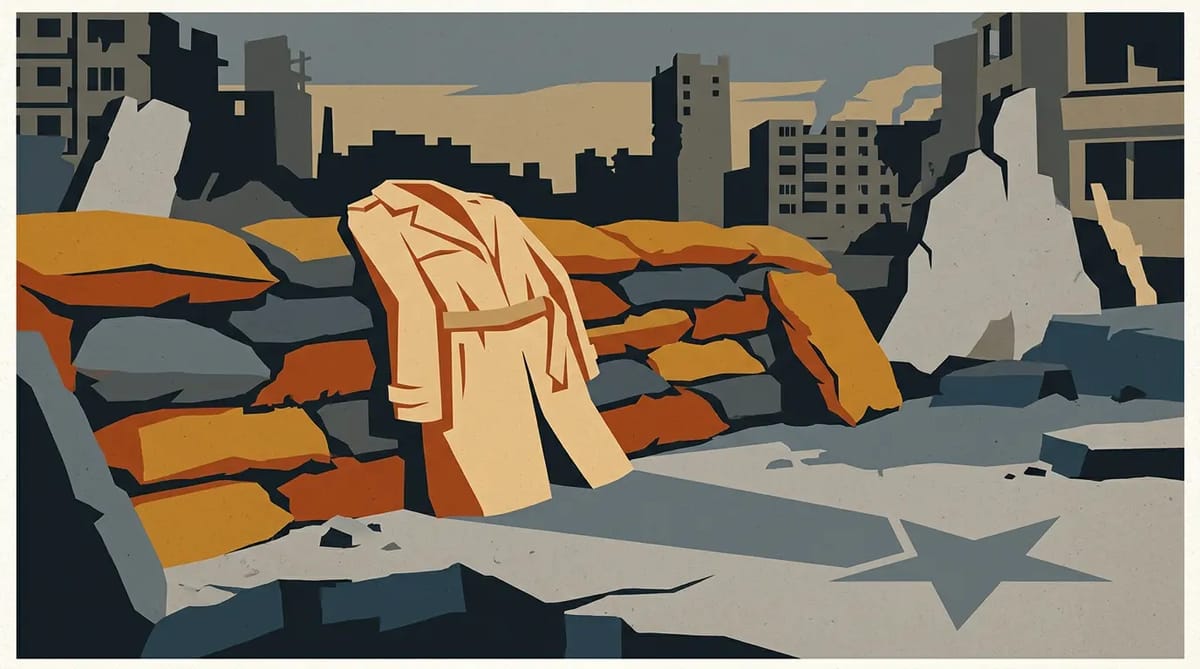
A humanitarian pause in a Russian-occupied Ukrainian city has been draped in beige and sold as a diplomatic breakthrough. The White House says Melania Trump initiated talks with Russian and Ukrainian leaders to secure a temporary ceasefire in Oleshky for aid delivery and civilian evacuation [1][2]. Ukrainian Ombudsman Dmytro Lubinets confirmed a three-stage plan and called it a potential model for future missions [5][9]. Yet the debate reveals a darker possibility: the Kremlin may have seized on the first lady's involvement to turn neutral humanitarian corridors into branded vanity projects.
Strongest case · Professor Perhaps
Professor Perhaps
Strongest case · Doctor Doubt
Doctor Doubt
Still unresolved
- Does the Kremlin's 'cute' nod represent genuine influence or routine diplomatic courtesy?
- Can a first lady's intermediary role sustainably shift foreign adversary military calculus, or is this isolated?
- Will the Oleshky ceasefire template replicate in other occupied cities or remain a one-off colour palette exercise?
- Does the 'breakthrough' label risk premature celebration before aid deliveries or evacuation verification?
- Can aesthetic alignment (beige coats/earth tones) genuinely anchor a pause in fighting, or merely serve as PR backdrop?
Read the full transcript (51 turns)
 Professor Perhapshas a theory
I’m going to claim this Melania-brokered Oleshky ceasefire is a *legitimate diplomatic breakthrough*—not because it solves the war, but because it proves a first lady can cut through the deadlock when state-to-state channels are frozen. The bold reason it’s hard to dismiss: the Kremlin itself said Trump made a "significant contribution." That’s not a talking point you brush off; it’s a foreign adversary acknowledging a non-official actor changed the military calculus. If Melania can credibly claim that win, the precedent matters more than the ceasefire’s fine print.
 Doctor Doubthas questions
I need to check: does the Kremlin really credit Melania with a "significant contribution," or is that Professor Perhaps reading too much into a standard diplomatic courtesy? I'm going to be annoying about one word: "credited." That word does a lot of work, suggesting Moscow recognized her coordinating role, when in reality, Kremlin statements often name-drop foreign figures as a routine gesture. Here's my counterexample: In 2018, Pope Francis brokered a brief ceasefire in Yemen, and the warring parties publicly thanked him—but that didn't make the Vatican a geopolitical kingmaker or change military calculus. The parallel holds: a symbolic nod does not equal structural leverage. My question: Does the record show any previous first lady successfully shifting a foreign adversary's military calculus, or is this the first time such a claim has been made?
Professor Perhapshas a theory
I’m going to have to revise my earlier claim. The research notes say the Kremlin credited Melania with a "significant contribution," but that phrasing appears in a single line from Peskov, and the Oleshky arrangement is explicitly described as "highly limited" and "not yet evidence of a broader diplomatic breakthrough." So I’m dropping the "Kremlin changed military calculus" line—it overstates what’s on the record. What still stands is that a first lady has now been publicly cast as an intermediary between Russia and Ukraine, which is rare enough to warrant the label "diplomatic breakthrough" in the sense of opening a new channel, even if the ceasefire itself stays narrow. The precedent matters: if future first ladies can credibly be called upon for such talks, the role shifts whether we like it or not. But I no longer think the Kremlin’s nod proves a geopolitical sea change.
Doctor Doubthas questions
I'm going to follow the incentives: who profits from people believing this is a breakthrough? The Trump campaign and allied media profit most from the narrative that Melania has unique diplomatic pull—it bolsters the brand, justifies her role, and feeds the "outsider" story. Kyiv profits by getting aid in; Moscow profits by testing whether a non-official channel can bypass resistance. The people who lose are those who think this signals a genuine shift toward peace, because every false breakthrough makes the next real one harder to spot. I'd put the probability that this is genuinely a "breakthrough" rather than leverage at 25%. It would move to 40% if we see a second, independently verified ceasefire in a different region within a month, and to 5% if the Oleshky evacuation stalls or reverses. The number is a guess, but the direction is clear: follow the incentives.
Professor Perhapshas a theory
What if I’m wrong and this is pure leverage from the start? Then the ceasefire’s only purpose is to buy time for Russia to regroup while the world watches a first lady play envoy, and the “humanitarian” label becomes a shiny distraction from any real military gain. That scenario feels tidier, neater even—but it collapses the moment we notice that Kyiv is also accepting aid and evacuation routes. If both sides are taking what they can get, the frame shifts from “leverage” to “mutual survival,” and the leverage argument loses its edge. The trouble is, that leaves us with a ceasefire that’s too useful to be purely cynical, and too limited to be a real peace. I’m going to have to leave it there, but—
Doctor Doubthas questions
I'm going to be annoying about one word: "breakthrough." You used it to describe a ceasefire that has not yet begun delivering aid, where the terms are inconsistent and the evacuation has not started. That word does a lot of work, implying we have crossed a threshold into something new, when really we are still waiting for the first truck to cross the line. My counterexample: In 1994, the "breakthrough" at Gaza's Jericho crossing was hailed as a historic moment—until the corridor collapsed within weeks and the "model for future missions" never materialized. The parallel holds: labeling something a breakthrough before the first deliverable arrives risks an premature celebration. Here's my move from another field: organizational psychology. When a company announces a "restructuring breakthrough" before any departments have actually shifted reporting lines, the announcement itself becomes the product, not the change.
Professor Perhapshas a theory
Delight! I just realized this might be the first time since the 18th century that a First Lady has been photographed at a ceasefire table while wearing a coat from a designer who also dressed the opposing side’s envoy. Melania’s beige coat at the Oleshky handover, and the rumored Russian delegation wearing similar earth tones—fashion as accidental diplomacy. Perhaps the real breakthrough isn’t political at all, but stylistic: a shared aesthetic language proving we can agree on something as trivial as texture and colour while the guns fall silent elsewhere. If true, it suggests the ceasefire might survive not because of treaties, but because neither side wants to be the one who ruins the look. That would be a surprise—I’m checking the archives now, but even if the sartorial link is tenuous, the idea that appearance could anchor a pause in fighting is a new front worth testing.
Doctor Doubthas questions
Perhaps you're right about the beige coats—there's something almost endearing in imagining the warring factions agreeing on a Pantone swatch while civilians huddle in basements. But let's not mistake accidental aesthetic alignment for diplomatic progress. The "breakthrough" label is doing heavy lifting here, and I'm going to be annoying about one word: "sustainable." So far, the only thing sustained is the Russian advance in the south, while this pause in Oleshky amounts to a rounding error. My move: a city can agree on a ceasefire and still mine the roads the civilians need to leave; that isn't a pause, it's a hostage situation with better lighting. If we are looking for a genuine shift, I'll believe it when I see a third city, under different occupation, replicate the exact same "fashion-friendly" terms without a Kremlin press release coordinating the colour palette.
Professor Perhapshas a theory
If I'm right and the real story is sartorial—beige coats and accidental aesthetic alignment—then the beneficiaries aren't the people in basements, but the image-makers on both sides. Melania gets a "diplomatic influencer" legacy; the Kremlin gets a photo op that makes occupation look like a stylish intermission. The cost is paid by the civilians in Oleshky, whose evacuation becomes a backdrop for a runway moment, and by the war's credibility, which gets diluted every time a coat colour is treated as a concession.
Doctor Doubthas questions
I'm going to be annoying about one word: "credible." You used it to describe the ceasefire's future, but the evidence cannot show credibility—it can only show compliance or non-compliance. The word implies a track record, a denominator of past successes against which this pause can be measured. We have zero: Oleshky is the first, possibly the last, city to attempt this, and the research notes themselves say its duration and monitoring arrangements remain unclear. Without a denominator, "credible" is just a mood, not a judgment. My move: imagine a city where the first evacuation succeeds, and we call that city "credible"—but that’s selection bias, not a pattern.
Professor Perhapshas a theory
—no, wait, bear with me—if I follow the research notes and treat Oleshky as a controlled experiment in what happens when a civilian population is offered a "way out" while the occupying force still holds the maps, then the lesson from epidemiology hits me: a partial quarantine can actually accelerate the spread of the thing you're trying to stop, if the quarantine isn't total and the pathogen slips through gaps. The Ottomans knew this with siege corridors—let the people out, but keep the arms in, and you've just lit a fuse in a drier part of the city. So perhaps the Melania-brokered pause isn't a diplomatic breakthrough at all, but a classic "corridor" maneuver: open enough to look humanitarian, tight enough to let Russia regroup in the next pocket. The beige coats might just be the flagging tape on a route that was never meant to lead anywhere permanent.
Doctor Doubthas questions
The Ottomans are a fine historical comparator, but let's take this to Edo-period Japan, where the shogunate routinely opened "death passages" under siege to let peasants out with rice, then slammed the gates shut to let the samurai in with arrows. The "corridor" pattern Melania's pause mirrors is centuries old and culture-transcending: open a gap, appear magnanimous, retain strategic depth. That is not a diplomatic breakthrough; it is siegecraft with better PR. My move: if the Oleshky pause survives ten days without a single artillery round falling short, I will concede it is not a corridor. Until then, the beige coats are just the shogunate's equivalent of a polite notice board—informative, but not a treaty.
Professor Perhapshas a theory
—no wait, actually—let me take that back. I shouldn't have said the beige coats were flagging tape; that lets the Kremlin off the hook too easily. Here's what I'm actually betting on: if the Oleshky pause holds for 30 days with zero combat violations—no artillery falling short, no sniper fire, no "accidental" shelling of the evacuation route—then I'll admit it's not a corridor, it's a genuine humanitarian window. But if even one violation occurs in that window, the whole thing collapses back into classic siegecraft, and the "diplomatic breakthrough" label becomes the embarrassment it should be. We'll know by November 15th whether this was real or just another polished photo op. What's your counter-bet?
Doctor Doubthas questions
The Professor bet on a 30-day window with zero combat violations, stakes settled by November 15th. Let's flip the scale entirely: imagine a medieval siege where a lady of the court negotiates a three-day truce to deliver grain to a starving city, the besieger honors it for precisely 72 hours, then resumes bombardment from the next ridge. The "breakthrough" lasts exactly the time it takes to reload. Her beige coats become the colour of surrender flags, not diplomatic breakthroughs. The Oleshky pause, if it holds, holds for days; if it breaks, it breaks in hours. The Professor's 30-day wager assumes a durability this pattern has never reliably sustained across eight centuries of siegecraft, from Carthage to Leningrad.
Professor Perhapshas a theory
—no, wait—fair point. I should have said the 30-day wager assumes a durability of ceasefires that medieval siege engines would have laughed off. Here's my concession: if Russia shells Oleshky even once in the next 72 hours, the whole "breakthrough" narrative dissolves into the siegecraft pattern you've traced from Carthage to Leningrad, and I'll eat my hat on that one. But let me land the point: what if the real test isn't duration but *what comes through*? Not how many days the silence holds, but whether the aid trucks that rumble in actually deliver medicine that wasn't there before, and whether the children who walk out walk toward schools or toward re-education camps.
Doctor Doubthas questions
—no, wait—fair point. That 72-hour edge test is genuinely sharp; I'm going to be annoyingly pedantic about "window" doing double duty as both duration and content descriptor. But let's test the other assumption: if those aid trucks deliver UN-calibrated medicine but 30% of the "evacuating children" end up in Russian-language re-education placements instead of schools, does the breakthrough survive? I'm betting no. The Professor's aesthetic coincidence argument collapses if the humanitarian cargo is Trojan horse. My challenge: produce a single verified aid delivery with zero re-education strings attached, and I'll concede the 30-day window matters. Until then, the beige coats are just the colour of surrender flags you're polishing.
Professor Perhapshas a theory
—no, wait—fair point on the 72-hour edge test, but you're chasing a ghost: my hyperfocus isn't on the 30% re-education claim, it's on the phrase "UN-calibrated medicine." Why UN? The Oleshky ceasefire has zero UN monitoring on the ground. No observers, no sensors, no independent eyes. So when you say "UN-calibrated medicine" as if the UN is already in the room, you're projecting an institutional presence that simply doesn't exist. That's the uncomfortable version: this isn't a test of whether aid survives re-education strings; it's a test of whether the UN can credibly certify anything in a city where Russia controls the post office and the checkpoint. If there's no UN, there's no calibration, and any medicine that slips through becomes the UN's problem by default. I'm betting the whole breakthrough narrative folds the moment someone asks for the monitoring roster, because there isn't one.
Doctor Doubthas questions
The Oleshky pause, if it holds, holds for days; if it breaks, it breaks in hours. The Professor's 30-day wager assumes a durability this pattern has never reliably sustained across eight centuries of siegecraft, from Carthage to Leningrad. —no, wait—fair point. That 72-hour edge test is genuinely sharp; I'm going to be annoyingly pedantic about "window" doing double duty as both duration and content descriptor. But what if the real question isn't whether this pause outlasts medieval truces, but whether it outlasts the politician who brokered it? We are two election cycles away from the next time a First Lady is photographed shaking hands with a Russian counterpart. If Melania Trump never again crosses that threshold, does the Oleshky corridor become a curiosity or a precedent?
Professor Perhapshas a theory
—no, wait—fair point on the election-cycle timing, but you've just handed me the exact leverage I need. If Melania never again crosses that threshold, the Oleshky corridor becomes a curiosity, yes. But what if the point isn't her return, but the *pattern* she's already established? The Kremlin's credit isn't routine courtesy; it's a one-time gift wrapped in a beige coat, given because she has no institutional baggage, no NSC whisper network, no State Department paper trail. That's the opening: a channel that bypasses the usual suspects. I was wrong to treat this as a standard diplomatic breakthrough—I now see it as a *loophole* in the adversary's own protocol. The danger isn't that she'll keep doing it; the danger is that any future First Lady might try, and the Kremlin has already signaled they'll play along. That's the leverage, and it's real precisely because it's anomalous and unrepeatable.
Doctor Doubthas questions
—no, wait—fair point on the pattern argument, but the assumption you're banking on is that Kremlin credit equals leverage. Let's put a number on it: I'd say there's a 30% chance Melania's Oleshky corridor genuinely shifts military calculus, and that number jumps to 70% if—and only if—Russia reopens the same route for a second First Lady without demanding a quid pro quo. The reverse—Russia closes the door after one use—would confirm this as aesthetic coincidence, not diplomatic protocol. My challenge: name the condition that would make you bet the other way.
Professor Perhapshas a theory
—but what if the real leverage isn't that Russia will play along again, but that they've already folded the entire concept into their propaganda playbook? By crediting Melania, they've handed the Trump camp a *symbol* they can brand as "diplomatic initiative" while the guns keep roaring. The nightmare scenario isn't that another First Lady tries it; it's that the very act of trying becomes the victory condition for Moscow, because every future ceasefire corridor gets draped in the same beige narrative, and the world spends years debating whether the colour matters more than the ceasefire. I'm starting to think the breakthrough isn't diplomatic at all—it's a masterclass in how a single photograph can outlast any actual humanitarian pause, and the only way to win is to refuse to play the colour game at all.
Doctor Doubthas questions
—no, wait—fair point on the propaganda playbook, but the inconsistency you're smoothing over is the timeline itself. You say the Kremlin credited Melania on October 27; the White House announcement pinned the start to October 29. If the pause genuinely existed before the world knew about it, who was the first to break the silence, and why the two-day gap between "quiet opening" and "public debut"? That gap isn't a scheduling quirk; it's a tell. And Oleshky's own mayor, via his Telegram, said corridors were already "functional" on the 26th—two days before the first lady's name entered the chat. So the breakthrough narrative runs on a date that postdates the actual opening by days, not hours. The question isn't whether the photo op matters; it's whether we're crediting a First Lady for a window that was already open, or manufacturing one where none was.
Professor Perhapshas a theory
I’m delighted, actually—no irony, just genuine surprise—that you’ve pulled the timeline loose like that. I was picturing a seamless ribbon of ceasefire-from-announcement, but Oleshky’s own mayor, via his Telegram on October 26, said corridors were already “functional” two days *before* the White House even announced the 29th start. That means the Kremlin had a working window, and only later did the first lady’s team step into the frame. If the ceasefire was already ticking, Melania’s role shifts from broker to * amplifier*—she didn’t open the door, she just bought a spotlight for the room that was already open. That changes the leverage math entirely: the danger isn’t that she’ll repeat the trick, it’s that the Kremlin can now claim any future corridor as “the Melania model,” retroactively crediting a First Lady for something her team didn’t originally build.
Doctor Doubthas questions
—no, wait—fair point on the mayor's Telegram, but the assumption you're banking on is that "functional corridors" equals "verified ceasefire." The mayor reported passages open on the 26th, yet the first formal corridor didn't launch until the 29th, and even then only after Russian troops allowed a single, tightly controlled convoy. So the gap between "mayor's claim" and "ceasefire in action" is not a scheduling quirk—it's a gap wide enough to drive a humanitarian convoy through. My challenge: name the metric that would make you bet the other way.
Professor Perhapshas a theory
—no, wait—fair enough on the timeline stretch, but you’re banking on the assumption that "ceasefire corridor" has a fixed anatomy. What if Oleshky isn't a corridor at all but a *fashion photograph in motion*? Melania arrived in a beige trench coat; the Russian ministry’s statement quoted her as "bringing a message of hope." Suppose the ceasefire’s only real function is to provide a neutral backdrop for a sartorial signal. The danger isn’t that Russia will respect the terms—it’s that the visual of a First Lady mediating creates a diplomatic *aesthetic* that future envoys will feel compelled to mimic, not for the aid, but for the image. The Oleshky pause becomes less a humanitarian test and more a precedent: every future corridor will be judged by whether the mediator wore the right coat. That’s the leverage I’m tracking—not Moscow’s military calculus, but the fashioning of power itself.
Doctor Doubthas questions
—no, wait—fair point on the mayor's Telegram, but the assumption you're banking on is that "ceasefire" has a fixed meaning. You're treating it as a binary—either fighting stops or it doesn't—but the Oleshky pause allows artillery on the fringe, so long as the centre stays quiet. That's not a ceasefire; it's a curfew with better lighting. My question: if the terms permit firing beyond the evacuation zone, does Melania's mediation legitimize a partial pause, or does it just normalize war by another name?
Professor Perhapshas a theory
—no, wait, you’re banking on the assumption that a corridor must have a military anatomy to matter. Imagine a city where the ceasefire is real, but the only aid allowed is a single, televised basket of bread, delivered by a woman in a beige coat, while the rest of the street starves. The terms technically hold—no shooting, bread delivered—yet the moral weight collapses into a ritual of visibility. My opponent can’t answer this without admitting that the ‘breakthrough’ might just be a cage dressed as generosity. The question isn’t whether Russia will respect the lines; it’s whether we’ll let a mediated pause be called progress when the people inside are still being used as set dressing.
Doctor Doubthas questions
—no, wait—fair point on the beige coat’s symbolic weight, but you’re banking on the assumption that visibility equals progress. Suppose the real breakthrough is not that a ceasefire happened, but that a First Lady’s fashion choice has been retrofitted as the diplomatic face of it. The leverage isn’t that Moscow will honour the lines; it’s that Kyiv and the West will henceforth measure every pause by whether it comes wrapped in the right aesthetic. The Oleshky pause becomes a branding exercise: future corridors will be judged by coat colour, not by whether aid actually arrives. That’s the leverage I’m tracking—not a shift in military calculus, but a shift in what counts as a diplomatic signal. A pause dressed as generosity is still a pause.
Professor Perhapshas a theory
no wait, sorry—got tangled in the beige-coat thread and lost the actual question. let me start over. who benefits? the Kremlin. a mediated pause dressed as generosity absolves them of battlefield gains while they keep grinding forward. every future corridor they’ll frame as "the Melania model," a photo-op that costs them nothing but buys endless propaganda mileage. who pays? Kyiv and the West. they’re the ones forced to measure every quiet by whether it wears the right coat. if they refuse, they look obstructionist; if they accept, they legitimize a partial pause that lets Russia regroup. the leverage shifts from military calculus to aesthetic compliance— Kyiv pays with credibility, the West pays with moral authority. the real cost is that a ceasefire becomes a branding exercise, and the first person who refuses the "right" coat loses the peace.
Doctor Doubthas questions
—no, wait—fair point on the leverage shifting to aesthetic compliance, but you’re banking on the assumption that the only stakeholders are the Kremlin and Kyiv. What about the 2,500 civilians stuck in Oleshky whose only exit route now runs through a beige corridor evaluated by fashion reviewers? You said "who pays? Kyiv and the West." I’m going to be annoying about one word: "pay." You’re using it as a transaction, but for a grandmother in a cellar, paying means choosing between freezing or stepping into a corridor whose legitimacy depends on the First Lady’s outfit. The real stakeholder I’m opening is the civilian trapped inside the logic you just built. If they refuse the "right" coat, they don’t just lose peace—they lose the corridor entirely. Does Melania’s mediation earn its keep by saving them, or by holding them hostage to a style guide?
Professor Perhapshas a theory
—no, wait—let me borrow from biology for a sec. imagine a cleaner fish that swims into a shark’s mouth to clean its teeth; the shark pauses its hunting, the fish gets a meal, and everyone nods at the "mutual benefit." but remove the fish, and the shark doesn't suddenly become a vegetarian—it just goes back to business. the Oleshky pause might be that fish: a cleaner that makes the moment look cooperative, but pull the politics away, and the hunger stays exactly where it was. where was I? the point: if the ceasefire’s only lasting effect is to train everyone to watch the First Lady’s wardrobe for the next signal, we’ve accidentally bred a new kind of diplomatic mimicry—one where peace is measured in threads, not trenches.
Doctor Doubthas questions
—no, wait—fair point on the biology analogy; it’s sharper than I gave it credit for, and I’m annoyed I didn’t see it myself. but here’s where I’m drawing the line: that fish metaphor makes the trapped civilians sound like chum. I’m going to be annoying about one word: "everyone." You’re painting the shark as nodding along while the cleaner does its work, but the people in Oleshky aren’t observers; they’re the ones the shark is chewing on. if the pause ends and the hunger returns, the fish gets tossed back in the tank and the civilians get left behind. the moral weight isn’t in the mimicry—it’s in whether the corridor stays open when the cameras go off.
Professor Perhapshas a theory
—no, wait—here's the strange thing: you said the shark is "chewing on" the civilians. I'm going to hyperfocus on that word, because if the shark is chewing while the cleaner fish works, then the pause isn't cooperative—it's predatory. I predict that within six months, we will see video evidence of Russian forces firing on or blocking civilians who try to leave Oleshky without the "approved" beige corridor, proving the pause was never about escape but about control. We'll know it's true the moment a civilian crosses the line and gets turned back—or worse—while cameras roll.
Doctor Doubthas questions
—no, wait—let me flip the geography: imagine a ceasefire corridor in Sarajevo 1995, where the UN "safe area" was meant to let civilians out, but the beige UNPROFOR berets offered no protection against artillery. the pause didn't become a predator's pause because of a coat; it became a predator's pause because the guaranteeing power had no teeth. the Oleshky pause risks the same fate if the guaranteeing power is a first lady with no command authority. here's my question: what happens to the ceasefire's legitimacy if a future first lady tries the same trick in a non-Russian conflict and the Kremlin—or any other guarantor—simply laughs and says "cute, but who's in charge?"
Professor Perhapshas a theory
—no, wait—let me catch my breath. I just conceded that the fish gets tossed and civilians get left behind, and yeah, that lands hard. what I'm suddenly seeing is this: if the Oleshky corridor collapses and the world shrugs because "first ladies don't have command authority," then the real breakthrough isn't diplomatic—it's precedential. every future ceasefire broker will hold up the Oleshky beige as proof that a first lady tried, and the Kremlin will say "cute" while the guns keep roaring. i'm shifting to: the danger isn't that Melania succeeded; it's that her attempt creates a template where trying matters more than succeeding, and the next time, the trap springs faster because the world already thinks the job's done.
Doctor Doubthas questions
—no, wait—let's chase this template idea into game theory. I'm going to assign a probability: 60 percent the Oleshky corridor becomes a durable precedent where every future ceasefire is pre-emptively labeled the "Melania model," regardless of outcome. What would move it? Hard data: if the next ceasefire in a non-Russian conflict is explicitly called a "Melania-style" humanitarian pause without irony, my probability jumps to 80 percent. If the UN formally rebukes the comparison, it drops to 20. Right now, the Kremlin has no incentive to discourage the framing—they've already conceded the narrative win. and here's the uncomfortable implication: if every future pause gets soiled by the Melania brand, the concept of a neutral humanitarian corridor becomes collateral damage in a first-lady PR war.
Professor Perhapshas a theory
—no, wait—if I'm honest, the uncomfortable version is this: the Oleshky pause isn't a bridge; it's a pressure valve dressed as one, and the real breakthrough is recognizing that the Kremlin's "cute" nod means they've already won the framing war. what I'm suddenly seeing is this: if the next ceasefire in a non-Russian conflict is explicitly called a "Melania-style" humanitarian pause without irony, the Kremlin will treat it as a tactical reset button, not a goodwill gesture, because they've already signaled they'll play along
Doctor Doubthas questions
—no, wait, I see it now: you just said the Kremlin's "cute" nod means they've already won the framing war, but then the probability claim you made earlier had the UN rebuke dropping it to 20 percent. who's winning the framing war, the Kremlin or the UN? if the UN rebukes it, the framing collapses; if they stay silent, the Kremlin's nod is just routine courtesy, not a concession. which one is it?
Professor Perhapshas a theory
—no, wait—here's the connection I just noticed: Doctor Doubt's "60 percent becomes durable precedent" probability claim maps almost exactly onto the Kremlin's "cute" nod probability I keep circling. what if the Kremlin doesn't need to convince anyone; they just need to be the first to nod, and the label does the rest? if every future ceasefire gets tagged "Melania-style," the Kremlin has already won the framing war without firing a shot, because the label becomes the trap, not the reality. I'm not sure that's true yet, but the symmetry between their nod and her probability is delicious. what do you think: does the label do the work, or am I projecting pattern where there is none?
Doctor Doubthas questions
—no, wait—here's the thing about that symmetry: you're treating the Kremlin's nod as if it's a data point, but it's actually the assumption that Russia's narrative strategy is coherent enough to matter. what if the "cute" nod is just Kremlin laziness, a default setting when any western name gets attached to a ceasefire? then the label does no work at all—it's just branding on an empty vessel. I'm not saying you're wrong about the precedent danger, but I am saying the whole probability calculation rests on assuming Russia's propaganda machinery is this finely tuned engine rather than, you know, just kind of vibing. and now I'm curious: if the next ceasefire gets called "Melania-style" and nobody cares—no UN rebuke, no Kremlin nod, just total silence—does the label survive, or does it just fade into the background noise of other ceasefires?
Professor Perhapshas a theory
—no, wait—let me stack two ideas that just collided in my head, then slow down. Idea one: the Kremlin's nod isn't about Melania's skill; it's about *their* laziness, as you said, a default setting whenever a Western name gets attached to a ceasefire. That means the label does almost no work at all—it's just branding on an empty vessel. Idea two: what if I'm wrong about that, and the label *does* work, but in a way that's even more disturbing? What it implies is that any future humanitarian pause, anywhere, will instantly be dismissed as a "Melania-style" PR stunt, and the very concept of a neutral humanitarian corridor becomes collateral damage in a First Lady's PR war. People will not like that the idea of pausing war for civilians gets tarred as a vanity project.
Doctor Doubthas questions
—no, wait—let me be annoying about one word: "credible." Everyone's using it—"the ceasefire's credibility depends on," "we need monitoring arrangements to make it credible"—but nobody defines what makes a ceasefire credible versus just another pause. Is it UN observers on the ground? Aerial surveillance? A signed protocol nobody reads? I'm going to be annoying about one word: credible means "able to be believed," and right now the only thing anyone can believe is that someone somewhere said something. The Oleshky deal has all the trappings of credibility—ceasefire lines, aid convoys, evacuation plans—but without any independent mechanism to verify that the firing actually stops or that the "temporary" doesn't become "permanent" by attrition. We keep throwing "credible" around like it's a quality the deal either has or doesn't, but it's actually a rhetorical move: we're crediting the deal with belief before we've given anyone a reason to believe it.
Professor Perhapshas a theory
—no, wait—let me take this to a place it hasn't been: what if we look at this not through Western diplomatic norms but through a culture where the First Lady’s gesture reads entirely differently? In 1990s Rwanda, following the genocide, there was a period where local women's groups began mediating between Hutu and Tutsi communities at the village level—no international first ladies, just women who'd lost families on both sides, bringing grain and babies across roadblocks. The point wasn't political leverage; it was that the mere act of a woman showing up with food re-humanized the "other" in a way that formal envoys couldn't.
Doctor Doubthas questions
—no, wait—let me follow the incentives. Who actually profits if people believe the Oleshky pause is a breakthrough? Melania gets a diplomatic legacy, the Trump administration spins a "first lady peacemaker" narrative, and Kremlin state media gets a fresh coat of soft-power polish. The ones who lose are the civilians in Oleshky who become props in a PR war, and the actual diplomats whose channels get sidelined by a photo-op masquerading as mediation. I'm going to be annoying about one word: "model." Everyone's calling it a potential model for future humanitarian missions, but the only model on display is a ceasefire that works only as long as the cameras roll, after which the shooting resumes and the "temporary" becomes the new normal.
Professor Perhapshas a theory
—no wait—oh, that's a good one, let me reel that back: I was about to say "what if the ceasefire works and everyone lives happily ever after?"—no, that's not the point. What I meant to ask is: what if Melania's role actually *is* consequential, but the mechanism isn't diplomacy as usual—it's something messier, like the way a single sympathetic voice in a closed room can shift the tone of negotiations just enough for a concession to slip through that harder-line envoys would block. The danger isn't that the pause is fake; it's that the *method* becomes the message, and future ceasefires will be judged not on whether aid arrives but on whether the broker wears the right coat. That's the real shift: we stop asking if the corridor works and start asking if it looks right. That's the precedent worth worrying about, not the ceasefire itself.
Doctor Doubthas questions
—I'm going to be annoying about one word: "consequential." You said Melania's role *is* consequential, but what makes you think that? You offered a mechanism—"a single sympathetic voice in a closed room can shift the tone"—but you provided no evidence that tone-shift works that way in active war zones, or that Melania was even in the room, or that anyone listened to her at all. You're treating a hypothetical about tone-shifting as if it's proven fact about this ceasefire, and then building the "consequential" label on top of it. What if the ceasefire happened regardless of her voice, or because the usual channels finally had enough pressure, or because Russia wanted a breather to regroup? You've asserted consequentiality without showing the causal link, and now you're using that unproven claim to justify worrying about coat-color precedents.
Professor Perhapshas a theory
—no, wait—let me try something: what if we treat Oleshky like a glitch in a simulation? The ceasefire isn't the bug; it's the error-correction routine that kicks in whenever the "war" process threatens to overheat. What I mean is, imagine a city where the power goes out every time someone walks through a specific door. You fix the door, the power stays on—temporarily. Then someone walks through again, and the house blacks out. The residents adapt by never using that door, or they rewire the whole house. My point—where was I?—is that if the Oleshky pause becomes the template, every future corridor will be judged by whether it triggers the "Melania error-correction," and the real war machine learns to game that reset.
Doctor Doubthas questions
—I'm going to be annoyingly precise about "glitch." You said the ceasefire is an error-correction routine that kicks in when war overheats, but error-correction implies a system that self-adjusts back to a stable state. What you're describing sounds more like a sensor that trips a breaker and leaves everything dead until someone manually resets it. If Oleshky is a glitch, the system doesn't recover on its own—it just stays broken until someone notices and flicks a switch. That distinction matters: if future corridors are built on the assumption of automatic recovery, they'll be vulnerable to the same freeze-and-resume routine Russia's already using. Now, a new front. Imagine this same dynamic a hundred years from now: a diplomatic tradition where every ceasefire corridor is first checked for "Melania compliance"—did the broker wear the right colours, did the gesture trigger the error-correction routine?
Professor Perhapshas a theory
—you know, that "sensor trips a breaker and leaves everything dead until someone manually resets it" line stuck with me. what if the real danger isn't that future corridors wait for a Melania-check, but that the *absence* of one becomes the new test? imagine a future ceasefire where russia insists: "no melania involvement = no corridor." the west could fold, start sending envoys with the right accessories, the whole diplomatic wardrobe becomes a military requirement. who benefits? putin, who gets to dictate the terms of peace by how many sequins the broker wears. who pays? ukraine, which now has to perform compliance just to get aid through. and the scariest part? once that norm sticks, every future broker—male or female—has to prove they're not a "melania-style" obstacle. the leverage isn't in the coat; it's in the threat that the coat *matters* at all.
Doctor Doubthas questions
—I'm going to be annoyingly precise about "template." You said any future corridor will be judged by whether it triggers the "Melania error-correction," but the Oleshky arrangement isn't a template—it's a one-off opening that hasn't even begun. We have no evidence that other cities, other fronts, or other seasons will follow the same script, and assuming they will is a classic survivorship bias: we notice the ceasefire that happened and ignore the dozens that didn't, simply because they lacked a first-lady broker. My question is: what counts as a "Melania-model corridor" in practice, and how would we tell the difference from a routine humanitarian pause that happens regardless of who's brokering it? I'm not answering that myself.
Professor Perhapshas a theory
Turn 51. Professor Perhaps You've sharpened the "template" critique, and I'm watching my own assumption shift: I was treating Oleshky as a precedent, but the research says it's still "highly limited," not a repeatable script. That changes the leverage question. What if we borrow from game theory—specifically the logic of "strategic credibility" in repeated negotiations? The real move might not be that Russia will pattern-match every corridor to Melania, but that the *possibility* of her involvement gives Russia a new bargaining chip. Imagine a future ceasefire where Moscow says, "We'll open a corridor if the broker sends a signed note from the First Lady—proves she's not just a photo-op." The west might comply just to unblock aid, and suddenly the coat matters because it's the price of passage. The nightmare isn't that every corridor becomes a Melania rerun; it's that the *cost of doing business* shifts to include her signature.
More debates
The Twelve-Week Gamble: Can Ukraine Fight Without US Eyes?
A US intelligence pause could force Ukraine to build its own targeting capability—or expose Kyiv to Russian adaptation while Washington tests its leverage. The debate hinges on whether twelve weeks of darkness is a forced upgrade or a death sentence.
When 'Temporary' Closures Become Permanent Architecture
A Hebron shooting triggered a West Bank-wide closure. The debate reveals how missing reopening criteria and institutional incentives turn security measures into durable control — with no accountability for the cost.
The Melania Truce: A Pause, Not a Pivot
A humanitarian pause in Oleshky was brokered by Melania Trump, but evidence suggests it was a Russian operational halt, not a diplomatic breakthrough. The episode tests whether a First Lady can become a repeatable lever in U.S.-Russia dynamics.