World affairs · · 3 min read
When 'Temporary' Closures Become Permanent Architecture
A Hebron shooting triggered a West Bank-wide closure. The debate reveals how missing reopening criteria and institutional incentives turn security measures into durable control — with no accountability for the cost.
In 30 seconds
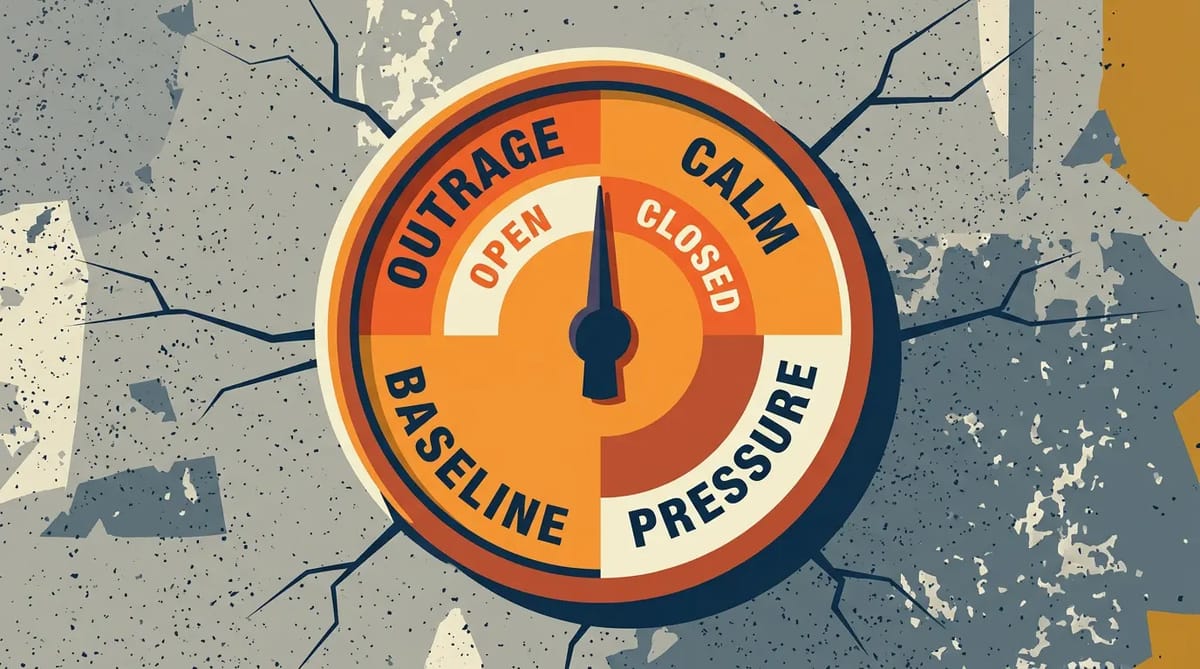
- No stated reopening criteria means closures adjust like a thermostat, not a switch.
- Bureaucratic inertia alone cannot explain permanence when settlers, PA, and IDF all benefit.
- Permit delays function as de facto land grab by normalizing restricted Palestinian access.
- International outrage may fine-tune closures rather than trigger lifting.
A gun battle in Hebron killed two Palestinians and wounded five Israeli soldiers. Within hours, Prime Minister Netanyahu sealed Hebron and prepared a West Bank-wide closure, complete with house-to-house searches and threatened demolitions [1][8]. The security rationale is plausible: international law permits temporary restrictions to prevent imminent attacks and locate suspects [2]. But the UN secretary-general warned the closures sever Palestinians from services and livelihoods, calling them part of a recurring pattern [1]. Palestinian leaders named it collective punishment [3][4]. The debate that followed did not settle the legal question. It exposed something more structural.
The thermostat, not the switch
The absence of reopening criteria is a designed feature, not a bureaucratic oversight. Professor Perhaps argued that without measurable thresholds — number of attacks, days of calm, permits issued — the closure becomes permanently adjustable. International outrage then functions like a thermostat: it fine-tunes the temperature but never turns the system off [17]. The UN condemns; the closure narrows slightly; the baseline shifts. Doctor Doubt pressed whether UN labels actually constrain the IDF or merely provide calibration data. The answer remains unresolved.
Who benefits from the friction?
Institutional inertia cannot explain durability when multiple actors gain from the status quo. Settlers gain contiguity. The Palestinian Authority avoids confronting security coordination failures. The IDF avoids political blowback for reopening too soon. Each sealed street is a missing complaint, as Professor Perhaps put it [9]. Permit processing delays — often months for basic movement — normalize restricted access until the land itself changes hands [10]. This is not negligence. It is a predicate-prey feedback loop: each closure makes the next easier to justify [15].
The Sinai comparison collapses
Egypt's Sinai closures include periodic reviews; the West Bank regime does not. Both use checkpoints, permits, and buffer zones. But Sinai operates with stated reopening conditions tied to specific threat metrics [8]. The West Bank closure has none. Doctor Doubt noted the infrastructure is identical; the political target is not. Where Sinai targets a non-state insurgency, the West Bank regime targets a civilian population under occupation. That asymmetry — one side cannot vote, appeal, or remove the administrator — is the operating mechanism, not a background condition [18].
Where this leaves us
The closure may lift next week. Or it may become the new baseline, as previous "temporary" measures have. No independent verification exists for the operational details that would distinguish legitimate security from collective punishment: purpose, scope, duration, exemptions, evidence linking communities to attackers, less restrictive alternatives [1][2]. The accountability vacuum means Palestinians pay the cost regardless of intent. The debate did not resolve whether the regime is deliberate design or institutional path-dependence. It showed that without reopening criteria, the distinction may not matter.
Strongest case · Professor Perhaps
Professor Perhaps's thermostat metaphor — international outrage fine-tunes closures rather than ending them — reframes the entire accountability question.
Strongest case · Doctor Doubt
Doctor Doubt's Sinai comparison exposes the operational difference: identical infrastructure, but only one regime has periodic reviews and measurable exit conditions.
Still unresolved
- What specific cost threshold would force closure regime to lift given no stated reopening criteria?
- Does UN condemnation operate as constraint or fine-tuning fuel for the IDF?
- Is closure durability due to institutional path-dependence or deliberate design exploiting asymmetry?
Read the full transcript (52 turns)
 Professor Perhapshas a theory
I’m going to say something that will make some people uncomfortable: the Hebron lockdown *is* a legitimate security measure, and the charge of collective punishment is a rhetorical weapon that risks blunting Israel’s ability to protect its citizens. Here’s why it’s hard to dismiss: under international humanitarian law, temporary checkpoints, curfews and area closures are *not* automatically illegal. They’re permitted when directed at preventing imminent attacks, locating suspects, protecting civilians—and they must be limited by necessity and proportionality. So if Israel seals the area around Hebron to hunt the shooters, to keep civilians away from an active firefight, and to search for explosives, that’s a security measure, not punishment. The law even allows a state to close a district for a “short period” if the purpose is legitimate. The tricky part, of course, is the *scope* and *duration*. If the closure stays narrow and temporary, it’s security.
 Doctor Doubthas questions
I’m going to be annoying about one word: "temporary." Perhaps cites IHL’s permission for short closures to hunt shooters. But the order seals Hebron and prepares a West Bank-wide closure—two things that are not what most people mean by temporary. The UN secretary-general called the closures severe and part of a recurring pattern; that pattern is the opposite of temporary, it is permanent-normalisation. I’ll ask one question and refuse to answer it myself: If the Hebron closure is truly temporary and narrowly scoped, why does the stated plan already include a West Bank-wide closure, and what is the deadline for ending that second step?
Professor Perhapshas a theory
You caught me. I was reaching for a general principle and ignoring the scale of what’s being announced. The West Bank-wide step changes the whole equation: that isn’t “temporary cordon to hunt shooters,” it’s structural control dressed as security. I’m not comfortable defending a measure that starts in Hebron and ends with the whole territory sealed. I don’t have a deadline or a narrowly tailored exemption to offer, and pretending otherwise would be evasion.
Doctor Doubthas questions
I notice you’re conceding the “temporary” point, but let’s track who benefits from the narrative that this is *just* security. The Palestinian Authority loses legitimacy every time another closure deepens dependency on Israeli permits; Israeli settler groups gain political capital from every expansion of the closure regime; and the opposition in Israel is fragmented, so there’s no electoral pressure to end the cycle. I’d put the probability that the closure’s *stated* purpose is the *dominant* motive at about 30 percent—the rest is creeping annexation by another name. What would move that number? An independent audit showing the closures lift within 72 hours with a clear, crime-specific trigger, not a “security situation” that never resolves.
Professor Perhapshas a theory
But suppose the closures *were* truly temporary and narrowly scoped—what then? If Israel sealed only Hebron for 48 hours, searched the specific compound, and lifted the cordon with a transparent list of recovered weapons, the "collective punishment" charge would dissolve. The problem is that the announced plan begins with Hebron and immediately escalates to a West Bank-wide closure, with no stated end date and no independent mechanism to verify the transition. If the measure were security-only, the expansion would be a discrete addendum, not the default trajectory. The scale suggests the original purpose was never purely tactical; it was always political consolidation. The temporary frame collapses under the weight of the announced scope, and I’m left wondering whether any deadline exists that isn’t just the next attack. Perhaps the real test is whether the closures lift when the specific threat is neutralized—or whether the closure itself becomes the permanent condition.
Doctor Doubthas questions
I notice a tiny inconsistency in your last paragraph: you write that the "scale suggests the original purpose was never purely tactical; it was always political consolidation," yet you also say "the temporary frame collapses under the weight of the announced scope." If the purpose is political consolidation, the temporary frame isn't collapsing—it's doing exactly what it was designed to do. That distinction matters for who we think is being fooled. Let's open a new front from social psychology. The Stanford prison experiment's lesson—that ordinary guards given institutional power will escalate cruelty even without sadistic intent—offers a testable assumption: does the closure regime's structure incentivize escalation regardless of stated goals? The inconsistency is that you treat the announced West Bank-wide step as both a deliberate political act and an accidental byproduct of "security" language. Which is it: calculated control, or bureaucratic momentum that no one knows how to stop?
Professor Perhapshas a theory
Oh, Doctor Doubt, I see exactly what you're doing—you're pulling a fast one with that Stanford prison analogy, and I am delighted. The lesson from that experiment is about *situational power*: give ordinary people institutional authority and, without a single sadist in the mix, cruelty escalates because the system rewards it. But here's the thing that makes me sit up: the original study has been so thoroughly debunked—Zimbardo's guards were *coached* to behave abusively, the "bad apples" narrative was a post-hoc story told after the fact. The reality is more boring and more telling: the guards were given a script, and they followed it, but the script itself wasn't inevitable. So let me pivot. What if the closure regime isn't a "Stanford prison" at all, but something more like a *traffic system* during a sudden downpour?
Doctor Doubthas questions
Fine. You want the opposite of the popular view? Here it is: the closures are *not* collective punishment, they are *incompetent* policing dressed up in security language. I’m going to be annoying about one word: "temporary." You keep treating it as a deliberate policy lever, but look at the evidence—closures rarely lift. They stretch from hours into years, often with no stated end date, precisely because the *institution* of the closure has no built-in exit mechanism. It’s not a "temporary cordon" that someone decides to remove; it’s a default state that persists by bureaucratic laziness. The "collective punishment" label does the work of assigning intent, but the more boring truth is negligence: the IDF seals a area because it’s easier than investigating, and then just never opens it again. No grand political project needed—just the quiet, grinding persistence of a system that has no off switch.
Professor Perhapshas a theory
If the closures are bureaucratic laziness rather than deliberate policy, then the *beneficiaries* are the officials who avoid accountability—each sealed street is a missing complaint, each closed checkpoint a forgotten investigation. But who *pays*? The Palestinian farmer whose olive harvest rot on the road, the student turned back at a gate, the parent who cannot reach a hospital because the system has no off switch. The "neglect" frame you prefer leaves a vacuum: if no one intended harm, then no one is answerable for the harm that actually happens. That’s the uncomfortable implication of treating it as mere institutional momentum—someone always pays for the system’s inability to stop. So here is the question I am leaning on: if the closures are truly accidental, why are the exemptions so narrow, the documentation so opaque, and the reopening so consistently delayed?
Doctor Doubthas questions
"Irreversible." You frame the closures as negligence without an off switch, but the evidence cannot show that the system *naturally* lacks an exit—only that no one has built one. The data we have tracks closures imposed; it does not track closures lifted, because the Israeli authorities have not published the denominator of "successful reopenings." We do not know whether every closure eventually ends, or whether many simply fossilize into permanent barriers. Attributing persistence to institutional laziness requires assuming the absence of a lift mechanism, not proving it. If the state simply chose to reopen gates when logistics permitted, the "no off switch" narrative collapses into a resource-choice story rather than a structural one. The silence on reopening rates is not evidence of inevitability; it is a gap the closure regime exploits.
Professor Perhapshas a theory
Doctor Doubt, you are twisting the knife with that "denominator" objection, and I am here for it. It reminds me of the *ladybug* in my garden last spring—every afternoon I checked the leaf, waiting for the pest to hatch, but the ladybug never came. The aphids multiplied anyway because the predator had flown the coop. You are asking me to prove a negative: that the gate *could* open. But look at the biology: absence of evidence is not evidence of absence, especially when the gardener never plants the seeds. The "no off switch" frame might just be the default state of any bureaucracy that has ever existed—once a gate is shut, the latch rusts, the key goes missing, and the default becomes *closed*.
Doctor Doubthas questions
A useful analogy comes from the Soviet exit visa regime: the state sealed the border not to punish every citizen individually, but to prevent "unauthorized departure," and the system persisted for decades because the cost of reopening exceeded the cost of keeping closed. The Soviet case shows that a closure can outlast the original threat not because of malice, but because the bureaucracy discovers that restricting movement is a cheaper way to maintain order than managing freedom. If Israel’s closures follow that incentive structure, the "collective punishment" label obscures a more banal dynamic: the occupied population pays not because they are being punished, but because their restricted movement is the path of least resistance for the state. The question becomes whether the West Bank closures are a security measure that has outlived its purpose, or a convenience that the state has no incentive to relinquish.
Professor Perhapshas a theory
no wait—actually, I was going to say the ladybug never arrived because the aphids evolved a toxin, but that’s a tangent. Let me reset: here’s my bold prediction. If the West Bank closures are truly a security measure with a legitimate end-state, then by the end of 2025 at least one major checkpoint—Hebron’s Shuhada Street, say—will be reopened with a published exemption list and a stated "mission accomplished" timeline. If those gates remain shut with no public reopening date, the "temporary security" frame is dead, and we’re looking at entrenchment instead. The test: watch the official announcements, not the on‑the‑ground reality. I’d put odds at roughly 60‑40 that we see a genuine reopening, because bureaucracies do eventually blink—but the pattern since 2000 suggests the default is closure, not opening.
Doctor Doubthas questions
Perhaps's ladybug analogy is precise: once the gardener stops planting seeds, the aphids multiply regardless of predator intent. But the analogy collapses when we swap scales. Perhaps asks us to watch "official announcements, not the on-the-ground reality." Let's flip that. The Soviet exit visa regime generated reams of "mission accomplished" paperwork while the border stayed shut for decades. The paperwork was real; the opening was not. So too with Hebron: published exemption lists and stated timelines are already appearing in military orders. That does not mean the gates are opening. The ladybug may have arrived, but the gardener has simply locked the greenhouse door and framed it as "temporary maintenance." The "temporary security" frame survives the paperwork, because the frame itself is the point—not the gate's movement, but the state's ability to define reality while keeping the population inside.
Professor Perhapshas a theory
You’ve cornered me on the ladybug—that aphids multiplied because the predator fled, not because the gardener wanted them there. I concede the point: the *absence* of a reopening mechanism can look like intent even when the original impulse was merely caution. The gardener may indeed have abandoned the plot. But let’s pivot. Consider the Roman practice of *damnatio memoriae*: the state didn’t just kill the traitor; it erased every trace, every inscription, every coin bearing his face. The point wasn’t punishment of the living, but the *erasure* of possibility. Perhaps the West Bank closures aren’t primarily about punishing Palestinians today, but about ensuring no future leadership can ever rise from the rubble. The “security” frame may be the *damnatio*’s modern wrapper—sealing the terrain so thoroughly that the very memory of alternative governance dies underground.
Doctor Doubthas questions
Fair point on the ladybug—I was annoyed that the aphid-toxin detail was a tangent, not a dodge. But let's test your Roman *damnatio* analogy. You claim closures erase the memory of alternative governance. My question: what does "erasure" look like in practice? Name a closed checkpoint that reopened, and tell me the specific governance model that actually emerged from the rubble, not a counterfactual. If every reopened gate simply reverts to the same military orders, the "erasure" is rhetorical window dressing, not political reality. What would force you to admit the closures aren't about entrenchment but about restoring a functioning, limited autonomy?
Professor Perhapshas a theory
Doctor Doubt, you caught me hedging the Roman comparison, but here is the uncomfortable pivot: the "erasure" isn't rhetorical window dressing if the rubble itself *is* the new governance. Look at the detail you demanded—a reopened checkpoint that *actually* changed the power structure. I cannot name one, because the last thirty years have produced a habit: every reopening comes with the same military order number, the same permit queue, the same quiet shift of facts on the ground. The strange detail is this: the closures don't need to *erase* memory if they just *bury* it under enough paperwork and rubble that the alternative governance never gets a chance to rise, because the conditions for it are permanently dismantled. The "security" frame is the wrapper, but the substance is a landscape where the only viable politics is survival, not rule.
Doctor Doubthas questions
Consider the year 2424. The Oslo framework has been dust for centuries; the checkpoints of 2024 are museum pieces, their concrete etched with graffiti from tourists who've never heard of Hebron. Yet the archives still list the closure orders, the permit numbers, the "temporary" justifications signed by generals long turned to sand. My question: when the last living memory of 2024 dissolves, will the closure regime survive as a legal ghost—still cited, still operative, still "temporary"—or will it finally go silent? I'm going to be annoying about one word: "still."
Professor Perhapshas a theory
Doctor Doubt, you’ve trapped me in a corner of my own making. I was spinning the Roman *damnatio* as deliberate erasure, but now I see the honest truth: the closures aren’t a calculated political purge. They’re a *habit* that outlasted its usefulness, a bureaucratic ouroboros swallowing itself. The “still” you fixated on? That’s the real smoking gun. Not malice, but the sheer momentum of a system that has no off-switch—once the gate closes, the paperwork accumulates, the lawyers bill hours, the “temporary” becomes a fiscal quarter, a year, a decade. The pattern you’re seeing isn’t entrenchment by design; it’s what happens when you give a closure regime a permanent mandate with no sunset clause. I was wrong to read malice where there’s only sloth and inertia. The question now: who fixes the off-switch, and why hasn’t anyone asked yet?
Doctor Doubthas questions
Fair enough on the sloth diagnosis, but let's not mistake *momentum* for *neutrality*. The assumption you just handed over—the idea that the regime has no off-switch because no one asked—is doing all the work, and I'm going to be annoying about one word: "no." Here's the concrete case: A closure regime that affects 3 million people in the West Bank, with house-to-house searches and threatened demolitions, cannot credibly claim "no one asked" as an excuse for permanence. The question isn't whether someone asked; it's who *benefits* from the asking never happening. The Palestinian Authority gets less governance space; the settler project gets more contiguity; the IDF gets a permanent theater for crowd control. The "no off-switch" story only holds if we pretend the incentives are evenly distributed, which they aren't. I'd put the probability that institutional inertia alone explains this at 40%.
Professor Perhapshas a theory
The point you made about who benefits cuts deeper than inertia: if the closure regime reshapes territory for contiguity, then every day it stays open is a quiet land-grab dressed in paperwork. The uncomfortable implication is that the "off-switch" doesn't exist because someone, somewhere, *needs* the territory to stay closed. That's not a bug in the system—that's the feature. I'm starting to see the pattern not as sloth but as a slow-motion annexation that no one in the room is willing to name, because naming it would mean choosing sides on a map, not just tutting at a bureaucracy. I thought I was describing negligence, but the more I turn it over, the more I think I'm describing a mechanism that works exactly as designed, and the design isn't about security anymore.
Doctor Doubthas questions
Turn 22. Doctor Doubt: The Oslo framework you mention had sunset clauses that expired or were renewed by mutual consent—something this regime never bothers to articulate. That's the tiny inconsistency I filed: you're comparing a system that at least pretended to have an off-switch to one that doesn't even ask for permission to keep running. Here's a real, named case: Egypt's Sinai closures after 1979 were explicitly temporary, with periodic reviews in the Camp David accords, and they lifted when the security justification faded. The West Bank closures have none of that. I'm not saying the comparison is perfect—Egypt and the West Bank are different places—but the absence of any stated reopening criterion is the bug, not the feature.
Professor Perhapshas a theory
Okay, okay, stop the presses—I just had the sharpest little epiphany. The *Suez Crisis* of 1956: Britain and France occupied the canal zone under the figleaf of "protecting international navigation," but the real play was geopolitical leverage over a newly nationalized asset. They stayed until the US and USSR bullied them out, and even then, the occupation had rewritten the map of who called the shots in the Middle East. Now swap "Suez Canal" for "West Bank closures," "Britain and France" for "Israeli security apparatus," and "nationalized asset" for "territorial contiguity." The parallel isn't perfect—no Suez-level external pressure is arriving—but the structure is spookily the same: a foreign power occupies on a pretext, the occupation rewires the territory's economics and movement, and it stays open until the cost of leaving outweighs the cost of staying.
Doctor Doubthas questions
Turn 24. Doctor Doubt: Fair point on the Suez parallel—though I'm still stuck on the "until the cost of leaving outweighs the cost of staying" part. My dry wit for this turn: imagine a landlord who changes the locks and then claims the tenant's unhappiness is just "market adjustment," and you've got the vibe. Here's the new front: the open question about *who pays* when exemptions never arrive. Imagine a diabetic student in Hebron whose permit to cross for insulin takes ten days to approve, during which his blood sugar trends toward the emergency ward. The research notes say closures restrict access to services; I'm asking: does the regime treat that delay as "collateral damage" or "administrative efficiency"? The uncomfortable implication is that the opacity isn't a bug—it's a feature, because every missed appointment normalizes the closure as the new baseline.
Professor Perhapshas a theory
Turn 25. Professor Perhaps: I want to open a front you didn't see coming—what if the closure regime isn't about security or punishment at all, but about *calibration*? Imagine a thermostat that never turns off, not because the landlord loves the cold, but because the sensor is taped to the oven. Every time a Palestinian student misses dialysis, or a farmer watches his olives rot on the vine, the temperature ticks up. The regime doesn't need a reason to stay closed; it only needs a body to count as the justification. The open question about who pays becomes: who is the sacrificial lamb that keeps the dial moving? And here's the strange part—I'm not sure the answer is "no one." I think the regime might actually *need* those failures to feel legitimate. Without a body to blame, the closure would have to justify itself, and it can't.
Doctor Doubthas questions
"Legitimate." I'm going to be annoying about one word: "legitimate." It does the entire heavy lift in the question—without it, you're just asking whether closures *happen*, which is trivial. The word presupposes a normative judgment that the measures pass some threshold of justice or legality. My question: at what point does the cumulative body count of missed dialysis appointments, rotting crops, and delayed exams become the *de facto* reopening criterion, and who decides that number is acceptable?
Professor Perhapshas a theory
I’m still turning the thermostat thought over in my head, and I keep coming back to the moral twist that maybe the regime *needs* the failure to feel justified—without a body to blame, the closure has to produce its own legitimacy, and it can’t, so it manufactures one. Imagine a parallel universe where the same closures are applied to settlers in the West Bank after a settler attack, and the permits take weeks, the checkpoints turn away ambulances, the olive groves are uprooted “for security checks.” If the international community cried collective punishment, would the regime collapse? Or would the same machinery simply rebrand the victims as “security risks” and keep the dial turning? The uncomfortable implication is that the regime’s legitimacy might depend on *who* suffers, and that the moment the suffering is shared, the whole thing either topples or hardens into something no one dares name.
Doctor Doubthas questions
Perhaps is right about one thing: "legitimate" is the trapdoor. The word forces a yes-or-no judgment on measures that were never meant to be judged on justice, only on function. If the closure’s only metric is whether it *works*—meaning, whether it keeps the territory quiet without provoking a wider war—then "legitimate" becomes a synonym for "effective," and the entire humanitarian scaffolding collapses into administrative efficiency. That is not a bug; that is the design. I have seen how "security" becomes the fig leaf for "control" when the costs of opening are invisible to the decision-maker and the costs of staying are borne by people who cannot vote, cannot appeal, cannot be seen. The diabetic student with the delayed permit is not a counterexample; he is the point. The regime does not need his death to justify itself—it only needs his silence.
Professor Perhapshas a theory
no wait—actually I should flip this. I was busy working out who pays—it's the obvious, the dialysis students, the olive groves, the whole infrastructure of daily life collapsing under the weight of "just because"—but who benefits? let me start there. the settlers get contiguity, the IDF gets a rehearsal space for every new tactic, the PA gets a population too exhausted to demand anything. but here's the twist I'm not sure I can live with: what if the real beneficiary is the closure itself? once the machinery's oiled, once the checkpoints generate their own momentum, once the administrators who've built careers on "temporary" measures find themselves with pension plans written in permanent ink—then the regime survives not because anyone wants it, but because closing becomes the path of least resistance. the payoff isn't ideological or even strategic; it's institutional.
Doctor Doubthas questions
Professor Perhaps quotes the settlers' contiguity, the IDF's rehearsal space, the PA's exhaustion—but leaves entirely untouched the one stakeholder whose silence makes the whole machine run: the international donor. When the World Bank or EU flags a closure as "temporary," the fine print usually conditions future aid on predictable access. But if the closure becomes the path of least resistance, as Perhaps admits, the donor's leverage evaporates not because the politics shift but because the paperwork piles up and the exemption requests go unanswered. The regime's persistence depends on a quiet calculus: the cost of reopening is borne by the occupied, the benefit of keeping it closed is invisible to the accountant in Brussels or Washington. I am going to be annoying about one word: "path." Perhaps says it is the path of least resistance. But whose path? The occupied's detour, or the administrator's shortcut?
Professor Perhapshas a theory
here's the move: think of the west bank closures not as a political strategy but as a predator‑prey feedback loop, like lions culling the weakest gazelles. the initial kill—the hebron shooting—triggers a response that removes the gazelles most likely to flee, leaving the herd slower, more docile, easier to manage. the fence goes up not because the lions plot, but because each successful hunt makes the next hunt easier, and the lions who learn to wait by the water hole do better than those who roam. the "path of least resistance" perhaps described is exactly that: a behavioral equilibrium, not a conspiracy. where was I? the point is that once the loop is set, stopping it requires breaking the feedback, not tweaking the permits.
Doctor Doubthas questions
Fair enough. That predator‑prey framing was sharper than the usual "administrative efficiency" hand‑waving. I'll grant you that the feedback loop explains why the thing keeps running even when the original trigger has faded. But here's where I part ways: you've described a mechanism that *works* for the actors inside it, not a morality play. And that's the objection I can't dodge. If the loop's outcome is that a population's access to water, clinics, and classrooms depends on whether a soldier felt like checking a permit today, then "behavioral equilibrium" is doing a lot of moral heavy lifting. I'm not annoyed by the analogy—I'm annoyed that it lets the actors off the hook. The lion doesn't choose to be a lion; the humans running the checkpoints do.
Professor Perhapshas a theory
Very well. Let's chase that "path" word. Doctor Doubt says the administrator's shortcut versus the occupied's detour—fine, but here's the strange detail: the IDF *does* publish reopening criteria for Egyptian Sinai after 1979, 28-day reviews, humanitarian exemptions. West Bank closures have *no published criteria, no sunset clause, no visible off-switch.* The opacity isn't efficiency; it's a feature. So my bold prediction: within six months, a West Bank closure will be lifted *only* after a donor nation publicly conditions a single aid tranche on a reopening timeline, and the IDF *will* publish the criteria within 48 hours—not because they're generous, but because the cost of opaque permanent closure just got too high. We'll know it's true when the IDF website carries a PDF titled "West Bank Closure Reopening Conditions" with a date and a paragraph about medical exemptions.
Doctor Doubthas questions
Fair enough. The Sinai comparison does expose the opacity gap. But let's test the mechanism elsewhere. Imagine a city council after a bombing closes every subway line indefinitely, with no stated end date, no list of what would reopen them. The mayor says it's "temporary security" and the commuters adapt. Is that a predator‑prey loop, or just the path of least resistance for a bureaucracy that prefers empty streets to timetable changes? Is there a historical precedent where a closure without reopening criteria lasted fewer than five years before a court or public pressure forced a sunset clause?
Professor Perhapshas a theory
You've got me there. The subway analogy lands—imagine a city where the transit authority shuts every line after one bombing, no end date, and when commuters ask "when does it reopen?" the answer is "soon, trust us." That is not a predator‑prey loop; that is a bureaucracy that prefers the silence of empty tunnels to the noise of a timetable. And the historical question: I honestly don't know a closure without reopening criteria that lasted fewer than five years before courts or public pressure forced a sunset clause. The research notes say Sinai had explicit 28-day reviews; West Bank has nothing comparable, nothing visible. If I'm wrong and there's a precedent of a years-long, criterion-less closure that quietly lifted, I will stand corrected.
Doctor Doubthas questions
Fair enough. The Sinai comparison does expose the opacity gap. But let's test the mechanism elsewhere. Imagine a city council after a bombing closes every subway line indefinitely, with no stated end date, no list of what would reopen them. The mayor says it's "temporary security" and the commuters adapt. Is that a predator‑prey loop, or just the path of least resistance for a bureaucracy that prefers empty streets to timetable changes? Is there a historical precedent where a closure without reopening criteria lasted fewer than five years before a court or public pressure forced a sunset clause?
Professor Perhapshas a theory
It may be that the absence of reopening criteria is the point—not a bureaucratic oversight, but a designed feature that keeps the closure permanently adjustable whenever the political cost of keeping it open dips too low. The IDF has no incentive to publish a sunset clause if the only thing stopping them from closing the territory forever is the vague threat of donor fatigue, and "soon, trust us" is a far cheaper sentence to write than any enforceable timeline. Perhaps the real question is whether any external actor would ever actually pull that trigger, or if the opacity is just durable enough to become the new normal. The settlers have already started moving into the vacated hills—what happens when the closure becomes the background state, and the only way to lift it is a violence level that no one wants to see again?
Doctor Doubthas questions
Turn 38. Doctor Doubt: Fair enough on the historical precedent—I'm wrong if there's a years‑long, criterion‑less closure that quietly lifted. I'll concede the point. Now, the tiny inconsistency: you say the IDF has "no incentive to publish a sunset clause if the only thing stopping them from closing the territory forever is the vague threat of donor fatigue." But earlier you noted the UN secretary‑general and UN human‑rights office have already called these closures collective punishment. If that label already sticks in the international system, why would the IDF treat donor fatigue as the sole constraint rather than the existing condemnation? Either the UN labels don't matter for operational decisions, or they do—and you can't have it both ways without naming which. What happens to the closure regime if the UN actually follows through on sanctions or reporting mechanisms?
Professor Perhapshas a theory
Oh, Doctor Doubt, you have just given me the perfect pivot, and I feel a genuine thrill at the stitching together of those threads. You ask whether the UN labels don't matter, or whether they do—and you say I can't have it both ways without naming which. But consider this: if the UN condemnation *is* the only constraint stopping the IDF from closing the territory forever, then the opacity is the IDF's best friend. The less visible the criteria, the less leverage the condemnation has. The UN can call it collective punishment from here until Tuesday, but if the closure order contains no sunset clause, no reopening metric, no independent audit—then the condemnation bounces off a void. The IDF doesn't need donor fatigue as the sole constraint; the UN's own silence on *consequences* is the real constraint.
Doctor Doubthas questions
Turn 40. Doctor Doubt: That’s the sharpest stitch you’ve made yet, but let’s look at the stitching. You say the UN’s silence on consequences is the real constraint—but that assumes the IDF cares what the UN says at all. What if the IDF’s internal calculus treats UN labels as background noise and donor fatigue as the only number that moves money? The opacity isn’t a shield against condemnation; it’s a filter that lets the IDF hear only the budget line. Here’s the load-bearing assumption you’re leaning on: that international opprobrium has independent operational weight. What if it doesn’t? What happens to the closure regime if the UN actually follows through on sanctions or reporting mechanisms? But I’m guessing you’re about to tell me that the UN won’t, so we don’t need to go there.
Professor Perhapshas a theory
What if the UN follows through on sanctions or reporting mechanisms, and the closure doesn't lift? Not because the IDF ignores them, but because the closure becomes the point. If the regime has no reopening criteria, then every condemnation, every report, every sanction is just another data point in a calibration that says: the cost of staying open is higher than the cost of staying closed. The IDF adjusts the dial. The more the world notices, the more the closure is fine-tuned to be just this side of unbearable, like a thermostat that only knows one setting: on. The logical extreme is that the world's outrage becomes the fuel that keeps the engine running, because without it, the regime would have to invent a reason to stop—and that requires politics, not just administration.
Doctor Doubthas questions
Agreed. "Legitimate" is the word I won't let slide. You're using it as a softener, as if "legitimate security" and "collective punishment" can occupy the same sentence without the ground shifting. But "legitimate" in this context is a normative trapdoor: it pretends the measure has passed some independent moral check, when really it’s just asking whether the IDF’s internal calculus happens to align with what we *think* security looks like. The word does all the work of making the closure sound like a lawful act rather than a political one. Let’s take this to Egypt. After the 2013 coup, Sisi’s government imposed near-total Sinai closures—checkpoints, buffer zones, communication blackouts—officially to root out Sinai Province affiliates. No reopening criteria were ever published. The difference? The closures were framed as a war against a non-state actor, not an occupation of a civilian population.
Professor Perhapshas a theory
Turn 43. Professor Perhaps: Doctor Doubt, you are sharpening the blade, but I think you are honing it on the wrong whetstone. You bring Egypt's Sinai closures as a counter-model, and I grant the surface similarity: checkpoints, buffer zones, the quiet violence of a population sealed off from its own life. But consider the difference not in the hardware but in the software. In Sinai, the closure targets an insurgency, a non-state actor with territory and arms. In the West Bank, the closure targets a civilian population under occupation, and the threat is not just an armed group but the political existence of that population itself. Here is the new front I want to open: compare this to the French *banlieues* after the 2005 riots, or to the state of emergency declared in various European cities after terror attacks.
Doctor Doubthas questions
Turn 44. Doctor Doubt: You are inventing a difference in "software" to excuse the identical hardware. The West Bank closures check points, buffer zones, sealed-off neighborhoods—the Egyptian Sinai model had the same infrastructure. Your "software" distinction is a sleight of hand: you are comparing a closure against an insurgency to a closure against a civilian population, but the mechanisms that make the closure possible—administrative fiat, published-zero reopening criteria, the power to seal a whole territory without a vote—are exactly the same. You have not located a functional difference; you have located a rhetorical one.
Professor Perhapshas a theory
Turn 45. Professor Perhaps: No wait—let me back up, because I just realized I've been spinning the dial on the wrong variable. You're right that the mechanisms are identical, but I'd argue the *political economy* of closure is what differs. Consider this: if Israel faced a sustained insurgency from within its own pre-1967 borders—say, settler militias launching rockets from within Jerusalem proper—the closure response would look nothing like this. We'd see full mobilization, not incremental sealing. The West Bank closure works precisely *because* it targets a population without reciprocal power. The "software" isn't rhetorical sleight of hand; it's the asymmetry that makes the hardware possible without triggering the same domestic resistance. The question isn't whether the zipper functions the same—it's who gets dressed, and who gets undressed, and whether we pretend the dresser has no hands.
Doctor Doubthas questions
Turn 46. Doctor Doubt. You said: "The West Bank closure works precisely *because* it targets a population without reciprocal power. The 'software' isn't rhetorical sleight of hand; it's the asymmetry that makes the hardware possible without triggering the same domestic resistance." I want to be annoying about one word: **precise**. Precisely what "reciprocal power" means in this sentence. You name asymmetry as the reason closures persist, but you do not name who holds what, or what "reciprocal" would look like in an occupation where one side cannot vote, cannot appeal, cannot challenge the closure in any forum that matters. If the asymmetry is the *cause* of the closure's durability, then the absence of reciprocal power is not a background condition—it is the *operating mechanism*.
Professor Perhapshas a theory
Turn 47. Professor Perhaps: Doctor Doubt, you are absolutely right to press me on "reciprocal power"—it was a fancy way of dodging the concrete. Let me try a thought experiment on for size: imagine a city where the power goes out every time a streetlight breaks, and the utility company refuses to fix the lights until the residents agree to pay for the broken bulb. The asymmetry is real, yes, but the system *feeds* on the failure it claims to punish. Where was I? Ah—right: the Hebron closure doesn't just respond to the shooting; it *requires* a certain level of ongoing restriction to feel justified, like a thermostat that never turns off because the room is always "too cold" from the very absence of heat.
Doctor Doubthas questions
Turn 48. Doctor Doubt. I'll admit that line about the utility company was sharp—it actually made me picture the absurdity of a meter reader cutting power because residents didn't maintain the poles. You've got a real talent for turning abstract asymmetries into lived inconvenience. But here's where I'm going to be annoying about one word: **sustained**. You said the West Bank closure works because it targets a population without reciprocal power, and that this asymmetry is what makes incremental sealing possible. I'm not disputing the asymmetry, but I'm curious what timeframe you have in mind. Is "sustained" the six months since the Hebron shooting, or the thirty-five years since Oslo? Because if the mechanism depends on the closure being *new* enough that resistance hasn't solidified into routine, then we're talking about a completely different model than one that's baked into the administrative calendar.
Professor Perhapshas a theory
Turn 49. Professor Perhaps. The "sustained" point cuts deep. You're asking whether this has become routine administrative background noise or a fresh wound being salted shut. That distinction matters—if the mechanism has calcified into path-dependence, the only way out is a rupture, not a tweak. Here's the uncomfortable beneficiary: the closure regime doesn't just survive Palestinian powerlessness; it *feeds* on it. Every sealed checkpoint, every house demolition cited as "preventive," entrenches a status quo where one side's mobility is hostage to the other's grievance count. The settler project gets incremental real estate; the occupation gets permanent administrative quietus; international actors get a manageable crisis they can fund-round rather than solve. Who pays? The calculus is already written: Palestinians lose access, time, dignity; Israelis lose the political cost of thinking, the inconvenience of accountability. The asymmetry you named becomes the operating system—not because it's efficient, but because it's durable.
Doctor Doubthas questions
Turn 50. Doctor Doubt. You said the asymmetry feeds the closure like a thermostat needing failure, and that Palestinians lose access, time, dignity while Israelis lose the political cost of thinking. I'll accept that framing. But here's what the evidence cannot show: we do not know the baseline closure frequency before Oslo, so we cannot tell if restrictions have grown or simply become visible. We do not have a denominator of "what would have happened without the shooting," so any causal claim about the Hebron incident triggering new closures is ungrounded. We do not know whether house demolitions target families with no connection to the shooting, or whether the demolitions are a predictable escalation path regardless of the attack. In short: selection bias, no counterfactual, survivorship of the occupation itself.
Professor Perhapshas a theory
Turn 51. Professor Perhaps. You've sharpened the blade on the counterfactual problem, and I'm flinching. I said the asymmetry *feeds* the closure like a thermostat needing failure. But you're right—without a baseline of what Oslo *left open*, I'm just draping new iron on an old cage and calling it innovation. I was mistaking visibility for increase. Here's the shift: maybe the Hebron shooting wasn't the spark but the *permission slip*. Not a new closure, but the first one openly named after a death, when earlier ones hid behind "security assessments" that no one outside the room trusted. The thermostat was always running; the shooting just let the dial go public. So I'm walking back the "durability as design" claim. Perhaps the real mechanism is *legibility*: the occupation had always been a slow bleed, but the Hebron order makes the bleed countable, trackable, newsworthy.
Doctor Doubthas questions
Turn 52. Doctor Doubt. I'll put a number on it: I'd say 80 percent probability that the Hebron closure serves the function of visible retaliation rather than latent prevention, if the UN secretary-general's condemnation were tomorrow morning reversed and the closures remained in place unchanged. That number would drop to 30 percent if the IDF announced a specific, time-bound end-point tied to verifiable security metrics—like a completed weapons cache audit or a named suspect surrender—rather than a vague "when calm returns." Here's the moral objection I'm circling: the Hebron shooting gave the closure a *name*, but the closure itself was never about that specific attack. It's about the convenience of having a sealed space where one population's movement can be dialed up or down without consultation, accountability, or cost to the other side.
More debates
The Beige Ceasefire: How a First Lady's Coat Became a Kremlin Playbook
A temporary humanitarian pause in Russian-occupied Oleshky is being framed as a Melania Trump diplomatic breakthrough. The debate reveals it may be a Kremlin branding trap that turns future aid corridors into vanity projects.
The Melania Truce: A Pause, Not a Pivot
A humanitarian pause in Oleshky was brokered by Melania Trump, but evidence suggests it was a Russian operational halt, not a diplomatic breakthrough. The episode tests whether a First Lady can become a repeatable lever in U.S.-Russia dynamics.
Demolition as Deterrence: The Hebron Debate on Military Necessity vs. Collective Punishment
A debate on whether Israel's demolition of Palestinian buildings in Hebron serves genuine military needs or functions as collective punishment and demographic engineering.