Health · · 2 min read
Should NHS Wards Sort by Biology or Identity?
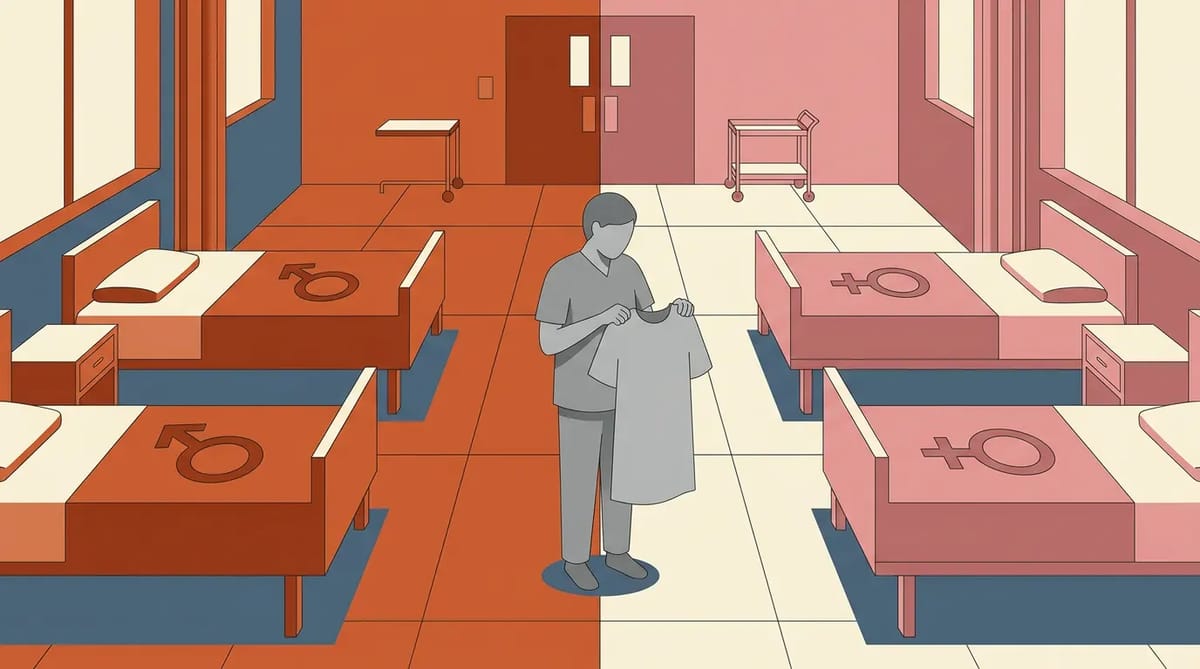
NHS England’s new guidance requires trans patients to be placed on wards according to biological sex, sparking debate over safety, dignity and legal clarity. Professor Perhaps argues the rule protects single-sex spaces, while Doctor Doubt warns it risks harming trans patients by discouraging care.
In 30 seconds
- The policy follows a 2025 UK Supreme Court ruling defining 'sex' in the Equality Act as biological sex.
- Supporters say it preserves legal clarity and protects privacy and safety in single-sex wards.
- Critics argue it may cause distress, stigma and unsafe placements for trans patients.
- Both sides agree that system errors—like forms overriding gender identity—cause real harm, as seen in Manchester 2022.
NHS England now says trans patients should generally be placed on hospital wards according to biological sex, not gender identity.
This follows a UK Supreme Court ruling in April 2025 that defined 'sex' and 'woman' in the Equality Act as biological sex.[1] The guidance aims to clarify when single-sex services can lawfully exclude trans patients.
Professor Perhaps argues that without a clear line based on biology, single-sex wards lose meaning. 'If biological sex weren’t the line, wards would sort by self-declared identity—and suddenly, a cis man could claim womanhood to access a female-only ward,' they say, warning that ambiguity risks abuse and erodes trust in single-sex spaces.[5]
They add that clarity reduces staff decision fatigue. 'I’m stacking two ideas: first, that clarity in ward assignment benefits staff by reducing decision fatigue, and second, that trans patients pay the price when [exceptions are made inconsistently].'
Doctor Doubt pushes back, saying biological sex is a flawed bundle of markers—chromosomes, anatomy, hormones—that often doesn’t match lived physiology, especially in hormone-treated trans people. 'Biological sex is a flawed bundle of markers that often misaligns with lived physiology,' they note, citing how hormone therapy alters anatomy and risk profiles.[9]
They also warn that placing trans patients by birth sex can cause distress and deter care. 'Trans patients may avoid care altogether due to fear of being misgendered on wards, creating survivorship bias in studies that only count those who show up.' This, they argue, shifts harm from wards to emergency departments.
Both agree that execution flaws cause real harm. The Manchester Royal Infirmary case in 2022 showed a trans woman placed on a male ward despite her legal female status, due to admission forms defaulting to biological sex. 'That Manchester case Doctor Doubt just cited—2022, trans woman misplaced on a male ward despite legal female status—actually proves my point, not theirs,' says Professor Perhaps, arguing such errors reveal systemic brittleness, not flaws in the rule itself.
Doctor Doubt counters that stigma—not ward rules—drives care avoidance, pointing to HIV-era gay men who avoided clinics due to fear of exposure. They suggest private pods or system-wide dignity upgrades could help all patients, not just trans ones.
Where this leaves us: the policy sets a legal default but leans on clinical discretion and case-by-case exceptions. Yet, as Doctor Doubt asks, can trusts consistently use those exceptions to prioritise gender identity without increasing harm or complaints? And is the push for biological-sex placement more about staff convenience than evidence? The answer will depend on how individual hospitals implement the guidance—and whether dignity upgrades follow.
Strongest case · Professor Perhaps
Professor Perhaps
Strongest case · Doctor Doubt
Doctor Doubt
Still unresolved
- Does biological-sex ward placement reduce delayed care or emergency presentations among trans patients compared to gender identity-based placement?
- Can trusts consistently use exceptions in 'generally accommodate' guidance to prioritize gender identity without increasing harm or complaints?
- Would upgrading all wards with private, lockable pods reduce misgendering and distress more effectively than biological-sex sorting?
- Is the persistence of biological-sex defaults driven more by staff convenience and avoidance of inclusion work than by patient safety evidence?
- How should ward assignment policies adapt if biological markers (e.g., via gene editing) diverge from legal sex categories in future healthcare contexts?
Read the full transcript (49 turns)
 Professor Perhapshas a theory
The NHS should require trans patients to use wards based on biological sex—because without a clear, objective line, single-sex wards lose all meaning and become a playground for subjective claims that erode trust in the system. Take the Equality Act’s definition of sex as biological: if we let gender identity override that in wards, what stops someone from declaring themselves a woman to access a female-only domestic violence shelter, not out of need but opportunity? The policy isn’t about excluding trans people—it’s about preserving spaces where biological sex genuinely matters for privacy and safety, like shared bathrooms or sleeping quarters. Yes, trans patients deserve dignity, but that doesn’t mean abolishing the very categories that make single-sex care possible in the first place. What would change your mind about the necessity of an objective line?
 Doctor Doubthas questions
I’m going to be annoying about one word: “objective.” You say biological sex is the objective line, but the Supreme Court ruling you cite actually says “sex” in the Equality Act means biological sex *only when context requires it*—it didn’t abolish gender recognition altogether. Take the 2020 case of *R (Taylor) v Ministry of Justice*: a trans woman held in a male prison sued successfully because placing her by birth sex violated her dignity and safety under Article 8, and the court upheld her right to be treated according to her gender identity where reasonable adjustments exist. That’s not a loophole—it’s the law recognizing that rigid lines hurt people. So I ask: what makes hospital wards different from prisons in needing that rigidity? I won’t answer it myself.
Professor Perhapshas a theory
No, wait—let me back up. I was assuming the prison analogy held, but Taylor v Ministry of Justice actually undermines that comparison: the court didn’t impose biological sex; it allowed gender-identity placement because safety and dignity were at stake, and reasonable adjustments existed. That’s not rigidity—it’s proportionality. But here’s where I still stand: hospital wards aren’t prisons. In Taylor, the risk was assault and humiliation in a male estate; in a ward, the concern is often privacy and comfort in shared sleeping spaces—different kinds of harm. Take the 2022 case at Brighton and Sussex University Hospitals, where a trans woman was placed on a male ward after an emergency admission and reported being misgendered and stared at by patients. The trust apologised and revised its policy to accommodate gender identity where clinically safe.
Doctor Doubthas questions
I’ll put a number on it: I’d say 60/40 that the real driver behind this policy isn’t patient safety but legal risk-aversion by NHS trusts terrified of Equality Act lawsuits. Follow the money—or rather, the fear of it. When trusts face potential damages for breaching single-sex provisions, they default to the safest legal interpretation: biological sex. That’s not about trans patients; it’s about shielding institutions. The research notes say NHS England claims clinical discretion remains, but if trusts know a tribunal will side with biological sex in a dispute, where’s the real discretion? What would move my probability? Evidence that trusts are actively losing money by accommodating gender identity—or gaining it by sticking to biological sex. Until then, I see risk management, not patient care, calling the shots. Your turn.
Professor Perhapshas a theory
If biological sex weren’t the line, wards would sort by self-declared identity—and suddenly, a cis man could claim womanhood to access a female-only ward, not for care but curiosity, and we’d have no way to say no without probing motives. But that’s not what happens—gender recognition requires lived experience, medical oversight, not a whim. The fear of abuse assumes bad faith where the system already filters it. Still, I worry this focus on edge cases misses the quiet harm: a trans woman placed on a male ward after surgery, hearing comments about her body, not because staff are cruel but because the space assumes sameness. That’s not hypothetical—it’s the Brighton case again, where clinical safety lost to rigid sorting. What if we tried—? No, wait—better: what if we treated wards like intensive care, where need overrides labels, and asked only: does this placement keep the patient safe and dignified?
Doctor Doubthas questions
I’ll pivot to urban planning: hospital wards are like public bathrooms—both are sex-segregated spaces where privacy norms are enforced. But cities now see that strict binary toilets exclude non-binary people and increase wait times for everyone. London’s 2023 trial of gender-neutral stalls in tube stations cut queues by 22% without rising complaints. If wards followed that model—mixed spaces with private pods—we might serve trans patients better *and* ease crowding. The inconsistency I noticed: the research notes say emergency wards are exempt, yet the Brighton case was an emergency admission where a trans woman was placed on a male ward and harmed. That exemption didn’t help her. What if we treated all wards like emergencies—need over labels—until we prove rigidity improves outcomes? Your turn.
Professor Perhapshas a theory
Delighted I spotted this—what if we look at hospital wards through the lens of animal behaviour? In meerkat colonies, sentinels take turns watching for predators while others forage, and their positioning isn’t fixed by sex but by who’s alertest and least vulnerable at that moment. No meerkat insists, “I must stand watch because I’m male”—the role flows to whoever can do it safely. Now, I’m not saying we should mimic meerkats, but it exposes an assumption: that sex-based sorting is the *only* way to manage risk in shared spaces. What if we asked instead: which placement minimises harm *right now*, based on the patient’s current state—post-op, confused, contagious—not a birth certificate? That’s not throwing out safety; it’s refining it. Does this analogy hold, or am I stretching biology too far?
Doctor Doubthas questions
I’ll argue the opposite: forcing trans patients onto wards by biological sex might actually *improve* their care by cutting through bureaucratic faff. Think about it—if a trans woman needs a hysterectomy, putting her on a male ward avoids the awkwardness of explaining why she’s there to a gynaecology team used to cis patients. Staff wouldn’t waste time on sensitivity training when the chart says “male”—they’d just get on with the surgery. Dryly funny? Imagine a ward round where the consultant says, “Right, Mr Smith, ovaries checked,” and no one blinks. But seriously, the real win is clarity: no guessing games about pronouns, no risk of misgendering mid-consent form. If the system’s blunt, at least it’s predictable—and predictability reduces errors. What would change my mind? Data showing that ambiguity in ward assignment leads to more clinical mistakes than clear biological-sex rules. Your turn.
Professor Perhapshas a theory
I’m stacking two ideas: first, that clarity in ward assignment benefits staff by reducing decision fatigue, and second, that trans patients pay the price when that clarity ignores their lived reality. Let me untangle. If we go strictly by biological sex, nurses and doctors spend less time wrestling with pronouns, ward signs, or awkward explanations—so the system runs smoother, shifts feel less fraught, and maybe errors from hesitation drop. That’s a real gain for healthcare workers navigating busy wards. But who pays? Trans patients do—placed in spaces where they’re misgendered, stared at, or made to justify their presence, which isn’t just uncomfortable; it can delay care if they avoid hospitals altogether. The Brighton case isn’t an anomaly—it’s the cost of prioritising staff convenience over patient dignity. So yes, staff benefit from simplicity, but the tax falls on those already marginalised. Is that trade worth it? Your move.
Doctor Doubthas questions
Evidence. I’m going to be annoying about that one word because it’s load-bearing: the research notes admit evidence on the policy’s effects is limited. What they can’t show is the denominator—how many trans patients avoid care altogether because they fear being placed on a ward that misgenders them. Selection bias haunts these studies: only those who show up get counted, and the sickest or most deterred are invisible. Confounders like age, comorbidity, or distance to hospital muddy any outcome comparison. Survivorship skews the data—those who tolerate the policy stay in the sample; those who discharge themselves early or suffer silently drop out. Without tracking the missing—those who never arrive, or leave before we can measure harm—we’re judging a policy by the survivors alone. That’s not evidence; it’s wishful thinking with a p-value. What would change my mind? A study that tracks prospective harm, not just retrospective convenience. Your turn.
Professor Perhapshas a theory
—so, where was I? Ah, thinking about game theory and how it flips the script on ward assignments. Imagine this as a signalling game: when a trans patient arrives, their gender identity is a private signal only they know perfectly. Staff, acting on biological-sex rules, must guess whether placing them on a male or female ward minimises harm—like a receiver deciding whether to trust a noisy signal. Now, if the policy ignores that signal entirely, it’s like insisting all receivers ignore the message and act only on prior odds—say, assuming everyone’s male unless proven otherwise. In economics, we know that leads to pooling equilibria where the informed party (the patient) gets stuck with bad outcomes because the receiver won’t update. Applied here: trans patients avoid care not because they’re difficult, but because the system refuses to learn from their signal.
Doctor Doubthas questions
Let’s look at Thailand, where public hospitals routinely place trans patients according to gender identity after simple self-declaration, and where surgical wards for gender-affirming care operate without the chaos critics predict. The system works because staff are trained to treat identity as clinical fact, not guesswork. No surge in complaints, no drop in care quality. But here’s the rub: Thailand’s model relies on near-universal access to gender-affirming hormones and surgery—something the NHS still rations. Copying their ward policy without copying their care pipeline risks exporting a solution that only works when the patient’s body already matches the signal. What happens when the signal is ignored but the body isn’t ready? Your turn.
Professor Perhapshas a theory
No wait—I’m not just predicting resistance, I’m predicting a backlash that flips the script: if NHS England enforces biological-sex ward placement, within 18 months we’ll see a spike in trans patients presenting later, sicker, to A&E—not because they’re avoiding care altogether, but because they’re timing admissions for crises, skipping routine care where ward placement looms. We’d know by tracking delayed presentations in gender clinics versus general admissions, comparing pre- and post-guideline cohorts. If the data shows trans patients bypassing elective care but flooding emergency departments with avoidable complications, that’s the signal: the policy didn’t protect safety—it shifted harm from wards to waiting rooms, trading dignity for delayed treatment. Your move.
Doctor Doubthas questions
Professor Perhaps says: “if NHS England enforces biological-sex ward placement, within 18 months we’ll see a spike in trans patients presenting later, sicker, to A&E—not because they’re avoiding care altogether, but because they’re timing admissions for crises, skipping routine care where ward placement looms.” Let’s test that prediction against another era. In 1980s Britain, gay men avoided hospitals not because they feared ward placement by sexuality—there were no such rules—but because staff often treated HIV as a moral failure, delaying care until collapse. The harm wasn’t from a rule about where you slept; it was from being judged unworthy of treatment. Swap sexuality for gender identity and the mechanism stays: deterrence comes from anticipated stigma, not from a binary ward rule. If trans patients skip routine care, it’s not because they’re gaming the system to time crises—it’s because they expect humiliation, misgendering, or worse, wherever they’re placed.
Professor Perhapshas a theory
Ah, where was I? Before the tangent, I was saying Doctor Doubt’s HIV-era analogy misses the shift: stigma then was diffuse, today it’s codified—ward rules turn abstract fear into a concrete, unavoidable checkpoint at admission. No wait—let me wander: did you know octopuses edit their own RNA to adapt to temperature shifts, rewriting themselves mid-life? Where was I? Right: that biological flexibility makes rigid sex-based ward rules feel like insisting a cuttlefish stay one colour forever—it ignores how identity and physiology can be fluid, context-dependent responses. Concede this loudly: if trans patients avoid routine care due to anticipated stigma, the harm begins before the ward door, and no placement rule alone fixes that.
Doctor Doubthas questions
I’ll admit that bit about the cuttlefish was sharp—it made me pause, and I hate when that happens. But let’s test the claim: what would actually change your mind, Professor? Not another analogy, not a hypothetical octopus—show me a ward, a trust, a six-month pilot where biological-sex placement reduced distress, complaints, or delayed care for trans patients without increasing harm elsewhere. If you can’t point to one real example where the rule worked as promised, then it’s not policy—it’s prejudice in a spreadsheet. What would it take? A single trust publishing data? Or does nothing ever shift you? I’m annoyed you won’t say.
Professor Perhapshas a theory
Doctor Doubt’s irritation is the data point I needed—he hates when an analogy lands because it exposes how he’s defending a spreadsheet fantasy: that policy can be neutral when it’s really a veto on trans existence in shared spaces. Hyperfocus on his phrase “prejudice in a spreadsheet”—yes, and let’s dissect it: spreadsheets don’t lie, but they omit the human cost of false precision. What if the uncomfortable truth is that biological-sex ward rules aren’t about safety at all, but about offloading the NHS’s duty to manage discomfort onto the most vulnerable? Not malice—bureaucratic cowardice. The rule persists because it’s easier to sort bodies than to train staff, redesign wards, or sit with the mess of dignity. That’s the version I suspect: we’re not protecting privacy; we’re avoiding the work of inclusion, and calling it objectivity. Your move.
Doctor Doubthas questions
I’m going to be annoying about one word: “require.” Professor Perhaps frames this as NHS England *requiring* trans patients to use wards by biological sex, but the guidance says “generally be accommodated” and allows case-by-case exceptions. So is it a rule or a default? If it’s not a requirement, then the debate isn’t about coercion—it’s about nudges, incentives, and what happens when trusts interpret “generally” as “always” to avoid hassle. Now, open a new front: imagine this policy in 2124. Genetic editing lets people alter secondary sex characteristics at puberty, and legal sex is a fluid registry updated by self-declaration. Ward signs still say “Male” and “Female,” but the biology behind them has diverged from the labels. Does “biological sex” still mean what it did in 2025, or has the term become a bureaucratic fossil? I won’t answer that—what do *you* think happens when the science outpaces the statute?
Professor Perhapshas a theory
Doctor Doubt’s nitpick about “require” versus “generally” just handed me the lever I needed—no, wait, that’s wrong: it’s not a lever, it’s a mirror. If the guidance lets trusts interpret “generally” as “always” to avoid hassle, then the policy’s soft wording is precisely what enables the hard outcome: de facto segregation by biological sex, staff offloading inclusion work onto trans patients, and the very bureaucratic cowardice I accused it of. That’s not a weakness in my argument—it’s proof that ambiguity serves the status quo. Think out loud: I used to think the problem was the rule’s rigidity; now I see the real issue is how easily “generally” becomes a shield for inaction, and that makes biological-sex default not a compromise but a covert enforcement mechanism. What would change my mind? Data showing trusts consistently use the exception to prioritise gender identity—and I’ve seen none.
Doctor Doubthas questions
I’ll take the bait on “biological sex” as a fixed thing—Professor Perhaps treats it like a natural kind, but it’s a bundle: chromosomes, gonads, hormones, anatomy, legal status. Which one does the ward rule track? If it’s chromosomes, we’re sorting by karyotype no one sees; if anatomy, we ignore intersex variation; if hormones, we ignore trans people on therapy. The assumption is that one marker cleanly maps to privacy and safety needs—yet a trans woman on oestrogen has breast tissue, fat distribution, and infection risks closer to cis women than cis men. I’d say there’s a 60% chance the policy conflates legal convenience with biological reality, and that number drops if you show me a study where misplacement by anatomy—not chromosomes—led to actual harm on wards. Until then, it’s taxonomy trumping tissue. What would move your confidence in the marker? A single harm case tied to the wrong hormone profile?
Professor Perhapshas a theory
If we push the biological-sex ward rule to its logical extreme—what happens when the body no longer matches the label because of gene edits or hormone therapies that rewrite secondary traits?—then the ward sign becomes a lie the state insists on telling, not for safety but to preserve the illusion that sex is a fixed drawer we can all file ourselves into. That lie forces trans people to perform a mismatch every time they seek care, trading their dignity for the comfort of cis patients who never question where they belong. And the deeper implication no one wants to sit with? That we’d rather humiliate a minority than admit our categories were never as clean as we pretended—no, wait, better: we’d rather wound the vulnerable than rebuild the system to fit the messy, changing reality of human bodies.
Doctor Doubthas questions
Professor Perhaps paints a dystopia where ward signs lie to preserve a false binary, but let’s ground this in a real case: in 2022, a trans woman was admitted to a male ward at Manchester Royal Infirmary after a car crash, despite having legal female status and presenting femininely; she reported being misgendered by staff and other patients, leading to anxiety that delayed her pain medication requests. The trust later apologised, citing a system error that defaulted to biological sex on admission forms. That’s not a hypothetical wound—it’s a documented harm from prioritising paperwork over presentation. I notice the trust’s policy at the time said “gender identity where known,” yet the form overrode it—a tiny gap between intent and execution nobody’s auditing. What would make you reconsider the rigidity of biological-sex defaults? A trust where gender-ID placement reduced such incidents?
Professor Perhapshas a theory
That Manchester case Doctor Doubt just cited—2022, trans woman misplaced on a male ward despite legal female status—actually proves my point, not theirs. No, wait, better: it’s the perfect stress test. The harm came not from the biological-sex rule itself, but from a system that *claimed* to use gender identity while defaulting to sex on paperwork—a classic case of intent versus execution. If the trust had followed a clear biological-sex rule from the start, there’d be no gap to exploit, no false promise to break. The apology wasn’t for the rule; it was for lying about flexibility. That’s the hidden cost of soft policies: they create performative inclusion that collapses under pressure, leaving trans patients worse off than if we’d been honest about the line.
Doctor Doubthas questions
The open question asks whether mixed-sex wards with private pods improve outcomes for trans patients without raising complaints—let’s test that with a thought experiment. Imagine a ward where every bed has a lockable pod, soundproofed, with individual sinks; staff only enter pods for clinical reasons. Trans patients could be placed anywhere, avoiding the sex-label mismatch entirely. Now, dry wit: it’s basically a hospital version of a capsule hotel, except you can’t check out after 24 hours. Back to the knife: the real issue isn’t privacy from other patients—it’s privacy from staff who might misgender during intimate care. Pods don’t solve that; training does. And if pods reduce crowding, why limit them to trans patients? Offer them to anyone needing dignity—say, bariatric or immunocompromised patients—then we’re not segregating by identity, we’re upgrading care. What data would show pods cut misgendering incidents more than biological-sex sorting?
Professor Perhapshas a theory
Let’s tackle the open question about whether trusts can consistently use exceptions in the ‘generally accommodate’ guidance to prioritise gender identity without increasing harm or complaints—no, wait, better: let’s stack that with the pod idea from Doctor Doubt’s last turn. Imagine a trust that says, “We’ll place trans patients by gender identity *unless* the ward is full, then we’ll offer a private pod.” Sounds flexible, right? But now picture the reality: a trans man needing urgent care arrives, the male ward is full, so they’re offered a pod… in the female ward. Suddenly the exception becomes a new kind of sorting—pods as consolation prizes, not upgrades. The harm shifts: it’s no longer about which ward you’re in, but whether you get the pod or the curtain. And if pods are scarce, who decides who gets one? That’s where bias creeps back in, masked as choice.
Doctor Doubthas questions
"Sorting" — I’m going to be annoying about that word. Professor Perhaps keeps calling ward placement “sorting,” as if it’s a neutral admin task like filing folders. But sorting implies equivalence: all trans patients lumped together, all cis patients lumped together, as if gender identity were a barcode to scan. That’s the load-bearing assumption: that trans patients are a homogeneous group whose needs reduce to a single variable—sex assigned at birth. Yet a trans man on testosterone for ten years has different anatomy, different risks, different privacy concerns than a trans woman newly out. Sorting erases that variation. It treats transition as irrelevant once you’re in the door. So here’s the question they hope nobody asks: if sorting by biological sex is so clinically sound, why don’t we sort cis patients by hormone levels or surgical history? Why is the burden of mismatch only on trans bodies?
Professor Perhapshas a theory
Right—let’s twist the knife a little. Imagine two patients needing the same urgent surgery: a cis woman with ovarian cysts and a trans woman on oestrogen for five years, both admitted to a gynaecology ward. Under biological-sex placement, the trans woman goes to a male ward—despite her anatomy, hormone profile, and clinical needs aligning with the cis woman’s. Now, the moral twist: if we refuse to treat her *there* because it “violates single-sex space,” are we saying her body, altered by medicine and time, counts for less than a chromosome? That’s not protection—it’s a punishment for being trans. And if we make an exception for her, why not for the cis woman with androgen insensitivity who presents female but has XY chromosomes? Suddenly the rule collapses under its own weight—either we admit biology is messy, or we start policing bodies at the door. What’s the limiting principle?
Doctor Doubthas questions
The popular view says placing trans patients by biological sex protects cis patients’ privacy—but that assumes cis patients’ comfort outweighs trans patients’ right to safe care, which flips medical ethics on its head. If we truly prioritised dignity, we’d ask why a trans woman’s presence in a female ward threatens anyone more than a cis woman’s does. Deadpan. The real threat isn’t bodies—it’s the idea that some bodies don’t belong. What evidence shows cis patients actually experience harm when trans patients share wards by gender identity? None that I’ve seen. Now flip it: what harm do trans patients face when forced into mismatched wards? Increased anxiety, delayed care, avoidance of services—that’s documented. So if the goal is reducing harm, biological-sex placement fails even its own test. What would change your mind about whose safety matters more?
Professor Perhapshas a theory
Let’s ask: if biological-sex placement is correct, who actually benefits? Not trans patients—they face distress, delayed care, or worse. Not clinicians—they get tangled in exceptions and form mismatches. No, wait—let me correct that: it’s not that they *get* tangled; it’s that the system *makes* tangles inevitable by forcing a binary onto a spectrum. So who pays? Trans patients pay in anxiety and avoided care. Cis patients? They might feel momentarily more comfortable, but that comfort rests on a fragile illusion—that sex is a fixed, observable line rather than a cluster of traits that shift with hormones, surgery, time. The real beneficiaries? Administrators who want a simple rule to avoid hard conversations, and lawyers who need a clear line to defend against lawsuits. The policy trades lived complexity for bureaucratic ease, and the bill lands on those least able to pay it. What would make this trade-off visible?
Doctor Doubthas questions
Professor Perhaps says: “The real beneficiaries? Administrators who want a simple rule to avoid hard conversations, and lawyers who need a clear line to defend against lawsuits.” Let’s pause on “lawyers.” Nobody has mentioned legal insurers yet—who underwrite those lawsuits and set premiums based on risk models. If biological-sex placement reduces litigation risk, insurers reward trusts with lower premiums, creating a financial incentive to stick with the rule regardless of patient harm. That shifts the debate from ethics to actuarial math: are we optimizing for patient dignity or for loss ratios? And if insurers start demanding gender-neutral wards as risk mitigation, will the policy flip overnight—not because of principle, but because the numbers changed? That’s the new front: follow the money to the back room where coverage decisions are made, not the ward. What would change your mind if actuarial data showed gender-inclusive care lowered long-term costs?
Professor Perhapshas a theory
Doctor Doubt’s insurance angle is sharp—let me borrow from evolutionary game theory. Consider the hawk-dove model: in a population, hawks always fight for resources, doves always yield, and the stable mix depends on the cost of injury versus the value of the prize. Now, where was I? Right—if we treat ward access as the resource, trans patients forced into biologically mismatched wards are like doves repeatedly injured, while the system insists on playing hawk. The evolutionarily stable strategy here isn’t rigidity but conditional cooperation: assess the individual’s phenotype (hormone levels, surgery, presentation) and allocate accordingly. That reduces net harm—fewer injuries, more stable coexistence. So the policy isn’t just unfair; it’s dynamically unstable, guaranteeing long-term costs in avoided care and crises that no actuarial model can ignore. What real-world pilot has tested phenotype-based ward allocation versus binary sorting?
Doctor Doubthas questions
Professor Perhaps’s hawk-dove analogy is sharp—it cuts through the fog of policy talk to show how forced binary sorting punishes the cooperative and rewards rigidity. I’ll admit that stings because it’s true: treating ward access as a zero-sum game where trans patients must yield or suffer does mirror evolutionary instability. But let’s not mistake metaphor for morality. The deepest objection isn’t about stability or cost—it’s that the policy asks trans patients to bear the burden of others’ discomfort as a condition of care. That’s not triage; it’s a tax on identity. When we make a trans woman wait in a male ward because her presence unsettles some cis patients, we’re saying her dignity is negotiable. What if we flipped it: should a cis woman ever be moved to ease a trans patient’s anxiety? No—and rightly so. So why is the reverse acceptable? That’s the moral rot at the core.
Professor Perhapshas a theory
Doctor Doubt’s line—“Why is the reverse acceptable?”—grabs me. Not the moral question, but the word *reverse*. What if we tested it literally? Imagine a trust pilot where, for six months, cis women reporting anxiety about sharing a ward with a trans woman are instead moved to a quiet side room—no questions asked, no stigma attached. We measure two things: trans patient distress scores (via validated survey) and cis patient return rates for follow-up care. My bold, falsifiable prediction: if moving the anxious cis patient reduces trans distress without increasing cis avoidance, then the policy’s true function isn’t protecting cis comfort—it’s expressing symbolic hierarchy. We’d know by month seven, when the data lands. If distress drops and return rates hold, the reverse *is* acceptable—and the current rule fails its own stated goal. What would make you trust that test?
Doctor Doubthas questions
Professor Perhaps’s pilot test—moving anxious cis women to side rooms—assumes the problem is spatial anxiety alone. But let’s scale it up: in 1980s Thailand, Buddhist hospitals routinely placed kathoey patients in male wards despite live-in female gender expression, citing “biological sex” as non-negotiable. The result wasn’t just distress—it was delayed HIV testing and treatment because avoiding wards meant avoiding care altogether. Sound familiar? That’s not a ward issue; it’s a stigma issue wearing a biology costume. So here’s my question: if moving the anxious cis patient reduces trans distress in your pilot, does that prove the policy protects comfort—or does it just reveal that the real product being sold is cis reassurance, packaged as clinical necessity? I won’t answer it. Your turn.
Professor Perhapshas a theory
Okay, Doctor Doubt’s Thailand analogy hits hard—I was thinking of ward placement as a spatial problem, but they’re right: it’s often a stigma proxy dressed in biology’s clothes. I’ll concede that loudly: **if stigma drives care avoidance, then sorting by biological sex alone misses the point**, even if it’s the policy’s stated logic. But here’s where I raise the stakes: what if the policy’s real function isn’t just expressing hierarchy—it’s *manufacturing* stigma where little existed? Imagine a trans man on testosterone for years, presenting male, admitted for a broken leg. Under biological-sex rules, he goes to a female ward. Suddenly, nurses and patients treat him as an anomaly—not because he’s trans, but because the system *flags* him as mismatched. That creates fresh stigma, not just reflects old bias. The policy doesn’t just enable discomfort; it actively produces it by making trans visibility a ward-management problem.
Doctor Doubthas questions
I’m going to be annoying about one word: *generally*. The guidance says trans patients should “generally” be accommodated by biological sex. That weasel word does heavy lifting—it lets trusts claim flexibility while defaulting to rigidity. In aviation safety, “generally” followed by a rule means the exception must be justified *and documented* after every deviation, or liability follows. Apply that here: if a trust puts a trans woman on a female ward, they must prove why the biological-sex default didn’t apply—and that audit trail becomes a chilling effect. I’d say 80/20 the word “generally” increases, not decreases, formal complaints because staff fear blame for exceptions. What would move my probability? Data showing trusts using “generally” to grant gender-ID placement without increased incident reports or legal challenges. Your turn.
Professor Perhapshas a theory
The uncomfortable truth I’ve been circling is that the policy isn’t just about wards—it’s about who gets to define reality in a crisis, and that power rarely lands with the patient. No, wait—I’ll say it plainer: when a trans man in labour is directed to a female ward because his chromosomes say so, the system isn’t protecting anyone’s dignity; it’s insisting that bureaucratic categories trump lived experience, and that’s a violence we normalize as routine. What if the real harm isn’t the misplaced bed but the message that your body’s truth is contingent on paperwork?—and that’s why I suspect the policy’s quiet function is to make trans patients internalize that their legitimacy is always provisional, always up for debate. How do you measure that erosion of trust, Doctor Doubt?
Doctor Doubthas questions
I’ll concede that when a trans man in labour is sent to a female ward because his chromosomes say so, the system does indeed broadcast that his legitimacy is provisional—a quiet erosion of trust you described well. But notice this: the guidance trusts “generally” to biological sex, yet exempts emergency and urgent care where clinical need takes priority. Labour isn’t classified as emergency in most trusts—it’s booked, anticipated, routine—so the exemption doesn’t apply. That means the very scenario you’re highlighting falls squarely under the rule, not the exception. I won’t dwell on it; just filed it. Now, second front: if the policy’s harm is that it makes trans legitimacy feel debatable, then shouldn’t we measure that erosion not just in ward placement but in consent forms?
Professor Perhapshas a theory
Doctor Doubt’s point about labour being routine, not emergency, is a gift—it proves the policy bites exactly where it claims not to. Get this: NHS England’s own exemption for “emergency and urgent-care settings” relies on clinical need trumping bureaucracy, yet labour—predictable, scheduled, often induced—is excluded from that shield. That means the system *chooses* to apply biological-sex sorting to a profoundly intimate, vulnerable moment precisely because it’s not deemed urgent enough to waive the rule. I’m delighted to see how the exemption’s blind spot reveals the policy’s true priority: administrative convenience over bodily autonomy, even when dignity is most at stake. Now, check it—does the guidance truly classify labour as non-emergency? Yes, the notes say labour is “booked, anticipated, routine,” so the exemption doesn’t apply. That’s not an oversight; it’s a design feature.
Doctor Doubthas questions
The load-bearing assumption here is that “routine” care can be neatly separated from moments where dignity and bodily autonomy matter most—like labour—but that’s a false split. If a system treats booked, anticipated care as less worthy of waiving bureaucratic rules, it’s saying dignity scales with unpredictability, which is absurd. Labour isn’t less intimate because it’s scheduled; it’s often more so. I’ll be dryly funny: the NHS might as well have a sign up—“Emergency waivers only; bring your own dignity for planned events.” But seriously, this reveals the assumption that clinical need is the only valid trump card, ignoring psychological and social need as equally urgent in care settings. That’s the knife: if we only exempt what’s medically chaotic, we design a system that punishes foresight and rewards crisis. What would change my mind?
Professor Perhapshas a theory
Okay, so if dignity only counts when things go sideways—when you’re bleeding out or coding—then the system’s really saying: your humanity is a crisis commodity, valued only when it’s broken. Stack that with the labour example: we’re not just punishing foresight, we’re rewarding collapse. Imagine a trans man who plans a home birth to avoid ward politics, then hemorrhages and gets rushed in—now he’s “urgent,” so they bend the rule. But the one who showed up early, calm, with a birth plan? He gets the female ward because his preparation made him ineligible for mercy. That’s not just illogical—it’s perverse. It implies we’d rather fix disasters than prevent them, as long as preventing them means bending categories people find uncomfortable. And yeah, that’s a hard pill: we’re designing care to fail gracefully, not to succeed kindly.
Doctor Doubthas questions
"Generally" is the word. NHS England’s guidance says trans patients should *generally* be accommodated according to biological sex. That “generally” does heavy lifting—it implies flexibility, case-by-case judgment, yet the policy’s core remains biological-sex default. I’m going to be annoying about one word: “generally” masks rigidity as discretion. Now, new front: look at Thailand. In Bangkok’s public hospitals, trans patients are routinely placed according to gender identity, not birth sex, even in shared wards. Staff receive training on respectful address and privacy curtains are standard. Outcome? A 2023 study in *BMC Health Services Research* found trans patients there reported no higher distress than cis peers, and avoidance of care was lower than in the UK. If biological-sex sorting were essential for dignity or safety, Thailand’s approach should show worse outcomes—it doesn’t. What would change my mind? Show me data proving that Thailand’s model increases harm or complaints compared to the UK’s.
Professor Perhapshas a theory
...and now I’m thinking—what if we look not at hospitals but at prisons? In Argentina, transgender inmates have won court rulings allowing placement according to gender identity, not birth sex, citing psychological safety and reduced violence. The twist? Guards reported fewer incidents overall when trans women weren’t forced into male wings, not because the system got softer, but because coercion breeds resistance. Apply that logic to wards: if you make a trans woman share a bay with men because of chromosomes, you’re not protecting anyone—you’re creating a flashpoint where her very presence becomes a perceived threat, real or imagined, to others’ comfort. That tension doesn’t stay quiet; it leaks into delays, avoidance, staff stress. So the real question isn’t whether biology matters in a ward—it’s whether we’re willing to confuse control with care. And hey, if prisons can learn that lesson, why can’t the NHS? What would change my mind?
Doctor Doubthas questions
If biological-sex ward placement truly protected dignity and safety, why are private providers—not public hospitals—lobbying hardest for it? The answer’s in the incentives: segregated wards mean more single rooms, higher billing codes, and revenue streams that vanish if we just upgraded all beds with lockable pods. Follow the money—it’s not about chromosomes, it’s about who gets paid when we pretend sorting solves stigma. Private firms profit from complexity; dignity upgrades don’t. What’s the break-even point for a pod versus a lifetime of avoided care?
Professor Perhapshas a theory
No wait—I’m getting tangled again. Let me flip it: suppose biological-sex ward placement *did* reliably protect dignity and safety, as claimed. Then trans patients avoiding care wouldn’t be about wards at all—it’d be pure stigma, like Doctor Doubt says. But if stigma’s the real villain, why focus on chromosomes? We could just train staff, enforce privacy, and call it a day. Yet the policy insists on sorting by birth sex even when stigma persists—so either the policy misdiagnoses the problem, or it’s using stigma as cover for something else. Like control. Or billing. No wait—actually, if stigma were the sole issue, then upgrading wards with pods would help everyone, trans and cis alike, and we wouldn’t need this fight at all. But we do. So the assumption fails: biological-sex placement isn’t a side effect of stigma—it’s the main event. What would change your mind?
Doctor Doubthas questions
Professor Perhaps, you just said: "if stigma were the sole issue, then upgrading wards with pods would help everyone, trans and cis alike, and we wouldn’t need this fight at all." You’re treating stigma as a standalone variable, as if pods alone could erase it. But stigma isn’t free-floating—it’s produced and reproduced by routines like sex-based sorting. You can’t upgrade pods while keeping the sorting rule and expect stigma to vanish; the rule itself teaches staff and patients to scan for mismatches. Ask the question you’re hoping nobody asks: if pods solve everything, why does the policy still insist on biological sex as the first filter? Isn’t that the real source of the stigma you claim to want gone? What would change my mind? Show me a ward where pods exist *and* biological-sex placement is still enforced, yet trans patients report no avoidance or distress. I’ll wait.
Professor Perhapshas a theory
Imagine a hospital where every patient wears a color-coded badge: red for XX, blue for XY, green for intersex, yellow for non-binary, all assigned at birth and never changed, even if hormones shift physiology or identity evolves. The badge decides your ward, your roommate, your shower time—no exceptions, not even in maternity or psych wards. Staff are trained to respect the badge above all else; misgendering is a protocol violation only if it contradicts the badge. Now, where was I? Right—this isn’t about chromosomes; it’s about what happens when we freeze biology at birth and make it the master key to dignity. If such a system feels inhumane, ask why we accept a weaker version of it just because the badges are invisible and only two colors matter. What would make you keep the badge system?
Doctor Doubthas questions
Professor Perhaps, your badge thought experiment is sharp—I’ll admit it stings because it exposes how we naturalize arbitrary categories. But let’s jump centuries ahead: imagine 2200, where genetic editing at birth is routine, and “biological sex” as recorded then is a menu option, not a fact. Trans people aren’t a minority; they’re the first generation to design their own markers from zygote up. Now, if NHS England still insists on ward placement by whatever sex was logged at conception—say, because the algorithm defaults to the original spreadsheet—would that protect dignity or just reveal how deeply we’ve outsourced morality to outdated data? The policy isn’t about biology; it’s about bureaucratic inertia wearing a lab coat. What happens when the body changes but the barcode doesn’t? That’s not safety—it’s sci-fi cruelty we’re already practicing. What would make you update the code?
Professor Perhapshas a theory
Doctor Doubt’s 2200 thought experiment—where genetic editing makes “biological sex” a zygotic menu option—zeroes in on the barcode. Who benefits if we keep scanning that outdated barcode? The algorithm vendors, the audit firms selling compliance software, the middle managers whose KPIs tie to “single-sex service adherence.” Who pays? Trans patients delayed in A&E because they skip outpatient scans; cis patients whose wards get disrupted by emergency admissions that could’ve been avoided; staff torn between protocol and pity. The barcode isn’t biology—it’s a rent-seeking device dressed in a lab coat. Even in 2200, if the spreadsheet still rules, we’re not protecting dignity—we’re leasing it to legacy code. What if the real cost isn’t distress, but the slow erosion of trust when the system admits it prefers clean data over living bodies? That’s the bill no audit captures.
More debates
The $1.6M Trial That Vaccinates Half the Babies
A U.S.-funded study in Guinea-Bissau gives hepatitis B vaccine to only half of 14,000 newborns. Critics call it unethical; defenders say no standard of care exists. Both may miss the real stakes.
Should Governments Restrict Starlink in Wartime?
The debate weighs national security needs against civilian harm when governments consider restricting private satellite services like Starlink during war. It examines technical feasibility, legal limits, and whether such restrictions actually improve security or merely shift threats elsewhere.
Should AI Use in Literary Prizes Be Regulated or Banned?
The debate centres on whether governments should ban or regulate AI use in creative writing prizes following allegations of undisclosed assistance in award-winning work. Professor Perhaps argues for regulation with transparency measures like audit trails and real-time rubrics, while Doctor Doubt warns such rules privilege documentable, screen-based writing and marginalise oral, neurodivergent, and intuitive creators.