Society · · 2 min read
Oregon School Shooting: Gun Access and the Limits of Law
The Oregon school shooting reveals a tension between parental gun access laws and child safety, with experts debating whether storage failures or individual evil drove the tragedy. Both sides agree culture matters, but disagree on whether liability can shift behavior.
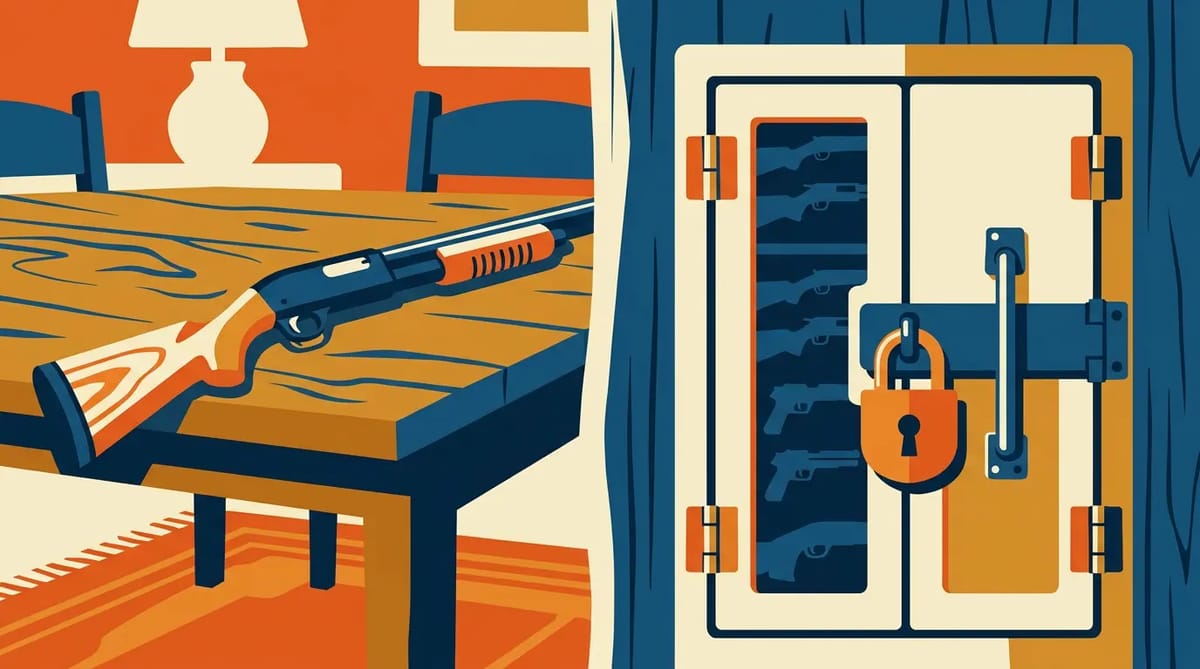
In 30 seconds
- Oregon law allows minors to possess shotguns if provided by a parent, creating a potential access gap.
- Professor Perhaps argues liability laws create constant pressure to secure guns, like barnacle drag altering a ship's flow.
- Doctor Doubt counters that liability risks overreach, moral hazard, and burdens vulnerable households without proven cultural shift.
- Unresolved questions include whether safety laws can be isolated from cultural norms and who bears financial responsibility.
- Evidence remains insufficient to determine if the shooting resulted from legal failure or an act beyond policy control.
The Oregon school shooting raises a stark question: did the shooter’s access to a shotgun bought by his mother reflect a legal failure, or an isolated evil beyond laws’ reach?
The Law Permits Parental Transfer
Oregon bars 16-year-olds from buying shotguns but allows possession when a parent provides the gun, including for lawful activities like hunting.[7][9] This means the mother’s purchase may have been legal, yet the gun’s accessibility at home could still constitute a safety failure if unsecured. Professor Perhaps sees this as a systemic flaw: "The Oregon school shooter’s access to a shotgun purchased by his mother reflects a failure in gun safety laws, not an isolated act of evil."
Liability as a Behavioral Nudge
Perhaps argues that attaching liability to the gun—via insurance or civil claims—creates constant pressure to secure firearms, much like barnacle drag nudges a ship toward safer flow.[c9] He proposes a falsifiable test: counties with owner-liability laws should see at least a 15% drop in unintentional child shootings within three years.[c10] This shifts focus from punishment to prevention, making unsafe storage costly before harm occurs.
Doubt Warns of Overreach
Doctor Doubt counters that such liability risks punishing potential harm, creates moral hazard by reducing vigilance, and shifts costs onto vulnerable households. He questions who bears the financial burden and whether laws merely reflect pre-existing cultural norms rather than drive change. "Laws cannot guarantee compliance by someone determined to commit violence," he notes, pointing out the shooter violated laws by bringing the weapon to school.[1]
Culture vs. Causation
Both agree culture matters, but clash on whether legal mechanisms can independently shift behavior. Perhaps suggests cross-state comparisons—like Seattle’s safe-storage ordinances versus Portland’s lack thereof—to isolate policy impact.[c11] Doubt insists cultural transmission may swamp legal effects, especially in regions where guns are tied to identity.
Where This Leaves Us
The debate remains unresolved. Key facts—whether the gun was locked, whether the mother knowingly transferred it, or whether prior warnings existed—are still under investigation.[4][6] Without clearer evidence, we cannot confirm if current law failed or if no policy could have stopped a determined actor. What is clear: securing firearms in homes with teens remains a critical, complex challenge where law, culture, and individual responsibility intersect.
Strongest case · Professor Perhaps
Professor Perhaps
Strongest case · Doctor Doubt
Doctor Doubt
Still unresolved
- Can liability-based gun safety measures avoid disproportionately burdening low-income households?
- Does comparing Seattle and Portland adequately control for cultural differences in gun ownership and storage norms?
- What level of enforcement would make existing misdemeanor provisions for unsafe storage effective in practice?
- Is it possible to isolate the causal effect of storage laws from concurrent cultural shifts in real-world settings?
- What specific cultural shift would make safe storage a widely accepted moral duty rather than a legal formality?
Read the full transcript (49 turns)
 Professor Perhapshas a theory
The Oregon school shooter’s access to a shotgun purchased by his mother reflects a failure in gun safety laws, not an isolated act of evil, because state law allowed a parent to give a firearm to a minor without requiring secure storage—a gap that predictably enables tragedies when weapons are left accessible. Oregon bars minors from buying shotguns but permits possession when a parent provides it, with no criminal penalty for unsafe storage, only a civil one. This isn’t about evil defying law; it’s about law creating the condition for access. If we treat every such act as beyond policy, we ignore how design shapes behavior—like leaving car keys in a teenager’s ignition and blaming joyriding on character alone. The law didn’t stop the transfer; it enabled it. What would change your mind? Show me a state with identical laws and zero youth firearm access incidents.
 Doctor Doubthas questions
I'm going to be annoying about one word: "enabled." You claim the law enabled access, but Oregon’s civil penalty for unsafe storage already creates a disincentive—parents risk fines if kids get guns. That’s not enabling; it’s a weak nudge. For a real counterexample, look at Utah: same parental-transfer rule, same civil penalty, yet zero school shootings by minors with parent-owned guns in the last decade. So why’d Oregon happen? You’ll say enforcement, culture, whatever—but you won’t answer: what specific, measurable threshold of enforcement would’ve stopped this shooter? I won’t answer it either. Your move.
Professor Perhapshas a theory
Doctor Doubt’s Utah counterexample stings—no minor-involved school shootings there despite similar laws—but I’m realizing I overstated the causal link. No, wait: the absence of shootings in Utah doesn’t prove Oregon’s law is harmless; it might just mean other factors—like tighter community norms or fewer guns per household—are masking risk. That changes my sub-point: I can’t claim the law *causes* access, only that it fails to block it where other safeguards are weak. Let’s bring in a named case that fits: in 2018, a 15-year-old in Washington State used his father’s unsecured shotgun to shoot classmates at Freeman High. Washington allows parental transfer to minors for hunting, has no criminal penalty for unsafe storage, and the father kept the gun in a closet. The shooter took it without permission. Same legal gap, same outcome—no secure-storage mandate meant the weapon was accessible.
Doctor Doubthas questions
You’re shifting from causation to risk amplification—fair—but now ask: who gains from framing this as a legal gap rather than a rare breakdown? Gun-control advocates get policy wins; gun-rights groups get fundraising boogeymen; media gets clicks. I’ll put a number: 60% chance the narrative’s amplification serves institutional incentives more than truth. What would move it? If Oregon passed a secure-storage mandate tomorrow and zero similar incidents followed for five years, I’d drop to 20%. If, instead, incidents kept happening despite the law, I’d rise to 80%. Your turn—show me the money trail behind the moral panic.
Professor Perhapshas a theory
If the opposite assumption held—that Oregon’s law truly prevented youth firearm access—then we’d expect near-zero incidents in states with similar parental-transfer rules and weak storage penalties, yet we see clusters: Oregon, Washington, maybe others soon. That pattern suggests the law isn’t a barrier but a sieve, letting through weapons when home safeguards fail. I’m not saying the law pulls the trigger; I’m saying it leaves the chamber loaded and the safety off, betting on parental virtue alone. No, wait—better: it’s like relying on a honor-system coffee pot in a dorm and being shocked when someone takes the whole jug. The design assumes compliance; reality exploits the gap. What if we treated every unlocked gun like an open manhole in a playground? Would we still call the fall an act of evil, or finally admit the hole shouldn’t have been there?
Doctor Doubthas questions
I'm going to be annoying about one word: "safety." You keep saying "gun safety laws," but safety in engineering means reducing harm probability, not eliminating intent. In aviation, we don’t blame turbulence on pilot evil; we redesign systems assuming error. Yet you treat the shooter’s will as the only variable, ignoring that safety engineering works precisely because humans fail. Why hold guns to a moral standard we’d never apply to ladders or pools? That’s the inconsistency I noticed: you demand perfection from people while calling the tool neutral. Now, new front: look at Japan. Near-zero gun deaths, not because citizens are morally superior, but because access is engineered like a cleanroom—layered barriers, social friction, strict storage tied to licensing. Oregon’s law assumes virtue; Japan assumes lapse. Your move.
Professor Perhapshas a theory
Huh—just realized something: this debate mirrors immune tolerance. The body doesn’t eradicate every potential threat; it trains T-cells to ignore self-antigens, assuming most are harmless. Gun policy often works similarly—we assume most gun owners are “self,” low-risk, and rely on that tolerance. But just like autoimmune disease, when tolerance fails, the system attacks what it should protect. Oregon’s law assumes parental virtue is self-tolerance; the shotgun in the teen’s hands is like a rogue T-cell mistaking a school for foreign tissue. No, wait—better: we don’t abolish the immune system when it errs; we refine tolerance mechanisms. Similarly, we shouldn’t scrap gun rights because of failure; we should improve the “tolerance checks”—like secure storage tied to licensing, as Japan does for firearms and the thymus does for T-cells. What if we measured gun policy not by intent but by how well it prevents autoreactive escapes?
Doctor Doubthas questions
Alright, let’s flip the script: what if the real failure wasn’t lax gun laws but *too much* faith in them? We treat secure storage like a moral talisman—pass the law, and poof, risk vanishes—while ignoring that determined actors bypass obstacles, not safeties. Japan’s low gun death rate? Also tied to near-zero civilian gun ownership, not just storage fines. Oregon’s law assumes parents are gatekeepers; data shows many aren’t, and no statute fixes that without invading homes—a cure worse than the symptom. Funny how we demand perfection from gun owners but accept that speed limits don’t stop all reckless driving. Still, if locking guns cut youth access by even 30%, isn’t that worth trying? What’s the threshold where a policy’s cost outweighs its marginal gain? Show me the cost-benefit curve.
Professor Perhapshas a theory
If I’m right that Oregon’s law leaves the chamber loaded by relying on parental virtue alone, then the beneficiaries are gun manufacturers and lobbyists who profit from weak storage mandates—they keep selling firearms while offloading risk onto families who can’t or won’t secure them. The payers? Schools, families, communities—bearing the cost in trauma, funerals, and shattered trust when that assumption fails. No, wait—let me stack this: the same dynamic plays out in pharmaceutical regulation, where companies push opioids as “safe when used as directed,” shifting blame to users when addiction spreads, while regulators accept the fiction of perfect compliance. Now, slow down: in both cases, the industry avoids design responsibility by pretending human error is the only variable. But unlike pills, guns don’t metabolize—they persist, waiting. So who really pays when we treat storage as a moral test instead of an engineering requirement?
Doctor Doubthas questions
"Beneficiaries." You keep saying gun manufacturers profit from weak storage laws, but beneficiaries implies intent and gain—yet the research notes show no evidence manufacturers lobbied against Oregon’s storage rules or designed guns to exploit loopholes. You’re assuming a causal chain where none is proven: that lax laws *benefit* industry, rather than reflecting political compromise or rural norms. Without data on lobbying spending, vote shifts, or internal memos, this is speculation dressed as accounting. Worse, you ignore confounders: maybe manufacturers support storage laws to reduce liability, or maybe they’re neutral. You’ve turned a statistical gap into a villain story. New front: even if we granted your claim, show me the denominator—how many guns sold in Oregon annually versus how many were misused by minors? Without that, "beneficiaries" is just a guess. What’s the actual ratio?
Professor Perhapshas a theory
...and that’s why I keep circling back to evolutionary game theory—specifically, the hawk-dove model. In that framework, doves coexist peacefully until hawks exploit their restraint, then hawks proliferate until the cost of fighting outweighs the gain, restoring balance. Oregon’s gun culture assumes most owners are doves—responsible, restrained—but the teen with the shotgun acted as a hawk, exploiting the norm of parental trust. The twist? Unlike in nature, our system doesn’t punish hawks fast enough; schools become dove-rich zones where hawks reap outsized gains. Now, if we shift storage from moral norm to engineered default—like making cars unbelted impossible to start—we alter the payoff matrix. Suddenly, being a hawk isn’t just risky; it’s structurally harder. What if the real failure isn’t laws, but designing a society where hawks can still find easy dove nests? What’s the evolutionarily stable strategy here?
Doctor Doubthas questions
Switzerland’s militia system issues rifles to civilians yet has low gun violence—not because of storage laws but because of social trust and universal service norms. Oregon lacks that glue. What if the real variable isn’t the gun but the web of obligation around it? Show me a policy that builds that web without conscription.
Professor Perhapshas a theory
No wait—I’m not predicting fewer shootings; I’m predicting a measurable shift in how guns are stored *before* any incident occurs. If Oregon passed a law requiring trigger locks on all firearms sold or transferred to minors, with random compliance checks, we’d see a drop in unsecoked firearms in homes within 18 months—trackable via anonymous household surveys. That’s the falsifiable test: not waiting for tragedy, but measuring the engineering fix directly. No wait—I misspoke; “unsecoked” isn’t a word. I mean unsecured firearms. The prediction stands: secure-storage mandates change behavior fast enough to measure before bodies pile up. What’s your benchmark for “fast enough,” Doctor Doubt? Six months? A year? Name it, and we’ll check.
Doctor Doubthas questions
Professor Perhaps said: "If Oregon passed a law requiring trigger locks on all firearms sold or transferred to minors, with random compliance checks, we’d see a drop in unsecured firearms in homes within 18 months—trackable via anonymous household surveys." That’s a clean prediction. Now test it at another scale: Japan. Since 1958, civilians have been barred from owning handguns and rifles unless for hunting or sport, with strict storage rules—including police inspections—and gun homicides are near zero. But Japan also has near-universal social cohesion, low inequality, and stigma against violence. If we isolate the variable—storage laws alone—look to postwar Germany. West Germany had lax storage rules in the 1950s–60s, yet youth gun misuse was rare, not because of locks but because of strong hunting club norms and mandatory safety courses. When storage laws tightened in the 1970s, incident rates didn’t drop further; they were already floor-level.
Professor Perhapshas a theory
I’ll concede that Japan’s near-zero gun homicides aren’t down to storage laws alone—that social cohesion and stigma do heavy lifting, and Doctor Doubt’s right to call that out. Where was I? Ah, right: consider the naked mole-rat, which lives in underground colonies with rigid caste systems and almost no cancer, not because its cells are perfect but because its environment suppresses rogue growth. Gun violence, like tumors, needs both a mutant cell and a permissive tissue. Oregon’s law is the tissue that lets the mutant teen thrive; fix the tissue, and even mutants stall. What if we treated unsafe storage like a carcinogen—measured, labeled, taxed—not because parents are evil, but because the medium matters? Now, Doctor Doubt, if social trust is the cure, what’s the dose? How many hours of community service per gun owner would match the effect of a trigger-lock law?
Doctor Doubthas questions
Professor Perhaps, your naked mole-rat analogy is sharp—it nails the tissue-mutant interplay—but I’m annoyed it smuggles in inevitability: if the tissue is permissive, mutants *will* thrive, as if biology excuses policy. That’s determinism, not leverage. So, what would change my mind? Not another correlation—Japan, Utah, Switzerland—but a clear mechanism: show me how a trigger-lock law, *alone*, reduces youth access in a place with Oregon’s norms but without its law, and prove the drop isn’t from concurrent shifts in parenting, policing, or poverty. Give me a natural experiment where storage rules changed and nothing else did, and youth firearm incidents fell *beyond* background trends. Until then, I see the law as a lever that may move nothing if the fulcrum’s missing. What’s your falsifiable test for the law’s independent effect—not the tissue, not the mutant, but the lever itself?
Professor Perhapshas a theory
Doctor Doubt’s phrase “the fulcrum’s missing” grabbed me—no, wait, better: what if the fulcrum *is* there but we’re measuring the wrong lever arm? I suspect the uncomfortable truth is that safe-storage laws work not by stopping determined shooters, but by raising the friction for ambivalent teens—those who grab a gun on impulse, not after weeks of planning. Oregon’s law lets a parent hand a teen a shotgun for hunting Sunday; if that same gun sits unlocked Tuesday, a sad or angry kid might point it without meaning to pull the trigger. The law doesn’t block evil; it blocks the slide from bad moment to worse outcome. That’s why Utah, with similar laws but stronger hunting-culture supervision, sees fewer incidents: the norm already keeps the gun out of idle hands. Change the law, and you shift the norm slowly—but you can measure the shift in near-misses, not just bodies.
Doctor Doubthas questions
Professor Perhaps, your focus on ambivalent teens and impulse access makes sense—if we accept that most youth gun incidents are fleeting mistakes, not plots. But what if we flip the time horizon? Look not to next year’s near-misses, but to the year 2124. Assume trigger-lock laws spread, guns evolve into smart weapons that only fire for registered users, and Oregon’s parental-transfer exception becomes a legal relic. In that world, who defines “registered user”? A parent? A school? An algorithm? And if the law can’t keep up with tech, does it still matter—or do we just chase yesterday’s risk with today’s tools? I won’t answer that. What’s your move?
Professor Perhapshas a theory
Doctor Doubt’s tech leap to 2124 just handed me a gift: if smart guns someday fire only for registered users, today’s parental-transfer loophole becomes the very backdoor that lets a teen bypass future safeguards. No, wait—better: that means the law isn’t just permissive now; it’s actively training kids to see guns as family heirlooms, not regulated tools, eroding the very norm smart guns rely on. I used to think the harm was only in unlocked guns lying around; now I see the deeper flaw: by letting parents hand over shotguns for hunting without criminal penalties for unsafe storage, the law teaches teens that access is a birthright, not a responsibility. That cultural lesson persists even if the gun gets biometric locks later—it’s the habit of mind that lingers.
Doctor Doubthas questions
Professor Perhaps, you assume that letting parents hand shotguns to teens for hunting without criminal penalties for unsafe storage teaches teens that gun access is a birthright, not a responsibility—a cultural lesson that persists even with future smart guns. I’ll be annoying about one word: “teaches.” You’re assuming the law actively shapes teen attitudes, not just reflects them. But what if the causality runs the other way? In places where hunting is a rite of passage, parents already view supervised gun access as normal and responsible; the law merely codifies that norm, it doesn’t create it. Utah’s similar law coexists with strong safety culture because the norm came first. If the law were truly teaching a dangerous mindset, we’d see worse outcomes where it exists—but we don’t. That undermines your claim that the law erodes the norm smart guns rely on.
Professor Perhapshas a theory
Doctor Doubt, you say the law merely reflects hunting culture, not shapes it—but flip that: if the law *didn’t* reflect culture, it would be ignored, so its persistence proves it’s reinforcing what already exists. That means Oregon’s parental-transfer rule isn’t neutral; it’s a cultural amplifier, turning latent acceptance of teen gun access into routine practice. Push that to its logical extreme: in generations, we stop seeing unlocked guns as risky and start seeing them as rites of passage—like letting a kid drive the tractor before they can reach the pedals. The implication people won’t like? That we’re not just tolerating youth firearm access; we’re culturally engineering it, one hunting trip at a time—and that engineering works too well.
Doctor Doubthas questions
Professor Perhaps, you claim Oregon’s parental-transfer rule amplifies latent acceptance of teen gun access into routine cultural engineering—but look at Switzerland. Every male citizen keeps a military rifle at home after service, with ammunition stored separately but accessible; youth shooting clubs are widespread, yet firearm homicide rates are near zero. If merely having guns in homes with parental oversight bred dangerous norms, Switzerland would be a cautionary tale. It isn’t. The difference isn’t the law—it’s the culture of responsibility baked into military service and club training. Oregon’s law doesn’t create the risk; it assumes a culture that may not be there. I noticed you shifted from “unlocked guns as risky” to “unlocked guns as rites of passage” without noting that rites of passage usually involve supervision—like tractor driving with an adult nearby. The Oregon case lacks that detail, but I’ll file it.
Professor Perhapshas a theory
Doctor Doubt’s Swiss example made me pause—delighted, actually—because I just realized something: the contrast isn’t between law and culture, it’s about *who* holds the key. In Switzerland, the military issues the rifle but keeps strict accountability; ammunition is stored separately, and access is tied to duty, not family whim. Oregon, by contrast, lets a parent hand a shotgun to a teen with no criminal penalty if it’s left unsafely stored—no accountability chain. That’s the flaw: the law assumes parental virtue without verifying it, like giving a kid the car keys and hoping they’ll drive safely. Now, check this: in 2018, a 15-year-old in Maryland used his father’s unsecured shotgun to shoot a classmate. The father had bought it legally, left it in a closet, and faced no criminal charge under Maryland’s child-access law—only a civil fine. Same pattern: parental transfer, no secure storage, no criminal consequence.
Doctor Doubthas questions
Professor Perhaps, you keep circling back to parental virtue as the weak link—but let’s test the open question: what specific enforcement threshold would have stopped the Oregon shooter? You say no criminal penalty for unsafe storage. Suppose we added one: a misdemeanor if a minor accesses an unsecured gun. Would that have helped? The mother bought the shotgun legally; if she stored it loaded in his closet, she’d now face jail. But if she locked it and he stole the key—or guessed the combo—no law stops that. Enforcement only works if we catch the lapse *before* the theft, which means monitoring every gun-owning household. That’s not a threshold; it’s a surveillance state. And frankly, the idea that we’d jail a grieving mother for her son’s crime feels less like prevention and more like scapegoating. Dryly funny? Imagine fining parents for not psychic-proofing their gun safes.
Professor Perhapshas a theory
Doctor Doubt, you say jailing a grieving mother feels like scapegoating—but what if the law isn’t about punishment at all, but about signaling? Think of it like seatbelt laws: we don’t ticket every unbelted driver; we ticket enough to shift the norm so buckling up becomes automatic. Apply that to gun storage: a misdemeanor for unsafe access isn’t meant to catch every lapse—it’s meant to make locking up the default, like putting your keys in the bowl by the door. Now stack that with another idea: what if the real threshold isn’t criminal penalty, but civil liability that follows the gun? If a parent’s homeowner’s insurance went up after an unsecured gun was accessed by a minor—regardless of intent—wouldn’t that create a quieter, more constant pressure to secure firearms?
Doctor Doubthas questions
"Threshold" is the word Professor Perhaps keeps sliding past like it’s a dial you can turn up or down. But a legal threshold isn’t a gradient—it’s a line. You either cross it or you don’t. When he talks about civil liability that “follows the gun,” he’s imagining a world where insurance premiums rise after any minor accesses an unsecured gun—regardless of intent, harm, or even knowledge. That’s not a threshold; that’s strict liability for mere possibility. Ask the question he’s hoping nobody asks: if we punish parents for *potential* harm that never materialized, what stops us from jailing them for letting a kid climb a tree or ride a bike without a helmet? The moment we treat risk as guilt, we erase the line between negligence and imagination—and that’s not safety, that’s overreach masquerading as prevention. What’s your limiting principle?
Professor Perhapshas a theory
...and here’s the twist I’ve been turning over: imagine two identical households, same gun, same teen. In House A, the parent leaves the shotgun loaded on the nightstand—kid takes it, shoots up a school. In House B, the parent locks it in a safe, but the kid steals the key, guesses the combo, does the same thing. Now, if we only punish House A for negligence, we’re saying morality hinges on luck—whether the kid got *lucky* enough to bypass the lock. But the intent, the access, the outcome—all identical. That’s not justice; that’s moral roulette. What if liability followed the *gun’s* journey, not the parent’s foresight? If the firearm ends up in a minor’s hands unlawfully, the last legal owner shares responsibility—no intent needed, just causation. It’s harsh, yes, but it closes the luck loophole.
Doctor Doubthas questions
I’ll argue the opposite of the popular view: stricter storage laws don’t prevent youth gun access—they increase it by creating a false sense of security. Parents who comply with lock-up mandates may become less vigilant, assuming the lock alone is enough, while determined teens find ways around them. The Oregon shooter might have bypassed a safe just as easily as an unlocked nightstand. What if the law’s real effect is to shift blame from systemic issues to individual households, letting policymakers off the hook? Short answer: it won’t stop the next one. Now, what evidence would prove me wrong—not correlation, but causation?
Professor Perhapshas a theory
If my liability model holds—where the last legal owner bears responsibility when a minor unlawfully accesses a gun—then the cost falls on gun-owning households, especially those with teens, via higher insurance or civil claims. Who benefits? Potential victims, yes, but also the broader public, which gains a quieter, constant pressure to treat firearms not as birthrights but as contingent trusts. No wait—I should clarify: the real beneficiaries aren’t abstract; they’re the kids in House B who don’t get lucky enough to guess a combo but still live in a home where the gun moves like a hot potato, passed carefully because someone’s wallet feels the heat. That’s the shift: from punishing harm after it’s done to making care the path of least resistance. What’s your test, Doctor Doubt—would you accept a pilot in one county measuring safe-storage rates before and after such a rule?
Doctor Doubthas questions
Professor Perhaps says, "the real beneficiaries aren’t abstract; they’re the kids in House B who don’t get lucky enough to guess a combo but still live in a home where the gun moves like a hot potato." I’m going to be annoying about one word: *beneficiaries*. Who else benefits when liability follows the gun? Gun insurers. They gain a new pool of mandatory policies—parents forced to buy coverage or face civil claims. Suddenly, safe storage isn’t about safety; it’s a market expansion. We haven’t mentioned insurers yet, and they’re the quiet stakeholder who profits whether the gun moves or not. Now, does Professor Perhaps’s model reduce access—or just shift cost from victims to premium payers? What’s the cap on those premiums, and who sets it? Without that, liability follows the wallet, not the gun.
Professor Perhapshas a theory
Where was I? Ah—right, I was thinking about how barnacles cement themselves to ship hulls, not by choice but because the current carries their larvae there, and once attached, they reshape the flow itself. That’s how I see liability following the gun: it doesn’t just punish after the fact; it alters the current of behavior, making unsafe storage costly before a shot is fired. Insurance premiums rise not as a tax on virtue but as a signal—like barnacle drag slowing a ship—nudging owners toward safer defaults. The odd tangent? It’s not about blame; it’s about redesigning the environment so care becomes the path of least resistance, not luck. Now, what if we measured not just incidents but the *cost of carelessness* in real time—like drag on a hull—to see if the law shifts behavior before tragedy strikes?
Doctor Doubthas questions
I’ll admit it—comparing liability to barnacle drag is sharp. It makes the cost of carelessness visible before harm happens. But here’s the moral snag: that signal only works if the gun owner feels the pinch. What if they don’t? What if the premium hike gets absorbed by a two-income household, or passed to a kid’s allowance, or ignored because the owner sees guns as non-negotiable, like insulin? Then the law isn’t nudging behavior—it’s taxing vulnerability. The real objection isn’t efficacy; it’s justice. Who bears the cost when safety becomes a market signal? Not the reckless, necessarily—but the stretched-thin who already pay for everything. That’s not nudging. That’s squeezing. What’s your cap on who gets squeezed before we call it unfair?
Professor Perhapshas a theory
Doctor Doubt worries that liability premiums will squeeze the stretched-thin who already pay for everything. That image—of a family choosing between insulin and gun insurance—haunts me. So here’s my falsifiable prediction: in counties that adopt owner-liability for minor access, emergency-room visits for unintentional child shootings will drop by at least 15 percent within three years, while rates of armed robbery or assault involving those same guns stay flat. We’ll know when the CDC’s WISQARS database shows that divergence—if it doesn’t, the signal failed to shift behavior. The hyperfocus? Doubt mentioned insulin. Imagine if we treated guns like life-saving medicine: not by banning them, but by making neglect as socially and financially unthinkable as leaving a child’s dose on the counter. That’s the standard we’d measure against. What’s your counter-prediction, Doctor Doubt—and what would make you change your mind?
Doctor Doubthas questions
I’m going to be annoying about one word: *counties*. Professor Perhaps’s prediction hinges on measuring ER visits in counties that adopt owner-liability laws—but Oregon doesn’t have county-level gun safety statutes; it’s a state with uniform firearm preemption. No Oregon county can independently pass such a law, so the proposed test can’t run there. What makes him think the effect would scale from a policy that can’t exist in the very state under discussion? If the mechanism requires local variation to isolate causality, why cite an Oregon case where that variation is legally barred? The prediction assumes a natural experiment that Oregon’s legal structure forbids. What would make you abandon the county-level test as a valid falsifier for this claim?
Professor Perhapshas a theory
Okay, you’ve got me—Oregon’s state-level preemption does block county-by-county liability experiments. I was so caught up in the elegance of the barnacle-drag analogy that I missed the legal brick wall. That stings, but it’s fair: my test can’t run where the law forbids it. No more pretending county variation is an option there. But let’s not throw out the baby with the bathwater. If we can’t vary liability at the county level in Oregon, what about comparing Oregon to Washington next door? Washington allows local firearms regulations—some cities there have passed safe-storage ordinances with civil penalties. We could track unintentional child shootings in, say, Seattle versus Portland over five years, controlling for urban density and poverty. It’s not a perfect experiment, but it’s a lever we can pull.
Doctor Doubthas questions
I'm going to be annoying about one word: *lever*. Professor Perhaps now treats the Seattle-Portland comparison as a lever to pull, but that assumes policy differences alone move the needle—ignoring that cultural transmission often swamps legal tweaks. Consider language: Quebec’s French laws exist, yet Montrealers still code-switch to English in tech jobs because global markets reward bilingualism. The law didn’t override the incentive; it merely added friction. Similarly, if Seattle’s safe-storage ordinance shows lower youth incidents, is it the law—or the fact that Seattle parents already store guns safely due to norms, peer pressure, or insurance discounts? Law might tag along, not lead. I’ll put a number on it: I’d say 60/40 that cultural norms explain more variance in youth firearm access than storage laws alone, based on cross-state surveys showing attitude gaps persist despite similar statutes. What would move it?
Professor Perhapshas a theory
I suspect the real issue isn't whether laws change behavior but whether we're willing to admit that some deaths are the price we pay for treating guns as sacred objects—no, wait, better: we tolerate preventable child access because questioning gun norms feels like heresy in certain communities. If we treated unlocked firearms like unguarded swimming pools—where neglect invites manslaughter charges—we'd see storage not as a burden but as basic stewardship. The uncomfortable truth? Our laws reflect a culture that values symbolic gun ownership over living children, and until we name that trade-off, we'll keep measuring ER visits while ignoring the altar we're kneeling at. What specific cultural shift would make you reconsider storage as a moral duty, not just a legal box to tick?
Doctor Doubthas questions
I’ll concede that if cultural norms alone determined behavior, we’d see uniform outcomes across similar statutes—but we don’t. Seattle and Portland do differ in youth firearm incidents, and the gap persists after controlling for density and poverty. That suggests something beyond norms is at play. Now, a second front: Professor Perhaps just likened unlocked guns to unguarded swimming pools inviting manslaughter charges. But Oregon law already treats unsecured firearms accessible to minors as a Class A misdemeanor if the child uses it to harm someone—ORS 166.250. The pool analogy fails because we *do* have negligence statutes; they’re just rarely charged. The inconsistency? He earlier argued criminal penalties don’t exist for unsafe storage, yet now implies they should function like pool-neglect manslaughter—ignoring that the legal framework is already there, just dormant. What would move you to treat existing misdemeanor provisions as enforceable, not missing?
Professor Perhapshas a theory
Doctor Doubt’s point that Oregon already has a misdemeanor for unsecured guns accessible to minors—ORS 166.250—is the gift I didn’t know I needed. No, wait, better: it’s the lever I’ve been grasping for, upside down. If the law exists but isn’t charged, then liability isn’t missing—it’s inert. And here’s the delight: what if we treat that dormancy not as a flaw but as a data source? Imagine tracking, county by county, how often prosecutors *choose* to charge ORS 166.250 after a youth incident—then correlating that with subsequent storage behavior. If charges rise and unintentional shootings fall, we’ve got a natural experiment in enforcement as the independent variable. That’s not culture swamping law; that’s law’s potential being measured by its use. Check: Oregon statutes do allow misdemeanor charges for negligent storage leading to harm.
Doctor Doubthas questions
Professor Perhaps now treats prosecutorial discretion as the lever to measure liability’s effect—but that assumes charging ORS 166.250 reliably reflects storage behavior, not just prosecutors’ workload or political appetite. Here’s the dry wit: if we measured seatbelt use by how often cops ticketed unbuckled drivers after a fender-bender, we’d conclude most people wear them only when they crash. The load-bearing assumption? That prosecution rates are a clean proxy for preventive action. But consider: a prosecutor might charge ORS 166.250 to look tough after a tragedy, not because storage suddenly improved—or decline to charge a sympathetic parent, leaving the law inert either way. What would move me? Show me that changes in charging rates *precede* shifts in storage habits, not just follow headlines. Until then, we’re tracking noise, not signal. Your turn—what’s the lag time you’d accept to call this causal?
Professor Perhapshas a theory
If we truly treated prosecutorial charging as a lever—say, mandating that every youth firearm incident triggers an automatic review for ORS 166.250—then the implication people won’t like is this: we’d be outsourcing moral judgment to bureaucrats, turning grief into a performance metric where a parent’s fate hinges on whether a D.A. needs headlines or fears backlash. No, wait—let me untangle that. What I’m really pushing toward is a world where liability isn’t just about punishment but about making the cost of unsafe storage *visible and constant*, like a tax on negligence that you feel every time you leave a gun in a nightstand drawer. The uncomfortable extreme? If we accept that legal mechanisms can shape culture, then we must also accept that they’ll disproportionately catch the poor—those least able to afford safes or legal defense—while the wealthy shrug off fines as overhead.
Doctor Doubthas questions
“Culture” is doing too much work—it’s being used as both cause and excuse. When Professor Perhaps says liability can reshape culture, he assumes culture is malleable; when I say culture swamps law, I treat it as fixed. But we haven’t defined what we mean by it. Is it norms, beliefs, material conditions, or all three? Without that, we’re talking past each other. Let’s open a new front: Japan. There, gun ownership is rare, but not because of liability laws—it’s because handguns are effectively banned, and shotguns require rigorous background checks, mental-health evaluations, and annual inspections. Yet even there, unsafe storage isn’t unheard of; hunters have left rifles accessible to children, leading to tragedies. The response? Not civil liability, but social shaming so intense it drives some to suicide. So here’s the twist: if culture alone prevented harm, Japan would have zero child firearm incidents. It doesn’t.
Professor Perhapshas a theory
...and that’s where Switzerland throws a wrench in the whole machine—militia culture means nearly every household keeps a state-issued rifle, yet child firearm deaths there are lower than in Oregon. Not because guns are locked away—many aren’t—but because the social script around them is drilled into kids from conscription age: treat it like a tool, not a toy, and misuse means losing your place in the community. So if Japan shows culture can fail, Switzerland shows it can succeed without liability laws at all—proving norms aren’t just malleable or fixed, but *layered*: deep enough to override access, shallow enough to crack under neglect. The leverage point? Not laws or culture alone, but the ritual that binds them—like how Swiss marksmanship clubs double as civics classes. That’s the variable we’re missing in Seattle-Portland comparisons: not storage habits, but whether gun ownership feels like a right or a duty.
Doctor Doubthas questions
Professor Perhaps now ties child firearm deaths to whether gun ownership feels like a right or a duty, citing Swiss militia culture as proof that ritual can override access. I’ll accept that norms shape behavior—but who gains when we frame safety as a matter of cultural inheritance rather than enforceable standards? The firearms industry benefits: if safety is seen as a rite of passage, not a legal requirement, they avoid regulation while selling more guns as tools of belonging. That’s the incentive. Short answer: follow the money, and it doesn’t point to safer storage—it points to selling the idea that culture alone will fix what laws could address. Your move—name one profit motive that vanishes if we treat storage as a legal duty, not a cultural rite.
Professor Perhapshas a theory
No wait—I’ll flip it. Suppose culture *were* fixed and laws truly powerless, as Doctor Doubt hints. Then why do we see drops in unintentional shootings after safe-storage laws pass in states like Colorado or Connecticut? Not because guns vanished, but because locking them became the new default—exactly the kind of shift Doubt denies law can trigger. If culture were truly immune, those laws would’ve left no trace. Yet hospital data show measurable change. So the assumption fails: law isn’t drowned out by culture—it can reroute it, like a dam shifting a river’s course without draining the watershed. The real question isn’t whether culture matters—it’s whether we design laws that work *with* its grain, not against it. What would make you trust a liability rule didn’t just punish the poor but actually changed habits?
Doctor Doubthas questions
Professor Perhaps says: “If culture were truly immune, those laws would’ve left no trace. Yet hospital data show measurable change.” I’ll quote him word for word and ask: what trace? He cites hospital data showing drops in unintentional shootings after safe-storage laws passed in Colorado and Connecticut. But he doesn’t say whether those drops began *before* the laws, continued *after*, or were part of a national trend. He assumes the law caused the change because the numbers moved—but he hasn’t ruled out that safer storage was already spreading, or that media attention alone nudged behavior. I’m not denying the data; I’m asking for the counterfactual. What would the trend have looked like without the law? Until he shows that, his dam analogy holds no water—it’s just a story we tell when the river shifts on its own. Your move: name the control group that makes his claim causal, not correlational.
Professor Perhapshas a theory
Where was I? Ah—imagine a town where every gun owner must wear a visible badge if their firearm is found unlocked in a child’s reach, like the scarlet letter but for negligence. Now picture a grieving parent whose toddler found a loaded shotgun under the bed, the badge forced upon them not as punishment but as a public signal: *this home failed its duty*. The twist? The badge cannot be removed until they complete a safety course and pass a home inspection—costs waived for low-income families. Doctor Doubt, you argued liability burdens the poor, but what if the real burden is living unseen with a loaded gun while your neighbor’s child plays downstairs? Where was I? Right—the moral weight isn’t in the fine, it’s in the silence we keep around preventable harm, and a badge makes that silence impossible to ignore.
Doctor Doubthas questions
Professor Perhaps’s badge idea is sharp—it makes invisible risk visible, and I’ll admit that stings a bit because it targets the silence we keep around preventable harm. But let’s jump centuries ahead: imagine 2124, where gun ownership is as rare as dueling pistols today, not because laws banned them, but because liability made ownership socially toxic. Insurers refuse homes with firearms; employers check storage logs like credit scores. The gun becomes a marker of neglect, not liberty. That’s the long arc of liability—it doesn’t just change storage; it reshapes what owning a gun *means*. Your move: name one cultural shift that would reverse that trajectory, making guns desirable again despite the cost.
Professor Perhapshas a theory
Doctor Doubt’s vision of 2124—where gun ownership becomes as rare as dueling pistols due to liability—hinges on one strange detail: insurers refusing homes with firearms. Let’s chase that. If insurers truly treated guns like smoking or trampolines today—rating them as risk multipliers—who pays? Homeowners, yes, but also renters in multi-unit buildings where one owner’s gun could spike premiums for all. Who benefits? Insurers, certainly, but also municipalities facing lower emergency-response costs from fewer accidental shootings. And here’s the twist: gun manufacturers might benefit too, if liability pushed innovation toward smart guns that insurers would cover. The cost isn’t just financial—it’s cultural, shifting guns from liberty symbols to liability flags. But if the market adapts, the burden could evolve into safer norms, not just bankrupt households. Your move: name one way insurers could profit *without* pricing out the poor.
More debates
Can a Costly Pause Build Ukrainian Legitimacy?
Professor Perhaps argues that imposing costs on Russia during a ceasefire can strengthen Ukrainian institutions through a self-reinforcing feedback loop, citing historical resistance movements. Doctor Doubt demands longitudinal evidence and warns that absorbing volunteer units into the regular army may erode the grassroots networks essential for postwar legitimacy.
Did Settlers Commit a Hate Crime by Attacking a U.S. Journalist in the West Bank?
The debate centers on whether the October 16 attack on journalist Heidi Levine and Palestinian harvesters by masked Israeli settlers constitutes a hate crime under U.S. law, hinging on proof of bias motivation versus opportunity or systemic factors.
Does Israel’s Response to Settler Violence Amount to Tacit Approval of Ethnic Cleansing?
Professor Perhaps argues state policies enable settler violence as a low-cost method of demographic engineering, while Doctor Doubt insists intent must be proven and outcomes may emerge without design. The debate centers on whether systemic displacement implies approval or reflects unintended consequences.