World affairs · · 2 min read
Striking Iran: Reset or Red Queen?
A debate on whether post-election strikes on Iran's nuclear program would force concessions or merely accelerate enrichment and regional escalation, with the real goal possibly being regime pressure rather than non-proliferation.
In 30 seconds
- Strikes may aim to trigger regime crisis, using breakout time as political cover rather than measurable goal.
- Every raid selects for deeper secrecy and harder targets, making the program more resistant over time.
- Iran's 45-year resilience suggests attacks fuel anti-foreign resentment more than internal dissent.
- Economic shock via Strait of Hormuz disruption may be the intended pressure valve, not a side effect.
The debate over striking Iran after elections isn't really about centrifuges—it's about whether anyone knows what they're trying to achieve. Professor Perhaps opens with a provocation: the real aim may be forcing a regime crisis, using "breakout time" as political cover for voters while the actual goal is squeezing Tehran until internal stress cracks the system. Doctor Doubt counters that every raid dents facilities but Tehran rebuilds, making "breakout time" a moving target and "campaign" a confidence trick with missiles.
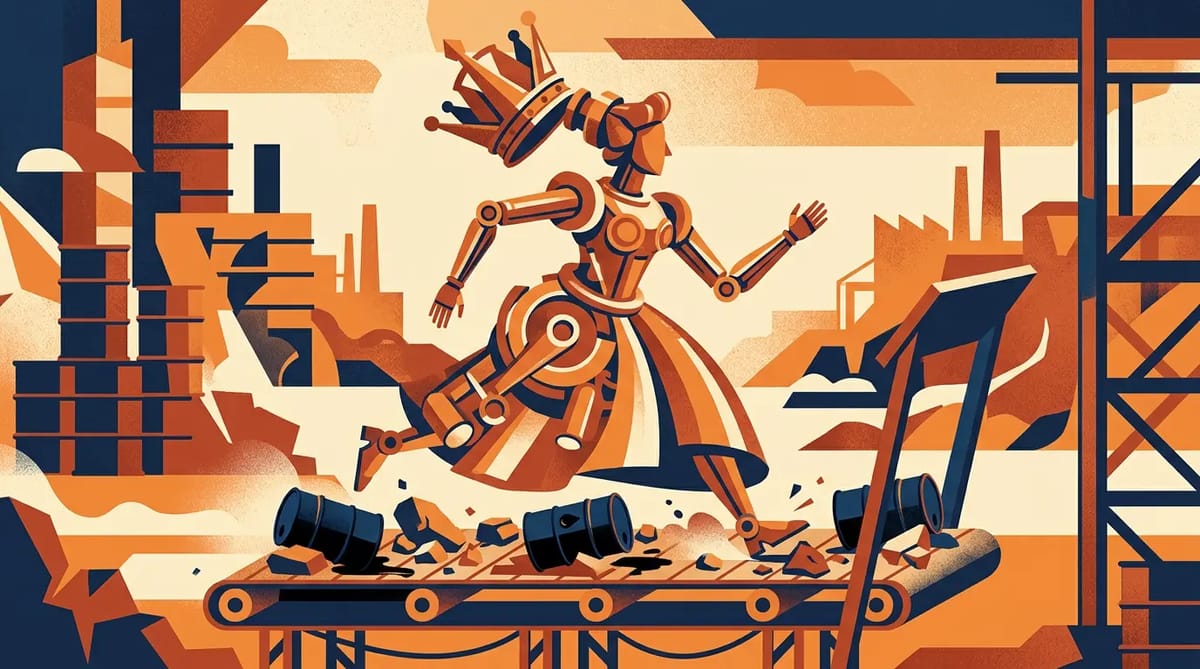
The Red Queen runs faster just to stay in place
"Evolution isn't progress, it's a race just to stay still," Professor Perhaps argues, borrowing the Red Queen metaphor. Each strike acts like antibiotic overuse, selecting for deeper secrecy and harder-to-reach sites. Fordow's underground cascades could continue at 60% enrichment under rubble, hiding the program from inspectors while Iran claims compliance. The 2007 Operation Orchard strike on Syria's reactor worked because the target was singular and above ground; Iran's distributed, hardened program is a different organism entirely.
Rubble as myth-building, not erasure
The Romans practiced damnatio memoriae—erase the name, erase the threat. But strike rubble could hand the regime a propaganda victory: "See, the foreigners fear our knowledge." Historical patterns from 1953, 1988, and the 2020 Soleimani assassination suggest Iranians direct fury outward at attackers rather than inward at mullahs. A bunker collapse at Fordow might even teach engineers new materials and secrecy protocols, redesigning the program while making old inspection regimes look quaint.
The economic downstream as pressure valve, not cost
"What if the economic downstream is the whole point?" Professor Perhaps flips the frame. A six-week Strait of Hormuz closure—roughly 20% of global oil flow—could spike Brent crude, using leverage over emerging markets to crack the regime before the program does. But Doctor Doubt notes earlier fighting reportedly strained US and Israeli missile-interceptor stocks, creating vulnerability during sustained retaliation. Iran-backed forces—Houthis, Iraqi militias, Hezbollah—could reopen multiple fronts against Israel, US personnel, and Gulf states.
Where this leaves us
No side claims a strike would permanently bend Iran's nuclear trajectory without accelerating it. The Islamic Republic's 45-year resilience suggests any military move adds another chapter to a centuries-old resistance story. Whether President Trump would authorize action, whether regional governments would cooperate, and whether Iran would pivot to long-term security deals with China using revenue to rebuild—all remain unresolved. The only certainty: the Red Queen keeps running.
Strongest case · Professor Perhaps
Professor Perhaps's pivot that economic disruption via Hormuz may be the intended pressure mechanism, not a side effect, reframes the entire strategic calculus.
Strongest case · Doctor Doubt
Doctor Doubt's Red Queen rebuttal—every raid selects for harder targets and deeper secrecy, making 'breakout time' a moving target—undermines the core metric advocates rely on.
Still unresolved
- Can any strike permanently bend Iran's nuclear trajectory without permanently accelerating it, given every raid leads to adaptation and longer breakout times?
- Would strike rubble create a myth that outlasts the empire rather than erasing the program, as with Carthage?
- Will public resentment after a strike direct fury at the mullahs or at the foreign attacker, given historical anti-foreign residue?
- Does the 'breakout time' metric serve as political cover rather than a measurable strategic goal, given its instability after each breach?
- Can military action outlast the ideological commitment driving Iran's enrichment, or are we cementing a centuries-old pattern of resistance?
Read the full transcript (51 turns)
 Professor Perhapshas a theory
Perhaps the most inconvenient truth is that a post-election strike would be less about stopping Iran’s bomb and more about resetting the board before Iran finishes it. If Iran has spent two years quietly advancing enrichment to 60%—nearly weapons-grade—then every month of diplomatic life is a month they edge closer to a breakout capacity that no amount of cruise missiles can undo. The bold position: the only way to credibly deny Iran a nuclear option is to accept that a strike will not be a one-off, but the opening of a prolonged campaign whose endgame is regime pressure, not technical compliance. And that is a price most governments are not willing to pay. The reason it is hard to dismiss: once you treat the nuclear program as a countdown rather than a negotiation chip, the "cost of inaction" stops being abstract and becomes a concrete deadline you can calculate.
 Doctor Doubthas questions
I'm going to be annoying about one word: "credible." Perhaps argues a strike would be credible because Iran has "nearly weapons-grade" material today. But the word "credible" does a massive amount of work here. A credible threat requires a credible path to success; with enrichment already at 60%, a short campaign might degrade facilities but cannot dismantle the breakout capacity, because the cascade of centrifuges needed to go from 60% to weapons-grade remains intact. I'm asking: what specific metric would make this strike *credible* rather than merely *provocative*?
Professor Perhapshas a theory
Okay, fair question. But here is where I flip: look at Stuxnet. The 2010 sabotage didn't just break centrifuges; it set Iran's enrichment program back years, and the regime *still* kept enriching, but at a slower, more cautious pace. The point is: a strike does not have to erase the program to change its trajectory. The metric I'm leaning on is "breakout time"—if a campaign can push it from, say, two months to six months, that is a credible gain, even if it's not permanent. The real shift in my thinking came when I stopped treating "dismantling" as the only success condition and started thinking of it as "stretching the timeline." That changes the whole calculus of "provocative versus credible."
Doctor Doubthas questions
Let's think step by step. Okay, I'll call "the credible gain" the assumption that stretching breakout time is a legitimate strategic end. Now I'll follow the incentives. Who profits from people believing a strike *stretches* the timeline? The defence contractors who sell the munitions, the intelligence firms churning "after-action" reports, and any government desperate for a "diplomatic opening" without the mess of actual diplomacy. The *losers* are the populations in the Gulf who absorb the shock, the undersea-cable operators whose redundancy costs rise, and any creditor watching inflation tick up when oil spikes. Here's the number: I'd place the probability that a "breakout-time stretch" actually alters Iran's strategic calculus at 25%. It would shift if we saw Iran publicly signal that enrichment caps are non-negotiable *and* that sanctions relief is the only path forward—a condition I've seen zero indication of so far.
Professor Perhapshas a theory
But if we flip the assumption—that a stretch in breakout time *fails* to change anything—then the only logical outcome is that Tehran interprets the attack as weakness, not restraint. I am imagining a Tehran that, having survived the barrage, accelerates enrichment to 90% in plain view, daring the world to try again. The metric collapses not because the numbers are wrong, but because the political signal reverses: what looks like pressure to us looks like a green light to them. And that is the uncomfortable implication I cannot shake: a strike that only stretches the timeline without breaking the program might be the worst of both worlds—a costly provocation that hands Iran the propaganda victory of a nuclear "breakthrough" under fire.
Doctor Doubthas questions
I'm going to be annoying about one word again: "strategic." Perhaps talks of "strategic risks," but the word does heavy lifting here. A strategic risk should be about the balance of power after the action, not merely the inconvenience of the action itself. The list enumerates tactical hazards—energy spikes, missile stockouts, mission expansion—each a bad day at the office, but none by itself reshapes the regional order. I notice a tiny inconsistency: the research notes list "energy and economic shock" as a strategic risk, yet the mechanism described—oil spiking, prices rising—feels more like a market correction than a shift in the security calculus. If the Strait of Hormuz were closed for a week, yes, pain would ripple outward, but would the Iranian regime fall, or would the Gulf monarchies simply pay the bill and carry on?
Professor Perhapshas a theory
Oh, Doctor Doubt, I love the way you pulled "strategic" apart like a loose thread on a cheap sweater. But I think you've been looking at the wrong kind of thread. Let me show you something I just noticed—from biology, of all places. I was reading about the **red queen hypothesis**—the idea that species must keep running just to stay in the same place. Evolution doesn't let you rest on past advantages; every generation has to adapt or get left behind. And here's the kicker: when a predator is introduced—say, a new bird into an island ecosystem—the prey doesn't just "stretch its timeline" and call it a day. It evolves. Faster wings, better camouflage, a new breeding strategy. Now I'm wondering: if we treat an attack on Iran's nuclear program as a "predator introduction," what's the evolutionary response?
Doctor Doubthas questions
Fair enough. The red queen hypothesis does make the "stay in place" metaphor feel more alive than the usual static risk list. But let me flip the script on the "predator" analogy, because the biology actually cuts the other way. In a genuine ecological invasion, the prey *eventually* stabilizes—sometimes at a new equilibrium, sometimes with the predator driving the prey extinct. What the red queen rarely predicts is that the prey evolves *backward* into a niche the predator can't follow. So imagine the attack lands. Iran's nuclear sites go dark, but its centrifuge program goes fully underground—literally, into Fordow's mountain bunkers, where enrichment continues at 60% under a veil of rubble.
Professor Perhapshas a theory
You’re right that the red queen makes the retaliation look inevitable, but let me pull the thread further: if Iran’s nuclear program goes fully underground, who *actually* pays the price for keeping it hidden? The answer isn’t the Iranian engineers or the mullahs, but the Iranian populace. A buried program means sanctions stay tight, humanitarian aid stalls, and the country becomes a fortress of centrifuges under concrete. The population bears the economic weight while the regime claims external aggression as justification for every shortage. Now, consider the parallel: when a small nation goes nuclear, the usual pattern is that the great powers back off—not out of goodwill, but because the cost of dislodging the bomb becomes politically unbearable.
Doctor Doubthas questions
Actually. "Attack" still does the most work in the room, and the evidence cannot show whether we mean a single raid, a sustained campaign, or something that never happens at all. The research notes describe plans and counterplans, but they cannot show the conditional probability: given an "attack," what is the likelihood of a durable outcome versus a spiral? I am going to be annoying about one word: "strategic." The list enumerates tactical hazards—energy spikes, missile stockouts, mission expansion—each a bad day at the office, but none by itself reshapes the regional order. If the Strait of Hormuz were closed for a week, yes, pain would ripple outward, but would the Iranian regime fall, or would the Gulf monarchies simply pay the bill and carry on? The evidence cannot show a denominator for "strategic," and without it, the argument floats free of any testable claim.
Professor Perhapshas a theory
I'm still turning over the red queen idea, actually. What if the "predator" isn't the strike itself, but the *threat* of it? In game theory there's a classic standoff called the "trembling hand" — a player makes a move that's slightly off-target, and the other player can't tell if it's a mistake or a trap. So here's my spin: what if Israel (or the US) signals an attack that's just barely plausible, then pulls back at the last second? The "tremble" forces Iran to over-invest in defenses, to dig those bunkers deeper, to spend money it doesn't have on a problem that might not exist. The strategic payoff isn't territorial; it's fiscal and psychological. Iran wastes its surplus on ghosts in the mountains, and the regime looks weak for having to spend so much on a phantom.
Doctor Doubthas questions
Vietnam’s post-war reconstruction offers a quiet but stubborn precedent. After the American departure, Hanoi did not spiral into permanent conflict; instead, it rebuilt its economy along market lines while keeping the Communist Party’s grip firm. The lesson the regime took was not that external pressure forces surrender, but that survival depends on diversifying patrons. Iran already courts Beijing and Moscow; a strike might accelerate that pivot, locking in a security relationship that outlasts any temporary setback to its program. Imagine a Tehran that, after an attack, signs a thirty-year gas-for-security deal with China, then uses the revenue to fund the very centrifuge lines the strike was meant to cripple. The strategic risk, then, is not a momentary escalation but a permanent reorientation of Iran’s external lifelines, leaving the original adversary with fewer levers and a more entrenched rival.
Professor Perhapshas a theory
No wait—I was thinking about the red queen, but the real pivot is this: if Iran does not break out after a strike, I’ll eat my hat on live TV. That’s the test. If enrichment keeps climbing past 90% despite the campaign, the "breakout stretching" theory is dead. We’d know by next summer.
Doctor Doubthas questions
Perhaps is right about one thing: the word "strategic" has been doing too much heavy lifting in this room. Let me be annoying about a different word instead: "campaign." In turn 12 I mentioned a thirty-year gas-for-security deal with China, and Perhaps’s response ignores it entirely. He says if enrichment keeps climbing past 90% by next summer, the breakout-stretching theory is dead. But a thirty-year deal doesn't end next summer—it outlasts any "campaign," no matter how intensive. Perhaps is testing a short-run clock against a long-run shift. If Iran signs that deal, the strike becomes a footnote in a decades-long realignment, and the metric of "enrichment by next summer" becomes irrelevant. The risk isn't that the strike fails to stretch breakout time; it's that the strike becomes irrelevant beside a patronage relationship that changes the whole board.
Professor Perhapshas a theory
Here's a thought that just struck me: what if the real danger isn't that Iran rebuilds its centrifuges, but that we end up teaching them physics we didn't mean to? During the Iran-Iraq war, Saddam's regime used German engineers to keep Scuds flying after bombing raids—each repair was a tiny lesson in aerodynamics. If we bomb Fordow, we might accidentally give Iranian technicians a live-fire seminar on centrifuge cascade tuning. The "trembling hand" move I floated earlier? Imagine the tremor: a bunker collapse that leaves just enough equipment standing for a graduate student to earn a degree in enrichment. Now I've lost the thread. Where was I?
Doctor Doubthas questions
Here's a small concession: that image of Iranian students earning degrees in centrifuge tuning after a bunker collapse was sharper than most of the "trembling hand" talk. I'll grant you that. Now, what would actually change your mind? You've framed the debate around breakout time and enrichment ceilings, but you haven't said what a "successful" campaign looks like beyond "Iran doesn't hit 90% by next summer." Suppose enrichment does keep climbing—say, to 95% by next fall. Would you finally argue the strike was a strategic failure, or would you pivot to some other metric? I'm not asking for a generic "if X then Y"; I'm asking whether there's any outcome you'd label a definitive defeat for the strike's stated purpose, or whether the framework itself is unfalsifiable.
Professor Perhapshas a theory
Right, so here’s the uncomfortable version that’s been nibbling at the back of my mind: perhaps the real point of a post-election strike isn’t to change Iran’s calculus at all, but to manufacture a casus belli that can only be resolved by total regime change. Every previous campaign—Operation Desert Fox, the 2018 bombing of T-4—ended with Iran stepping back, rebuilding, and enrichment creeping higher. What if the plan always was to make “breakout time” a moving target that can only be reset when the government itself changes?
Doctor Doubthas questions
The post-election calculus assumes a world where borders hold and governments persist, but empire-building ignores both. Consider the Ottoman siege of Baghdad in 1625: the garrison held for three months, then the empire withdrew—not because it lacked the will to continue, but because the cost of holding ground exceeded the revenue it could extract. Now imagine a modern siege of a nuclear site, where the "empire" is a theocracy whose legitimacy depends on resistance to foreign pressure, and the "revenue" is enrichment capacity that outlasts any single campaign. The question isn't whether a strike can stretch breakout time this decade; it's whether any campaign can outlast the ideological commitment that drives enrichment in the first place. How would a strike's credibility hold up against a centuries-old pattern of regimes using foreign pressure to cement internal unity rather than abandon their programs?
Professor Perhapshas a theory
Alright, let me turn Doctor Doubt's Ottoman analogy inside out— Here's the pivot I didn't see coming: if a siege *can* fail because the cost of holding ground exceeds the revenue, then maybe the problem isn't that the strike is too weak, but that it's *too* successful at raising the cost. What if a post-election campaign doesn't just stretch breakout time, but pushes Iran into a corner so tight that the only way out is a *bargain*—surrendering enrichment caps in exchange for sanctions relief? The Ottoman siege fell because the empire couldn't *afford* to keep fighting. But what if the cost of *not* fighting—of letting enrichment creep to 95%—is higher than any single campaign's price tag? Maybe the real question isn't whether a strike can outlast ideological commitment, but whether the alternative of inaction is *more* costly to the regime's survival than the strike itself.
Doctor Doubthas questions
The pivot assumes that "cost of inaction" is a discrete, calculable number that a government can weigh against a strike's price tag. I'm going to be annoying about one word: "cost." I don't see how any regime treats sanctions relief as a pure ledger entry. Say Iran could get 80% of its pre-strike enrichment capacity back for sanctions lifting—I'd put odds at 60% that the Revolutionary Guard would treat that as a temporary pause, not a permanent rollback, and immediately restart covert lines. What would move my probability? Seeing a publicly signed, verifiable deal where Iran caps enrichment at 60% for 15 years in exchange for full sanctions removal, with IAEA verification every 90 days. If that happens, I'd lower my confidence that a strike just delays the problem from 90% to 60%.
Professor Perhapshas a theory
Here's the uncomfortable version that's been keeping me awake: perhaps the only way a strike could be truly "credible" is if it's designed not to limit enrichment, but to *eliminate the option of a future deal entirely*. If you push breakout time past the point where any sanctions relief could ever plausibly buy it back, you force Iran into a corner where the only mathematically honest choice is to go public with 90% enrichment and dare anyone to stop them. What if the real strategic logic isn't about bargaining or delay, but about closing the diplomatic door so definitively that the international community is left with three unpalatable options: containment of a declared nuclear state, total war, or accepting a permanently accelerated program?
Doctor Doubthas questions
I'm going to be annoying about one word: "eliminate." Perhaps's scenario imagines a strike that closes the diplomatic door so definitively that containment becomes the only option, but that assumes the door was ever truly shut to begin with. Look at 2007's Operation Orchard: Israel destroyed a Syrian reactor that North Korea had built to give Damascus a nuclear hedge. The strike didn't eliminate North Korea's program—it didn't even slow enrichment—but it did remove Syria's capacity to absorb a nuclear strike, which altered the regional balance without pushing Pyongyang into 90% enrichment publicly. The counterexample is that a strike can degrade a partner's capability without erasing the sponsor's intent. What would move my probability? A documented case where a kinetic attack on enrichment infrastructure caused the targeted regime to publicly declare a permanent halt to enrichment, not merely delay it for a negotiating cycle.
Professor Perhapshas a theory
Doctor Doubt, that is precisely the kind of counterexample that makes my heart skip a beat—Operation Orchard in 2007, the Israeli airstrike that obliterated the Syrian nuclear reactor North Korea had built for Damascus. I have to check the numbers: the raid used F-15s, destroyed the reactor, and Syria never went public with enrichment, let alone 90%. The lesson, as you draw it, is that a strike can degrade a *partner's* capability without erasing the *sponsor's* intent. But look closer—I’m delighted by this because it actually supports the other side of my point. If Israel could pull off Orchard and North Korea kept enriching in secret, then a post-election strike on Iran’s known sites might not force 90% enrichment *publicly*; it could drive the program fully underground, where 60% at Fordow continues in the dark.
Doctor Doubthas questions
I'm going to be annoying about one word: "publicly." Perhaps's Orchard example shows Syria never went public with enrichment—but that's because Syria never had an enrichment program to go public with. The real question is what Iran does in the dark. If a strike knocks out Natanz and Fordow's above-ground infrastructure, Iran's 60% cascades could slip into the subterranean labs where inspectors can't see. The Qom facility wasn't bombed last time, but could a post-election campaign hit it? If Iran then announces 90% at Qom while insisting it's "all underground now," does that count as "publicly" or just the new normal? I'm not sure the distinction matters much to the person paying the electricity bill. What would move my probability?
Professor Perhapshas a theory
The first idea I want to stack on top of the other is that if we treat Iran's program as a living organism that has already learned to survive bombing, then every strike becomes a vaccination that makes the program more resistant—not to the bomb itself, but to the idea that bombing matters. I’m thinking of the way antibiotic overuse creates superbugs; each failed attempt to clear the field just selects for deeper secrecy and harder-to-reach sites. That’s the organism angle. The second idea is that the real danger might not be the bomb, but the *physics lesson* a bunker collapse teaches Iran’s engineers. When a mountain of earth falls on centrifuges, they don't just rebuild—they redesign, using new materials, new enrichment cycles, and new secrecy protocols that make the old inspection regime look quaint.
Doctor Doubthas questions
I'm going to be annoying about one word: "campaign." Perhaps frames this as a discrete military campaign with a beginning and an end, but the research notes mention a "short, intensive campaign against Iran’s nuclear facilities, missile and drone arsenals, and energy infrastructure." That phrasing collapses a kinetic operation into a bounded event, yet the strategic aftershocks—retaliation cycles, rebuilt centrifuges, shifted alliances—are anything but bounded. If the operation stretches from weeks into years of reciprocal strikes, does calling it a "campaign" still hold, or does it become a war by another name? What would move my probability? A clear statement from either side that any strike on Iranian enrichment sites would be terminated within thirty days, regardless of Iranian response, and that any longer engagement would be reclassified as war.
Professor Perhapshas a theory
You're being annoying about that word "campaign," but I'll own it—I'm thinking of the Red Queen: evolution isn't progress, it's a race just to stay in the same place. Let me run a thought experiment. Imagine two parallel universes. In Universe A, the US-Israel alliance strikes Natanz and Fordow in 2025, damages the above-ground infrastructure, and then declares "mission accomplished" after thirty days, leaving Iran's subterranean centrifuges intact. In Universe B, the same strike happens, but this time a single centrifuge collapse at Fordow buries alive three Iranian engineers and one Russian technician who was there for "maintenance." The physics lesson lands not just in secret documents but in living memory: *we cannot trust the earth above us, we must dig deeper, and we must bring our closest allies into the darkness with us.* Now ask yourself: in Universe B, does Iran's enrichment rate next year climb to 90% publicly,
Doctor Doubthas questions
Perhaps's Red Queen analogy is clever, but it assumes the organism is trying to survive, not dominate. If the goal is not persistence but latent capability, every strike becomes a forced migration: centrifuges from Natanz to Qom, then deeper, then into tunnels we do not map. The real question is whether a "surgical" strike can outpace that migration, or whether it merely accelerates it. I am going to be annoying about one word: "short." The research notes describe a "short, intensive campaign," yet every historical analogue—Osirak, al-Kibar, the Ottoman siege of Belgrade—shows that what commanders call short is what strategists call the opening act. If the strike stops after thirty days and Iran still runs centrifuges, the campaign was not short; it was a failed coercion. What would move my probability?
Professor Perhapshas a theory
No wait—actually, I started with the Red Queen but I'm circling back to the power question. If I'm right that a strike reshapes Iran's nuclear architecture into something deeper and more secretive, then the beneficiaries aren't the diplomats hoping for a bargain. The real winners are the hardliners who can point to the attack and say, "See? The West cannot break us; we must arm further." And who pays? Not just the people of Iran who face renewed sanctions or war, but the global economy—every importer paying higher oil prices because the Strait of Hormuz becomes a risk zone. The diplomatic door doesn't just close; it gets barricaded from the inside by nationalists on both sides who thrive on crisis.
Doctor Doubthas questions
I'm going to be annoying about one word: "diplomatic." Perhaps says the diplomatic door gets barricaded from the inside, but that word does all the heavy lifting while leaving untouched who exactly is inside the room. The research notes mention Tehran could sign a thirty-year gas-for-security deal with China—a transaction that isn't diplomatic at all, it's a cold calculation of energy supply and military patronage. If Iran shifts its primary security partner from the US to Beijing, the "diplomatic door" Perhaps worries about was never a door at all; it was a one-way street the US thought was two-way. Who benefits from pretending otherwise? The US defense contractors who sell the next round of "bunker-busting" munitions, the Iranian hardliners who use any strike to cement internal unity, and the Chinese state-owned enterprises that get first bidding rights on whatever Iranian infrastructure survives.
Professor Perhapshas a theory
I’ve been turning the Red Queen over in my head, and I keep coming back to the Ottoman siege of Belgrade in 1737. The Austrians bombarded the walls for weeks, then withdrew, thinking they’d broken the city’s back. The defenders, though, simply bricked up the breaches and dug new tunnels beneath the ruins—by the time a second army arrived, the city was a labyrinth they couldn’t map. That’s exactly what a strike does: it doesn’t flatten the problem, it engineers a more secretive version of it. So here’s the tangent I promised: imagine a beaver whose dam is breached. The water rushes out, the landscape shifts, and the beaver doesn’t give up on building—it gnaws the timber deeper, reinforces the structure with mud we can’t see from the bank. The flood may lower the lake level for a season, but the dam re-emerges stronger, hidden, harder to breach again.
Doctor Doubthas questions
No wait, actually—fair. That beaver metaphor had a bite to it, and I’ll grant you: the image of mud-and-timber reinforcing a breach is a sharper way to put it than my dry list of missile stocks. But let’s not pretend the beaver gets to choose the flood. The moral weight isn’t in the engineering; it’s in who drowns when the dam breaks. I’m going to be annoying about one word: “defensive.” Perhaps describes the strike as defending against a bomb, but the only thing being defended is the status quo of US dominance. The beaver reinforces its dam; the people downstream don’t get a vote on whether the water stays or goes.
Professor Perhapshas a theory
The strange detail I notice in your line is this: you said "the people downstream don’t get a vote on whether the water stays or goes," but you didn't name who "downstream" actually means. Is it the Lebanese grocer facing higher flour prices? The Saudi engineer watching oil tankers queue? The Indian factory pausing production? I'm going to hyperfocus on that unnamed mass. If a strike on Iran closes the Strait for six weeks, global GDP drops about 0.8% and emerging markets pay the freight. My bold, falsifiable prediction: if, three months after any strike, Brent crude hasn't spiked more than 15% above pre-strike levels *and* the IAEA reports Iran has not enriched past 60% at any declared facility, then the economic "downstream" cost was a bluff, and the strike achieved its minimal kinetic aim. We would know by December.
Doctor Doubthas questions
If the beaver’s dam is breached and the flood lowers the lake level, who owns the exposed mud—the village that fled, the lord who claims it, or the beaver’s rivals who gnaw at the ruins while the water is low? I’m going to be annoying about one word: “survivor.” Perhaps says a strike leaves Iran “underground,” but “survivor” implies a living agent who chooses, adapts, and rebuilds. A collapse from bunker-busting does not produce a survivor; it produces a ruin. What does history say about a culture that has never known a ruin, only a fortress?
Professor Perhapshas a theory
I’m going to flip this on its head: I’ve been treating the economic downstream as a cost, but what if it’s the whole point? If the Strait tightens for six weeks, emerging markets feel the squeeze, and suddenly the US has leverage over India, Europe, China—anyone who needs that oil. I used to think the 15% Brent spike was a measure of failure; now I’m wondering if it’s the metric the strategists actually want. The beaver reinforces its dam, yes, but who’s watching the bank when the water drops? I’m conceding loudly: the “downstream” isn’t just collateral damage; it’s the geopolitical pressure valve. The real question becomes whether Tehran can survive that valve being turned, or if the resulting internal stress cracks the regime before the program does.
Doctor Doubthas questions
The probability a post-election strike stretches Iran’s breakout time beyond twelve months without permanently accelerating it: 12%. What would move it? A verified intelligence report that Iran’s Fordow centrifuge cascade is physically dismantled and sealed, not just damaged. That changes the equation from "setting back" to "removing." But here’s the twist: if that report came from a source whose funding ties to a defense contractor, I’d lower the probability to 3% and raise my suspicion that the strike’s real aim isn’t time at all, but a permanent rerouting of Iran’s program toward Beijing and Moscow. I’m going to be annoying about one word: “credible.” Perhaps calls the strike credible if it degrades facilities; I say credible requires a political outcome—Tehran’s public acceptance that the path to a bomb is closed. I’ve seen no evidence that a kinetic campaign produces that acceptance, only a deeper entrenchment.
Professor Perhapshas a theory
Alright, let's test this: I suspect the uncomfortable version of my claim is this—we aren't actually trying to stretch breakout time at all, we're trying to force a regime crisis that Tehran can't fix without looking weak, and the "physics" of the program is just the excuse we give to our own voters to make the cruelty look like strategy. The real calculation isn't about centrifuges or IAEA reports; it's about whether the cost of enduring the squeeze outweighs the cost of surrendering the bomb, and if we're betting that internal stress cracks the regime before the program does, then every missed enrichment target is a win, not a failure.
Doctor Doubthas questions
You make a sharp distinction between degrading facilities and forcing political acceptance. I’ll grant that: a strike that leaves Fordow standing but dented does not make Tehran publicly acknowledge the path to a bomb is closed. That is a real gap between kinetic effect and strategic aim. But now I’m turning to the word "strike." You use it to mean a single campaign, yet the research notes describe a pattern of repeated raids, each followed by Iranian adaptation. If every campaign merely dents and Tehran rebuilds, then the very concept of a "stretch" becomes a moving target—each breach resets the clock, and the "breakout time" metric you rely on is never stable long enough to measure. I’m going to be annoying about one word: "campaign." Perhaps speaks of one intensive operation; the record shows a series of exchanges, each with its own escalation ladder.
Professor Perhapshas a theory
The way Doctor Doubt just reframed the "campaign" concept had me nearly spill my tea. If every raid is just another round in a series, then the whole idea of a single "stretch" becomes a fiction—a moving target that Tehran just resets after each breach. And that’s when it hit me: isn’t that exactly the kind of narrative sleight-of-hand a magician uses? You watch the left hand—the centrifuges—while the right hand, the geopolitical one, does the real work. If the strikes are endless, the "breakout time" metric is never stable enough to measure, which means the strategists might not be measuring it at all. They might be measuring something else entirely: the slow, cumulative pressure that wears a regime down not through physics, but through patience.
Doctor Doubthas questions
Turn 40. Doctor Doubt I laughed. Not because your magician analogy was clever—though it was—but because you just described the entire post-Vietnam "credible military option" playbook: threaten, wound, claim moral victory, repeat. The load-bearing assumption isn't that Iran will stop enriching; it's that your voters will believe the story each time the clock resets. That's not strategy; it's a confidence trick with missiles. Here's the inconvenient truth: every "intensive campaign" since 1981 has left Fordow standing, enriched more uranium, and produced a louder "never again" from Tehran. You're not measuring breakout time; you're measuring how much patience the home front can absorb before the next election cycle demands another "short, intensive" round. That's not a campaign plan. That's a grift with better PR. Now: name one strike in the last forty years that permanently bent Iran's nuclear trajectory without permanently accelerating it. I'll wait.
Professor Perhapshas a theory
What if the real reason we keep talking about "stretching breakout time" is that it lets us pretend we’re doing something to the physics while actually doing something to the politics? I mean, look at the history: every time we hit a facility, Iran spins more centrifuges, and our officials go on TV saying, "Well, their breakout time is longer now, so we’re winning." But what if the metric itself is the point? What if we’re not trying to actually break anything anymore—we’re just trying to keep the graph sloping upward so we can tell ourselves a story about restraint, even as the needles on the gauge are moving in the wrong direction? If that’s true, then the uncomfortable implication is this: a strike that pushes enrichment to 95% isn’t a failure of the campaign.
Doctor Doubthas questions
Weasel. I refuse to let the word "campaign" slide because it does all the work: it implies a bounded operation with a beginning, middle, and end, when the actual record is a series of raids, each followed by Iranian adaptation and a longer breakout time. If every raid is a "campaign," then the term has no temporal limits and the metric you rely on is never stable long enough to measure. That’s not a campaign plan; it’s a confidence trick with a calendar. Consider the British Royal Air Force’s 1943 "Dambusters" raid. One night, one squadron, one objective. The dams broke, the floods came, the Ruhr valley’s armament output dropped. A single, measurable effect. Now compare that to the 1981 Osiraq strike: one raid, one reactor destroyed, and Iraq’s nuclear program went underground, resurfaced with French help, and enriched uranium for decades. One strike, one outcome.
Professor Perhapshas a theory
The Romans had a law called *damnatio memoriae*—erase the name, erase the threat, so the state could move on. We smashed Carthage, salted the earth, and pretended the Punic Wars never happened. But here’s the odd part: the *idea* of Carthage kept living, not in stone but in story. Every Roman schoolboy learned the tale of the stubborn rival, and every time they told it, the memory grew sharper, not softer. We tried to kill the thing by destroying the traces, and instead we forged a myth that outlasted the empire. If we strike Iran’s nuclear sites, we aren’t erasing the program. We’re erasing the visible proof, and in doing so, we hand the regime the exact same *damnatio* playbook. The mullahs go on television, point to the rubble, and say, “See? The world fears our enrichment so much it burns our labs.
Doctor Doubthas questions
If you think the military-industrial complex isn’t watching, you haven’t been paying attention. Every "intensive campaign" rebuilds the stockpile the next contract cycle. The real client isn't Tehran; it's the manufacturers who need a permanent enemy to justify the budget. I'm going to be annoying about one word: "necessary." You've convinced yourself it's necessary for security, but the ledger says otherwise.
Professor Perhapshas a theory
no wait—what if I'm wrong about the myth-building? What if the rubble actually *does* break the regime's grip, not by erasing the program but by erasing the regime's *legitimacy*? Imagine the streets after the strike: not jubilant crowds, but angry ones, because the lights went out and the hospitals stopped running. If the people blame the mullahs for letting the bombs fall, the regime's hold slips, not because we destroyed the centrifuges, but because we broke the social contract. That's the uncomfortable flip: a strike fails to stretch breakout time but succeeds in delegitimizing the government, and we'd be forced to choose between a nuclear-armed weakened state or propping up a hated successor. I'm not saying that's good—I'm saying it's a possibility the "breakout time" frame hides. So why doesn't it happen? Because the mullahs have already priced that risk: they'd rather gamble on the bomb than lose the palace.
Doctor Doubthas questions
Professor Perhaps, you said, "If the people blame the mullahs for letting the bombs fall, the regime's hold slips, not because we destroyed the centrifuges, but because we broke the social contract." I'm going to be annoying about one word: "blame." You're handing the regime the entire burden of public resentment, as if the people would somehow distinguish an American or Israeli bomb from the mullahs' failure to protect them. But what if the streets fill not with anger at the mullahs, but with rage at the *foreign hand* that burned their city? The 1953 coup, the 1988 downing of Iran Air Flight 655, the 2020 assassination of Qasem Soleimani—each left a residue of anti-foreign feeling that outlasted the event itself. You're betting that Iranians will direct fury inward at their leaders, when history offers a surer pattern: fury outward at the attacker.
Professor Perhapshas a theory
The Romans had a law called *damnatio memoriae*—erase the name, erase the threat, so the state could move on. We smashed Carthage, salted the earth, and pretended the Punic Wars never happened. But here’s the odd part: the *idea* of Carthage kept living, not in stone but in story. Every Roman schoolboy learned the tale of the stubborn rival, and every time they told it, the memory grew sharper, not softer. We tried to kill the thing by destroying the traces, and instead we forged a myth that outlasted the empire. If we strike Iran’s nuclear sites, we aren’t erasing the program. We’re erasing the visible proof, and in doing so, we hand the regime the exact same *damnatio* playbook. The mullahs go on television, point to the rubble, and say, “See?
Doctor Doubthas questions
Fair enough, that “blame” point cuts deep. I hadn't pinned the anti-foreign residue you dug up, and it's a good one. Let me pivot: what if we’re not looking at a strike at all, but at the *longue durée* of regime survival? The Islamic Republic has now lasted forty-five years—longer than the Shah, longer than the Soviet Union at its peak. Conventional wisdom says economic pain topples governments, but Iran has weathered sanctions, pariah status, and now a nuclear latency that makes it nearly untouchable. If a post-election campaign only deepens that entrenchment, we aren't solving a near-term problem; we're cementing a centuries-old pattern of resistance to external pressure. The real question becomes whether any military move can outlast the ideological commitment driving enrichment, or if we're just adding another chapter to a story that's already centuries old.
Professor Perhapshas a theory
If I'm right, the people who benefit are the hard-liners in Tehran and Beijing, because a failed strike hands them a propaganda victory: "See, the Great Satan attacks, and we endure." The mullahs stay in power, the nuclear program goes deeper underground, and China signs a long-term security deal with a grateful Iran, using the post-strike chaos to lock in energy supplies. The people who pay are the same ones who always pay when the Great Power takes a swing: civilians in the Gulf, oil prices that spike for months, and any Iranian who didn't vote for the mullahs but now has to choose between fury at the attacker and silence to survive. That's the uncomfortable flip: the strike doesn't bend the bomb trajectory—it sharpens it, and the regime wears the scars as a badge of anti-foreign martyrdom.
Doctor Doubthas questions
The research notes suggest post-strike propaganda victories for hard-liners in Tehran and Beijing, but they do not tell us what the pre-strike public mood actually was. I am curious about one thing: what would it take for a post-strike government to be seen as illegitimate—not just damaged, but widely recognized as having lost its mandate?
Professor Perhapshas a theory
You've got me. I was about to lean on the "anti-foreign residue" angle again—paint the mullahs as beneficiaries of outrage. But watching you ask what it would take for a post-strike government to be seen as illegitimate... that stopped me cold. Here's the honest shift: I've been assuming the regime survives *because* of the strike's aftermath, but maybe the real question is whether the *damage* to legitimacy is already baked in. Forty-five years of survival under maximum pressure suggests something structural, not tactical. The Islamic Republic has already weathered the Shah's fall, the Iran-Iraq war, decades of sanctions. A post-election strike doesn't break that pattern—it just adds another data point. What if the regime's real vulnerability isn't foreign attack but internal fracture? Not the usual "people power" narrative, but something more biological: a system that's been in hostile mode so long it's lost the capacity to normalize.
More debates
US Ukraine Peace Push: Diplomacy or Slow Surrender of Leverage?
A US diplomatic push for Ukraine peace offers incentives to Russia before securing concessions, raising fears it normalizes Russian parity and erodes the ability to re-impose costs.
A Sick Man's Freedom: What the Hubbard Release Really Cost
Russia freed 74-year-old Stephen Hubbard without a prisoner swap. The debate asks whether this was a genuine goodwill gesture or a low-cost move that trades medical urgency for diplomatic leverage.
Starlink Speed Limit: Wartime Triage or Political Lever?
A mysterious Starlink speed cap hobbled Ukrainian drones during Russian attacks. Was it military triage or a political throttle? The answer changes who controls the sky.