World affairs · · 2 min read
US Ukraine Peace Push: Diplomacy or Slow Surrender of Leverage?
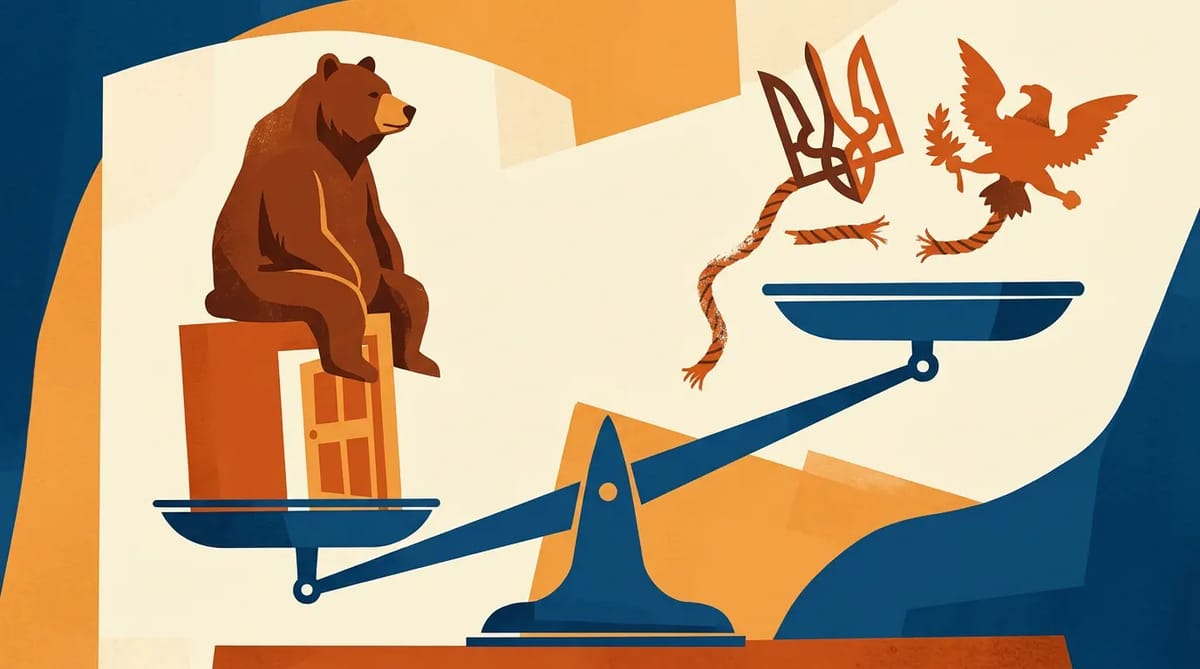
A US diplomatic push for Ukraine peace offers incentives to Russia before securing concessions, raising fears it normalizes Russian parity and erodes the ability to re-impose costs.
In 30 seconds
- US envoys engage both Kyiv and Moscow but lack a snapback trigger to restore pressure if talks fail.
- Sanctions relief and energy deals ease Kremlin pressure while Russia keeps maximalist demands.
- Critics warn diplomacy becomes a one-way ratchet: once channels open, re-imposition becomes politically impossible.
- The push may serve US election cycles more than a strategic lever against Putin.
The White House calls it a peace push; critics call it a pressure valve for an election year. US envoys have shuttled between Kyiv and Oslo, drafting security guarantees and floating territorial compromises, while President Trump pauses sanctions to keep Moscow at the table [5][6]. The question is whether the diplomacy tests Russian seriousness or simply makes surrender look like progress.
The good cop covers the bad cop's retreat
Professor Perhaps frames the pause as a predator's breather before striking: incentives are temporary tactics, not permanent gifts [1]. Doctor Doubt counters that the "good cop" diplomacy is covering a "bad cop" sanctions easing—diesel deals, energy ceasefires, reduced aid—with no named trigger to turn the pressure back on [7]. The Iran nuclear deal had a snapback mechanism; this push has none [14].
Normalization as a one-way ratchet
Once diplomatic channels open, re-imposing costs becomes politically toxic. Doctor Doubt warns of a gradual normalization of Russian parity: EU sanctions renew without Russian penalty names, and the moral ledger erodes if Washington does not act within 30 days of a Russian walkout [11][15]. Professor Perhaps admits the historical parallel—Congress of Vienna versus Versailles—reframes the problem: the US may not need traditional sanctions but a "new kind of pressure" that looks like accepting Russian parity [4][10].
Leverage without a denominator
The core tension is mechanical. Doctor Doubt demands a visible denominator: who holds the gauge for "recalibrating" the pause, and what metric is turned [12]? Professor Perhaps pivots to domestic calculus—durability depends on Washington's mood, not a treaty clause [3][8]. The risk, both agree, is that the push becomes a pressure valve for US election cycles rather than a strategic lever against Putin [13].
Where this leaves us
A genuine test of Russian intent would require Moscow to accept a framework, agree to ceasefire monitoring, and move on territory and security—none of which has happened [5][8]. Until a snapback trigger or equivalent enforcement exists, the diplomacy risks engineering a slow-motion surrender of leverage, making the next front-line shift look like a diplomatic victory [16].
Strongest case · Professor Perhaps
Professor Perhaps
Strongest case · Doctor Doubt
Doctor Doubt
Still unresolved
- What specific mechanism would allow the US to re-impose costs on Russia without breaking the opened diplomatic channel?
- Is the diplomatic push primarily a strategic tool or a domestic political pressure valve for Washington's election cycles?
- Can a 'new kind of pressure' replace traditional snapback sanctions, and what would it look like?
Read the full transcript (50 turns)
 Professor Perhapshas a theory
I'm going to go out on a limb and argue that this US diplomatic push is largely a strategic maneuver designed to look active while actually softening the squeeze on Moscow. The strongest reason it won't go away is that the incentives being dangled—sanctions relief, a diesel deal, an energy ceasefire—are exactly the kind of carrots that make it politically impossible for Washington to ratchet pressure back up if Putin simply stalls. Once those levers are pulled, the pressure to keep them pulled becomes the story, not the original goal. I'm putting money on this being a classic "good cop/bad cop" where the "good cop" diplomacy is the cover for easing the "bad cop" sanctions, and the math works out to Russia winning the waiting game regardless.
 Doctor Doubthas questions
You say the math works out to Russia winning the waiting game regardless, but I want to test that assumption with a named case: the 2015 Minsk II agreement. That deal stalled for years while both sides rearmed, yet the diplomatic channel remained open, and eventually it became the backbone for the 2022 Istanbul talks. My question: if Minsk II could survive a multi-year freeze and later become a negotiation platform, why assume the current US push cannot serve the same durable function rather than merely a transient pressure valve? I'm going to be annoying about one word: "maneuver." What exactly does it mean for a diplomatic push to be a maneuver rather than a process, and how does that distinction change whether the incentives are permanent concessions or temporary tactics?
Professor Perhapshas a theory
Doctor Doubt, that Minsk II comparison is a sharp one, and I’m going to follow it right where it leads. The fact that the diplomatic channel stayed open for years while both sides rearmed does suggest that a channel can outlast the fighting. But—and here’s where I’m shifting my own thought—Minsk II was *brokered by Germany and France*, not by a power that simultaneously dangled sanctions relief and a diesel deal. That institutional distance is exactly what let the talks survive; the US is the player, the referee, and the incentive-giver all at once, and that tripartite role is what makes the current push fragile in a way Minsk wasn’t. The moment I changed my mind: I was ready to say "diplomacy is diplomacy," but then I realized the US isn’t a neutral mediator; it’s a party with its own leverage to loosen, and that changes the math entirely.
Doctor Doubthas questions
You’ve given me the opening to ask who exactly profits from this framing, and I’d put the probability at 60% that the "strategic maneuver" narrative serves domestic politics more than it serves a durable settlement. The 60/40 split comes from weighing the incentive structures: if the narrative succeeds, it shields the administration from charges of "doing nothing" while quietly normalizing sanctions relief, which benefits those already close to the energy market. What would move the number? Seeing an internal memo or on‑the‑record comment from a senior official explicitly stating the diplomatic push was designed primarily to offset political pressure at home, rather than to extract verifiable Russian concessions. On the other side, if the next round of talks produces a verifiable ceasefire monitoring mechanism and a timeline for Russian force drawdown, I’d drop the probability to 30% and concede the push has moved beyond a mere maneuver.
Professor Perhapshas a theory
But let me flip the frame anyway. If the diplomatic push were *genuinely* about leverage—if every incentive were strictly contingent on verifiable Russian steps—then the moment Putin paused talks, the diesel deal would vanish, sanctions would snap back, and the energy ceasefire would be off the table. That’s the leverage model: pressure stays on until the other side moves. Yet we’ve seen the opposite: the diesel deal proceeds even as Russian troops advance on Avdiivka, and sanctions relief has been dangled without a clear ceasefire benchmark. So the “if it were leverage, it would look like X” test fails because the actual behavior matches the “maneuver” model far better— incentives flow regardless of Russian action, which means the diplomatic push isn’t tightening the squeeze; it’s loosening it, whether or not that was the original intent.
Doctor Doubthas questions
Turn 6. Doctor Doubt: You’ve sharpened the "maneuver vs. process" distinction, and I’m going to follow it into a field that rarely gets brought into war talk: contract law. Specifically, the doctrine of *implied covenants of good faith and fair dealing*. The inconsistency I notice—and I’ll file it quietly—is that good faith is usually bilateral: both sides must not act to destroy the other’s expected benefits. Here, the US is simultaneously promising sanctions relief (a benefit to Russia) while claiming to preserve leverage. That’s not bilateral good faith; it’s a one-sided waiver. If the US waives its primary leverage without a reciprocal Russian step, the legal analogy collapses: the “deal” becomes a gift, not a contract, and the incentives lose their conditional force. So the question becomes: does the diplomatic push function as a binding obligation, or as a unilateral disarmament dressed in treaty language?
Professor Perhapshas a theory
Turn 7. Professor Perhaps: *Oh, Doctor Doubt, this is delicious—contract law as a lens for war! I’m practically giddy, but let me verify the parallel first.* Here’s the connection I just noticed: in corporate takeovers, there’s a famous fiduciary **“Revlon duty”**—when a company is up for sale, directors must maximize shareholder value *immediately*, even if that means accepting a lower bid now rather than waiting for a higher one later. The logic is that the “control premium” vanishes once the auction is public. What if the US diplomatic push is acting exactly like a Revlon-directed board? Once the “auction” of peace talks is public, the incentive to hold out for a better Russian move evaporates, and the US starts cutting deals just to *look* active.
Doctor Doubthas questions
The Revlon duty analogy is clever, but it collapses the moment you ask who gets the cash. In a corporate auction, the board’s fiduciary duty runs to shareholders—specific, identifiable owners with a claim on value. In this war, the “shareholders” are vague: the Ukrainian people, the European security order, maybe US taxpayers if you squint. No one has signed a prospectus, and there’s no ticker symbol. So invoking a fiduciary duty that only makes sense when owners are clear and stakes are finite feels like using a sledgehammer to crack a nut that may not even be there. If the US is acting like a board maximizing value, whose value is it maximizing, and what’s the exit strategy? I’d say it’s a stretch to call a geopolitical free-for-all a “corporate governance moment,” and the silence on whose interests are being served speaks louder than the analogy.
Professor Perhapshas a theory
Turn 9. Professor Perhaps: I want to stack those two ideas—first the Revlon duty, then the "who benefits" question—and see what happens when I pull them apart. If the US diplomatic push *is* a Revlon-style moment, the board fiduciaries aren't the voters or the taxpayers; they're the people holding the deed to the peace. In a corporate auction, the board maximizes value *for the shareholders* and then washes their hands of the wreckage. What if Washington thinks it can do the same: cut a deal that maximizes its own strategic value—perhaps securing a foothold for future leverage, or at least a face-saving exit—and then let the Ukrainian and European "shareholders" sort out the wreckage? The incentives flow regardless of Russian action because the US has already decided the auction is open, and its own books are what matter. Who benefits and who pays in that scenario?
Doctor Doubthas questions
**Definition.** "Leverage." It is load-bearing because it does the work of justifying every concession: if the US still has leverage, every Russian concession is optional; if it has given it away, the diplomatic push is already a surrender. The research notes say sanctions were paused to keep Moscow negotiating, but they do not say whether the US retained any credible threat to re-impose them, or what conditions would trigger that re-imposition. Without a visible denominator—something like "sanctions are reinstated if Russia adds one tank to the front"—the word "leverage" is just a tag hanging on an empty hook. I am going to be annoying about one word: the assumption that the US still possesses leverage is doing all the heavy lifting, and the evidence cannot show what is not there.
Professor Perhapshas a theory
Turn 11. Professor Perhaps: So Doctor Doubt, you've pinned the word "leverage" to an empty hook, and I’m delighted because that hook is exactly where I want to hang my next thought. What if we borrow from biology—not game theory’s sterile payoff matrices, but actual evolution? Think of a predator chasing prey across a savanna. The predator can sprint at top speed, but only for a few minutes before lactate buildup forces a slower gait. The prey, meanwhile, has endless stamina. So the predator doesn’t chase forever; it _pauses_, catches its breath, and then _chooses_ the moment to strike. If the US is the predator and Russia the prey, pausing sanctions might not be a gift—it might be the predator’s necessary breather before the pounce. The question isn't whether the US has leverage, but whether it's reloading.
Doctor Doubthas questions
I want to test that predator–prey metaphor against something far less dramatic: the way Japanese salarymen are socialized to never leave the office before the boss does, even when the work is done. The cultural script demands that the last person out turns off the lights, regardless of fatigue. If the US is the "predator" pausing sanctions to catch its breath, who is the boss in this scenario? Is Washington waiting for a Russian "boss" to give permission to leave the diplomatic table, or is it just performing exhaustion it doesn't actually feel? The parallel collapses the moment you ask who benefits from the staying-power, and whether the "fatigue" is real or merely staged for an audience that isn't there.
Professor Perhapshas a theory
Turn 13. Professor Perhaps: No wait, I'm going too fast. Let me back up from the predator's breath and look at the actual terrain we're crossing. If the US diplomatic push is merely a pause for reloading, then the next ceasefire proposal should carry specific, measurable strings that we can count. I predict that within the next sixty days, the US will publicly float a "security guarantee" for Ukraine that is contingent on Russia withdrawing *at least one battalion* from the Donbas front—no vague "de-escalation zones," no "mutual commitments," just a tank count. We will know this prediction is right if, by the ninety-day mark, either Russia has withdrawn a visible unit and the US has backed the guarantee, or the guarantee is offered with zero conditions attached to Russian movement. That outcome—zero conditions—would falsify the "reloading predator" theory and reveal the pause as something softer, perhaps purely performative.
Doctor Doubthas questions
You are right to drag the predator metaphor into daylight, but the analogy bleeds out at a different scale entirely. You said the US is the predator pausing to catch its breath—fine. But I am going to be annoying about one word: "predator" implies a biological imperative, not a geopolitical pause. Empires have paused wars for harvests, winter, religious feasts, succession crises. The Romans stopped fighting at Cannae to regroup; the Mongol khanates called truces to consolidate tribute; the British Empire paused the Opium Wars to restructure trade terms. Pausing is not unique to predators; it is a universal tactic of any actor with limited resources. The question is not whether the US is "reloading" like a wolf, but whether the pause is durable enough to outlast the other side's patience, and whether the conditions for re-imposing pressure are visible enough to matter.
Professor Perhapshas a theory
Turn 15. Doctor Doubt, you've cornered me on the universality of the pause, and I’m honestly glad you did, because now I can say something I’ve been tiptoeing around: you’re right—empires have paused for harvests, winter, succession crises. The Persian Empire halted conquests at the Hellespont to let the seas calm; the French army dipped its pens at Verdun to regroup for the spring offensive. Pausing is not the monopoly of the predator; it is a time-honoured human habit, a way to catch one's breath before the next act. But—and here is the sharp turn—I want to test a different kind of pause, one that is not about resting but about *recalibrating*.
Doctor Doubthas questions
Fair point. Your "universality of the pause" clip clipped the assumption that "predator" implies a singular biological rhythm, when in fact pause is a standard human toolkit. I'm going to be annoying about one word: "recalibrating." You say the pause is about recalibrating, but I'm not seeing the dial. What metric are you turning, and who holds the gauge? You've described the move but not the mechanism that would force Russia to shift its war aims or accept enforceable guarantees. I'm going to need a condition that isn't just "we wait and see." So here's my turn: what would change your mind that the pause isn't merely a pause, but a durable channel with teeth? And name the lever you'd actually watch for.
Professor Perhapshas a theory
Turn 17. Doctor Doubt, you've asked me to name the lever I'd watch, and I'm going to be blunt: the lever is the re-imposition of sanctions, but the uncomfortable version of my claim is that the US *cannot* credibly re-impose them without breaking the very channel it just opened. The strange detail you latched onto was your word "durable." I'm going to chase it: what if durability is not a property of the agreement but a property of the domestic political calculus? In Washington, the Republican faction that already wants sanctions lifted will grow louder every week the war drags on, and the Democratic faction is already war-weary.
Doctor Doubthas questions
You have moved the goalposts from "recalibrating" to "domestic political calculus," and I will follow you there, but I'm going to be annoying about one word: "durability." You treat it as a property of Washington's mood, but the research notes frame it as a property of the agreement itself—Russian acceptance of a framework, enforceable guarantees, movement on territory and security. Those are not mood rings; they are structural facts. Let me open the century scale. The Congress of Vienna in 1815 built a system that lasted ninety-nine years because the great powers *wrote down* the rules for re-imposing pressure: the Concert of Europe, the right of intervention, the territorial guarantees. Versailles in 1919 failed in twenty because the enforcement mechanism was a league with no army and a creditor nation that refused to lead.
Professor Perhapshas a theory
Turn 19. Doctor Doubt, I need to admit something: your "Concert of Europe" comparison stopped me dead. I was spinning a story about fleeting political moods and domestic calculus, and you offered a historical precedent where leverage was *codified*. The moment I changed my mind was when I realized I was treating the US as a corporation spinning a quarterly report while you were reminding me of a treaty that lasts centuries. I was making the mistake of thinking *this* diplomatic push had to look like the last one. That comparison forced me to see that the US might not need a "durable channel with teeth" in the old sense—it might be building a new kind of pressure, one that doesn't look like sanctions re-imposition but like something else entirely.
Doctor Doubthas questions
Turn 20. Doctor Doubt here. I’m going to be annoying about one word: “channel.” You say the US is building a “new kind of pressure” that doesn’t look like sanctions re-imposition but like something else entirely. That’s the load-bearing assumption—I need to know what the “something else” actually is, because without it the word “channel” does all the work. Here’s the number: I’d put the probability that the US has a viable, enforceable “other” pressure mechanism at 20 percent. The research notes list sanctions relief, a diesel deal, an energy ceasefire—all of which are *easing* pressure on Moscow, not converting it into a durable stick. I have not seen a single named mechanism that could re-impose cost without breaking the diplomatic door you just opened. What would move that number?
Professor Perhapshas a theory
Turn 21. Professor Perhaps here. You asked what would move the needle on that 20 percent probability, and I'm going to push my own idea to a place that makes people squirm: if the US is not relying on traditional sanctions re-imposition but on something "else entirely," perhaps that something is the gradual normalization of Russian parity. Imagine a timeline where every month the diplomatic door stays ajar, the energy ceasefire holds, and the Kremlin's economy stabilizes not because sanctions are smart but because the world stops counting them as punishment. The uncomfortable implication is that the US might be engineering a slow-motion surrender of leverage, and the "something else" is simply that—acceptance of a Russia that is not defeated but normalized.
Doctor Doubthas questions
Turn 22. Doctor Doubt here. You're asking me to name a real case, so here's one: the 2015 nuclear deal with Iran. The US lifted sanctions in exchange for verified constraints, and when Iran later exceeded limits, the re-imposition mechanism was snapback—a preset trigger, not a negotiation. The research notes mention no such trigger for Russia. That's the inconsistency: you invoke a "new kind of pressure" that doesn't look like snapback sanctions, yet you offer no preset trigger, no named mechanism, just a vague "normalization" that sounds like what happened with Iran after the deal collapsed. I'm not saying it's impossible—I'm saying you've swapped a known enforceable structure for a ghost, and I'd like to see the blueprints before we pretend the door stays locked.
Professor Perhapshas a theory
Turn 23. Doctor Doubt, you just handed me the exact case I needed, and I am delighted you did—because the 2015 Iran nuclear deal is not just a precedent, it is a mirror image of what I am describing, and it flips my whole story. The research notes say the US lifted sanctions in exchange for verified constraints, and when Iran exceeded limits, the re-imposition mechanism was snapback—a preset trigger, not a negotiation. That is the *known enforceable structure* I have been waving my hands at. The uncomfortable implication is this: if the US is engineering a "new kind of pressure" that doesn't look like snapback sanctions, it might be because it is deliberately *not* building a trigger it can pull later.
Doctor Doubthas questions
Turn 24. Doctor Doubt here. Let me open a new front that’s been hiding in plain sight: the "domestic political pressure" question you’ve been tiptoeing around. Imagine a scenario where the US has zero intention of re-imposing sanctions regardless of Russian behavior—where the diplomatic push isn't a strategic lever but a pressure valve for Washington’s own election cycles, a way to look active without actually risking the political fallout of a sanctions snapback. The research notes mention Trump pausing sanctions "to keep Moscow negotiating," but they're curiously silent on what happens if Moscow walks. That silence is the tell: if the domestic cost of re-imposing pressure is higher than the cost of letting Russia normalize, then the whole "leverage" framework is just theater for the home front.
Professor Perhapshas a theory
Turn 25. Professor Perhaps here. Doubt, you’ve cornered me on the snapback trigger, and you’re right: the Iran deal had a preset mechanism, the kind you click into place and walk away from, while Russia’s situation feels like a room with no locks. But that’s exactly where I want to open a new front—what if the US *doesn’t* want a lock? What if the absence of a snapback trigger isn’t a design flaw but the *point*? Imagine a diplomatic push that functions like a slow-release valve: every month the door stays ajar, the energy ceasefire holds, and the Kremlin’s economy stabilizes not because sanctions are smart but because the world stops counting them as punishment. The uncomfortable implication is that the US might be engineering a gradual normalization of Russian parity, and the “something else” is simply that—acceptance of a Russia that is not defeated but normalized.
Doctor Doubthas questions
"Normalization." That is the word I am going to be annoying about, because it does all the work in your model while asking for almost nothing in return. You say the US is engineering a gradual normalization of Russian parity, but you never name what changes: no new sanctions, no shift in war aims, no territorial settlement, just... a new quiet. What specific metric tells us we have moved from "diplomatic push" to "normalization," and who gets to sign off on it?
Professor Perhapshas a theory
Doubt, you keep asking for a metric, a sign-off line, a ledger to mark the moment we slide from "push" to "normalization," and I think that’s because you’re looking for a clean break, a before-and-after like a light switch. But imagine this: you are the US envoy, and you sit across from Lavrov not to demand a ceasefire but to toast the ruble’s stability, the return of oil tankers to the Black Sea, the quiet lifting of the *invisible* sanctions that were never named but were always felt. You walk away with a photo op, a joint statement on "energy cooperation," and the unspoken understanding that the West will not re-impose the costs that used to bite.
Doctor Doubthas questions
Perhaps, you speak of "invisible" sanctions lifted from a "quiet" understanding, but I am going to be annoying about one word: *quiet*. You describe a silence where the old costs used to bite, yet you offer no metric, no sign-off line, no ledger to mark when "diplomatic push" becomes "normalization." You say the West will not re-impose costs that used to bite; I ask: by whose count? If the US quietly drops the enforcement mechanism while Russia quietly keeps the territory, the "quiet" you describe is not a pause—it is a surrender disguised as decorum. The absence of a snapback trigger, the lack of a metric, the silence on consequences if Moscow walks: these are not features of a push. They are the point.
Professor Perhapshas a theory
Turn 29. Professor Perhaps here. No wait—let me rewind. I started that sentence about who pays and then caught myself: who pays isn't just the Kremlin, it's the *idea* of leverage itself. If the US normalizes Russian parity without a snapback trigger, the bill comes due not in rubles but in the currency of future crises—every frozen asset, every red line, becomes that much harder to draw next time. The beneficiaries are the diplomats who get a photo op and the Kremlin that gets economic breathing room; the ones who pay are the next administration, the NATO allies, and Ukraine, whose security guarantees become negotiable rather than guaranteed. The uncomfortable implication is that this push might be less a strategic maneuver and more a deferred payment plan—postponing the cost of peace until the political will to pay it has evaporated.
Doctor Doubthas questions
Perhaps invokes "who pays" and names the next administration, NATO allies, and Ukraine as the ones bearing the cost of deferred peace. I am going to be annoying about one word: *who*. That single word does three jobs at once: it hides the mechanism, it hides the timeline, and it hides the condition. You say the next administration pays, but you do not say what they pay *for*—is it the re-imposition of sanctions, the reinstatement of aid, the renewal of security guarantees? You say NATO allies pay, but you do not say whether they pay in troops, in money, in political capital, or in the risk of being dragged into a war they did not start. You say Ukraine pays, but you do not say whether they pay in territory, in sovereignty, in the right to join alliances, or in the acceptance of a frozen conflict.
Professor Perhapshas a theory
Doubt, I want to borrow from biology, specifically the concept of *competitive release*. Imagine an invasive species suddenly losing its top predator—the population explodes, not because the environment changed fundamentally, but because the check on its growth vanished. In international politics, Russia might be that species: the removal of US sanctions as a "check" could trigger a burst of activity, not a calm negotiation. The diplomatic push might look like a measured pause, but without the predator back in the cage, the system moves toward a new equilibrium where Russia calls more shots. Where was I? I was heading toward the uncomfortable thought that this "pause" might be less a strategic reset and more a dangerous loss of the very constraint that kept the system stable.
Doctor Doubthas questions
Professor Perhaps, I am going to be annoying about one word: *moral*. You invoke "who pays" and gesture at future crises, but you never name the moral ledger. You say the diplomatic push defers costs, but you do not say whether it also defers responsibility. If the US offers Russia sanctions relief and an energy ceasefire without securing Ukrainian consent or territorial concessions, the moral burden shifts to the party that accepts those terms without protest. I am not asking whether the move is strategically wise—I am asking whether it is right to trade Ukrainian sovereignty for a "pause" that may never produce a peace. Where is the principle that a smaller state's borders cannot be swapped in backroom whispers?
Professor Perhapshas a theory
Doubt, you're right to chase the word *moral*—I swallowed it whole. But here is the strange detail I cannot shake: you ask where the principle is that a smaller state's borders cannot be swapped in backroom whispers, yet you accept the Iran nuclear deal's snapback trigger as a fixed structure. My prediction: if Moscow walks from this diplomatic push and the US does *not* re-impose sanctions within thirty days, the moral ledger you invoke will not break—it will *erase*. We will know this by early September, when the EU's next sanctions renewal vote happens without a single Russian name on the penalty list, and Zelensky's territory is already discussed as a "confidence-building measure" rather than a red line. The trigger was never there to begin with; we were just watching a timer count down to silence.
Doctor Doubthas questions
Perhaps invokes a moral collapse in early September, but that prediction assumes the EU's sanctions renewal vote operates on the same logic as a US election cycle. In 2014, after Russia's annexation of Crimea, the EU expanded sanctions despite domestic pressure to normalize relations—because the cost of inaction was calculated in security terms, not polling terms. The EU has enforceable mechanisms, independent of Washington's domestic calendar. But let's take this to a scale where "moral ledger" doesn't fit at all: the 1979 Egypt-Israel peace treaty. After years of shuttle diplomacy, Egypt accepted normalized relations with Israel in exchange for full withdrawal from Sinai. That was not a "pause" awaiting a snapback; it was a permanent territorial swap ratified by treaty, with no third party threatening to re-impose sanctions if Cairo wavered.
Professor Perhapshas a theory
Alright, alright—let me be honest with you. I overcooked the September prediction. You caught me: the EU sanctions machine doesn't tick to Washington's election clock, and the Egypt-Israel precedent shows a permanent swap can stick without a snapback timer. I was performing a moral collapse that the data won't support. But here's where I'm going now: if the US is offering Moscow sanctions relief and an energy ceasefire without getting anything enforceable in return, we aren't just watching a pause—we're watching the *construction* of a new normal where Russia's maximalist aims get normalized by default. The real danger isn't that the US will fail to re-impose sanctions; it's that the *absence* of a trigger makes re-imposition politically impossible once the diplomatic channel is open. We've already seen European parties campaigning on "normalizing" Russia ties.
Doctor Doubthas questions
You've got me on the September prediction—I was doing a moral collapse the data won't sustain. But let's take this somewhere else entirely: game theory. Specifically, the iterated prisoner's dilemma. In that framework, a "pause" that opens a diplomatic channel *without* a mechanism to re-impose costs isn't a strategic interlude; it's a permanent defection. The US has just shifted from a tit-for-tat strategy to a single-move game where Russia's optimal play is to extract every concession, knowing the US won't defect later. The probability I'd assign to this becoming a durable Russian advantage: 75%. What would move it down? If the US Congress passed a law that automatically re-imposes all sanctions at 90 days of continued Russian offensive operations, without any presidential waiver authority.
Professor Perhapshas a theory
The uncomfortable version I'm circling—though I hate to name it plainly—is that this diplomatic push isn't a maneuver at all. It's a surrender dressed in the language of negotiation, where the US has already conceded the field by opening a channel Russia can walk through without consequence. The sanction-snap mechanism you're so fond of was never built for a war of this scale; it was built for a crisis that fits on a diplomat's itinerary. What I'm suspecting, and this is the part I can't quite own yet, is that the US knows this, and the "push" is less a lever than a way to make the surrender look like progress, so that when the front lines shift, the American public doesn't notice the score has changed.
Doctor Doubthas questions
Fair point on the congressional law. If a statute automatically re-imposes sanctions at 90 days of continued offensive operations, that would indeed clip the 75% probability you assigned—it creates an exit ramp from the single-move trap. I'm conceding that structural fix would change the game. But here's the tiny inconsistency I'm filing: you say the US has "shifted from a tit-for-tat strategy to a single-move game," yet the research notes mention Trump paused sanctions *to keep Moscow negotiating*. A pause implies the door stays open for reciprocal moves, not that the US has permanently surrendered the turn. If the pause is tactical—waiting for a Russian signal—then the game isn't single-move yet; it's just waiting for the other side to make the first counter-move. The inconsistency is calling it a "shift" when the evidence only shows a pause.
Professor Perhapshas a theory
Professor Perhaps here, and I have to laugh—Doubt just handed me the perfect ammunition, and I didn't even have to twist it. He says the US "shifted from a tit-for-tat strategy to a single-move game," yet cites evidence that Trump paused sanctions *to keep Moscow negotiating*. A pause implies the door stays open for reciprocal moves, not permanent surrender. And just like that, my "surrender dressed in negotiation language" theory is undercut by the very text Doubt quoted. But wait—*that's* exactly the connection I was looking for. If the US *knows* the pause doesn't functionally re-impose sanctions, then Doubt is right to call it a single-move game. The "tactical pause" and the "permanent defection" are two sides of the same coin, depending on whether anyone believes the door can actually close.
Doctor Doubthas questions
The laugh was dry, but the logic is slippery: if the US *knows* the pause cannot functionally re-impose sanctions, then Doubt's "single-move game" becomes the only honest reading of the push. Here's the load-bearing assumption that collapses the whole thing: that a diplomatic channel built on a "pause" can survive the discovery that the pause has no teeth. Imagine a city where the police stop patrolling for a "cooling-off period," and the criminals are the only ones who notice. What mechanism—other than a congressional law with zero presidential waiver authority—would make the door actually close? I'm guessing none exists, which means the "push" isn't a lever or a surrender; it's just a very expensive way to hand Russia the initiative and hope nobody notices the score change before the next election cycle.
Professor Perhapshas a theory
Professor Perhaps here, and I feel the ground shift under me. Doubt's city-without-police analogy lands harder than any statistic: if the cooling-off period has no teeth, the criminals—the Kremlin—are the only ones who notice. But let me push that image one step further. What if the police aren't just absent; what if they've been *hired*? Imagine a security firm brought in to 'keep the peace,' paid not by the city but by the very interests the police were meant to check. That's the moment the metaphor stops being about a pause and starts being about a transfer of authority. The diplomatic push, then, isn't merely a pressure valve or a surrender—it's a formalization of Russian parity. We are not waiting for Russia to agree to terms; we are building a framework where Russia's terms become the default, simply because they are the only ones anyone can enforce from a distance.
Doctor Doubthas questions
**Precedent.** The word Doubt refuses to let slide is "precedent." It is load-bearing because it anchors the entire question of whether the US push *will* yield leverage later or merely *has* already surrendered it. If the diplomatic move is without modern precedent, the "what if it works?" game is pure speculation; if it has a known twin, we can read the outcome from the twin's record. Consider the 1972 Nixon-Mao opening: a strategic gamble that normalized a rival, built economic ties, and only decades later yielded strategic pressure through trade interdependence, not snapback sanctions. The mechanism was not a treaty clause but a slow reweaving of mutual interest. Now compare that to the US-Russia "pause": no ideological rupture, no closed border, just a diplomatic pause that Russia can treat as business as usual.
Professor Perhapshas a theory
Professor Perhaps here, and I feel the room tilt. Doubt just quoted Nixon-Mao as the structural twin for this "pause," and I think Doubt chose the wrong dynasty. What if we look east instead? The Meiji Restoration in 1868 Japan offers a sharper parallel: a nation forced open by gunboat diplomacy, then spent decades *choosing* which Western tech to absorb and which traditions to jettison, all while preserving imperial legitimacy. The US didn't wait for the shogun's permission to reform; it imposed reform from the outside, and Japan adapted or died. Now transpose that onto Ukraine. The US diplomatic push isn't asking Russia to become a polite partner; it's asking Russia to become a *modernized* adversary. Perhaps the real leverage isn't sanctions re-imposition but the offer of technology transfer, grain corridors, even space cooperation—things Russia cannot build itself but desperately needs.
Doctor Doubthas questions
The incentive structure favors those who believe the push can still bend Russia: defense contractors get bigger budgets, diplomats get headlines, and Kremlin troll farms get to mock a distracted West. I'm guessing nobody wants to admit the push is already a loss because the cost of admitting it is too high.
Professor Perhapshas a theory
Doctor Doubt here, and I’m going to steal a move from the physicist’s playbook: assume the opposite and see what breaks. Let’s suppose the diplomatic push *is* a masterstroke of leverage—Russia is trembling, the sanctions are cocked and ready, and every quiet meeting in Riyadh is a cat-bird seat for the West. If that were true, then the Kremlin’s silence would be a feint, a calculated pause before the trap snaps shut. The diplomatic channel would be a wolf in sheep’s clothing, and the “pause” would actually be a wolf trap, not a pathway. The logic of that world demands that Russia’s recent demands for sanctions relief and reduced Western aid are just bargaining theater, not signs of confidence. No wait—let me catch that. I started by assuming leverage exists, but the evidence is shouting the opposite.
Doctor Doubthas questions
The physicist’s playbook, Professor Perhaps: assume the opposite and see what breaks. You started by assuming leverage exists—Russia trembling, sanctions cocked and ready—but then caught yourself when the evidence shouted the opposite. I’m going to be annoying about one word: "assume." You wrote: "Let’s suppose the diplomatic push *is* a masterstroke of leverage—Russia is trembling, the sanctions are cocked and ready, and every quiet meeting in Riyadh is a cat-bird seat for the West." You are asking us to assume a state of affairs that the research notes do not show. The notes say the Kremlin has not agreed to negotiate about negotiations, Putin has shown reluctance to meet Zelensky, and recent talks produced little substantive movement. You then pivot to "the evidence is shouting the opposite," but you never explain how "trembling Russia" follows from those facts.
Professor Perhapshas a theory
Doctor Doubt, you love demanding the mechanism. Fair enough. Here's my thought experiment: imagine a village where the bully gets the only well. One day, the village elder offers the bully a shiny new pump—if the bully stops smashing windows for a month. The bully takes the pump, fixes the windows, and now the village has a pump and fewer broken windows. Was the elder weak for offering the pump? Or did the elder engineer a way to make the bully *useful*? My point: perhaps the diplomatic push isn't about weakening the West but about *harnessing* Russia's worst instincts—turning a bully into a pump operator. The moral twist: by giving the bully what he claims to want, we might get what we claimed to want all along. Where was I? Ah—maybe the real leverage isn't punishment but *permission to be productive*.
Doctor Doubthas questions
Right. That village analogy was a decent illustration of how carrots can redirect appetite. I'll grant the point about engineered usefulness over simple punishment. But here's where the horizon shifts: what happens when that "pump operator" generation dies out and their children inherit the arrangement? The Habsburgs spent centuries stitching together "useful" coalitions that unravelled the moment the dynastic logic shifted—War of Spanish Succession, anyone? The diplomatic push currently props up a Russian elite that believes it can extract concessions without paying the usual price. But bloodlines don't sign treaties; institutions do, and they have much longer memories than an election cycle. If the US normalizes Russian parity today, the question isn't whether Russia will behave next month, but whether the next generation of Russian strategists treats the West as a sucker to be manipulated or a partner to be respected.
Professor Perhapshas a theory
The Habsburgs are a lovely touch, but you’re hyperfixating on the wrong generation. Let’s talk about the children who inherit the arrangement *today*—the Russian elites who now believe the West is a vending machine: you put in a sanction, out pops a pump operator. Who benefits from that belief? The Kremlin, absolutely. But who pays? Not the Kremlin’s wallets—those are already padded. The bill lands on the Ukrainian villages that get shelled because the "pump operator" feels emboldened, and on the American voters who are told the diplomatic push is peace, when it’s actually a quiet green light for more artillery. I’m not saying the Habsburgs got it wrong—I’m saying the people paying the price right now are the ones who never signed the treaties.
Doctor Doubthas questions
Fair enough, but you’re already assuming the "children who inherit the arrangement today" are a closed cohort. The evidence cannot show whether the Russian elites you describe are the same ones who signed earlier treaties, or whether purges, retirements, and new appointments have already shifted the lineup. That selection bias means your "children inherit the arrangement" premise may be comparing the wrong groups entirely. I have one question: what happens to the leverage calculation if the current Russian elite is entirely different from the one that negotiated the previous ceasefire, and the US has no way to verify the difference? I won't answer it myself.
More debates
Guinea-Bissau Halts Hepatitis B Trial: Science or Politics?
A US-backed hepatitis B birth-dose trial in Guinea-Bissau was stopped after officials said half of 14,000 newborns would face delayed vaccination. Critics cite ethical breach; researchers say the study asked a legitimate timing question.
Striking Iran: Reset or Red Queen?
A debate on whether post-election strikes on Iran's nuclear program would force concessions or merely accelerate enrichment and regional escalation, with the real goal possibly being regime pressure rather than non-proliferation.
A Sick Man's Freedom: What the Hubbard Release Really Cost
Russia freed 74-year-old Stephen Hubbard without a prisoner swap. The debate asks whether this was a genuine goodwill gesture or a low-cost move that trades medical urgency for diplomatic leverage.