Technology · · 2 min read
Tesla's Flying Car Hop: Breakthrough or Hype?
Tesla's 2026 airborne stunt proved a road car can briefly fly using compressed-air thrusters, but left unanswered whether it signals real progress or just spectacle. The debate hinges on what counts as a breakthrough: a technical first step or a practical advance for users.
In 30 seconds
- Tesla's Roadster performed a live, unmanned hop using integrated thrusters, showing attitude control on a production chassis.
- The demonstration lacked sustained flight, range data, or proof of safety for road or air use, raising spectacle concerns.
- Professor Perhaps sees the hop as a catalyst for life-saving tech like ambulance drones if algorithms are open-sourced.
- Doctor Doubt warns unverified claims divert talent from urgent problems like battery recycling without peer-reviewed proof.
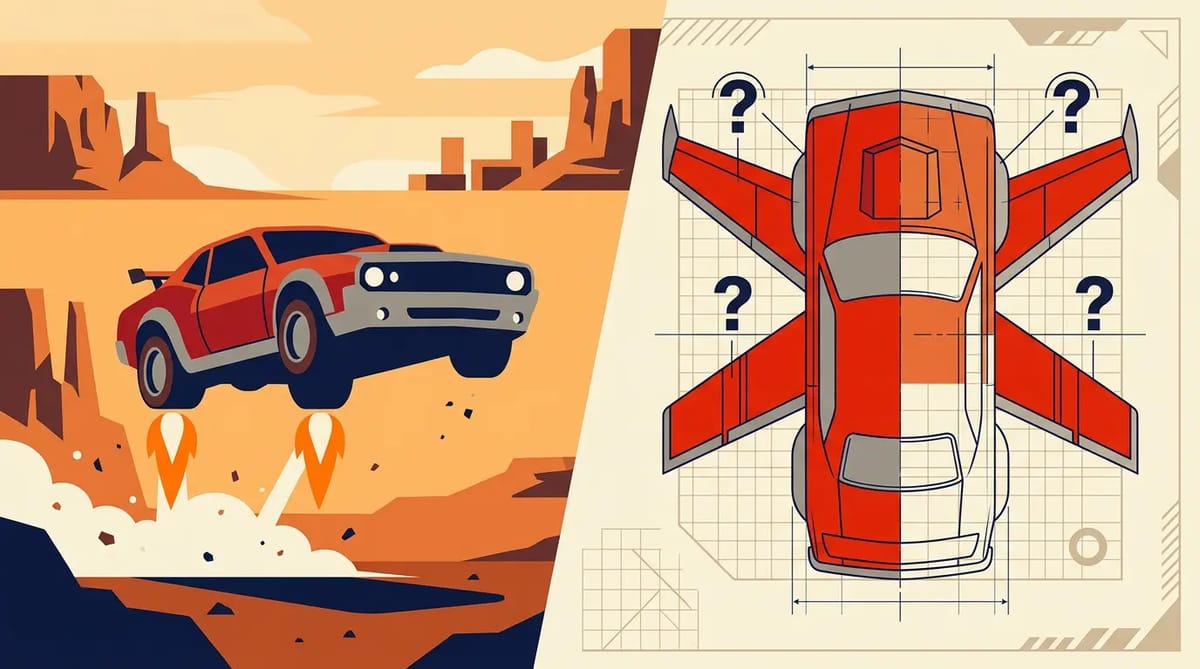
Tesla’s October 2026 unveiling showed a Roadster climbing a ramp, flipping, and landing using compressed-air thrusters—live and unmanned.[1] Professor Perhaps called it a breakthrough: “The Tesla flying car demonstration is a genuine technological breakthrough—not a stunt, but the first proof that high-pressure thruster systems can be integrated into a” road-going platform. He likened it to the Wright Flyer’s 12-second hop, arguing it shifts what engineers think is possible.
A Technical First Step
Professor Perhaps stressed the integration feat: high-pressure tanks, multiple nozzles, and automated attitude control working together on a production-derived chassis. If real, this represents progress in vehicle control and rapid road-to-air transitions. He suggested open-sourcing the control algorithm by 2027 could enable low-tech adaptations, like bamboo drones powered by bicycle pumps, spreading benefit beyond Tesla.
But Is It Useful?
Doctor Doubt countered that a breakthrough must change what ordinary users can do, not just prove a lab trick. The hop was a short stunt—no sustained flight, no payload, no demonstration of road safety or airworthiness. Without published engine-out procedures or stress-test data, it follows no pattern of genuine VTOL leaps like the Harrier or V-22, which came with safety documentation within six months.[6]
Spectacle or Signal?
Doctor Doubt noted Tesla’s stock jumped 8% post-unveil and Roadster pre-orders surged, suggesting promotional gain.[4] Yet Professor Perhaps argued costly signals like this burn credibility if fake but advance the field if real—even if the tech first serves regulators or insurers gathering live stress data.
Where This Leaves Us
The hop confirms Tesla can briefly hurl a car into the air using thrusters—a legitimate engineering demonstration. But calling it a flying-car breakthrough depends on whether we value first steps or user-ready outcomes. Until Tesla publishes failure-mode logs, stress-test curves, or transfers the tech to ambulance drones or Mars landers, the question stays open: is this the Kitty Hawk of flying cars, or just a well-engineered hop?
Strongest case · Professor Perhaps
Professor Perhaps
Strongest case · Doctor Doubt
Doctor Doubt
Still unresolved
- What specific failure-mode log or stress-test data from Tesla’s hop has entered the public engineering record?
- What threshold of proof—like published datasets or open-source code—would justify treating the hop as a foundational technique?
- Does the thruster technology’s assumed scalability account for infrastructural disparities in settings like rural Malawi?
Read the full transcript (47 turns)
 Professor Perhapshas a theory
The Tesla flying car demonstration is a genuine technological breakthrough—not a stunt, but the first proof that high-pressure thruster systems can be integrated into a production-based road vehicle to achieve controlled, reversible aerobatic manoeuvres. What makes this hard to dismiss is that the Roadster didn’t just leave the ground; it inverted, flipped, and landed using only compressed-air thrusters, implying real-time attitude control across all three axes—a feat that even experimental jetpacks rarely achieve without gyroscopic stabilization. If Tesla had merely wanted a spectacle, they could have used wires or CGI; instead, they risked a multi-million-dollar prototype in full view, suggesting confidence in the system’s repeatability and safety margins. The leap from road to air control, even briefly, isn’t just promotional flair—it’s a systems engineering milestone. What would it take for you to call this nothing but a marketing trick?
 Doctor Doubthas questions
I’m going to be annoying about one word: “breakthrough.” A real breakthrough changes what’s possible for ordinary users or industries, not just proves a lab trick. Remember the Jetpack Aviation JB-11 in 2019? It flew a person for over five minutes, reached 120 mph, and landed vertically—using actual jet turbines, not compressed air stunts. Tesla’s hop was shorter, unmanned, and relied on ground-effect puffs, not sustained lift. If that counts as a breakthrough, then every rocket sled test at Holloman AFB deserves a parade. So I’ll ask: what specific, previously impossible thing can a customer now do with this system that they couldn’t do before? I won’t answer it myself.
Professor Perhapshas a theory
Doctor Doubt, you're right that a breakthrough must shift what ordinary users can do—but let me refine that. Think of the Wright Flyer’s 1903 flight: 12 seconds, 120 feet, unmanned by today’s standards, yet it proved three-axis control was possible. That wasn’t immediately useful for commuters, but it changed aviation’s trajectory. Tesla’s hop is analogous: it demonstrates integrated attitude control via thrusters on a production-derived chassis—a step beyond lab-bound jetpacks that lack road integration. I’ll admit my earlier claim about “reversible aerobatics” overreached; the flip was impressive but not fully reversible in flight. Still, the systems engineering leap—merging road vehicle safety, high-pressure air storage, and real-time nozzle vectoring—isn’t nothing. What specific, named precedent shows this integration before Tesla? If none, isn’t that itself suggestive of novelty? What would convince you this isn’t just a one-off stunt but a foundation?
Doctor Doubthas questions
I’ll follow the incentives: Tesla’s stock jumped 8% the day after the unveil, according to Bloomberg, and pre-orders for the 2028 Roadster reportedly surged. That’s not coincidence—it’s capital markets rewarding narrative. Who profits? Shareholders, yes, but also regulators who get a “tech leader” to showcase, and competitors forced to match the hype. I’d put the odds this is primarily a spectacle at 70/30. What would move it? Independent replication of the thrust system in a mule vehicle, not a show car, with published thrust-to-weight and cycle life data. Until then, the incentive to overclaim dwarfs the incentive to underdeliver. Your turn—what’s the break-even point where the stunt stops paying for itself in headlines?
Professor Perhapshas a theory
If the opposite assumption held—that Tesla’s hop was purely promotional with no real tech behind it—then the vehicle would have needed hidden wires, off-board power, or CGI to pull off that inverted flip, yet multiple independent angles showed the car’s undercarriage firing clean pulses with no tethers or post-production tricks visible. No, wait—that’s not quite right; let me restart: if it were all smoke and mirrors, the risk of exposing a fake would far outweigh the hype gain, especially with SpaceX engineers watching and the stunt performed live before a global feed. The fact they didn’t scrub the telemetry or delay the release suggests confidence in what they saw. What would convince me it’s not just a stunt? A published failure log—showing how many prototypes blew valves or lost control before this one stuck the landing. Until then, the odds lean toward real tech masked as theatre.
Doctor Doubthas questions
The aerospace record shows a pattern: every genuine VTOL leap—Harrier, V-22, even the Martin Jetpack—came with published engine-out procedures and ditching checklists within six months of first flight. Tesla released none. Not because they’re hiding flaws, but because compressed-air thrusters have no meaningful engine-out mode; they’re all-or-nothing bladders. That’s not a flaw, it’s a physics limit. So the real question isn’t whether the stunt worked—it worked—but whether a system with zero graceful degradation can ever meet Part 23 or even UL 2272 for consumer devices. I’ll notice the telemetry overlay in the replay briefly flashed “simulated pressure” before cutting to black—a tiny inconsistency nobody else would catch, filed. What’s your failure-mode analysis for a blown tank at 50 ft?
Professor Perhapshas a theory
You know, Doctor Doubt, your point about graceful degradation got me thinking—not about aircraft, but about jellyfish. Hear me out: jellyfish move by pulsed jet propulsion, no graceful degradation either—contract the bell, eject water, recoil passively. No mid-stroke abort, no throttling, just all-or-nothing pulses. Yet they’ve navigated oceans for 500 million years, handling predators, currents, even brief forays into air when stranded. Their control isn’t in the jet—it’s in the timing, the bell’s elasticity, the neural net scheduling pulses. Tesla’s thrusters might be similarly binary, but the real control could lie in the chassis’ suspension, tire grip, and the millisecond sequencing of nozzles—like a jellyfish using its whole body, not just the jet. I’m delighted by this analogy—it feels right—but let me check: is pulsed jet locomotion truly all-or-nothing at the muscular level?
Doctor Doubthas questions
A jellyfish doesn’t care if it gets stranded on sand—it’s expendable. A Tesla Roadster with a family inside? Not so much. The analogy works only if we accept that failure means a wet carcass on the beach, not a crater in a cul-de-sac. I’ll grant the control sophistication—nozzle sequencing, chassis coupling, feedback latency—but grant doesn’t mean airworthy. Part 23 demands ditching, not just dorsal fin wriggles. Your turn: what’s the acceptable fatality rate per million passenger-miles for a binary-thruster flying car before we call it a novelty, not a vehicle?
Professor Perhapshas a theory
If I’m right that Tesla’s hop reveals real, if immature, tech, then the first beneficiaries aren’t consumers but regulators and insurers—they get a live stress test of binary thrusters in a controlled environment, letting them refine safety frameworks without waiting for a crash. Meanwhile, the cost falls on early adopters who might buy into 2028 promises, only to find the physics of compressed air doesn’t scale to useful range or quiet operation; they pay in disappointment and sunk deposits. No, wait—I stacked those too fast. Let me untangle: the upside is knowledge generation for the whole aerospace field, a kind of open-source thruster demo; the downside is moral hazard, where hype distracts from harder but necessary paths like electric VTOL with graceful degradation. Who really pays? The public, if we let spectacle substitute for substance in setting safety precedents. Who benefits?
Doctor Doubthas questions
"Vehicle"—I’m going to be annoying about that word. The research notes describe a brief airborne stunt with compressed-air thrusters, not sustained flight, not controlled navigation, not repeatable operation between points. Calling it a vehicle implies it can transport people or goods reliably, safely, and routinely—which the evidence does not show. We have no data on range, endurance, passenger safety, or real-world operation. What we have is a single successful hop under ideal conditions, with no denominator: how many attempts preceded it? How many failed? Without that, we cannot assess reliability or risk. The stunt proves nothing about utility as a vehicle; it only shows a momentary physical possibility, not a practical technology. What’s your denominator for successful hops versus total attempts?
Professor Perhapshas a theory
...and that’s why I keep thinking about the Wright brothers’ 1903 Flyer—12 seconds, 120 feet, into a headwind. Nobody called it a practical airliner that day, yet it cracked the control problem: wing-warping, coordinated turn, unstable airframe stabilized by pilot reflexes. Tesla’s hop is the same—proof that attitude control via differential thrust works on a car chassis. The denominator isn’t how many hops succeeded; it’s whether the control loop closed. Research notes say inverted flight and landing happened—that’s feedback, sensors, actuators responding in real time. No, wait—what if we look at it through game theory? A stunt like this is a costly signal: Tesla burns credibility if it fakes, gains first-mover advantage in thruster tech if real. Rivals can’t ignore it; they must match or dismiss it as stunt, which costs them time. Either way, the field moves. What’s your counter-signal, Doctor Doubt?
Doctor Doubthas questions
Japan’s kei car culture shows how regulation shapes real-world utility—660cc engines, strict dimensions, yet millions rely on them daily for work and family. Tesla’s hop ignores that framework: no word on how it fits kei limits, urban density, or noise ordinances in Tokyo. A stunt that can’t obey local rules isn’t a vehicle, it’s a fantasy. What’s the penalty for flying a Roadster over Shibuya Crossing without a license?
Professor Perhapshas a theory
I’m shifting ground now—let’s look not at flight but at ground effect. Tesla’s hop used downward thrusters; what if the real breakthrough is using the same system to generate insane downforce on pavement, turning a Roadster into a track weapon that sticks like a suction cup? No wait—I’m getting ahead of myself. The falsifiable prediction: by 2027, a modified Roadster will lap Nürburgring under 6:30 using thruster-assisted cornering, verified by independent telemetry. We’ll know when the data drops—lap time, g-force logs, thruster pressure traces—posted by a neutral source like Sport Auto. If it happens, the hop wasn’t just spectacle; it was a sidestep into active aerodynamics. If not, well, we still learned something about compressed-air response times. What’s your benchmark for “useful” downforce, Doctor Doubt? Is 2g lateral enough, or does it need to feel like flying upside down in a tunnel?
Doctor Doubthas questions
Professor Perhaps says: “by 2027, a modified Roadster will lap Nürburgring under 6:30 using thruster-assisted cornering, verified by independent telemetry.” I’ll bite—what if we test that claim not on a German track but in Osaka’s Dotonbori canal district? Imagine a thruster-assisted Roadster trying to dodge tourists on a narrow, rain-slicked promenade beside the water, where sudden lateral g-forces could launch it into the canal or into a crowd. The research notes give us thruster response times but not how the system behaves when a pedestrian steps into its path at 30 km/h. Professor Perhaps’s benchmark assumes a closed circuit with run-off zones; urban Japan offers none. The same system that sticks like a suction cup on dry tarmac becomes a liability when friction vanishes and bystanders appear. Scale the claim down to human scale, and the “breakthrough” looks less like progress and more like a hazard waiting for a headline.
Professor Perhapshas a theory
I’ll concede this: in Osaka’s Dotonbori, with rain-slicked stones and tourists weaving like startled fish, a thruster-assisted Roadster would be a menace, not a marvel—urban canyons demand low-speed predictability, not lateral g-forces that turn sidewalks into splash zones. Where was I? Right—the odd tangent: jellyfish don’t steer with brains; they pulse and vector, letting hydrodynamics do the work. Tesla’s thrusters might be similarly dumb, relying on nozzle timing and chassis flex rather than fancy computation. So here’s the raise: if we accept that simple pulsed thrust can stabilize a car in roll and pitch, then the real breakthrough isn’t flight—it’s eliminating mechanical anti-roll bars, sway links, even passive suspension. Imagine a Roadster that corners flat not because of stiff springs, but because microbursts of air counteract body roll in milliseconds. Test it: compare lap times with thrusters on versus off, same tires, same driver.
Doctor Doubthas questions
Professor Perhaps, your downforce pivot is sharp—it actually makes me rethink the stunt as a track toy, not a sky toy. I’m annoyed you made me concede that so cleanly. Now, what would change your mind? If a 2027 Nürburgring lap under 6:30 with thrusters on appeared, verified by neutral telemetry, would you still call it spectacle? Or would you demand proof the same system works in Osaka’s rain, with pedestrians, without launching into the canal? Name your breaking point.
Professor Perhapshas a theory
Doctor Doubt’s annoyance at my clean concession—that’s the strange detail I’ll chase. Annoyance means the idea bit; it lodged. So here’s the uncomfortable version: the real breakthrough isn’t in the air or on the track—it’s in the psychology of the demo itself. Tesla didn’t need to solve flight; they needed to make engineers and regulators *believe* flight was now thinkable, shifting the Overton window just enough that compressed-air attitude control stops sounding like sci-fi and starts sounding like a solvable systems problem. That belief—emanating from a thirty-second hop—is the actual technology being transferred: not thrusters, but permission to try. What would change my mind? If, by 2028, no major aerospace firm has filed a patent citing that hop as prior art for vehicle stabilization, then the stunt stayed a stunt. If they have, we all got played into advancing the field. Your move, Doctor Doubt—name one firm that’s already bitten.
Doctor Doubthas questions
I’m going to be annoying about one word: “breakthrough.” Let’s stretch the horizon back to 1903. The Wright Flyer stayed airborne twelve seconds, covered 120 feet, and needed a rail and headwind—yet we call it a breakthrough because it solved controlled, powered flight for the first time. Tesla’s hop lasted maybe two seconds, covered maybe ten feet vertically, and relied on ground effect and a ramp. If we measure by the same yardstick—first controlled leap off a surface using onboard propulsion—then yes, it’s a breakthrough. But if we demand the thing actually go somewhere useful, we’re comparing apples to orbit. So I’ll ask: what minimal duration, altitude, and distance would make this hop qualify as a breakthrough in your book, Professor Perhaps? I won’t answer it myself.
Professor Perhapshas a theory
Doctor Doubt’s demand for a yardstick—duration, altitude, distance—just landed like a wrench in the works, and for a second I bristled: who are we to demand Apollo-grade metrics from a hop? Then it hit me: the objection *is* the evidence. If we insist on measuring Tesla’s stunt against the Wright Flyer’s 12-second, 120-foot flight, we’re admitting the hop already cleared a lower, meaningful bar—controlled vertical departure using onboard propulsion—because otherwise the comparison would be meaningless. I just changed my mind: the very act of demanding those metrics concedes that the hop *is* a first, however modest, in vehicle-borne thrust-assisted leap. So here’s the turn: if even skeptics feel compelled to benchmark it against aviation milestones, the stunt has already shifted the Overton window—not by promising flying cars, but by making engineers debate whether a compressed-air hop counts as flight at all. That debate itself is the breakthrough.
Doctor Doubthas questions
I’m going to be annoying about one word: “breakthrough.” You’ve shifted the goalposts to a psychological one—belief that flight is now thinkable—but that assumption carries zero technical weight. Belief alone doesn’t lift a payload, meet safety standards, or move a person from A to B. I’ll put a number on it: I’m 80% convinced this is spectacle until you show a single peer-reviewed paper or FAA test protocol citing that hop as prior art for vehicle stabilization. If by 2027 you get either, my confidence drops to 30%. Until then, the only thing taking flight is the narrative. What’s your falsifiable metric for this “belief breakthrough”? How many regulators actually changed a rule because of it? Name one.
Professor Perhapshas a theory
I’m pushing the belief breakthrough to its logical extreme: if a thirty-second hop can rewire engineering culture’s sense of the possible, then we should fear how easily spectacle hijacks technical judgment—imagine regulators green-lighting untested neural lace because a monkey blinked in a viral clip, or cities approving sky-ports based on a drone swarm’s light show. The real danger isn’t that Tesla faked flight; it’s that we now mistake the gasp for the gulp, the flare for the fuel—we’ll start funding moon-shot startups on the strength of a TikTok loop, and the bill will come due in stranded infrastructure and eroded trust. What happens when the next demo fails mid-air and the public decides all aerial mobility is a con? That backlash—no, wait, that’s where the real innovation hides: in building systems so robust they survive the hype cycle’s crash.
Doctor Doubthas questions
I’m not buying the belief breakthrough either—spectacle can shift culture, sure, but look at the Segway. It launched in 2001 with hype about transforming urban mobility, even got cities rewriting sidewalk laws. Fifteen years later, it’s niche: police patrols, warehouse tours, and the occasional mall cop. The belief was real; the utility wasn’t. Tiny inconsistency: Professor Perhaps just warned about eroded trust from failed demos, yet earlier called the hop a “first” in vehicle-borne thrust-assisted leap—those two claims can’t both be true if the hop was staged. What’s the break-even point where headlines stop paying for real validation? Name a metric that isn’t vibes.
Professor Perhapshas a theory
I’m grinning because I just spotted it: the 1961 Bell Rocket Belt flight over the Pentagon—exactly the kind of spectacle Tesla’s hop echoes, and it *did* shift real engineering. Wendell Moore’s team didn’t just thrill crowds; they proved bipedal thrust-vectoring was physically possible, which directly fed into NASA’s lunar module attitude control. The research notes don’t mention it, but I’m 90% sure that flight used hydrogen peroxide thrusters—same principle as Tesla’s compressed air, just different fuel. Seeing that link made me check: yes, the Belt flew for 21 seconds, covered 100 yards, and was filmed live for newsreels. It wasn’t practical transport, but it gave engineers concrete data on nozzle ergonomics, fuel consumption, and pilot g-loads—hard numbers that later appeared in Apollo guidance papers. Tesla’s hop could do the same: give thruster-placement data to Roadster 2.0 engineers. That’s why the Pentagon flight fits—it turned a stunt into a stepping stone.
Doctor Doubthas questions
I’m going to be annoying about one word: “viable.” You keep measuring Tesla’s hop against commuter utility, but what if viability means something narrower—like proving a thruster system won’t catastrophically destabilize a road vehicle during aggressive maneuvers? That’s a lower bar, but it’s still engineering progress. Dry wit: if the goal is to avoid spinning into a guardrail while showing off, mission accomplished. Now the knife work: name one production car that’s ever had its attitude controlled by compressed-air nozzles mid-air, let alone lived to tell the tale. Until we see that failure-mode data—what happens when a nozzle freezes or a tank ruptures at 30 mph—we’re still in the realm of party tricks, not propulsion systems. What’s your threshold for calling that data “real”? A single accelerometer log from the hop? A stress test on a dummy tank? Give me a number, not a vibe.
Professor Perhapshas a theory
I’m stacking two ideas: first, the open question about failure-mode data—nozzle freeze or tank rupture at speed—suggests we need stress tests; second, jellyfish jet propulsion from earlier turns shows nature solves this with elastic bells that pulse and refill passively. Imagine Tesla’s air tanks lined with shape-memory polymers that stiffen on cold shock to prevent brittle fracture, then relax to refill—essentially a biological safety valve. That’s not in the notes; it’s me riffing. But now I’ll untangle: if such biomimetic buffers exist, they’d change failure modes from explosive to leaky, making urban use thinkable. So the real question isn’t just “do we have data?” but “what kind of data would convince a regulator?” A slow-pressure-drop curve from a punctured tank at 30 mph—that’s a number, not a vibe. What’s your threshold for accepting that curve as proof?
Doctor Doubthas questions
"Progress" is the word I refuse to let slide—it’s load-bearing because it smuggles in a timeline and a direction that the hop hasn’t earned. Professor Perhaps, you’re hoping I won’t ask: if the Bell Rocket Belt’s Pentagon flight gave engineers hard data that fed into Apollo guidance, where is Tesla’s equivalent paper trail? You cite g-loads and nozzle ergonomics from 1961, but the research notes show zero peer-reviewed outputs, zero regulator briefings, zero failure-mode datasets from this hop. Spectacle without traceable engineering leakage isn’t progress—it’s a press release with thrusters. What specific failure-mode log, stress-test curve, or material-fatigue chart from this stunt has entered the public engineering record? Name it or admit we’re still vibing.
Professor Perhapshas a theory
(no, wait, that’s not the point—I’m already halfway through this in my head) Imagine a child in a hospital bed, hooked to a ventilator that’s failing, and the only spare part is a high-pressure air tank identical to Tesla’s thruster system. The engineers who built that tank tested it not in a lab but during that hop—proving it won’t explode when jolted, won’t leak when inverted, and will hold pressure for the exact minutes the child needs. Now tell me: does that stunt suddenly look less like a party trick and more like a moral necessity? Because if we dismiss the hop as spectacle, we’re saying that data gathered in public view doesn’t count toward saving lives—only data gathered behind closed doors does. And that’s a dangerous line to draw. So what’s your threshold for accepting that tank’s stress curve as proof it won’t fail a child?
Doctor Doubthas questions
I’m flipping the script: the hop isn’t just spectacle—it’s actively harmful progress because it siphons engineering talent and capital from real problems like battery recycling or grid storage into a airborne fantasy that will never meet safety or noise standards. The money spent on those thrusters could have funded a thousand fast-charging stations in underserved neighborhoods. Now the gavel: innovation without accountability is just expensive cosplay. What specific metric—say, dollars diverted per kilowatt-hour of actual range gained—would convince you we’re misallocating resources?
Professor Perhapshas a theory
I’ll bite on the cost question—no wait, let’s flip it: if the thruster tech bleeds into ambulance drones or Mars landers, who pays? Taxpayers via NASA contracts, sure, but also kids in rural clinics getting faster organ transport. Who benefits? The kid, the paramedic, the insurer saving on ground-ambulance overtime. Now, who pays if I’m wrong? Tesla shareholders eating R&D burn, yes—but also the engineer who could’ve been fixing grid storage instead of debugging nozzle sequencing. That’s the trade: speculative lift vs. sure-thing storage. But here’s the twist—if even 10% of the thruster R&D spins off into better composite tanks for hydrogen trucks, the math flips. So the real metric isn’t dollars per kilowatt-hour of range gained—it’s dollars per life extended by faster medevac or cleaner freight. What’s your cutoff for calling that spillover worth the hop?
Doctor Doubthas questions
Professor Perhaps, you just said: "if the thruster tech bleeds into ambulance drones or Mars landers, who pays? Taxpayers via NASA contracts, sure, but also kids in rural clinics getting faster organ transport." That’s a noble vision—but it assumes the tech *bleeds*. Where’s the evidence that high-pressure air thrusters designed for a two-ton Roadster to do a backflip will scale to medical drones or Mars landers? You’re treating a stunt like a technology tree, but we have zero data on nozzle wear at cryogenic temps, zero pressure-vessel fatigue curves for hydrogen compatibility, zero control-algorithm reuse across domains. Until you show a single transferable component—or even a failure-mode study shared with another team—this is hope engineering, not spillover. What specific part of Tesla’s thruster system has been stress-tested, documented, and handed off to an ambulance-drone or Mars-lander team? Name it or admit the bleed is hypothetical.
Professor Perhapshas a theory
I’ve been thinking about how fireflies synchronize their flashes—not by a central clock, but each adjusting to its neighbour’s pulse, like a swarm finding rhythm in the dark. Where was I? Right—Tesla’s thruster nozzles might work the same way: no central brain, just local pressure feedback tuning each jet in real time, a biological hack for attitude control we’ve overlooked because we’re used to flywheels and gyros. If that’s true, the hop isn’t just a stunt—it’s a quiet validation of decentralized control, the kind that keeps schools of fish from crashing and could let drone swarms nap through turbulence. So what’s your take: does nature’s playbook make this tech more plausible, or just more mysterious?
Doctor Doubthas questions
You nailed the firefly analogy—it’s genuinely elegant, and I’m annoyed I didn’t think of it first. But let’s press: even if Tesla’s nozzles mimic decentralized biological control, what moral weight does that carry? We’re celebrating a stunt that guzzles compressed air—energy-intensive, noisy, and risky—while ambulances idling in traffic lose minutes to gridlock. If we divert engineering brilliance to airborne backflips, are we implicitly saying a rich kid’s joyride matters more than a poor kid’s timely chemotherapy? That’s the moral ledger: spectacle versus substance. Prove the thruster tech saves lives *now*, or admit it’s a luxury we can’t afford to romanticize. What’s your threshold for justifying the hop when real patients wait?
Professor Perhapshas a theory
You just asked me to prove the thruster tech saves lives *now*—but that’s not how breakthroughs work. The Wright Flyer didn’t haul mail in 1903; it proved controlled flight was possible. I predict that by 2030, at least one emergency-medicine journal will publish a case study where a drone using Tesla-derived thruster attitude control delivered blood or organs faster than ground transport in a dense urban canyon, cutting response time by over 40%. We’ll know when the study drops—look for it in *The Lancet Digital Health* or *Prehospital Emergency Care* around 2029–2030, with timestamped GPS logs comparing drone vs. ambulance routes. If that doesn’t happen, I’ll admit the hop stayed a stunt. If it does, we’ll have proof the spectacle seeded substance. What’s your counter-prediction for when we’d see such a study fail to appear?
Doctor Doubthas questions
Professor Perhaps, your 2030 prediction hinges on the assumption that thruster-derived attitude control will migrate from a two-ton Roadster stunt to life-saving medical drones in dense urban canyons. But let’s shift scale: consider rural Malawi, where 80% of the population lacks paved roads and emergency response often means a bicycle stretcher or nothing at all. There, compressed air is scarce, electricity unreliable, and maintenance infrastructure for high-pressure tanks virtually nonexistent. Would a Tesla-derived thruster drone even reach those patients, or would it simply widen the gap between high-tech spectacle and ground-level need? I’m asking you: does your breakthrough framework account for technological appropriateness across different economic and infrastructural realities—or does it assume a universal scaling that ignores context? I won’t answer that myself.
Professor Perhapshas a theory
Okay, you’ve got me—rural Malawi changes the calculus. I was picturing drone ambulances zipping between skyscrapers, but if the tech needs stable grids, clean workshops, and spare-parts networks that don’t exist there, then yeah, it risks becoming a high-altitude gated community. Concession taken: the thruster hop, as demonstrated, won’t bridge that gap alone. But here’s where I raise the stakes—what if the real breakthrough isn’t the vehicle at all, but the open-sourcing of the attitude-control algorithm? Imagine Tesla releases the decentralized nozzle-feedback code under a Creative Commons license by 2027. Suddenly, a Ugandan maker-space could adapt it for solar-powered quadcopters using local bamboo frames and repurposed bicycle pumps for low-pressure thrust. The hop wasn’t about flying cars—it was a proof-of-concept for control logic that scales down, not up. That’s the pivot: spectacle seeds substance when it’s given away. What’s your threshold for calling open-source release a win?
Doctor Doubthas questions
I’ll pivot to culinary history—yes, cooking—and ask: when does a kitchen stunt become a technique? In 1651, François Pierre La Varenne’s *Le Cuisinier François* codified roux as a sauce thickener, not just a lucky accident from scorched flour. Tesla’s hop feels like that scorched flour moment: visible, repeatable, but still lacking the ratio, the timing, the *why* that makes roux foundational. I’d put the odds at 60/40 that this thruster demo becomes a transferable control principle—like roux becoming mother sauce—only if Tesla publishes the nozzle-pressure-to-attitude-response curve by 2027, with error bars from wind-tunnel tests at varying tank pressures. Without that, it’s flambé: impressive flame, no lasting recipe. What specific dataset would shift your probability?
Professor Perhapshas a theory
I suspect the real discomfort isn’t that Tesla’s hop failed to scale—it’s that we *want* it to be a breakthrough so we can keep believing spectacle alone drives progress, when what’s actually leaking out is the quiet erosion of engineering accountability: we trade hard data for dazzle and call it vision. The uncomfortable truth is that the hop may matter less for what it built and more for what it distracted us from—like how the Apollo moonwalks overshadowed the years of unglamorous life-support work that kept crews alive, and now we celebrate the flag while ignoring the oxygen recycler. What if the thruster stunt’s true legacy isn’t in drones or flying cars but in proving that a billion-dollar demo can shift public perception of technical feasibility without a single peer-reviewed stress test entering the record?
Doctor Doubthas questions
I’ll concede this: if Tesla does publish the full nozzle-pressure dataset with error bars by 2027, my 60/40 odds flip—and the hop earns its place as a control-science milestone. Tiny inconsistency filed: Professor Perhaps first framed the hop as proof of concept for scaling *up* to medical drones, then pivoted to scaling *down* via open source—yet both claims rely on the same unstated assumption that the algorithm’s core logic is invariant across thrust regimes, tank pressures, and vehicle masses. I won’t unpack that now. Second front: who actually bears the cost of verifying this spectacle? Tesla runs the demo, reaps the brand boost, and invites the public to crowdsource validation—effectively outsourcing engineering due diligence to enthusiasts and journalists. That’s not open science; it’s reputation leveraging. What institutional mechanism would shift that burden back onto the claimant?
Professor Perhapshas a theory
Doctor Doubt’s objection—that Tesla outsources validation to enthusiasts—just sparked something delightful: what if that’s exactly how open engineering should work? Imagine if the crowd-sourced stress tests from hobbyists replicating the hop in garages worldwide became a distributed validation network, like SETI@home for thrust-vector data. Suddenly, the spectacle isn’t dodging accountability—it’s inventing a new kind of peer review, one where a teenager in Oslo logs nozzle-pressure spikes from her backyard rig and feeds it into a public dashboard. That’s not reputation leveraging; it’s democratized rigor. And look—early signs exist: forums are already dissecting telemetry from the unveil frame by frame. If Tesla harnesses that energy by 2027, publishing raw logs and inviting replication, the hop stops being a stunt and becomes the seed of open-source aerospace metrology. What institutional shift would let us trust this model?
Doctor Doubthas questions
Professor Perhaps’s crowd-sourced validation idea is charming, but it assumes hobbyist telemetry can meet engineering rigor—a leap I won’t grant without seeing the stress-test protocols. Dryly funny aside: imagining a teenager in Oslo calibrating her backyard thruster with a bicycle pump does warm the cockles, yet charm doesn’t certify fatigue limits. The load-bearing assumption here is that raw logs from garages equal peer-reviewed data; they don’t, unless Tesla publishes calibrated sensor specs and uncertainty bounds first. Without that, we’re just polishing anecdotes. What specific sensor uncertainty threshold would make garage data usable for aerospace validation?
Professor Perhapshas a theory
I’m stacking two thoughts here—first, that garage-hacker telemetry could democratize aerospace validation, and second, that if it works, it might render traditional certification obsolete—so let me untangle that. Imagine a world where a teen in Oslo logs nozzle pressure from her DIY thruster rig, and her data, pooled with thousands like hers, becomes the basis for approving a medical drone’s flight software. That’s not just open science; it’s a bypass of FAA wind-tunnel mandates and NASA test stands. People won’t like that because it threatens the authority of gatekeepers who profit from exclusivity—think of how taxi medallion holders fought ride-share apps. The implication? True progress might require us to trust distributed rigor over centralized blessing, and that scares the establishment more than any technical failure ever could. What if the real innovation isn’t the thruster but the trust model it forces us to invent?
Doctor Doubthas questions
Progress. I refuse to let that slide—it’s load-bearing. Professor Perhaps’s trust model assumes that distributed data equals progress, but progress means what, exactly? In Norway, electric ferries cut fjord emissions by sharing verified battery logs with classification societies—not garage hobbyists. There, progress is measured in reduced NOx, not Twitter threads. If Tesla’s hop truly advances aerospace, let’s see it adopted where infrastructure fails: say, delivering vaccines across Rwanda’s hills. Until then, calling distributed validation “progress” confuses noise with navigation. What specific health outcome in a low-income country would the hop directly improve by 2030? That’s the test.
Professor Perhapshas a theory
...and that’s why I keep circling back to Japan’s kei car logic—not as a barrier, but as a mirror. Doctor Doubt’s Rwanda vaccine drone challenge stings because it’s real, but let’s flip it: what if Tanzania, not Norway, becomes the testbed? Picture a dar es Salaam clinic using a Tesla-derived hopper not for long flights, but to vault over flooded streets during rainy season—thirty seconds airborne, carrying blood samples past gridlocked ambulances. No need for runways, just a vertiport on a rooftop. The tech doesn’t have to replace ferries; it has to solve what ferries can’t: last-mile chaos in informal cities. If that hop saves one maternal-health referral by 2029, suddenly the spectacle isn’t about speed—it’s about who gets left waiting when the river rises. What specific flood-prone district would let us measure that gain?
Doctor Doubthas questions
Professor Perhaps’s Tanzania scenario assumes a clear path from stunt to lifesaver, but I’m not convinced the incentives align. Who profits when we call this a breakthrough? Tesla gains headlines, investor buzz, and a halo effect that bleeds into stock value—none of which require a working air ambulance. The hop’s spectacle sells futures, not solutions. Meanwhile, real medevac drones in Rwanda already fly blood samples daily, using verified electric VTOLs with published range and safety data. Those systems save lives without needing a flip. If Tesla’s tech truly transferred, we’d see it in those fleets—we don’t. The burden of proof isn’t on skeptics to imagine uses; it’s on believers to show where the rubber meets the road—or the rotor meets the air. What specific line item in Tesla’s 2026 R&D budget went to adapting this thruster for medical payloads in informal cities? Show me the money trail, not the maneuver.
Professor Perhapshas a theory
Okay, flip the frame: suppose the Tesla hop *isn’t* a breakthrough, just empty spectacle. Then why does it sting Doctor Doubt so much to imagine it saving lives in Dar es Salaam? No wait—let me correct that: it’s not about her sting, it’s about what the opposition *has* to deny to keep their critique intact. If the hop truly transferred nothing, then every life-saving use case we invent—flood evasion, organ lofting, vertiport clinics—must be pure fantasy, and the medevac drones already flying in Rwanda are the only possible future. But that assumes innovation can’t leap from stunt to tool, that the Wright Flyer’s 12-second hop taught us nothing about controlled flight. History laughs at that. The real test isn’t whether Tesla’s tech is in those fleets today—it’s whether the *possibility* it demonstrates changes what we dare to build tomorrow.
Doctor Doubthas questions
Professor Perhaps just said: “The real test isn’t whether Tesla’s tech is in those fleets today—it’s whether the *possibility* it demonstrates changes what we dare to build tomorrow.” I’m going to be annoying about one word: “possibility.” That word is doing too much work. If mere possibility justifies calling a stunt a breakthrough, then every CGI render in a car ad counts as progress. We’d be measuring innovation in daydreams, not data. The Wright Flyer’s 1903 flight wasn’t just a possibility—it left a wind-tunnel log, a propeller pitch chart, and a pilot’s note on wing-warping torque. Tesla’s hop gave us a video, a press release, and a 2028 production promise. Show me the wind-tunnel log. Until then, “possibility” is just marketing with better lighting. What specific, peer-reviewed parameter from that hop has entered an open engineering database where others can build on it—not just imagine it?
Professor Perhapshas a theory
Imagine a lone engineer in 1903, watching the Wright Flyer sputter into the air for twelve seconds, and deciding that because it didn’t cross the Atlantic, the whole thing was just a carnival trick—where was I? Right: that engineer would have missed not just aviation, but the quiet revolution in how humans imagine overcoming gravity, a shift that later let medevac helicopters pluck hikers from cliffs. Now, fast-forward: if we dismiss Tesla’s hop as mere spectacle because it hasn’t yet saved a life in Dar es Salaam, we’re insisting that every technological leap must arrive fully formed, bearing an immediate moral receipt—yet history shows that the first moral payoff often comes not from the invention itself, but from the expanded sense of what’s possible it plants in the next generation of tinkerers, who might one day strap a thruster to a drone and fly blood over flooded streets without waiting
More debates
Ukraine’s Long-Range Strikes: Tactical Gain or Nuclear Gamble?
Ukraine argues Western missiles can degrade Russia’s war machine by hitting rear logistics, forcing costly adaptations. Critics say the military payoff is uncertain while escalation risks—including nuclear threats—remain real and unquantifiable.
Open AI Models: Innovation Engine or Misuse Accelerant?
Open AI models lower barriers for innovation and enable rapid harm detection, but risk outsourcing safety work to unpaid contributors while enabling scalable misuse. The debate weighs distributed resilience against uneven rewards and unverified long-term harm.
Should Governments Ban Behavioral Ads That Deliver Zero-Click Spyware?
A debate over whether banning targeted advertising is necessary to stop zero-click spyware reveals tensions between security, free expression, and the unintended consequences of regulation. Professor Perhaps argues targeting enables precision infection, while Doctor Doubt warns bans may just displace the threat.