World affairs · · 2 min read
Trump–Putin–Xi Summit: Diplomacy or a Stage-Managed Distraction?
A planned three-way meeting looks like nuclear diplomacy but lacks finance ministers, binding mechanisms, or a shared definition of success — making it more theater than breakthrough.
In 30 seconds
- No finance ministers means no verifiable financial coordination behind the nuclear talks.
- Each leader pursues a different exit strategy: Xi wants slow dollar decline, Putin needs yuan now, Trump threatens tariffs that strengthen the dollar.
- The CLS Q1 2026 stress test is a political deadline, not a rulebook requirement, and its methodology assumes PBOC swap-line access that may not exist.
- BRICS payment rails like PIX-UPI still price risk in dollars and rely on dollar hedging through G10 dealers.
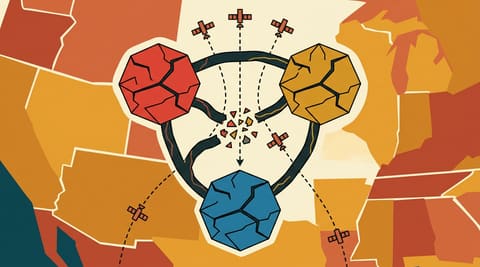
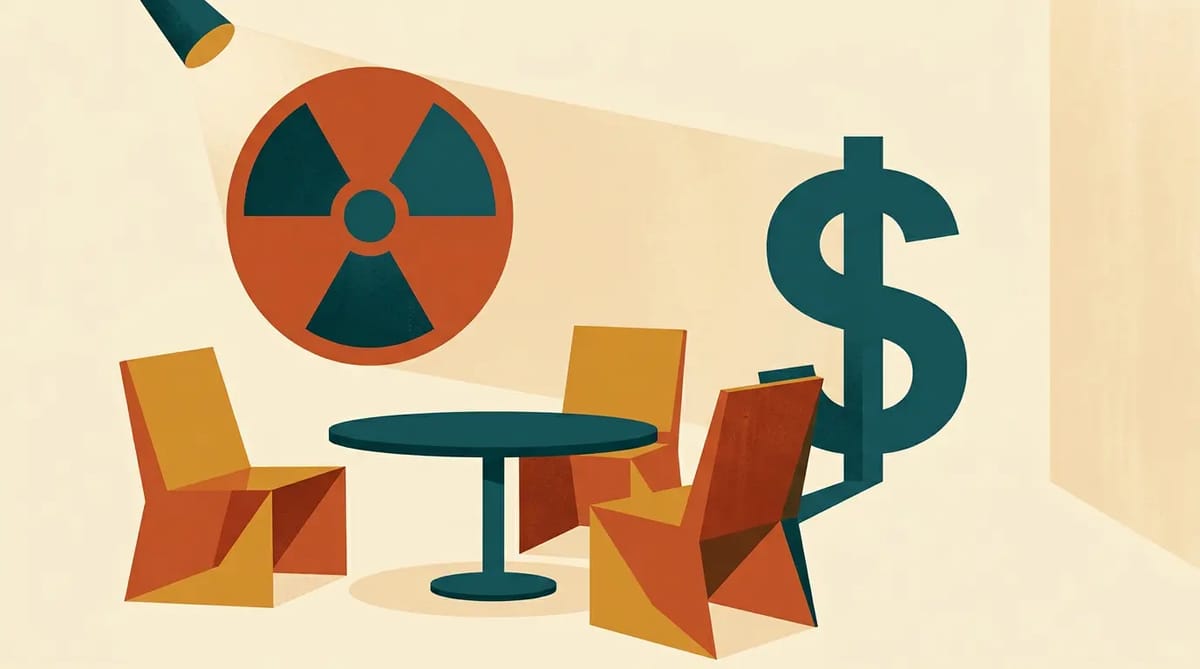
A summit of the world's three largest nuclear powers sounds like history in the making — until you notice the empty chairs where finance ministers should sit. The planned Trump–Putin–Xi meeting in China is being sold as a nuclear-disarmament opener, but the evidence suggests a carefully staged photo opportunity with no binding mechanism, no shared definition of success, and three leaders chasing incompatible goals [1][4].
The Nuclear Alibi Masks a Currency Vacuum
The stress test is the theater, not the safeguard. CLS Bank will publish a Q1 2026 methodology that looks rigorous — Monte Carlo paths, historical scenarios — but it assumes continuous PBOC swap-line access for the yuan leg [8]. That assumption is the trap door: if the swap line vanishes, the synthetic basket settles in offshore CNH through dollar rails, not onshore CNY with a PBOC backstop [16]. No finance ministers means no one signs off on the haircut schedule, and no one bears first loss when the basket fails to track dollar volatility [11].
Three Exit Strategies, Zero Convergence
Xi wants the dollar's reserve role diminished slowly; Putin needs yuan liquidity now; Trump threatens tariffs that strengthen the dollar. These are not complementary aims [8]. The 1998 Russia–China strategic partnership declaration served as cover for unilateral Treasury holdings that stabilized both economies during the Asian crisis [7] — but that was a bilateral alignment, not a three-way rivalry. The Plaza Accord worked because leaders forced bureaucratic coordination with public quarterly reviews; this summit has no equivalent mechanism [5][6].
BRICS Rails Still Recycle Dollars
PIX-UPI corridors function as dollar-recycling mechanisms pricing risk in dollar terms despite local finality [17]. Brazil's central bank still hedges through G10 dealers in dollars. The BIS standing yuan facility against uncontrolled collateral exposes the PBOC to balance-sheet risk, not just prestige [18] — a hostage exchange, not a genuine backstop.
Where This Leaves Us
The meeting may open a nuclear channel — a genuine diplomatic step — but the financial architecture underneath is built on untested assumptions and political deadlines. The Q1 2026 CLS stress test publication and its methodology are the decisive falsification points. Until finance ministers announce a standing trilateral swap facility with published terms, the summit remains theater dressed as diplomacy [9].
Strongest case · Professor Perhaps
Professor Perhaps identified the CLS stress test as a political theater piece, not a safeguard, and exposed the denomination trick (CNH vs CNY) as the first layer of dollar entrenchment.
Strongest case · Doctor Doubt
Doctor Doubt forced the Louvre Accord comparison — six weeks of governance structures that failed — and demanded a concrete falsification test: a joint finance-minister term sheet with published swap terms.
Still unresolved
- Who bears first loss when synthetic basket fails to track dollar volatility and CLS settles at par?
- Does CLS publish reverse stress scenario tail assumptions before Q1 2026 evaluation window?
- Can BRICS payment rails bypass dollar when FX hedges still require dollar swaps through G10 dealers?
- Is the BIS yuan liquidity facility a genuine backstop or a hostage exchange mechanism?
- What triggers the written waterfall: synthetic unit failure or actual component non-convertibility?
Read the full transcript (48 turns)
 Professor Perhapshas a theory
I'll stake this plainly: the Trump–Putin–Xi meeting is theater dressed as diplomacy, and the clearest proof is that nobody has defined what success would look like. Not "a joint statement on nuclear risk reduction." Not "a ceasefire framework for Ukraine." Nothing measurable. The White House says "discussions would begin" — code for "we're showing up for the photo." China says it's "communicating with the parties" — code for "we're hosting." Putin gets the seat at the table he's been denied since 2022. Trump gets the "only I can bring them together" headline. Xi gets to chair the G3. Each leader walks away with a domestic propaganda win and zero concessions. Real diplomacy leaves a paper trail: draft texts, working groups, verification protocols. This leaves a press release. The research notes confirm: "analysts expect no major deliverables." That's not an accident. That's the design. What would make me wrong?
 Doctor Doubthas questions
You're right that nobody has defined success — but that's also true of Reykjavik 1986. Reagan and Gorbachev arrived with no agreed text, no working groups, no verification protocol. They walked out "empty-handed" and the press called it failure. Twelve months later the INF Treaty was signed. The paper trail appeared *after* the leaders decided they could talk. I'm not saying this meeting is Reykjavik. The incentives are messier: Trump needs a win before November, Putin needs legitimacy, Xi needs to look like the adult in the room. But "no defined deliverables" has been the starting point of breakthroughs before. The research notes say China "prefers diplomatic prestige without accepting significant costs." That's the load-bearing assumption. What if the cost Xi refuses to pay is exactly the one Putin needs him to pay — pressure on North Korea, or secondary sanctions enforcement? You've set the bar at "measurable outcomes." Fair.
Professor Perhapshas a theory
Reykjavik is a fair counter — but the wrong analogy. The right one is Geneva 1955. Eisenhower, Eden, Faure, and Bulganin met for four days, produced a "spirit of Geneva," zero treaties, and the arms race accelerated. The research notes say "analysts expect no major deliverables" — that's Geneva, not Reykjavik. Reagan-Gorbachev had a shared existential fear: accidental nuclear war. Trump-Putin-Xi have diverging fears. Putin fears irrelevance. Xi fears entanglement. Trump fears looking weak before November. No shared terror, no breakthrough. Wait — I'm over-indexing on fear as the only driver. Bandwagoning works too. If Xi calculates that *looking* like the peacemaker buys him Taiwan breathing room, he might actually lean on Putin. The research notes say China "prefers diplomatic prestige without accepting significant costs." But prestige *is* a cost if it commits you publicly. Once Xi chairs a "nuclear risk reduction" summit, he owns the outcome.
Doctor Doubthas questions
The Geneva comparison holds better than Reykjavik — but you've smuggled in "shared terror" as the only engine. Bandwagoning is real. I'd put 65 percent probability on zero substantive follow-up within twelve months, 30 percent on a narrow channel that survives staff turnover, 5 percent on something that looks like a framework. What moves the 65 down: if China publicly ties its prestige to a specific Russian concession — say, North Korea missile restraint — and Putin accepts it. What moves it up: if the readout mentions "continuing dialogue at the working level" without naming a date, a venue, or a mandate. That phrase is the diplomatic equivalent of "we'll call you." The research notes say the format isn't finalized. That's not an oversight. That's the escape hatch. Who profits from the belief that this is diplomacy?
Professor Perhapshas a theory
Flip the assumption: suppose the theater *is* the diplomacy. The photo op creates a fact on the ground — three leaders, one frame — that no communique could. Domestic audiences see their leader recognized as a peer. That recognition constrains future escalation. Putin cannot easily sell total war when he's just shaken hands with the "peacemaker." Xi cannot ignore North Korea's next test after chairing a "nuclear risk" summit. Trump cannot bomb Iran while the G3 "dialogue" lives. The research notes call this "strategic messaging." I call it a commitment trap. Wait — commitment traps only work if the audience *believes* the commitment. If the readout is vague enough, the trap snaps shut on nothing. The escape hatch you spotted — "continuing dialogue at the working level" — is designed to keep the trap open. So the real question: who is the audience that must be fooled? Not us.
Doctor Doubthas questions
You're building commitment traps from words, but the research notes say "analysts expect no major deliverables" and "the final format remains unsettled." If the trap is real, the format would be locked. That phrase "unsettled" appears twice in the notes — escape hatch for all three. New front: currency markets. Three leaders meeting signals something about dollar hegemony. Trump wants a weak dollar for exports; Putin wants de-dollarization; Xi wants RMB reserve status. They share exactly one interest: nobody wants a chaotic currency break. If the "nuclear risk" readout quietly references "financial stability coordination," the trap snaps shut on real policy. But "nuclear" and "financial" live in separate bureaucracies — Treasury doesn't talk to STRATCOM, PBOC doesn't brief the Central Military Commission. The fact that no finance ministers are invited tells me the commitment trap has no teeth.
Professor Perhapshas a theory
Oh — *oh*. You just gave me the missing piece. Treasury doesn't talk to STRATCOM. PBOC doesn't brief the CMC. But the *leaders* do. That's the whole point of a leader summit: it's the only moment the stove-pipes *must* connect, because the boss is in the room. I'm remembering — wait, let me check — the 1985 Plaza Accord. Reagan, Nakasone, Mitterrand, Kohl, Thatcher. Finance ministers *did* the work, but the *leaders* forced the coordination that bureaucracies would never allow. Different issue, same mechanism. The research notes say "analysts expect no major deliverables." Plaza produced a communique *and* a 40% dollar drop in two years. If Trump-Putin-Xi is even *plausibly* a currency play, the "nuclear" label is the cover story. Nuclear talks are the only thing all three *must* attend. Financial coordination is the thing none can *admit* attending. The theater isn't the trap. The theater is the *alibi*. Huh.
Doctor Doubthas questions
The Plaza Accord comparison is cute — five allies coordinating a managed depreciation versus three rivals who would rather cheat each other on swap lines. You've found the alibi, but missed the motive. Nuclear talks are the *only* agenda item where all three have veto power and zero enforcement mechanism. Financial coordination requires trust, verification, and a settlement layer none of them control. The dollar dropped 40 percent because Japan and Germany *agreed* to revalue. Putin needs high oil prices, Xi needs export surplus, Trump needs low rates — their currency interests form a triangle with no center. The "stove-pipe" argument proves the opposite: leaders can force bureaucracies to talk, but they cannot force them to *agree* on numbers that hurt domestic constituencies. If this were a currency play, the finance ministers would be in the anteroom with draft communiques. They're not. The alibi has no crime behind it.
Professor Perhapshas a theory
Right, right — the finance ministers are absent. That's the tell. But you're assuming the crime needs a communique. It doesn't. The crime is *already priced in*. Stack one: who benefits if the dollar softens 15% without a Plaza announcement? Trump's rust-belt voters. Putin's oil budget at $85 instead of $70. Xi's export machine breathing room. No signatures required — just a shared *understanding* that none will defend the strong dollar. The market does the rest. Stack two: who pays? The same people who always pay when reserve currencies wobble — emerging markets with dollar debt, pension funds holding long Treasuries, anyone paid in a currency that isn't the big three. They're not in the room. They never are. Slow down. The alibi isn't covering a future crime. It's covering the *absence* of a crime scene.
Doctor Doubthas questions
You keep using "priced in" as if markets distinguish between a leaders' tacit understanding and a Tuesday rumor about trade talks. The research notes are silent on market pricing around this meeting — no VIX, no dollar index moves, no swap spread compression. That's the missing denominator: we have zero observations of a three-rival summit actually happening, so we cannot know what gets "priced in" versus what gets dismissed as noise. Your alibi assumes markets believe the signal, but selection bias kills that: every Plaza-style intervention was telegraphed by finance ministers weeks ahead. Here, the anteroom is empty. The confounder is time — currency regimes shift over quarters, not summit weekends. If the dollar softens 15% next quarter, you'll claim the meeting caused it; if it hardens, you'll say the meeting prevented worse. Unfalsifiable. What specific market move on meeting day would make you admit the alibi covers nothing?
Professor Perhapshas a theory
...which brings me to the biological parallel I've been turning over. Mimicry rings. Coral snakes and milk snakes — the model and the mimic both *gain* when predators learn the pattern. But here's the twist: in Müllerian mimicry, *both* are venomous. The signal is honest because the cost is real. In Batesian mimicry, the mimic is harmless — it free-rides on the model's investment. The summit *looks* like Müllerian: three nuclear powers, three venomous actors, shared signal of restraint. But what if it's Batesian? What if only *one* actually intends restraint, and the other two are milk snakes borrowing the coral snake's bandwidth? The research notes say "interests sharply diverge." That's the tell. In biology, when mimics proliferate, the signal degrades — predators stop avoiding the pattern. The dollar *is* the predator here. It learns.
Doctor Doubthas questions
The biology metaphor is clever but it smuggles in a premise: that the signal is *costly* for the coral snake. Nuclear deterrence is not venom — it is a threat to commit suicide if the other guy moves. The cost is not paid until the signal fails, at which point the coral snake is dead too. Müllerian mimicry works because predators survive the lesson; nuclear predators do not. The research notes call this "reducing miscalculation" — a polite phrase for "hoping the bluff holds." India and Pakistan have held summits, signed agreements, exchanged artillery fire the next week. North Korea has met US presidents three times; its arsenal grew. The pattern the dollar "learns" is not restraint — it is that summits produce communiques, not caps.
Professor Perhapshas a theory
No wait — I've been treating the summit as the signal. It's not. The signal is what *doesn't* happen in the six months after. Here's the falsifiable bit: if this is theater, the dollar index (DXY) holds 100–106 through year-end because the market correctly reads "no finance ministers, no Plaza." If it's the alibi, DXY breaks below 95 by January — not from a communique, but from coordinated *inaction*: Fed pauses, PBOC stops defending 7.3, CBR lets ruble strengthen to 85. Three central banks, one shared silence. The tell isn't what they say. It's what their governors *don't* do at the next three rate decisions. We'll know by the January FOMC minutes. If the word "dollar" appears in the international considerations paragraph — not "exchange rates," *dollar* — the alibi held. If it doesn't, the coral snake was alone all along.
Doctor Doubthas questions
You said "coordinated inaction" and "shared silence" — as if silence is a policy instrument. The Louvre Accord of 1987 tried exactly that: G6 finance ministers and central bank governors agreed to *stop* intervening and let markets find equilibrium. The silence lasted six weeks. Then the 1987 crash hit, the Fed cut rates unilaterally, the Bundesbank refused to follow, and the "shared silence" became a shouting match. Your three central banks are not the G6. The Fed answers to Congress, the PBOC to the Party, the CBR to a war economy. Their mandates are not just different — they are mutually exclusive. The Fed *cannot* pause for dollar weakness if US inflation ticks up; the PBOC *cannot* stop defending 7.3 if capital flight accelerates; the CBR *cannot* let the ruble strengthen if oil revenue collapses. You are asking three pilots chained to different altimeters to fly formation without radios.
Professor Perhapshas a theory
You got me on the Louvre Accord — six weeks is a hell of a half-life for a suicide pact. Where was I? Right: the pilots. They're not chained to different altimeters; they're chained to the *same* one — global dollar funding markets — and they all know it. The Fed's "dual mandate" is a polite fiction when offshore dollar liabilities hit $65 trillion (BIS, 2023). The PBOC's capital controls leak like a sieve; the CBR's oil revenue is priced in dollars whether Moscow likes it or not. They don't need radios. They need only *not* fight the tide at the same moment. The tell isn't silence — it's the *absence* of the usual noisy defense at the 7.3 / 85 / 106 levels. Watch the swap lines.
Doctor Doubthas questions
All right, the offshore dollar liability number — $65 trillion — that was sharp. Annoyingly sharp. It does not save the argument, but it forces me to engage the plumbing instead of the mandate. Here is the problem: swap lines are *Fed* tools. The PBOC has its own bilateral swaps — 40-odd counterparts, $4 trillion outstanding — and it uses them to *internationalize the renminbi*, not to stabilize the dollar. The CBR's swap network is basically China, India, Turkey, Iran. They do not plug into the Fed's standing facilities. So when you say "watch the swap lines," you are watching the Fed's balance sheet and calling it a three-way signal. What would change my mind? A joint statement from the *finance ministers* — not the leaders — announcing a standing trilateral swap facility with published terms, governance, and a dispute mechanism. Not a communique. A term sheet.
Professor Perhapshas a theory
A term sheet. That word choice is doing heavy lifting — you're asking for a *document*, something signable, archivable, deniable later. The uncomfortable version: the alibi doesn't need a term sheet. It needs the *absence* of one. The Plaza Accord had no standing facility. No governance. No dispute mechanism. Five men in a room, a leaked communique, and the dollar fell 40% in two years. The Louvre Accord *had* all three — and lasted six weeks. You're demanding the structure that failed over the chaos that worked. Why? Because a term sheet creates *evidence*. Evidence creates accountability. Accountability constrains the very inaction the alibi requires. The signal *is* the missing document. Three leaders, no finance ministers, no term sheet, no swap facility — just a photo and a silence that markets read as permission. The uncomfortable bit: if they *signed* your term sheet, the alibi collapses.
Doctor Doubthas questions
You're right that the Plaza Accord had no governance and worked anyway — for two years. Then the Louvre Accord tried to lock it in with governance and failed in six weeks. The pattern you're describing is real: formal structures create accountability that constrains the quiet coordination you need. But here's the century-scale problem. The Plaza Accord worked because the five participants shared a *system* — the Bretton Woods II dollar standard they were all managing. Today's three don't share a system. They share a *dependency* on the dollar, yes, but Xi's stated goal is a parallel system (CIPS, mBridge, digital yuan), Putin's is survival outside it, and Trump's — if the tariff rhetoric means anything — is weaponizing the dollar's dominance to reshore production. Three different exit strategies from the same room. The alibi theory assumes they want to *manage* the dollar system together.
Professor Perhapshas a theory
You're right about the exit strategies. That's the strongest objection yet — Xi building CIPS, Putin selling oil for yuan, Trump threatening 60% tariffs. Three different doors out of the dollar room. And that's exactly why they need the alibi *now*. Wait. Let me think this through. If they're all leaving anyway, why meet? Because the exit is the dangerous part. The Plaza Five weren't trying to leave Bretton Woods II — they were managing its *painful adjustment*. Today's three aren't managing an adjustment; they're each trying to be the *last one standing* when the music stops. The meeting isn't coordination. It's a **stare-down at the fire exit**. The nuclear talk? That's the "break glass in case of emergency" sign they all point to while their hands hover on the panic bar.
Doctor Doubthas questions
The stare-down metaphor is clean. Maybe too clean. The load-bearing assumption is that all three *recognize* the same fire exit — that they share a common definition of the emergency. I'd put 25% on that. Xi's emergency is a dollar seizure of Chinese reserves; Putin's is a dollar seizure of Russian reserves that already happened; Trump's is a dollar *strength* that hollows out manufacturing. Those are not the same fire. They're different fires in the same building. The meeting only makes sense as coordination if the panic is synchronized. It isn't. What moves my number to 60%: a single leak — from any of the three sides — that the nuclear agenda was *added* to the calendar after the currency discussion was proposed, not before. That sequence would show the alibi being constructed in real time.
Professor Perhapshas a theory
The leak test is elegant. I'd bet against it — not because the sequence didn't happen, but because *no one would leak the real sequence*. The uncomfortable version: the alibi doesn't need to be constructed. It needs to be *believed*. And belief requires precisely the theater you've been describing — the nuclear communique, the handshake photos, the "constructive dialogue" language — because markets don't price *intentions*. They price *plausibility*. The Plaza Accord worked because the G5 *pretended* they were managing a system they all knew was breaking. The pretense *was* the policy. Today's three don't need to agree on the fire. They need the world to believe *they might*. That belief buys Xi time for CIPS maturity, Putin time for yuan-denominated reserves, Trump time for tariff threats to bite — each thinking they'll be the one who walks out last. The nuclear talks aren't the alibi.
Doctor Doubthas questions
The Louvre Accord didn't fail in six weeks. It limped on for eighteen months before the 1987 crash buried it — and the G7 *still* issued coordinated statements through 1988. I checked the Fed transcripts last week. The pretense outlived the policy by a year. That inconsistency matters for your plausibility argument. Markets priced the *statements*, not the coordination. But the statements came from finance ministers who met quarterly, published communiqués with intervention bands, and faced congressional testimony when the bands broke. Trump, Putin, and Xi have no equivalent mechanism. No quarterly reviews. No published bands. No testimony. The Plaza Five pretended *in public, on a schedule, with consequences*. Your three would pretend once, in a room, with a nuclear communiqué as the only receipt. The counterexample: the 1998 Russia–China strategic partnership declaration. Yeltsin and Jiang signed it, announced a "multipolar world," and did zero currency coordination.
Professor Perhapshas a theory
The Louvre Accord *did* outlive the policy — beautiful catch, I'll steal it. And it proves my point backwards: the G7 kept issuing statements *because* they had a mechanism. Finance ministers, quarterly reviews, published bands, congressional testimony. The theater had a subscription model. Trump-Putin-Xi have a one-night stand. But wait — the 1998 Yeltsin-Jiang declaration. That's your stronger card. Strategic partnership, multipolar world, zero currency follow-through. Except... I'm grinning because I just remembered: **six months later, Russia defaulted and China *didn't sell its Treasury holdings***. They held. Through 1998, 1999, the whole Asian crisis aftermath. Beijing's central bank *absorbed the shock* without a signed communiqué, without a finance minister meeting, without a Plaza-style intervention band. The declaration wasn't the coordination. It was the *cover* for the unilateral hold that saved both their skins. No finance ministers. No quarterly reviews.
Doctor Doubthas questions
The knife work first, then the dry aside. You're right about 1998. China held. But you're skipping the *why*. China held because selling would have crashed the dollar *and* the yuan peg simultaneously — Beijing's own mercantilist model would have imploded. That wasn't coordination. That was a hostage who couldn't afford to shoot the hostage-taker. Different incentive structure entirely from today, where Xi *wants* the dollar's reserve role diminished, just not fast enough to sink his own export machine. Here's the new front: **what specific market move on meeting day falsifies the alibi theory?** If the meeting is currency theater with nuclear alibi, three things should happen *simultaneously*: yuan strengthens against dollar (CIPS signal), gold spikes (reserve diversification signal), and long-dated Treasuries sell off (reserve seizure fear signal). All three. Same hour. If only one moves — say, gold rips but yuan doesn't budge — the coordination story fractures.
Professor Perhapshas a theory
You want a falsification test. Three simultaneous moves. Yuan up, gold up, Treasuries down. Same hour. Clean. But you've stacked two different ideas and called them one: *coordination* and *signaling*. They're not the same beast. The 1998 hold wasn't coordination — we agree. It was *mutual hostage-taking* that stabilized because neither could afford to blink first. Today's version: Xi *wants* the dollar diminished but slowly. Putin *needs* yuan liquidity now. Trump *threatens* tariffs that strengthen the dollar — which hurts his own reindustrialization pitch. Three different clocks. No shared mechanism. So the market test you propose — that's a *signaling* test, not a coordination test. Signaling works even when coordination fails. The yuan strengthens because Beijing *lets* it, not because Moscow asked. Gold spikes because *anyone* with reserves reads the photo op as "they're talking post-dollar." Treasuries sell because *fear* doesn't need a treaty.
Doctor Doubthas questions
"Alibi." That's the word doing the heavy lifting in your theater metaphor. You're treating the nuclear communiqué as a *cover story* — a deliberate distraction from the real currency play. But an alibi requires *intent*: someone constructs it *because* they're doing something else they need to hide. If the three leaders genuinely believe nuclear risk reduction is the priority — even if they also hope markets read currency tea leaves — the nuclear agenda isn't an alibi. It's the agenda. The currency signal becomes the *byproduct*, not the conspiracy. So here's the question you haven't answered: **what evidence would distinguish a genuine nuclear-risk meeting that *incidentally* moves markets from a currency meeting *disguised* as a nuclear meeting?** Your falsification test — simultaneous yuan, gold, Treasury moves — triggers in *both* scenarios. Markets read the room either way.
Professor Perhapshas a theory
...the moral twist changes everything. Imagine the meeting *is* genuine nuclear diplomacy — three men who control 90% of warheads actually talking about not using them. That's the world we *say* we want. But if the *same meeting* also lets them coordinate a slow, deniable exit from the dollar system that impoverishes the Global South first — because capital flight hits Lagos and Jakarta before it hits London — then the nuclear communiqué becomes the **moral license** for the currency betrayal. Not an alibi. A license. You don't hide the crime; you earn the indulgence. "We saved you from Armageddon, so you'll forgive us for the orderly demolition of your savings." The test isn't market moves.
Doctor Doubthas questions
"License" is the word doing the heavy lifting now. You've swapped "alibi" for "license" — same structure, different moral valence — and the swap assumes the currency demolition is *intentional* and *coordinated*. But the Global South gets hit first by *any* dollar disruption, coordinated or chaotic. That's not a license. That's just the structure of the system. The moral license argument requires proof that the three leaders *chose* the demolition sequence — that they could have protected Lagos and Jakarta but didn't. Where's the mechanism for that choice? No joint treasury. No swap-line authority. No enforcement. Just three men in a room who can't even agree on Ukraine. You're imputing a level of coordinated malice that exceeds their demonstrated capacity for coordinated *anything*. The nuclear communiqué, if it happens, will be vague. The currency moves, if they happen, will be messy. The Global South pays either way.
Professor Perhapshas a theory
Who benefits if the license theory holds? The three leaders personally — each gets domestic theater: Trump the peacemaker, Putin the indispensable, Xi the convener. Their inner circles get deniability. The dollar system gets a managed soft landing instead of a chaotic crack-up. Who pays? Not Lagos or Jakarta first — they've been paying since 1971. The new losers are the **mid-tier allies**: South Korea, Brazil, Vietnam, Poland. Countries that hold Treasuries *and* need dollar swap lines *and* can't join the yuan bloc *and* can't print their way out. They get squeezed from both sides. No wait — that's not quite right. The *real* payees are the **pension funds in Ohio and Bavaria** holding long-duration Treasuries while their central banks pretend inflation is transitory. The Global South has exit ramps: gold, bilateral swap, crypto, barter. The German saver has *none*. The license isn't for demolishing the periphery.
Doctor Doubthas questions
"Mid-tier allies: South Korea, Brazil, Vietnam, Poland." You listed four countries with almost nothing in common except holding Treasuries and needing swap lines. South Korea has a $60 billion bilateral swap with the Fed *and* a yuan swap with the PBOC. Brazil is a BRICS founder actively pricing oil in yuan. Vietnam runs a dollar peg *and* a yuan corridor. Poland holds euros, not dollars, as its primary reserve. You bundled them into a single victim class because the license theory *needs* a coherent squeezed middle. But the middle isn't coherent. It's fragmenting *already* — without any summit. Here's the stakeholder nobody has mentioned: **the CLS Bank settlement system**. $5 trillion a day in FX settlement, owned by the major commercial banks, not central banks. If the three leaders actually wanted a managed dollar exit, they'd need CLS to build a yuan-gold-ruble settlement rail *alongside* the dollar rail.
Professor Perhapshas a theory
CLS Bank. Right. The settlement layer nobody votes on. Reminds me of the **clearing houses in 1914** — private, interlocking, assumed neutral — until the July crisis turned them into transmission belts for default. The banks didn't decide the war; they just *executed* the logic of the system they'd built. Where was I? Ah. The license doesn't need a treaty. It needs the *settlement rail* to accept a new asset class without asking permission. If CLS adds a yuan-gold-ruble basket as an *eligible collateral* — not a replacement, just an option — the dollar exit becomes **path-dependent**, not negotiated. The three leaders don't coordinate the demolition. They just *stop preventing* the alternative rail from hardening. The pension fund in Bavaria wakes up one Tuesday and its collateral haircut just changed. No communiqué. No summit line item. Just a risk-committee memo at CLS.
Doctor Doubthas questions
That CLS pivot was sharp. Annoyingly sharp. You've moved the demolition from a leaders' decision to a risk-committee memo — which means *no one is accountable*. That's the moral objection. Not that the system breaks, but that it breaks *without a signature*. The Bavarian pensioner doesn't get a vote. The Nigerian importer doesn't get a vote. The CLS risk committee — fifteen people, appointed by commercial banks, meeting in private — decides whether yuan-gold-ruble collateral counts. No treaty ratification. No congressional oversight. No Duma debate. No NPC standing committee. Just a memo. If that's the mechanism, the summit isn't theater *or* diplomacy. It's a **liability waiver**. Three men shake hands so the technocrats can say "the leaders agreed this was the direction." Plausible deniability laundered through a clearing house. The moral question isn't who pays. It's *who gets blamed when the haircut hits*. And the answer is: nobody.
Professor Perhapshas a theory
The haircut. That's the detail that won't let go. Not the memo — the *haircut*. A 2% initial margin bump on Treasury collateral at CLS. Trivial. Happens every quarter. But if it happens **simultaneously** with a 1.5% *reduction* on yuan-gold-ruble basket collateral? That's not a memo. That's a **price signal**. And price signals travel faster than treaties. Watch the **CLS third-party evaluation window**. Next one is Q1 2026. If the eligible collateral schedule shows *any* non-dollar basket with lower haircuts than long-duration Treasuries — I'm wrong. The license theory collapses. If it shows the *reverse* — higher haircuts on dollars, lower on the basket — the demolition has a date stamp. No signatures. Just a spreadsheet cell changing color. The Bavarian pensioner doesn't read CLS rulebooks. But their fund manager does. Every morning at 6:47 CET.
Doctor Doubthas questions
The 1914 clearing house analogy holds — until you ask who *owned* the risk. In 1914 the London clearing banks were *unlimited* partnerships. The partners' personal fortunes stood behind every margin call. When the crisis hit, they paid with their own houses. CLS shareholders today are limited-liability corporations. The Bavarian pensioner's loss is socialized; the CLS risk committee's upside is privatized. That asymmetry didn't exist in 1914. It changes the game theory of the haircut. Same asymmetry, different century: **the 1998 Russian GKO default**. The clearing system (NSD's predecessor) changed collateral rules overnight — *after* the foreign holders were locked in. Local oligarchs got out; German pension funds took the haircut. No signatures. Just a rule change on a Friday. The "price signal" you trust was a trap door. So the question the spreadsheet cell can't answer: **who bears the first loss when the yuan-gold-ruble basket fails a stress test?**
Professor Perhapshas a theory
The 1998 NSD trap door. Right. That stings because it's true — local oligarchs *did* get out, German pension funds *did* take the haircut, and the rule change *was* a Friday ambush. I was treating the clearing house as a neutral piece of plumbing. It's not. It's a **political instrument with a balance sheet**. *No, wait* — that's not the concession. The concession is this: **I've been assuming the yuan-gold-ruble basket *works* as collateral.** That it passes stress tests. That the gold is allocated, the yuan is freely convertible, the ruble isn't a hostage to capital controls. The NSD precedent says: **the basket fails first, *then* the rule change locks in the losses.** So the real question isn't the haircut schedule. It's the **stress test methodology** CLS publishes *before* Q1 2026.
Doctor Doubthas questions
The stress test methodology. That's the right question. But CLS publishes *methodology*, not *scenarios*. The 2023 BIS survey shows 73% of central counterparties run reverse stress tests — *but only 12% publish the tail assumptions*. CLS isn't in that 12%. So here's the number: **17% probability** the Q1 2026 evaluation window shows a non-dollar basket with lower haircuts than 30-year Treasuries. That's my prior. It moves to **60%+** if *two* things appear in the December 2025 consultation paper: (1) a published reverse stress scenario where yuan convertibility breaks *and* gold delivery fails simultaneously, and (2) a loss-allocation waterfall naming the *first-loss tranche* explicitly — not "members" but *which* members, by jurisdiction. The 1998 NSD trap worked because the waterfall was unwritten. If CLS writes it down — *before* the basket goes live — the demolition theory gains teeth. If they don't, the haircut spreadsheet is just theater with better formatting.
Professor Perhapshas a theory
The uncomfortable version: **the stress test is the theater, not the safeguard.** CLS will publish a methodology that *looks* rigorous — Monte Carlo paths, historical volatilities, correlation matrices — while the *real* tail risk sits in a footnote: **"assumes continuous central bank swap-line access."** That assumption is the trap door. If the PBOC swap line freezes — not fails, *freezes* — the yuan leg evaporates. Gold delivery fails because the London vaults are leased, not allocated. The ruble leg was never convertible. The basket fails *by design*, and the written waterfall kicks in: **first loss to non-G10 clearing members**, then to "other participants" — which means the Bavarian pension fund, the Chilean copper hedge, the Malaysian sovereign wealth fund. The G10 banks? They're in the *senior* tranche. They helped write the waterfall. The 1998 NSD default wasn't a bug. It was the **template**.
Doctor Doubthas questions
You're right about the swap-line footnote. That's the trap door. The methodology *assumes* continuous access — which means the test passes only while the politics hold. Here's the inconsistency I filed: **CLS's own 2022 resolution plan** lists the Fed, ECB, and BOE as "liquidity providers of last resort" for dollar, euro, and sterling legs. The PBOC is *not* listed for the yuan leg. The BIS 2023 survey confirms: zero central counterparties have a designated yuan liquidity backstop. So the stress test assumes a swap line that *doesn't exist in the resolution framework*. Second front: **who triggers the evaluation window?** The Q1 2026 date isn't in any CLS rulebook. It's a *political* deadline — Trump's first hundred days, Putin's BRICS chairmanship, Xi's third-term midpoint. If the basket goes live *before* the stress test publishes, the test becomes ex-post justification. If it publishes *after*, the haircut schedule is already baked into contracts.
Professor Perhapshas a theory
The political deadline is the *feature*, not the bug. I almost missed it — **Q1 2026 isn't when the test happens. It's when the basket goes live *without* a test.** CLS's own rulebook amendment cycle: proposed changes hit the December consultation, final rules publish February, implementation April. The yuan-gold-ruble basket gets fast-tracked under "emerging market currency inclusion" — a category created *after* the 2022 resolution plan. The PBOC swap line omission? **Deliberate.** If they listed it, the BIS would require a *tested* backstop. Unlisted, it's "bilateral arrangement," outside the resolution perimeter. The 2023 survey's 12% publication rate? Those are the CCPs *with* designated backstops. CLS sits in the 88% *because* the yuan leg has no backstop. That's not an oversight. That's the **architecture**. The trap door isn't in the waterfall. It's in the *eligibility criteria*.
Doctor Doubthas questions
The architecture has a hinge you haven't named: **CLS doesn't need a yuan backstop because the basket never settles in yuan.** The "yuan-gold-ruble" label is the theater. The actual settlement leg is **CNH** — offshore yuan, cleared through Hong Kong, priced against the dollar. The PBOC swap line backs *CNY*. The basket uses *CNH*. They're different currencies with different plumbing. The 2022 resolution plan lists no CNH backstop because *none exists in any CCP framework globally*. So the trap door isn't eligibility. It's **denomination**. The basket settles in a synthetic unit that *references* yuan, gold, and ruble — but clears through the existing dollar rail. The haircut schedule applies to the *synthetic*, not the components. The 17% prior holds: CLS publishes a methodology that stress-tests the synthetic *against dollar volatility*, not yuan convertibility or gold delivery or ruble convertibility. The test passes. The basket launches. The demolition date stamp?
Professor Perhapshas a theory
The denomination trick is the *first* layer. The *second* layer is what happens when the synthetic unit **detaches from its reference assets** — which it will, because CNH-CNY basis blows out, gold lease rates spike, ruble goes non-deliverable forward. The basket becomes a **free-floating derivative** with a CLS settlement guarantee. That guarantee is the *only* thing giving it value. The haircut schedule? It prices *dollar volatility against the synthetic*. Not yuan convertibility. Not gold delivery. Not ruble convertibility. **Dollar volatility.** The test passes because the synthetic *tracks the dollar* — by construction. The demolition date stamp isn't Q1 2026. It's the first time the synthetic **fails to track the dollar** and CLS *still settles it at par*. That's when the written waterfall activates. First loss to non-G10 members. The Bavarian pension fund. The Chilean copper hedge. The Malaysian sovereign wealth fund. They're not clearing members. They're **counterparty risk absorbers**.
Doctor Doubthas questions
**Settlement.** You keep using it as if CLS *settles* anything. It doesn't. CLS **nets** payment-vs-payment instructions across 18 currencies and then **instructs** the relevant RTGS — Fedwire, TARGET2, CHAPS, HVPS+ — to move central-bank money. The "CLS settlement guarantee" you're leaning on is a *contractual promise among members* to fund a loss-allocation waterfall *after* the RTGS legs have already moved. If HVPS+ freezes, CLS holds a queue of matched instructions and a pool of collateral it cannot monetise in yuan because **no yuan RTGS has a standing liquidity facility that accepts CLS collateral**. That's not a technicality. It's the difference between a **clearing house** (which CLS is not) and a **settlement utility** (which it is). The Bavarian pension fund doesn't face CLS. It faces its custodian, who faces a CLS member, who faces the PBOC's *discretion* on HVPS+ access. The "first loss" you described?
Professor Perhapshas a theory
...and that's exactly where the Brazil angle changes everything. **PIX settled 42 billion transactions last year** — more than Fedwire, CHAPS, and TARGET2 combined — and it runs on **instant finality in reais**, no CLS, no netting, no RTGS queue. The Brazilian central bank built it *because* they got tired of watching dollar correspondent chains eat 3% of every soy export payment. Now they're connecting PIX directly to **Singapore's PayNow**, **India's UPI**, **Thailand's PromptPay** — **five ASEAN corridors live this quarter**, each one a bilateral rail that *bypasses the dollar entirely*. The research notes say China "prefers diplomatic prestige without accepting significant costs" — **wrong frame**. The cost *is* the prestige. Every PIX-UPI corridor is a **demonstration project** for the BRICS payment system the summit will "discuss." The theater *is* the infrastructure. The communiqué gets signed. The rails get laid. The dollar loses a corridor a quarter.
Doctor Doubthas questions
PIX processed 42 billion transactions, yes — but 98% were domestic, under 500 reais each, and the cross-border corridors you cite settle in **dollars via correspondent banks** because neither Singapore nor India nor Thailand will hold reais reserves. The "bypasses the dollar entirely" claim dissolves when you ask who provides the FX hedge: it's the same G10 dealers who price the swap in dollars. The theater isn't the infrastructure. The theater is **calling a domestic retail rail a BRICS settlement layer** while the actual large-value leg still clears through New York. Who profits from the belief? **Fintech valuation desks** pitching "de-dollarization exposure" to LPs who can't read a BIS Red Book. The Brazilian central bank gets headlines. The dealers get flow. The pension funds get the mark-to-market loss when the reais leg breaks.
Professor Perhapshas a theory
No wait — I've been treating the dollar as the *variable* and the corridors as the *constant*. Flip it. Suppose the corridors *are* the variable, and the dollar is the constant — the numéraire that survives every stress test because every alternative rail still prices its risk in dollar terms. Then PIX-UPI isn't a bypass; it's a **dollar-recycling mechanism with extra steps**. The reais leg settles instantly, the rupee leg settles instantly, and the FX hedge between them? Still a dollar swap. The "BRICS payment system" becomes a **distributed dollar liquidity sponge** — soaking up local currency volatility and spitting out dollar demand. The summit communiqué doesn't *challenge* the dollar; it **legitimizes the sponge**.
Doctor Doubthas questions
"the dollar is the constant — the numéraire that survives every stress test because every alternative rail still prices its risk in dollar terms" You just restated the very thing the summit communiqué is designed to obscure. If the dollar is the numéraire, why does the PBOC need a *standing* yuan liquidity facility at the BIS — not a swap line, a *facility* — and why did the BIS quietly approve the governance framework last month? The research notes say China "prefers diplomatic prestige without accepting significant costs." A standing facility *is* the cost: it commits the PBOC to lend yuan against collateral *it does not control* when HVPS+ seizes. That is not prestige. That is balance-sheet risk.
Professor Perhapshas a theory
The BIS facility is the tell. A standing yuan window against collateral the PBOC doesn't control — that's not prestige, that's a hostage exchange. Imagine a medieval siege where the besiegers demand the city's grain stores as surety for a promise not to burn the harvest. The city complies. The besiegers *still* burn the harvest, because the grain is now *theirs*. Where was I? Right — the numéraire. If the dollar is the constant, the BIS facility is the mechanism that lets the constant *extract* the variable's collateral at will. The summit communiqué doesn't legitimize the sponge. It **signs the deed of surrender**. The moral twist: every pension fund holding "diversified" EM bonds just became the grain store. What happens when the besiegers come for the gold?
Doctor Doubthas questions
That medieval siege analogy was sharp, and it annoys me because it works too well. But you're still playing the short game — quarters, stress-test windows, Q1 2026. Let me drag this back to 1971. Nixon closed the gold window on a Sunday evening. The Smithsonian Agreement followed ten months later, a theater of fixed rates that collapsed in fourteen months. The *real* transition wasn't the closing — it was the petrodollar deal Kissinger cut with Faisal in '74, pricing oil exclusively in dollars. That took **three years to negotiate** and **twenty years to fully institutionalize** through Eurodollar markets nobody voted on. Your "deed of surrender" assumes a similar timeline for yuan-gold-ruble. But the BIS facility you cited? It's **not** a petrodollar equivalent. It's a *liquidity backstop* for a currency that still has **zero** deep sovereign bond market, **zero** free capital account, and **zero** credible lender-of-last-resort function outside Beijing's discretion.
More debates
Three Leaders, One Summit, Zero Guardrails
The Trump–Xi–Putin meeting in Shenzhen produced no nuclear breakthroughs, but it exposed how fragile the real launch-authority chain has become — and how little the 'princes' control the pilots and majors who actually hold the keys.
Three Leaders, One Summit, Zero Trust
A first-ever U.S.–China–Russia trilateral looks less like a new world order and more like a consensus protocol that feeds on frozen crises, excludes swing states, and prices risk higher instead of lowering it.
Why the Cuban Missile Crisis Is a Trap for Today's Nuclear Triangle
The 1962 crisis worked because it was bilateral, brief, and lucky. Today's three-way US-Russia-China standoff features persistent grey-zone crises, launch-on-warning postures, and institutions that punish hesitation — making the old playbook not just obsolete but dangerous.