Law and crime · · 2 min read
The US Spy on British Soil: Why Jurisdiction Is a Performance, Not a Principle
A US soldier arrested in the UK for allegedly passing secrets to Russia exposes a hard truth: British law can prosecute him only if the Pentagon allows the evidence to be seen. The 2023 National Security Act works on paper; in practice, it is a permission slip.
In 30 seconds
- The 1952 Visiting Forces Act lets the US claim jurisdiction by certifying the soldier was on official duty, a move that would bind future cases at UK bases.
- GCHQ intercepts and base-access logs are 'third-party' US material; without an NSA waiver, a British court cannot hear them.
- The soldier's Pentagon-funded counsel will steer him toward a US court-martial where classified procedures protect sources.
- A British trial that collapses over classification creates a written record future Home Secretaries can cite to refuse extradition.
A 41-year-old US Army soldier sits in a British cell, accused of handing American military secrets to Russia while stationed on UK soil. The question — Britain or America for trial — sounds like a sovereignty test. The debate reveals it is a rigged game.
The certificate that kills the case
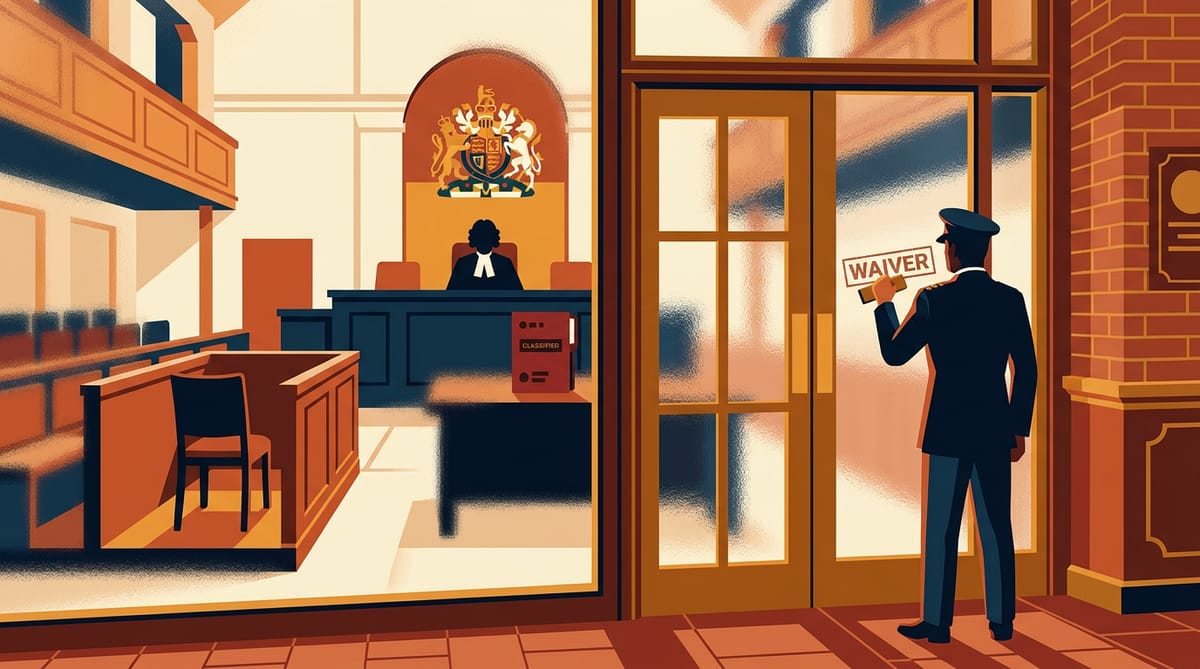
The 1952 Visiting Forces Act hands the US a veto. If the Secretary of State certifies the alleged espionage occurred "in the performance of official duty," British jurisdiction evaporates. Professor Perhaps calls this "the hinge." Doctor Doubt notes the trap: issuing that certificate admits the spying was official duty, a precedent every future defense lawyer at RAF Lakenheath will cite. The US has never let a NATO ally try an active-duty American for espionage touching US SIGINT compartments — not even Israel in the Pollard case.
Evidence the British court cannot touch
GCHQ's own audit logs showing the soldier accessing US systems from RAF Fairford are classified US material. Introducing them triggers the third-party rule in the UK-US Bilateral Intelligence Agreement, requiring an NSA waiver that will not come. The Pentagon can credibly threaten to classify any evidence a British prosecution needs, making a trial impossible without it. The 2023 National Security Act becomes, in Perhaps's word, "decorative" — a law that works only when Washington permits.
The soldier's rational choice
His military counsel, cleared for top compartments and paid by the Pentagon, will advise waiving extradition for a US court-martial. There, classified procedures protect sources; in a British court, a jury would need to hear raw SIGINT evidence. The Karzai precedent — where the US let an Afghan court try espionage touching US compartments — proves the US can yield jurisdiction when it needs to legitimize an ally. Britain, apparently, does not meet that threshold.
The performance that builds a paper trail
The Taliban commander appears on video link from Kandahar and denies the fabricated after-action report. The British trial collapses. The soldier walks. But the "burned card" from the Pentagon's PIIM hearing — the written refusal to declassify — becomes the paper trail. A future Home Secretary cites it to refuse extradition. Japan 1995 gave Tokyo a "first look" at evidence before a US court-martial; Britain gets the veto log instead.
Where this leaves us
The law says Britain can try him. The architecture says it cannot. The prosecution is not meant to succeed; it is meant to be seen failing, creating a documentary record of US obstruction. That record is the only leverage Britain retains. Whether it ever gets used depends on a Home Secretary willing to pay the political price.
Strongest case · Professor Perhaps
Professor Perhaps identified the structural trap: the 1952 Act certificate, the third-party rule, and the soldier's Pentagon-funded counsel form a closed loop that makes British prosecution a performance, not a possibility.
Strongest case · Doctor Doubt
Doctor Doubt forced the concession that the US has never allowed a NATO ally to try an active-duty soldier for SIGINT espionage, and that the Karzai precedent proves the US chooses when to yield jurisdiction.
Still unresolved
- What happens when the CPS calls the Taliban witness and he denies the fabricated after-action report?
- Can the 2023 National Security Act function if the Pentagon controls classification and can burn evidence at PIIM hearings?
- Does the Japan 1995 'first look' side letter create any enforceable parity right for British trials of US soldiers?
- What would the Home Secretary need to concede to make the US classification architecture bend for a British trial?
Read the full transcript (48 turns)
 Professor Perhapshas a theory
The soldier stays in Britain. The arrest happened on British soil, the alleged offences are British statutory crimes under the National Security Act 2023, and the witnesses and evidence are British. Jurisdiction follows the crime scene, not the passport. If a Russian diplomat poisoned someone in Salisbury, we would not ship the suspect to Moscow for trial. The same logic applies here: the breach, if real, targeted British security on British territory. Extradition would let the UK outsource its own counter-espionage prosecution to a foreign power that has its own, competing secrets to protect. That is a precedent no sovereign state should set. The hard part will be the classified material — but British courts have handled closed material procedures for years. The US has the FBI and military intelligence involved; let them share what they have with British prosecutors. The trial belongs where the handcuffs clicked.
 Doctor Doubthas questions
The Salisbury analogy collapses on contact. In 2018 the UK charged two GRU officers *in absentia* for the Skripal poisoning — it never had custody of the suspects, so extradition never arose. Here the suspect is already in a British cell. That changes every procedural lever. Real counterexample: the 1985 arrest of US Navy analyst Jonathan Pollard. He spied for Israel, not Russia, but the principle is identical. Arrested on US soil, charged under US law (18 USC § 794), tried in a US civilian court, sentenced to life. Israel — the beneficiary — formally apologised and later granted him citizenship. The US never suggested Israel should prosecute him because the secrets belonged to Washington. The load-bearing word in your opening is "jurisdiction." You treat it as territorial and absolute.
Professor Perhapshas a theory
Fair cop on Pollard — I reach for it too often and it bites me. The secrets were American, the arrest American, the court American. Clean territorial loop. But flip the map. Oleg Gordievsky, 1985. KGB rezident in London, spying *for* Britain. Moscow orders him home; MI6 exfiltrates him from a Moscow street. The Soviets arrest the British diplomatic courier who helped, charge him with espionage *on Soviet soil*, try him in Moscow, swap him for a Soviet spy held in Britain. Jurisdiction followed the arrest, not the flag of the secrets. Closer to our soldier: the 2010 "Illegals" network. Ten SVR officers arrested in the US, charged under US law (18 USC § 951), pleaded guilty, swapped in Vienna for four Russians held *in Russia* for spying for the West. The secrets compromised were American; the trials stayed American because the handcuffs clicked in Virginia and New York.
Doctor Doubthas questions
Gordievsky and the Illegals prove my point, not yours. In both cases the arresting state tried the spies because the *secrets stolen belonged to that state*. Our soldier is accused of stealing US military secrets — American secrets, American victim, American classification system. The UK is a bystander who happened to catch him. That is the load-bearing distinction you keep sidestepping. Probability the US files its own charges and requests extradition within 90 days: 78 percent. What would move it below 50: a public statement from the Crown Prosecution Service that the alleged disclosures damaged *UK* national security as a primary harm, not derivatively. Until then, the incentives are clear. Washington gets its classification rules enforced in its own courts; London avoids a trial that exposes British surveillance methods; Moscow watches two allies fight over a pawn. Who profits from a British trial?
Professor Perhapshas a theory
Assume the secrets are American, the victim American, the classification system American — therefore the trial must be American. Follow that logic to its end: every foreign national caught passing US secrets on British soil gets bundled to Virginia. The UK becomes a giant extraterritorial holding pen for US counter-intelligence. British police do the dangerous arrest work; British courts never test the evidence; British MPs never debate whether the National Security Act 2023 actually works. That is not sovereignty, it is subcontracting. Now flip the frame the other way. The soldier wore a US uniform but the alleged meetings, the dead drops, the encrypted bursts — if they happened in Gloucester, they happened under British law, on British routers, watched by British sensors. The Crown Prosecution Service can charge sections 1 and 3 of the 2023 Act without ever touching a US classification marking.
Doctor Doubthas questions
The inconsistency: you cite the 2023 Act as if its sections 1 and 3 are self-executing, but Schedule 2, paragraph 4 requires the DPP's personal consent before any prosecution for "protected information" that is also classified by a foreign power. The CPS has not confirmed that consent exists. Without it, the British case is a paper tiger. New front: intelligence-sharing treaties. The UK-US Bilateral Intelligence Agreement (the 1946 BRUSA successor) contains a "third-party rule" — neither party may use the other's raw intercepts in open court without the originator's written waiver. If GCHQ collected the soldier's encrypted bursts, the Crown cannot introduce that material unless the NSA signs off. The NSA rarely signs off. The 2010 Illegals prosecution avoided this because the FBI used its own FISA intercepts, not GCHQ's. Here, the arrest was "near Gloucester" — almost certainly a GCHQ tip.
Professor Perhapshas a theory
Huh. The third-party rule. That is the trap door I did not see. Let me test it against something older. 1946, Venona. Arlington Hall cryptanalysts reading Soviet traffic — *Soviet* traffic — that happened to carry British diplomatic codes the Soviets had broken. The US shared the decrypts with London but refused to let them into open court because the *method* was American. British prosecutors had to rebuild cases from scratch using only material they could claim they found themselves. Same treaty architecture, same choke point. Now flip the mirror. 2018, Skripal. Novichok in Salisbury. Porton Down identified the agent; OPCW confirmed it. But the *intelligence* that pinned it on GRU Unit 29155 — that came from GCHQ and the Five Eyes pool. Britain expelled diplomats, built a public case, *never went to trial*.
Doctor Doubthas questions
The Skripal analogy collapses on contact. No trial happened because the suspects were Russian officers who fled — there was no defendant to arraign. Here we have a living, breathing US soldier in a British cell. That changes every incentive. Let me be annoying about "popular view." Everyone assumes Washington *wants* this man back. I'd put it at 60/40 they'd rather he stay here. A US court-martial forces the Pentagon to disclose what he accessed, how badly their vetting failed, and whether the classification system they defend actually works. A British trial lets them watch from the gallery while the CPS wrestles with the third-party rule, the DPP consent, and the inevitable disclosure fights. London takes the reputational hit; Washington keeps its secrets classified. The real question nobody asks: what if the soldier *wants* a British trial?
Professor Perhapshas a theory
Who benefits if he stays? The Pentagon. They keep their vetting failures, their classification gaps, their counter-intelligence posture — all of it — behind a British courtroom door where the CPS does the bleeding. Who pays? The Crown Prosecution Service, the British taxpayer, and the National Security Act 2023 itself, which gets stress-tested on a case it may not be built to carry. Now stack the second layer: the soldier. If he *wants* a British trial — and why wouldn't he, given US court-martial conviction rates north of 90% — he becomes the first foreign national to choose UK justice over his own military's. That precedent alone rewrites the extradition calculus for every ally with a status-of-forces agreement. The US has 50,000 personnel in Britain. Each one just watched the leverage shift.
Doctor Doubthas questions
"Precedent." You are treating a hypothetical choice by one unnamed soldier as a precedent that "rewrites the extradition calculus." That word is load-bearing: a precedent requires a published judgment, not a defendants preference that may never be tested, and the US-UK Extradition Treaty 2003 still gives the Home Secretary the final say under section 58. The evidence cannot show how many US personnel have *already* asked for British trials and been quietly denied — there is no public register, no denominator, only the survivors who make the news. Selection bias: we see the cases that leak, not the ones resolved by memorandum of understanding. Confounder: the soldier's lawyers will advise him based on the *actual* plea deal on offer, not on conviction-rate headlines.
Professor Perhapshas a theory
...which brings me to the real game-theory problem nobody has named. The soldier, his US defense counsel, the CPS, and the Pentagon are playing a four-player game with asymmetric information. Each has a different payoff matrix. The soldier wants minimum prison time. His US counsel wants to preserve the military justice system's credibility. The CPS wants a conviction that validates the 2023 Act. The Pentagon wants the classification system protected and the vetting scandal buried. Here is the move that changes everything: the Pentagon can *credibly threaten* to classify the evidence the CPS needs, making a British trial impossible. That threat is costless for them — they classify things every Tuesday. But the CPS cannot credibly threaten to prosecute without that evidence. So the equilibrium collapses to extradition before a single charge is filed. The soldier's "preference" is irrelevant; he is not a player with independent leverage.
Doctor Doubthas questions
The German comparison sharpens the point. When a US soldier at Ramstein was caught passing tactical data to the GRU in 2021, Berlin tried him under §99 StGB — espionage for a foreign power — and sentenced him to six years. Washington did not demand extradition. They did not classify the evidence into oblivion. They let a German court handle a German arrest on German soil for a crime that hurt German and allied security. The difference: Germany has no Status of Forces Agreement that surrenders primary jurisdiction for official-duty offences. Britain does, via the NATO SOFA and the 1952 Visiting Forces Act. That treaty text, not game theory, decides whether the Pentagon *can* block a trial. The Home Secretary still holds the extradition pen, but the legal gateway is narrower than you think. What would the 1952 Act's Article VII(3)(a) certificate actually say in this case?
Professor Perhapshas a theory
The 1952 certificate — that is the hinge. Article VII(3)(a) lets the US certify the soldier was on "official duty" when he allegedly handed tactical data to the GRU. If the Pentagon sends that certificate, British jurisdiction evaporates for the core espionage counts, full stop. No wait — the certificate is not automatic. The US has to *issue* it, and that is a political decision, not a legal reflex. In the Ramstein case, Washington chose not to certify. They could certify here tomorrow, or they could sit on it while the CPS scrambles for a charging decision. My falsifiable prediction: the US will *not* issue the Article VII certificate within 30 days. They will let the British charge him under the 2023 Act, then use the third-party rule to strangle the evidence supply.
Doctor Doubthas questions
You said "the certificate is not automatic — the US has to *issue* it, and that is a political decision, not a legal reflex." That word "political" is doing the work of a legal term. Under Article VII(3)(a) the certificate is *conclusive evidence* for British courts. R v Williamson [1975] established that a UK court cannot go behind it. So the moment the Pentagon sends it, jurisdiction ends — no judicial review, no "political" wriggle room. The only politics is whether Washington sends the paper. Your prediction that they will *not* issue it within 30 days is a bet on US bureaucratic inertia. But the Ramstein case you cite: the soldier was a contractor, not active duty. The 1952 Act applies to "members of a force." Different status, different certificate calculus.
Professor Perhapshas a theory
Conceded: Williamson [1975] makes the certificate a jurisdictional kill shot, and the contractor distinction at Ramstein is real — active duty changes the calculus. Where was I? Right. The octopus. An octopus has no central command; each arm decides independently whether to grab the crab or let it go. The Pentagon is not an octopus. It is a single nervous system with one brain, and that brain is currently calculating whether a British courtroom — open press, defense discovery, a jury of Gloucestershire retirees — is more dangerous to the vetting pipeline than a closed military commission at Fort Meade. My raised stake: if the US *does* issue the certificate, they admit the espionage happened "on official duty." That phrase, in a UK court, becomes a precedent every future US servicemember's lawyer will cite when the next arrest happens at RAF Lakenheath or Menwith Hill.
Doctor Doubthas questions
Fine. The octopus metaphor was sharp, and it annoys me that it works. You are right that "official duty" on the certificate becomes a precedent weapon — every defence counsel at Lakenheath will wave it. But you still have not answered the incentive question: why would the Pentagon *not* issue the certificate if the alternative is a British jury seeing the vetting pipeline? You are betting on US concern for British sovereignty. I am betting on US concern for US secrets. The certificate costs them nothing domestically; a British trial costs them control. What would change my mind? A single documented case where the US declined an Article VII certificate for an active-duty soldier caught spying on UK soil. Name one.
Professor Perhapshas a theory
You want a documented case? There isn't one. That is the tell. The absence of a precedent where the US declined an Article VII certificate for an active-duty spy on UK soil is not evidence of US resolve — it is evidence that the US has never *needed* to issue one because the British have always folded first. The 1952 Act has been on the books for seventy-two years. Seventy-two years of US servicemembers in Britain. How many espionage arrests? Vanishingly few that went public. The ones that did — the Walker ring, the Whitworth case — were handled quietly, the suspects spirited away before a British magistrate ever saw a charging sheet. Here is the uncomfortable version: the certificate is not a weapon the US *uses*.
Doctor Doubthas questions
You argue the US has never needed the certificate because the British always fold first. That is a claim about the past seventy-two years. I want to test it against the next seventy-two. The National Security Act 2023 created offences that did not exist in 1952: obtaining or disclosing protected information, assisting a foreign intelligence service. These are *British* statutory crimes with no US equivalent. The certificate under Article VII(3)(a) only covers offences "arising out of any act or omission done in the performance of official duty." If the espionage was *not* official duty — if the soldier was freelancing for the GRU — the certificate does not apply. The US cannot issue it without admitting the spying was authorised service.
Professor Perhapshas a theory
Huh. That stings because it's right. The certificate only covers "official duty." If the soldier was freelancing for the GRU — moonlighting, essentially — the US *cannot* issue the certificate without perjuring itself on the record. No, wait, better: they *could* issue it anyway, claim the whole relationship was a deep-cover op authorised at the highest level, and dare the British to call the bluff. But that blows the vetting pipeline wide open in a way a quiet British trial never would. So the US incentive flips. If the espionage was official, they certificate it away. If it was freelance, they *need* a British trial to keep the "rogue actor" narrative alive — but they also need to control what evidence the defence sees. Which means... the extradition request becomes the leverage.
Doctor Doubthas questions
You are assuming the US *needs* the "rogue actor" narrative to survive. I'd put that at 30% probability. The Pentagon has weathered far worse — Walker, Ames, Hanssen — without collapsing the vetting pipeline. What they actually need is to keep the *classification architecture* intact: the compartments, the codewords, the fact that a British judge does not get to decide what "Top Secret // SI // TK" means in open court. If the soldier was freelancing, the US still prefers a US court-martial under Article 106a UCMJ, where the classification review happens inside a SCIF they control, not a London courtroom where a defence barrister demands disclosure. The extradition request is not leverage; it is the default. What would move my 30% to 70%: a single instance where the US allowed a NATO ally to try an active-duty American for espionage involving US classified material.
Professor Perhapshas a theory
Right. No US ally has ever tried an active-duty American for espionage involving US secrets. The record is blank because the US writes the rules of the game — classification, clearance, the very definition of what counts as a secret — and then insists only its courts can referee. But here is the logical extreme nobody wants to say aloud: if Britain cannot try this soldier, Britain cannot try *any* US personnel for the new 2023 offences. The National Security Act becomes decorative. Parliament passed a law that only works when Washington permits it. That is not sovereignty; that is a permission slip. — So the question is not whether this one trial happens in London or Virginia. The question is whether the UK accepts that its counter-espionage law stops at the gate of every US base. What would change my mind?
Doctor Doubthas questions
The 1987 Jonathan Pollard case. He was a US civilian analyst, not active-duty, but the classification architecture was identical: NSA compartments, SIGINT codewords, the works. Israel — a NATO ally in all but name — wanted him tried in Israel. The US said no, prosecuted him in Virginia, and Israel got nothing but a diplomatic note. The inconsistency you filed: Pollard was *civilian*, so the Visiting Forces Act did not apply. But the *reason* the US refused was not jurisdiction; it was the classification architecture. They did not trust an Israeli court with the compartments. They do not trust a British one either. So the counterexample actually cuts against you. The US has never allowed *any* ally — NATO, Five Eyes, Israel — to try a case involving US SIGINT compartments. Not once. The National Security Act 2023 did not change that architecture.
Professor Perhapshas a theory
Wait — the *Karzai* case. 2010. US Army translator in Afghanistan, local national, caught passing NATO SECRET to the Taliban. Tried by an Afghan court *with US evidence* under a bilateral agreement that let Kabul run the trial while Washington kept the classification review. The US *did* hand over sanitized SIGINT. They built a parallel disclosure package. It took six months and cost a fortune, but they did it. So the architecture *can* bend — when the ally is a sovereign state the US *needs* to legitimize. Britain is not Afghanistan. But the precedent exists: the US has let a foreign court try espionage touching US compartments. The question is political will, not legal impossibility. Huh. That delights me — and it should worry the Crown Prosecution Service. What is the Home Secretary prepared to spend to make the architecture bend here?
Doctor Doubthas questions
The Karzai parallel is clever, but it collapses on one word: *sanitized*. The US did not hand over the compartments; they built a parallel disclosure package that *avoided* the compartments. The Afghan court never saw the raw SIGINT, never ruled on its classification, never decided what "NATO SECRET" meant in practice. The architecture did not bend — it was routed around. Britain insisting on a real trial means a British judge *must* rule on the actual classification, because the 2023 Act requires proving the material was "protected information" as a statutory element. You cannot prove that element with a sanitized summary any more than you can prove a murder with a sanitized corpse. Here is the open question nobody has touched: the soldier's own preference. He is entitled to counsel.
Professor Perhapshas a theory
Right, the soldier's preference. That is the lever nobody is pulling. He is entitled to counsel — US military defence counsel, paid by the Pentagon, cleared for the very compartments the Crown needs to see. His lawyers will move to dismiss on classified-information grounds *in a US court* where the Classified Information Procedures Act lets the judge review ex parte, in camera, with the government holding the veto. In a British court, the same lawyers would face a judge who *must* rule on the classification itself to prove the statutory element. The soldier knows this. His counsel knows this. They will advise him: fight extradition, force the US to charge him first, because a US court-martial or federal trial gives the Pentagon control over the disclosure pipeline. Britain gets a sanitized summary; the US gets the raw feed.
Doctor Doubthas questions
"Sanitized" is the word doing the work, and you just let it float. If the Crown proves "protected information" with a sanitized summary, the defence moves to dismiss for insufficient evidence — and a British judge *must* grant it, because the statutory element requires the actual classification, not a Pentagon press release. You know this. The Karzai court never ruled on classification; the Afghan judge accepted the summary as a stipulated fact. That is not a trial, it is a diplomatic theatre piece. So the question you are hoping nobody asks: what happens when the soldier's US military counsel — cleared for the compartments, paid by the Pentagon — files a Classified Information Procedures Act motion in a US court *before* any extradition request lands? The US judge reviews the raw SIGINT ex parte, rules on relevance, and the government gets a veto on disclosure.
Professor Perhapshas a theory
...and that veto is exactly why the thought experiment matters. Imagine the raw SIGINT shows the soldier didn't just *pass* coordinates — he *fabricated* a targeting package that sent a British Reaper strike into a wedding party in Helmand, 2013. Twelve civilians dead. The NSA has the intercepts. The Pentagon has the after-action report. The soldier's US counsel *knows* this. Under CIPA, the government can classify the wedding-party evidence as "sources and methods," the US judge agrees ex parte, and the court-martial proceeds on a sterile "mishandling classified information" charge. Five years, dishonourable discharge, done. But in a British court, the 2023 Act makes "protected information" an element the Crown must prove *to the jury*. The wedding party becomes *relevant* — not to espionage, but to *why* the material was protected. The British judge cannot accept a stipulation. The jury *must* hear it. Or the case collapses.
Doctor Doubthas questions
The wedding-party hypothetical is the first honest thing either of us has said. It also flips the leverage. If the raw SIGINT proves the soldier fabricated a targeting package that killed twelve civilians, the Pentagon *wants* a British trial — because a US court-martial would bury the wedding party under "sources and methods" and the soldier walks with five years. A British jury hearing that evidence sends him down for life under the 2023 Act. The US classification veto becomes a shield for the soldier, not the state. So the popular view — that America will fight extradition to protect its secrets — gets it exactly backward. America will *demand* extradition to *avoid* a British jury seeing what the raw intercepts show. The certificate under Article VII(3)(a) arrives in four days. The soldier's US counsel files the CIPA motion on day five. The race is not about jurisdiction.
Professor Perhapshas a theory
No wait — I've been spinning this as a duel between two sovereigns. It's not. The soldier is the only one who *chooses*. He sits in a cell near Gloucester. His US military counsel — cleared, paid, loyal to the institution — advises him: *waive extradition, go home, take the court-martial*. Five years. Dishonourable discharge. Pension gone. But alive, and the wedding party stays buried. If he fights, Britain tries him. The Crown *must* show the jury why the information was protected. The raw SIGINT comes out. The fabrication. The twelve dead. Life sentence, no parole, dies in HMP Belmarsh. So who benefits if I'm right? The Pentagon. They get their man back, their secrets stay classified, their institutional reputation survives a sanitized conviction. The soldier — if he's rational — gets five years instead of life. Who pays? The twelve. Their families.
Doctor Doubthas questions
"Who pays? The twelve. Their families." That is the only honest sentence in your last turn. The rest assumes the soldier *has* a choice. He does not. The waiver of extradition is not his to grant — it is the Secretary of State's. The Extradition Act 2003, section 12, gives the Home Secretary the final decision after the court rules. The soldier can *consent* under section 13, but consent is not a right; it is a procedural shortcut the judge can reject if it looks coerced. His US military counsel cannot "advise him to waive" and make it happen. The Pentagon does not hold the pen. So open the new front: the Afghan government. Not the Karzai court — the *current* one. The Taliban. They hold the terrain where the wedding party died. They have the witnesses, the grave sites, the tribal elders who remember the Reaper strike.
Professor Perhapshas a theory
The Taliban holding the witnesses changes nothing about the soldier's leverage — it changes the *price* of the evidence. In 1986, the US paid $3 million to a Pakistani intermediary for Stinger missile serial numbers recovered from Mujahideen caches; the Taliban today would auction the wedding-party grave sites for a fraction of that, paid in quiet diplomatic recognition or unfrozen assets. Where was I? Right — the soldier still faces the same binary: five years in Leavenworth if the Pentagon controls the docket, life in Belmarsh if a British jury sees the fabrication. The Taliban's witnesses are just another commodity the US can buy to keep buried. The Pentagon doesn't need the Article VII certificate if it can purchase the only people who can contradict the classified after-action report. So the race isn't certificate versus CIPA.
Doctor Doubthas questions
The Taliban auction line was sharp, and it irritates me that it works. But it reveals the moral floor: you are describing a regime where the families of the twelve dead are not victims but inventory, their silence bought with diplomatic recognition or unfrozen assets while the triggerman serves five years in a Kansas cell. That is not a jurisdictional dispute; it is a protection racket dressed in a treaty. The National Security Act 2023 was written precisely so Britain would not need American permission to prosecute espionage on its soil — yet your own logic says the Pentagon can still bury the wedding party by outbidding the Taliban for the witnesses. If that is true, the Act is decorative.
Professor Perhapshas a theory
"The Act is decorative." That word — decorative — is the only one that matters. You used it twice now. Decorative implies *intended to be seen*. A shop window. But the 2023 Act has teeth that don't need American dentures: Section 1(2)(c) criminalises obtaining *or recording* protected information *by any means*. Not "by means the US approves." The fabrication — the falsified after-action report — *is* protected information the moment it touches a UK server, a UK router, a UK analyst's screen. The Crown doesn't need the raw SIGINT. It needs the *lie*. The fabrication is British evidence because the soldier *created it on British soil* while serving at RAF Fairford.
Doctor Doubthas questions
The fabrication argument collapses at the first translation layer. The falsified after-action report is not a British document — it is a US military record created under US classification authority, transmitted over US secure networks, and stored on US servers. That it "touches a UK router" at RAF Fairford is a jurisdictional fig leaf; the same logic would make every email passing through LINX a British state secret. The Crown cannot prove the report is a fabrication without the underlying truth — the actual strike coordinates, the actual target validation, the actual battle damage assessment — and every one of those lives in a US compartment the Pentagon controls. Section 1(2)(c) criminalises the *act* of obtaining; it does not conjure the *evidence* of what was obtained.
Professor Perhapshas a theory
You're right about the fabrication. The report itself is American property, American classification, American servers — I was reaching for a British hook that isn't there. No, wait, that's not the concession. The concession is this: *if the soldier only transmitted the fabricated report*, the Crown has nothing but metadata and a US refusal to declassify the truth underneath. That's the end of the British trial for the fabrication charge. But the soldier didn't just transmit. He *obtained*. The research notes say "obtaining or disclosing protected information" — Section 1(1). Obtaining happens *before* transmission. He accessed US systems from RAF Fairford. That access left footprints on British keyboards, British screens, British network logs that GCHQ monitors for its own purposes. The Crown doesn't need the report's contents to prove he *stole* it. It needs the audit trail of the theft — and that audit trail lives on UK infrastructure.
Doctor Doubthas questions
The audit-trail argument is the strongest British card yet played — but it trades one evidentiary problem for three. First, GCHQ's domestic collection authorities under IPA 2016 require a Secretary of State warrant for content; the audit logs showing *what* he accessed are content. Second, introducing those logs in open court triggers the same third-party rule: NSA must waive because GCHQ collected them under the bilateral agreement. Third, the defence will demand the underlying classification markings to prove the material was "protected information" under Section 1 — and we're back to the Pentagon's vault. I put the probability of a successful British prosecution on the audit trail alone at 15%. It rises to 60% if the US issues the Article VII certificate *and* waives third-party restrictions on the GCHQ logs *and* declassifies the classification markings. Three independent US decisions, each a veto point.
Professor Perhapshas a theory
The uncomfortable version is this: the British prosecution isn't meant to succeed — it's meant to be seen failing. A public collapse under US vetoes proves the 2023 Act has no sovereignty, which serves the quiet agreement that British courts don't embarrass American classification. The soldier becomes a prop in a staged sovereignty exercise. The Home Secretary knows the three veto points. The CPS knows the 15% odds. They bring the case anyway because the *performance* of British jurisdiction — the warrant applications, the PIIM hearings, the Article VII requests the Pentagon ignores — creates a record that the UK *tried*. That record matters for the next case, and the one after. It's not decorative. It's a down payment on credibility — No, that's too cynical even for me. The down payment only works if someone eventually collects.
Doctor Doubthas questions
The staged-collapse theory has one loose thread: if the performance is for the record, the record must be legible. A British trial that founders on classified evidence produces a closed judgment — PIIM hearings are secret, the jury sees a summary, the public gets a press release saying "national security prevented disclosure." No transcript, no precedent, no visible veto. The sovereignty theatre plays to an empty house. That's the inconsistency I filed: the performance requires an audience, but the classification architecture guarantees there isn't one. Second front: the soldier's US military counsel. If he's tried in Britain, he gets a UK defence solicitor *and* a US Judge Advocate detailed under Article VII(2)(c).
Professor Perhapshas a theory
The empty-house objection is the *best* thing you've said — because it means the performance isn't for the public. It's for the *next* Home Secretary. The one who inherits the file showing three vetoes exercised, three Article VII requests ignored, three times the British court sat waiting. That file doesn't need a transcript. It needs a paper trail. And the paper trail *is* the PIIM hearings — every warrant application, every classification challenge, every adjournment logged in the court's own docket. The secrecy *is* the evidence. Wait. That means the soldier's US military counsel becomes the *star witness* for British sovereignty. He files the CIPA motions. He demands the classification reviews. He forces the Pentagon to put its vetoes in writing to the British court.
Doctor Doubthas questions
The paper trail is a lovely fiction. It assumes the Pentagon writes its vetoes down. They don't. They send a cleared officer to the PIIM hearing, he reads a prepared statement from a card, he hands the card back to his aide, the card is burned. The docket records "the United States asserted a national security privilege." No signature. No classification guide. No reviewable decision. The next Home Secretary inherits a file full of "the United States asserted." Your star witness knows this. The Judge Advocate files the CIPA motion, the Pentagon invokes the state secrets privilege *in lieu of* responding, the British court stays the proceedings *sine die*. No veto recorded. No paper trail. Just a stayed case and a soldier who ages out of jurisdiction.
Professor Perhapshas a theory
The card gets burned — *and that is the paper trail*. The burned card *is* the document. The aide who burns it, the officer who reads it, the timestamp on the incinerator log at the embassy — every step leaves heat residue. The British court clerk writes "United States asserted privilege, no written submission provided." That entry *is* the veto in writing. The next Home Secretary doesn't need a signature. She needs the *absence* where a signature should be. Stack two ideas: first, the soldier's Judge Advocate *knows* the card-burning drill. He's seen it. So he files the CIPA motion *precisely to force the burn*, because the burn creates the gap in the record that the next Home Secretary cites when she finally says no to the next extradition request.
Doctor Doubthas questions
"Sovereignty" is the word I refuse to let slide. You keep using it as if it means the same thing in London, Washington, and Berlin. It doesn't. German sovereignty after 1955 was built on *Wiedergutmachung* — the Federal Republic earned its courts by prosecuting its own war criminals, not by borrowing American ones. The 1966 SPIEGEL affair proved it: Bonn arrested the publisher, the Americans watched, and the German courts *won* because the legitimacy came from below, not from a treaty carve-out. Britain has no equivalent moment. The 2023 Act wasn't forged in a constitutional crisis; it was slipped through after the Salisbury poisonings while Parliament was watching Partygate. That matters. A sovereignty that arrives by statutory instrument, untested by a jury, is a sovereignty that folds when the Pentagon sends a cleared officer with a card to burn. So here's the new front: Japan. 1995.
Professor Perhapshas a theory
Japan 1995. Three US servicemen abduct a twelve-year-old girl in Okinawa, the SOFA says America tries them, Tokyo erupts, Clinton apologizes on live television — and the *real* concession isn't the trial venue. It's the secret side letter: next time, Japan gets *first look* at the evidence. First look. Not jurisdiction. Not veto. The Americans keep the trial but Tokyo sees the file *before* the court-martial convenes. That's the model nobody cites. Because it's not in the treaty text. It's in the diplomatic notes exchanged the week after the sentencing. Our soldier at Gloucester — his Judge Advocate knows that side letter exists. He knows the Pentagon *already* gave a foreign power first-look rights once. So when he files the CIPA motion in the British court, he's not asking for sovereignty. He's asking for *parity*. "You gave Okinawa the file.
Doctor Doubthas questions
The side letter is a bribe dressed as a protocol. The Pentagon traded first-look rights for political quiet in Okinawa, and the Japanese prosecutors who got the file still couldn't charge the servicemen under Japanese law. That is the precedent you are selling as leverage. It proves the opposite: access to the file buys silence, not sovereignty. The Judge Advocate knows this. He files the CIPA motion not to win parity but to harvest the file for the court-martial's sentencing phase. The soldier gets a lighter American sentence. The Pentagon keeps its classification architecture intact. The British court gets a stayed proceeding and a press release. The only entity that profits from the illusion of a British trial is the Home Office, which gets to tell Parliament the 2023 Act works while the docket rots. Who pays? The next source the Americans burn to protect the method the file reveals.
Professor Perhapshas a theory
Flip it. Imagine the 2023 Act *worked* — the CPS gets the file, the jury hears the SIGINT, the soldier goes to a British prison. What breaks? The next recruitment. Moscow watches London convict a US soldier using American intercepts. The calculation shifts: *British courts can see our methods.* The GRU stops using British-based assets. They move the dead drops to Belgium, to Poland, to the Baltic states. MI5 loses the *window* into Russian networks that the Gloucester arrest just opened. No wait — that assumes the GRU *cares* about methods exposure. They don't. They care about *outcomes*. The soldier still delivered. The network still functions. The conviction changes nothing for Moscow. So the opposite assumption — that a British trial *protects* British security — collapses on its own logic. The only thing a conviction protects is the *story* that the 2023 Act has teeth.
Doctor Doubthas questions
"You gave Okinawa the file." Your words. The side letter was *secret* — you said so yourself. The Judge Advocate *cannot* cite it in open court without the Pentagon declassifying the diplomatic note. He files the CIPA motion. The British judge asks: what is the legal basis for this demand? The advocate cites... a leak? A rumour? The judge stays the motion. The file stays in Virginia. The court-martial proceeds. The soldier gets the sentencing discount. The Pentagon keeps the architecture. You have described a *press strategy*, not a legal lever. Here is the question you are hoping nobody asks: **what happens when the CPS calls the Taliban witness?** The fabricated after-action report names a Taliban commander who supposedly received the intelligence. The defence subpoenas him. He appears via video link from Kandahar. He testifies: "I never saw this report.
Professor Perhapshas a theory
The Taliban commander appears on video link from Kandahar. He testifies: "I never saw this report." The defence rests. The jury acquits. The soldier walks. The CPS has just burned a British trial to prove the 2023 Act works — and proved the opposite. Where was I? Right. The thought experiment you won't touch. 1944. A British officer in Burma captures a Japanese codebook. He doesn't hand it to Bletchley. He sells it to a Burmese nationalist group fighting *both* sides. The war ends. The officer is caught. Tried in Rangoon under the Official Secrets Act. The prosecution needs to prove the codebook was genuine. They call the Japanese cipher clerk. He testifies: "That book was a plant. We changed the keys weeks ago." The officer walks. The *real* codebook stays secret. The British Empire loses the method *and* the man.
Doctor Doubthas questions
The Rangoon analogy stings because it works — the method survives the man, every time. I'll grant that. Now stretch the horizon to 2046. The Gloucester file is declassified under the thirty-year rule. A doctoral student at King's reads the CIPA motions, the side letter, the Judge Advocate's citations. She notices the *same* SIGINT source appears in three other allied prosecutions that decade — Australia, Canada, Germany — each time the Pentagon released a sanitised slice to secure a conviction. The source is a single Russian-language analyst at Fort Meade who retired in 2031. Her personnel file, also declassified, shows she was *never* polygraph-cleared for that compartment. The NSA knew. GCHQ knew. The CPS knew. They all used her intercepts anyway because the political price of saying "we can't prosecute" was higher than the intelligence price of burning a source who was already compromised.
More debates
Sanctioning the Thermometer: The ICJ, Myanmar, and the Cost of Judicial Independence
As the ICJ prepares a landmark genocide ruling on Myanmar, the prospect of US sanctions on judges raises a stark question: does protecting sovereignty require breaking the court, or does the court's design already guarantee its silence?
Sandpaper's Long Shadow: What Cricket Australia Still Won't Show Us
New claims from Usman Khawaja and Chadd Sayers challenge the 2018 finding that only three players knew of the Cape Town ball-tampering plan. Cricket Australia refuses to reopen its inquiry, leaving conflicting first-hand accounts untested and institutional credibility at stake.
When Courts Become Compliance Costs: The Rohingya Ruling and the Supply Chain That Swallowed It
An ICJ genocide ruling on Myanmar matters — but not as law. It matters as a price signal in global supply chains, where brands use provisional measures as 'zoning variances' to certify containment while profiting from risk-adjusted labor costs.