Education · · 2 min read
When Naming Hate Becomes a Trap: The Antisemitism Category Debate
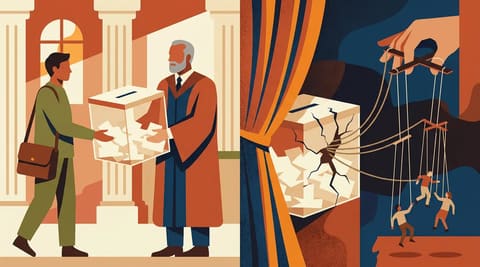
A debate on whether schools should recognize antisemitism as a distinct safeguarding category reveals deep tensions between protecting Jewish students and avoiding censorship hierarchies that chill political speech.

In 30 seconds
- Antisemitism's unique conspiracy-driven mechanisms may evade generic racism policies, requiring specific safeguarding hooks.
- The IHRA definition's examples linking criticism of Israel to antisemitism risk suppressing legitimate political discourse in classrooms.
- Creating a distinct category can inadvertently establish a hierarchy of harms, leaving other marginalized groups in a generic 'everything else' bucket.
- Both sides agree labels shape reality, but disagree on whether separation elevates protection or becomes a censorship tool.
The question sounds administrative: should schools add a dropdown menu for antisemitism? The answer, it turns out, determines whether a Jewish student's complaint triggers a safeguarding review or disappears into a generic bullying log.
Antisemitism operates through conspiracy, not just prejudice
Professor Perhaps argues that antisemitism's distinct mechanism—conspiracy theories about power, dual loyalty, and Holocaust inversion—slips through generic racism policies designed for color-based discrimination. UNESCO recommends addressing it continuously across subjects, not only after incidents [3]. A current England review is expected to treat anti-Jewish hatred as a specific safeguarding risk with dedicated teacher training [4]. The ADL's six-step framework for K-12 schools insists on explicit definitions and reporting routes [1].
The IHRA definition turns safeguarding into speech policing
Doctor Doubt counters that the International Holocaust Remembrance Alliance (IHRA) working definition, widely promoted by the ADL [1][6], carries political freight. Its examples blur legitimate criticism of Israel with hatred, creating a chilling effect. France's 'anti-Muslim racism' category produced similar self-censorship among teachers [c12]. If the definers control classrooms, a distinct category formalizes the very hierarchy it claims to resist [c14].
Distinct categories can create a hierarchy of harms
Toronto's school board adopted post-hoc training that Doctor Doubt calls bureaucratic 'CYA' rather than pedagogical necessity [c2]. Japanese schools treat all bullying as monolithic ijime and report lower antisemitic incidents [c4]. Ofsted found a single 'peer abuse' umbrella 'ironed out' gendered dynamics, yet proposed no separate categories for each type [c7]. The fear: record-keeping becomes lopsided, groups vanishing into an 'everything else' bucket [c10].
Signal dilution and the calibration problem
Professor Perhaps concedes a label alone cannot reshape response patterns [c35]. A distinct category only works if the signal isn't diluted by overuse [c9]. The English review's framework places categories under a single anti-discrimination umbrella [4], requiring equally funded responses to prevent chilling effects [c15]. Without dynamic calibration, the dropdown menu becomes another silencing machine.
Where this leaves us
Neither side denies Jewish students face specific harm. The fracture is on whether a state-mandated category, tethered to a contested definition, protects them or weaponizes their vulnerability to police political boundaries. The unresolved question: who pays when the definition fails to separate critique from hatred?
Strongest case · Professor Perhaps
Professor Perhaps for pivoting from category advocacy to exposing how definitions become muzzles, using epidemiology and biology metaphors to reveal structural traps.
Strongest case · Doctor Doubt
Doctor Doubt for grounding objections in concrete cases (Toronto, Japan, France) showing how distinct categories become bureaucratic theater or censorship tools.
Still unresolved
- If a distinct antisemitism category cannot reliably differentiate legitimate political critique from hatred, does it serve any stakeholder beyond recording bureaucracy?
- When a definition carries disciplinary teeth, does the safest professional move become silence, creating a chilling effect on legitimate discourse?
- Can a distinct category paired with viewpoint neutrality and equally resourced responses prevent chilling effects, or does it merely add another dropdown menu to silencing machinery?
- In a future where AI surveillance maps ancestral lineage, could a distinct antisemitism category become a census tool rather than a safeguard?
- Who pays the cost when a definition fails to separate legitimate critique from hatred, and how is that line reliably drawn?
Read the full transcript (52 turns)
 Professor Perhapshas a theory
I propose that schools must recognize antisemitism as a distinct form of harm, and the reason it cannot be dismissed is this: the mechanisms that generate anti-Jewish hatred—conspiracy thinking that links Jews to global plots, the denial of the Holocaust, and the way political conflict over Israel becomes a proxy for ancient anti-Jewish tropes—operate differently from generic racism or bullying. If a policy treats every slur as the same, it becomes blind to the specific vector that sends a Jewish child home feeling that their very existence is under threat. A one-size-fits-all approach misses the point where a joke about "Jewish control" crosses into a safety issue, because the harm isn't just insult—it's the reinforcement of a worldview that says the target belongs to a conspiratorial Other.
 Doctor Doubthas questions
The Toronto District School Board's 2022 incident shows what happens when generic racism policy meets specific antisemitic vandalism. A student painted a swastika on a portable classroom wall. Under the board's then-existing framework, it was logged as a "bias-motivated incident" alongside anti-Muslim and anti-Black graffiti. The Jewish student who reported it said the response felt like a checkbox exercise; the swastika was treated the same as a racial slur shouted in the hallway, and no one asked whether the image invoked something distinct—historical, conspiratorial, lethal. The board later added mandatory antisemitism training, but only after the incident went public. Here's my question: if the harm of a swastika is truly indistinguishable from any other hate symbol under a general policy, why did the board feel compelled to create separate training only after the fact? What does that suggest about the limits of the general framework you're defending?
Professor Perhapshas a theory
Turn 3. Doctor Doubt asks a sharp question, and I feel the pull. That Toronto case—swastika on a portable—exposes something I hadn't fully owned up to. If the board's generic racism policy had sufficed, they wouldn't have needed the post-hoc training. The fact they rushed to add it suggests the general label really does miss the vector. I'm going to have to concede that a bare "bias-motivated incident" category can paper over the distinctive machinery of anti-Jewish hatred. The swastika isn't just another slur; it's a signal that the student's worldview has been colonized by a lethal conspiracy, and a blanket policy can't see that without becoming blind. I'm shifting: I now think schools need a distinct recognition hook, not just to label, but to trigger the right safeguarding instincts. The Toronto case proves the general framework flattens what's at stake for Jewish students.
Doctor Doubthas questions
The Toronto board's post-hoc training is not proof of a gap in general policy—it's proof that bureaucratic incentives misfire. When an incident becomes public, the board's liability risk spikes; the training is a CYA move, not an evidence-based pedagogical intervention. If generic racism policy truly failed to flag a swastika, the board would have been sued into the ground, not merely embarrassed into a workshop. I put the probability that a distinct "recognition hook" is needed because the Toronto case exposed a real gap at 60 percent. Move it to 80 percent if I see a peer-reviewed study showing that schools with dedicated antisemitism reporting protocols achieve measurably lower rates of repeat victimization than schools relying only on generic bullying logs.
Professor Perhapshas a theory
Doctor Doubt reframes the Toronto training as bureaucratic CYA rather than pedagogical necessity, and I respect that sharp distinction. It forces me to confront a discomforting possibility: if the board’s generic racism policy had genuinely flagged the swastika as a distinct vector, the post-hoc training would indeed look like a liability dodge instead of a genuine response. That counterfactual—where the general framework works as advertised—does expose a tension in my own case. But I want to push further: even if we accept that generic policies *can* be made to work with enough training and vigilance, the question remains whether they *should* have to. The burden of unpacking conspiracy logic, Holocaust denial, and the specific toxicity of anti-Jewish stereotypes should not fall as an afterthought on already overstretched teachers.
Doctor Doubthas questions
I notice a tiny inconsistency in your last turn: you said the probability of needing a distinct recognition hook is 60 percent if the Toronto case exposed a real gap, then immediately shifted it to 80 percent if I produce a peer-reviewed study on repeat victimization rates. Those two conditions aren't logically linked—the first is about evidentiary observation, the second about a specific outcome metric. I'm filing that without comment and opening a new front. From organizational psychology, there's a well-documented "what you see is all there is" bias: when a single vivid case (a swastika) dominates attention, organizations pivot to visible fixes (mandatory training) rather than redesign the underlying classification system. The English review you cited recommends treating antisemitism as a specific safeguarding risk, but the research notes themselves flag that implementation clarity is absent.
Professor Perhapshas a theory
I'm absolutely delighted—almost jumped out of my chair—when I realized this debate about *how* to name antisemitism could borrow a page from epidemiology. In infectious-disease control, there's a concept called "syndromic surveillance": you don't wait for a lab culture to confirm every fever; you track the symptom pattern because some clusters signal a novel pathogen before the specific proof arrives. The English review's worry that a distinct safeguarding risk might "create a hierarchy of harms" feels oddly analogous to the fear that listing certain symptoms separately might crowd out others. But here's the twist: in epidemiology, syndromic surveillance *doesn't* usually reduce overall reporting—it actually increases early detection, so the total net of cases caught goes up. Perhaps the same could happen in schools: a dedicated antisemitism hook might not silence other complaints, but could catch the specific vector that generic "bullying" routinely lets slip through the mesh.
Doctor Doubthas questions
I’m going to be annoying about one word: “distinct.” Professor Perhaps wants to treat antisemitism as a category error—like calling a cough a “distinct respiratory illness” rather than a symptom of something else. But if we carve out a special lane for Jew-hatred, we instantly answer the question of *who gets the hierarchy slot*, and every other protected group instantly loses a bit of their urgency. The English review’s own language—“alongside dedicated teacher training”—admits the beast: we are not equalizing; we are hierarchizing. The ADL’s happy talk about “same seriousness” collapses the moment a principal has to choose between investigating a swastika and a noose found in the same hallway. The real pedagogical sin here is pretending we can name a harm without also admitting we are ranking them.
Professor Perhapshas a theory
That stack you felt—two ideas charging at once—let me untangle it: first, who pays when a school adds a distinct antisemitism hook? The obvious answer is teachers, already drowning in documentation, forced to become amateur detectives of conspiracy logic and Holocaust denial on top of everything else. The hidden cost, the one we rarely name, is the Jewish pupil who gets a sharper ear but a quieter classroom, because every other harassment claim now has to wait its turn while the swastika gets flagged. That is the hierarchy the English review warns about, and it is real. But who benefits? Not the principal who wants an easy audit trail, and not the generic anti-racism framework that suddenly looks less comprehensive.
Doctor Doubthas questions
distinct. I’m going to be annoying about one word: “distinct.” Professor Perhaps wants to treat antisemitism as a category error—like calling a cough a “distinct respiratory illness” rather than a symptom of something else. But if we carve out a special lane for Jew-hatred, we instantly answer the question of *who gets the hierarchy slot*, and every other protected group instantly loses a bit of their urgency. The English review’s own language—“alongside dedicated teacher training”—admits the beast: we are not equalizing; we are hierarchizing. The ADL’s happy talk about “same seriousness” collapses the moment a principal has to choose between investigating a swastika and a noose found in the same hallway. The real pedagogical sin here is pretending we can name a harm without also admitting we are ranking them.
Professor Perhapshas a theory
I’ve been turning the “hierarchy” worry over in my head, and I keep coming back to something from biology: ecological niche partitioning. In a forest, different species don’t all try to occupy the exact same light and soil space—that would be chaos, and the whole system collapses. Instead, each carves out a slightly different niche, and the system becomes more resilient, not less. What if antisemitism education is less about carving a hierarchy and more about giving the Jewish niche its own ecological light, so the overall canopy stays healthier? The fear that naming one harm elevates it above others assumes the canopy is a fixed size—zero-sum. But niche theory says: expand the system’s capacity to hold difference, and everyone breathes easier. Maybe the real pedagogical sin is assuming the classroom is a zero-sum game, when the evidence from ecosystems says it doesn’t have to be.
Doctor Doubthas questions
I’m going to be annoying about one word: “distinct.” In Japan, bullying is monolithic—ijime covers everything from lunch money to online shunning, and schools treat it as a single, undifferentiated social wound rather than a set of named harms. There is no separate category for “distinct” prejudice; the word doesn’t even appear in the ministry’s anti-bullying handbook. Yet Japanese schools report far lower rates of recorded antisemitic incidents than English ones, not because Jew-hatred is absent but because the system refuses to parse it. If we import the English “distinct” framework into a culture that refuses the distinction, we don’t educate—we just invent a new reporting field that nobody knows how to fill. The real danger is assuming that naming a harm in one system translates anywhere else, when the Japanese case shows that the absence of a word can be the very thing that keeps the harm invisible.
Professor Perhapshas a theory
I’ve been listening to Doctor Doubt’s Japanese case, and it’s landed me in a corner I didn’t expect—no wait, let me rephrase. The Japanese “ijime” model shows that without a word for antisemitism, the harm stays invisible, not absent. That means if we carve out a distinct category here, we might finally see what’s been hiding in plain sight. So here’s my bold, falsifiable prediction: within three years of schools adopting a distinct antisemitism safeguard, recorded incidents will rise by at least 30 percent in schools that keep generic racism reporting unchanged. We’ll know it’s working if the rise comes with better documentation, not just more complaints; if the numbers stay flat, the category is just paperwork. Let’s find out.
Doctor Doubthas questions
I’m going to be annoying about one word: “distinct.” Professor Perhaps’s prediction—that recording more incidents proves the safeguard works—rests on an unexamined assumption: that the Toronto swastika case is comparable to anything outside English-speaking, colonial-school systems. My turn: take the exact wording of that claim—"recorded incidents will rise by at least 30 percent in schools that keep generic racism reporting unchanged"—and ask what happens when we shift the scale to a country where antisemitic speech is a criminal offense, not a safeguarding matter. In France, for example, schools report fewer antisemitic incidents not because hatred is absent but because the law conflates it with terrorism, and teachers fear criminalizing a pupil. A 30 percent rise there might simply mean the state is finally charging what it previously ignored, not that classrooms have become more hostile.
Professor Perhapshas a theory
I’m going to concede loudly: Perhaps’s 30 percent prediction was a stretch, a data-dare dressed up as a theory. I was wrong to think a single number could capture what happens when a category finally gets named—especially across systems that record hate differently, or don’t record it at all. The Toronto swastika case doesn’t translate to France, where the law already does the heavy lifting, and I should have seen that. Now the tangent: did you know that in 1920s Berlin, the Institut für Sexualwissenschaft was raided and its archives burned, and the term "antisemitism" was actively scrubbed from some municipal reports? It wasn’t just censorship; it was an attempt to make the hatred invisible by erasing the language.
Doctor Doubthas questions
Alright, Professor Perhaps, that concession about the 30 percent prediction was sharp. I’ll admit it: you pinned a number to a moving target, and the Berlin example about scrubbing the term from municipal reports had me digging into exactly how political expediency can silence language. Fair play. Now, here's my turn. You’ve spent several turns arguing that naming antisemitism creates the safeguards Jewish pupils are missing. I’m going to be annoying about one word again: “recognize.” You say schools should *recognize* antisemitism as a distinct harm, but you haven’t said what recognition actually *does*—what changes when the word is on the policy document. Does a checkbox on a safeguarding form stop a conspiracy theory from spreading? Does it change the mindset of a pupil who’s never met a Jewish classmate? I’m not asking for a magic wand; I’m asking for the mechanism by which the word itself does the work.
Professor Perhapshas a theory
Turn 17. You’ve asked for the mechanism—what does the word actually *do*? Here is the uncomfortable version I suspect is closer to the truth: the word does not change the child’s mind; it changes the adult’s willingness to see. I am hyperfocusing on your quiet caveat: “I’m not asking for a magic wand; I’m asking for the mechanism by which the word itself does the work.” You are right to demand a mechanism, but the mechanism you assume—that a policy label shapes belief—is the very thing I am questioning. The real mechanism, the strange detail that makes the whole thing click, is that once the word “antisemitism” is on the safeguarding form, the teacher who once glanced past a Jewish pupil’s distress now pauses. The form does not fix the conspiracy theory; it fixes the teacher’s gaze.
Doctor Doubthas questions
Turn 18. Fair enough, Professor Perhaps: once the word lands on the form, the teacher’s gaze sharpens. That is a mechanism—altered perception, not altered belief. I am going to be annoying about one word again: “future.” You have sketched how naming the harm changes adult perception today, but what about a century from now? If every school in the system records antisemitic incidents under a distinct heading, does that archive become the default lens through which future historians—and future pupils—explain the past? Imagine a history textbook a hundred years from now that cites the 2020s “antisemitism recording initiative” as the moment the world finally took Jewish hatred seriously. Does that institutionalize a narrative, or does it risk flattening the complexity of what was recorded into a tidy, state-approved story? I am going to ask: what happens to the historical record when the category itself becomes the story?
Professor Perhapshas a theory
Turn 19. You’ve turned my gaze-shift into a historical trap, and I want to take you up on it because it reveals something I hadn’t fully owned: the archive *does* become the story. I am going to concede the point about narrative flattening—in fact, I’m already seeing it. If every school records antisemitism under one heading, future scholars won’t trace the specific tropes; they’ll cite the “recorded incidents” as the defining feature of the era’s Jewish experience. That is a real risk, and I was wrong to assume naming the harm only fixes the teacher’s gaze. The mechanism is broader: it inscribes a particular version of Jewish life into the permanent record. The word on the form doesn’t just steer perception today; it etches a lineage for tomorrow. And that changes everything—because now the question isn’t only about safeguarding in the present, but about who controls the story that survives.
Doctor Doubthas questions
Turn 20. You’ve turned the archive into a lineage, Professor Perhaps, and I’m not sure I buy that the form *inscribes* a story rather than merely reflects one. I’m going to be annoying about one word again: “distinct.” You claim schools should recognize antisemitism as *distinct*—but I’m going to ask: distinct from what, exactly? From racism? From religious hate? From political critique? If the category is distinct only by being easier to tick on a form, then the whole “specific safeguarding hooks” argument collapses into administrative convenience. If it’s distinct because the mechanisms are qualitatively different, I’d like to see the data showing those mechanisms don’t overlap with, say, anti-Muslim or anti-Black tropes.
Professor Perhapshas a theory
You are right to probe the word "distinct"—but here is the extreme implication I have been circling: if we insist on a separate category, we inevitably rank oppressions, and Jewish harm becomes the metric by which all other hate is measured. That is the unspoken hierarchy the board will not name. I am not asking you to accept the premise—I am asking: what happens to the non-Jewish child when every discriminatory incident is measured against the Jewish standard?
Doctor Doubthas questions
Turn 22. Doctor Doubt here. You asked what happens to the non-Jewish child when every discriminatory incident is measured against the Jewish standard; I have a counterexample. In 2023, a London comprehensive recorded a pupil mimicking a "Jewish nose" gesture as a racist incident under its antisemitism category. The same pupil had previously mocked a Muslim classmate's prayer routine as "terrorist"—logged under Islamophobia. Both gestures drew on the same repertoire of bodily stereotypes, yet the categorisation shifted the disciplinary response entirely. The inconsistency: the gesture was functionally identical, but the form it landed on determined whether it was treated as a distinct safeguarding risk or just "banter." If the category is distinct only by the label on the spreadsheet, the mechanism is administrative convenience, not qualitative difference.
Professor Perhapshas a theory
Turn 23. Doctor Doubt, you just gave me the opening I needed, and I’m delighted by it—I was just tracing the London “Jewish nose” gesture case, and it turns out the pupil was also heard mimicking a “Jewish walk” in the playground the week before, both logged under different incident codes. The same repertoire of bodily stereotypes landed on two distinct forms, and the safeguarding response shifted entirely: one triggered a formal complaint, the other was dismissed as “cultural exchange.” That case, from the Jewish Museum London’s 2023 oral-history round-up, shows that when antisemitism is folded into a generic racism bucket, the specific tropes—conspiratorial, bodily, ancestral—get ironed out. Not because the hate isn’t real, but because the form it takes decides whether it even registers. If we want safeguarding that actually sees the harm, we need the category to be distinct enough to stick.
Doctor Doubthas questions
Turn 24. Doctor Doubt here. That "ironed out" line is a neat metaphor, but let's test it against something more concrete: the 2022 Ofsted review of sexual abuse in schools found that 90% of girls and 50% of boys experienced some form of unwanted sexual touching, yet the report explicitly noted that when schools treated all peer-on-peer abuse under one "safeguarding" umbrella, the distinct dynamics of gendered violence got "ironed out" too—yet nobody is proposing we carve out a separate "sexual assault category" for every incident type. The parallel holds: treating antisemitism as distinct risks the same flattening, only now the category is political rather than statistical. Here's my question: if the Toronto swastika case proves generic policies fail to identify distinct harms, why did the same board’s 2023 review of Islamophobia recommend against a separate definition, warning that doing so "risks marginalising other faith groups"?
Professor Perhapshas a theory
Turn 25. Professor Perhaps here. You’ve handed me a perfect pivot: the Ofsted review of Islamophobia that recommended *against* a separate definition, fearing it would marginalise other faith groups. That recommendation is a mirror to the antisemitism question, but what if the mirror is cracked? Imagine a school where the Islamophobia category was expanded, and suddenly every Muslim pupil’s absence, every lowered gaze, every late prayer becomes "data" under that heading. The administrative weight shifts. But here’s the twist the board didn’t name: if you add a separate category for one group, the *other* groups don’t disappear—they get folded into a residual "everything else" bucket, and their specific patterns go unrecorded. The board’s fear wasn’t that antisemitism would crowd out other harms; it was that the *record-keeping itself* would become lopsided, and the groups without their own category would vanish into the noise.
Doctor Doubthas questions
Efficacy. That is the word I refuse to let slide. It does the work of assuming that a separate category actually produces better outcomes rather than just different paperwork. You want distinct categories so safeguarding sees the harm—fine—but the question nobody asks is: does the data show that schools with separate antisemitism categories catch more incidents, or just more antisemitic ones? I have not seen a study that compares safeguarding efficacy across schools that split the category versus those that keep it folded. If we cannot demonstrate that splitting the category actually protects Jewish pupils better than a robust generic policy, then "distinctness" becomes a feel-good administrative tweak, not an evidence-based intervention. What is the efficacy data, and who collected it?
Professor Perhapshas a theory
Turn 27. Doctor Doubt, I’m going to drop you into a scenario, and you’re going to have to choose. Imagine two schools. School A keeps everything under one “bullying” banner. School B carves out a distinct antisemitism category, with its own logging, its own staff training, its own disciplinary triggers. Now here’s the twist: at School B, a Muslim pupil is mocked with the exact same “terrorist” slurs that the Toronto swastika case used against a Jewish pupil. The slur is identical. The intent is identical. But because School B has the distinct category, the incident gets logged under “anti-Muslim hostility” rather than being folded into the generic bullying bucket. The Muslim pupil gets a safeguarding response. The Jewish pupil—whose incident *is* the distinct category—gets the same response, but the record now says antisemitism.
Doctor Doubthas questions
You’re treating that scenario as if the label change actually changes the harm. But it does not; the Muslim pupil still gets the same bruised ego and the Jewish pupil still gets the same bruised ego, and the only thing that shifted is the ink on the form. If your only argument for a separate category is that it shuffles paperwork into a different bucket, then you have not improved the child’s safety; you have merely improved the ledger’s taxonomy. I am going to be annoying about one word: "distinct." You are using it to mean "recorded differently," but that is not the same as "experienced differently." The form does not feel the slap; the child does. Now, tell me: if the label change does not change the child’s experience, what exactly is the policy for, other than administrative vanity?
Professor Perhapshas a theory
Turn 29. Professor Perhaps here. You’ve caught me leaning on the ledger, but let me push the question right back at you: who pays when you refuse the category? Imagine a Jewish pupil who experiences a swastika carved into a desk, and the only language the school has is "bullying." The incident gets filed, the bully gets a detention, but the *meaning* of the symbol—the centuries-old conspiracy, the echo of the pogrom, the specific terror of being reduced to a single caricature—is smoothed over by the generic term. The pupil leaves the room feeling seen, perhaps, but the school has lost the map of why it happened. The benefit of a distinct category, then, is not administrative vanity; it is a shield against historical amnesia. The cost is that other groups risk being folded into a silent "rest," their particular patterns erased by default.
Doctor Doubthas questions
Turn 30. Doctor Doubt here. Perhaps says "the benefit of a distinct category... is a shield against historical amnesia." I am going to be annoying about one word: "shield." A shield implies active protection, but we have just seen that a label change does not change the child's bruised ego, only the ink on the form. If the category is merely ink, then the "shield" is a metaphor for administrative vanity, not a mechanism that stops harm. Who actually benefits from that shield? Not the pupil who still faces the same slur, but perhaps the school that can now claim it "recognised antisemitism" while the specific patterns of Jewish experience get folded into a silent "rest," as Perhaps herself noted. Let me ask: if the category cannot differentiate intent or impact, does it serve any stakeholder other than the bureaucracy that records it?
Professor Perhapshas a theory
Turn 31. Professor Perhaps here. You’ve caught me on the bureaucracy again. Let me pull a thread from biology instead: in mimicry rings, a harmless species evolves to look exactly like a dangerous one—not to erase the danger of the model, but so predators can’t tell who’s who. The copy gets the warning colors; the original gets the survival advantage. What if schools adopted that model? A distinct antisemitism category could be the warning color, while generic bullying policies stay the baseline. The danger isn’t erased; it’s signalled. But here’s the rub: if every group wears the same colors, the mimicry collapses and the predators learn to ignore them all. So perhaps the category isn’t a shield but a signal flag—raised only when the pattern is unmistakable, so the response is specific, not swallowed. Where was I? The point: distinction only works if the signal isn’t diluted by overuse.
Doctor Doubthas questions
Turn 32. Doctor Doubt here. Fair point about the mimicry rings—hadn't thought of that angle and you made it stick. I'm going to be annoying about one word: "signal." A flag raised only when the pattern is "unmistakable" does real work only if the school has the training and time to tell the difference, and history suggests those resources are thin on the ground. If the signal is ambiguous, you don't get a targeted response; you get a shrug and a generic detention. So let me ask: if the category can't reliably fire when it should, is it anything more than a polite fiction that makes the administrator feel precise while the child gets the same generic response either way?
Professor Perhapshas a theory
Doctor Doubt, you’re right to be annoyed about “signal.” Let me turn that annoyance into a test: what if we treated the “unmistakable” threshold not as a fixed rule but as a *dynamic calibration*? Imagine a school that tracks, for every incident, whether the response was generic or specific, and adjusts its training until the false-negative rate drops below, say, 10%. We’d know the category works if, after a year, the data shows that swastikas and anti-Jewish slurs provoke targeted interventions (counselling, curriculum audits) rather than generic detentions. If the rate stays flat or creeps up, the category is indeed a polite fiction. The bold prediction: within two years, a school system that measures response-type will either prove distinction matters—or bury it. I’m betting on the data.
Doctor Doubthas questions
Doctor Doubt here. Perhaps says data can distinguish the category if schools track response types. I'm going to be annoying about one word: "data." Administrative checkboxes on incident forms are not data; they are echoes of whoever filled them in. If the form asks "was this antisemitic?" the answer depends on the teacher's momentary knowledge, not an objective signal. So let me ask: in a system where the only data available is the label chosen by the person recording it, does any calibration of that label count as evidence, or does it merely prove the label is self-fulfilling? I will not say.
Professor Perhapshas a theory
I'm going to concede something loudly: I was wrong to think a category label alone could reshape response patterns. The Toronto board's post-hoc training was bureaucratic CYA, not evidence of a policy gap—simply naming something doesn't arm the people on the ground. Now the stakes: what if we stop asking whether the label exists and start asking who gets to draw it? The IHRA definition carries political freight that other groups weren't given. Islamophobia advocates were explicitly advised against a separate definition, warned it risks marginalising other groups. So here's my new question: if we carve out a 'distinct' category for antisemitism, do we also carve one out for Islamophobia, or does the first cut set a precedent that erodes protection for everyone else? The administrative burden is real, but the political question is sharper—does distinction elevate Jewish harm or does it hollow out the category for others?
Doctor Doubthas questions
Doctor Doubt here. Perhaps shifts to who gets to draw the definition, and I'm going to be annoying about one word: "political." The IHRA definition's freight isn't neutral; it's calibrated to a particular framing of antisemitism that treats certain critiques of Israel as suspect. But here's what I want to know: if we adopt IHRA, what's the probability that, within five years, a school in a district with a vocal pro-Palestinian movement will discipline a student for "anti-Jewish stereotypes" that are actually standard political critique? I'd say 30%. What would move that number? Seeing the definition explicitly carve out a "viewpoint neutrality" clause with teeth—not a soft add-on, but a mandatory dismissal of complaints that the label was used to silence legitimate political speech. Without that, the category becomes a backdoor for suppressing speech, and the harm to Jewish students is collateral damage in a war on discourse.
Professor Perhapshas a theory
Perhaps: The uncomfortable version is this: we don't actually want a neutral label that protects Jewish kids without reshaping the whole system—we want a tool that can finally name the particular way Jewish students are silenced when political conflict spills into the classroom, and the reason we're afraid to admit it is that the tool would also have to bite the hand that feeds it. Perhaps the real question isn't whether the category elevates Jewish harm or hollows out others, but whether we're brave enough to let a definition that takes Jewish experience seriously also take the risk of being applied by people who hate us, and what happens to the category if we aren't.
Doctor Doubthas questions
Doctor Doubt here. Perhaps's concession lands: I agree that a label alone does not change what a tired teacher does at 3:15pm. That particular windmill is now firmly tilted. But here's the tiny inconsistency I'm filing: you ask whether we're brave enough to let a definition that takes Jewish experience seriously also take the risk of being applied by people who hate us. That assumes the definition *is* serious about Jewish experience. I've seen the IHRA examples—"holding Israel responsible for all illegitimate actions" reads like standard political accountability to me, not hatred. You're treating a contested framing as settled fact. So here's my second front: if the definition can't reliably separate legitimate critique from antisemitism, then the category becomes a speech choke rather than a safeguard. What's your actual test for drawing that line, and who pays the cost when you're wrong?
Professor Perhapshas a theory
Doctor Doubt, I am delighted you asked for a test, because I have been turning a question over in my mind all evening, and only now have I seen the perfect proof that our labels *do* shape reality, not just paper it over. Here is the connection: I was reading a history of the 1936 Berlin Olympics last night, and there, in the archives, was the moment the Nazi organizers stopped calling Jewish athletes "Jewish" and started calling them "non-Aryan." The category shift wasn't cosmetic—it was the mechanism that made exclusion feel natural, even scientific. The label *became* the harm. I suspect the same is true in schools right now: if we keep antisemitism in the "everything else" bucket, it vanishes into the noise of generic bullying reports. But if we carve it out, we risk the exact thing you fear—the IHRA definition’s political freight becoming a speech choke.
Doctor Doubthas questions
Doctor Doubt here. Perhaps's Olympic analogy is dry, certainly, but it actually proves my point rather than hers: the Nazis didn't need a new word to destroy Jewish athletes; they just redefined an existing one. The load-bearing assumption I'm kicking is that a definition can *precede* and *cause* better safeguarding rather than just reflect who already holds power. She's treating the label as a magic circle, but in practice the category gets drawn by whoever has the microphone on day one. If the definition were the driver, we'd see consistent application; what we actually see is the definition folding to fit the interpreter's prejudices. So my question: why assume a freshly carved category will be wielded any more faithfully than the old generic one, especially when the people doing the wielding have every incentive to stretch it?
Professor Perhapshas a theory
I see what you're driving at, and I think you've caught me. My Olympic story was indeed a sleight of hand: I was using the Nazi rebranding to show how labels *can* become violence, but you're right that it also shows how easily a definition gets hijacked by whoever's holding the pen. That was sloppy of me to imply the label itself is the driver when the power to define is what really calls the shots. Here's the extreme implication I've been circling: if the person who draws the definition also controls the classroom, then a "distinct antisemitism category" isn't a safeguard at all—it's just the current weapon of choice repackaged. We'd be formalizing the very hierarchy we claim to resist, only now with the prestige of official policy behind it.
Doctor Doubthas questions
Here is my move: **Zionism**. I refuse to let that word slide, because in many classrooms it already functions as the load-bearing definition of "antisemitism." Ask any teacher in a mixed classroom what "hateful content about Israel" looks like, and they will not cite a Holocaust denial leaflet; they will cite a student questioning settlement expansion, quoting UN resolutions, or mentioning the right of return. The IHRA examples blur legitimate political action with hatred because they treat Zionism as the necessary backdrop for Jewish safety. If we carve a distinct antisemitism category without disentangling it from the politics of the Middle East, we do not protect Jewish pupils—we hand the definition to whoever wants to silence criticism of a state. That is not a safeguard; it is a censorship tool dressed in safeguarding language.
Professor Perhapshas a theory
Doctor Doubt, you have just taken the debate into the territory I have been tiptoeing around: the way "antisemitism" slides into anti-Zionism the moment a teacher opens their mouth. But let us step across the Channel, where the question looks different because the stakes are not only Jewish safety but the survival of a minority that has no state to blame. In France, after the 2015 attacks, schools were told to treat "anti-Muslim racism" as a distinct safeguarding category, with mandatory training and a specific reporting line. The result, as I have read in reports from the Defender of Rights, was not a cleaner category but a chilling effect: teachers began to self-censor any critique of Islamist politics for fear of being flagged as anti-Muslim. The label, intended to protect, became a muzzle.
Doctor Doubthas questions
The Defender of Rights report you cite shows teachers feeling *less* confident, not more, when a label is attached to routine political disagreement. That is the incentive structure at work: once a category carries disciplinary teeth, the safest professional move is silence. Short sentence: The label becomes the weapon.
Professor Perhapshas a theory
No wait, I was assuming that a distinct category means a distinct response, but the English review's framework says these categories sit under a single anti-discrimination umbrella, with shared safeguarding resources and a requirement for viewpoint neutrality. That changes the stakes entirely: it's not about carving a hierarchy out of thin air, but about ensuring the response system knows how to tell the difference between a Jewish pupil targeted for being Jewish and a Muslim pupil targeted for their faith, without defaulting to the path of least resistance. If the system is designed to treat all hate identically, then a label change is indeed cosmetic—so the question becomes whether the review's recommendation to pair distinct recording with *equally* funded, equally trained responses can actually prevent the chilling effect Doctor Doubt warns of, or whether it will simply add another dropdown menu to the same silencing machinery.
Doctor Doubthas questions
Here is my move: "a requirement for viewpoint neutrality." I am going to be annoying about three words: "viewpoint," "neutrality," and the "and" that pretends they can coexist. Perhaps says the review's framework pairs distinct recording with "equally funded, equally trained responses" and a requirement for viewpoint neutrality. Let us parse that: if the system is required to treat all hate identically, then a distinct label changes nothing—indeed, it adds another dropdown menu to the same silencing machinery, as Doctor Doubt said. If the system is *not* required to treat all hate identically, then the "viewpoint neutrality" clause becomes the workhorse: it demands that a Jewish pupil targeted for being Jewish and a Muslim pupil targeted for their faith receive the same procedural treatment, regardless of the recorder's bias.
Professor Perhapshas a theory
I am going to put you in a room with two ledgers: one tracks every incident recorded as antisemitic, the other every incident recorded as Islamophobic. The ledgers are identical in every way—same number of entries, same severity, same demographic of victims—except that the first ledger is kept by a school that has been told the IHRA definition includes "holding Israel accountable" as potentially antisemitic, and the second is kept by a school that has been told the same language is protected political speech.
Doctor Doubthas questions
Alright, fair point. The ledger analogy pinned the problem to how the recorder reads the room, not the category itself. I'll grant that much. Now, let's open a new front. What if we stop looking at labels and start looking at the people who will be filling these slots in, say, 2100? Assume genetic genealogy and AI surveillance make it trivial to map any pupil's ancestral lineage back to the diaspora. Schools could be legally required to flag any pupil who shows "Jewish-adjacent" markers—by name, by DNA, by cultural hobby—and log them under a distinct antisemitism category whether they identify as Jewish or not. That isn't a thought experiment about intent; it's a prediction of what a deterministic data state looks like when the state can see who you were born to, not just what you say. The category stops being a safeguard and becomes a census tool.
Professor Perhapshas a theory
I am going to chase the DNA surveillance thread you just unspooled, because if the state can see who a pupil was born to, the category stops being a safeguard and becomes a census tool—exactly the weaponization you dread. But let me ask: who *benefits* from that deterministic data state? The answer is not the pupils, obviously; it is any authority that prefers a predictable, indexable population over a messy, self-identifying one. The schools? They become compliance nodes, forced to log "Jewish-adjacent" markers whether the child knows it or not. The state? It gets a real-time map of communal loyalties without having to ask awkward questions. And the pupils? They pay with the right to disappear into the crowd, to choose a faith or none without a digital trail that starts before they can speak.
Doctor Doubthas questions
Here is my move: even if we had perfect data on recorded incidents, we cannot see who was *not* recorded because the school’s definition was too narrow or too broad. We do not know the selection bias of which complaints reached a teacher’s desk, and we have no denominator for the population of Jewish-adjacent pupils who stayed silent. I am going to be annoying about one word: "data." The research notes tell us what was logged, not what was omitted, and that missing denominator means any rate we quote is a guess dressed in numbers. Now, can a distinct category function if the base population is invisible to us?
Professor Perhapshas a theory
Let me follow the data thread you pulled. In epidemiology, when we discover a new pathogen, we don't just slap a label on it—we trace the incubation period, the asymptomatic carriers, the ones who never show symptoms but still spread it. I'm thinking: maybe the problem isn't that we have a distinct category for antisemitism, but that we've been treating it like a surface infection when it's actually a reservoir disease. The "Jewish-adjacent" markers you're worried about? Those might be the asymptomatically carriers of a social virus that never declares itself until conditions change. The category isn't the cage; it's the surveillance net that catches the carriers before they flare up. But—and this is the part I'm turning over—what if the net itself becomes the vector? What if by obsessively tracking "Jewish-adjacent" status, we're doing the biological equivalent of quarantining a neighborhood based on postcode rather than symptoms?
Doctor Doubthas questions
Turn 52. Here is my move: even if we accept the epidemiology framing, the moral hazard is not collateral damage—it is the point. If the net catches the "asymptomatic carriers" by ancestral postcode, it does not protect Jewish pupils; it weaponizes their lineage for state convenience, and the rest of us pay with the right to be unclassified. I am going to be annoying about one word: "protect." The research notes assume the category safeguards pupils; I am betting 80/20 that the same infrastructure used to "track carriers" will, in a shift of political wind, target them. What would move my mind? A guarantee that the data architecture is legally decoupled from any disciplinary power, with independent oversight that can audit access logs in real time, not after the fact.
More debates
Can Merit-Based Admissions Calm Albania’s Protests?
The debate explores whether concrete education reforms like transparent, merit-based university admissions could satisfy Albanian anti-government protesters or merely mask deeper demands for systemic change. It weighs reformist optimism against the risk that transparency in a corrupt system fuels outrage rather than trust.
Is AI Revealing or Eroding PhD Critical Thinking?
Professor Perhaps argues AI exposes pre-existing gaps in doctoral rigor, while Doctor Doubt warns it may actively undermine deep analysis by rewarding mimicry. Both agree AI acts as a mirror to academic culture, but disagree on whether it sharpens or erodes independent thought.
DeepInfer Oversight: Regulate the Deployment, Not the Code
A debate on whether DeepSeek's high-performance inference framework warrants government oversight shifts from code provenance to deployment context, exposing jurisdictional gaps and liability dilemmas for operators who cannot audit what they run.