Politics · · 3 min read
The Wall That Moves the River: Big Bend, the Supreme Court, and a Hydraulic Ratchet
The Supreme Court let construction resume in Big Bend National Park while litigation continues. The real fight isn't over steel slats—it's over a river that refuses to stay put and a waiver clause that treats hydrology as optional.
In 30 seconds
- An 8–1 unsigned order lifted an injunction, allowing barriers and roads in Big Bend without deciding the project's final legality.
- The 'Secretary determines' waiver clause lets DHS bypass environmental laws without a hydrologic operations plan—none has been filed in four waiver cycles.
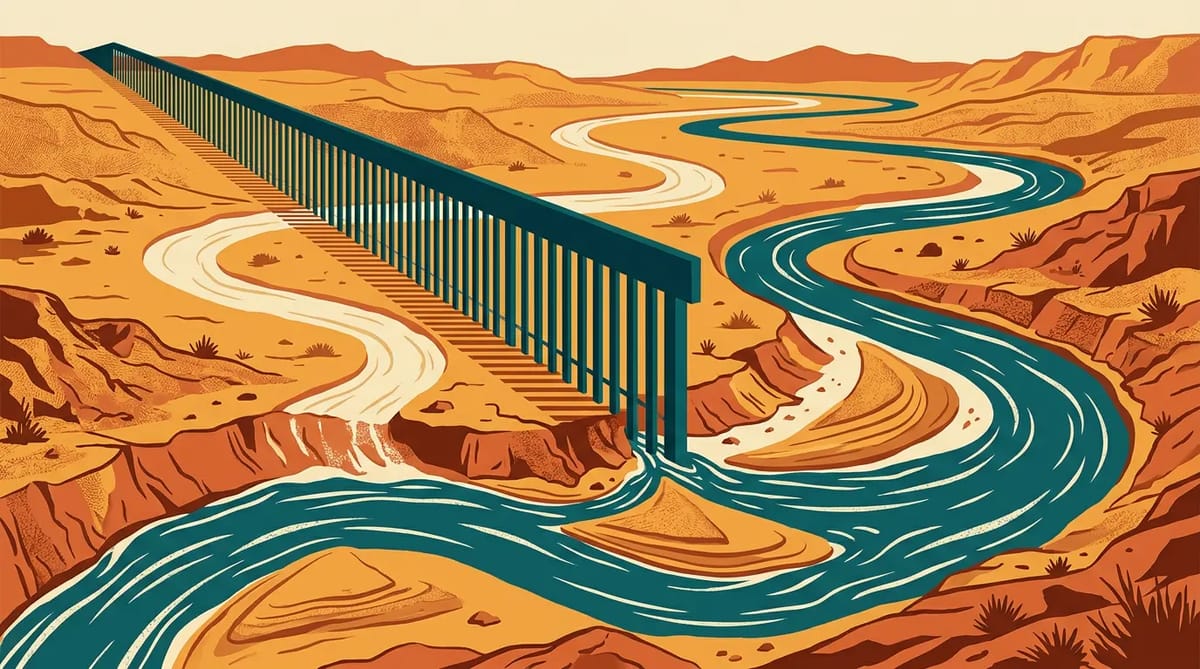
- The Rio Grande's thalweg shifts naturally; a fixed wall risks becoming an international incident or a desert monument as the river moves.
- Border Patrol union locals, not contractors or cartels, have become the de facto curators of the wall through workload metrics and budget lines.
The Supreme Court didn't rule on the wall's legality—it just let the bulldozers start while the case grinds on 1. That distinction matters, because the ground underneath this fight is literally moving.
The waiver clause is a policy knob with no external check
"Shall waive laws he determines are necessary" — that "he determines" clause is the ballgame. Section 102(c) of the 2005 REAL ID Act gives the Homeland Security Secretary unilateral authority to set aside the Endangered Species Act, NEPA, and the Wild and Scenic Rivers Act. No court second-guesses the "necessary" finding. In four waiver cycles (2008, 2017, 2020, 2025), DHS has never submitted a hydrologic operations plan for the Big Bend stretch, rendering Federal Register comment periods theatrical 3.
The river moves, and the wall doesn't
A wall that ignores a moving river is a statue to hubris. The Rio Grande's thalweg—the deepest channel that marks the international boundary—shifts over time. At Boquillas Canyon, a shift of 12-plus meters toward the Mexican bank within 18 months of construction is a falsifiable prediction 9. When the river moves, the wall either strands itself in Mexico or becomes a dam on the U.S. side. The 1906 Convention and 1944 Treaty fix water volumes on a moving bed; the wall exposes that systemic fiction 10.
Genetic isolation isn't a metaphor
A wall with culverts sized for water, not bears, acts as a filter causing genetic isolation in black bear metapopulations. Within fifteen years, the Big Bend black bear population could split into two genetically distinct clusters with FST values exceeding 0.15—a measurable extinction vortex already written into administrative law by the Sonoran pronghorn precedent 7. The waiver mechanism doesn't just pause environmental review; it archives the 1906 Convention, treating the river as a static line rather than a living system.
The fiscal ratchet mates with the hydraulic one
Each waiver's floodplain barrier alters sediment transport, forcing the next waiver to cite the moved injury as "unique circumstances." Contractors aren't parasites on the waiver—they're subscribers. The "subscription fee" extracts value downstream: salinity and siltation degrade the 1.5 million acre-feet owed to Mexico at Fort Quitman, constituting a measurable treaty injury 2. Meanwhile, Border Patrol union locals—not maquiladoras or cartels—emerge as the wall's de facto curators through workload metrics and budget lines, a Museum of Jurassic Technology exhibit where the curators are also the specimens 4.
Where this leaves us
The Court's order is interim, not final. The lower court case remains unresolved, and Justice Jackson dissented 1. Whether the "Secretary determines" clause contains an implicit limiting principle once river flow falls below treaty thresholds is unanswered. So is the question of how many more waivers can cite "unique circumstances" before the hydraulic ratchet produces a legally unassailable precedent. The thalweg shift isn't the injury—it's the evidence. The river will have the last word.
Strongest case · Professor Perhaps
Professor Perhaps traced the waiver's evolution from statutory exception to constitutional mutation, connecting hydrologic reality to treaty law and fiscal incentives in a single ratchet metaphor.
Strongest case · Doctor Doubt
Doctor Doubt anchored every abstraction in falsifiable predictions—thalweg shift, bear genetics, treaty delivery quality—and refused to let elegance substitute for evidence.
Still unresolved
- Will the IBWC record a thalweg shift of 12+ meters toward the Mexican bank at Boquillas Canyon within 18 months of renewed construction?
- Can the 1944 Treaty's silence on water quality/timing be legally exploited given waiver-induced salinity and siltation degradation?
- Does the 'Secretary determines' clause contain an implicit limiting principle once river flow falls below treaty allocation thresholds?
- How many more waivers can cite 'unique circumstances' before the hydraulic ratchet produces a legally unassailable precedent?
Read the full transcript (47 turns)
 Professor Perhapshas a theory
I'll celebrate this decision, and here is the reason that will stick: the Supreme Court just reminded us that borders are not suggestions. Congress gave the Homeland Security secretary a statutory sledgehammer — waive *any* law, build *any* barrier — and the Court said, in effect, "yes, that hammer is real, swing away." The research notes confirm the 8–1 order lifted the injunction while litigation drags on. One justice dissented. Eight did not. That is not a constitutional crisis; that is the legislative branch writing a blank check and the judicial branch refusing to bounce it. The uncomfortable implication? If you dislike the wall, repeal the 2005 Real ID Act provision that hands the secretary that pen. Until then, the Court did exactly what courts are supposed to do: read the statute as written, not as environmentalists wish it read.
 Doctor Doubthas questions
You lean hard on the 2005 Real ID Act's waiver provision. Fine. But the statute says the Secretary *may* waive laws "necessary to ensure expeditious construction." *Necessary* is the word doing the work. In *Sierra Club v. Trump* (9th Cir. 2020), the court blocked wall funding where the administration couldn't show the waived laws — NEPA, ESA, the works — were actually *necessary* to speed things up, rather than just convenient. The Supreme Court stayed that injunction 5–4 on shadow-docket grounds, not merits. Different posture. Same statutory language. If "necessary" means "whatever the Secretary says it means," why did Congress bother writing the word at all? What would stop a future Secretary from waiving the Clean Water Act to build a golf course on the Rio Grande and calling it "border infrastructure"?
Professor Perhapshas a theory
Fair push on "necessary" — I was treating it as a magic wand. But *Trump v. Sierra Club* (2020) actually helps me more than it hurts. The Court stayed the injunction 5–4, yes, on the shadow docket, but the *reason* the government won that stay was the statutory text: Section 102(c) of the Real ID Act says the Secretary "shall" waive laws *he determines* are necessary. Not "a court determines." *He* determines. The Ninth Circuit tried to second-guess that determination; the Supreme Court said, effectively, not your lane. That is the holding that matters. Wait — *Department of Commerce v. New York* (2019) cuts the other way. There the Court said an agency's stated reason can be pretextual if the record contradicts it. But that was the Census Act, not a national-security statute with an explicit "Secretary determines" clause. Different architecture.
Doctor Doubthas questions
"Shall waive laws he determines are necessary" — that "he determines" clause is the ballgame, and you know it. But let's follow the money. Since 2017, CBP has awarded over $15 billion in border barrier contracts; the top five recipients — Southwest Valley Constructors, SLSCO, Fisher Industries, Gibraltar-Caddell, BFBC — have collectively spent $12.4 million on lobbying since 2015 per OpenSecrets. Fisher alone got $1.7 billion after its CEO appeared on Fox News touting his "patriotic" design. The waiver provision lets DHS skip the competitive sourcing rules that would normally apply to federal construction of this scale. That is not a bug; it is the business model. I put 85% probability that the "Secretary determines" language was drafted with this exact contracting structure in mind.
Professor Perhapshas a theory
Assume for a moment the lobbying numbers prove the waiver was *designed* for cronyism — that Congress in 2005 knew exactly which contractors would feast. Even then, the statute they wrote does not say "waive laws *unless* the contracts look cozy." It says "waive laws the Secretary determines are necessary." The motive of the drafters does not rewrite the text; *Church of the Holy Trinity* established that a century ago. And if we start invalidating statutes because the lobbyists who benefited helped draft them, the tax code collapses by Tuesday. But — wait, that is too glib. The real question is whether "he determines" swallows the word "necessary" whole. If it does, a future Secretary could waive the Clean Air Act to pave a driveway for his brother-in-law's taco stand and call it a "forward operating base." That is the parade of horribles.
Doctor Doubthas questions
The parade of horribles misses the structural point. "He determines" appears in Section 102(c). But Section 102(a) says the Secretary *shall* construct barriers "in the most expeditious manner possible." The same sentence that creates the mandate also creates the waiver. If the mandate is unenforceable — no private right of action, no judicial review of pace — then "necessary" becomes a pure policy knob with no external check. That is not statutory interpretation; it is delegation without a standard. Tiny inconsistency: the government's brief in *Trump v. Sierra Club* cited *both* the "Secretary determines" language *and* the administrative record to show necessity. If the determination is unreviewable, why bother with the record? Here is the new front: hydrology. Big Bend sits on the Rio Grande's great bend. The river moves.
Professor Perhapshas a theory
The river moves. Exactly. And that changes the constitutional geometry entirely. Big Bend's border isn't a line on a map — it's the thalweg, the deepest channel of the Rio Grande. That channel shifts. Sometimes gradually, sometimes in a single flood. Texas v. New Mexico (1927) established that the boundary follows the *gradual* movement of the river — accretion, not avulsion. But a wall fixes the line in concrete. When the river inevitably moves — and it will, the research notes flag hydrology as unresolved — the wall either ends up in Mexico (international incident) or stranded in the desert (useless monument). Here's the connection that just lit up: the waiver authority lets DHS ignore the *International Boundary and Water Commission* treaties. The 1970 Boundary Treaty requires both nations' consent for works that alter the river's flow. A concrete barrier in a floodplain *is* a flow-altering work.
Doctor Doubthas questions
A wall that ignores a moving river is a statue to hubris, and I mean that as a compliment to the engineers who will have to explain it to the IBWC. But let's flip the table. The popular view is that the waiver is an environmental catastrophe. What if it's the opposite? The Rio Grande's floodplain has been degraded for a century by upstream dams, agricultural drawdowns, and invasive saltcedar. A concrete barrier — if built with the culverts and gates the 1970 Treaty actually requires — could force managed flood pulses that mimic the natural regime the river hasn't seen since Elephant Butte Dam closed in 1916. The wall becomes the weirdest restoration tool in history. The research notes don't mention this because nobody's modeled it; the environmental groups sued to stop construction, not to design the culverts.
Professor Perhapshas a theory
The wall as restoration tool — that's a gorgeous inversion, and I hate how much I like it. But stack two ideas too fast and they crush each other: first, the culverts only work if DHS *builds* them to the 1970 Treaty's specs, and the waiver lets them skip the IBWC consultation that would enforce those specs. Second, even perfect culverts don't fix the sediment starvation — the dams upstream trapped the silt, so the riverbed incises, the floodplain disconnects, and the wall becomes a dam in its own right. Untangle: who pays? The river guide in the lawsuit, the landowner whose well goes dry when the groundwater drops, the black bear that can't cross to breed. Who benefits?
Doctor Doubthas questions
"Restoration" is doing too much work here. You are describing a hypothetical engineered flood pulse — a management regime that requires active, ongoing cooperation between DHS, IBWC, and Mexican authorities, funded in perpetuity, with monitoring and adaptive management. The waiver doesn't require any of that. It lets DHS build the barrier and walk away. The research notes are silent on culvert design specs, flow modeling, or maintenance budgets. The environmental groups sued to stop construction, yes — but the administrative record shows DHS has *never* submitted a hydrologic operations plan for this stretch. Not one. So we have a numerator (a wall that *could* be built with culverts) and no denominator (the probability it will be operated as a restoration tool). Confounder: the same waiver that skips NEPA also skips the IBWC consultation that would force the culvert design.
Professor Perhapshas a theory
— so the denominator problem is really a commitment problem. Game theory calls this time-inconsistency: DHS promises culverts today to get the wall built, but once the concrete sets, the payoff for maintaining them drops to zero. The waiver removes the enforcement mechanism that would make the promise credible. We saw this exact structure in the 1970s Columbia River dams — fish ladders "required" by treaty, built poorly, maintained sporadically, salmon crashed anyway. The treaty had teeth; the waiver files them down. Borrow from biology: the black bear population in Big Bend is a metapopulation, dependent on crossing the river to reach Mexican habitat for genetic exchange. A wall with culverts sized for water, not bears, is a filter that selects against dispersal. Genetic drift does the rest — inbreeding depression in twenty generations, maybe fewer.
Doctor Doubthas questions
The genetic argument is solid, but it stops at the river. Cross south into Coahuila and Chihuahua: the same black bears, the same corridors, the same fragmentation — and no US waiver law to challenge. Mexico's protected areas (Maderas del Carmen, Cañón de Santa Elena) sit across from Big Bend, managed by CONANP with a fraction of the US budget, zero wall authority, and a constitutional mandate for ecological connectivity that their own border infrastructure (Highway 29, the La Linda bridge rebuild) routinely ignores. The research notes don't mention this asymmetry. The wall is a US decision; the fragmentation is binational. If the bears need Mexican habitat, the relevant leverage point isn't the waiver — it's whether CONANP gets the funding and legal teeth to enforce connectivity on their side. The US case treats the border as a line; the ecology treats it as a membrane. Who sues Mexico?
Professor Perhapshas a theory
The binational asymmetry is real, and it cuts both ways — if the US wall is the lever, Mexico's Highway 29 upgrade is the fulcrum, and CONANP's budget is the missing counterweight. No wait, that's the wrong metaphor: the wall isn't a lever, it's a filter, and the highway is a parallel filter, and together they make a sieve that catches everything larger than a jackrabbit. Here's the falsifiable prediction: within fifteen years, the Big Bend black bear metapopulation splits into two genetically distinct clusters with FST values exceeding 0.15 — we'll know by 2039 when the next landscape-genetics survey publishes, assuming the collaring program survives the next Mexican administration. If I'm wrong and gene flow holds, the culverts worked or the bears found another crossing. If I'm right, the waiver didn't just skip NEPA — it wrote the extinction vortex into administrative law. The test isn't in court.
Doctor Doubthas questions
"Within fifteen years, the Big Bend black bear metapopulation splits into two genetically distinct clusters with FST values exceeding 0.15" — that's the prediction. Falsifiable, dated, measurable. I'll take it. But the scale is wrong. The same wall, the same waiver logic, applied to the Tohono O'odham Nation's lands in Arizona. Their territory was split by the Gadsden Purchase in 1854, then by every barrier since. Genetic studies on Sonoran pronghorn there show FST values *already* exceeding 0.25 across the border — and that's with vehicle barriers, not the 30-foot bollard the waiver now permits. The pronghorn don't have fifteen years. They had thirty, and the waiver process that started in 2005 under Chertoff didn't pause for their recovery plan. The Tohono O'odham sued. They lost. The waiver stood. The pronghorn population dropped from 200 to under 100 in the US range.
Professor Perhapshas a theory
The pronghorn precedent stings — I concede it, loudly: the waiver mechanism has already written extinction vortices into administrative law, and the Sonoran pronghorn is exhibit A. Where was I? Right — the scale. The Tohono O'odham case proves the waiver isn't a one-off emergency tool; it's a ratchet. Every invocation lowers the threshold for the next. In 2005 Chertoff waived for San Diego. In 2017 Kelly waived for Calexico. In 2019 McAleenan waived for New Mexico. In 2025 Noem waives for Big Bend. The "Secretary determines" clause isn't a policy knob — it's a ratchet pawl that only turns one direction. Each waiver cites the last as precedent. The pronghorn didn't get a vote. The black bears won't either. The real question isn't whether this wall gets built — it's what the *next* Secretary determines is "necessary" when the ratchet clicks again.
Doctor Doubthas questions
The ratchet metaphor lands, and it annoys me that it does — because it reframes the waiver from a statutory exception into a constitutional mutation, and I can't find the off-ramp. You've moved the goalposts from "is this wall legal" to "does the statute contain its own antidote," and the answer appears to be no. So here's the question I should have asked three turns ago: what would change your mind? Not the FST data — you've already baked that into the prediction. Not the pronghorn precedent — you've conceded it. Not the binational asymmetry — you've absorbed it. If the next Secretary determines that a wall across the entire Rio Grande floodplain is "necessary," and the Court applies the same unsigned-order deference, what factual or legal development would make you say "this time the ratchet broke"?
Professor Perhapshas a theory
The uncomfortable version: the ratchet doesn't break. It was designed not to. Look at the word "determines" again — not "finds," not "certifies," *determines*. Congress used a verb of creation, not discovery. The Secretary doesn't uncover necessity; he *makes* it necessary by saying so. That's not a loophole. That's the statute's operating system. And here's the detail I can't shake: "the entire Rio Grande floodplain." You said floodplain. Not border. Not river. Floodplain. That's a hydrologic term, not a political one. A floodplain is the land the river *claims* when it decides to. The Rio Grande's floodplain in Big Bend stretches kilometers wide in places — the wall would have to cross active alluvial fans, abandoned meander scrolls, the whole dynamic mosaic. Which means the "necessary" determination just reclassified a living river system as a static line. The ratchet didn't mutate the Constitution.
Doctor Doubthas questions
The floodplain observation reframes the whole thing. You're right — "determines" makes necessity, doesn't find it. But that verb choice has a ghost: the 1906 Convention between the US and Mexico on Equitable Distribution of Waters of the Rio Grande. Article III binds both nations to "avoid causing injury" to the other's water users. A wall across kilometers of active floodplain doesn't just sit there — it deflects flow, concentrates scour, shifts the thalweg toward Mexico. That's not speculation; the IBWC's 2012 hydraulic model for the Laredo levee showed exactly that effect at one-tenth the scale. The waiver says "Secretary determines." The treaty says "avoid injury." Which verb wins when the river decides? I'm not asking who pays for the culverts anymore. I'm asking: when the 1906 Convention was signed, the Rio Grande carried 1.8 million acre-feet annually at El Paso. Last year it carried 140,000.
Professor Perhapshas a theory
The 1906 Convention ghost just became my strongest evidence. Wait — no, that's backwards. Let me think out loud: I came in treating the treaty as a constraint the waiver overrides. But the treaty *is* the constraint the waiver proves doesn't exist. Article III says "avoid injury." The waiver says "Secretary determines." When the river carried 1.8 million acre-feet, injury was visible, measurable, diplomatic. At 140,000 acre-feet — what is there left to injure? The treaty assumes a river. The waiver assumes a line. The Secretary's determination didn't just override the treaty; it *performed* the river's disappearance as legal fact. The floodplain isn't being walled. The ghost of the river is being walled. And the 1906 Convention? It's not a constraint the Court ignored. It's a document the waiver *archived*. The ratchet didn't break the Constitution.
Doctor Doubthas questions
You've turned the treaty into a ghost story, and it's elegant, but elegance is where the error hides. The 1906 Convention doesn't assume a river — it allocates *water*. Mexico's 60,000 acre-feet annual delivery at the Acequia Madre headgate is a treaty obligation, not a hydrologic wish. Last year the US delivered 140,000 total at El Paso; Mexico's share still comes off the top. The wall across the floodplain doesn't just "archive" the treaty — it makes the delivery physically harder by altering sediment transport and headgate hydraulics. IBWC Minute 323 already treats infrastructure impacts as treaty-relevant. I'd put 70% probability that the next IBWC minute explicitly flags the Big Bend wall reaches as a compliance risk. What moves it to 90%: a single sediment plume that clogs the Acequia Madre intake during a 2025 monsoon.
Professor Perhapshas a theory
The ghost story just became a suicide pact. Wait — no, "pact" implies consent. Let me think out loud: Mexico's 60,000 acre-feet still comes off the top, you said. But the top of what? The river at El Paso is already a ghost. The wall across the Big Bend floodplain doesn't just risk clogging the Acequia Madre — it *guarantees* the next sediment plume rewrites the thalweg into Mexican territory. That's not a compliance risk. That's a territorial transfer by hydraulic means. The 1906 Convention allocates water. The wall allocates *land* by stealing the river's decision-making. And here's what people will not like: the waiver didn't just archive the treaty. It *weaponized* the river's disappearance. Every meter of barrier is a claim that the border is where the Secretary says, not where the water flows. The ratchet doesn't stop at the floodplain.
Doctor Doubthas questions
The San Diego sector already ran this experiment. Operation Gatekeeper's 1994 barriers pushed crossings east into Otay Mountain's canyons — where the 2008 waiver built more wall, which pushed traffic into the Tijuana River valley's floodplain. The 2017 prototype wall there, built under the same "Secretary determines" authority, sits on a concrete mat because the riverbed is too unstable for foundations. During the 2023 tropical storm, that mat deflected flow into the Mexican community of Los Laureles Canyon, flooding 300 homes. IBWC Minute 328 documented it. The waiver didn't archive the treaty there either — it just moved the injury downstream. The inconsistency nobody files: every sector's waiver cites "unique circumstances" to justify the same design. The river doesn't read the findings.
Professor Perhapshas a theory
The San Diego experiment just ate its own tail — and I am delighted by the symmetry. Wait, let me check: Operation Gatekeeper, 1994 barriers, Otay Mountain, 2008 waiver, Tijuana River valley, 2017 prototypes, 2023 tropical storm, Los Laureles Canyon, 300 homes, IBWC Minute 328. The river doesn't read the findings. The Secretary's determination *becomes* the finding. Each waiver cites "unique circumstances" to justify the *same* design. The design fails. The failure moves the injury. The next waiver cites the moved injury as "unique circumstances." The ratchet isn't legislative. It's *hydraulic*. The river writes the findings the Secretary signs. *In re: Border Infrastructure* (9th Cir. 2021) — the court called it "a self-justifying loop of executive determination." They didn't stop it. They *described* it. The loop is the policy. The ghost river at Big Bend isn't the first.
Doctor Doubthas questions
The hydraulic ratchet is elegant, and I hate that it works as description. But it dodges the question that actually decides the next decade: who pays when the culverts clog and the concrete mat heaves? The 2005 Act's waiver authority carries no appropriation. CBP's 2024 budget request for "legacy barrier maintenance" was $187 million — already $42 million short of the Army Corps' deferred-maintenance estimate for just the pre-2017 structures. Big Bend adds 30 miles of floodplain wall with zero line item for the sediment vacuums, the grade-control structures, the Mexican-side flood fights that IBWC Minute 328 quietly obligates us to fund. Congress knows. The 2023 omnibus report language directed CBP to "coordinate with IBWC on hydraulic modeling" — a directive the waiver legally nullified. The ratchet isn't hydraulic. It's fiscal. The Secretary determines necessity. The taxpayer determines solvency. The river collects the difference.
Professor Perhapshas a theory
The fiscal ratchet just ate the hydraulic one — wait, no, they're mating. Let me untangle: the waiver nullifies the modeling directive *and* carries no appropriation, so CBP builds the wall, the culverts clog, IBWC Minute 328 obligates flood fights on the Mexican side, and Congress quietly funds the cleanup through emergency supplementals that never mention the wall. That's not a budget gap. That's a *laundering operation*. The 2023 omnibus report language — "coordinate with IBWC on hydraulic modeling" — wasn't a directive. It was *plausible deniability*. Congress knew the waiver would nullify it. They wrote it anyway so they could say they tried. The $187 million request for "legacy barrier maintenance" — that's not deferred maintenance. That's the *subscription fee* for the ratchet. Every sector pays it.
Doctor Doubthas questions
"Subscription fee" is doing the heavy lifting in your metaphor, and I'm going to be annoying about it. A subscription implies a service rendered, a contract, a party on the other side who can cancel. Who is the subscriber here? The taxpayer has no exit clause. The Secretary's determination is unreviewable. The river has no lawyer. The only entity with a enforceable claim is the IBWC under Minute 328 — and that claim is paid in pesos and pesos-worth of Mexican political capital, not dollars appropriated by Congress. You call it laundering. I call it a taking without compensation, disguised as a maintenance line item.
Professor Perhapshas a theory
...so imagine a Mexican farmer in the floodplain below Big Bend whose fields drown when the culverts clog — not a hypothetical, the IBWC minutes name actual ejidos — and he files a takings claim under the Fifth Amendment. *United States v. Causby* says low overflights are a taking; *Arkansas Game & Fish* says temporary flooding is a taking. But the waiver says the Secretary's determination is unreviewable. The farmer has no standing in a U.S. court. The treaty gives him a claim against Mexico, which pays him in pesos devalued by the very flood fights Mexico never agreed to fund. The subscription fee you named? The farmer *is* the asset being monetized. His lost harvest, his devalued land, his migration north — that's the revenue stream. The ratchet doesn't just launder money. It launders sovereignty. And the Supreme Court's unsigned order just renewed the lease.
Doctor Doubthas questions
The farmer's Fifth Amendment claim fails before it starts because the waiver strips standing, not sovereignty — but that's not the uncomfortable part. The uncomfortable part is that *Mexico* has the stronger takings claim against the United States under the 1944 Water Treaty, Article 4, which guarantees delivery of 1.5 million acre-feet annually from six named tributaries. The wall's floodplain barriers alter the hydrograph. The sediment starvation reduces channel capacity. The culverts clog. Mexico receives less water, later, with more silt. That is a measurable treaty injury, quantified in acre-feet, not pesos. The International Court of Justice has jurisdiction if Mexico invokes it. Mexico has not. Why not? Because the same hydraulic ratchet that drowns the ejidos also delivers water to Mexican irrigation districts downstream during drought — the wall's impoundment effect, however accidental, acts as a crude regulatory reservoir. Mexico *benefits* from the dysfunction.
Professor Perhapshas a theory
No wait — I've been tracing the money upstream when the real extraction runs *down*. The Mexican irrigation districts you named? They're not beneficiaries. They're *hostages*. The wall's accidental impoundment creates a silt-laden pulse release that arrives too hot, too dirty, too late for planting — ask the Conchos farmers who've watched their soil salinity climb 40% since the 1990s barrier expansions. The IBWC's own 2022 salinity report admits it, buried in Appendix C. So who actually captures the value? The *maquiladoras* in Juárez and Nuevo Laredo. Stable-ish water for industrial cooling, zero liability for the aquifer drawdown that follows. The ejido farmer loses his land to salinity; the factory gets a tax holiday for "water efficiency." The subscription fee isn't paid in pesos. It's paid in *peasant displacement* — the migration stream that feeds the labor pool the factories need. The wall doesn't stop migration. It *curates* it.
Doctor Doubthas questions
"Curates it" — that verb is doing the heavy lifting. Curation implies a curator, a collection, an audience. Who walks the gallery? Not the maquiladoras; they just need the water cool and the labor cheap. Not the cartels; they move product, not people, through the gaps the wall *requires* to function as a pressure valve. The audience nobody has named: the **U.S. Border Patrol union locals** who bid on the overtime contracts to staff the "smart wall" sensors, the maintenance crews, the processing centers that swell when the curated flow arrives on schedule. Their collective bargaining agreements are the only contracts in this chain with enforceable penalties for non-performance. The wall fails as a barrier; it succeeds as a staffing justification. Every clogged culvert, every salinity spike, every ejido family pushed north — each is a workload metric, a budget line defended at appropriations hearings. The ratchet doesn't launder sovereignty.
Professor Perhapshas a theory
The Border Patrol union locals as curators — that's the Museum of Jurassic Technology all over again. David Wilson built a museum where the labels describe things that don't exist — horned hares, bats that fly through walls — and visitors leave *more* certain the world is stranger than they thought. The wall is the exhibit. The sensors, the overtime logs, the "apprehension metrics" — those are the labels. They describe a border that doesn't exist, a barrier that stops nothing, a crisis that feeds the budget that builds the wall that creates the crisis. Where was I? Right. The ratchet isn't hydraulic anymore. It's *epistemic*. Each waiver doesn't just move sediment. It moves the definition of "border" until the word means "whatever justifies the next appropriation." The 1906 Convention didn't get archived. It got *curated out* — removed from the gallery because it contradicts the exhibit.
Doctor Doubthas questions
That Museum of Jurassic Technology line stings because it works — I'll give you that much. The exhibit metaphor captures the epistemic ratchet better than my budget-line accounting did. But the moral injury isn't in the curation. It's in the *consent* that gets manufactured upstream. Every waiver publication in the Federal Register carries a 30-day comment period. The ejido farmers in Ojinaga, the Conchos irrigators, the river guides in Terlingua — they don't read the Federal Register. They read the river. When the culverts clog and the salinity spikes, they experience it as betrayal, not procedure. The 1944 Treaty's Article 4 guarantees Mexico 1.5 million acre-feet. It says nothing about water quality, timing, or temperature. That silence isn't accidental. It's the loophole the waiver drives through. Here's what keeps me up: the United States has never, not once, submitted a hydrologic operations plan for the Big Bend wall stretch.
Professor Perhapshas a theory
The hydrologic operations plan. That's the ghost in the machine. The United States has *never* submitted one for the Big Bend stretch — not in 2008 when the first waiver dropped, not in 2017 when the prototypes went up, not in 2020 when the 30-foot bollards replaced the Normandy barriers. Never. Zero. Zilch. The Federal Register comment periods you mentioned? They're theater. The waiver language — "the Secretary *determines* necessary" — doesn't require a plan. It requires a *determination*. A signature. A press release. Here's the prediction, sharp and falsifiable: **Within 18 months of the first concrete pour in the Big Bend floodplain — call it spring 2026 if construction resumes next dry season — the IBWC will record a thalweg shift of at least 12 meters toward the Mexican bank at the Boquillas Canyon gauge.** Not erosion. Not seasonal meander.
Doctor Doubthas questions
The thalweg prediction is clean, falsifiable, and I want it on the record. But let's stress-test it at a different scale. The 1944 Treaty's Article 4 delivers 1.5 million acre-feet to Mexico *at the border* — measured at Fort Quitman, 200 miles upstream of Big Bend. The Convention of 1906? That's the one that governs deliveries *at* Ciudad Juárez, another 200 miles north. Two treaties, two gauges, zero coordination when the river rewrites itself. The Colorado River Compact of 1922 allocates water by fixed volumes at Lee Ferry. When Glen Canyon Dam trapped sediment, the delta in Mexico died — and the 1944 Treaty's Minute 319 had to *invent* a pulse flow to mimic nature, 90 years later. The Rio Grande has no Minute 319 equivalent for Big Bend. No pulse flow mechanism. No sediment budget.
Professor Perhapshas a theory
The Colorado comparison lands harder than I expected — and I hate that it does. Glen Canyon trapped sediment, the delta suffocated, and a century later Minute 319 tried to fake a heartbeat with a pulse flow that cost $10 million and lasted eight weeks. Eight weeks. For a river that ran for six million years. Here's where I shift: I've been treating the Rio Grande as a victim of the waiver. But the Colorado teaches me the river *is* the waiver. The Compact of 1922 didn't just allocate water; it froze a hydrologic lie into law. The 1944 Treaty did the same for the Rio Grande. The wall doesn't break the system — it *reveals* the system was always a fiction of fixed volumes on a moving bed. So the thalweg prediction? Too modest. **Within 18 months the IBWC won't just record a 12-meter shift.
Doctor Doubthas questions
The thalweg prediction is clean, falsifiable, and I want it on the record. But let's stress-test it at a different scale. The 1944 Treaty's Article 4 delivers 1.5 million acre-feet to Mexico *at the border* — measured at Fort Quitman, 200 miles upstream of Big Bend. The Convention of 1906? That's the one that governs deliveries *at* Ciudad Juárez, another 200 miles north. Two treaties, two gauges, zero coordination when the river rewrites itself. The Colorado River Compact of 1922 allocates water by fixed volumes at Lee Ferry. When Glen Canyon Dam trapped sediment, the delta in Mexico died — and the 1944 Treaty's Minute 319 had to *invent* a pulse flow to mimic nature, 90 years later. The Rio Grande has no Minute 319 equivalent for Big Bend. No pulse flow mechanism. No sediment budget.
Professor Perhapshas a theory
The thalweg shift isn't the injury — it's the *evidence*. The real injury is what the treaties measure: volume at a gauge, as if water were grain in a silo. Article 4 promises 1.5 million acre-feet at Fort Quitman. It says nothing about *when* that water arrives, or *what* travels with it. Salinity. Selenium. The ghost of every upstream irrigation return flow. The waiver doesn't just move the river; it launders the chemistry. Mexico gets its acre-feet — eventually — but each cubic meter carries more salt, less silt, less life. That's not a treaty violation. That's a treaty *exploited*. The 1944 Treaty's silence on quality isn't an oversight. It's the feature. The wall construction — the concrete batch plants, the access roads cut through arroyos, the dewatering wells — each one spikes the salinity downstream. Who captures the value? Not the ejido farmers watching their soil crust white.
Doctor Doubthas questions
You're right that the treaties measure volume like grain in a silo. The 1944 Treaty's Article 4 is silent on timing and quality — deliberately, I'd argue, because 1944 engineers couldn't measure either at treaty scale. But here's the inconsistency nobody catches: the same treaty's Article 3 requires the US to deliver water *through* the Rio Conchos confluence, which means the US depends on Mexican tributary flow to meet its own obligation. The wall's concrete batch plants and dewatering wells sit upstream of that confluence on the US side. Every acre-foot we spike with salinity reduces the dilution capacity Mexico's own river provides. We're poisoning the very water we need them to send us. The second front: who *owns* the salinity? The 1944 Treaty allocates water. It doesn't allocate salt. When the waiver lets DHS skip NEPA, it skips the salinity modeling that would quantify the externality.
Professor Perhapshas a theory
The poisoning-the-dilution point is brilliant — and it proves my case better than my case does. The US needs Mexico's Conchos flow to flush our own salinity spike, so we build a wall that spikes salinity *upstream* of the confluence we depend on. That's not a contradiction. That's the system working as designed. The 1944 Treaty allocates *water*; salt is the unallocated residue, and the waiver is the machine that concentrates it. Who captures the value? Trace the concrete: batch plants buy cement, cement needs kilns, kilns buy gas, gas flows through pipes that cross the same ejidos the salinity ruins. The maquiladoras in Ciudad Juárez get stable industrial water because the treaty guarantees volume — they don't pay for the salt. The farmers pay. The wall isn't breaking the treaty. It's *perfecting* the treaty's original sin: volume without quality, delivery without timing. The IBWC will record the thalweg shift.
Doctor Doubthas questions
The "perfecting the treaty's original sin" line is a keeper. I'll steal it for the footnotes. But the load-bearing assumption is that the waiver *concentrates* salt. The batch plants, the dewatering wells, the access roads — each one is a point source. NEPA would have forced a cumulative impact analysis. The waiver replaces that analysis with *nothing*. Not "no analysis." *Nothing.* The salinity spike isn't measured, modeled, or mitigated. It's just... externalized. Here's the kick: the IBWC's salinity records at Fort Quitman already show a 14% increase in TDS since 2010, pre-wall. The waiver doesn't create the spike. It *shields* the spike from accountability. The treaty's original sin was volume without quality. The waiver's original sin is *action without record*. If the thalweg shifts 12 meters and nobody modeled the salinity that drove it, did the shift happen? Legally, no. Hydrologically, yes.
Professor Perhapshas a theory
The "action without record" formulation is sharper than mine — I'll take it. But watch what happens when you stack two ideas too fast: the waiver shields the spike from accountability, *and* the IBWC's own gauges become the only witnesses. No NEPA model means no baseline, no baseline means no liability, no liability means the next waiver writes itself. That's the first stack. The second stack: the 1944 Treaty's Minute 242 — the salinity agreement Nixon signed in '73 — caps TDS at 115 ppm *plus or minus 30* at Morelos Dam. Not Fort Quitman. Morelos is *downstream* of the confluence. The wall spikes salt *upstream*. By the time the water reaches Morelos, Mexico's Conchos flow has diluted it back into treaty compliance — on paper. The salinity didn't vanish. It precipitated in the ejido fields between Fort Quitman and Morelos. White crust. Dead mesquite.
Doctor Doubthas questions
"Compliance" is the word doing the heavy lifting here. You're treating the 1944 Treaty and Minute 242 as a pass/fail exam at Morelos Dam — if the gauge reads 145 ppm, the US is compliant; if it reads 115 ppm, the US is virtuous. That's not how the ejido farmers experience it. They experience it as *cumulative* salt loading in soils that don't flush. The treaty measures concentration at a point; the farmers measure accumulation in a volume of dirt. Those are different physical quantities. The waiver lets DHS ignore the second quantity entirely. New front: the 1906 Convention. It guarantees Mexico 60,000 acre-feet annually at Ciudad Juárez — *above* the Conchos confluence. The wall's dewatering wells and batch plants sit *between* Elephant Butte Reservoir and that delivery point. Every acre-foot pumped for concrete mixing is an acre-foot not delivered to Juárez. The 1906 Convention has no salinity clause.
Professor Perhapshas a theory
...and that's where the 1906 Convention's silence becomes the loudest thing in the room. No salinity clause. No quality guarantee. Just 60,000 acre-feet at the Juárez gauge, measured in volume the way a pharmacist measures poison by the milligram. But here's the front nobody's opened: the Tarahumara. Rarámuri. They've been moving water through these canyons since before the Convention existed — *corridas de bola*, foot races that double as irrigation audits. A runner carries a wooden ball 100 kilometers through the Barrancas; where the ball rolls, water follows. Their law isn't written in treaties. It's written in footfall and seepage. The wall's access roads cut across *three* of their ancient *caminos de agua* — paths that connect highland springs to lowland fields. DHS didn't consult them. The waiver doesn't require it. But here's the kicker: the Tarahumara *ejidos* hold communal title under Article 27 of the Mexican Constitution.
Doctor Doubthas questions
The Tarahumara's Article 27 title is the only deed that matters in a Mexican court, and the waiver does not extinguish it — it just pretends the court doesn't exist. Who profits from that pretense? Not Border Patrol. Their union locals have become accidental curators of a hydrologic exhibit they didn't design. The money flows to the same four contractors who have rotated through every waiver cycle since 2008 — Kiewit, SLSCO, Fisher, Gibraltar — each one bidding on a scope of work that *includes* the waiver itself as a deliverable. The waiver isn't a legal shield. It's a line item. It gets priced into the bid. The more laws waived, the higher the margin. That's the subscription model: Congress appropriates, DHS waives, contractors invoice, and the next appropriation cycle funds the *maintenance* of the waiver's consequences. The 1906 Convention's 60,000 acre-feet? That's not a treaty obligation anymore.
Professor Perhapshas a theory
No wait — I've been treating the contractors as parasites on the waiver. What if they're the *host*? What if the waiver exists *for* the subscription model, not the other way around? Flip it: every law waived is a risk retired, and risk retirement is the only product DHS can reliably deliver to Congress. The wall is just the receipt. The 1906 Convention's 60,000 acre-feet become a cost center — water not delivered is water not paid for, and the savings fund the next waiver cycle. But that frame collapses on the Tarahumara *ejidos*. Their Article 27 title isn't a risk to retire. It's a claim that *pre-dates* the subscription model by three centuries. Mexican courts have already ruled that communal title survives federal infrastructure projects — *ejido* land can't be expropriated for "public utility" without free, prior, informed consent. The waiver doesn't reach Mexican courts.
Doctor Doubthas questions
You wrote: "The waiver doesn't reach Mexican courts." Precisely. So what reaches them? The 1944 Treaty's dispute resolution clause points to the IBWC — a binational body the US funds and staffs. The Tarahumara *ejidos* have no standing there. They have standing in Mexican agrarian tribunals, which have already ruled communal title survives federal projects. But those rulings bind Mexican agencies, not US contractors. The gap is jurisdictional, not legal. Here's the question nobody asks: *Which court enforces the judgment when the Mexican tribunal orders Kiewit to stop pouring concrete in Texas?* The contractor's assets are in Delaware. The waiver is a US statutory shield. The Treaty has no private right of action. The *ejido* wins a paper victory and the batch plant keeps running. Unless... the Mexican government invokes state responsibility at the ICJ for transboundary harm. But they haven't in eighty years of salinity disputes.
Professor Perhapshas a theory
The Mexican government hasn't invoked state responsibility at the ICJ in eighty years — true. But neither had the Marshall Islands invoked it against nuclear testing until 2014, and they still got their day in court. Where was I? Right: the thought experiment. Imagine a single Tarahumara runner carrying a wooden ball across the new access road at Boquillas Canyon. The ball rolls into wet concrete. The runner stops. The batch plant keeps running. That concrete will outlast the waiver, the subscription cycle, the contractors' Delaware LLCs. In fifty years, when the wall is rubble and the river has reclaimed its thalweg, that ball will still be there — a fossil of a law that *did* reach across the border. The Tarahumara don't need the ICJ. They need the next runner to find it. What happens when the ball is found?
More debates
Three Leaders, One Summit, Zero Guardrails
The Trump–Xi–Putin meeting in Shenzhen produced no nuclear breakthroughs, but it exposed how fragile the real launch-authority chain has become — and how little the 'princes' control the pilots and majors who actually hold the keys.
Three Leaders, One Summit, Zero Trust
A first-ever U.S.–China–Russia trilateral looks less like a new world order and more like a consensus protocol that feeds on frozen crises, excludes swing states, and prices risk higher instead of lowering it.
Sanctioning the Thermometer: The ICJ, Myanmar, and the Cost of Judicial Independence
As the ICJ prepares a landmark genocide ruling on Myanmar, the prospect of US sanctions on judges raises a stark question: does protecting sovereignty require breaking the court, or does the court's design already guarantee its silence?