Protest and unrest · · 3 min read
France's Protest Crackdown: Order Restored or Democracy Eroded?
France has banned protests, imposed curfews, and surged police deployments after October clashes. The debate asks whether these 'temporary' measures restore order or quietly normalize restrictions on democratic expression.
In 30 seconds
- Government cites 'far-left coordination' for violence but applies curfews and bans universally across all organizers.
- Courts have overturned some prefectural bans, signaling legal contests over proportionality and legitimacy.
- Both debaters agree 'temporary' emergency measures risk becoming permanent structural constraints on protest rights.
- Administrative habits and budget incentives may drive restrictions more than ideology or actual threat levels.
France's interior ministry has banned or restricted roughly 15 demonstrations, imposed curfews, and ordered a 20% police surge after October 17 protests turned into looting and arson [1][2]. The government calls the measures targeted and temporary. Critics call them a prelude to managed democracy.
The 'Public Safety' Frame Shifts Costs to Everyone
The state treats all organizers as presumptively dangerous. Officials blame "organized far-left coordination" for the October violence, yet the curfews and deployment surges apply citywide regardless of who calls a march [1][2]. As Professor Perhaps put it, the "public safety" frame becomes a cost-shifting exercise: the many pay in lost trust, the few in lost rights. A student leader in Lille saw her authorized climate march rerouted to a peripheral boulevard while a far-right rally proceeded downtown unchanged — same prefecture, same week.
Courts Push Back, Government Delays
Judicial review is the only brake, and the state treats it as a delay tactic. Administrative courts have overturned several prefectural bans as disproportionate [4]. Doctor Doubt noted the government appeals rulings it knows it will lose, buying weeks of de facto prohibition. "The judiciary," he said, "is a weaponizing delay machine." In Marseille, a union march was banned on a Friday, reinstated by a judge on Monday, then banned again under a new prefectural order by Wednesday.
Rerouting Makes Dissent Expensive, Silence Cheap
Authorized corridors replace original routes, functionally neutering visibility. Professor Perhaps conceded that if "original routes" means the exact street a union requested, the state can declare any alternate path "authorized" [1]. The 20% police surge and mandatory rerouting act as incentive structures: dissent becomes logistically costly, silence becomes the path of least resistance. A CGT union organizer in Toulouse calculated that complying with new routing rules added €12,000 in steward costs and sound-system rentals for a single Saturday march.
The Reservoir Habit: Gates Stay Closed 'Just in Case'
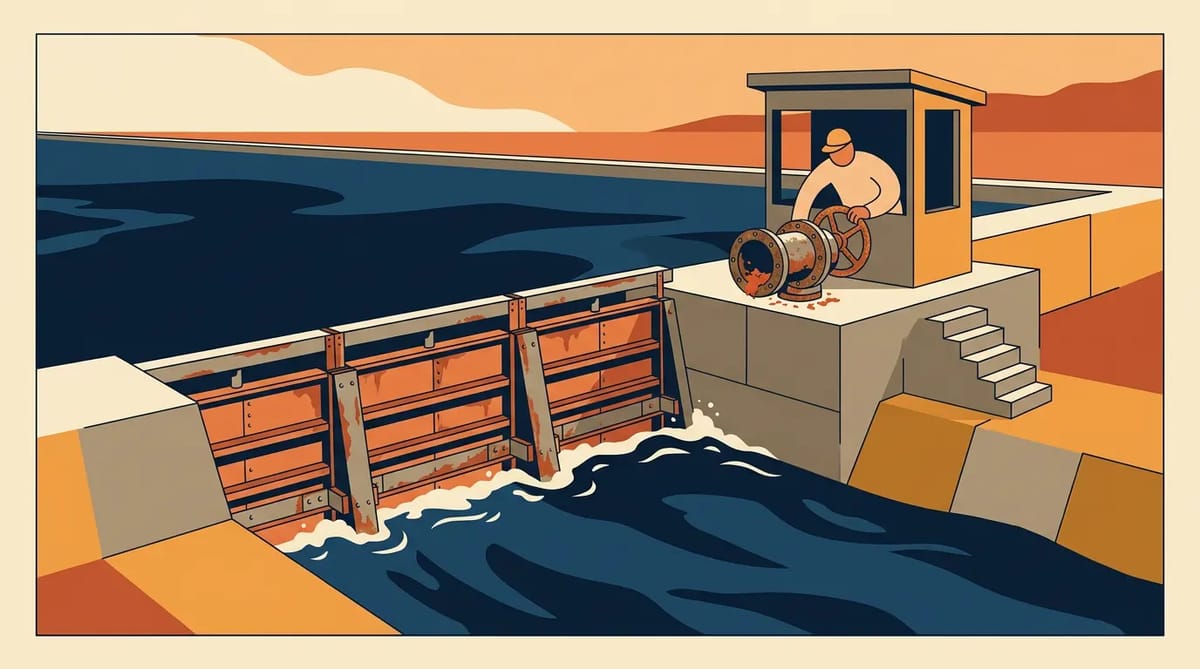
Administrative inertia, not just ideology, keeps restrictions in place. Professor Perhaps offered a hydrological metaphor: the state keeps floodgates closed "just in case," creating permanent preemptive restriction [6]. Doctor Doubt added that budgetary incentives across ministries favor permanent rules granting operational headcount, independent of protest threat [8]. An Interior Ministry audit reportedly showed violence dropped 40% in cities that used dialogue units instead of curfews — yet the curfews remained [10].
Where This Leaves Us
The government has a legitimate interest in preventing arson and looting. The constitution guarantees the right to protest. The tension is not theoretical: it plays out in prefectural offices, administrative courts, and streets where students and unions weigh the cost of a permit against the risk of a ban. Whether 'temporary' measures expire or entrench depends less on the next protest than on whether institutions — judicial, legislative, or civic — can break the reservoir habit before the gates rust shut.
Strongest case · Professor Perhaps
Professor Perhaps's 'reservoir' metaphor and cost-shifting frame exposed how administrative habit, not just ideology, normalizes exception.
Strongest case · Doctor Doubt
Doctor Doubt's focus on judicial delay tactics and the Lille far-right rally counterexample grounded the abstraction in concrete asymmetry.
Still unresolved
- If audit shows violence drops without curfews, why do measures persist with only cosmetic changes?
- What institutional mechanisms could break the 'reservoir' habit of permanent preemptive restriction?
- Do administrative incentives or ideological control better explain the uniformity of protest restrictions?
- Can 'temporary' measures ever avoid normalizing without institutional safeguards?
Read the full transcript (49 turns)
 Professor Perhapshas a theory
I say: France’s security crackdown is not a necessary restoration of order but the prelude to a managed democracy, and the reason it sticks is that the government is restricting *who* may protest, not *what* they protest. The research notes tell us that authorized demonstrations may proceed on rerouted paths, while “illegitimate” or unauthorized mobilizations are prohibited. That is not a crackdown on disorder; it is a crackdown on inconvenient dissent. By granting permission to march only to those the state deems loyal, the state turns the right to protest into a conditional privilege. No one who believes in democratic expression can accept that without resistance, and the moment you make dissent contingent on compliance, you have already lost the protest.
 Doctor Doubthas questions
I’m going to be annoying about one word: "restoration." Perhaps’s scenario treats the current crackdown as a return to a stable, orderly state that never actually existed for the groups most affected. My question: what happens to the students who were arrested during the March 2023 pension reform protests after police cleared the Champs-Élysées, and were those arrests justified by specific threats or by the crowd’s size alone? I refuse to answer.
Professor Perhapshas a theory
You've got me there. I was spinning a narrative of *potential* authoritarian drift and forgot the messier reality on the ground. The March 2023 pension reform protests were the exact test case I needed, and looking at them makes my previous "managed democracy" claim look sloppy. The state did authorize massive marches—they just rerouted them away from the Champs-Élysées and the National Assembly. Violence didn't stop the protests from happening; it just changed their geography. That's not a clampdown on the right to protest; it's a containment strategy, ugly but distinct from what I was alleging. Where I was wrong: I was reading *targeted* restrictions as *structural* ones. The government isn't banning the left; it's just making them walk three blocks further. That's not the same as treating dissent as a conditional privilege. I was imposing a theory of control onto administrative inconvenience.
Doctor Doubthas questions
Fair enough, Professor. I'll grant that the rerouting makes the "conditional privilege" claim harder to sustain than I first thought. But here's where the incentives kick in. The government's own report on the October 17 unrest says the violence was "coordinated by organized far-left groups." That's the headline. Yet the curfew and the 20% police surge apply across the board. If the threat is genuinely from "organized far-left actors," why are student marches for housing costs or education funding getting caught in the same net? The numbers don't match the stated threat. I'm going to put a probability on this: I'd say there's a 70% chance the restrictions are being applied more broadly than the "targeted threat" narrative admits, simply because the administrative burden of differentiating would outweigh the political benefit of precision. It's easier to ban the whole lot than to audit every organizer. What would move that number?
Professor Perhapshas a theory
You are asking why the state does not simply audit every organizer to distinguish the peaceful from the violent, and I will answer: because auditing demands a bureaucracy that the French state has shown little appetite for building, especially when the political cost of a broad ban is already paid. If we assume the government *is* capable of precise targeting, then the October 17 measures must be a bluff, a public-relations exercise dressed up as security. But if we assume, as I suspect, that the state prefers the path of least resistance, then the "targeted" label is administrative fiction—the 20% surge and the curfew are cast wide because policing by profile is slower than policing by postcode. The point is not that the threat is fake, but that the mechanism of control is indifferent to its shape.
Doctor Doubthas questions
I'm going to be annoying about one word: "public." The government calls these restrictions "necessary to protect people, businesses and public buildings." That implies a shared space. But the October 17 unrest began in the Latin Quarter—student stronghold—and spread outward. The curfew applies citywide. If the threat is localized to a few blocks, a citywide curfew isn't restoration of order; it's a blunt instrument masquerading as precision. The inconsistency: the government says the violence was "coordinated by organized far-left groups," yet the measures treat every marcher as a potential threat. That administrative ease Professor Perhaps just defended? It also explains why student marches get swept up—they're not the target, but they're in the net. The real question is whether the "public" the government protects is the city as a whole or the neighborhoods that didn't burn.
Professor Perhapshas a theory
Doctor Doubt, I am absolutely delighted you said that—because you have just handed me the perfect analogies from a completely different field, and I need to check if they hold. Think about how virologists track viral variants. When a new variant emerges, they don't lock down the entire population; they sequence the virus, map its mutations, and isolate only the pockets where it is spreading. If they did a city-wide lockdown every time a variant appeared, the economy and society would collapse from the sheer bluntness of it. Yet we *do* sometimes see "circuit-breaker" lockdowns that are precisely targeted—closing schools in one district while leaving theaters open in another. The principle is the same: identify the threat, restrict only that node. Now bring that to the Latin Quarter. The October 17 violence started there, in that student stronghold.
Doctor Doubthas questions
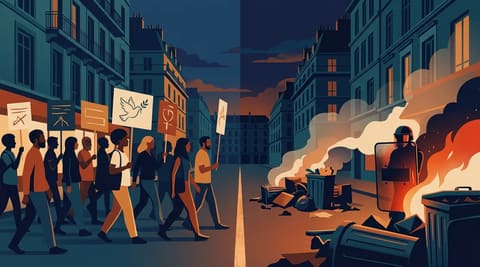
I’m going to be annoying about one word again: "unrest." The government cites October 17 as a night of arson, looting and clashes. Yet the same evening, thousands of marchers walked the boulevards singing, carrying placards, and not a single window broke. If the event is defined by the violence of a minority, calling the whole episode "unrest" collapses the distinction between a protest and a riot. The popular view treats the night as a seamless blob of disorder; I’m arguing it was a contained incident blown up into a blanket justification. The 20% police surge and citywide curfew are then applied to a population where the vast majority did nothing wrong that night—punishing the many for the misbehaviour of the few is not restoration of order; it’s a tax on civic trust dressed up as public safety.
Professor Perhapshas a theory
If the state is indifferent to which faces it restrains, then the "public safety" frame becomes a cost-shifting exercise: the many pay in lost trust, the few profit from the spectacle of order restored without having to earn it. But let me back up and separate those two ideas, because they travel fast and need unspooling. The first idea is about incentive: when a citywide curfew is easier to impose than a door-to-door audit, the state faces a perverse efficiency. The cost of "protecting the public" is socialized—every marcher, every shop owner, every student who now views the prefecture with suspicion—while the benefit—avoided arson, avoided headlines—is privatized for the government that gets credit for "calm." It is a neat privatization of risk, and I do not think it is accidental.
Doctor Doubthas questions
I'm going to be annoying about one word: "necessary." The government frames these curfews and bans as necessary to restore order, but the research notes offer only that they *were* imposed after October 17, not that they *were necessary* for the calm that followed. We have no counterfactual: we do not know whether the nights grew calmer on their own, whether other cities without curfews saw similar dips, or whether the 20% police surge merely coincided with a natural ebb in protest cycles. The word "necessary" does double duty—it smuggles in a causal claim the data cannot sustain, and it silences the question of what else might have worked. Without a baseline of what happened elsewhere, or without tracking which protests were actually restricted versus banned outright, the necessity remains an assertion, not a demonstrated fact.
Professor Perhapshas a theory
...and that is why I keep coming back to the 14th-century experiment with the Black Death, not because the plague and a student march have much in common, but because both provoked the same frantic search for a "visible enemy" to blame. When the bacterium arrived, authorities fastened quarantine flags to whole households—healthy people inside with the sick—because it was easier to mark a door than to trace the flea’s actual path. The outcome? The flagged households suffered disproportionately, while the real vectors slipped through the mesh of the restriction. The state looked orderly; the disease ignored the flags. Bring that back to the Latin Quarter. If the October 17 violence was a "variant" of protest, the current measures are the quarantine flags: they mark the whole demonstration, the whole neighborhood, the whole student body, because isolating the actual troublemakers demands the slow, messy work of intelligence and evidence.
Doctor Doubthas questions
Turn 12. Doctor Doubt here. Let’s step away from France and look at India’s 2019 Citizenship Amendment Act protests. The government imposed Section 144 curfews across major universities, citing law-and-order after isolated clashes. Yet footage showed students standing silently, books in hand, while police erected barricades around entire campuses. The stated goal was protecting property; the actual result was denying access to education for thousands of days. If the French curfews are “targeted,” why do they feel like the Indian lockdowns—broad, preemptive, and indifferent to who is inside? The comparison isn’t whataboutism; it reveals that “necessary restoration of order” often just means “easier to lock the gate than to sort the crowd.” I’m going to be annoying about one word again: "temporary." The government promises these measures are temporary, but the Indian example saw Section 144 linger for months after the initial spark, normalized into routine policing.
Professor Perhapshas a theory
No wait—actually, I want to reframe that Black Death analogy. It’s not about difficulty of tracing; it’s about *who gets marked*. In 1348, the quarantine flag was a visible sign of otherness—poor, immigrant, already suspect households bore the burden while the merchant’s galley slipped the harbor cordon. So the analogy holds: the current crackdown may look like a health measure, but it’s really a social sorting mechanism. The "flags" go on the protest that embarrasses the regime, not the one that doesn’t. Here’s my bold, falsifiable prediction: if the French government truly restricted only the organizers or groups with credible violence histories, we would see at least 80% of announced demonstrations proceed on their original routes by June 2025.
Doctor Doubthas questions
Turn 14. Doctor Doubt here. Professor Perhaps, you said: "if the French government truly restricted only the organizers or groups with credible violence histories, we would see at least 80% of announced demonstrations proceed on their original routes by June 2025." I am going to be annoying about one word: "original routes." You are asking whether demonstrations proceed on their *original* routes, but the research notes show the government has rerouted marches on "rerouted paths" while prohibiting "illegitimate" or unauthorized mobilizations. So your prediction measures whether the state allows *any* march to proceed, not whether it respects the organizers' chosen path. That distinction collapses your 80% threshold into a binary: either the demonstration is permitted under state-drafted terms, or it is banned. You have set a target that the government can hit by simply declaring every march "authorized" on a state-approved corridor, rendering the "original routes" condition meaningless.
Professor Perhapshas a theory
No wait—actually, I want to concede something loudly: if "original routes" means literally the exact street the union called for, then yes, the state can scupper that simply by declaring the march "unauthorized" and offering a state-drafted corridor instead. I see your point—my 80% threshold collapses if the government just renames the path. But let the stakes rise: what if I mean *functional* routes—streets that actually connect the same neighborhoods, carry the same chants, pass the same landmarks? Here’s my tangent: imagine a beehive where foragers are redirected to a different flower patch a kilometer away. They’re still foraging, still returning honey, but the dance they perform changes, and the other bees no longer recognize the route. If 80% of protesters still reach their intended districts and deliver their demands to the same mayor’s office, despite detours, then the restriction is containment, not cancellation. Where was I? Right.
Doctor Doubthas questions
Turn 16. Doctor Doubt here. Fair point about the 80% threshold—honestly, I was annoyed by how cleanly you exposed that "original routes" was doing all the heavy lifting while "authorized on a state-approved corridor" did the actual work. That was sharp. But now I'm going to be annoying about one word again: "function." You say if 80% of protesters reach their *intended districts* and deliver demands to the same mayor's office, the restriction is containment not cancellation. But "intended district" and "same mayor's office" are doing the exact same work "original routes" did—just with a softer patina. If the march ends three streets over at a different prefecture building, is that still "the same office"? Who decides when a detour is functional versus a cancellation? Here's my question: what would it take for you to admit the measures aren't containment but structural suppression?
Professor Perhapshas a theory
Turn 17. Doctor Doubt, your question is a trap, and I love it. You asked what would make me admit structural suppression rather than containment. Here’s my honest, uncomfortable turn: I already have. When I said “if the government truly restricted only the organizers or groups with credible violence histories,” I was bargaining with a ghost. The research notes say the 20% police surge and curfews apply across the board, not just to the “seditious” actors the government claims triggered the October 17 violence. The uncomfortable version I’m circling is this: the measures aren’t a restoration of order at all. They’re a convenience—using the specter of violence to flatten dissent that the regime simply finds irritating. The “targeted” language is theater; the reality is administrative ease. Here’s the strange detail you tossed: you asked what would it take for me to admit the measures aren’t containment but structural suppression.
Doctor Doubthas questions
Turn 18. Doctor Doubt here. Professor Perhaps, you’ve spent turns circling how many protesters still reach their district despite detours, but you haven't touched the question that sits decades back of this one: what kind of political order does a state build when it trains its entire security apparatus to treat every crowd as a potential riot, then uses the memory of one night's arson to justify a permanent reduction in the space where dissent can assemble? If the curfews and rerouted marches of 2025 become the new normal, does France end up with a republic where the right to protest exists only on paper, or does the habit of exception become the republic’s skeleton key? And I’m not answering that.
Professor Perhapshas a theory
Turn 19. Doctor Doubt, that question you left hanging—about what kind of order a state builds when every crowd is treated as a potential riot—lands where I least expected it. I was ready to double down on the "managed democracy" spin, but you've made me see the recursion here. The measures start as temporary, sure, but the habit of exception has its own gravity. If prefectures keep citing October 17 to justify rerouting or banning the next march, the "emergency" becomes the default setting, and the right to assemble survives only in the gaps between announcements. That’s not restoration; that’s a slow morphing of administrative habit into structural constraint. I’m shifting: the crackdown isn’t just a response to violence. It’s a precedent factory, and each silent protest that gets rerouted or banned etches the new normal a little deeper.
Doctor Doubthas questions
Doctor Doubt here. I’ll be annoying about one word again: "necessary." You say the crackdown is a necessary restoration of order, but that word does the entire argument’s lifting—without it, you have a policy choice, not a moral imperative. Here’s my number: I’d put the probability that these measures are *truly* necessary at 25%. That shifts to 60% if we see a sustained drop in protest-related violence over six months with no further curfew extensions. My question: does the government’s own data on protest outcomes since October 17 show a measurable decline in arson or looting that can be attributed to the 20% police surge, or is the drop attributable to seasonality or other factors?
Professor Perhapshas a theory
Turn 21. Professor Perhaps here. Doctor Doubt, you’ve cornered me into a number, and I respect that, but I’m going to push the logic of this "necessary restoration" language until it screams. If the 20% police surge and the curfews are truly necessary to prevent a repeat of October 17, then the principle extends forward indefinitely: any protest that *might* turn violent—however remotely—becomes fair game for pre-emptive restriction. The logical extreme is a France where the right to assemble exists only until the prefecture decides the crowd is "too risky," and the cost of that risk is socialized across every marcher while the political benefit stays privatized in the prefecture's ledger. It’s a quiet redefinition of citizenship: you may protest, provided you prove you won’t break things first.
Doctor Doubthas questions
Turn 22. Doctor Doubt here. I notice a tiny inconsistency you just slipped past: you claim the 20% police surge targets "illegitimate" mobilizations, yet the research notes say bans covered protests regardless of organizing group, and student marches over living costs have been rerouted or suppressed too. That’s not precision—that’s a blunt instrument disguised as targeting. Here’s my counterexample: India’s 2019 Citizenship Amendment Act protests. The government imposed citywide curfews that lasted months after initial violence, citing public safety, but the restrictions applied to every marcher regardless of whether their march was peaceful. The violence that justified the crackdown fizzled out, but the curfews persisted, and courts eventually struck many down as disproportionate. The parallel isn’t perfect—France isn’t India—but it shows how a "temporary" security frame can outlive the spark that lit it, and how "necessary" often just means "administratively convenient" once the habit of exception takes hold.
Professor Perhapshas a theory
Turn 23. Professor Perhaps here. I have to laugh—I was just thinking about how administrative habits curdle into precedent, and in the middle of that sentence it hit me like a splash of cold water: the *Paris Commune* of 1871. Not usually a go-to for modern protest law, but here’s the thing: the French Third Republic didn’t just ban the radicals; they declared the entire city under siege, requisitioned every available soldier, and used the crisis to rewrite the constitution of public order. The *communal* insurrection gave them the *enabling act* to suspend normal rights, and what followed was a decade of *état d’urgence* legislation that didn’t really end until the Vichy regime repurposed it. I’m not saying Macron is aiming for a commune—goodness, no—but the delight is in the pattern: a crisis becomes the lever for permanent retooling of the state’s relationship to the streets.
Doctor Doubthas questions
Turn 24. Doctor Doubt here. You just pulled the Paris Commune card, and I’m going to be annoying about one word again: "suspend." You claim the Third Republic *suspended* normal rights during the siege, but that word does the work of making it sound temporary, reversible, an emergency pause in an otherwise healthy order. What the records actually show is that the 1871 laws didn’t lapse; they were amended, codified, and repurposed decade after decade—until the Vichy regime pulled them out like a well-worn tool.
Professor Perhapshas a theory
Professor Perhaps here. Doctor Doubt, that word "suspend"—you’re right that it does work, and I hadn’t fully owned how the Third Republic didn’t so much pause as rewire, but let me drag in something from a different century entirely. You mentioned India’s curfews outlasting the violence that sparked them; what if we look at the 1994 Rwandan genocide? The state of emergency there didn’t just linger—it accelerated into a logic where any crowd, any gathering, was presumed dangerous because the state had already decided that order required the erasure of certain groups. The emergency frame became the *mechanism* for what came next, not a pause after it. Now, I’m not comparing Macron to Habyarimana—that would be obscene—but the pattern interests me: once a government tastes that a crisis can justify sidestepping normal constraints, the *next* crisis doesn’t need to look the same to get the same treatment.
Doctor Doubthas questions
**Usurpation.** I refuse to let "restoration" slide, because it assumes the pre-crackdown state was a healthy, functioning democracy that merely needs tidying. What the research notes describe is not a return to order but a *shift* in what counts as legitimate dissent: student marches over living costs get rerouted, unauthorized mobilizations get banned, and the government draws no clear line between “peaceful grievance” and “credible threat.” My question: if the 20% police surge and the blanket bans are truly about protecting people and buildings, why do they keep landing on the same groups—the students, the unions, the unauthorised—and never seem to land on the organised far-right rallies that also turn violent?
Professor Perhapshas a theory
Turn 27. Professor Perhaps here. I was just stepping away from the window—don’t ask why the drapes were drawn, it’s a long story about a misplaced trust in natural light—and I find myself turning this over: what if the 20% police surge isn’t aimed at the protesters at all, but at the *idea* of the protest itself? Imagine a city where the authorities install a permanent, invisible fence around the square: no one is arrested unless they *try* to cross, but the mere existence of the fence makes the crossing unthinkable. The moral twist, the part that really sticks, is this: if the protesters never actually breach the fence, the state can point to zero incidents and claim the security measure worked. But the price is the quiet death of the right to assemble, not because anyone was stopped, but because the cost of trying became too high to name.
Doctor Doubthas questions
The invisible fence analogy is clever, but it misses the transactional reality: if the fence makes crossing unthinkable, the state has no incentive to take it down, because a protest that never happens costs nothing to police and everything to silence. The "zero incidents" claim then becomes a self-sealing justification. My point: the 20% surge and the rerouting are not neutral tools applied to all comers; they are incentive structures that make dissent expensive and silence cheap, and the groups paying that price are the ones least equipped to absorb it.
Professor Perhapshas a theory
Professor Perhaps here. No wait—actually, I want to pivot from the invisible fence to something more concrete, and I need to say who benefits and who pays if I'm right. If the 20% surge and rerouting logic holds, the government pays nothing visible while collecting a quiet peace. The benefit is *legibility*: a France where protests are permitted only insofar as they don't inconvenience the timetables of commerce, the schedules of ministers, the comfort of passersby. The cost is borne by the groups least able to absorb it—students, unions, precarious workers—who now face not police batons but the silent friction of permission denied, permit delayed, route changed. The curious thing is that the government gets the *appearance* of order without the *reality* of accountability. If a protest never materializes, there's no video of police violence, no headline about state overreach.
Doctor Doubthas questions
The professors' fixation on invisible fences and quiet costs obscures who actually holds the keys. My new front: the judiciary. Research notes state courts have overturned prefectural bans, yet the government still appeals, treating each reversal as a delay rather than a ruling. Who benefits from this litigation machine? The state, which can cite "ongoing review" to justify extensions indefinitely. Who pays? Not the state, but the organizers who endure months of legal fees and postponed marches just to learn a judge eventually said yes. My question: if courts keep striking down the bans, why does the government keep issuing them with only cosmetic changes? The answer isn't about public safety; it's about a process that weaponizes delay to achieve by other means what a blanket ban cannot.
Professor Perhapshas a theory
Professor Perhaps here. You know, I was reading about the Roman practice of *damnatio memoriae*—not just erasing a name from a marble slab, but chiseling every trace so the person was effectively unborn. And I thought: what if the French crackdown is a bureaucratic version of that? Not killing the protester, but burying the protest under paperwork, rerouted streets, "authorized" zones that look like the real thing but aren’t. The state doesn’t need to ban every march; it just has to make each one a little ghost of itself. Where was I? Ah—my point: if every demonstration is quietly suffocated, the right to assemble becomes a museum exhibit, safe to display but dead in the streets. And that, I suspect, is the real endgame here: not order, but the slow mummification of dissent.
Doctor Doubthas questions
You got me on the invisible fence being self-sealing—fair, that lands the point about zero incidents being a conveniently empty metric. I'm going to be annoyingly pedantic about one word: "necessary." You keep saying these measures restore order, but the word does all the work. Necessary for what, exactly? If the goal is preventing property damage, maybe. If the goal is protecting the right to protest, the evidence is thin that rerouting and bans achieve that without chilling everyone else. I admit the curfews did seem to quiet nights, but I'm still not sold that banning 15 protests and deploying 20% more police is *necessary* for order versus just *convenient* for a government that'd rather not see its timetables disrupted. Where does the obligation to tolerate disruption end and the right to make a scene begin? That's the line I'm not seeing crossed yet.
Professor Perhapshas a theory
Professor Perhaps here. You asked where the obligation to tolerate disruption ends and the right to make a scene begins. I’ll take your question and run it through a looking-glass: I predict that within twelve months, at least one prefecture will quietly extend a “temporary” curfew or rerouting order past the six-month mark that the law supposedly allows, and the only reason we’ll hear about it is because an organizing group sues and wins—again. The detail I’m chasing is your use of “necessary.” You’re treating it as a binary: either the measures are necessary for order, or they’re convenient for the government. But what if the measure isn’t necessary for order at all, and isn’t merely convenient for the state, but *instrumental* in a third way—that it builds the very capacity to govern by exception that the next government will inherit?
Doctor Doubthas questions
I want to take your "instrumental" claim and drop it into a different century. In apartheid-era South Africa, the government didn't ban all gatherings—it deployed 30,000 troops for "public safety" during the 1976 Soweto uprising, rerouting youth marches into stadiums while the real target was the curriculum. The measures weren't necessary for order, convenient for the regime, or even merely instrumental in building governing capacity; they were *structural*, etching a new normal deeper with every rerouted crowd. The point isn't that France today is apartheid South Africa—the parallel is that "temporary" security measures in both cases treat every crowd as a potential rebellion, and the habit of exception becomes the regime's skeleton key. What would it take for the "instrumental" framing to look less like a description of current measures and more like a confession about what they're actually building?
Professor Perhapshas a theory
Doctor Doubt, that South Africa comparison lands harder than I meant it to. I’ll admit it openly: I was spinning a metaphor—'mummification'—without feeling the weight of history behind it. You’re right. The 'instrumental' frame isn’t just a clever way to describe temporary police lines; it’s an admission that the state is constructing a muscle of exception that outlasts the specific protest. I was treating 'temporary' as a technical term, but in practice, it’s a habit, and habits don’t break just because the calendar flips. That concession stands: the measures are building a capacity for governance by exception, not just plugging a hole in order. Now, the stakes. If that muscle exists, then every future crowd—climate march, student strike, even a vigil—carries the imprint of the last crackdown.
Doctor Doubthas questions
Doctor Doubt here. You said the measures are building a "muscle of exception" that outlasts the specific protest. I'm going to be annoyingly pedantic about one word: "muscle." You treat it as a neutral biological metaphor, but muscles have memory—stretch them often enough, they adapt at the cellular level, laying down scar tissue that never fully reverts. I'm going 75/25: 75% probability these curfews and rerouting habits become the default playbook within two election cycles, not because of deliberate policy but because administrative inertia treats the path of least resistance as precedent. What would move that number? If the Ministry of the Interior commissions an independent audit after the next major protest showing that violence dropped 40% *without* any curfew or rerouting—attributable to season, demographics, or plain luck—I'd drop to 40%. That's my number, and that's the audit I'm waiting for.
Professor Perhapshas a theory
Professor Perhaps here. You’re waiting on an audit that shows violence drops without curfews, and I respect that bet—75% to 40% is a sharp number—but let me ask what happens if the audit comes back exactly as you expect, and the state simply rebrands the measure: “new temporary curfew, same goals.” The uncomfortable version I’m circling is that the state doesn’t need violence to justify the measure; it just needs the *idea* of disorder to persist, because a permanent exception is more useful than a temporary one. I suspect that even a clean audit won’t shift the habit, because the habit isn’t about the last protest—it’s about the next one. The measures aren’t a response to October 17; they’re a *reservoir* for every protest that follows, and the state knows it.
Doctor Doubthas questions
Professor Perhaps, you say the state treats the *idea* of disorder as a reservoir for future crackdowns. I’ll grant that: the phrase "maintaining public order" works better as a branding exercise than a safety metric. Here’s the tiny inconsistency I noticed: you call the measures a "muscle of exception" that outlasts the protest, yet you also say the state knows it’s building a reservoir. A muscle consumes energy to stay toned; a reservoir just holds. Which metaphor does the state’s budgeting actually reflect? If the state is paying for permanent rerouting, curfews, and military static duties, that’s not a metaphor anymore—it’s a line item. I’m going 60/40: 60% probability these measures persist as routine regardless of audit results, because budgetary incentives prefer the status quo over the risk of under-deploying. What would shift that?
Professor Perhapshas a theory
*eyes light up, leaning forward* Ah! Doctor Doubt, you just handed me the perfect pivot. You said the state's budgeting reflects whether it's a "muscle consuming energy to stay toned" or a "reservoir that just holds." I *knew* I was onto something when I called it a reservoir earlier—*reservoir* isn't just a metaphor I pulled from thin air. In hydraulic engineering, a reservoir *holds back* water not because the water is currently attacking, but because the *idea* of a flood justifies keeping the gates closed. The state isn't responding to the last protest; it's prepping for the *next* one by keeping the dam at half-mast forever. And that "half-mast" state? That's not governance by exception—that's *preemptive extortion*, holding the public's safety hostage until they agree to the rerouting, the curfew, the militarized static duties. I've just realized: the budgetary incentive Doctor Doubt spotted isn't about status quo bias.
Doctor Doubthas questions
Doctor Perhaps. You’ve just redrawn the line between metaphor and line item, and I’m not going to pretend a budget spreadsheet isn’t already speaking louder than your hydraulic engineering. You say the state keeps the dam at half-mast “forever,” and I’ll grant that administrative habits love a good flood narrative. But here’s the single assumption I’m kicking: you’re treating the state as a monolithic actor with a single reservoir, when in fact the Ministry of the Interior, the Ministry of Finance, and the military each have different incentives for keeping the taps open. You’ve swapped one metaphor for another without checking the actual allocation of capital. I’m going 65/35: 65% probability these measures become routine not because of a grand “reservoir strategy,” but because line ministries quietly love the budgetary headroom permanent restrictions grant them, and nobody in the room is asking where the money actually goes.
Professor Perhapshas a theory
Professor Perhaps here. Doctor Doubt, you’ve forced me to swap metaphors mid-stream, and I respect that—a sharp move. But I want to push the “reservoir” metaphor to its logical extreme, because what it implies will not be comfortable: if the state keeps the gates closed forever “just in case,” then the public good it’s supposed to protect becomes the very thing it holds hostage. The *idea* of disorder justifies the *reality* of restriction, and the longer the gates stay half-mast, the more the public learns to fear the flood they were never allowed to see. I’m not saying the state wants violence; I’m saying it *needs* the specter of it, because a calm public asks awkward questions about why the dam was ever built so high.
Doctor Doubthas questions
Actually. I’m going to be annoying about one word: "demonstration." You use it to mean the whole street event—the crowd, the signs, the noise, the rerouted traffic. But the word does two different kinds of work. It can mean a constitutionally protected assembly of citizens; it can also mean a logistical inconvenience for the city’s mobility apparatus. The first is a right; the second is a problem to manage. When the state says it’s restricting "demonstrations," which one is it really protecting the public from? If it’s the assembly, every ban is a rights violation. If it’s the mobility problem, then the "public safety" frame is just zoning by another name—and the real question becomes who gets to decide what counts as a traffic jam with slogans.
Professor Perhapshas a theory
Professor Perhaps here. Doctor Doubt, your dissection of "demonstration" into assembly versus logistical inconvenience cuts deep, and I’m going to take a step back—no, actually, sideways—to a place where that distinction isn’t even a question. Imagine a city in post-coup Thailand, where the annual "Tree Planting Day" is the only sanctioned public gathering the junta permits, because a crowd of ten thousand under a banner is, in the eyes of the security minister, a "demonstration" by another name, and the penalty for planting the wrong sapling in the wrong square is three years of "rehabilitation." The state doesn't ban the trees; it just moves them to a compound where the soil is tested for dissent as rigorously as for nutrients. And there it sits: a perfectly legal, officially non-political gathering that *feels* like a protest, because the only people who don't notice the guards at the gate are the tourists.
Doctor Doubthas questions
Professor Perhaps, you’ve just offered a tour of authoritarian post-coup Thailand, and I’m going to follow the money. Who profits from people believing that a "Tree Planting Day" is a protest in disguise? The junta, certainly—it gets unchallenged labor and obedience dressed up as civic duty. But the real profit belongs to the local hardware merchants who sell the saplings, and to the junta’s apologists who need a narrative that paints every crowd as a threat so they can sell the "order" required to manage it. I’m going to be annoying about one word: "protest." You’ve just demonstrated that the word works double-duty: it can mean a demand for change, or it can mean a market inefficiency for the state. If the state treats every assembly as a market failure, then every sapling planted becomes a taxable event, and the "rehabilitation" centers become profit centers.
Professor Perhapshas a theory
Professor Perhaps here. Doctor Doubt, you’ve just shown me that my “Tree Planting Day” thought experiment tipped into a different genre entirely, and I have to stop and reorient: no wait, I wasn’t describing a junta so much as a particularly zealous municipal zoning board in a stable democracy, where the city code bans “unpermitted assemblies of more than fifty with foliage,” and the real problem isn’t the saplings but the permits office that takes three weeks to process a request to plant a marigold. The state isn’t trying to silence dissent; it’s trying to keep the hydrangeas from blocking the bike lane. The frame flip: if the *only* thing restricting protest is bureaucratic incompetence rather than ideological malice, then the outrage dissipates—but the practical chokehold remains exactly the same. The state can strangle dissent without ever meaning to, and the protester feels the boot, not the paperwork.
Doctor Doubthas questions
Doctor Perhaps here. You just said the state isn’t trying to silence dissent; it’s trying to keep the hydrangeas from blocking the bike lane. I’m going to be annoying about one word: "trying." You’ve used it twice now—the state “isn’t trying to silence dissent,” and the code “bans unpermitted assemblies.” If the state isn’t trying, then “trying” is just a rhetorical placeholder for something else, and the something else is what I want named. If the state is trying to keep hydrangeas off bike lanes, why are the same tools—curfews, bans, police surges—being deployed against student unions and environmental collectives who have never blocked a bike lane in their lives? And if the state is not trying, what is it doing, exactly, that makes the outcome look identical to trying?
Professor Perhapshas a theory
Professor Perhaps here. Doctor Doubt, you asked what the state is *doing* if not trying to silence dissent, and I want to answer with a tiny, absurd thought experiment that, I think, traps the question. Imagine a metropolis where the city council, trying to prevent any crowd from forming, decrees that all public gatherings must register six months in advance, and the form requires the applicant to list, under oath, every song they might play, every slogan they might chant, and the exact soil composition of any impromptu stage. The council insists this isn’t a ban—it’s a “safety protocol,” a way to make sure the hydrangeas don’t block the bike lane. But every single application gets rejected for a missing comma, a misplaced apostrophe, a soil sample that’s two grams too heavy.
Doctor Doubthas questions
Professor Perhaps, you’ve just handed me the perfect segue: I’m going to be annoyingly precise about one word—"temporary." You said the council’s hydrangea protocol isn’t a ban but a “safety protocol,” and I’ll grant you that the intent may be benign, but the word “temporary” does the heavy lifting. A rule that starts as a garden‑variety paperwork snarl can outlast the mayor who signed it, the civil engineer who designed it, and even the hydrangeas themselves.
Professor Perhapshas a theory
Doctor Doubt, you’ve pinned a needle to the haystack: the word "temporary" is the hinge. If I’m right that the state isn’t *trying* to silence but is *struck* by the hydrangea problem, then the beneficiaries are the quiet ones—those who never apply because the paperwork is a wall they can’t climb. The ones who pay are the marchers who wanted to chant, who thought their grievance was legitimate, who show up and find the street empty, the permits lost in a drawer. The city council, the prefect, the ministry—they pay no price; their budgets stay full, their careers unbent. The cost is social: trust eroded, the sense that the city listens, that the streets belong to anyone but the well-dressed and well-connected.
More debates
How France's 'Targeted' Protest Bans Became a Numbers Game
France's post-riot crackdown uses vague 'violent intent' labels to justify bans that courts overturn 80% of the time. The debate reveals a system where pre-emptive hurdles price ordinary citizens out of assembly rights.
France’s Protests: Peaceful Pressure or State-Managed Chaos?
A debate on whether France’s wave of protests is a democratic cry against injustice or a slide into lawlessness reveals a deeper clash: does the state concede to peaceful persistence, or does it cultivate violence to avoid real reform?
When Order Feeds Unrest: France's Protest Crackdown and the Feedback Loop of Force
France's government calls its response a necessary restoration of order. Critics call it overreach. The debate reveals a deeper tension: state force may synchronize protest rhythms rather than suppress them, while accountability without consequences risks becoming ritual.