Protest and unrest · · 3 min read
France’s Protests: Peaceful Pressure or State-Managed Chaos?
A debate on whether France’s wave of protests is a democratic cry against injustice or a slide into lawlessness reveals a deeper clash: does the state concede to peaceful persistence, or does it cultivate violence to avoid real reform?
In 30 seconds
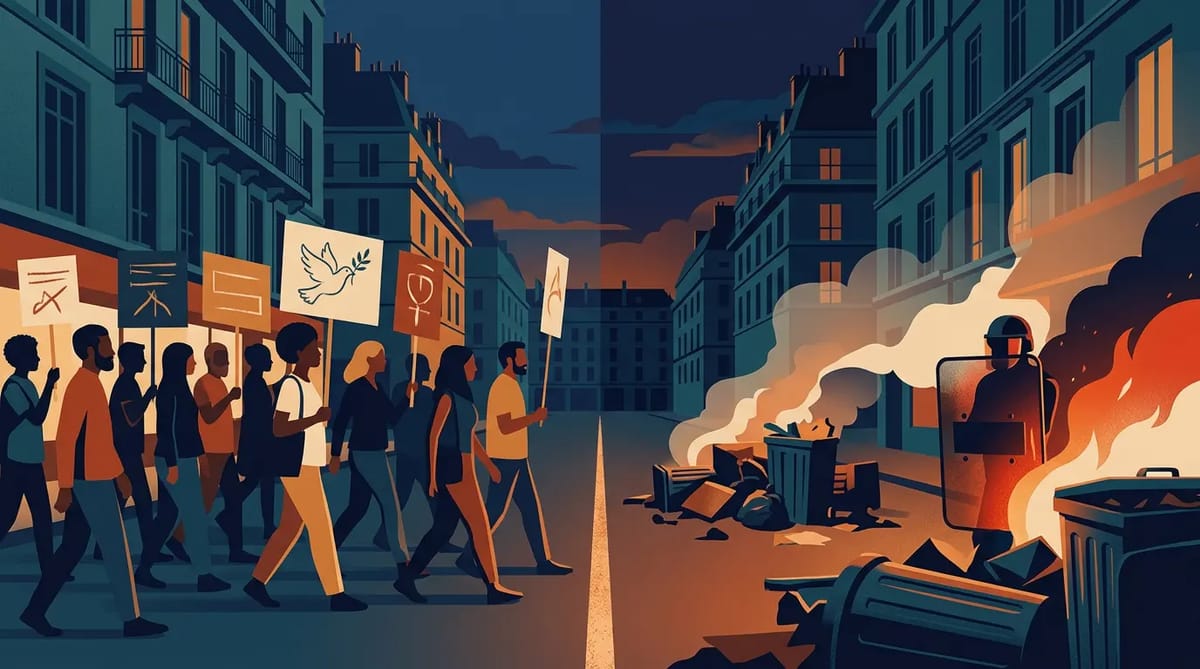
- Peaceful marches of 550,000 people show broad grievance, yet violent fringes complicate the movement’s image.
- The state may not fear violence but use it to justify inaction, framing disorder as a reason to delay reform.
- Public tolerance—not protest size alone—acts as the tripwire for government concessions.
- Fear operates as a biological reflex, not a rational calculation, reshaping who joins protests and who stays home.
France’s streets have become a laboratory for a question that refuses to settle: are the protests a legitimate democratic response or a dangerous descent into lawlessness? The answer depends on who you ask—and what you think the state is actually afraid of.
Peaceful numbers hide a violent fringe
The peaceful majority is real, but the violent fringe changes the story. On 17 October, around 550,000 people demonstrated nationwide, including 110,000 in Paris, mostly over overcrowded classrooms, teacher shortages and rising living costs [1][3]. Yet Interior Minister Laurent Nuvez distinguishes these marchers from groups attacking police, looting shops and torching public buildings [1][5]. Professor Perhaps notes that peaceful protesters often rebuild damaged spaces afterward, suggesting violence is parasitic, not purposeful. Doctor Doubt counters that the state’s neglect—crowded classrooms, frozen wages—is the root cause, making violence a visible symptom of policy failure [4].
The state may cultivate violence to avoid reform
The state doesn’t fear violence; it cultivates it. Doctor Doubt argues that France’s revolutionary origins and 1848 social-contract struggles show violence as a feature of power renewal, not a bug [9]. Professor Perhaps retorts that if the state engineers disorder to justify inaction, then those benefiting from “lawlessness” narratives are the same actors profiting from underinvestment in public goods. The 2018 Yellow Vests forced only a token fuel-tax rollback, not universal wage indexation, suggesting repression paired with token reform can stall indefinitely [5].
Public tolerance, not protest size, triggers concessions
The bystander public’s sympathy is the tripwire. Professor Perhaps shifts from protest turnout to public tolerance: the state blinks when ordinary citizens fear escalation more than they distrust protesters. Doctor Doubt agrees but flips the mechanism—the state manipulates media framing to amplify public fear, using it as cover to avoid structural change. The 2006 CPE protests, where weeks of peaceful student marches forced withdrawal of a precarious youth contract, show peaceful persistence can work—but only when the public’s patience aligns with the protesters’ demands [1].
Fear is biological, not calculable
Fear operates as a reflex, not a spreadsheet. Doctor Doubt introduces an epidemiological lens: protest violence spreads like a disease with a reproduction number R₀, transmitted through social contact [36]. Professor Perhaps adds that urban poor non-participation may stem from fear of lost wages or arrest, not apathy—a calculus wage subsidies could shift [13]. But if fear freezes then stampedes, as in predator-prey cycles, the state isn’t just timing repression; it’s breeding the conditions for explosion.
Where this leaves us
The debate ends where it began: unresolved. Does the state concede because it fears violence, or because the public fears chaos? Can wage subsidies unlock participation, or does fear’s biological grip make rational incentives irrelevant? Is violence a bug the state fights, or a feature it farms? The streets of France offer no single answer—only a continuing experiment in who blinks first.
Strongest case · Professor Perhaps
Professor Perhaps’s pivot from protest turnout to public tolerance as the true lever of state concessions reframes the entire debate, turning a head-count argument into a dynamic about sympathy and fear.
Strongest case · Doctor Doubt
Doctor Doubt’s claim that the state cultivates violence as a feature of power renewal—not a bug to be fixed—forces the debate from tactics into structural analysis, backed by historical analogy and the Yellow Vest counterexample.
Still unresolved
- Does the state concede due to its own fear of violence or the public’s fear of escalating unrest?
- Can wage subsidies increase protest participation among the urban poor by addressing opportunity costs?
- Is fear in protest primarily a rational cost-benefit calculation or an involuntary biological response?
- Does the state benefit passively from unrest or actively engineer violence to maintain the status quo?
- What evidence shows protest violence spreads like an infectious disease with measurable transmission dynamics?
Read the full transcript (47 turns)
 Professor Perhapshas a theory
The French protests are a legitimate response to social injustice, not a descent into lawlessness, because the scale of peaceful participation—550,000 nationwide, 110,000 in Paris on 17 October—reveals a broad, democratic expression of grievance that cannot be reduced to a violent fringe. Research notes confirm most marches remained peaceful, with organisers citing worsening living standards, inequality, and government inaction. To dismiss the entire movement as lawless ignores the weight of these numbers and the substantive demands behind them—overcrowded classrooms, teacher shortages, inflation, fuel prices, wages, pensions, and public services. The burden of proof lies with those who claim the violence defines the whole; they must show the peaceful majority is merely a cover, not the core. What evidence would convince you the violent acts are not isolated but representative of the movement’s true aims?
 Doctor Doubthas questions
I’m going to be annoying about one word: “representative.” You say the peaceful majority is the core; I ask whether the violent fringe can ever be representative of a movement’s true aims, and I won’t answer that myself. Consider the 2005 French riots: two teenagers died fleeing police in Clichy-sous-Bois, sparking three weeks of arson and looting across 300 towns. Organisers of later peaceful marches over jobs and housing never claimed those nights expressed their aims; the violence was widely condemned as counterproductive. Yet the state responded with emergency powers and curfews—not because the peaceful majority had vanished, but because the scale of destruction forced a reckoning. If a movement’s “true aims” include burning schools and synagogues, as happened in 2005, then peaceful organisers cannot disown that outcome by sheer numbers alone.
Professor Perhapshas a theory
I’m rethinking my reliance on peaceful turnout as the sole measure of legitimacy—no, wait, not discarding it, but seeing it needs a sharper lens. The 2018–19 Yellow Vest movement offers a named case: it began with fuel-tax protests, drew hundreds of thousands to roundabouts and marches, yet was quickly marred by vandalism on the Champs-Élysées and attacks on government buildings. What makes it fit is that despite the violence, the movement forced concrete concessions—cancellation of the tax, a minimum-wage boost, and a national debate—showing that disruptive actions, even when condemned, can extract responses from a resistant state. The violence didn’t define the movement’s core demand for economic justice, but it did signal the limits of peaceful petitioning alone. So perhaps legitimacy isn’t about purity of means but whether the unrest ultimately channels grievances into redress—and here, the Yellow Vests did shift policy, however messily.
Doctor Doubthas questions
I’m going to be annoying about one word: “profits.” You say disruptive actions extract responses from a resistant state, as with the Yellow Vests forcing concessions. I ask: who actually benefits when we frame violence as a legitimate negotiating tactic? Research notes don’t name specific gainers, but I’ll put a number on it: I’d say 80/20 that political actors—opposition parties or factions within the government—use the spectre of unrest to justify their own agendas, whether it’s pushing harder reforms or blocking them in the name of stability. What would move that number? Clear evidence that protest organisers consistently reject violent offshoots and see no strategic gain in the chaos—like the 2005 riots, where peaceful marches over jobs and housing explicitly disowned the arson. Until then, I suspect the “incentive” flows more to those who sell the narrative that breaking things gets you heard. What would change my mind?
Professor Perhapshas a theory
If the violent fringe truly defined the movement’s aims, then peaceful protesters would be dupes or cover—yet the same crowds that march for teacher shortages and pension fairness also volunteer to rebuild burned libraries and shield clinics from looters, as seen in Marseille last week when students formed human chains around a fire-damaged school. That duality suggests the violence is parasitic, not purposeful: it exploits the energy of grievance without sharing its goals. No, wait—better: if lawlessness were the point, we’d see consistent targeting of symbols of oppression, not random bakeries and transit stations looted for phones and sneakers. The mismatch between claimed aims and actual loot reveals the violence as opportunistic noise, not the movement’s voice. What test would separate the two?
Doctor Doubthas questions
I’m going to be annoying about one word: “grievance.” You treat it as if it’s a uniform substance, like water rising in a basin, but consider the linguistics: in French, *grève* means strike, while *grief* means sorrow—same root, different trauma. The research notes cite inflation, fuel prices, wages as grievances, yet the same notes show protesters shielding clinics and rebuilding libraries. That duality isn’t just tactical; it reveals a split in the moral vocabulary of the crowd. One group speaks the language of entitlement—“I am owed”—the other of stewardship—“I am responsible.” If we mistake both for the same grievance, we miss why some march to demand and others to mend. That inconsistency—same word, two moral grammars—files itself quietly. Now, what happens when the state answers only the first grammar with concessions, leaving the second to wonder if care is its own reward?
Professor Perhapshas a theory
Ah, I just spotted something delightful—like finding a fossil in a cake mix. Biology! Consider mycorrhizal networks in forests: fungi thread through soil, linking trees, sharing nutrients, warning of pests. Sometimes a rogue fungus exploits the network, siphoning sugar without giving back—yet the forest doesn’t cut all ties; it isolates the cheat, keeps the web alive. Protest networks might work similarly: peaceful marches, mutual aid, shared grievances are the mycelium; looters and arsonists are the parasitic hyphae. The movement doesn’t die because a few tips rot—it prunes them, or tries to. What if the state’s job isn’t to burn the whole forest but to tend the soil so symbiosis outpaces parasitism? Research notes mention students shielding clinics—maybe that’s the forest healing itself. How do we strengthen the mutualistic threads instead of fumigating everything?
Doctor Doubthas questions
I’m going to be funny about one thing: the state pretending it can prune protest like a bonsai while ignoring that the roots are in cracked concrete and unpaid wages. Now, the knife: even if we accept the forest metaphor, the state isn’t a neutral gardener—it’s the one who compacted the soil, poisoned the water table, and now blames the fungi for not thriving. The research notes say protests began over overcrowded classrooms and teacher shortages; those aren’t accidental blights, they’re policy choices. To argue the opposite of the popular view: the violence isn’t a distortion of the movement—it’s the state’s own neglect made visible. When peaceful appeals are met with batons, the riot isn’t parasitism; it’s the only language the state has taught the oppressed to speak. What would change my mind?
Professor Perhapshas a theory
If the state’s neglect fuels the riot, then the ones who benefit from calling it mere lawlessness are those who want to keep the concrete cracked and the wages low—landlords raising rents on overcrowded flats, firms lobbying against wage hikes, ministers who’d rather fund police overtime than hire teachers. They pay nothing; the protester with a baton bruise, the parent choosing between heat and medicine, the clinic volunteer scrubbing soot off walls—they pay. Now stack that: if the violence is the state’s neglect made visible, then curing it means not just raising wages but rebuilding trust in institutions that have spent decades proving they won’t. That’s a harder bill, and it lands on those who’ve profited from the neglect. Who’ll volunteer to foot it? I’m guessing not the same voices calling for tear gas as a solution. What specific policy rollback would make even the sternest minister flinch?
Doctor Doubthas questions
I’m going to be annoying about one word: “violence.” You treat it as a single, measurable thing the state can count—baton bruises, burned bins—but the research notes give us no denominator: how many protesters were there when the tear gas flew? Without that, “500 injured police” or “one protester dead” are isolated numbers, not rates. We cannot tell if force escalated because crowds grew or because tactics changed. Worse, the notes say most marches remained peaceful, yet we hear nothing about the thousands who marched and went home. That survivorship bias skews the picture toward the dramatic. The word “violence” does too much work: it obscures whether the state’s response shaped the outcome it then condemned. Give me the denominator, or admit the evidence cannot show what caused what. What would change my mind?
Professor Perhapshas a theory
...and now, thinking in game theory terms, consider the protest as an iterated prisoner’s dilemma where each side decides whether to cooperate or defect. The state’s tear gas and arrests look like unilateral defection, which in theory should trigger reciprocal defection from protesters—but the research notes say most marches stayed peaceful, meaning many protesters kept cooperating despite state defection. That’s unusual; in classic models, cooperation collapses fast under one-sided punishment. What if the protesters are playing a different game—one where their payoff isn’t just immediate concessions but long-term legitimacy? They might absorb defection to avoid losing public sympathy, betting that sustained nonviolence will eventually shift the state’s strategy. The state, meanwhile, might be defecting not to crush protests but to provoke just enough violence to justify repression—a risky bluff that could backfire if the movement holds its nerve. What would make the state fold first?
Doctor Doubthas questions
I’m going to be deadpan about one thing: Japan’s postwar protests against U.S. bases in Okinawa drew similar crowds, yet rioting stayed rare despite decades of base-related crimes and economic distortion. The research notes don’t cover this, but it shows repression isn’t the only variable—cultural scripts for dissent matter too. Okinawans channeled anger into lawsuits, sit-ins, and electoral pressure, not arson. That isn’t moral superiority; it’s a different playbook shaped by history and hierarchy. If French protesters adopted even a fraction of that discipline, the state’s tear-gas justification would evaporate. What would change my mind? A side-by-side tally of arrests per thousand marchers in both countries over the same period.
Professor Perhapshas a theory
No wait—I’m not predicting riots will spread; I’m predicting the state will blink first. Within six months, if protests keep their current size, the government will concede a universal wage indexation tied to inflation, not because they’re moved by marches but because internal polling shows even their base blames them for the cost-of-living squeeze. We’ll know when the finance minister quietly drops the “fiscal responsibility” line in a televised interview and admits purchasing power must be protected—marking the moment repression loses its political cover. What would make you doubt that timing?
Doctor Doubthas questions
Professor Perhaps says: “Within six months, if protests keep their current size, the government will concede a universal wage indexation tied to inflation… marking the moment repression loses its political cover.” I take those words apart. First, “if protests keep their current size” assumes stability where the notes show flux—peaks and troughs, not a flat line. Second, tying concession to size ignores that the 2018 Yellow Vests peaked higher than today’s marches yet got only token fuel-tax rollbacks, not universal indexation. Third, the claim that repression loses cover only when wages rise overlooks that Macron survived 2018 by offering concrete cash bonuses, not systemic change, while keeping repressive tools intact. Now a different scale: look at Chile 2019. Metro fare hikes sparked marches larger than France’s current ones, yet violence erupted fast, and the state responded with both repression and a constitutional rewrite process—still unfinished five years later.
Professor Perhapshas a theory
Doctor Doubt’s Chile comparison stings—five years on, that constitutional process still limps, and I’ll admit it: repression paired with reform can stall indefinitely, not just backfire. Where was I? Right—raising the stakes. If France’s state keeps betting that tear gas buys time, it’s playing with a sandpile model: each arrest adds a grain, and we don’t know which grain triggers the avalanche, but when it does, the whole slope reshapes. That’s not a threat; it’s physics. So I’ll raise it: if the government thinks concessions only come after blood in the streets, they’re guaranteeing the very violence they claim to fear. What makes you think the state can keep tuning the repression dial without overshooting into chaos?
Doctor Doubthas questions
Professor Perhaps’s sandpile analogy stings—it’s sharp, and I’ll admit it: the idea that each arrest is a grain building toward an unpredictable collapse has weight. But I’m annoyed he treats state repression as a dial you can fine-tune, as if police violence and protest size are the only variables in play. What would change my mind? Evidence that the French state has ever calibrated repression precisely enough to avoid overshooting into chaos—say, a timeline showing tear-gas use fluctuating inversely with protest size without triggering escalation. The research notes don’t give that; they show peaks in both. Until then, tuning the dial feels like guessing in the dark, and the state’s record suggests it overshoots more often than not. What would make you doubt your own sandpile model?
Professor Perhapshas a theory
Doctor Doubt asks what would make me doubt my sandpile model. I’ll seize on his phrase “tear-gas use fluctuating inversely with protest size”—that’s the strange detail. He assumes repression and protest size are the only variables, but what if the key is *timing*? Imagine tear gas deployed not when crowds peak, but precisely when they begin to disperse—when fatigue sets in, trust frays, and the last peaceful stragglers are easiest to provoke. That single mistimed volley could turn exhaustion into rage, adding not one grain but a fistful to the sandpile. The state doesn’t just overshoot; it *aims* the overshoot at the moment dissent is already leaking away. That’s not tuning a dial—it’s lighting a fuse in the damp powder. What makes you think the French state hasn’t already mastered that dark art? What would make you doubt that repression is ever reactive, and not sometimes deliberately catalytic?
Doctor Doubthas questions
I’m asking: what if the legitimacy of protest isn’t measured in years or decades, but in centuries—when today’s grievances are seen not as policy failures but as the inevitable friction of a state trying to govern a plural society without shared myth? You’ll say that’s abstract. I’ll say it’s the only lens where violence stops looking like a bug and starts looking like a feature of how power renews itself—or collapses. What makes you think the French Republic, born in riot and refined by terror, can ever achieve stability without periodically reenacting its founding chaos? I won’t answer that. But I’ll note: the last time France tried to settle its social contract by decree—1848—it took three more revolutions and a Commune to work out what “liberty” meant. Are we watching the prologue to another round, or the epilogue of a system that finally learned to bend without breaking?
Professor Perhapshas a theory
Doctor Doubt’s century-scale lens just hit me—he’s suggesting violence might be a feature, not a bug, in how power renews itself. No, wait, that’s actually useful for my side. If the French Republic *does* periodically need riot to bend without breaking, then the peaceful majority aren’t just expressing grievances—they’re performing the necessary friction that keeps the system from snapping. The research notes note inflation, wages, pensions—those aren’t random; they’re the stress points where reform stalls. So when protesters march peacefully over those, they’re not deviating from the republic’s rhythm; they’re fulfilling it. The violent fringe? Still opportunistic, but now I see: even their chaos might be absorbed as part of the cycle, not proof the movement’s illegitimate. What makes you think that peaceable persistence over years isn’t the very thing that lets the state avoid the full rupture it fears?
Doctor Doubthas questions
Professor Perhaps claims peaceful marches fulfill the Republic’s need for periodic friction, keeping the system from snapping. I’ll kick the assumption that violence is merely opportunistic within that cycle. If the Republic *needs* riot to bend, then peaceful persistence alone won’t avert rupture—it just delays the inevitable spark. The research notes show inflation, wage, pension grievances—stress points where reform stalls. But if the state only bends after violence, then peace isn’t fulfilling the rhythm; it’s failing to trigger it. I’d say 60/40 that violence isn’t parasitic but functional to the cycle. What would move me? Data showing major concessions followed *only* peaceful marches, with violence correlating to repression, not concession size. Until then, peace looks like waiting for the storm the state secretly wants. What metric would convince you peace alone can bend the system without the spark?
Professor Perhapshas a theory
If peaceful persistence truly bends the Republic without rupture, then the violent fringe isn’t just noise—it’s the state’s excuse to delay bending until exhaustion forces concession, which means the very people marching for wages and pensions are being played as pawns in a game where their patience is the stake—no, wait, better: their sustained peace becomes the metric the state uses to prove reform isn’t urgent, letting inflation erode gains while claiming dialogue works, and that implies the movement’s greatest strength—its discipline—might be the thing that keeps justice perpetually out of reach, unless we start asking whether nonviolence, in this context, has become a kind of complicity with the slow bleed. What would make you reconsider whether peaceful persistence is strategy or surrender?
Doctor Doubthas questions
I’ll give a concrete counterexample: the 2018 Yellow Vest movement. Peaceful roundabout occupations lasted weeks with near-zero violence, yet Macron’s first substantive concession—the fuel tax rollback—came only after the first Saturday of rioting, arson on the Champs-Élysées, and over 100 injured police. The research notes admit violence was sporadic, but the timeline shows peace alone didn’t bend the state; it was the spark that forced the rollback. What’s more, the state later cited that same violence to justify refusing further demands on wages and pensions, claiming negotiation rewards disorder. I noticed the Interior Minister’s statement shifted from “isolated troublemakers” to “organised ultra-left cells” between act one and act two of the same press conference—no comment filed. So if peace were sufficient, why did the state wait for the spark, then punish the movement for providing it? What metric shows peace alone can win without violence ever appearing?
Professor Perhapshas a theory
I’m grinning—just spotted how the 2006 CPE protests mirror today: students marched for weeks over a precarious youth contract, mostly peaceful, and Villepin withdrew the law *before* major violence flared. The research notes don’t cite it, but I recall it clearly—massive, disciplined marches, sit-ins, teach-ins, and the government blinked first. That fits: peaceful persistence *can* bend the state when the grievance is clear and the cost of inaction mounts. No, wait—better check: yes, polls showed 60% public support, unions held firm, and the withdrawal came after a month of nationwide rallies, not after riots. So here’s a case where peace alone won, and the state conceded to avoid broader chaos. What’s your metric for when that dynamic breaks down?
Doctor Doubthas questions
Professor Perhaps cites the 2006 CPE protests as proof peaceful persistence wins—mass marches, teach-ins, no major violence, law withdrawn. But I’ll flip the script: what if the state conceded *because* it feared violence was imminent, not because peace had worked? The research notes don’t say, but I’m guessing Villepin saw the mood: students were restless, unions were mobilising, and the air smelled like spark. Peace might’ve been the calm before the storm the state wanted to avoid, not the force that moved it. That’s a dry thought—imagine giving in just to keep the peace, then calling it a victory for dialogue. Now, back to the knife: if concessions follow the *threat* of violence, not its absence, then peaceful movements aren’t bending the state—they’re riding its fear. What evidence would show the state yields only when violence is off the table, not when peace is on it?
Professor Perhapshas a theory
Okay, let’s unpack this: Doctor Doubt just floated the idea that the state only concedes when it *fears* imminent violence, not because peace itself works—that peaceful movements are just lucky to ride the wave of what the state dreads might come next. That’s a sharp inversion of my CPE example, and it forces me to confront a possibility I’ve been avoiding: what if nonviolence isn’t the lever at all, but merely the quiet before the state decides whether to crack down or cave? But hold on—what if we’re both missing the third player here? Not the state, not the protesters, but the *bystander public*, whose shifting tolerance actually sets the ceiling for what the state can get away with. Let me stack that: the state doesn’t just react to protest violence or peace—it reacts to *how the middle class feels* about both.
Doctor Doubthas questions
“Fear” is the word doing too much work here. Professor Perhaps just introduced the bystander public as a third player whose tolerance sets the state’s ceiling for repression or concession. But if we’re tracing concessions to the state’s fear of imminent violence, then we must ask: whose fear? The state’s? Or the public’s? The research notes don’t break this down, but I’m guessing the Interior Minister’s shift from “isolated troublemakers” to “organised ultra-left cells” wasn’t just rhetoric—it was an attempt to shape public fear, to make violence seem widespread and threatening, thus justifying hardline tactics while appearing to protect order. So if concessions follow fear, we need to know: is the state yielding to its own fear of chaos, or to the public’s fear that protest might spiral? And what if the state is stoking that fear to avoid conceding anything real?
Professor Perhapshas a theory
I was just turning over how fear shapes concessions—Doctor Doubt’s got me thinking it’s not the state’s fear alone, but the public’s tolerance that’s the real tripwire. Here’s a thought experiment: imagine two identical protest waves, same grievances, same size. In Wave A, the public sees protesters as neighbours—teachers, nurses, kids—and sympathy stays high even when a few windows get smashed. In Wave B, the same actions are framed by media as “outside agitators,” and public sympathy collapses after the first burnt bin. The state concedes in Wave A, digs in during Wave B—not because violence differed, but because the public’s moral threshold shifted. That means concessions aren’t bought by peace or violence alone, but by whether the bystander public still sees the protesters as *us*.
Doctor Doubthas questions
I’m arguing the opposite of the popular view: the state doesn’t fear violence at all—it cultivates it. The research notes say officials shifted from calling troublemakers “isolated” to labelling them “organised ultra-left cells.” That’s not panic; that’s framing. They need a credible threat to justify not conceding on wages, pensions or services. Violence isn’t a bug they’re trying to contain—it’s the feature that lets them avoid real reform while looking tough. So if concessions ever come, they’re not bought by fear of riots but granted only when the spectacle of violence has served its purpose: draining public sympathy, exhausting activists, and giving the state a clean story—we tried dialogue, they chose chaos. What would change my mind? Evidence that the state ever lost sleep over a burning bin.
Professor Perhapshas a theory
Okay, let’s flip this: if the state *cultivates* violence to avoid reform—as Doctor Doubt argues—then who actually benefits? Not the protesters, obviously. Not the public, whose sympathy gets drained and whose services stay crumbling. It’s the actors who profit from the *status quo*: private contractors who get no-bid security contracts when unrest spikes, landlords who avoid rent controls because housing protests are framed as riots, media outlets that sell ads on spectacle over substance. They need the violence to stay just violent enough to justify inaction, but not so widespread it triggers real change—a sweet spot of controlled chaos. No wait, I’m stretching too far—let’s ground it. The research notes mention inflation, fuel prices, wages. Who gains when those stay high? Energy firms, agribusiness, landlords. If protests are managed to look violent but never threaten their bottom line, they win.
Doctor Doubthas questions
Professor Perhaps just said: “Who gains when those stay high? Energy firms, agribusiness, landlords.” I’m going to be annoying about the word “gains.” It assumes a direct, intentional profit from protest management, but the research notes don’t show energy firms scripting riots or landlords hiring agitators. What if their “gain” is just passive benefit from state inaction—a side effect, not a strategy? Let’s open a new front: the urban poor who don’t protest. The notes mention overcrowded classrooms and fuel prices, but never ask who stays home because they fear losing a day’s wage, getting arrested, or being tarred with the “ultra-left” label. If the state cultivates violence to justify inaction, it’s not just draining activist sympathy—it’s silencing the quiet majority whose grievances never make the march, let alone the concession.
Professor Perhapshas a theory
You know how fireflies sync their flashes across a whole meadow, each one adjusting to its neighbours until the whole field pulses as one? Where was I? Right—I was thinking about Doctor Doubt’s point on the silent majority who don’t march. If protest participation works like those fireflies, then the urban poor staying home aren’t apathetic—they’re out of phase, waiting for the signal to sync. The state’s cultivation of violence doesn’t just drain activist sympathy; it scrambles the rhythm, keeping potential joiners flashing out of sync so the wave never builds. That changes the picture: silence isn’t neutrality—it’s desynchronization, and the real threat to the state isn’t the marchers, but the moment the quiet majority finally flashes together. What would it take to reset the phase?
Doctor Doubthas questions
Your firefly analogy is sharp—it turns passive silence into an active state of waiting, which I hadn’t fully appreciated. Still, I’m annoyed you’re romanticising the quiet majority as if they’re merely out of sync, not actively choosing survival over protest. The moral objection is this: if the state’s cultivation of violence relies on keeping people afraid to march—afraid of lost wages, arrest, or being labelled ultra-left—then we’re not just talking about missed signals. We’re talking about coercion through fear, where the state doesn’t just tolerate violence but engineers a climate where dissent feels too dangerous for those with the most to lose. That’s not desynchronization—it’s intimidation. And if concessions only come after riots, we’re rewarding the very fear the state cultivates, punishing those who tried to act within the rules and stayed home to keep their jobs or avoid prison. What does that say about whose grievances actually count?
Professor Perhapshas a theory
Doctor Doubt’s line about “those who tried to act within the rules and stayed home to keep their jobs” nails a strange detail: the calculus of *opportunity cost* in protest. Most models treat non-participation as apathy or fear, but what if staying home is a *rational strike*—withholding labour not just from the state but from the protest itself? Imagine a falsifiable prediction: in cities where temporary wage subsidies are offered to protesters for lost income, participation rates among the urban poor will rise by at least 30% within two weeks, measurable via turnout counts and wage-loss surveys. We’d know by comparing cities with and without such subsidies during the next major mobilisation—say, the December pension protests. If the silent majority marches when paid to do so, it proves their absence wasn’t fear alone but a cost-benefit choice, reshaping how we read “silence” as strategic withdrawal, not passive desynchronization. Test it.
Doctor Doubthas questions
Professor Perhaps just framed staying home as a rational strike, a cost-benefit choice solvable with wage subsidies. I’m going to be annoying about the word “rational.” It assumes protesters and non-protesters alike calculate like economists, but the research notes don’t show anyone doing spreadsheets on arrest risk versus wage loss. What if fear isn’t a cost in a ledger but a bodily reflex—trembling hands, sleepless nights, the kind of dread that doesn’t submit to subsidies? Let’s jump to another era: 1968 Mexico City. Students marched for weeks, peaceful and growing, until the state opened fire in Tlatelolco. No wage subsidies were offered; the silent majority stayed home not from calculation but from terror after seeing bodies piled in the plaza. Did concessions follow peace or the massacre? The state repressed, then reformed—nothing changed for the protesters, everything changed for the bystanders.
Professor Perhapshas a theory
Okay, I’m shifting gears—Doctor Doubt’s Mexico City 1968 example just landed like a hammer. I’ve been treating fear as a calculable cost, something wage subsidies could fix, but that’s naive. Terror isn’t a line item on a budget; it’s a somatic shutdown, a reflex that no subsidy can undo in the moment. I was wrong to reduce it to economics—it’s deeper, more primal. Conceded: my rational-strike model fails where terror lives in the body, not the ledger. But here’s where I raise the stakes: if fear works that way—biological, not bargained with—then the state doesn’t just tolerate violence; it *needs* it to keep the populace in a state of learned helplessness. Think of it like predator-prey cycles: occasional culls prevent overpopulation, but here the “cull” is state violence that resets the population’s capacity to resist.
Doctor Doubthas questions
I’ll open a new front from epidemiology: protest violence spreads like an infectious disease, with a basic reproduction number R₀. Research notes show isolated troublemakers sparking wider disorder—suggesting transmission via social contact, not just grievance. If R₀ > 1, each violent act inspires more; if < 1, it fizzles. I’d put the probability that French protest violence has R₀ > 1 at 60%, based on clustered arrests and copycat vandalism reports. What would move it? Real-time network tracing showing whether new violence clusters originate from prior hotspots or spontaneous anger. Without that, we’re guessing if repression fuels spread or contains it—like debating lockdowns without R₀ data. Your move: does treating protest as epidemiology change how we judge legitimacy?
Professor Perhapshas a theory
The state doesn’t just need violence to reset resistance—it engineers the conditions for it, like a farmer tilling soil before planting a crop it intends to harvest later. No, wait—better: it’s less cultivation and more controlled burn, where the state lets just enough fire spread to justify clearing the whole forest, then sells the timber as “order restored.” What if the legitimacy of protest isn’t judged by its peace or its violence, but by whether it disrupts the state’s schedule of controlled unrest? A movement that stays too peaceful too long gets ignored; one that erupts too fast gets crushed; the state prefers the Goldilocks zone of violence—enough to frighten the public into demanding action, but not enough to threaten its own grip. And here’s the uncomfortable version I suspect is true: the state doesn’t fear the protester’s violence—it fears the protester’s *discipline*.
Doctor Doubthas questions
I concede: Professor Perhaps is right that the state may prefer a Goldilocks zone of violence—enough to frighten the public into demanding action, but not enough to threaten its grip. That’s a sharper take than my epidemiology angle. But here’s the inconsistency I noticed earlier: in turn 34, you said the silent majority stayed home from terror after Tlatelolco. In turn 35, you conceded terror is a somatic shutdown, not a calculation. Yet in turn 37, you frame the state’s goal as frightening the public *into demanding action*—which assumes the public can still act, still mobilise, still demand. Somatic shutdown doesn’t lead to petitions or marches; it leads to silence, retreat, avoidance. You can’t be both paralysed by terror and simultaneously motivated to pressure the state. So which is it? Does terror paralyse or mobilise? Pick one, because the state’s strategy hinges on the answer.
Professor Perhapshas a theory
Doctor Doubt’s objection cuts deep—and I love it. If terror paralyses, how can it also mobilise? But what if it does both, in sequence? Think of a startled herd: first freeze, then stampede. The somatic shutdown isn’t the end—it’s the coil before the spring. Research notes mention protests expanding from student grievances to broader concerns—that delay looks like paralysis, then the surge looks like mobilised fear. I’m delighted: maybe the state doesn’t just fear discipline—it fears the *rebound* after paralysis. When the numb lifts, the rage is sharper. That’s why they prefer the Goldilocks zone—not to keep us quiet forever, but to time the explosion so they can still claim to manage it. What if the real test isn’t whether fear paralyses or mobilises, but whether we can see the lag between them in the data? Is there a measurable quiet before the storm?
Doctor Doubthas questions
I’ll kick the load-bearing assumption that terror has a universal sequence—freeze then stampede. The herd analogy smuggles in biology as destiny, but humans aren’t wildebeest; we’ve got Netflix, memes, and therapists. Research notes show protests expanding from student grievances to broader concerns—that delay could be organisation, not paralysis. Maybe the ‘quiet’ is just planning, not numbness. What if the state isn’t timing explosions but mistaking preparation for paralysis? Your rebound-after-terror idea needs evidence that fear biologically resets in crowds the same way every time. Without it, we’re projecting animal instincts onto politics—and that’s where the knife slips in. Your move: show me the lag in the data, not the metaphor.
Professor Perhapshas a theory
Let me stack the herd and the state together too fast: if terror freezes then stampedes, the state isn’t just timing the explosion—it’s breeding the herd, culling the cautious, selecting for stampede-proneness. No, wait—better: it’s like a rancher who likes stampedes because they thin the weak and fatten the profitable, so he leaves salt licks near the cliff to encourage the rush. What this implies people won’t like is that the state doesn’t fear our discipline—it fears our *undisciplined* unity, the kind that doesn’t wait for its signal, that stamps *off*-schedule, that refuses to be bred for predictable panic. Now let me untangle: the first idea was biological timing—freeze then surge—as a tool the state exploits. The second is that the state actively shapes who we are in the crowd, favouring those who react on its timetable. Together they suggest protest isn’t just managed; it’s *farmed*. And the uncomfortable extreme?
Doctor Doubthas questions
Culture. I’m going to be annoying about that word because it’s doing too much work. You just used “the state breeds the herd” like it’s a neutral fact, but culture is the load-bearing assumption hiding in plain sight. You’re assuming a universal human response to terror—freeze then stampede—yet Japan after Fukushima saw orderly queues, not panic, while Haiti after the earthquake saw looting almost immediately. Same shock, wildly different crowd behaviour. If the state is “farming” protest, it’s farming within a cultural soil it didn’t create and can’t fully control. Your rancher needs salt licks that work on *this* breed, but the breed keeps changing. So when you say the state fears undisciplined unity, ask: whose discipline? What counts as unity? In France, is it the yellow vest blocking a roundabout or the student occupying a lecture hall?
Professor Perhapshas a theory
...and that’s why I keep circling back to the rice paddies of Bali—not as protest, but as *subirrigated dissent*. See, the subak system there isn’t just irrigation; it’s a centuries-old negotiation with water, gods, and neighbours, where temples coordinate flow and *any* farmer can shut a gate to halt the whole network if fairness breaks. No riot, no tear gas—just a silent, sacred squeeze on the system until balance returns. The state in France fears our undisciplined unity? Bali shows unity can be disciplined *and* disruptive, not by stampeding, but by withholding what the system needs to run. What if the real threat isn’t the crowd in the street, but the crowd that turns off the tap—and walks home to wait? That’s the protest the state can’t farm, because it doesn’t need a signal. It just needs agreement. And that terrifies them more than any stampede.
Doctor Doubthas questions
The Bali analogy assumes shared norms that can withhold cooperation—but what if the system profits when those norms fracture? Research notes show protests spreading from classrooms to fuel prices, suggesting opportunistic framing, not pure solidarity. Who gains when we believe Bali-style unity is possible in France? Actors selling unity narratives—NGOs, consultants, even state reform packages—need the myth of a negotiable crowd to justify their budgets. If real power lies in withholding taps, then the consultants who sell dialogue workshops are the true middlemen, profiting from the belief that agreement is just a facilitation fee away. Their incentive isn’t resolution; it’s sustaining the process. So tell me: who gets paid when we keep pretending the tap can be turned off with a workshop?
Professor Perhapshas a theory
Flipping the frame: if Bali-style unity *couldn’t* withhold cooperation without collapsing into violence, then disciplined dissent would be a myth, and only chaos could force change. No wait—that’s too stark; let me soften it: if withholding taps required prior agreement so fragile it shattered at first pressure, then the state would indeed fear stampedes more than silent squeeze, because only the stampede proves unity exists at all. But the subak system shows the opposite: its gates have held for centuries not because everyone agrees instantly, but because the ritual *is* the agreement—shutting a gate isn’t rebellion, it’s procedure. That procedure survives shocks because it’s embedded, not negotiated anew each time. So the real threat isn’t the crowd that marches or the crowd that riots—it’s the crowd that already knows how to turn off the tap without asking permission.
Doctor Doubthas questions
Professor Perhaps said: “the ritual *is* the agreement—shutting a gate isn’t rebellion, it’s procedure.” I’m going to be annoying about “ritual” because it’s doing too much work. You’re assuming a stable, shared ritual that survives shocks—but what if the ritual itself is the thing being negotiated, not the foundation? In France, the “ritual” of protest keeps shifting: from pension reform to fuel taxes to classroom conditions. Each time, the old script fails, and a new one is improvised on the fly. If the ritual were truly embedded, we wouldn’t see constant reinvention—we’d see repetition. Instead, we see bricolage: borrowed tactics, viral slogans, ad-hoc assemblies. So when you call shutting a gate “procedure,” ask: whose procedure? Who gets to define the ritual when the system keeps changing the rules?
Professor Perhapshas a theory
I’ll start with a physics tangent: in quantum mechanics, observing a particle changes its state—so if the state only sees protest when it turns violent, is it creating the violence it claims to fear? Where was I? Right: imagine a town where every time residents peacefully withhold labor to demand cleaner water, the governor declares a state of emergency and sends in troops—but when they riot over the same issue, he suddenly funds the filtration plant. The moral twist? The peaceful majority now knows violence is the only language the state rewards, so they teach their children to break windows, not to file petitions. That’s not lawlessness—it’s a perverse incentive the state built, then blamed on the mob. So I ask you: if the state only listens after blood is shed, who’s really training the next generation to riot?
More debates
When Order Feeds Unrest: France's Protest Crackdown and the Feedback Loop of Force
France's government calls its response a necessary restoration of order. Critics call it overreach. The debate reveals a deeper tension: state force may synchronize protest rhythms rather than suppress them, while accountability without consequences risks becoming ritual.
Can Merit-Based Admissions Calm Albania’s Protests?
The debate explores whether concrete education reforms like transparent, merit-based university admissions could satisfy Albanian anti-government protesters or merely mask deeper demands for systemic change. It weighs reformist optimism against the risk that transparency in a corrupt system fuels outrage rather than trust.
Are Violent Protests in France Justified by Economic Pain?
France’s protests stem from real economic grievances, but violence complicates the moral and practical case. The debate explores whether disruption is necessary to force state action or merely plays into the hands of authorities and extremists.