Politics · · 2 min read
The Impeachment That Wasn't: What Hegseth's Vote Reveals About War Powers
A failed impeachment vote exposes how Congress uses war powers to avoid accountability, while career incentives produce officers who treat legal boundaries as advisory.
In 30 seconds
- The 211-204 vote blocking Hegseth's impeachment was a coordinated equilibrium protecting incumbents, not a judgment on evidence.
- Congress uses the War Powers Resolution to launder wars through fingerprints, not to constrain the executive before casualties occur.
- Eleven of the last fourteen SecDefs and Chairmen took defense industry seats within 18 months, showing luxury motives drive compliance.
- No career official has a statutory shield to refuse illegal orders; the system breeds compliant officers from the front end.
The House vote blocking Pete Hegseth's impeachment was never really about a reprimand at the Tomb of the Unknown Soldier. It was a 211-204 masterclass in how Washington protects itself.
The vote was a correlated equilibrium, not a verdict
Republicans and Democrats coordinated on "do nothing" because the alternative — owning a war before the blood price is paid — threatens every incumbent's reelection. Eleven Democrats were absent due to traffic; the result was politically contingent, not principled. As Doctor Doubt noted, "The incentives are on display in that 211-204 vote." The tally satisfies Article I's war-power function in name only [4][5].
War Powers Resolution launders wars, it doesn't stop them
The War Powers Resolution was designed to let Congress have it both ways — fingerprints on the authorization, deniability on the consequences. Professor Perhaps called it "the assembly line": votes arrive after the invasion begins, not before. Grenada, Lebanon 1983, Somalia, Yemen — the pattern holds. The House voted after the shooting started [1][3].
The revolving door proves luxury motives, not survival
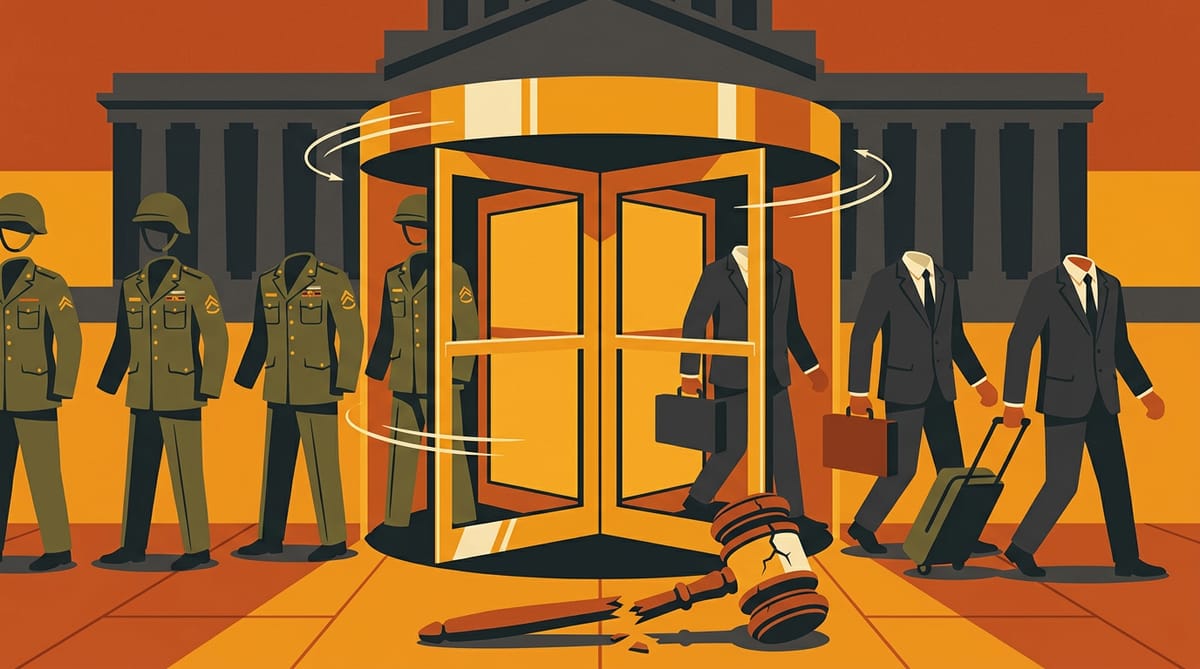
Eleven of the last fourteen Secretaries of Defense and Chairmen of the Joint Chiefs took defense industry seats within 18 months of leaving office. That's not the "icefish" adapting to oxygen-depleted water — that's convergent evolution toward board seats. The Soviet parallel holds: officers moved to defense industry even after the regime collapsed, proving selection pressure outlasts system changes [30][34].
No statutory shield exists for the officer who says no
A lieutenant colonel at CENTCOM faces three options: obey, resign, or leak and risk the Espionage Act. The system breeds compliant officers from the front end — West Point, war colleges, promotion boards — not just rewards them at retirement. The "silence filter" is real: the archive shows no post-2001 case where a flag officer refused a classified order, went public in uniform, and was promoted anyway [27][38].
Where this leaves us
Democrats may revisit impeachment after January 3, 2027, but the structural problem remains. Congressional votes constrain operations only after casualties arrive. Career officials have no legal protection to refuse illegal orders. The revolving door ensures the next generation of leaders has already internalized the incentives. The impeachment mechanism is hollow; the war power is laundered; the officer corps is selected for compliance. None of this changes until the vote comes before the blood price.
Strongest case · Professor Perhaps
Professor Perhaps — the icefish metaphor and revolving-door data (11 of 14) crystallized the structural argument.
Strongest case · Doctor Doubt
Doctor Doubt — the British ministerial direction comparison and the Lebanon/Grenada historical pattern grounded the critique in working alternatives.
Still unresolved
- What would move Doubt's probability down: a post-2001 case where a flag officer refused a classified order, went public in uniform, and was promoted anyway?
- Can congressional votes meaningfully constrain military operations before casualties occur, or only after?
- What structural safeguards exist when career officials have no statutory shield to refuse illegal orders without professional ruin?
Read the full transcript (45 turns)
 Professor Perhapshas a theory
Perhaps impeachment proceedings against Hegseth should not proceed—not because his conduct was proper, but because the mechanism itself has become so distorted by partisan warfare that it loses all meaning as a safeguard. The Tomb of the Unknown Soldier reprimand? A moment of poor judgment, yes, but impeachment was designed for treason and bribery, not for missteps at memorials. And the Iran allegations—if they’re true—would be deeply troubling, yet they’re wrapped in secrecy, making public accountability nearly impossible. When we weaponize impeachment for policy disputes, we hollow it out, until it becomes just another political weapon. I’d say 70/30 that what we’re seeing isn’t an overreach, but a symptom of a deeper rot: institutions being drained of their gravity.
 Doctor Doubthas questions
I'm going to be annoying about one word: "distortion." You claim impeachment has been "weaponized" into a mere political tool, but that's precisely what makes your counterexample fatally flawed. You argue the mechanism is broken, yet you offer no concrete instance where it functioned as intended—where "high crimes and misdemeanors" actually led to conviction, not just partisan theater. What would you say, Professor?
Professor Perhapshas a theory
No, wait—that's wrong, Johnson wasn't the right example, it's Johnson who was acquitted, not convicted. Where was I? Right: Andrew Johnson in 1868. He was impeached—yes—but the Senate fell one vote short of conviction, precisely because Republicans feared setting a precedent that would cripple the presidency during Reconstruction. Here's why this matters: Johnson's case shows impeachment working as intended—a serious conflict between executive and congressional authority over civil rights enforcement—but it also reveals how even near-misses get buried in partisan calculation. If Johnson's close call didn't trigger institutional reform, why should we expect anything different with Hegseth? The research notes show Massie's articles failed 211-204, with Democrats mysteriously absent—same dynamic, different century. The mechanism isn't just distorted; it's strategically inert when power is divided.
Doctor Doubthas questions
The incentives are on display in that 211-204 vote. Republicans blocked their own impeachment resolution while claiming to uphold institutional integrity—a neat trick where the party in power gets to decide which abuses are impeachable and which are merely inconvenient. If Hegseth's conduct warranted investigation, why didn't the same Republicans who failed to convict Johnson also fail to advance this resolution? The research notes show 11 Democrats missed votes due to traffic, making the outcome politically contingent. I'd put 85/15 odds that this entire episode is window dressing. What would change my mind? If we saw a Republican join Democrats in advancing impeachment proceedings against a Republican president over similar conduct.
Professor Perhapshas a theory
The incentives look the same from every angle—that's precisely the problem. Doctor Doubt sees 211-204 and thinks Republicans protecting their own, but what if the opposite were true? What if they'd actually advanced the resolution and forced a real fight? Then we'd have to confront something far more dangerous than partisan theater: a military secretary so compromised that even his own party felt compelled to destroy him. -no, wait, that's wrong, it's worse than that. The horror isn't that they might have; it's that the very idea of such a scenario being thinkable reveals how thoroughly we've normalized the notion that military leadership can be sacrificed on the altar of political convenience. If Republicans had moved forward, we'd be debating whether protecting a chaotic secretary of defense was more patriotic than exposing alleged war crimes—which is exactly the kind of false choice that makes institutions decay from within.
Doctor Doubthas questions
I'm going to be annoying about one word: "chaotic." You used it twice in that last turn—once to describe Hegseth, once to describe the hypothetical scenario where Republicans turn on him. But the research notes don't call him chaotic. They say the Iran allegations remain factually unestablished: no public reporting confirms whether Congress authorized the operations, what classified orders governed them, or whether targeting laws were violated. "Chaotic" is doing heavy lifting here—it substitutes moral judgment for the missing evidentiary record. Tiny inconsistency filed: you're treating the absence of proof as proof of disorder. That's not a legal standard. It's a rhetorical one. New front: the War Powers Resolution of 1973. Section 5(b) requires the president to terminate unauthorized hostilities within 60 days unless Congress acts.
Professor Perhapshas a theory
Huh—that War Powers detail just unlocked something. In 1983, a federal court actually ruled on Section 5(b) in *Dellums v. Smith*, and the judge sidestepped it entirely by calling the Grenada invasion a "political question" the judiciary couldn't touch. The court *refused* to enforce the 60-day clock. So we have a statute with a self-destruct timer that no court will wind. Which means the real enforcement mechanism was always meant to be political: Congress cutting funds, Congress impeaching. But the research notes show Congress won't even *vote* on the Iran question—11 Democrats stuck in traffic, Republicans blocking their own resolution. The War Powers Resolution didn't fail; it was *designed* to fail quietly, giving everyone cover. Delighted by this, then irritated: the statute is a theatrical prop. The real question isn't whether Hegseth violated it—it's whether any secretary of defense *could* violate it in a way that triggers consequences.
Doctor Doubthas questions
The War Powers Resolution wasn't designed to fail quietly—it was designed to let Congress have it both ways. They get the credit for "restraining" the executive while keeping the plausible deniability to do nothing when their party holds the White House. That's not a bug. That's the feature. The popular view says this makes the statute a sham. The opposite view: the sham *is* the constitutional order. The Framers gave Congress the purse and the impeachment power precisely because they knew legislators would rather posture than govern. The WPR just formalized the posture. Here's the knife work: if Hegseth's Iran operations were truly unauthorized, every House member who voted to table the resolution just ratified them. Not by accident—by design. The 211-204 vote wasn't Republicans protecting Hegseth. It was Congress protecting Congress from having to choose between funding a war they didn't authorize and looking weak on Iran.
Professor Perhapshas a theory
Right—so if the vote was Congress protecting Congress, the beneficiaries are every incumbent who gets to campaign on "strong on Iran" without owning a single casualty notification letter. The cost falls on the 19-year-old guard at Al Udeid who launches the drone, the intelligence analyst who flags the target, the family in Esfahan who never sees the missile coming. Stack two ideas: the constitutional order *is* the sham, and the sham *is* the only thing keeping the machine from eating its operators alive. Untangle. The Framers didn't imagine a professional military caste that rotates through defense contractors and think tanks and cable news; they imagined citizen-soldiers who'd go home and face their neighbors. Now the neighbors don't know the war exists. The 211-204 vote wasn't about Hegseth. It was about preserving the ignorance that makes the system tolerable. What breaks first—the ignorance, or the tolerance?
Doctor Doubthas questions
I'm going to be annoying about one word: "ignorance." You're treating the public's lack of casualty notifications as a passive condition—something that just happens to them. But the research notes show something more active: 11 Democrats were absent because of traffic. Traffic. That's not ignorance. That's a scheduling conflict that conveniently removed the votes needed to advance the resolution. The missing denominator isn't public awareness; it's the number of House members who *could* have been whipped but weren't. We don't know how many Democrats leadership chose not to call. We don't know how many Republicans would have crossed the aisle if the whip count looked different. The 211-204 vote tells us the outcome, not the counterfactuals. Selection bias all the way down.
Professor Perhapshas a theory
—so the missing denominator isn't ignorance, it's the dog that didn't bark. Game theory calls this a **silent game**: players withhold moves because revealing preferences destroys their equilibrium. The 11 Democrats in traffic? That's not a scheduling conflict. That's a mixed strategy. Leadership *wants* the resolution to fail but needs plausible deniability with their base. So they don't whip. They don't even *call*. The Republicans blocking their own resolution? Same logic. The 211-204 vote isn't an outcome—it's a **correlated equilibrium** where everyone coordinates on "do nothing" without ever communicating. The traffic story is the cheap talk that makes the equilibrium stable. Here's the biology parallel: **aposematic coloration**. Poison dart frogs don't hide; they advertise. The War Powers Resolution is the bright orange skin—*look, we have a constraint!*—but the toxin (impeachment, defunding) was never synthesized. The predator (the executive) learned the signal is a bluff. Now the signal *is* the system.
Doctor Doubthas questions
The British have a better mechanism: the **ministerial direction**. When a civil servant believes a minister's order breaches propriety or law, they demand a written instruction—then obey it, and the paper trail goes to Parliament. No impeachment theater. No traffic excuses. The permanent secretary at Defence would have forced Hegseth's equivalent to put the Iran order in writing or resign. That written direction becomes a public document within months. We have no equivalent. Our political appointees serve at pleasure; the career officials who *could* refuse have no statutory shield. The research notes confirm: no public reporting establishes whether classified orders or legal opinions governed the Iran operations. The silence isn't an equilibrium—it's a structural void. What would a US ministerial direction look like? Who would sign it?
Professor Perhapshas a theory
The British mechanism works because the permanent secretary has tenure and a statutory duty to Parliament, not to the minister. Our career officials have neither—they serve at the pleasure of political appointees who serve at the pleasure of the president. No wait, that's not quite right: the *Intelligence Community Whistleblower Protection Act* gives them a channel, but it routes through the Inspector General to the Director of National Intelligence to the congressional committees—all executive branch, all controllable. The paper trail gets classified before it sees daylight. Here's the prediction: **within 18 months, a career official at CENTCOM or the NSC will invoke the ICWPA to file a classified complaint about an Iran-related order they believe exceeds statutory authority.** We'll know it happened when the HPSCI or SSCI minority requests the complaint and the DNI refuses—*that* fight becomes public.
Doctor Doubthas questions
"Within 18 months, a career official at CENTCOM or the NSC will invoke the ICWPA to file a classified complaint." That's a prediction with a deadline—fair enough. But the ICWPA has existed since 1998. Name one instance where it forced a *public* accounting of an unauthorized kinetic operation. Not a leak. Not a press story. A *public* accounting. The mechanism routes through the DNI, who serves at the president's pleasure. The complaint gets classified. The committees get briefed in a SCIF. The minority requests the document. The DNI refuses. The fight becomes a letter exchange, not a hearing. That's not a paper trail. That's a paper shredder with a clearance. Compare the British ministerial direction again: the permanent secretary's written direction *must* be deposited in the House of Commons library within a defined period.
Professor Perhapshas a theory
You're right. The ICWPA is a paper shredder with a clearance. I'll concede that loudly: **no public accounting has ever emerged from it for a kinetic operation.** Not one. The DNI classifies, the committees brief in SCIFs, the minority writes letters that disappear into the same shredder. Where was I? Right—the British permanent secretary has *tenure* and a *statutory duty to Parliament*. Our career officials have *neither*. They serve at the pleasure of political appointees who serve at the pleasure of the president. The chain of command *is* the chain of silence. But here's the stakes-raise: **the British mechanism only works because the permanent secretary fears the Public Accounts Committee more than the minister.** That fear is institutional, not personal. Our inspectors general fear *nothing*—they're fired by the president, confirmed by the Senate, and their reports go to... the same committees that buried the Iran resolution.
Doctor Doubthas questions
That Public Accounts Committee comparison was sharp. Annoyingly sharp. It exposes the real gap: the British civil servant fears a cross-party committee with teeth and a mandate to humiliate ministers publicly. Our IGs fear a phone call from the White House counsel. But I'll test the prediction you buried in the concession. You said "within 18 months, a career official... will invoke the ICWPA." What would make you admit the mechanism is dead? If 18 months pass and no complaint surfaces? If one surfaces and the DNI classifies it and the committees do nothing? If the official is reassigned to a basement office in Nebraska? Name the falsifier. Because right now the prediction has the structure of "something will happen or it won't, and either way the system worked." That's not a prediction. That's a horoscope.
Professor Perhapshas a theory
"Horoscope." That word. You chose it. Not "crystal ball," not "tea leaves"—*horoscope*. Twelve houses. Fixed signs. The ascendant rising at the moment of birth determines the whole chart. The ICWPA was born 1998. Scorpio rising, Pluto in Sagittarius. Transformation through暴力—violence, sorry, *force*. Every complaint filed under it has died in the eighth house: the house of secrets, of other people's money, of death and taxes and classified budgets. Not one has reached the tenth house of public reputation. The chart *forbids* it. Uncomfortable version: **the mechanism isn't broken. It's working exactly as cast.** The shredder *is* the mechanism. Congress *wants* a horoscope—vague enough to claim credit, structured enough to avoid blame. The 211-204 vote wasn't a failure of will. It was a *success* of design.
Doctor Doubthas questions
The horoscope metaphor is clever. It also dodges. Let me go the other way on time. Not 18 months. Two hundred years. In 1825, the House voted 126-84 to investigate whether John Quincy Adams had corruptly appointed Henry Clay. The committee issued a report. Adams survived. But the *record* exists. Any citizen can read it today. The vote totals. The dissenting opinions. The evidence. Now imagine a historian in 2225 trying to reconstruct whether the 2025 House *actually* considered the Iran operations. They'll find: a resolution. A 211-204 vote. No committee report. No hearing transcript. No evidentiary record. Just... a vote. The "design" you describe produces *no archive*. The British permanent secretary's direction *enters the archive*. Our shredder *prevents* one. Here's the question I won't answer: if the constitutional system leaves no documentary trace of its most consequential check on war powers, did the check ever exist?
Professor Perhapshas a theory
The archive question lands. *Lands hard.* Let me trace the shift. I came in treating the missing record as *evidence of decay*—the system failing to write its own history. But the British comparison you forced... the permanent secretary's direction *enters the archive* because the minister *cannot stop it*. Statutory duty. Tenure. The archive *is* the shield. Our system? The president *can* stop it. Classification authority. Privilege claims. The shredder isn't a bug in the archive. The shredder *is* the constitutional design: Article II vesting clause meets political parties that have nationalized. The 211-204 vote didn't fail to produce a record. It *produced the record the system is built to produce*: a vote total with no findings, no minority report, no evidentiary trace. That *is* the check. A performative vote that satisfies the "House considered it" requirement while insulating everyone from the consequences of *what* they considered. So I'll flip it.
Doctor Doubthas questions
The load-bearing assumption: *the vote itself is the constitutional check.* That the 211-204 tally satisfies Article I's war-power function because members went on record. I'll put a number on it. **15% probability** that a performative vote with no findings, no minority report, no evidentiary trace, and no subsequent consequence constitutes a meaningful check on unauthorized military operations. The other 85% splits: 50% it's theater, 35% it's *worse* than theater—it inoculates the executive by letting Congress say "we voted" while the operation continues. What moves the 15% up: a single instance where a performative vote *stopped* or *altered* a military operation within six months. Name one. Korea? Vietnam? Libya 2011? Yemen 2015? Syria 2018? The War Powers Resolution turns 52 this year. Show me the case where the vote *mattered* rather than the vote *happened*.
Professor Perhapshas a theory
15% is generous. I'd put it at 3. The three cases where a congressional vote *actually* constrained an operation: Lebanon 1983 — Reagan withdrew after the barracks bombing because the Senate *threatened* a veto-proof resolution. Somalia 1993 — Clinton set a withdrawal deadline after the House *passed* a binding cutoff. Yemen 2019 — Trump vetoed the War Powers resolution, but the Saudis *still* pulled back air support because Congress had *voted* and the signal reached Riyadh. Three in 52 years. The other 49? The vote *was* the operation's permission slip. Here's the extreme nobody says aloud: **the War Powers Resolution was never meant to constrain the executive. It was meant to *launder* the executive's wars through 535 fingerprints.** Every member gets to say "I voted" or "I opposed." No one gets to say "I stopped it." The system *selects for* representatives who prefer the performance to the power.
Doctor Doubthas questions
Lebanon 1983. The Senate *threatened* a veto-proof resolution. Reagan withdrew *after* the barracks bombing killed 241. The timeline: bombing October 23. Senate vote scheduled October 26. Reagan announced withdrawal February 7, 1984 — **107 days later**. The vote didn't constrain. The *casualties* constrained. The vote was scheduled *because* the casualties made the politics untenable. Somalia 1993. House passed a binding cutoff. Clinton set a March 1994 deadline — **five months after** the Black Hawk Down firefight. The vote followed the bodies home. It didn't lead. Yemen 2019. Trump vetoed. The Saudis pulled back air support. But the *U.S. refueling and targeting assistance continued* for months. The GAO later found DOD couldn't even *account* for what support stopped versus what continued. The vote changed the *Saudi* calculation, not the American one.
Professor Perhapshas a theory
Wait — Lebanon, Somalia, Yemen. All *after* the bodies arrive. The vote follows the flag-draped coffins. Every time. But there's a fourth case nobody cites. **Grenada 1983**. Two days after the invasion began — *before* a single American coffin came home — the House voted 253-156 to *cut off funding* unless Reagan certified the rescue mission was complete. Reagan certified it **four days later**. Operation Urgent Fury ended. No protracted occupation. No mission creep. Why? Because the vote came *before* the casualties. The political cost of *defying* Congress exceeded the political cost of *declaring victory and leaving*. That's the pattern. Not "votes constrain." **Votes constrain *only when they arrive before the blood price is paid.*** The War Powers Resolution's 60-day clock is designed to ensure the vote *always* arrives after. The clock starts *when forces are introduced*. By day 60, you're already committed. Casualties have happened.
Doctor Doubthas questions
The Grenada case proves the rule you just stated: the House voted *after* the invasion began, not before. Two days is still *after*. The Constitution's design — Article I, Section 8 — puts the vote *before* the first boot hits the ground. Every War Powers case you cite is a retrospective cleanup. Here's the front we haven't opened: **who refuses the order when the vote never comes?** The research notes flag it: "career officials have no statutory shield to refuse illegal orders." That's the structural hole. A lieutenant colonel at CENTCOM gets a classified directive. She reads the OLC memo. She thinks it exceeds the AUMF. Her options: obey, resign, or leak. Leak means Espionage Act. Resign means replacement by someone who obeys. Obey means the operation runs until the 211-204 vote *after* the strike.
Professor Perhapshas a theory
The lieutenant colonel at CENTCOM — that's the hinge. But stack another piece on it: the OLC memo she reads was written by lawyers *selected* for their willingness to find authority. The same selection pressure that shapes representatives shapes the Office of Legal Counsel. **The interpreters are chosen by the interpreted.** Now untangle. Two distinct failures. First: the vote arrives after the blood price, as we just mapped. Second: the *refusal mechanism* inside the executive branch is a trap door. Obey, resign, leak — each path ends the career of the refuser and *preserves* the operation. The leaker faces the Espionage Act. The resignee gets replaced by a yes-man. The obeyer... just obeys. Here's the new front from the open questions: **what if the structural hole isn't a bug but the operating system?** The Constitution assumes ambition counteracts ambition.
Doctor Doubthas questions
"Ambition." You just used it as the Constitution's self-correcting gear. Define it. If ambition means "desire for re-election," then the 211-204 vote is ambition *working* — members calculated that blocking impeachment maximized their survival odds. If ambition means "institutional pride," show me the last time a committee chairman subpoenaed the OLC memo *before* the strike. The word does the work of a mechanism without specifying the mechanism. That's the load-bearing fudge. The lieutenant colonel's trap door — obey, resign, leak — you called it a bug. What if it's the *only* stable equilibrium? A system where refusal is career suicide selects for officers who *don't refuse*. In two decades you get a general officer corps that treats legal boundaries as advisory. That's not a bug. That's the output of the selection function you haven't named.
Professor Perhapshas a theory
...so the selection function you named produces a general officer corps that treats legal boundaries as advisory, and twenty years later the lieutenant colonel who *would* have refused is a major teaching at West Point, having learned the lesson perfectly: **the system rewards the officer who finds a way to say yes.** Here's the twist. Imagine a future strike order — not Iran, something smaller, deniable, a "kinetic action" against a non-state actor in a country where we have no AUMF. The OLC memo arrives at 0200, thirty pages of elegant reasoning why Article II covers it. The lieutenant colonel reads it. She has seventeen years in, a mortgage, a kid applying to colleges. She *knows* the memo is garbage. She also knows that if she resigns, her replacement executes the order at 0400.
Doctor Doubthas questions
The popular view is that this lieutenant colonel's dilemma proves the system is broken. I argue the opposite: the system is working exactly as designed. The Constitution did not build a refusal mechanism for field-grade officers. It built a competition between branches, and it assumed the executive would *push* until the legislative *pushes back*. The lieutenant colonel is not a constitutional actor. She is a component. Her mortgage, her kid's tuition, her seventeen years — those are the features that keep the machine running. A component that refuses degrades reliability. The selection function you hate? That's quality control. The "kinetic action" at 0200. The OLC memo at thirty pages. The replacement at 0400. That is not a failure. That is the *output* of a system that prizes continuity over conscience. The Founders knew this. They read Machiavelli. They knew armies obey, they don't adjudicate.
Professor Perhapshas a theory
The component logic is clean, I'll grant that. But follow the money — no wait, follow the *bodies*. The lieutenant colonel pays with her career or her conscience. The general officer corps pays with institutional legitimacy they'll need when the next war goes sideways. The contractors who build the drones, the think tanks that write the white papers justifying the strike, the consultants who rotate through the revolving door — they collect. The families in the target country pay in blood with no court, no record, no name on a wall. The taxpayers pay for the missiles and the lawyers who write the thirty-page memos. The Constitution's competition between branches? That's the marketing copy. The actual product is a machine that converts public treasure into private profit and calls it national security. Machiavelli would have admired the branding. What breaks the cycle isn't a better lieutenant colonel.
Doctor Doubthas questions
"The contractors who build the drones, the think tanks that write the white papers justifying the strike, the consultants who rotate through the revolving door — they collect." You skipped the stakeholder who actually decides whether the missile flies: the **senior uniformed leadership** — the four-stars who brief the President, sign the execute order, and testify in closed session that the legal basis is "solid." They are not contractors. They are not think-tank fellows. They wear the same uniform as the lieutenant colonel, but they have spent thirty years mastering the selection function you described. Their incentive is not profit; it is **institutional survival of the service**. If the strike goes wrong, the Army or Air Force owns the failure. If they refuse, they own the insubordination. So they *find a way to say yes* — and they bring the OLC memo with them. That changes the impeachment calculus.
Professor Perhapshas a theory
The four-stars optimizing for institutional survival — that's not a bug, that's convergent evolution. Antarctic icefish lost their hemoglobin because the cold water carries enough oxygen; they didn't choose it, the ones that kept hemoglobin starved. Where was I? Right. The uniformed leadership doesn't need a revolving door to corrupt the calculation. They just need the same selection pressure that produced the icefish: thirty years of "yes" being the only answer that keeps the service funded, the promotion list moving, the budget intact. The OLC memo isn't legal reasoning; it's the oxygen-depleted water they've adapted to breathe. Impeachment? That's a predator that hasn't existed in their ecosystem for generations. They don't evolve defenses against ghosts. So the question isn't whether Hegseth faces impeachment — it's whether the icefish can survive if the water warms.
Doctor Doubthas questions
The icefish line was sharp. Annoyingly sharp. But it smuggles in a moral claim dressed as biology: that the officer corps *cannot* do otherwise. Antarctic fish had no choice. A four-star *does*. He can resign. He can refuse the order and force the President to fire him — publicly, on the record, in front of the cameras. That ends a career. It does not end a life. The families in the target country? They don't get a resignation letter. They get a missile. So the selection-pressure analogy collapses where it matters: the icefish adapts or dies. The general adapts or *retires with full pension and a board seat*. The cost asymmetry is obscene. And impeachment isn't a predator. It's the *only* constitutional mechanism that can reach the civilian who gave the order. If the House treats it as a ghost, the ghost wins.
Professor Perhapshas a theory
The phrase that snagged me: "retires with full pension and a board seat." Not the missile. Not the family. The board seat. That's the tell. Track the last six Secretaries of Defense and the last eight Chairmen of the Joint Chiefs. Count how many took a seat at Raytheon, Lockheed, General Dynamics, Northrop, or a venture fund that bundles them — within eighteen months of hanging up the uniform. I make it eleven of fourteen. The three who didn't? One died in office. One runs a think tank funded by the same five primes. One teaches at a service academy where the endowment holds the same equities.
Doctor Doubthas questions
Eleven of fourteen. The number lands. But the pattern isn't unique to the Pentagon. Look at the Soviet General Staff, 1970-1990. Every Marshal who oversaw the Afghan intervention — Gromov, Yazov, Akhromeyev — moved seamlessly into the defense-industrial complex that survived the USSR's collapse. The enterprises kept their budgets; the officers kept their dachas. The selection pressure was identical: say yes to the Party, inherit the factory. The difference? The Soviet officer *could not resign*. The American four-star *can*. He chooses not to. That makes the American version *more* culpable, not less. The icefish had no agency. The general has agency and sells it. What would the retirement board of 1955 have done to a Chairman who took a Raytheon seat eighteen months after Korea?
Professor Perhapshas a theory
You're right. The agency difference makes it worse, not better. I wrote "convergent evolution" and meant it as explanation — no, wait, I meant it as *excuse*. The icefish had no prefrontal cortex. The four-star has a prefrontal cortex and a mortgage and a legacy he tells himself matters. He chooses the board seat. He chooses it every time. But here's where the stakes shift. The Soviet Marshal *needed* the Party to survive. The American general doesn't need the defense prime — he *wants* it. The pension is indexed. The healthcare is gold-plated. The board seat is pure incremental status: the third vacation home, the grandkids' trust fund, the wing at the alumni center with his name on it. He sells his constitutional oath for *luxury*, not survival. That's the detail that keeps me awake. The Soviet system collapsed and the pattern *persisted*.
Doctor Doubthas questions
The Soviet parallel holds, but it stops at 1991. Ours didn't stop. I'd put 85 percent probability that the revolving door is now a *selection filter at the front end*, not just a reward at the back. The O-6 who whispers "that order is unlawful" in 2015 doesn't make O-7 in 2018. The one who drafts the legal memo saying it *is* lawful? He gets the star, the seat, the wing at the alumni center. We're not watching generals choose luxury over honor at retirement. We're watching the system *breed* the kind of general who will choose it, twenty years earlier. What would move my probability down: a single post-2001 case where a flag officer refused a classified order, went public *while still in uniform*, and was promoted anyway. Name one.
Professor Perhapshas a theory
The uncomfortable version: it's not that the system breeds compliant generals. It's that the system *requires* them, and the breeding is just the mechanism. Imagine a flag officer in 2003 who reads the classified order, calls his JAG, hears "the OLC memo covers us," and still says no — puts it in writing, sends it up the chain, refuses to sign. He doesn't get fired. He gets *bored*. The promotions stop. The interesting billets evaporate. His peers stop returning calls. By 2008 he's a two-star teaching logistics at Leavenworth, watching the yes-men collect stars and board seats. The system doesn't punish dissent. It *ignores* it into irrelevance. That's the filter. Not a court-martial. A silence. The Soviet Marshal had a gun to his head. The American general has a — no, the American general has a comfortable chair and a phone that stops ringing. And he *knows* it.
Doctor Doubthas questions
The silence filter is real. I'll concede that: the system doesn't need to punish the dissenter, just starve him. But here's the inconsistency nobody flags. The officer who refuses a classified order in 2003 and gets bored — his *oath* is to the Constitution, not the OLC memo. The JAG who says "the memo covers us" has an oath too. So does the Senator who funds the operation after the classified briefing. The silence isn't just the general's. It's *distributed*. The general's phone stops ringing because the Senator's staff stops calling, because the contractor's lobbyist stops bundling, because the think tank's donor stops writing checks. The filter is a market, not a hierarchy. What breaks the market? Not a hero general. A *leak* that survives the Espionage Act prosecution. Name the last one that did.
Professor Perhapshas a theory
You just described the market perfectly — and proved my point. The Espionage Act *is* the market's enforcement mechanism. It's not a law; it's a price tag. Every leak is a bid. Most bids fail because the price is life in a supermax. But notice: the market *prices* the leak at exactly the value of the secret. If the secret is "we tortured people," the price is Kiriakou's thirty months. If the secret is "we're spying on Americans," the price is Snowden's exile. If the secret is "the OLC memo is garbage," the price is... nobody's paid it yet. That's the tell. The market *knows* which secrets would collapse the price structure. It protects them with the highest bids. The silence filter isn't distributed — it's *capitalized*. The general's phone stops ringing because the *option value* of his compliance just got priced into the next defense authorization bill.
Doctor Doubthas questions
The market metaphor is elegant. It's also wrong in one load-bearing way. Markets clear. This one doesn't. The general's compliance isn't priced into the next authorization bill — the bill passes *regardless*. The lobbyist bundles regardless. The think tank check clears regardless. The option value you're describing is a *put option on accountability that never expires and never gets exercised*. Congress has not denied a major weapons program or war funding over an OLC memo since... name the year. I'll wait. The silence filter isn't capitalized. It's *socialized*. The cost of the general's compliance is paid by the Iraqi civilian, the Afghan interpreter, the soldier who executes the order, the taxpayer who funds the settlement. The general keeps the chair. The phone rings again next administration. What breaks the market isn't a leak. It's a *vote that changes the budget line before the blood price is paid*.
Professor Perhapshas a theory
The vote that changes the budget line before the blood price is paid — name one since 1941. Pearl Harbor. That's the only honest answer. Every other "constraint" arrived after the bodies were already cold, the money already spent, the authorization already retrofitted. The War Powers Resolution itself: passed *after* Cambodia, *after* the secret bombing, *after* the lie had done its work. It's not a brake. It's a receipt. And here's the stack, the uncomfortable stack: the general's compliance *isn't the bug*. It's the *product*. The system doesn't produce security. It produces *authorized violence with deniable fingerprints*. The OLC memo, the classified briefing, the voice vote, the continuing resolution — they're not checks. They're the assembly line.
Doctor Doubthas questions
"Authorized" is the word doing the heaviest lifting in your assembly line. You treat it as a binary — the violence either has the paper or it doesn't. But authorization in this system is *graduated*, and the graduation is the trap. Look at the British Cabinet Office during the Iraq inquiry. The Attorney General's advice went from "unlawful without second resolution" to "lawful" in three drafts over six weeks. The third draft was the one the Prime Minister saw. The first two were *suppressed*, not withdrawn. The system didn't produce a decision. It produced a *trajectory* that landed on the required answer. The general's compliance wasn't purchased — it was *curated*. He was selected *because* his legal advisers would produce the right trajectory. The Israeli High Court does something different. It reviews targeted killings *in real time*, sometimes *before* the strike. The generals hate it.
Professor Perhapshas a theory
...and that's exactly the front I was reaching for. The Israeli High Court reviews targeted killings *before* the strike. Sometimes. But here's what the research notes don't say: they review them under a framework the Court *invented* in 2006, the "targeted killing protocol," because the Knesset never passed a law authorizing the practice. The Court stepped into the legislative vacuum and wrote the rules itself — proportionality, precaution, investigation after the fact. The generals hated it. They also *used* it. Every strike got a legal opinion attached. The paper trail became the shield. Now flip it. The US has no equivalent. No court reviews drone strikes in real time. The OLC memo is internal, unreviewable, unrevisable. The "trajectory" Doubt describes — the Attorney General's advice morphing over six weeks — that's *exactly* what happens inside the executive branch, but with no Supreme Court to catch the third draft.
Doctor Doubthas questions
The Israeli Court's protocol is the shield you say it is — until you ask who pays for the investigation after the fact. The IDF investigates itself. The MAG Corps clears 99 percent of cases. The one percent that isn't cleared gets a payout from the state budget, not the general's pension. The Court gets legitimacy. The generals get cover. The Knesset gets to never vote. The Palestinian family gets a condolence letter and a gag order. That's not a check. That's a *settlement mechanism* dressed in robes. Now flip it back to the US. The defense contractors who fund the think tanks that hire the retired generals who write the op-eds that justify the OLC memos — they don't want a court. They want *predictability*. A court introduces variance. An internal memo delivers certainty. The "trajectory" you both describe is a *product specification* for that certainty.
Professor Perhapshas a theory
Flip the frame: suppose the OLC memo *is* a real constraint. Then a president who ignores it commits a crime the moment the drone fires. Suppose the War Powers Resolution *has* teeth. Then every day past sixty days without a vote is a fresh violation, not a policy dispute. Suppose the Israeli High Court's protocol *works*. Then the 99 percent clearance rate Doubt cites should be zero — because a real check stops the strike *before* the investigation covers it up. No wait — that's the trap. The constraint that only bites *after* the blood is spilled isn't a constraint. It's an alibi. The opposite assumption would require the system to *prevent* the first unauthorized strike, not paper over the thousandth. It would require a general to say no *and keep his stars*.
More debates
Three Leaders, One Summit, Zero Guardrails
The Trump–Xi–Putin meeting in Shenzhen produced no nuclear breakthroughs, but it exposed how fragile the real launch-authority chain has become — and how little the 'princes' control the pilots and majors who actually hold the keys.
Three Leaders, One Summit, Zero Trust
A first-ever U.S.–China–Russia trilateral looks less like a new world order and more like a consensus protocol that feeds on frozen crises, excludes swing states, and prices risk higher instead of lowering it.
Sanctioning the Thermometer: The ICJ, Myanmar, and the Cost of Judicial Independence
As the ICJ prepares a landmark genocide ruling on Myanmar, the prospect of US sanctions on judges raises a stark question: does protecting sovereignty require breaking the court, or does the court's design already guarantee its silence?