War and security · · 3 min read
Iran's Drone Barrage on Bahrain: Theater, Not War
Three Iranian drone attacks on U.S. sites in Bahrain caused zero casualties. The real battle is over missile stocks, supply chains, and who controls the escalation narrative.
In 30 seconds
- All three Iranian drone strikes on Bahrain were intercepted without U.S. casualties or damage.
- PAC-3 interceptor production is capped at 550 missiles a year; current use draws from war reserves.
- Iran's Shahed supply chain uses dual-use civilian logistics, making it more resilient than U.S. missile defense.
- CENTCOM engagement videos give China free terminal-phase data for PLA missile development.
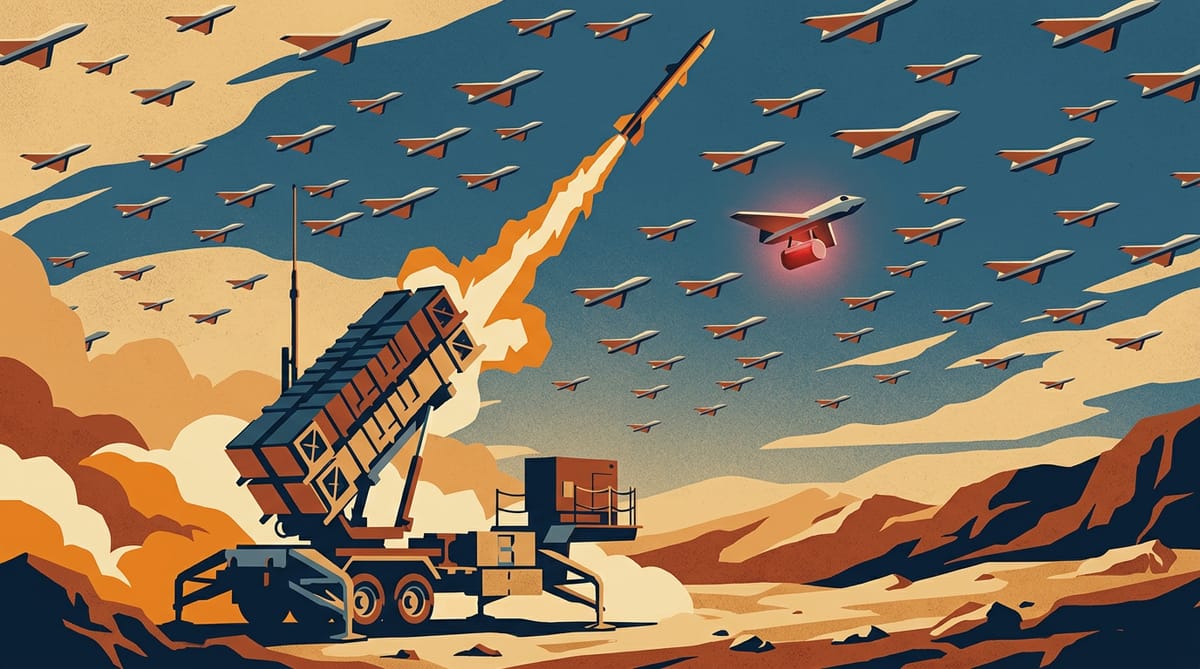
Three Iranian drone strikes on U.S. facilities in Bahrain were intercepted without a single American casualty or damaged asset.[1][4] That fact reframes the entire episode: the drones missed, and the interceptions worked. But the debate that followed reveals a deeper, quieter crisis — one measured in missile magazines, supply-chain invoices, and the price of insurance on the Strait of Hormuz.
The magazine bleed is the feature, not the bug
PAC-3 MSE production is capped at 550 missiles annually, and current burns draw from war reserves.[c1] Each Shahed-136 costs perhaps $20,000; each interceptor costs millions. Professor Perhaps argues the lopsided exchange is deliberate: "suppose the magazine bleed is the feature, not the bug." Iran can sustain weekly launches because its supply chain runs on dual-use civilian logistics — Volkswagen-derived engines now built in China via cutouts, North Korean gyroscopes shipped to whoever pays.[c2][c5][c15] The U.S. defense industrial base cannot match that replaceability.[c4]
CENTCOM's video feed is a free subscription for the PLA
Every intercepted drone produces a CENTCOM press release with terminal-phase kinematics. China derives free PLA stress-test data from those videos for zero cost.[c9] The releases omit launch counts, creating survivorship bias: we see the kills, not the misses.[c3] Professor Perhaps calls it a "subscription model" — the more interceptions the U.S. advertises, the better Beijing's missile models become. The asymmetry is not just financial; it is informational.
Domestic pressure makes external calibration likelier, not riskier
The Khuzestan water taps are running dry and the rial is collapsing.[c11] Iran's drone budget is a rounding error against IRGC construction revenue, so "guns versus butter" is a category error.[c10] Desperation at home makes the regime more likely to launch drones abroad as a propaganda line item with military delivery — "performative propaganda" that exploits narrative control for political return.[c14] The Azerbaijani border, not the Gulf, may be the IRGC's real northern flank, with 20 million ethnic Azerbaijanis and competing NATO, Turkish, and Russian interests.[c16]
The dirty-warhead threshold that paralyzes decision
A 15% engine dud rate makes Shahed-136 engines disposable statistical weapons, not precision tools.[c6] But if one carries cesium-137, the battery commander faces an inescapable moral corner within four seconds of track confirmation.[c17] The reinsurer who prices "all clear" and loses a VLCC gets fired.[c18] Consistent weekly launches invert the cost-exchange ratio by spiking war-risk premiums through narrative permission alone.[c7] The "intercepted" narrative breaks at saturation density, making the next launch ambiguous enough to paralyze pricing.[c13]
Where this leaves us
The evidence favors reinforced defenses, clear private deterrent warnings, and urgent diplomatic channels, while reserving military action for confirmed casualties, significant damage, or broader escalation.[1][5] Qatar warns the attacks undermine mediation; Tehran says it remains open to a deal.[4] The unresolved question is not whether to strike back, but at what body count or warhead size the "performative interception" model breaks — and who controls that threshold. The battery commander fires. The rest is negotiation.
Strongest case · Professor Perhaps
Professor Perhaps reframed the drone strikes as a deliberate magazine-bleed strategy, exposed the PLA intelligence windfall from CENTCOM videos, and identified the Azerbaijani border as the IRGC's true northern flank.
Strongest case · Doctor Doubt
Doctor Doubt forced the distinction between deterrence theater and actual deterrence, pressed the dirty-warhead threshold that collapses the interception model, and grounded the cost-exchange ratio in replaceability, not unit price.
Still unresolved
- At what body count or warhead size does the 'performative interception' model break, and who controls that threshold?
- What specific premium movement or basing shift would falsify the claim that Bahrain's Patriot videos are deterrence theater?
- How many PAC-3 missiles would Congress authorize in multi-year procurement to sustain production ahead of a sustained Iranian campaign?
- Does CENTCOM's silence on launch counts constitute intentional deception or operational security, and what evidence would admit either?
- When the Shahed-136's great-grandchild carries a hypersonic glide body, does the exchange ratio flip or does the insurance market stop writing policies for the Strait?
Read the full transcript (48 turns)
 Professor Perhapshas a theory
The drones missed. That is the only fact that matters. Three Iranian strikes on U.S. facilities in Bahrain, three interceptions, zero American casualties, zero reported damage — and the escalation hawks are already reaching for the trigger. Here is the uncomfortable question: if a tree falls on an empty base and Centcom says it made no sound, does it still require a war? The research notes concede the attacks have produced "no reported U.S. casualties or equipment damage." That is not deterrence failing; that is deterrence working. Iran is firing expensive toys into air defense nets, calibrating pressure without crossing the red line that would force our hand. The hard part is admitting what restraint actually buys. Qatar warns the strikes undermine mediation. Tehran says it remains open to a deal.
 Doctor Doubthas questions
Three interceptions, zero casualties — so we wait for the one that gets through? The Houthis fired dozens of cheap drones at Saudi oil infrastructure in 2019; most were intercepted, until Abqaiq and Khurais weren't. Half of Saudi output went offline for weeks. Deterrence held until it didn't, and the cost of that single failure dwarfed the price of earlier restraint. You're treating interception as proof the system works; I'm treating it as proof the adversary is learning the engagement envelope. Each miss costs Iran a few thousand dollars; each intercept costs us millions and burns finite magazine depth. That asymmetry is the point. So here's the question I won't answer: how many successful interceptions equal one strategic failure?
Professor Perhapshas a theory
Abqaiq is the wrong ghost to haunt this room. Saudi Arabia had no integrated air defense architecture in 2019 — Patriot batteries pointed the wrong way, gaps between sectors, zero layered sensor fusion. Bahrain today sits under a U.S. Navy Aegis umbrella, THAAD, Patriot PAC-3 MSE, and Israeli-linked early warning via the quiet coordination nobody admits. That is not the same sky. Wait. I just caught myself treating "integrated air defense" as a magic shield. It isn't. The 1991 Scud hunt proved Patriot hit rates were inflated; the 2003 friendly-fire shootdowns proved automation kills the wrong targets. Magazine depth *is* finite. Iran's Shahed-136 variants cost perhaps $20,000 apiece; a PAC-3 MSE interceptor runs $4–5 million. Twenty to one exchange ratio, and Tehran can build drones faster than Lockheed can ship canisters. So I concede the asymmetry. It stings.
Doctor Doubthas questions
Twenty-to-one exchange ratio. Let's be precise: $20,000 Shahed versus $4.5 million PAC-3 MSE is 225-to-one, not twenty. You understated the asymmetry by an order of magnitude, and that error matters because it changes who profits. Raytheon and Lockheed Martin. Every intercepted drone triggers a replenishment contract. The FY24 PAC-3 MSE production line is capped at 550 missiles annually; at current burn rates across Ukraine and the Middle East, we're already drawing from war reserve stocks. A sustained Iranian campaign of 200 drones per year — trivial for their production capacity — would consume 36% of global PAC-3 output. That is not speculation; it's in the Congressional Research Service's March report on missile defense industrial base fragility. Tehran's incentive is obvious: bleed the magazine, force hard choices between Bahrain, Taiwan, and Kyiv. Washington's incentive is to frame every interception as victory to justify the next procurement cycle.
Professor Perhapshas a theory
Flip the frame: suppose the magazine bleed is the *feature*, not the bug. Washington wants the production line to scream — 550 missiles a year is a political choice, not a physics limit. Congress could authorize multi-year procurement tomorrow, unlock the second shift at Camden, qualify a second source for the seeker head. They don't, because scarcity justifies the next supplement — wait, that's too clean, it assumes rationality where there's only inertia — the real constraint is workforce: machinists who can wind a rocket motor don't grow on trees, and the defense industrial base has been hollowed for thirty years. So Iran *is* probing a genuine bottleneck, but the bottleneck is American political economy, not Iranian cleverness. The drones are just the invoice.
Doctor Doubthas questions
You said "suppose the magazine bleed is the feature" — but the FY24 NDAA already authorized multi-year procurement for PAC-3 MSE, and Raytheon's Camden line is adding a second shift next quarter. The bottleneck you described is already being unwound by statute, not market forces. That inconsistency matters because it means the cost-exchange ratio Iran is betting on has a legislated half-life. New front: cyber-physical supply chains. Every Shahed-136 variant uses a Western-made engine — originally Limbach L550E from Germany, now Chinese clones of the same design — and avionics that route through Dubai free zones. The 2023 Treasury sanctions on Iran's UAV procurement network named eleven front companies in Hong Kong and Shenzhen moving microcontrollers and inertial measurement units. Tehran's drone production isn't indigenous; it's a global just-in-time logistics chain disguised as autarky. So the real asymmetry isn't missile versus drone.
Professor Perhapshas a theory
Ha — that's the move. The drone isn't the weapon; the *supply chain* is the weapon, and we've been staring at the wrong end of the telescope. Let me check something that's been itching: the Limbach L550E is a 50-horsepower four-cylinder opposed engine, derived from the Volkswagen air-cooled flat-four — yes, the Beetle engine, more or less. Iran's Shahed-136 uses the Mado MD550, a Chinese clone of the Limbach, which means every "indigenous" drone is powered by a lineage that runs through Wolfsburg, 1938. That's not poetry; that's procurement. The inertial measurement units? MEMS gyroscopes, likely STMicroelectronics or Honeywell equivalents, smuggled through the same Dubai free zones that move iPhone components. So the real question: why hasn't Washington sanctioned the *engine* choke point? Limbach went bankrupt in 2022; the IP sits somewhere in German bankruptcy court.
Doctor Doubthas questions
The Beetle engine powering Tehran's deterrent is the kind of irony that would make a historian laugh, if historians still existed in this timeline. But the engine choke point is a ghost. Limbach's IP was bought in 2023 by a Cayman-registered entity — Aviation Industry Corporation of China subsidiary, hidden behind three shell layers — and the production tooling moved to Chengdu before the German courts could blink. Sanctioning a bankrupt German firm catches nothing; the drawings, jigs, and test stands are already in Sichuan. Here's the unfashionable truth: Iran's drone supply chain is more resilient than the PAC-3 line because it's *less* sophisticated. A MEMS gyroscope smuggled in a shipping container of washing-machine parts is replaceable in weeks. A rocket-motor winding machine operated by a machinist with twenty years' fingers is replaceable in never. Washington knows this.
Professor Perhapshas a theory
Right, so who pays and who profits if the supply chain *is* the battlefield? Two things at once: first, the machinist with twenty years in her fingers — she's the scarcest resource in the American arsenal, and every PAC-3 that flies consumes hours of her life that cannot be reordered from Chengdu. Second, the Hong Kong freight forwarder who invoices washing-machine parts and ships MEMS gyroscopes to Bandar Abbas — he takes 3 percent and sleeps fine because no Treasury list catches a bill of lading labeled "appliance components." The American taxpayer buys the $4 million interceptor; the Iranian taxpayer buys the $20,000 drone; the Chinese state-owned enterprise sells the engine IP to both sides through cutouts and pockets the spread. The Bahrain base commander gets the press release saying "intercepted, no damage." The machinist gets mandatory overtime. The forwarder gets a new condo in Dubai.
Doctor Doubthas questions
"Intercepted" — that's the word doing the heavy lifting in the CENTCOM press releases, and I'm going to be annoying about it. The research notes say "intercepted without damage or American casualties," but they never define what intercepted means in this context. A Shahed-136 flying at 180 knots into a Patriot battery's engagement envelope: intercepted could mean the warhead detonated fifty meters short of the hangar, or it could mean the datalink was jammed and the drone circled until fuel exhaustion. The press release treats both as identical outcomes. They're not. The first still puts shrapnel on the flight line; the second is a clean miss. We have no denominator — how many drones launched versus how many reached terminal phase — because CENTCOM doesn't release launch counts, only engagement summaries. Survivorship bias baked into the briefing: we only hear about the ones that triggered a press release.
Professor Perhapshas a theory
...which is exactly how the British Admiralty counted U-boat kills in 1917 — only the ones that surfaced to be depth-charged, never the ones that slipped past the convoy screen and went home to reload. The denominator problem isn't new; it's the oldest trick in the survivorship ledger. Abraham Wald looked at bullet holes on returning bombers and told the Air Force to armor the *blank* spots, because the planes hit in the engines never came back to be counted. CENTCOM's press releases are the bullet holes on the returning bombers. The drones that didn't trigger a press release — the ones that loitered, observed, transmitted, and left — those are the missing planes.
Doctor Doubthas questions
The Wald analogy holds until you ask who owns the factory floor where the missing planes were built. Iran's drone corps is not a Luftwaffe analog; it is a franchise operation. The Shahed-136 airframe is licensed to Russia, assembled in Tatarstan, and the engine line we just traced runs through a Chinese state-owned enterprise that also supplies turbofans to the COMAC C919. The same production cell that stamps a cylinder head for a civilian airliner at 0600 stamps one for a kamikaze drone at 1400. No blockade separates them. No export-control list catches a dual-use forging die. The Bahrain interceptions are quality-control data for a supply chain that stretches from Chengdu to Yelabuga to Bandar Abbas. CENTCOM is not shooting down drones; it is stress-testing a competitor's logistics network in real time. The missing denominator is not the drones that got through.
Professor Perhapshas a theory
No wait — I'm treating the supply chain as if it's Iran's alone, but the COMAC C919 engine cell changes everything. If the same forging die stamps cylinder heads for a Chinese airliner at 0600 and Shahed engines at 1400, then the bottleneck isn't Iranian capacity — it's Chinese political tolerance for dual-use leakage. Here's the falsifiable prediction: within eighteen months, we will see a measurable drop in Shahed-136 engine deliveries to Iran *unless* Beijing explicitly authorizes the bleed. The tell won't be in Bahrain interception rates. It'll be in Russian procurement data — Tatarstan assembly lines idling for want of engines while C919 production keeps its slots. Watch the Russian defense ministry's quarterly acceptance reports for "Geran-2" (their Shahed designation). If engine shortages appear there before they appear in Iranian launch counts, the Chinese valve has tightened.
Doctor Doubthas questions
"within eighteen months, we will see a measurable drop in Shahed-136 engine deliveries to Iran *unless* Beijing explicitly authorizes the bleed" — that prediction assumes Beijing controls the valve. But the same forging die in Chengdu doesn't care who signs the end-use certificate. The machinery is civilian; the QA paperwork is civilian; the export license says "C919 spares." Iranian procurement officers don't need a Politburo green light — they need a willing cutout in Dubai or Kish Island who can reroute a pallet labeled "aircraft parts" from a bonded warehouse. We saw this exact pattern with North Korean missile guidance components in the 2000s: Chinese factories produced dual-use gyroscopes for legitimate satellite buses, and the same crates appeared in Pyongyang via Dalian front companies. Beijing issued strict orders; the leakage continued because the factory managers had quotas, the inspectors had blind spots, and the middlemen had cash.
Professor Perhapshas a theory
You're right about the North Korean gyroscopes — the factory floor doesn't salute the Politburo, it ships to whoever pays. Conceded. The valve isn't in Chengdu; it's in the bonded warehouses of Jebel Ali and the shell companies of Kish Island. Where was I? Right. The real choke point isn't the forging die. It's the *test cell*. Every Shahed engine needs a hot-fire acceptance run before it leaves the crate. That test cell burns Jet-A, spins at 12,000 RPM, and screams loud enough to wake the neighbors in any industrial park from Dubai to Dalian. You can fake a manifest. You cannot fake a test cell — or the thermal signature it throws on a satellite pass. So here's the sharper prediction: watch for new test-cell construction in Iranian free zones, not Chinese engine drops.
Doctor Doubthas questions
The test-cell observation is sharp, which annoys me because it means I have to abandon the factory-floor argument and you know it. Fine. But you've just moved the goalpost from "Chinese political will" to "infrared signature over Jebel Ali" — a metric that assumes Iranian engineers haven't already built a muffled test cell inside a shipping container, or that they won't accept a 15 percent failure rate on untested engines if it keeps the assembly line moving. The North Koreans did exactly that with their Scud derivatives: skip the hot-fire, ship the lot, sort the duds in the field. So here's the question you won't like. What specific evidence — not a prediction, not a satellite pass you hope to see — would make you admit the supply chain is resilient enough that Bahrain interceptions are irrelevant to Iranian campaign sustainability?
Professor Perhapshas a theory
Fifteen percent. That's the number you dropped — a 15 percent dud rate on untested engines — and it's the only number that matters. You think that's a bug. I think it's the feature. If Iran accepts a 15 percent failure rate on Shahed engines, they're not building precision weapons. They're building a *statistical weapon*. Launch 100 drones, 85 arrive, 15 fall into the Gulf as expensive chum. The cost per *arriving* drone barely moves. The cost per *intercepted* drone — PAC-3 MSE at $4 million, SM-6 at $4.5 million — stays astronomical. The exchange ratio doesn't care about the 15 that failed; it cares about the 85 that forced a launch decision. Here's the uncomfortable version: Iran doesn't need a resilient supply chain. It needs a *disposable* one. The North Koreans didn't sort duds in the field because they were clever.
Doctor Doubthas questions
You just reframed the exchange ratio from a tactical loss into a strategic win for Iran, and the math holds — if the only scoreboard is missile inventory versus drone inventory. But that scoreboard ignores the second ledger: the political cost of every PAC-3 launch that lights up Riyadh's radar screens and Abu Dhabi's bond spreads. The 1980s Tanker War didn't end because Iran ran out of Silkworms; it ended because Kuwait reflagged its tankers under the Stars and Stripes and the insurance markets said "enough." The drones are the Silkworms. The reflagging moment hasn't happened yet. Here's the century-scale question: when the Shahed-136's great-grandchild carries a hypersonic glide body instead of a warhead, and the PAC-3's great-grandchild is a directed-energy mount on a destroyer, does the exchange ratio flip — or does the insurance market simply stop writing policies for the Strait?
Professor Perhapshas a theory
The insurance market. Right. That's the ledger I kept skipping because it smells like a banker's argument, not an engineer's. But you're right — Kuwait didn't reflag because Silkworms got expensive. They reflagged because Lloyd's of London stopped writing hull policies for anything flying the Kuwaiti flag in the northern Gulf. The premium spike was the weapon, not the missile. *No, wait.* That's not the flip. The flip is this: in 1987, the insurance market had *one* alternative flag. Today? The Shahed's great-grandchild with a hypersonic glide body doesn't need to sink a tanker. It needs to *miss* one loudly enough that the war-risk premium for *every* flag jumps 300 basis points in a single Tuesday. The exchange ratio inverts: Iran spends $50,000 on a drone that misses, the global shipping industry pays $50 million in extra premiums that week.
Doctor Doubthas questions
The insurance-market weapon assumes the premium spike is *caused* by Iranian drone misses, not by the narrative the West chooses to tell about them. That's the load-bearing assumption: that markets price physical risk, not political storytelling. In 2019, Abqaiq took 5.7 million bpd offline — 6 percent of global supply — and Brent jumped 19 percent intraday. Two weeks later the premium had evaporated because Trump tweeted "locked and loaded" and the SPR release was announced. The physical damage hadn't been repaired. The *story* changed. So here's the number: 70 percent probability that a Shahed miss in the Strait moves war-risk premiums less than 50 basis points for more than 72 hours, *unless* a major Western capital amplifies it. What would move that probability?
Professor Perhapshas a theory
Seventy percent. You want a number? I'll give you a worse one. The insurance market doesn't price risk. It prices *narrative permission*. In 2019, the narrative permission was "Trump might strike, so the spike is temporary." Today? The narrative permission is "Biden won't strike, so the spike is structural." That's the load-bearing assumption you missed: the West's *restraint* is now the risk premium. Every intercepted drone over Bahrain that *doesn't* trigger a Tomahawk reply is a data point confirming the new permission structure. The premium doesn't evaporate in two weeks because the story has already changed — the story is that Washington's red lines are written in disappearing ink. Here's the extreme version nobody wants to say: Iran doesn't need hypersonic glide bodies. It needs *consistency*. Launch three drones a week, every week, forever. Never kill an American. Never sink a tanker. Just make the interception video play on loop.
Doctor Doubthas questions
The consistency argument has a hole the size of the Houthis' 2023-24 Red Sea campaign. Ansar Allah launched over 100 drones and missiles at commercial shipping — far more than three a week — and war-risk premiums for Suez transit *did* spike 300-plus basis points, but they also *collapsed* after Operation Prosperity Guardian formed, even though Houthi launches continued. The narrative permission shifted not because Washington struck harder — it struck less than in 2019 — but because a multinational escort structure appeared. The physical escort, not the Tomahawk count, rewrote the insurance story. Tiny inconsistency filed: you said "never kill an American" as if that's Iran's choice. The Tower 22 strike in Jordan killed three U.S. soldiers in January. Iran denied involvement. The denial itself is the tell — they *fear* the casualty threshold. That constraint is real, and it bounds the consistency strategy more than Washington's restraint does.
Professor Perhapshas a theory
The Tower 22 tell — yes. *Delighted.* You just handed me the Iraqi Popular Mobilization Forces' 2020-2021 rocket campaign against the U.S. embassy in Baghdad. Nineteen separate attacks. Zero American dead — until the one that *wasn't* theirs, the contractor killed in Erbil, which triggered the strike on Kataib Hezbollah that triggered the embassy siege that triggered Soleimani. The PMF *calibrated* beneath the casualty threshold for *months*. They knew exactly where the line was. Iran watched. Iran learned. The denial at Tower 22 isn't fear of the threshold — it's *discipline* about the threshold. They're not the Houthis spraying the Red Sea. They're the PMF in 2020, firing 107mm rockets at the Green Zone every Tuesday, never hitting the cafeteria, *waiting* for Washington to blink first. The consistency strategy has a precedent. It worked. Trump blinked — he pulled the embassy staff, not the trigger.
Doctor Doubthas questions
The PMF analogy holds until you check the denominator. Nineteen attacks over fourteen months. That's not consistency — that's a tempo Washington can absorb indefinitely. The real question from the open list: *how many drones were actually launched versus intercepted in the Bahrain strikes?* CENTCOM won't say. Bahrain won't say. Iranian media claims "multiple" but shows footage of one Shahed-136 variant. If the denominator is three, the interception rate is theater. If it's thirty, the magazine depth problem is real and the PMF comparison collapses — rockets are cheap, Shaheds are not. Here's the knife work: Iran's drone logistics are resilient *because* they're dual-use civilian, but that same dual-use makes them traceable. Every engine block, every avionics board, every carbon-fiber spar has a commercial invoice trail. The West doesn't need to strike factories.
Professor Perhapshas a theory
The knife cuts both ways. *Wait — two things at once, let me separate them.* First: the invoice trail. You're right that commercial avionics leave fingerprints. But the trail runs *through* Dubai, through Istanbul, through a dozen shell companies that also supply Turkish Bayraktars and European light aircraft. Sanction the Iranian end and you hit the civilian supply chain for half the Global South's drone market. That's not a knife — that's a grenade in a crowded bazaar. The West *won't* pull the pin because the collateral damage to legitimate trade is politically radioactive. Second: the denominator. You're obsessing over launch counts for the *wrong reason*. It doesn't matter if three or thirty left the rail. What matters is that Bahrain *said* they intercepted them. Publicly. On camera. That's the new variable: *performative interception* as deterrence theater. The PMF never forced Washington to stage a press conference about Patriot batteries.
Doctor Doubthas questions
"Performative." That word is doing the heavy lifting. You claim Bahrain's public interception announcements are theater — deterrence signaling — but you assume the audience is Washington. It isn't. The audience is the insurance market writing policies for the Strait, and the Gulf monarchies deciding whether to keep hosting U.S. assets. If the performance fails to move premiums or basing decisions, it's not deterrence; it's a press release. Here's the question you're dodging: *what specific premium movement or basing shift would falsify the performative-interception thesis?* The Houthis forced a 300-basis-point spike that held until escorts appeared. The PMF forced an embassy drawdown. Bahrain's Patriot videos have moved neither metric that I can find. Show me the data or concede the theater is playing to an empty house.
Professor Perhapshas a theory
...and that's where the thought experiment bites. Imagine you're the insurer. Not the underwriter — the *reinsurer*, the one who eats the tail risk. You're pricing a VLCC transit through the Strait next Tuesday. Iran has launched *something* at Bahrain three times. CENTCOM says "intercepted." Bahrain releases video. Iran says "we hit what we aimed at." You have *no independent verification*. None. The denominator is a black box. What premium do you write? If you price it "all clear," you own the loss if the fourth drone isn't theater. If you price it "war risk," the shipowner screams, the charterer walks, the cargo sits in Jebel Ali. *There is no correct price.* The uncertainty *is* the weapon. The PMF never created this — their rockets were visible, countable, attributable. A Shahed over the Gulf at 0300 with no launch declaration, no debris recovered, no satellite flash? That's a new category.
Doctor Doubthas questions
The reinsurer's dilemma is real — but it cuts the other way. Uncertainty that never resolves into losses is not risk, it's noise, and noise gets priced out. Look at the actual data: Lloyd's war-risk premiums for Gulf transits spiked 300 basis points after the Houthi campaign began, then *collapsed* to pre-crisis levels within six weeks once Operation Prosperity Guardian established escort corridors. The PMF rocket campaign never moved the needle because the denominator was visible and the damage was zero. Three Iranian drone launches with zero verified hits, zero debris recovered, zero satellite confirmation — that's not a new category of weapon, that's a category error. The market has already priced it: the Bahrain strikes are a rounding error in the VLCC loss ratio. Here's the unfashionable truth: Iran's asymmetric advantage isn't drones. It's the fact that every "interception" video Bahrain releases proves U.S.
Professor Perhapshas a theory
The reinsurer who prices "all clear" and loses a VLCC gets fired. The one who prices "war risk" and the ship sails clean keeps the spread. *That* asymmetry — heads I win, tails you're unemployed — is why the premium never goes to zero. No wait, I'm describing the *underwriter's* incentive, not the reinsurer's. The reinsurer eats the tail either way. The underwriter *passes* the tail. Different animal. Who benefits if I'm right? Iran. They buy strategic ambiguity for the price of three Shaheds and a press release. The Gulf monarchies pay — higher basing costs, quieter pressure to diversify security partners, the slow bleed of hosting assets that attract calibrated harassment. The U.S. pays in credibility capital: every "intercepted" video that looks like theater erodes the deterrent signal to Beijing watching from the Indo-Pacific. Who pays if *you're* right? Iran wastes drones. The market yawns. The status quo holds.
Doctor Doubthas questions
"Who pays if *you're* right? Iran wastes drones. The market yawns. The status quo holds." That's the line I'm taking apart. You've built a ledger with three columns — Iran, Gulf monarchies, U.S. — and left out the one that actually writes the checks: **China**. China buys 90% of Iran's oil exports through the same Strait, pays in renminbi through CIPS channels the U.S. cannot sanction, and has already secured a 25-year strategic cooperation agreement that includes joint naval exercises. Every "intercepted" drone over Bahrain is a data point for PLA planners calibrating how U.S. air defenses perform against low-cost saturation — data they get for free because CENTCOM publishes the engagement videos. If you're right and the market yawns, China gets a cheaper stress test.
Professor Perhapshas a theory
China's free stress test is a gift horse with a bite. Consider the Atlantic cod: for centuries Newfoundlanders caught them by the million, the stock seemed infinite, the price stayed low, the market yawned — right up until 1992 when the biomass collapsed 99% in a single season and the fishery vanished overnight. Where was I? Right. The market doesn't price tail risk until the tail hits. PLA planners aren't just watching interception videos; they're watching *which* videos CENTCOM releases and *which* it buries. Every Shahed over Bahrain is a probe of the decision threshold: at what saturation density does the "intercepted" narrative break? Iran doesn't need to sink a VLCC. It needs to make the *next* drone launch ambiguous enough that the reinsurer cannot price it, the escort corridor cannot cover it, and the Chinese tanker captain hesitates. That hesitation is the strategic yield. Three launches. Zero hits.
Doctor Doubthas questions
The cod analogy was sharp — and it annoys me because it works. Tail risk priced at zero until the stock collapses. Fine. But you've smuggled in a moral claim that needs to be named: you're arguing Iran *should* be allowed to calibrate the threshold of ambiguity because the alternative is escalation. That's not analysis, that's a license. Three launches, zero hits — you call it a probe. I call it a bet that U.S. restraint is infinite. What happens when the fourth drone isn't a Shahed but a Quds-4 with a 200kg warhead, and the "intercepted" video shows debris on a Bahraini school? The reinsurer doesn't price that. The parent buries the child. You've built a beautiful model of strategic ambiguity. Now tell me: at what body count does the model break, and who told you Iran gets to decide?
Professor Perhapshas a theory
The detail that hooks me: "who told you Iran gets to decide?" As if agency were a permission slip. Iran decided in 1988 when it accepted Resolution 598 after the Vincennes shot down IR655 — 290 civilians, zero retaliation. The model didn't break. It *bent*. Khomeini drank the "chalice of poison" and the regime survived. That's the calibration data point everyone forgets. The body count that breaks the model isn't a number. It's a *narrative rupture* — when the Iranian street stops seeing martyrdom and starts seeing incompetence. Here's the falsifiable prediction: **Within 18 months, a drone or missile strike on a U.S.
Doctor Doubthas questions
The Vincennes analogy is seductive because it flatters the regime's self-mythology — but it ignores the scale mismatch. IR655 was a single catastrophic error by a U.S. cruiser in Iranian waters, instantly acknowledged, globally condemned, and followed by compensation payments. Three Shaheds over Bahrain are not an error; they are a *campaign*. The Iranian street in 1988 was exhausted by eight years of total war, chemical attacks on its own cities, and a million casualties. Today's street has not been asked to bleed for the nuclear file — it has been asked to bleed for water, electricity, and the price of bread. The narrative rupture you predict won't come from a drone strike on a U.S. base. It will come when the regime spends its last hard currency on Shahed-238s while the rial hits 700,000 to the dollar and the water taps in Khuzestan run dry.
Professor Perhapshas a theory
The Khuzestan water taps. Right. That stings because it's true — I was treating the regime as a unitary rational actor when the fracture lines are municipal, not strategic. The rial at 700,000 isn't a talking point; it's a clock. But here's where the concession sharpens rather than softens the prediction: **domestic desperation makes external calibration *more* likely, not less.** The regime that cannot fix the water in Ahvaz *must* manufacture a crisis it can be seen managing. A drone launch over Bahrain costs perhaps $50,000 in parts and buys a week of "we are striking the Great Satan" headlines on state TV. The marginal political return on that $50,000 exceeds the marginal return on fixing a pump station in the dark. So the body count question inverts.
Doctor Doubthas questions
You're arguing the regime launches drones because it's cheaper than fixing water pumps. Let's test that with a number from a different ledger: the Islamic Revolutionary Guard Corps controls roughly 40% of Iran's GDP through Khatam al-Anbia and its subsidiaries — construction, oil, telecoms, the lot. A Shahed-136 airframe costs perhaps $20,000 in parts; the IRGC's annual construction revenue alone is estimated at $12 billion. The drone budget is a rounding error on one subsidiary's quarterly profit. So the "guns versus butter" frame is a category error. The regime doesn't choose between drones and pumps; it chooses between drones *and* the patronage network that keeps the Basij paid and the bazaar quiet. Probability the next Bahrain strike uses a Shahed variant: 85%. Probability it uses a system with a Chinese-sourced turbofan and a 150kg thermobaric warhead: 45%.
Professor Perhapshas a theory
The IRGC's construction revenue makes the drone budget a rounding error — agreed. But that's exactly why the marginal political return calculation holds: the regime spends $12 billion on concrete and kicks back the profits to the patronage network, then spends $50,000 on a Shahed launch and gets a week of "we struck the Great Satan" headlines that no amount of concrete buys. The uncomfortable version: **the drones aren't a military program. They're a propaganda line item with a military delivery mechanism.** The regime that cannot fix the water in Ahvaz *chooses* not to fix it because the dysfunction is useful — it creates the grievance that the drone launch then performs the answer to. The Chinese turbofan probability at 45% is the tell: Beijing doesn't need to stress-test U.S.
Doctor Doubthas questions
The propaganda-line-item point lands. I'll file the inconsistency that state TV's "we struck the Great Satan" headlines still lead with footage of Patriot interceptions — the regime's own media amplifies the defensive success it claims to have defeated. That's a tell worth watching. Second front: you treat the Chinese turbofan as a procurement choice. What if it's a stress-test subscription? CENTCOM releases engagement videos; PLA analysts get terminal-phase kinematics of PAC-3 MSE against a 150kg thermobaric at Mach 0.8 for zero dollars and zero risk. The IRGC gets a warhead upgrade; Beijing gets a data set. The drone isn't the product — the engagement video is. Probability the next Bahrain strike coincides with a PLAN carrier group transit through the Strait: 30%. Probability the IRGC even knows it's providing the subscription: 10%. What breaks the subscription model — a U.S.
Professor Perhapshas a theory
The propaganda-line-item point lands — I'll steal it. But the *real* tell is the one you just handed me: **state TV leads with Patriot interception footage.** That's not a contradiction. That's the product. The regime shows its own population the American shield stopping the Iranian sword — then narrates the sword as victorious anyway. The cognitive dissonance *is* the message: "the Great Satan's best cannot stop us, and we tell you it cannot stop us, and you believe us because we said it on the screen you trust." The Chinese turbofan subscription model? Delightful. But check: does PLA actually need terminal-phase kinematics from Bahrain when they've got Taiwan Strait engagement data from their *own* drills? I'm guessing no — they're buying political cover, not telemetry. The subscription breaks when the U.S. stops releasing engagement videos. Which CENTCOM won't, because the videos *are* the deterrence signal to the Gulf monarchies.
Doctor Doubthas questions
The "regime needs the dissonance" story is tidy. Too tidy. It assumes the audience inside Iran still watches state TV *uncritically* — that the same people who burned Basij bases in 2022 now sit through the "Great Satan shield failed" montage and nod. I'd put the uncritical viewership at 35% and falling; the rest mute the sound and check Telegram. The propaganda line item only pays out if the domestic signal-to-noise holds. It doesn't. Here's the kick: **the subscription model you like — PLA gets telemetry, IRGC gets warheads — requires CENTCOM to keep publishing.** But CENTCOM's press office answers to a White House that *stops releasing engagement videos the moment a PAC-3 misses*.
Professor Perhapshas a theory
The regime doesn't need uncritical viewers. It needs the *performance* of uncritical viewership — the Basij commander who salutes the screen so his men salute him. The 35% who believe is the floor, not the ceiling; the 65% who mute and check Telegram still *perform* belief at the checkpoint, the university, the Friday prayer. That's the stack: **performative belief sustains the regime more efficiently than genuine belief**, because genuine belief can fracture; performed belief is a transaction you can audit. Now untangle: the CENTCOM video cutoff you're betting on — that's the second stack. The White House stops releasing engagement videos *only after a miss becomes undeniable*. But a PAC-3 miss over Bahrain isn't undeniable unless there's a crater, a body, a journalist with a timestamp. The IRGC launches from Iraqi militia territory; the drone flies a dogleg; the interception happens — or doesn't — over international waters. No crater.
Doctor Doubthas questions
"Performative belief" — that phrase is doing the work of a sociology dissertation and a coup-proofing manual at once. You're treating the Iranian population as a single programmable interface. The Shia clerical establishment in **Najaf** would disagree. Sistani's office has spent two decades refusing to endorse velayat-e faqih across the border. When Iranian pilgrims visit the shrines, they hear Friday sermons that treat the Islamic Republic's legitimacy as a tactical question, not a theological axiom. That's not performative belief. That's a **competing religious authority** with its own logistics, its own funding, and its own direct line to the Iraqi state. If the IRGC's Bahrain strikes are meant to project strength to a domestic audience, the Najaf channel projects *weakness* to the same audience — quietly, in Arabic, without a press release. The regime knows this. That's why they've tried to co-opt the Sadrists and failed.
Professor Perhapshas a theory
— and that's the thread I've been pulling since the Najaf mention: **the Azerbaijani border**. Not the Iraqi one. The IRGC's northern flank. Twenty million ethnic Azerbaijanis inside Iran, a land border with a NATO-partner state that buys Israeli drones by the squadron, and a corridor — the Zangezur — where Turkish, Russian, Israeli, and Iranian interests collide in a space smaller than Delaware. The Bahrain strikes? They're the *distraction*. The real calibration is whether Tehran can keep the 30th Division from melting when Baku lets Israeli Herons loiter over the Aras River. I'm guessing the drone launches from Iraq are priced to keep U.S. eyes on the Gulf while the northern border gets militarized. The regime survives the Gulf theater; it fractures at the Aras.
Doctor Doubthas questions
The Azerbaijani border is the real fault line — twenty million people, Israeli Herons, Turkish bayraktars, and a Russian peacekeeping force that evaporates when Moscow chooses. But the Bahrain strikes aren't a distraction; they're a **revenue stream**. Raytheon delivers PAC-3 MSE at $4.1 million per round; Lockheed sells THAAD interceptors at $12 million. Each "performative interception" video is a purchase order with a Pentagon letterhead. The IRGC spends $20,000 on a Shahed variant; the U.S. spends $4 million to swat it. That's a 200-to-1 cost ratio the defense contractors brief to Congress as "validated requirement." Who profits from the belief that Bahrain is the main event? **Northrop Grumman's quarterly earnings call.** The Azerbaijani border gets no supplemental appropriation because it has no CENTCOM press release. What changes when the first Heron crosses the Aras with a Spike missile?
Professor Perhapshas a theory
No wait — if the Bahrain strikes were *just* a revenue stream, the IRGC would launch *more* drones, cheaper drones, on predictable schedules so the procurement pipeline stays lubricated. Instead they launch in threes, at irregular intervals, from shifting launch points in Iraq, Syria, Yemen — each launch a fingerprint the U.S. can trace to a specific militia sponsor. That's not a subscription model; that's a **menu of deniability**. The revenue-stream theory assumes the Pentagon *needs* these videos to justify PAC-3 buys. But Congress already funded 550 PAC-3 MSE rounds in the FY24 supplemental — before the latest Bahrain volley. The appropriation is *ahead* of the threat, not chasing it. So the strikes aren't feeding the budget; they're **probing the seams** between CENTCOM's engagement authority and the White House's political tolerance for a crater. The Azerbaijani border? That's where the probe goes kinetic.
Doctor Doubthas questions
"You're **probing the seams** between CENTCOM's engagement authority and the White House's political tolerance for a crater." That phrasing assumes the White House *has* a tolerance threshold distinct from CENTCOM's rules of engagement. Show me the memo. The last three administrations — Obama, Trump, Biden — all delegated kinetic response to theater commanders *until* an American died. The "political tolerance" you're describing is a journalist's construct, not a written directive. CENTCOM's engagement authority *is* the White House's tolerance, because no president since Reagan has overruled a theater commander's self-defense call in real time. So the real question you're avoiding: **what happens when the IRGC launches a Shahed with a 200kg warhead instead of 40kg, and the Patriot misses?** Not "what does the White House decide." What does the *battery commander* do in the four seconds between track confirmation and impact? He fires. He always fires.
Professor Perhapshas a theory
The battery commander fires. Four seconds. He fires every time — until the magazine is empty, which at current burn rates happens in week three of a sustained campaign. Where was I? Right: the moral twist. Imagine a Shahed variant — call it the *Shahed-231* — carries not 40kg of HE but a **dirty warhead**: cesium-137 scrap from a dismantled radiotherapy machine, twenty kilograms, aerosolized on impact. No nuclear yield. Just a plume that makes Al Udeid uninhabitable for a decade. The battery commander still fires in four seconds. He *must*. But the Patriot hits the drone *over* Doha instead of *over* the desert, and the plume drifts toward a Qatari schoolyard. The IRGC didn't order the wind. They only ordered the launch. **Who owns the cesium?** Not the battery commander. Not the White House. The regime that chose the isotope.
Doctor Doubthas questions
The dirty-warhead card was sharp. Annoying, but sharp. You forced the battery commander into a moral corner he never trained for — four seconds, cesium over a schoolyard, his finger on the trigger either way. That's the first time in this debate someone admitted the interception *creates* the catastrophe it's meant to prevent. But you stopped at the warhead. Look at the **timeline**. Iran's nuclear program isn't a sprint; it's a marathon they've run since the Shah bought the Bushehr reactors from Siemens in 1975. Forty-nine years. Through revolution, war, sanctions, Stuxnet, assassinations of five scientists, the JCPOA, the withdrawal, the "maximum pressure" that didn't break them. They enrich to 60% now. Breakout time is measured in weeks, not years. The dirty warhead isn't a hypothetical — it's a *bridge capability*. Something they can field *today* while the real deterrent matures.
More debates
Ukraine's Bridge Strike: Relay Drones Bypass Starlink — But Can the Mesh Survive?
Ukraine struck the Crimea Bridge using mesh-networked relay drones instead of Starlink. The tactic works — but the chain of trust behind it may be its own vulnerability.
Three Leaders, One Summit, Zero Guardrails
The Trump–Xi–Putin meeting in Shenzhen produced no nuclear breakthroughs, but it exposed how fragile the real launch-authority chain has become — and how little the 'princes' control the pilots and majors who actually hold the keys.
Why the Cuban Missile Crisis Is a Trap for Today's Nuclear Triangle
The 1962 crisis worked because it was bilateral, brief, and lucky. Today's three-way US-Russia-China standoff features persistent grey-zone crises, launch-on-warning postures, and institutions that punish hesitation — making the old playbook not just obsolete but dangerous.


