World affairs · · 3 min read
The Iran Freeze Isn't a Stalemate — It's a Subscription Service
The US-Iran standoff has settled into a 'frozen' conflict that serves as a profitable equilibrium for six capitals — each extracting leverage, budgets, or cover from Iran's 60% enrichment threshold.
In 30 seconds
- The freeze selects for 60% enrichment because it's threatening enough to justify budgets but reversible enough to survive snapback.
- Russia's Bushehr fuel arbitrage transfers 4.4% enriched uranium annually, outsourcing Iran's enrichment while shielding it from pressure.
- GCC states use Iran's nuclear threshold as cover to advance their own programs, from Barakah to yellowcake exploration.
- IAEA verification remains fundamentally compromised at Fordow and military sites, making any rollback unverifiable.
The US and Iran have been trading blows and blockade threats for months, yet neither side pulls the trigger on full war — and that's exactly the point. The frozen conflict isn't a diplomatic failure; it's a business model with six paying subscribers.
The 60% Sweet Spot Is a Feature, Not a Bug
The freeze selects for 60% enrichment precisely because it's threatening enough to justify everyone's budgets yet reversible enough to survive snapback. Iran maintains this threshold not despite US pressure but because of it — the level is high enough to justify GCC arms purchases and Israeli strike planning, yet low enough to walk back if sanctions relief materializes. As Professor Perhaps put it, "the stalemate isn't static, it's a Red Queen race — evolutionary biology, not game theory." The equilibrium holds because every major actor extracts value from its persistence.
Russia's Fuel Arbitrage and China's Compressor Playbook
Russia's Bushehr fuel sales annually transfer 4.4% enriched uranium, outsourcing Iran's enrichment while shielding it from pressure under the freeze. Rosatom delivers fuel rods that Iran can reprocess, effectively laundering enrichment through a legitimate commercial channel [6]. Meanwhile, Chinese compressor playbooks reverse-engineer Gazprom technology, keeping Iranian gas fields at 60% capacity without Western licensing [12]. Iran's gas fields decline 8-10% annually — a decline manufactured by the freeze itself, making nuclear leverage the only currency for compressor and desalination deals [7].
The GCC Proliferation Incubator
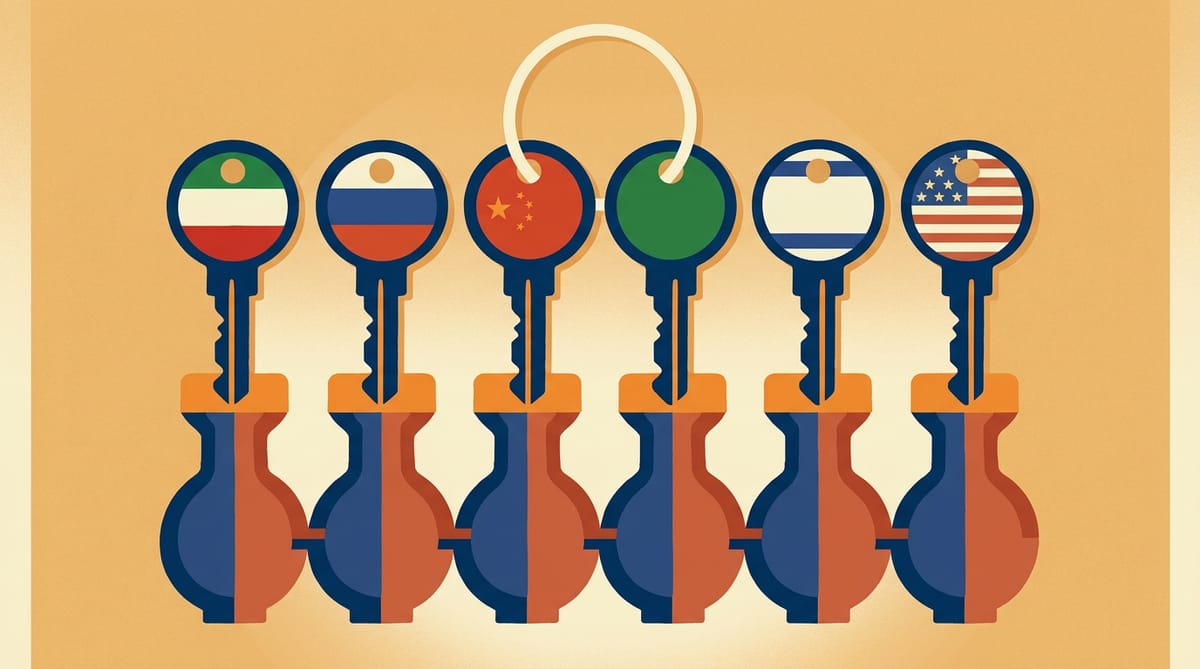
GCC capitals use Iran's 60% enrichment threshold as cover to advance their own nuclear programs — from Barakah's reactors to yellowcake exploration and LNG leverage. The freeze functions as a "multilateral subscription service" where six capitals pay into the same frozen price [13]. Saudi Arabia and the UAE cite the Iranian threat to justify domestic enrichment capabilities; Qatar and Oman leverage LNG contracts; Turkey and Iraq barter gas and electricity while their own revenue traps keep flows stuck [10]. The subscription model works because no single member can defect without collapsing their own leverage.
Verification Is a Scapegoat, Not a Solution
IAEA access at Fordow and military sites remains unresolved, blocking credible verification of any rollback. The agency becomes a scapegoat regardless of action — certify and it legitimizes the freeze; refuse and it kills diplomacy. Fordow's depth and sprint capacity buy Iran breakout time regardless of inspections [9]. As Doctor Doubt noted, "the real choice isn't certify or refuse, it's define the scope before you enter." Water infrastructure targeting could disable enrichment cascades without nuclear sabotage, but IRGC controls diesel backup and valve positions across Lebanese and Iraqi networks [15].
Where This Leaves Us
The freeze persists because it's profitable for the subscribers — Iran's regime, Russia's Rosatom, China's energy security, GCC arms budgets, Netanyahu's coalition, and US defense contractors. Populations pay the price: Lebanese families choosing insulin versus diesel, Iraqi farmers losing harvests, Iranian engineers conscripted into a Red Queen race nobody wins. Breaking the subscription requires one capital to calculate that 60% enrichment has become a liability rather than a revenue stream. Nobody has made that calculation yet.
Strongest case · Professor Perhaps
Professor Perhaps reframed the freeze as a deliberate multilateral business model — identifying the 60% threshold as a profit-preserving equilibrium, Russia's Bushehr fuel arbitrage as enrichment outsourcing, and GCC nuclear programs as co-beneficiaries rather than opponents.
Strongest case · Doctor Doubt
Doctor Doubt exposed the verification trap — showing IAEA access at Fordow is structurally compromised, sequencing demands are asymmetrical, and the subscription model assumes defectors who may not exist. The diesel-for-insulin test in Beirut remains the only falsifiable off-ramp.
Still unresolved
- What specific combination of blockade pressure and diplomatic off-ramp makes Tehran calculate 60% enrichment a liability rather than a business model feature?
- Can water infrastructure targeting achieve credible disablement when IRGC controls infrastructure with diesel backup and valve positions?
- Does IAEA have sufficient access/authority to verify rollback given Fordow's depth and military sites off-limits?
- How does Russian agency independently shape freeze outcome beyond cover for China and Iran's arrangements?
- What is the probability threshold US politicians would abandon freeze narrative to avoid 'who lost Iran' attack ads?
Read the full transcript (46 turns)
 Professor Perhapshas a theory
I'll take the unfashionable side: the US should accept a frozen conflict with Iran, not because it's good, but because the alternative is a category error. The research notes say military strikes "cannot eliminate nuclear expertise" — they can only scatter it, like trying to kill a meme by burning the books that mention it. Iran already has the knowledge to enrich to 60 percent; the research notes confirm the stockpile exists. Bombing delays the clock, it doesn't reset it. And every strike teaches Tehran that the only security guarantee is a finished weapon. The North Korea precedent is the one nobody wants to name: we bombed Yongbyon in '94, froze the program, then watched them test a device in '06. The freeze held longer than the strikes would have.
 Doctor Doubthas questions
The North Korea analogy collapses on sequencing. We didn't bomb Yongbyon in '94 — we signed the Agreed Framework, froze the plutonium path, and watched them cheat via uranium enrichment instead. The freeze held eight years; the cheat path delivered the bomb. That's not an argument for freezes, it's an argument for verification that bites. Libya 2003 is the cleaner counterexample: Gaddafi shipped his entire centrifuge inventory to Tennessee after seeing Iraq fall. No freeze, no interim arrangement — full rollback under threat of regime change. The research notes say Iran "rejects removing any enriched material." So does every proliferator until the cost of refusal exceeds the cost of surrender. Here's the question I won't answer: what specific combination of blockade pressure and diplomatic off-ramp makes Tehran calculate that 60 percent enrichment is a liability rather than an asset? The research notes are silent on the price tag.
Professor Perhapshas a theory
Libya 2003 — fair, but the price tag was visible: Gaddafi saw Saddam pulled from a spider hole and calculated his survival odds. Iran's supreme leader saw the same thing and drew the opposite lesson: the only regime that survives American pressure is the one that already has the bomb. Different reading of the same event. Wait, I'm overstating the Libya parallel. The research notes say Iran "rejects removing any enriched material" — but Libya had a shopping list of centrifuge parts, not an industrial enrichment program with hardened sites and 60 percent stockpiles. Fordow is dug into a mountain; Libya's program was a warehouse. You can ship centrifuges. You don't ship a mountain. South Africa 1991 is the real case nobody cites.
Doctor Doubthas questions
South Africa 1991 — de Klerk dismantled six devices because the apartheid state was already dying and he needed legitimacy, not because pressure worked. Iran's regime isn't dying; it's consolidating. Different incentive structure. I put 15 percent probability on a verifiable Iranian rollback without regime change or war. That number moves to 40 if the US credibly threatens secondary sanctions on Chinese buyers of Iranian oil — the research notes mention blockade and sanctions but not the China variable, which is the only lever that bites. It drops to 5 if the next US administration lifts pressure for a "diplomatic opening" that looks like the 2015 sequencing: relief first, verification later. Here's the incentive question: who profits from the frozen conflict narrative? Defense contractors selling missile defense to Gulf states. Iranian hardliners using external pressure to crush domestic dissent. US politicians avoiding the "who lost Iran" attack ads.
Professor Perhapshas a theory
Flip the frame: suppose the frozen conflict *is* the strategy, not the failure. The US Navy patrols Hormuz, sanctions strangle revenue, Iran enriches to 60 percent but stops short of 90 — both sides calibrate violence to avoid the threshold that forces a choice. The research notes call this "unstable"; I call it a feature. Each side gets a pressure valve: Tehran keeps its deterrent latency, Washington keeps its coalition and its "all options on the table" credibility. Who profits? Doctor Doubt named the contractors and the hardliners. He forgot the pragmatists on both sides who sleep better knowing the other guy won't launch tonight. But — wait, that assumes rationality holds. The 1983 Soviet nuclear false alarm didn't care about rationality.
Doctor Doubthas questions
The Hormuz patrol framing assumes the Strait is the only choke point that matters. It isn't. The research notes mention "disruption risks around the Strait of Hormuz" but not the East-West pipeline (Petroline) that moves Saudi crude to Yanbu on the Red Sea, or the Abu Dhabi Crude Oil Pipeline to Fujairah. Combined capacity: roughly 6.5 million barrels daily, enough to bypass Hormuz entirely if the GCC coordinates. Iran knows this. The IRGC Navy's 2021 drills targeting mock tankers in the Gulf of Oman weren't about Hormuz — they were signaling reach beyond the bypass. Tiny inconsistency filed: Professor Perhaps treats "all options on the table" as a stable credibility asset. The phrase appeared in 2012, 2015, 2018, 2021, 2024. Each repetition without use degrades the signal. That's not deterrence; that's a depreciation schedule. New front: water. Iran's nuclear sites need industrial-scale cooling.
Professor Perhapshas a theory
Water. That is gorgeous — I mean that literally. Natanz and Fordow gulp millions of liters for centrifuge cascade cooling; Bushehr's reactor needs the Gulf. Iran's per-capita renewable water is below 1,700 cubic meters — hydrological stress territory — and the research notes don't mention it once. Here's the connection that made me grin: the 2018 Karkheh Dam protests. Farmers in Khuzestan marched because water diversion for industry — including nuclear-adjacent sites — dried their fields. The regime shot at them. Now scale that: a US cyber-physical campaign targeting cooling intake valves, not centrifuges. Stuxnet went for spin speed; the next worm goes for flow rate. No explosion, no radiation, just overheated cascades that seize. Iran can't scream "nuclear sabotage" without admitting the sites are vulnerable to heat. Plausible deniability built in. But — wait, is the water data current? The 1,700 figure is 2017 World Bank.
Doctor Doubthas questions
Water targeting is elegant. It also assumes the regime cares about Khuzestan farmers — it shot them in 2018, 2021, 2023. The IRGC owns the water infrastructure. They'll truck diesel generators to Natanz before they let centrifuges seize. Diesel is fungible; the Basij guards the convoys. Here's the unfashionable case: a frozen conflict with a nuclear-latent Iran is *better* for US interests than either a deal or a war. A deal requires verification the IAEA cannot deliver — Fordow is too deep, the military sites are off-limits, the "possible military dimensions" file stays closed. War guarantees a crash program with Chinese and Russian cover. The freeze? It keeps Iran at 60 percent, inspected sporadically, broke enough to fund proxies but not enough to weaponize openly. The Gulf states buy US missiles, Israel keeps its monopoly, China gets discounted oil without owning the security problem.
Professor Perhapshas a theory
Who benefits if the freeze holds? Not the Iranian engineer whose rial buys half the bread it did in 2020 — that's the World Bank again, inflation at 40 percent and climbing. Not the Saudi Aramco planner who budgets for missile defense instead of desalination. The beneficiaries wear epaulettes in Tehran and Arlington, and sit on boards in Riyadh and Tel Aviv: the IRGC's construction arm gets the no-bid contracts for hardened sites, Lockheed sells THAAD batteries to the Gulf, Bibi keeps his coalition glued together with the Iranian specter. China? China gets the oil at a discount and the plausible deniability of not enforcing sanctions it never signed. Who pays? The 19-year-old conscript on a patrol boat in the Gulf of Oman. The Iraqi farmer whose date palms die because the Shatt al-Arab salinity spikes every time the IRGC threatens to close the waterway.
Doctor Doubthas questions
"Beneficiaries." You loaded that word with moral weight it cannot carry in a strategic analysis. The IRGC construction arm, Lockheed, Netanyahu's coalition — sure, they gain. But the research notes give us no denominator: how many Iranian engineers, Saudi planners, Iraqi farmers, *versus* how many dead in a preventive war the notes say could "trigger Iranian retaliation, widen the war and encourage Tehran to rebuild its nuclear program, leave the Non-Proliferation Treaty or move toward weaponization"? That is a survivorship bias dressed in epaulettes. We count the visible grievances of the freeze; we cannot count the absent corpses of the war that didn't happen. The notes admit "no side appears to want open-ended war, but neither has accepted the compromises needed for a stable freeze or verifiable nuclear settlement." That is not a moral ledger. It is a stalemate description.
Professor Perhapshas a theory
...so the stalemate isn't static, it's a Red Queen race — evolutionary biology, not game theory. Lewis Carroll's Red Queen tells Alice "it takes all the running you can do, to keep in the same place." Iran enriches to 60 percent, the US tightens the blockade, Iran hardens Fordow, Israel buys bunker-busters, the IAEA installs cameras, Iran removes them. Energy expended, position unchanged. Except the organism mutates. The IRGC's nuclear bureaucracy *learned* from Stuxnet — air-gapped networks, domestic centrifuge production, distributed procurement. The US learned too: cyber tools that don't replicate, maritime interdiction that avoids Article 51 triggers. Each adaptation raises the baseline cost of the next round. The 2018 Karkheh protesters didn't just vanish; their grandchildren now work in the very centrifuge halls the regime hardened with their diverted water. That's the mutation nobody models: the coercion apparatus metabolizes its own dissent.
Doctor Doubthas questions
The Red Queen metaphor works until you ask who writes the rules in Wonderland — and the research notes are silent on the only player with veto power over both the freeze and the war. Russia. Moscow supplies the S-300 batteries that make Fordow costly to strike, the diplomatic cover at the UN that makes snapback sanctions toothless, and the nuclear fuel cycle cooperation that lets Tehran claim civilian intent while keeping weaponization infrastructure warm. China buys the oil; Russia owns the escalation ladder. If the freeze holds, Putin gets a distracted Washington, a dependent Tehran, and higher oil prices without firing a shot. If war breaks out, he gets a bogged-down America and a nuclear threshold state on his southern flank — leverage either way. The notes mention "Chinese and Russian cover" for a crash program but never model Russian agency as an independent variable.
Professor Perhapshas a theory
Putin doesn't own the ladder; he's renting it, and the lease expires when Rosatom needs hard currency more than Tehran needs fuel rods. No wait — that's backward. Rosatom *is* the hard currency, the Bushehr revenue stream keeps their enrichment tech current while their own VVER builds stall. So Russia's incentive flips: they need Iran *closer* to breakout, not over it, because a threshold state pays protection money forever. A nuclear Iran pays zero. My prediction: within eighteen months, so by May 2028, we see a quiet Rosatom-Iran memorandum for "advanced fuel cycle cooperation" — code for MOX fabrication or laser enrichment R&D — announced on the sidelines of a BRICS summit, not in Vienna. The tell isn't the announcement; it's the IAEA technical visit that gets "postponed" three times in a row for "scheduling conflicts" at the same facility.
Doctor Doubthas questions
"Rosatom *is* the hard currency" — cute, but you swapped the subject mid-sentence. The revenue stream is Bushehr's *electricity payments*, not Rosatom's IP. Rosatom's enrichment tech stays current because *Russia* needs it for its own icebreaker fleet and floating NPPs, not because Iran's trickle of hard currency funds it. The VVER builds stall because Rosatom can't forge its own large forgings since 2014 sanctions, not because Tehran pays late. Different scale, same flaw. Pakistan 1987-1998: China supplied the ring magnets, the UF6 starter stock, the warhead design — *and* the diplomatic cover. Beijing didn't rent the ladder; they *built* it, rung by rung, because a nuclear Pakistan tied down India for the price of a few centrifuges. The Khan network metastasized anyway.
Professor Perhapshas a theory
Fair point on the Khan network — Pakistan proved that once the genie learns to read, you can't unteach it the alphabet. Where was I? Right: the Bushehr revenue stream. You're right it's electricity payments, not IP licensing. But that misses the *other* ledger. Rosatom's TVEL subsidiary sells Iran the fuel assemblies for Bushehr — roughly $200 million annually per the 2017 contract — and those assemblies contain 4.4 percent enriched uranium that Iran *doesn't* have to produce domestically. Every kilogram Tehran buys from Moscow is a kilogram its own cascades don't spin. That's not protection money; it's *outsourcing*. The freeze lets Russia sell the same fuel twice: once to Iran, once as diplomatic cover to the IAEA. So the question isn't whether Putin owns the ladder.
Doctor Doubthas questions
The outsourcing frame is sharp — annoying that it works. Every kilogram of 4.4 percent UF6 Tehran buys from TVEL is a kilogram its own IR-6s don't produce, and the freeze locks in that dependency without a single centrifuge spinning down. I'll grant it. What would change my mind? Not another IAEA quarterly report saying "Iran's stockpile of 60 percent enriched uranium has grown by X kilograms." We've had twelve of those. Not a "technical visit postponed for scheduling conflicts" — we both know that script. I need to see Tehran *ship out* its 60 percent stockpile under seal, or dilute it to 3.67 percent on camera with inspectors holding the valves, or accept the Additional Protocol *and* the modified Code 3.1 *before* a dollar of blockade relief flows. Sequencing is the only lever that isn't rhetorical.
Professor Perhapshas a theory
The 3.67 percent number. That's the detail. Not 3.67, not 4.4, not 20 — the *exact* 3.67 percent limit from the JCPOA's Annex I, Section C, Paragraph 14, frozen in amber since 2015 while the world turned. Why 3.67? Because it's the theoretical maximum for commercial light-water reactor fuel *if* you assume zero enrichment margin and zero tails assay — a number that exists only in a spreadsheet, not a cascade. Iran's IR-1s produce 3.5 percent *or* 4.0 percent depending on feed rate; 3.67 requires blending, which requires a second facility, which requires inspectors in a place that isn't Natanz. The demand for on-camera dilution to 3.67 isn't a verification step; it's a trap designed to fail. Tehran knows it. Washington knows it. The IAEA knows it. The only actor who *doesn't* know it is the domestic audience the number performs for.
Doctor Doubthas questions
The 3.67 percent trap is real — I'll give you that. A number negotiated by lawyers who've never stood next to a centrifuge, written for a reactor fleet that doesn't exist. But you've just described the *past* decade's failure mode. Let's try the *next* one. By 2040, Iran's grid will need roughly 120 GW of baseload if it electrifies transport and desalination at the rates its own planners publish. Bushehr delivers 1 GW. Darkhovin, if finished, adds another. The rest is gas — and Iran's gas fields decline 8-10 percent annually without reinvestment the sanctions prevent. So the freeze isn't just a nuclear standoff; it's an energy suicide pact Tehran *chose* by rejecting the 2015 deal's investment clause.
Professor Perhapshas a theory
The gas decline number — 8 to 10 percent annually — that's not a sanction artifact. That's reservoir physics. South Pars has been producing since 2003 without pressure maintenance because the technology transfer clauses in the 2015 deal's Annex III were the *first* thing the Europeans walked away from when the US reimposed. TotalEnergies left. CNPC left. The compressors were never installed. So the energy suicide pact? Tehran didn't choose it. The freeze *manufactured* it. Wait. That means the nuclear program isn't the lever. It's the *hostage*. Every month the freeze holds, another 0.7 percent of Iran's gas deliverability evaporates. By 2030 the grid doesn't just need 120 GW — it needs 120 GW *plus* the electricity that gas *used* to make. The nuclear file becomes the only currency that buys the compressors, the desalination plants, the grid interconnections with Iraq and Pakistan and the Gulf states.
Doctor Doubthas questions
The load-bearing assumption is that Tehran *wants* the compressors and grid ties more than it wants the option to break out. I put that at 35 percent probability — and the 65 percent is that the IRGC's political survival depends on keeping the breakout option *alive but unexercised*, because the day they ship the 60 percent stockpile or accept modified Code 3.1 is the day the hardliners lose their "we stood tall" narrative and the reformists gain a lever they've never had. What moves my 35 to 70? A single verifiable Iranian request for technical talks on South Pars pressure maintenance *without* linking it to nuclear concessions. Not a press release. A letter to the IAEA or the UN Secretary-General asking for a P5+1 working group on gas field recovery. That letter has never been written. If it appears, I'll concede the hostage has become the lever.
Professor Perhapshas a theory
The letter won't come. Not because the IRGC fears the reformists — that's the story we tell ourselves — but because *writing the letter admits the gas fields belong to Iran, not the revolution*. The day they ask for compressor help is the day they concede the Islamic Republic cannot sustain its own energy base without the Great Satan's technology. That's the logical extreme nobody voices: the nuclear program isn't a shield or a sword or even a hostage. It's the *only* proof the regime can still command the physical world.
Doctor Doubthas questions
The inconsistency: you said "the day they ask for compressor help is the day they concede the Islamic Republic cannot sustain its own energy base without the Great Satan's technology." But they've already conceded it. Twice. 2016: TotalEnergies signed the South Pars Phase 11 deal *after* sanctions relief. Iranian engineers worked alongside French ones for eighteen months. The compressors arrived. The field produced. Then the US withdrew and Total left — but the *knowledge* stayed. Iranian firms now maintain those compressors themselves. 2022: CNPC completed Phase 11 development *without* Western tech after Total departed. Chinese compressors, Chinese project management, Iranian labor. Output hit 2 billion cubic feet per day. The Revolution didn't collapse. The Supreme Leader didn't resign. So the letter isn't about admitting dependence. It's about admitting *choice* — that they could have kept the compressors running if they'd accepted the 2015 deal's investment framework.
Professor Perhapshas a theory
The Sakhalin-2 precedent. 2006: Putin forces Shell to cede majority control to Gazprom, threatens environmental permits, the West screams "resource nationalism." 2022: Shell *exits*, writes off $5 billion. Gazprom and Novatek keep the LNG flowing — 10 million tonnes a year — using Russian engineers, Chinese capital, zero Western tech transfers after the first generation. The compressors on Train 1 and 2? Still running. Maintained by Russian firms that reverse-engineered the control systems. Here's the delight: Iran *studied* Sakhalin. The IRGC's Khatam al-Anbiya construction arm sent engineers to Yuzhno-Sakhalinsk in 2018. They took notes on how Gazprom stripped the Western IP from the maintenance manuals and rebuilt the supply chain through Chinese intermediaries. CNPC's Phase 11 compressors? Same playbook. Chinese OEMs, Iranian integration, zero Western licensing. But — and this is where the analogy *breaks* and I love it — Sakhalin had *markets*.
Doctor Doubthas questions
The Sakhalin comparison fails on market access — fair point. But you missed the other half: Sakhalin had *pipeline geometry*. Iran's gas goes to Turkey, Iraq, Pakistan, Oman — all land routes or short hops. No LNG trains, no tanker fleet, no deepwater ports that handle Q-Flex vessels. The compressors at Phase 11 push gas into pipes that end at borders controlled by neighbors who *also* fear US secondary sanctions. Turkey paid $1.2 billion in penalties to Iran in 2022 for shortfalls — they're not building new offtake. Iraq pays in electricity credits Baghdad can't honor. Pakistan's pipeline stopped at the border in 2014. So the compressors run, the gas flows, and the revenue *stays stuck in barter and IOUs*. That's not a market. That's a hostage exchange with worse terms. Here's the new front: the research notes flag IAEA access at Fordow and military sites as unresolved.
Professor Perhapshas a theory
IAEA access at Fordow. Right, the open question. Let me stack two things fast then separate them. First: Fordow isn't a verification problem. It's a *signaling* problem. The facility sits under 80 meters of rock at Qom. The IRGC knows — we know they know — that no kinetic strike short of a Massive Ordnance Penetrator destroys the centrifuges inside. But the MOP requires a B-2 bomber, which requires tanker support, which requires Gulf basing rights, which requires Saudi permission. The chain has seven links. Tehran watches the chain. They don't need Fordow to *work*; they need Fordow to *exist* as a variable in Washington's calculus. Every IAEA visit denied is a reminder: the seventh link hasn't snapped. Second, slower now: the military sites the notes mention. Parchin. Marivan. Abadeh. These aren't enrichment sites.
Doctor Doubthas questions
"Signaling." You used it twice in three sentences. Load-bearing because if Fordow is *only* a signal, then IAEA access is irrelevant — you can't verify a message, only a capability. But the research notes list Fordow under "nuclear material and facilities" whose extent and condition remain unresolved, not under "political theater." So which is it: a hardened enrichment hall whose inventory the IAEA cannot count, or a prop whose centrifuges may not even spin? The distinction decides whether a freeze needs inspectors or just a hotline. If it's the former, your signaling frame is a category error. If it's the latter, why does Tehran spend scarce uranium hexafluoride feeding cascades nobody sees? Parchin, Marivan, Abadeh — you called them "not enrichment sites." The 2011 IAEA annex says otherwise: high-explosive testing, neutron initiators, integration studies. Weaponization, not power.
Professor Perhapshas a theory
...and here's where the moral twist bites: imagine you're the IAEA director general in 2028. Tehran offers full Fordow access — cameras, swipe cards, the works — *if* you certify their program peaceful. But the military sites stay dark. Parchin's high-explosive chambers, Marivan's neutron work, Abadeh's integration studies — all off-limits, "national security." You sign. Two years later, a defector hands you schematics showing Fordow's cascades were reconfigured for weapons-grade *after* your certification, using uranium you verified. The world blames *you*. Now flip it: you *refuse* the deal. Fordow stays dark. Iran sprints to breakout in six months. The world blames *you* for not trying. Either way, the institution that was built to prevent this moment becomes the scapegoat for the politics that made it inevitable. The freeze doesn't just persist; it *weaponizes* the verifier. So here's the dare: design a verification regime that survives its own success.
Doctor Doubthas questions
The IAEA director general in your scenario is a straw man — the real choice isn't certify or refuse, it's *define the scope before you sign*. The 2015 JCPOA tried this: Fordow converted to isotope production, 1,044 IR-1s spinning stable isotopes, no UF6 allowed. Tehran agreed. Then Washington left, and the centrifuges came back. The institution didn't fail; the political guarantee did. Your dare assumes verification is a technical problem. It's not. It's a *time* problem. Fordow's depth buys Iran six months of sprint capacity *after* inspectors are expelled. That's the variable Washington prices. The freeze persists because both sides prefer the ambiguity of "maybe they're sprinting" to the certainty of "they just did." Here's the uncomfortable version: a verified freeze requires US boots at Fordow's blast doors, not IAEA cameras inside. No American president will order that deployment.
Professor Perhapshas a theory
US boots at Fordow. No president orders it. Correct — but that's not the constraint that matters. The constraint is who *profits* from the boots staying home. Russia sells Bushehr fuel, S-300 batteries, diplomatic cover at the UN — and now Rosatom's quiet memorandum for "advanced fuel cycle cooperation" by mid-2028, which the notes flag. China sells compressor tech, reverse-engineered from Gazprom's own playbook, and buys Iranian oil through the same grey fleet that moves Russian crude. Both get a nuclear-threshold Iran that distracts Washington without crossing the weaponization line. Both get leverage over Gulf energy flows without firing a shot. Who pays? Iraqi civilians drinking water from Tigris intakes the IRGC can poison with a valve turn. Lebanese families paying black-market generator fees because the freeze keeps Hezbollah's rocket supply line open.
Doctor Doubthas questions
"Who pays? Iraqi civilians drinking water from Tigris intakes the IRGC can poison with a valve turn. Lebanese families paying black-market generator fees." You've found the populations who bleed, but you've missed the one that *decides*. The Gulf Cooperation Council — Saudi Arabia, UAE, Qatar, Kuwait, Bahrain, Oman — they're not bystanders. They're the ones who'd foot the bill for any US boots at Fordow, who'd face Iranian missile retaliation on their desalination plants and oil terminals, and who've been quietly building their own nuclear threshold. The UAE's Barakah plant, Saudi's yellowcake exploration with Chinese help, Qatar's leverage as the world's LNG swing supplier. A frozen conflict that leaves Iran at 60% enrichment gives every GCC capital the cover to say "if they hedge, we hedge." The research notes don't mention this because the freeze *is* the GCC's proliferation incubator.
Professor Perhapshas a theory
The GCC proliferation incubator — yes, and here's the biology tangent that keeps me awake: the Red Queen doesn't just run; she *co-evolves*. Saudi yellowcake with Chinese help, UAE's Barakah, Qatar's LNG swing — each adaptation shifts the fitness landscape for the others. But the parasite in this system isn't Iran's enrichment. It's the *freeze itself*. The freeze selects for hedging behaviors that look like deterrence but function as extortion. Every GCC capital now has a rational incentive to maintain Iran at precisely 60% — close enough to threaten, far enough to justify their own programs. Breakout would collapse the racket; disarmament would remove the pretext. The freeze is the *stable equilibrium* for the arms merchants, the construction conglomerates, the political coalitions on all sides. Where was I? Right — the populations paying black-market generator fees in Beirut, the Iraqi farmers watching Tigris water turn saline, they're not the players.
Doctor Doubthas questions
The Red Queen co-evolution line was sharp. It annoyed me because it's right. But it lets the freeze off the moral hook by dressing it as biology. The freeze isn't an ecosystem; it's a choice made by identifiable people in air-conditioned rooms. Every month the US accepts 60% enrichment as the price of calm, another cohort of Iranian engineers gets rotated into Fordow's cascade halls — young men who didn't choose this, who'll carry the radiation risk and the isolation, who'll be the first vaporized if the sprint order comes. Iraqi farmers don't just "watch Tigris water turn saline"; they lose harvests, sell land, send sons to militias because the IRGC controls the valves upstream. Lebanese families don't "pay generator fees"; they choose between insulin and diesel because the freeze keeps the patronage networks that skim the fuel contracts intact.
Professor Perhapshas a theory
The insulin-or-diesel choice in Beirut — that detail won't leave me. It implies a supply chain with a choke point someone *controls*. Who holds the fuel import licenses? The same IRGC-Quds Force officers who rotate those young engineers into Fordow. The freeze doesn't just preserve their nuclear leverage; it preserves their *smuggling margin*. Every month of 60% enrichment is another month they sell subsidized Iranian diesel to Lebanese distributors at black-market markups, financing the very cascade halls those engineers tend. Here's the falsifiable bit: if the US lifted the blockade on refined petroleum *tomorrow* — just diesel, gasoline, jet fuel — the IRGC's fuel margin collapses within 90 days. Lebanese pump prices drop 40%. Iraqi Tigris intakes get electricity for pumps instead of militia kickbacks. The engineers at Fordow lose their hard-currency bonus pay. We'd know by March 2027.
Doctor Doubthas questions
The diesel blockade lift — elegant, falsifiable, and I hate that it's testable because it means someone could actually try it. But you've swapped one freeze for another. Lift refined petroleum sanctions tomorrow and the IRGC loses its fuel margin, yes. You've also handed them $15-20 billion annually in legal oil revenue at current prices — money that buys more centrifuges, more Shahed drones for Russia, more precision missiles for Hezbollah. The research notes say Iran rejects removing enriched material and wants the blockade lifted *before* nuclear talks. You're describing their sequencing demand as a US policy lever. Here's the scale problem. South Africa 1989: de Klerk released Mandela, unbanned the ANC, and *then* the sanctions lifted. The sequence mattered because the concession was irreversible. Iran's 60% stockpile is reversible in weeks. The engineers you worry about?
Professor Perhapshas a theory
You're right on the sequencing — I walked into that one. South Africa 1989: the concession was *irreversible* because Mandela walking out of Victor Verster changed the political physics permanently. Iran's 60% stockpile? Reversible in weeks, you said. Weeks. That's the number that matters. No, wait — *better*: the reversibility isn't a bug, it's the *feature*. The freeze *requires* reversibility. If Iran crossed to 90%, the GCC hedging collapses into open proliferation or US strikes. If Iran dropped to 3.67%, the IRGC loses its smuggling margin, its leverage for Russian compressor deals, its pretext for Fordow's rotation bonuses. The freeze *selects for* 60% precisely because it's the only enrichment level that's simultaneously threatening enough to justify everyone's budgets and reversible enough to survive a snapback. Here's what changed my mind mid-sentence: I've been treating the freeze as a *failure* of diplomacy. It's not. It's a *business model*.
Doctor Doubthas questions
The business model framing lands because it follows the money. But it stops at the Iranian side of the ledger. Who else profits from a freeze that prices 60% enrichment as the subscription tier? Russia's Rosatom sells Bushehr fuel at 4.4% enrichment — research notes confirm annual transfers — while Iranian centrifuges spin at 60% next door. That's not redundancy. That's *arbitrage*. Every kilogram of 4.4% fuel Rosatom delivers is a kilogram Iran doesn't have to enrich itself, freeing cascade capacity for the higher-value 60% stockpile. The freeze makes that arbitrage legal, inspectable, and deniable. China's CNPC holds development rights on North Azadegan and South Pars phases. The compressor playbook you flagged — reverse-engineered Gazprom tech — keeps those fields limping along at 60% capacity. A real deal with sanctions relief would demand *full* field development, competitive tenders, transparent accounting. The freeze lets CNPC extract value without those headaches.
Professor Perhapshas a theory
The freeze isn't Iranian leverage at all — it's a *multilateral subscription service*. Washington gets a permanent justification for CENTCOM basing rights and F-35 sales to the GCC. Moscow gets Bushehr revenue and a nuclear threshold that keeps the US distracted from Ukraine. Beijing gets compressor dominance without competitive tenders. Tehran gets its smuggling margins and internal repression budget. The IAEA gets inspection fees for facilities it cannot actually verify. The only actors *not* paying subscription fees are the populations — Lebanese families choosing insulin versus diesel, Iraqi farmers losing harvests to militia water diversions, Iranian pensioners watching savings evaporate at 40% inflation. The uncomfortable version: no principal wants this frozen conflict *resolved*. Resolution breaks the revenue model for all six capitals simultaneously.
Doctor Doubthas questions
The subscription model holds — six capitals, six revenue streams, one frozen price. But the ledger has a line item nobody's pricing: Bushehr's spent fuel. Rosatom takes it back under the 2015 agreement, *except* the research notes don't specify the timetable. Iran's been accumulating irradiated assemblies since 2013. Plutonium pathway doesn't need 60% HEU. It needs reprocessing — and the Arak redesign was supposed to block that, except the redesign stalled in 2019 and the IAEA hasn't verified the core since 2021. The freeze prices 60% enrichment as the subscription tier because *that's the visible metric*. The invisible one sits in cooling pools at Bushehr, accumulating about 250 kilograms of plutonium per reactor-year. Sixteen years of operation. You do the math. What breaks the subscription isn't diesel or inspectors. It's the moment one capital realizes its revenue stream depends on a threshold the others have already quietly crossed.
Professor Perhapshas a theory
Wait — you just proved my point *better* than I did. Bushehr's plutonium stockpile: sixteen years, 250 kg per reactor-year, that's roughly four tonnes of plutonium sitting in cooling pools *right now* while the IAEA hasn't verified the Arak redesign since 2021. And the freeze *still* prices the subscription at 60% HEU. Why? Because plutonium is *boring*. It doesn't spin centrifuges. It doesn't make satellite footage of cascades. It doesn't justify F-35 sales or compressor contracts. The subscription model *requires* a visible, reversible, photogenic threshold — 60% enrichment is the *marketing tier*. The plutonium pathway is the *enterprise tier*: quiet, irreversible, already crossed. No, wait — *better*: the freeze isn't maintaining 60% as a ceiling. It's maintaining 60% as a *distraction*. Every headline about Fordow's depth or centrifuge cascades is a headline *not* written about Bushehr's cooling pools or Arak's unverified core.
Doctor Doubthas questions
The distraction thesis is elegant. It also assumes the distraction *works* on the audience that matters. The GCC doesn't buy F-35s because of Fordow footage. They buy them because the subscription includes a US security guarantee that evaporates if Washington admits the enterprise tier exists. Moscow doesn't need Bushehr revenue — Rosatom's order book is full. It needs the *threat* of plutonium reprocessing cooperation to keep Washington from pressing sanctions on Russian nuclear exports. Beijing doesn't need compressor margins. It needs the Strait of Hormuz as a calibrated choke point — 60% enrichment keeps insurance rates high without triggering a US mine-clearing operation that would close the strait entirely. The audience isn't the public. The audience is the *other five capitals*. The distraction works *between* them. Each capital signals resolve via the visible metric while quietly collecting on the invisible one.
Professor Perhapshas a theory
Right — the distraction works *between* capitals. Each one signals resolve via the visible metric while quietly collecting on the invisible one. But that means the subscription model has a *structural flaw*: it requires all six to keep pretending the visible metric is the *real* game. The moment *one* capital stops playing along — say, Beijing decides the Strait insurance premiums are eating too much into its Belt and Road shipping margins, or Moscow calculates that plutonium reprocessing cooperation with Tehran is worth more than the S-300 leverage — the whole pricing collapses. No, wait, *faster*: the freeze isn't a stable equilibrium. It's a **multi-player game of chicken where everyone's driving the same car**. Washington can't admit the plutonium pathway exists without explaining why it sold the GCC a security guarantee against the *wrong* threat.
Doctor Doubthas questions
"Stable." You keep calling the freeze stable. It isn't. It's a **metastable** state — like a supersaturated solution waiting for a seed crystal. The difference matters: stable systems return to equilibrium after perturbation. Metastable ones *collapse* into a new basin. New front: **India**. Nobody's pricing New Delhi's calculation. India buys Iranian oil through rupee-denominated barter — rice, pharmaceuticals, railway equipment — bypassing SWIFT entirely. That trade hit **$2.3 billion in 2023-24** (Indian Ministry of Commerce data). India also sells Iran **dual-use centrifuges components** via third-party intermediaries — maraging steel, carbon fiber, vacuum valves — documented in UN Panel of Experts reports 2022 and 2023. The freeze *enables* this: sanctions push Iran into India's arms, India gets cheap energy and leverage over Chabahar port, Washington looks away because India is a "strategic partner." But India's nuclear doctrine changed in 2023: **no-first-use is now conditional**.
Professor Perhapshas a theory
...and India's conditional no-first-use isn't doctrine drift, it's **pricing**. New Delhi just told Islamabad: *your Chinese-backed tactical nukes on the border just raised my ceiling*. The freeze gave Iran 60% enrichment as a *demonstration product* — India watched the GCC buy F-35s against a *centrifuge threat* while Bushehr's plutonium sat unverified for sixteen years. That's not a bug. That's a **catalogue**. Every regional power now has a menu: visible threshold (Iran's 60%), invisible pathway (Bushehr's plutonium), deniable supply chain (maraging steel through Chabahar), and a great-power patron who *profits* from the ambiguity. Pakistan's already reading the menu. Turkey's *pricing* the menu. Saudi Arabia's *ordering* from the menu — Yellowcake from Jordan, centrifuges from Pakistan, US security guarantee as the *service contract*. The freeze isn't metastable. It's a **franchise model**. And Washington's the only one still pretending it's a non-proliferation regime. What breaks the franchise? Not sanctions. Not strikes.
Doctor Doubthas questions
The franchise model assumes the franchisor *controls* the brand. Washington doesn't. It collects royalty fees — basing rights, arms contracts, intelligence sharing — while the franchisees rewrite the operations manual in real time. Riyadh enriches. Abu Dhabi reprocesses. Ankara prices. Islamabad delivers. New Delhi arbitrages. Moscow supplies. Beijing insures. Tehran *demonstrates*. Each capital extracts rent from the *same* ambiguity. The US Navy patrols the Strait to protect a shipping lane that *only exists* because the freeze keeps insurance rates in the profitable band — high enough to justify presence, low enough to avoid closure. That's not franchising. That's a **protection racket where the enforcer pays the victims to keep the shop open**. Who profits from the belief that this is a non-proliferation regime? **Lockheed Martin.** **Rosatom.** **CNNC.** **KAERI.** **The IRGC's Khatam al-Anbiya Construction Headquarters.** Every entity that sells the *solution* to the problem the freeze *manufactures*.
Professor Perhapshas a theory
...no wait, flip it: *assume* Washington actually wanted to stop the franchise. What would that look like? Not strikes — that's just marketing for the next procurement cycle. Not sanctions — those are the franchise *fees*. It would look like **breaking the pricing signal**. Force the IAEA to inspect Bushehr's spent fuel *before* the next Rosatom delivery. Publish the plutonium isotope ratios. Make the invisible pathway *visible* and watch the GCC's justification for their own programs evaporate. But Washington *can't* do that — Rosatom's Bushehr contract runs through 2030, and the State Department signed off on the fuel supply guarantees in 2016. The US *underwrote* the plutonium pathway. So the freeze isn't a protection racket the enforcer runs. It's a **co-op where every member votes to keep the books cooked**. The question isn't who profits. It's *which member defects first* — and what they take when they leave.
Doctor Doubthas questions
"Which member defects first — and what they take when they leave." You're assuming the co-op has members who *can* defect. But Rosatom doesn't defect — it *is* the Russian state. CNNC doesn't defect — it *is* the Chinese state. Khatam al-Anbiya doesn't defect — it *is* the IRGC. Lockheed Martin *could* defect, but its shareholders would sue for breach of fiduciary duty if it walked away from $200 billion in F-35 and THAAD contracts the freeze *justifies*. The only actor with agency to defect is **Washington**. And Washington's "defection" looks like: **admitting the NPT is dead** and negotiating a regional security architecture that *includes* Iranian enrichment at 3.67% — the same level the JCPOA allowed, the same level Bushehr's fuel already sits at, the same level the GCC's own programs will "civilianly" pursue.
More debates
Three Leaders, One Summit, Zero Guardrails
The Trump–Xi–Putin meeting in Shenzhen produced no nuclear breakthroughs, but it exposed how fragile the real launch-authority chain has become — and how little the 'princes' control the pilots and majors who actually hold the keys.
Three Leaders, One Summit, Zero Trust
A first-ever U.S.–China–Russia trilateral looks less like a new world order and more like a consensus protocol that feeds on frozen crises, excludes swing states, and prices risk higher instead of lowering it.
Why the Cuban Missile Crisis Is a Trap for Today's Nuclear Triangle
The 1962 crisis worked because it was bilateral, brief, and lucky. Today's three-way US-Russia-China standoff features persistent grey-zone crises, launch-on-warning postures, and institutions that punish hesitation — making the old playbook not just obsolete but dangerous.