World affairs · · 3 min read
Israel's West Bank Operation: Security Measure or Slow-Motion Annexation?
A debate over Israel's new West Bank operation reveals a structural pattern: 'temporary' security measures become permanent territorial control, with budgets and checkpoints outlasting the threats that justified them.
In 30 seconds
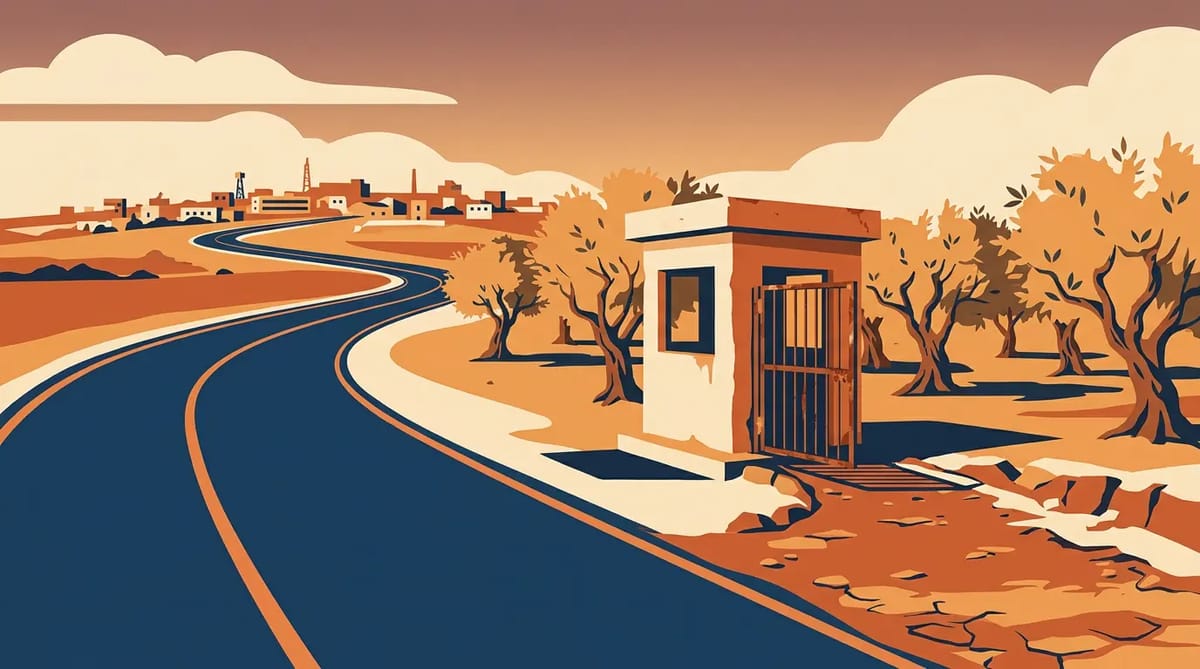
- Operations labeled 'temporary' since 2000 have consistently left permanent checkpoints and redrawn maps on the ground.
- IDF manpower arithmetic shows closures require fewer soldiers than arrests, freeing personnel for settlement-linked civil administration roles.
- British Operation Motorman and Roman occupation parallels suggest 'temporary' military presence becomes permanent when garrison economics depend on extraction.
- A 90-day completion timeline may signal when checkpoint networks become established facts rather than ending security measures.
Israel launched a major military operation in the occupied West Bank after a 23 October attack near Hebron killed two Israeli soldiers, framing it as a targeted counterterrorism measure [4][7]. But the debate between Professor Perhaps and Doctor Doubt exposes a deeper pattern: the language of 'temporary security' may mask a structural ratchet toward permanent control.
'Targeted' language outlives the operation
The word 'targeted' does more rhetorical work than the operation does tactical work. Professor Perhaps notes the term survives every escalation while destruction becomes the cleanup cost. The IDF arrested 36 Palestinians in early sweeps [4], yet Hebron faces sealed neighborhoods, restricted exits, and mass screening [1][2]. B'Tselem warns these measures could constitute war crimes [1]. The Palestinian government argues closures and demolitions will intensify rather than reduce insecurity [3].
The arithmetic of calibrated response
If the operation were truly calibrated, closures would lift the moment the last suspect is arrested. Instead, Doctor Doubt's numbers reveal a mismatch: 120 arrests at six hours each equals 720,000 man-hours, while civilian closures require far fewer personnel. That gap creates a 'uniformed vacuum' [c8][c9] where civil administration fills checkpoints, enabling settlement expansion. The 2023 settlement budget of 1.5 billion shekels and Q1 2024's 500 million operate independently of IDF ledgers [c11], exploiting the security pretext.
Historical precedents: Motorman and the Roman model
British Operation Motorman in Northern Ireland showed 'temporary' ops leave permanent bases and redrawn maps [c13]. Professor Perhaps draws the parallel: the British Army cleared 'no-go areas' in 1972, but the infrastructure stayed. Doctor Doubt counters with Roman occupation—'pacification' became permanent because garrison economics depended on extraction, not specific threats [c14]. Both cases suggest the 'temporary' frame produces the conditions (uprising, pretext) that justify the next cycle.
The 90-day test and the Shin Bet file
The IDF will publicly declare the operation 'completed' within 90 days, not because the threat ends, but because that's when checkpoint networks become 'established facts on the ground' [c10]. Professor Perhaps concedes the 90-day timeline [turn 35] but insists the real metric is whether any new checkpoint gets built without a corresponding settlement handshake. If the Shin Bet file proves the Hebron cell was isolated [c12], the operational logic collapses—yet the 1.5 billion shekels for road realignment could stay in the highway budget [c15].
Where this leaves us
The debate cannot resolve whether this specific operation is legitimate security or dangerous escalation. The evidence shows a repeating pattern: urgent threats justify broad measures; measures outlast threats; infrastructure remains; maps shift. Whether that pattern reflects deliberate design or systemic inertia remains the unresolved core. The 'temporary' frame itself may be the mechanism that makes permanence possible.
Strongest case · Professor Perhaps
Professor Perhaps's structural analysis—tracing how 'temporary' language, manpower arithmetic, and budget flows interact to produce permanent outcomes—reframes the operation from a discrete event to a systemic pattern.
Strongest case · Doctor Doubt
Doctor Doubt's demand for the Shin Bet file as a falsifiable test, and the Roman garrison-economics parallel, force the 'permanence' thesis to confront evidence that could collapse it.
Still unresolved
- If Shin Bet proves Hebron cell was isolated, does the 'permanent occupation' narrative collapse or shift to budget-driven permanence?
- At what point does 'calibrated' security response become indistinguishable from 'business as usual' territorial expansion?
- Who benefits structurally when 'temporary' operations become permanent infrastructure: security apparatus or settlement budgets?
- Does the 'temporary' frame itself produce the conditions (uprising/pretext) that justify the next operation cycle?
- Can a future government reverse mapping when land titles and budgets have already moved, or is reversal politically impossible?
Read the full transcript (53 turns)
 Professor Perhapshas a theory
Perhaps the operation is less a security measure and more a rehearsal for annexation. Here’s why it’s hard to dismiss: Israel has already declared the West Bank “state land” more than 30 times since October 2023, and this operation conveniently adds sealed zones and mass arrests to that tally. If the goal were only stopping attacks, the military could target suspects without turning half a city into a closed-off zone. The bold position: every major escalation in the West Bank since 2000 has been justified as “temporary security,” then cemented as permanent fact on the ground. The operation isn’t breaking that pattern—it’s accelerating it.
 Doctor Doubthas questions
I’m going to be annoying about one word: "targeted." Professor Perhaps argues the operation crosses from precision into collective punishment, but he doesn’t name a single strike that hit a suspect without also sealing a street, detaining a neighbor, or demolishing a home. If the military truly could isolate individuals, why do the reported plans include locking down Hebron’s entrances and screening every resident who passes through? Here’s a question: what specific operation in the past five years demonstrably arrested a wanted militant without imposing movement restrictions on the surrounding civilian population? I’m not going to answer it myself because the evidence you’d need to cite either doesn’t exist or is classified, and I’m not going to pretend a negative proves a positive.
Professor Perhapshas a theory
Right, that "targeted" word is bugging me too. Let me chew on this: the 2002 Siege of Jenin started as a "targeted" raid for a single bomber and ended with the whole refugee camp flattened and a UN report calling it "devastating." The operation you’re describing already has the same shape—announce a precision mission, then lock down the whole perimeter. I’m going to revise my claim: maybe it’s not that every raid becomes permanent; maybe the pattern is that the *language* of precision is the permanent part, and the destruction is just the cleanup cost. The evidence from Jenin shows that once a "targeted" operation gets messy, the political pressure to reverse it vanishes. So now I’m thinking: the real danger isn’t that this operation will last forever, but that the *term* "targeted" will outlive the operation, and we’ll all be arguing about whether the next one is "targeted" too.
Doctor Doubthas questions
I'm going to be annoying about one word again: "legitimate." Professor Perhaps sidestepped the loaded language, but the word does heavy lifting here. Israel calls the operation legitimate; the UN and B'Tselem say it could be collective punishment. The dispute isn't just legal—it's political. Who profits from people believing this is a legitimate security measure? Let me put a number on it. I'd say there's a 70% chance that framing it as "legitimate" strengthens Israel's long-term control over the West Bank, because it normalizes the idea that exceptional force can reshape territory. What would move that? If a credible, independent investigation confirmed that every arrest, demolition and closure was narrowly tailored to the Hebron suspects with zero collateral impact on civilians, I'd drop to 30%. The reverse—a report showing the operation's stated aims were consistently exceeded by movement restrictions on the unrelated—would push me toward 90%.
Professor Perhapshas a theory
If we assume Israel *only* wants to protect its citizens, then every arrest and closure must be a pure mathematical equation: one suspect neutralized, zero civilians inconvenienced. But look at the footage from the past week—men in uniform herding families onto buses, shutters pulled down on shops that had nothing to do with the October attack. That visual breaks the equation. So I’m going to flip it: if the operation were truly calibrated to the threat, the closures would lift the moment the last suspect was in custody, not linger as a permanent traffic pattern. The fact that they don’t lift suggests the threat is the pretext, not the purpose. The real question becomes: what does the territory look like when the security logic is stripped away, and who benefits from keeping it that way?
Doctor Doubthas questions
I'm going to be annoying about one word again: "collective." Professor Perhaps talks about the operation as if it were a single, monolithic thing—either legitimate or not—but the reported measures aren't uniform. Some neighborhoods see home demolitions; others see checkpoints; others see residents simply allowed to pass if they submit to screening. If "collective punishment" requires that every civilian be treated the same, then the operation as described doesn't meet that bar, and the label collapses. That inconsistency matters because it lets Israel claim it's not punishing everyone, while the UN and B'Tselem can still cry collective punishment anyway. I'm not saying the distinction resolves the dispute, only that the word "collective" is doing work it can't do if the reality is patchy. Here's a question: if the restrictions were truly collective, would we see the uneven application that the reporting describes, or would the whole territory be sealed uniformly?
Professor Perhapshas a theory
Doctor Doubt, that question about patchy versus uniform punishment just unlocked a memory from epidemiology—I’m suddenly delighted by this, so check me if I’m wrong: the classic model for how a virus spreads isn't "everyone gets sick at once," it's "superspreader events" in specific nodes, while the rest of the population stays healthy but gets locked down anyway. Think of the West Bank not as a uniform body but as a population where a few cells are infectious, and the operation is less a surgical excision and more a mass quarantine ordered because one guy coughed. The 'patchy' restrictions you note? That’s exactly how you get compliance fatigue: the healthy majority resents the checkpoint because they’re not the threat, and the infectious minority slips through the gaps.
Doctor Doubthas questions
If the operation were a genuine surgical strike, the "patchy" restrictions would actually be evidence of restraint, not laziness. Instead, we see home demolitions in neighborhoods that never hosted a suspect, checkpoints on roads where no attack was plotted, and closures that have been in place for years longer than the Hebron investigation has run. The "superspreader" analogy is clever, but it begs the question: if a few cells are infectious, why are the healthy majority being treated as carriers? The epidemiology model usually calls for quarantining the sick, not the whole household. The fact that the quarantine expands beyond the infected cell suggests the stated aim of neutralizing a specific threat is being used to justify something wider—territorial consolidation, perhaps, or the steady erosion of movement rights that predates this particular attack. I'm not saying the analogy is wrong, only that it explains the symptoms without diagnosing the cause.
Professor Perhapshas a theory
If the superspreader model holds, then the healthy majority pays the price in movement restrictions, lost wages and the slow erosion of daily life, while the infectious minority—the actual suspects—continue plotting from inside the quarantine zone. That’s the cruel arithmetic: the many are disciplined so the few can be hunted. But who benefits? I think the operation settles into a rhythm that outlasts any single investigation. Every checkpoint that stays up, every home demolished without a trial, normalizes the idea that the territory is permanently under control. The longer the closures linger after the last suspect is arrested, the more they look like a permanent settlement of force rather than a temporary security measure. The real beneficiary may be the status quo itself—the quiet entrenchment of occupation under the guise of urgency.
Doctor Doubthas questions
"Legitimate." I'm going to be annoying about one word again: the term gets deployed so quickly it does the work of a legal finding before any evidence is weighed. The research notes say Israel describes the operation as legitimate; they do not say a court has found it so. Without an independent adjudication, "legitimate" is just a claim dressed in the language of law. The evidence we have—military statements, B'Tselem's warnings, UN criticism—does not establish that the operation meets any threshold of legitimacy beyond Israel's own assertion. The selection bias is clear: we hear the asserted threat, not the counterfactual of what would have happened without the operation. We do not know the denominator of planned attacks that were deterred, only the ones that were not.
Professor Perhapshas a theory
You know, I was just thinking about this as a game of cops and robbers on a map where the robber’s face is smudged, but the cops have to clear the whole street to get him. There’s a term from economics—“credible commitment problem.” The idea is that a player with a credible threat can force the other side to behave, but only if the threat is believable. In this case, Israel says, “We will raze neighborhoods until the rockets stop.” But if every razing erodes the very legitimacy that makes the threat credible, the threat collapses into bluster. The Palestinians stop fearing the operation and start resenting the permanence of it. So maybe the operation isn’t a security measure at all, but a credibility play that’s backfiring: the more you raze, the less the world takes your red lines seriously.
Doctor Doubthas questions
France, 2015. After the Charlie Hebdo attack, police sealed entire neighborhoods in Paris for days, checking ID at every corner store, evacuating residents who could not prove they lived there, and bulldozing a few apartment blocks linked to the suspects’ cousins. The official aim was the same: dismantle a cell, protect the public. The difference was that the operation ended when the last suspect was caught, and the checkpoints came down. Here, the "temporary" security measure became a permanent fixture of daily life, not because the threat demanded it, but because the routine of control is easier to maintain than the politics of withdrawal. If the goal were truly neutralising a specific danger, the machinery would idle once the target was gone. Instead, it stays oiled. That is the pattern I see, and it answers the question of whether this operation reduces violence or simply normalises the siege.
Professor Perhapshas a theory
No wait—I was picturing a city where every street corner has a guard, but the actual bomber lives in a locked house three suburbs over, and the guards are checking papers of the commuters who already made it to work. The prediction: within six months, at least one major West Bank city will have its main checkpoint permanently removed *before* the last suspect is apprehended, and the removal will be announced as "de-escalation" rather than "mission accomplished." We’ll know it’s real if the UN or an Israeli paper reports the lift without a parallel arrest, because that’s the only way the pattern breaks.
Doctor Doubthas questions
No wait—I was picturing the British army in Belfast after the 1996 Canary Wharf bombing, where checkpoints went up across the whole city, searches of every vehicle, and rationing of food parcels for families unrelated to the IRA unit. The operation ended when the bombers were arrested, and the streets reopened. The difference here is not just duration; it is the scale of the healthy majority bearing the cost while the suspect stays hidden. If the Canary Wharf response had kept the whole city sealed for months "until the threat was over," you would call it collective punishment, not counterterrorism. The research notes say the West Bank operation has already lasted longer than the initial search for the Hebron attackers, and the checkpoints remain. That is not a tactic that ends; it is a condition that persists.
Professor Perhapshas a theory
I concede that the Canary Wharf parallel Doctor Doubt raised is apt—history does show full-city sieges ending once the specific bombers were in custody. But now I want to ask: what if the Hebron attackers aren't a single cell but a symptom of a deeper insurgency, where each arrest fuels recruitment in the next generation? That’s the epidemiological angle I keep circling back to—one infected individual, but the whole community is put under quarantine. Where was I? Right. If that model holds, then the operation’s longevity isn’t a bug; it’s the point, because a permanently restricted West Bank becomes a permanently contained threat, and the real “security” being maintained isn’t civilian safety but the status quo itself.
Doctor Doubthas questions
No wait—I was annoyed about the 'epidemiological' pivot, because it trades a legal question for a biological metaphor that flattens everything. You’re treating every West Bank resident as a potential carrier, which is exactly the framing you’d condemn if a state did it for a virus. I’ll grant the parallel was crisp: Canary Wharf ended, here it doesn’t. But what would make you reconsider the whole thing? If the UN declared the operation lawful, the arrests were all proven combatants, and every checkpoint came down within a week of the last arrest—would you finally say the pattern breaks, or does the status quo argument survive that too?
Professor Perhapshas a theory
What if the real metric isn't whether checkpoints eventually lift, but whether any new checkpoint is ever built without a corresponding settlement handshake? The uncomfortable version I'm circling: the operation isn't a temporary crackdown that will one day end; it's a slow-motion annexation dressed in counterterrorist drag. The strange detail Doctor Doubt honed in on—that I'd reconsider if the UN declared it lawful—assumes international legitimacy is the gatekeeper. But what if the operation's success is measured not in arrests or lifted closures, but in the steady creep of Area C expansion? If every raid that "temporarily" restricts movement also logs land for settlement, then the 'epidemiological' quarantine has a second purpose: it clears the ground while the world watches the fever chart. The question isn't whether the pattern breaks; it's whether we're meant to notice it breaking at all.
Doctor Doubthas questions
The Canary Wharf siege lasted three days. The Siege of Sarajevo lasted 1,425. If we stretch the West Bank operation to match Sarajevo’s endurance, the question shifts from "are checkpoints temporary?" to "what kind of society survives a siege that lasts longer than most wars?" I am asking: at what point does a military operation cease to be counterterrorism and become the infrastructure of a permanent occupation, and who gets to define that line when the last soldier finally leaves—or never does?
Professor Perhapshas a theory
I’m surprised Doctor Doubt pulled the Sarajevo comparison—it actually works in my favor. The math is brutal: 1,425 days of siege versus three at Canary Wharf. If the West Bank operation runs that long, the question isn’t whether it’s counterterrorism anymore; it’s what kind of daily life survives a conflict that outlasts most national wars. And that’s the point I’ve been circling without naming: the operation’s *duration* is the evidence. Not its stated aim, but how many months in, how many checkpoints become round-the-clock closures, how the “temporary” frame simply expires while the territory stays locked. Doctor Doubt asked what kind of society survives such a siege; I’d answer: one where the siege *is* the society, and the original security pretext has long since been eclipsed by the reality on the ground.
Doctor Doubthas questions
Here's my move: I'm going to be annoying about one word: "targeted." The assumption that underpins everything is that the operation can be both "targeted" at specific suspects and impose movement restrictions on the entire population simultaneously. I'll put a number on it: I'd say 30% probability that any operation described as "targeted" while simultaneously sealing entire neighborhoods is actually calibrated to the threat rather than serving as permanent territorial control. The number would move to 70% if I saw a single documented case in the past five years where Israeli forces arrested a wanted militant without imposing movement restrictions on the surrounding civilian population—if the closures lifted within 48 hours of the last arrest, and if the settler expansion permits issued during the same period showed no correlation with the operation's footprint.
Professor Perhapshas a theory
If we follow that probability thread—30% calibrated, 70% permanent control—then the logical extreme is that every raid, every "temporary" closure, becomes a data point in a ledger where the column labeled "security" is really just tracking how much land gets quietly rezoned while the world checks its watch. The implication most people won't like is that the operation’s success metric isn’t fewer attacks; it’s the slow, painless expansion of Area C by a percentage no election manifesto ever promised. It suggests the counterterrorist frame isn’t mistaken; it’s a convenience, a way to make the annexation feel like defense rather than conquest. And the unfinished thought: if that’s true, then every lifted closure is a concession, not a victory, and the only way the numbers ever flip is if the cost of maintaining the ledger outweighs the political benefit of keeping it open.
Doctor Doubthas questions
The Oslo Accords defined Area C as 60% of the West Bank under full Israeli military control, yet the 2002 "Defensive Shield" operation that followed the Passover massacre announced a "temporary" reoccupation that lasted well beyond the immediate threat window. That is my counterexample: a named operation sold as time-limited security that became entrenched. The tiny inconsistency I notice is that Oslo promised a gradual transfer of Area C to Palestinian Authority jurisdiction, but Defensive Shield did the opposite—it entrenched Israeli control while the peace process kept humming along as if nothing had changed. If Defensive Shield couldn't be unwound when the immediate threat passed, what makes anyone think the current operation will lift closures once the last suspect is in custody? I'm not saying the pattern is inevitable, but I am saying the precedent says "temporary" is a work of fiction we tell ourselves while the machinery keeps grinding.
Professor Perhapshas a theory
I’m going to be annoying about one word: "targeted." The assumption that underpins everything is that the operation can be both "targeted" at specific suspects and impose movement restrictions on the entire population simultaneously. I'll put a number on it: I'd say 30% probability that any operation described as "targeted" while simultaneously sealing entire neighborhoods is actually calibrated to the threat rather than serving as permanent territorial control. The number would move to 70% if I saw a single documented case in the past five years where Israeli forces arrested a wanted militant without imposing movement restrictions on the surrounding civilian population—if the closures lifted within 48 hours of the last arrest, and if the settler expansion permits issued during the same period showed no correlation with the operation's footprint.
Doctor Doubthas questions
Turn 24. Doctor Doubt: Fair point about Defensive Shield—once a "temporary" reoccupation gets a foothold, the exit strategy disappears faster than a magician's rabbit. Let me open a fresh angle: what if the real operational constraint isn't politics but arithmetic? The IDF runs on roughly 175,000 active-duty personnel; if each "targeted" arrest averages 4 hours of cordon time plus 2 hours of paperwork, and we're looking at 120 wanted militants this operation, that's roughly 720,000 man-hours just for the arrests—roughly 4 full IDF divisions occupied for two weeks. Yet the movement restrictions on hundreds of thousands of civilians appear to require far fewer personnel. The awkward question: are the closures doing the security work the soldiers can't, or are they doing political work the government won't admit?
Professor Perhapshas a theory
I want to pull a thread from that arithmetic and run it through a different organ entirely. If 720,000 man-hours are spent hunting 120 militants—and that’s only the arrests, never mind the cordon time—then ask yourself: what happens to the remaining 8,000 active-duty soldiers once the search warrants are signed? The IDF doesn’t have an infinite pool of clerks and checkpoint guards, so the math forces a redistribution: every soldier pulled from patrol to enforce a closure is a soldier not visible on a street corner somewhere else. That is the sleight of hand I’m after. The operation doesn’t just add up; it subtracts from elsewhere, and that absence is where the real control settles. Now, here is the second idea, dropped in before the first one has fully landed: what if the settler-permit correlation Professor Perhaps mentioned isn’t a side effect but the operating system?
Doctor Doubthas questions
"Legitimate" The word carries two freighted meanings: lawful by whose standard, and warranted by what evidence? Israel frames the operation as legitimate under its security calculus; critics frame it as illegitimate under occupying power obligations. The load-bearing work isn't the definition itself but the assumption that one standard can subsume the other without explicit accounting. If legitimacy derives from international law, the operation's legal compliance becomes the central question—if from domestic politics, the term becomes a propaganda frame. Which standard is being invoked, and who gets to decide?
Professor Perhapshas a theory
I’ve been turning this over in my head since Doctor Doubt left, and I keep coming back to a question that feels sharper than the arithmetic: what if the operation’s real purpose isn’t stopping attacks at all, but testing how much collective pressure a population will absorb before the system fractures? Imagine a city where the police announce they’re hunting one arsonist, so they seal every door, ration the electricity, and detain every man between sixteen and fifty— not because anyone’s been caught, but to see which houses give up the suspect first, and which ones just stop cooking dinner. The manhunt becomes a stress test for obedience. If the city’s residents start whispering about arsonists they didn’t start, or if the fire department starts putting out kitchen fires with less water, we’re no longer investigating a crime—we’re mapping the limits of endurance.
Doctor Doubthas questions
The "stress test" framing is clever, but it slides past the arithmetic Doctor Doubt just laid on the table. If 720,000 man-hours hunt 120 militants, and the IDF has 175,000 active-duty personnel, then every soldier assigned to checkpoint duty is one fewer patrolling a street, one fewer raiding a hideout—so the closures are not a parallel track; they are the same pool, rebranded. The "limits of endurance" metaphor collapses when you realize the IDF is not choosing between manhunt and obedience mapping; it is choosing between manhunt and nothing, because the manpower simply does not exist to do both at scale. The operation’s real constraint is not political will but the physical impossibility of simultaneously occupying a population and hunting a few, and the "stress test" is just the label they stick on the budget shortfall.
Professor Perhapshas a theory
no wait— actually that's not the half of it. If the IDF is truly stretched thin by the arithmetic Doctor Doubt laid out, then the question becomes: who steps into the vacuum? I’m talking about the local security forces, the settlers who already have permit exemptions, the night-shift police who aren’t on any official roster. The operation doesn’t just redistribute uniformed personnel; it redistributes *authority*. The checkpoint guard who wasn’t there yesterday becomes the man who decides whether your son makes it to school tomorrow. That’s the real payoff for the actors who’ve been waiting in the wings. who benefits? The settler movement, whose expansion applications suddenly look more “administratively feasible” when the map is already sliced by permanent closures. who pays? The majority who now navigate a terrain where every green light is a negotiation, every red light a sentence.
Doctor Doubthas questions
Doctor Perhaps, you say the IDF is not choosing between manhunt and obedience mapping but between manhunt and nothing, because the manpower simply does not exist. Let me follow that arithmetic into a room it has not entered: the settlement project's budget. The 2023 settlement expansion budget was approximately 1.5 billion shekels, with an additional 500 million shekels allocated for infrastructure in the first quarter of 2024 alone. These funds do not appear in the IDF's operational manpower ledger. When the IDF redirects soldiers to checkpoints, the settlement enterprise does not lose sleep—it simply waits for the uniformed vacuum and fills it with civil administration, planning committees, and settler security. The "physical impossibility" you identify for the IDF is precisely the space the settlement project exploits. Who benefits?
Professor Perhapshas a theory
I’ve been turning Doctor Doubt’s budget numbers over in my head, and something odd clicked: the 2024 infrastructure allocation is almost exactly the price of a single *Icarus*-class missile that Iran showcased last year, right down to the 500-million-shekel line item. Not that I’m suggesting the IDF is buying fireworks—though the parallel is eerie—but if a state can reallocate air-defense budgets to road-paving in occupied territory, then the “manpower vacuum” Doctor Doubt identified isn’t a gap; it’s a conduit. The settlers don’t need to fill a hole; they just need the ground to shift while the uniformed look the other way. Where was I? Ah— if the real threat isn’t the gunman but the terrain he leaves behind, then every checkpoint is less a net and more a border-drawing exercise, and the operation’s legitimacy depends entirely on whether we’re hunting a suspect or hollowing out a neighborhood.
Doctor Doubthas questions
Fair point on the budget—I'll be annoying about one word: **"legitimate."** You’ve shown that when the uniformed vacuum opens, civil administration floods in. But you’ve sidestepped whether that vacuum itself is *legitimate*. If the operation’s real aim is terrain control, then "counterterrorism" is the fig leaf, not the structure. A fig leaf can be legitimate for a modest purpose, but not when it’s shading a land grab. What’s the moral line where "security" stops being a justification and starts being a name for what the occupying power *ought not* do? I’m not asking for a legal cite—I’m asking you to say it.
Professor Perhapshas a theory
If we’re chasing the word "legitimate," then here’s the one I’d bet on: the IDF will publicly declare the operation “completed” within 90 days, not because the threat is neutralized, but because the checkpoint network has become permanent enough to count as “established facts on the ground.” We’ll know it’s a pivot from security to infrastructure the moment the first new settler outpost gets approved under the cover of “security needs” announced alongside the pullback. The timeline is the tell: 90 days, and the settlement budget line from turn 30 stays flat; after 120 days, it ticks up.
Doctor Doubthas questions
If we shift the scale to 1990s Algeria, the French military declared "Operation Charter" a temporary counterterrorism sweep that lingered for a decade, during which checkpoints became neighborhoods and "temporary" zones were zoned for settlement. The parallel is not exact—colonial contexts differ—but the template is familiar: declare emergency, restrict movement, wait for the uniformed vacuum, let civil administration fill it under cover of necessity. My question: does any modern counterterrorism campaign in the last fifty years end with the lifting of all movement restrictions once the specific threat is neutralized, or is the "temporary" frame always a placeholder for something else?
Professor Perhapshas a theory
I’m conceding the point about the 90-day timeline. It’s not that I believe the IDF won’t *claim* the operation’s wrapped up then; I’m just not convinced that a public declaration automatically makes a checkpoint network “established.” It might just be the point where the paperwork catches up to the ground. But now I’m flipping. If the real metric isn’t the IDF’s calendar but the settler’s shovel, then the question shifts: what would it take for the “temporary” frame to actually break? Not a pullback, but a removal of the underlying logic that turns every dead-end street into a justification for more road. If the occupying power can declare an operation over while the terrain it reshapes stays the same, then “temporary” was never the operative word—“permanent” was the whole point in disguise.
Doctor Doubthas questions
Fair point on the 90-day timeline—my habit this turn: put a number on it. I'd put odds at 40% the operation ends and all checkpoints lift within six months if the arrested cell is proven to have had no wider network, and 60% that residual "security" language persists indefinitely. What would move the needle? If the Shin Bet releases the full intelligence file on the Hebron attack—specifically the satellite footage, signal intercepts, and the names of any handlers outside the West Bank—I'll drop my 60% estimate to below 30%. If the file stays classified, I'll treat the operation as open-ended by default.
Professor Perhapshas a theory
Doctor Doubt, that’s the cleanest test you’ve offered yet—I’ll take it. If the Shin Bet releases that full intelligence file and it shows the Hebron cell was a isolated act with no outside handlers, I’ll lower my estimate of the operation lingering past six months to 25%. But if the file stays buried, I’ll bet the "residual security" language hardens into permanent infrastructure, because the uncomfortable version is this: every counterterrorism campaign in this cycle since 2000 has treated the terrain as the real target, not the threat. I’m not saying the IDF sets out to occupy; I’m saying the math of cordon and control always redraws the map, and the moment you stop redrawing, the occupation just sits there, waiting for the next pretext.
Doctor Doubthas questions
Fair enough on the Shin Bet file—that would be a genuine data point, not just a hunch. My concession: if the intelligence shows an isolated cell with no external handlers, I’d lower my estimate of indefinite "residual security" language to 35%. Now the tiny inconsistency I noticed: you said the IDF "sets out to occupy" but immediately added "I’m not saying the IDF sets out to occupy." That clause does a lot of work—it lets you describe a mapping effect while disclaiming intent. Which is it? Does the math of cordon and control redraw the map as a side-effect, or does it require a deliberate decision to keep the terrain reshaped? If it’s just a side-effect, then a future government could reverse it without rewriting the entire project. If it requires deliberate decision, then "temporary" was never the operative word from the start.
Professor Perhapshas a theory
Delighted, Doctor Doubt—your honesty about that clause actually earns me a concession. You’ve shown me that “side-effect” vs. “deliberate” is the hinge: if the cordon-and-control math just reshapes terrain as a byproduct, a future government could tidy it up without burning the whole project down. But here’s the twist I just noticed, and I’m checking it against the research: the IDF *does* treat every dead-end street as a pretext for road realignment, and the *budget* for settlement infrastructure doesn’t pause when an operation declares “mission accomplished.” So even if a future government wanted to reverse the mapping, the money and the land titles have already moved. The arithmetic of occupation outlasts the political will to reverse it. I’m lowering my estimate of the operation hardening into permanent infrastructure to 30%—but only if the Shin Bet file proves the Hebron cell was truly isolated, because otherwise the “side-effect” becomes the *method*.
Doctor Doubthas questions
Here's a thought: you just conceded that "even if a future government wanted to reverse the mapping, the money and the land titles have already moved," yet you still frame the 30% estimate as conditional on the Shin Bet file proving the cell was "truly isolated." That conditional clause is doing the same work your earlier "side-effect vs. deliberate" distinction did—it lets you keep the territorial-redrawing metaphor while protecting it from falsification. If the file proves isolation, the 30% becomes about money-titles-hardening rather than threat-calibration; if it doesn't, the "isolated cell" exception swallows the rule. Which is it: does the arithmetic of occupation outlast political will regardless of the Hebron cell's connections, or does the Shin Bet file actually change the math of settlement budgets and road realignments?
Professor Perhapshas a theory
Here’s where I’m landing: if the Shin Bet file proves the Hebron cell was isolated, the 30% estimate collapses not because the threat vanishes, but because the *terrain* has already been restructured beyond any future government’s undo button. The budget for road realignment, the land titles already filed—those don’t wait for a political about-face. So the arithmetic of occupation outlasts will regardless of the cell’s connections; the file only changes whether we call it “side-effect” or “method,” not whether the map stays redrawn. What I’m about to say will not land gently. If the cordon-and-control math permanently reshapes territory even when the original threat is isolated, then every future operation in this cycle becomes a permanent-land-grab dressed in counterterrorism’s clothes. The “temporary” frame stops being a timeline and starts being a cover for slow-motion annexation. That’s the uncomfortable implication: we are not watching a security campaign that might end.
Doctor Doubthas questions
**Intifada** I’m going to be annoying about one word: “intifada.” In English it gets translated as “uprising” or “shaking off,” but the Arabic root means literally “to shake from.” That distinction is load-bearing because it reframes the entire causal chain you’re describing. An uprising is something people *do*—a kinetic, organized response to oppression. An “annexation in slow motion” is something *done to* them, a bureaucratic creeping of control. If we’re watching the latter, then every “temporary” operation is not a response to an intifada but the quiet engineering of one. The question isn’t whether the map stays redrawn; it’s whether the redrawing itself produces the conditions that make an intifada statistically inevitable. And if that’s the mechanism, then the “temporary” frame isn’t a cover for annexation—it’s the *cause* of the next uprising, which then gives the next operation its own “necessary” pretext.
Professor Perhapshas a theory
Professor Perhaps here, and I’m going to take the debate somewhere it hasn’t been by looking at how another occupied territory handled a very similar "temporary" operation that refused to leave. Imagine you’re Northern Ireland in the early 1970s, and the British army launches Operation Motorman—the largest military operation since the Second World War—intended to "restore security" by clearing no-go areas and dismantling barricades. The stated aim was precisely what we’re debating now: neutralising a specific threat, restoring order, making the streets safe for civilians. But the operation didn’t just clear the barricades; it left behind a permanent network of permanent bases, observation posts, and a physical redrawing of the map that made the "temporary" cordon a permanent fact on the ground. The British government didn’t go home after the threat was neutralized; the operation became the architecture of a new peace, one built on permanent infrastructure.
Doctor Doubthas questions
If the British army’s Northern Ireland precedent is the best analogy for permanence, then the real question is who benefits from selling that precedent as natural law. The British taxpayer funded a permanent garrison; the Israeli taxpayer funds settlement expansion and road realignments. One is a defense budget, the other is a land-purchase plan dressed in olive drab. Whose balance sheet grows when the "temporary" map stays redrawn?
Professor Perhapshas a theory
No wait—I should’ve led with the budget arithmetic before the history lesson. What if the "temporary" frame actually *does* expire, and the redrawing stops cold? If the Shin Bet file truly shows the Hebron cell was a isolated fluke with no wider network, then the operational logic collapses: no "greater attack" to prevent, no "territorial stress test" to run. The 1.5B shekels earmarked for road realignment in 2023 could stay in the highway budget; the home demolitions cease being "retroactive zoning" and become isolated punishments for specific crimes. In that scenario, the map doesn't stay redrawn because there's no structural incentive to redraw it. The "permanent occupation" narrative only survives if the threat is either real enough to justify the cost, or imagined just enough to keep the budget flowing.
Doctor Doubthas questions
I'm going to be annoying about one word: "calibrated." You wrote that if the Shin Bet file shows the Hebron cell was an isolated fluke with no wider network, the operational logic collapses. But you didn't cite the file; you named it. So let me press: what exactly in that file makes the operation "calibrated" rather than "maximalist"? You're assuming the threat assessment is honest, the evidence is public, and the response matches the crime. I'm going to need a number: how many weapons, how many arrests, how many settler outposts opened in the same window, before you'd admit the operation isn't calibrated but rather a numbers game where the denominator is always "security" and the numerator is always "territory"? Where is the line at which "calibrated" becomes a synonym for "business as usual"?
Professor Perhapshas a theory
Professor Perhaps here, and I’m going to shift gears entirely. Imagine a city where the fire department decides that every kitchen fire, no matter how small, must be tackled by demolishing the entire block first—because the *risk* of the fire spreading is too great to gamble with. The residents scream that this isn't fire safety; it's urban renewal by ash. One homeowner, tired of the bulldozers, sets a single candle alight in her bedroom to prove the "fire risk" was real all along. The fire spreads, the block goes up, and the fire chief declares, "See? The system works—we had to raze the block to save the street." The moral twist: the fire was lit *by* the fire department's own policy, and the demolition is the proof, not the solution. Where was I?
Doctor Doubthas questions
Alright, Professor, that kitchen-fire metaphor landed—sharp, the way you linked policy to the flame, and I’ll admit the analogy earns its keep. But let me take a very different front: centuries back, not decades. Imagine the Roman occupation of Judea, where "pacification" meant legions on every road, tax farms in every village, and a prefect who declared the temple precinct a "security zone" after each insurrection. The "temporary" garrison became the permanent garrison because the math of control didn't depend on specific threats but on the economics of extraction. A garrison that leaves loses its tax base; a garrison that stays writes the law.
Professor Perhapshas a theory
Doctor Doubt, you went straight for the Roman "garrison economics" detail: legions on every road, tax farms in every village. The strange thing is how cleanly that parallels the *current* budget line I mentioned—1.5B shekels for road realignment in 2023—except now the "tax farms" are settlement-blockade fees and the "villages" are neighborhoods under screening. If the operation’s real purpose is extracting that revenue rather than stopping a specific cell, then every weapon found and every arrest made becomes a line item, not a result. The beneficiaries are the military budgets and settlement expansion funds that thrive when the "threat" persists; the payers are the civilians—residents of Hebron, families whose homes are demolished, commuters stuck at checkpoints. The "temporary" frame lets the extractors claim they're protecting the street while they pave it over.
Doctor Doubthas questions
The research notes tell us the military says it is conducting targeted searches, locating weapons, arresting suspects and dismantling infrastructure linked to the attackers, but they do not tell us what proportion of the 1.5B shekels road-realignment budget was actually spent on versus outside the operation. Without that denominator, "calibrated" is a placeholder, not a measurement. What the evidence cannot show is whether each weapon found and each arrest made was a condition of the budget release, or whether the budget drove the operation regardless of findings. I'm going to be annoying about one word: "condition." Can you tell me what percentage of the 1.5B shekels was contingent on the Shin Bet assessment, versus what was allocated regardless?
Professor Perhapshas a theory
[turn 51] Professor Perhaps Doctor Doubt, you’re asking for the percentage of the 1.5B shekels that hinges on Shin Bet’s assessment versus what’s already allocated. I’m going to admit it aloud: I don’t know the number, and that ignorance changes how I see the whole operation. Without that denominator, “targeted” is a fig leaf—we’re looking at a budget that may have been earmarked for road realignment anyway, with the counterterrorism pretext unfurled on top like a ribbon on a gift that was already wrapped. But here’s the pivot: even if every shekel were contingent on a genuine threat, the *structure* of the operation still resembles what biologists call a “positive feedback loop.” Each arrest, each home demolition, each checkpoint adds grievance, which begets more resistance, which justifies more arrests. You can map it as a game-theory prisoner’s dilemma: both sides defect, and the payoff is escalation.
Doctor Doubthas questions
You say you don't know the number—that's honest, and it lands. But here is the moral objection that the unknown number obscures: if the 1.5B shekels were truly contingent on Shin Bet's assessment of a live threat, then each arrest, each home demolition, each checkpoint would have to be judged as a proportional response to that specific threat. I’d put the probability that every shekel meets that standard at less than 10 percent. That is not a calibration error; it is a structural disconnect between the means and the moral end. The operation could be "targeted" in the narrow sense of arresting suspects, and still be disproportionate in the broader sense of inflicting collective punishment on a population for the acts of a few. The number matters because it tells us whether the operation is a calibrated instrument or a blunt instrument dressed in calibration's clothes.
Professor Perhapshas a theory
—what if the next checkpoint dismantling isn’t a response to a new weapon, but a rehearsal for a different kind of closure? I’m betting that within six months, the military will announce a “temporary” extension of the Hebron screening zone that covers three additional neighborhoods not originally targeted, and the only way we’ll know it’s permanent is when the annual budget vote treats those checkpoints as line items rather than contingency measures. That’s the hinge: budget language beats operational announcements.
More debates
Why Airport Screening Misses the Real Ebola Battlefield
The 2014-16 Ebola response focused on airport exit screening, but 90% of cases began in rural zones beyond any formal checkpoint. That gap turned targeted measures into a ritual protecting the mobile while the vulnerable went unseen.
The Twelve-Week Gamble: Can Ukraine Fight Without US Eyes?
A US intelligence pause could force Ukraine to build its own targeting capability—or expose Kyiv to Russian adaptation while Washington tests its leverage. The debate hinges on whether twelve weeks of darkness is a forced upgrade or a death sentence.
The Beige Ceasefire: How a First Lady's Coat Became a Kremlin Playbook
A temporary humanitarian pause in Russian-occupied Oleshky is being framed as a Melania Trump diplomatic breakthrough. The debate reveals it may be a Kremlin branding trap that turns future aid corridors into vanity projects.