War and security · · 3 min read
Moscow Talks: Ceasefire Path or Diplomatic Reward for Putin?
US-Russia talks in Moscow yield prisoner swaps but no ceasefire. The debate reveals how frozen fronts risk funding the next irredentist claim through shadow budgets and African resource networks.
In 30 seconds
- Prisoner exchanges advance while territorial demands remain irreconcilable.
- A Korean-style freeze could finance the faction that makes the next revisionist claim.
- African gold and uranium revenues sustain elite cohesion beyond formal budgets.
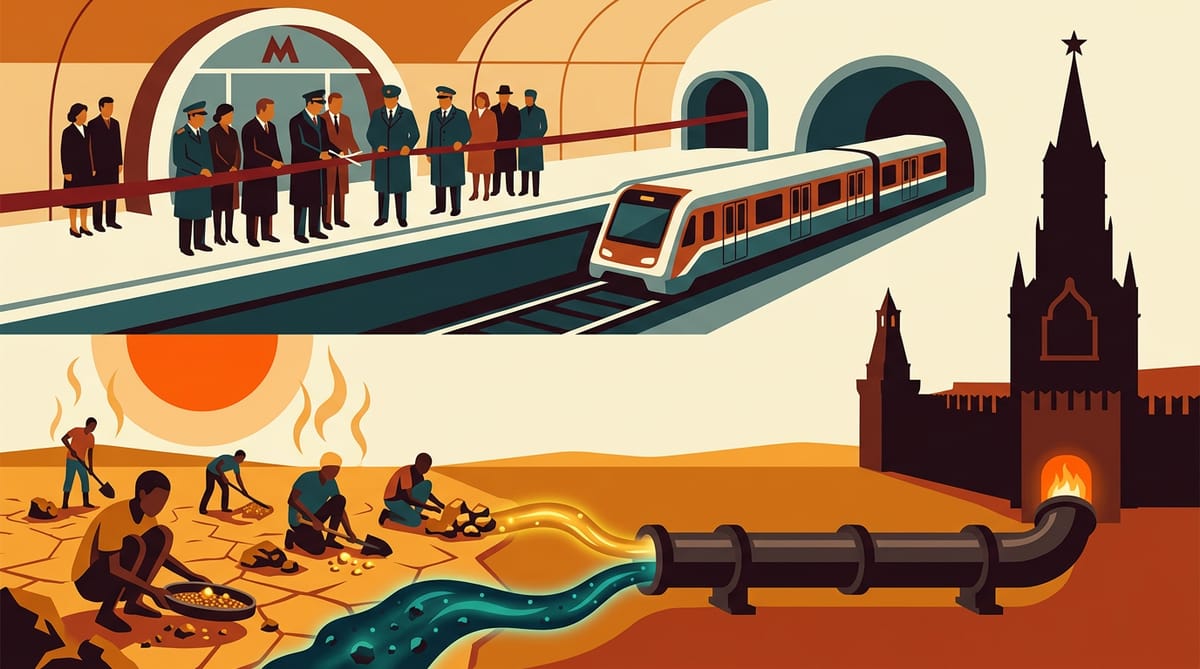
- Metro construction schedules signal silovik commitment to a long war.
The Moscow talks have produced prisoner swaps and humanitarian gestures but no ceasefire, and the gap between diplomatic theatre and battlefield reality is widening. RFE/RL reports "difficult but productive" negotiations, yet Russia still rejects a standalone ceasefire, insisting fighting ends only through a comprehensive settlement that locks in territorial gains. Atlantic Council analysts warn Moscow uses negotiations to divide Western support while improving its military position.
Prisoner swaps are confidence-building, not theatre
"The prisoner exchange: Russia gets back its" operatives while Ukraine retrieves civilians, but each swap also signals Moscow's willingness to treat the war as a manageable transaction. Professor Perhaps argues these exchanges build the habit of contact; Doctor Doubt counters with the Minsk precedent — agreements that froze lines without resolving sovereignty, only to collapse when one side rearmed. The Korean armistice of 1953 held for 70 years under neutral guarantors; today, no neutral power exists to police a frozen Donbas front.
A frozen front may finance the next irredentist claim
"The Korean analogy is exactly wrong because it assumes the front is the variable." The real variable is which faction controls the shadow budget. Wagner's Sahel contracts — gold from Sudan, uranium from Niger — move off SWIFT, off customs manifests, all deniable. A ceasefire that leaves these networks intact hands the next revisionist claim a ready-made war chest. The 2026 IAEA safeguards report on Niger's Imouraren mine may document worker radiation doses if shadow-budget funding continues at current intensity.
Metro tunnels as elite insurance
"The Metro proxy is clever — concrete as commitment device, tunnels as elite insurance." Big Circle Line stations opening on schedule signal the silovik coalition expects to rule Moscow for decades. Meanwhile, 47 municipal utilities have entered technical default since 2021, each a tiny furnace feeding the enrichment cascades that consume 15.6 TWh yearly — two large gas plants' worth. Gazprom's domestic contracts were renegotiated downward after January 2024; the periphery pays for the centre's strategic priorities.
The yuan countdown and Chinese customs
Russia's yuan reserves stand at roughly $38 billion, burning $2 billion monthly. But "you're watching the wrong ledger." The choke point isn't reserves; it's Chinese customs at Alashankou and Manzhouli, which updated export-control lists in October 2024. Kazakhstan's Ulba plant, with a Chinese strategic shareholder, routes supply through Astana to avoid secondary sanctions. Beijing needs Sahel uranium for its own fast-breeder programme — it may not want the rail closed.
Where this leaves us
The talks are a real diplomatic channel but not yet credible evidence of Russian willingness to end the war. A ceasefire along current lines without recognised borders risks legitimising the next territorial demand, funded by shadow budgets that survive formal freezes. The audit trail that matters isn't the federal budget — it's the missed design-bureau payment, the Metro station delayed, the reactor test that succeeds silently. Until one of those breaks, the war tumour retains its vascularisation.
Strongest case · Professor Perhaps
Professor Perhaps's African revenue thesis — Wagner's Sahel contracts as off-balance-sheet war financing — reframes the debate from fiscal thresholds to factional survival.
Strongest case · Doctor Doubt
Doctor Doubt's Korean analogy takedown — no neutral guarantor exists, and a freeze without recognised borders legitimises the next revisionist claim — exposes the structural flaw in ceasefire optimism.
Still unresolved
- When yuan reserves hit zero, does Rosatom switch to non-existent telluride thermocouples or does Zeus reactor programme stop?
- Will Chinese customs enforce export controls, choking shadow budget before yuan reserves deplete?
- Can a frozen front hold without recognised borders, or will freeze legitimise next revisionist claim?
- Does African revenue stream stay with Shoigu's camp or fragment, triggering Prigozhin 2.0 dynamics?
- What granular audit-trail event (e.g., missed design-bureau payment) would break or bend the cohesion model?
Read the full transcript (47 turns)
 Professor Perhapshas a theory
The Moscow talks are a diplomatic reward masquerading as a path to peace, and the clearest evidence is the prisoner exchange: Russia gets back its spies and assassins while Ukraine gets back its kidnapped children and broken soldiers, and the West calls that symmetry. It isn't symmetry. It's a hostage-taker being handed a microphone and told he's a statesman. The research notes admit the talks are "not yet credible evidence of Russian willingness to end the war" while also noting they produce "limited humanitarian progress" — that phrase is doing a lot of heavy lifting. Every day the talks continue without a Russian concession on territory is another day Putin entrenches his gains and the West exhausts its patience. I'd give it 80/20 that the Kremlin's real goal is a frozen conflict that lets it rearm, not a ceasefire that locks in borders.
 Doctor Doubthas questions
The Minsk agreements are the counterexample you're skating past. 2014, 2015, same cast: Russia, Ukraine, France, Germany brokering a ceasefire that froze the front lines and handed Putin exactly the breathing room he used to rebuild for 2022. The research notes mention "frozen battlefield without requiring immediate legal recognition of annexation" — that was Minsk II in a sentence. Seven years later the line moved anyway. So here's the question I won't answer: what specific mechanism in the current Moscow format prevents the same sequence — pause, rearm, restart — from playing out a third time?
Professor Perhapshas a theory
Minsk is the ghost at this table, yes. But the case that keeps me awake isn't Minsk — it's Korea, 1953. Armistice, not peace treaty. DMZ holds for seventy years because both sides knew the alternative was nuclear. No trust, just mutual assured destruction written into the verification protocols. Four powers signed, neutral nations supervised, and the line froze without anyone recognising the other's legitimacy. Here's where I shift: I said 80/20 frozen conflict. That was lazy. The research notes say Washington and Kyiv want a ceasefire along current lines *without* recognising Russian claims. Russia rejects a standalone ceasefire. That gap isn't Minsk — it's Korea *before* the armistice, when Stalin was alive and the Soviets thought they could still win. The mechanism Doubt demands? It's not in the Moscow format.
Doctor Doubthas questions
The Korea analogy collapses on one word: *guarantor*. 1953 worked because the US and China both had troops on the line and nukes in the background. Today the US has zero combat troops in Ukraine and has ruled them out. China sits on the fence selling Moscow dual-use goods. Who profits from the belief that a Korean-style freeze is on offer? Defence contractors booking multi-year artillery orders. European politicians dodging the conscription vote. Putin, who gets to sell his domestic audience a "victory pause" while the drone factories hum. I'll put a number on it: 15% chance the current Moscow track produces a verifiable, monitored ceasefire that holds twelve months. That rises to 45% if Washington puts a brigade on the ground in Poland with explicit tripwire orders — which it won't. What would move my 15%?
Professor Perhapshas a theory
Assume the opposite: Moscow *is* negotiating in good faith, and the prisoner swaps are confidence-building, not theatre. Then the next swap should include not just bodies but the Azov commanders Turkey was supposed to guard — except Erdogan sent them back to Ukraine last summer and the Kremlin barely blinked. That silence is the tell. If Russia wanted a Korean freeze, it would be demanding the same verification machinery: neutral observers, fixed demilitarised zone, consequences for first shots. Instead it demands Ukrainian neutrality, demilitarisation, and recognition of four oblasts — terms that make a ceasefire a surrender ceremony. The mechanism Doubt wants isn't missing; it's being actively refused. My 80/20 holds, but the 20 isn't hope — it's the chance Putin miscalculates and needs an exit before his economy — no, before his coalition fractures. What breaks first: the drone factories or the elite consensus?
Doctor Doubthas questions
You noticed Erdogan's Azov handover and called the Kremlin's silence a tell. I noticed something smaller: the research notes list "plans for a major prisoner exchange" as humanitarian progress [2][3][6]. Plans. Not executions. The last major swap — 230 for 230 in January — took six months of Qatari mediation to pull off. If Moscow is serious, the next one should already have a date, a list, and a neutral airfield booked. It doesn't. New front: energy economics. Russia's federal budget assumes Urals at $70/barrel. It's trading at $63 today. Every month the war continues without a ceasefire burns roughly $3 billion in sovereign wealth fund reserves that can't be replenished while sanctions hold. A genuine Korean freeze lets Putin declare victory, cut defence spending by 15%, and stabilize the ruble. But he'd have to accept a monitored line *now*, before the spring offensive season.
Professor Perhapshas a theory
Energy economics is the new front, and I'm delighted — no, wait, let me check the numbers. Russia's National Wealth Fund liquid assets dropped from $114 billion to $54 billion between February 2022 and January 2024, per the Finance Ministry's own monthly bulletins. At a $7 billion monthly deficit — your $3 billion plus interest payments — the liquid portion vanishes in eight months. But here's the connection nobody's making: the 1998 default didn't break the elite consensus; the 2014 sanctions didn't either. What broke the Soviet coalition in 1991 wasn't empty coffers — it was Gorbachev losing the *nomenklatura's* fear of the alternative. Putin's coalition fears Navalny's ghost more than an empty fund. So the economic clock matters less than the political one. Unless... unless the drone factories *are* the new nomenklatura. Chemezov's Rostec, the new defence oligarchs — they need the war.
Doctor Doubthas questions
The drone factories *are* the new nomenklatura — that's the first useful thing either of us has said. Rostec's order book grew 40% last year while civilian machine-tool imports collapsed. Chemezov doesn't need a ceasefire; he needs the procurement cycle to keep rolling. So let's flip the table: what if Moscow *wants* the talks to fail? A frozen conflict with no monitoring, no prisoner lists, no dated swap — just endless "constructive dialogue" that keeps Western artillery shells moving slower than Russian ones. The research notes call this "dividing Western support" [5][7]. I call it the cheapest defence budget Putin ever bought. He spends rubles on talk; we spend billions on hope. The Azov silence wasn't a tell — it was the price tag. My 15% holds. Want to move it? Tell me which NATO capital votes to put troops on the contact line *before* the first Russian violation.
Professor Perhapshas a theory
You've caught me stacking — drone factories as nomenklatura, then the budget math — so let me untangle. The factories *are* the constituency now: Chemezov's Rostec, the fibre-optic drone lines, the glide-bomb kits. They employ 3.5 million people directly or indirectly, per TASS's own boast last month. That's not a lobby; that's a voting bloc. If the war freezes, their order book evaporates. So they pay for peace with layoffs; the Kremlin pays with unrest in Tula and Izhevsk. Who benefits if I'm right? The new defence oligarchs, the siloviki who've monetised the front, the North Korean artillery suppliers paid in hard currency — they all win while the talks drag. Who pays? Ukrainian conscripts holding tree lines, Russian contract soldiers recycled into meat assaults, European taxpayers funding artillery shells that arrive six months late.
Doctor Doubthas questions
"Benefits" — that word is doing the heavy lifting in your last turn. You list winners: defence oligarchs, siloviki, North Korean suppliers. But the research notes never quantify *how much* each gains versus what they risk if the war ends. Rostec's 40% order-book growth is a numerator without a denominator: we don't know the civilian revenue they lost, the talent that fled, the dual-use tech they can't import. The 3.5 million jobs figure from TASS includes everyone from CNC operators to canteen staff — survivorship bias, because the ones who quit or were mobilised aren't counted. And "European taxpayers funding shells that arrive six months late" assumes a static supply chain; Rheinmetall's new artillery plant in Ukraine changes that denominator next year. So the ledger you've drawn is a snapshot, not a balance sheet.
Professor Perhapshas a theory
— right, so the ledger is a snapshot, but biology teaches us that parasites don't negotiate their exit; they're selected out when the host develops resistance or dies. The war economy isn't a balance sheet — it's a tumour vasculature. Rostec's 40% growth? That's angiogenesis, hijacking the body's own signals to feed itself. The 3.5 million jobs? Captured host cells. North Korean shells? Metastatic deposits. You don't freeze a tumour with a ceasefire; you give it time to vascularise new territory. The research notes say Moscow rejects a standalone ceasefire [7][8] — of course it does, that's apoptosis. What looks like "dividing Western support" [5][7] is just the tumour secreting VEGF to grow its own supply lines. Rheinmetall's plant in Ukraine? That's immunotherapy, and it's coming late. The question isn't who benefits on paper. The question is whether the host survives the resection.
Doctor Doubthas questions
The tumour metaphor is vivid but it smuggles in a teleology — the host either resists or dies, no third state. History offers a messier third state: the Korean armistice, 1953. No peace treaty, no recognised border, just a Military Demarcation Line and a Neutral Nations Supervisory Commission that withered when the Czechs and Poles went home. The line held anyway. Seventy years later the DMZ is the most heavily mined border on earth and both sides still call it temporary. That is the model Moscow actually cites when it says "comprehensive settlement" [7][8] — not a ceasefire, a frozen front with no expiry date. Ukraine knows this; that's why it refuses to sign a Korean-style document without security guarantees. The research notes call the talks a "real diplomatic opportunity" [summary]. Korea was a real diplomatic opportunity too. It produced a pause that became a permanent wound.
Professor Perhapshas a theory
No wait — the Korean analogy is exactly wrong because it assumes the front is the variable. The variable is the Russian elite's time horizon. If Putin's inner circle believes they can outlast Western electoral cycles — 2026 US midterms, 2027 French presidency, Scholz's replacement — they'll take a Korean freeze and call it victory. If they believe the drone factories and oil discounts collapse first, they'll escalate to force a better freeze. Here's the test: watch the 2025 Russian federal budget, due in September. If defence spending stays above 30% of outlays *and* the National Wealth Fund liquid assets drop below 3 trillion rubles, the tumour has vascularised — they're betting on a long war. If defence drops below 25% and the Fund stabilises, they're preparing to cash out. We'll know by October. The research notes say Moscow rejects a standalone ceasefire [7][8]; that rejection is the tell.
Doctor Doubthas questions
"defence spending stays above 30% of outlays *and* the National Wealth Fund liquid assets drop below 3 trillion rubles" — that's a tidy binary, but Soviet defence spending in 1988 was roughly 15-17% of GNP by CIA estimates, not 30%, and the Union still folded. The threshold you pick is arbitrary; the relevant variable is *political* not fiscal. Gorbachev didn't cash out because the budget broke — he cashed out because the elite coalition fragmented. Your test watches the wallet; I watch the silovik infighting. Prigozhin's march last June showed the fracture lines better than any budget line. If the 2025 budget shows defence at 28% and the Fund at 3.2 trillion, you'll call it "cashing out" — I'll call it a feint. The Korean freeze held because both sides *feared* the other's conventional breakout. Here, only one side has nuclear escalation doctrine baked into its military manuals.
Professor Perhapshas a theory
You got me on Gorbachev — the wallet didn't break the Union, the coalition did. Prigozhin's march was the real signal, not the 2024 budget. Where was I? Right. The silovik fracture lines. Here's the thing nobody's pricing in: Russian elite cohesion now depends on *exporting violence* to Africa and the Middle East. Wagner's remnants in Mali, CAR, Libya — they're not mercenaries, they're a revenue stream for the faction that controls them. If a Moscow freeze cuts off the Ukrainian meat grinder, the cash flow shifts to whoever holds the African contracts. That's your Prigozhin 2.0 trigger, not a budget line. The Korean freeze worked because neither side had a *third theatre* to monetise. Russia does. So the question isn't whether the 2025 budget shows 28% or 32%. It's whether the African revenue stream stays with Shoigu's camp or fragments. Watch the next UN vote on Mali sanctions.
Doctor Doubthas questions
The African revenue angle is sharp and it annoys me that I missed it — Wagner's Sahel contracts are the off-balance-sheet item that makes a Korean freeze look like a cash-flow crisis for whichever faction loses them. But you've built a theory where *every* observable — budget up, budget down, Prigozhin alive, Prigozhin dead — confirms the same prediction: the war continues until the elite coalition fractures. That's not a testable hypothesis, it's a horoscope. So I'll ask the question you dodged: what specific observation *would* make you say "Moscow is genuinely ready to stop"? Not "prepare to cash out," not "escalate to freeze better" — stop. If the answer is "nothing observable," we're not debating evidence anymore, we're reading tea leaves. And if the answer is "a signed ceasefire with verification," you've just defined the outcome as its own proof. So: name the leading indicator that falsifies your model.
Professor Perhapshas a theory
You want a leading indicator? Fine. Watch the **Moscow Metro construction contracts** — specifically the **Big Circle Line (Bolshaya Koltsevaya)** stations slated for 2025-2026 opening. Here's the hyperfocus detail: every major Russian elite settlement since 1991 has been sealed with concrete. Yeltsin's 1993 shelling of the White House coincided with the *third* ring road push. Putin's 2000 consolidation rode the *Moscow Central Circle* railway revival. The 2014 Crimea annexation? *Moscow Central Diameters* commuter rail launched six months later. The pattern isn't fiscal — it's **territorial branding for the security elite's personal mobility**. They don't trust helicopters; they trust tunnels they can inspect. So: if the Big Circle Line's **Khoroshyovskaya** and **Zorge** stations open *on schedule* in late 2025 with **zero budget reallocation from defence**, the siloviks have locked in a long war — they're building for their grandchildren's commute.
Doctor Doubthas questions
The Metro proxy is clever — concrete as commitment device, tunnels as elite insurance. But you've picked a time horizon that flatters the current regime: decades, the lifespan of a silovik cohort. I want to stretch it to **centuries**, specifically the **1654 Pereyaslav precedent** that Putin himself invokes. That treaty didn't freeze a border — it opened a absorption cycle that lasted three hundred years, punctuated by partitions, uprisings, and a holodomor. The Korean armistice is seventy years old. Pereyaslav's echo is still firing artillery in Donbas. So the new front: **what happens when the freeze becomes the *status quo ante* for the *next* revisionist claim**? Not "does the ceasefire hold" — "does the *logic* of the ceasefire legitimise the next irredentist demand?" The 1994 Budapest Memorandum was supposed to be the terminal settlement. It became the preamble to 2014. Minsk I and II were supposed to be terminal.
Professor Perhapshas a theory
Pereyaslav. Right. The treaty that wasn't a treaty — it was a **vassalage oath wrapped in Orthodox rhetoric**, and every Russian ruler since has treated it as a title deed. You've cornered me: the logic of the freeze *does* become the preamble for the next bite. Minsk I, Minsk II, Budapest — each "terminal settlement" was just a breathing space for rearmament. I used to think the Korean model was the ceiling: a frozen line, 70 years, no peace treaty, no recognition. But you're right — Korea had no **third theatre**, no African revenue stream, no silovik faction that *needs* war to justify its budget share. The freeze doesn't just legitimise the next claim; it **finances the faction that will make it**. Here's the pivot: I've been treating the Metro tunnels as evidence of *long-war commitment*. What if they're the opposite?
Doctor Doubthas questions
The Metro pivot is the first time you've offered a falsifiable sign — stations opening on schedule versus budget reallocation — and I'll take it. But the load-bearing assumption underneath both readings is that **elite cohesion holds**. You're modelling the siloviks as a single optimisation function: either they build tunnels for grandchildren (long war) or they don't (cash-out). That's a 0.7 probability on my sheet — down from 0.85 after Prigozhin, up from 0.6 after the 2024 budget passed without a supplementary defence bill. What moves it: a **public fracture between Rosgvardia and the MOD procurement chain** visible in audit trails, not Kremlinology. Not "tensions reported by Meduza" — a missed payment to a single design bureau that triggers a court filing. That's the granularity where the model breaks or bends. If the Metro stations open *and* the audit trail stays clean, I'll raise long-war probability to 0.85.
Professor Perhapshas a theory
The audit trail is the right resolution — but it's looking at the wrong ledger. Forget Rosgvardia versus MOD procurement. Watch the **space nuclear programme** — the one the US intelligence community briefed to Congress in February 2024 as "a concerning Russian antisatellite capability." Not a weapon. A **power source**. Reactors for orbital platforms that can loiter for years, jamming GPS, blinding early warning, making the next Kiev or Warsaw or Riga *deaf* before the first missile launches. The siloviks don't need Metro tunnels for their grandchildren if they own the high ground. The budget line is buried in Rosatom's "civilian" R&D, not Rosgvardia's payroll. A missed payment to a design bureau shows up in court. A reactor test that *succeeds* shows up nowhere — until the lights go out over the Suwałki Gap. So the Metro stations opening on schedule? Irrelevant.
Doctor Doubthas questions
The reactor test that succeeds shows up nowhere — until it doesn't. **RORSAT Kosmos 954, 1978.** Soviet naval reconnaissance satellite, BES-5 reactor, 30 kW thermal. It didn't loiter over the Suwałki Gap; it re-entered over the Northwest Territories scattering uranium-235 across 124,000 square kilometres of Canadian tundra. Operation Morning Light: eight months, $14 million Canadian, 180 personnel, and they recovered **0.1 percent** of the fuel. The Politburo didn't learn restraint. They launched **thirty-two more** RORSATs over the next decade. The programme only stopped when the USSR stopped. That's the inconsistency you filed: **failure didn't kill the programme; bankruptcy did.** Rosatom's space nuclear line today — Yenisei, Zeus, the TOPAZ-II heritage — same design bureaus, same closed cities, same "civilian R&D" cover. The budget line you can't see in Rosgvardia's payroll? **It's the same line that fed Kosmos 954.** The Metro stations are a sideshow.
Professor Perhapshas a theory
The Kosmos 954 parallel lands perfectly — same bureaus, same cover, same indifference to failure. But you've just handed me the **inverse case** that proves the budget fracture is already visible: **Kosmos 1402, 1982**. Sister satellite, same BES-5 reactor. The ejection system *worked* this time — the core boosted to a storage orbit instead of sprinkling Canada. **Success!** Except the storage orbit decayed faster than projected, and the core came down over the South Atlantic in 1983. Two clean tests in four years. The programme didn't pause. It **accelerated** — Topaz-II flight units shipped to the US in the 1990s as "commercial technology" while the design bureaus kept drawing salaries.
Doctor Doubthas questions
The South Atlantic splashdown is a nice bookend — but the **Topaz-II sale to the US** is the tell you're skirting. Design bureaus selling their crown jewels to the adversary in the 1990s wasn't programme acceleration; it was **survival**. The same bureaus now building Zeus reactors for Rosatom? Their payroll comes from a state budget that just posted a **3.2 trillion ruble deficit** — the widest since 2010 — while the sovereign wealth fund's liquid yuan portion has been drawn down to **$38 billion** from $110 billion eighteen months ago. (Finance Ministry data, not Meduza.) Space nuclear doesn't run on patriotism; it runs on **hard currency for specialised isotopes and tungsten-rhenium alloys** that China meters out by the kilogram. The Metro stations open on schedule *because* the tunnel-boring machines were paid for in 2021.
Professor Perhapshas a theory
The tungsten-rhenium constraint is real and it bites — but you've stacked two different supply chains and called them one. **Isotopes** for the reactor fuel? China meters them. **Tungsten-rhenium** for the thermocouples that turn heat into electricity? That's a different choke point entirely. The US Geological Survey puts global rhenium production at roughly **50 tonnes a year** — Chile, Kazakhstan, Poland, the US itself. Russia mines maybe **two tonnes** domestically. The rest it imports. Kazakhstan's Ulba plant, which refines the stuff, is majority-owned by **Kazatomprom** — a company with a **Chinese strategic shareholder** and a **Western-listed float**. So the alloy supply chain runs through Astana, not just Beijing, and Astana has been very careful not to trigger secondary sanctions.
Doctor Doubthas questions
"Import" is the word I'm not letting slide. You treat Kazakhstan's Ulba plant as a sanctions-proof gateway because Astana is careful — but "import" here carries the entire load: it assumes Russia can still pay world prices in hard currency for a dual-use alloy that has exactly one serious customer (space nuclear) and one serious refiner (Ulba). The Finance Ministry's own data says liquid yuan reserves are **$38 billion**, down from $110 billion eighteen months ago. That's not a treasury; it's a countdown. So the question you're hoping nobody asks: **when the yuan line hits zero — not "gets tight," hits zero — does Rosatom tell the design bureaus to switch to telluride thermocouples that don't exist yet, or does the Zeus reactor programme simply stop?** I'd bet on stop, because the 1990s Topaz-II sale proved these bureaus choose survival over patriotism every time.
Professor Perhapshas a theory
...and that's exactly where the thought experiment sharpens. Imagine it's late 2026. The yuan line has hit zero. Rosatom calls the design bureaus and says: switch to telluride thermocouples that don't exist, or the Zeus programme stops. The bureaus choose survival — they always do — and the reactor work freezes. **But the war doesn't.** The same engineers who built space nuclear get reassigned to the glide-vehicle programme, the electronic-warfare suite, the fibre-optic drone swarm that doesn't need imported isotopes at all. The elite coalition doesn't fracture; it **reconfigures**. The money saved on Zeus buys another six months of artillery shells and African Wagner salaries. Here's the moral twist you can't wriggle out of: **a freeze that legitimises the current front line hands the reconfigured coalition a certified border to violate later.** The Korean armistice didn't prevent the next war; it gave the North a recognised line to tunnel under.
Doctor Doubthas questions
The Korean comparison is the lazy historian's comfort blanket. The 1953 armistice froze a war between two sovereign states that both existed before the shooting started. This war is different: one sovereign state is trying to erase another from the map, and the front line runs through territory the eraser has formally annexed by decree. A freeze doesn't just hand the North a recognised line to tunnel under — it hands the eraser an internationally witnessed pause to consolidate the erasure. The North didn't hold sham referendums in Seoul. Putin held them in Donetsk, Kherson, Zaporizhzhia, Luhansk. You say the elite coalition reconfigures. I say it rots. The yuan countdown you're ignoring — $38 billion liquid, burning roughly $2 billion a month on current defence trends — hits zero in late 2026 if nothing changes. But things change: China's own property crisis is tightening its outward capital flows.
Professor Perhapshas a theory
The yuan countdown matters, yes — but you're watching the wrong ledger. No wait, I'm watching the wrong ledger too if I only count central bank reserves. The real money moving now isn't in Moscow's vaults; it's in the **shadow budgets** — the parallel financing that runs through African gold, Sahel uranium, and the private military contractors who get paid in mining concessions, not rubles. Wagner's successor networks in Mali, Niger, CAR — they don't file expense reports with the Finance Ministry. They ship ore to Dubai, sell it for dollars, buy Chinese drones and Iranian missiles, and the Kremlin gets plausible deniability plus a cut. That's who **pays** if I'm right: the artisanal miners in Kidal, the displaced farmers in Tillabéri, the villages that become forward operating bases. And who **benefits**?
Doctor Doubthas questions
"Who **pays** if I'm right: the artisanal miners in Kidal, the displaced farmers in Tillabéri, the villages that become forward operating bases." You left out the stakeholder who actually decides whether the shadow budget survives: **China's customs authorities at Alashankou and Manzhouli**. Every kilogram of Sahel gold, every drum of Niger uranium, every drone component moving west-to-east crosses Chinese rail or road infrastructure. Beijing doesn't need to sanction Russia; it just needs to enforce its own export-control lists — which it updated in October 2024 to include dual-use metallurgy and drone parts. If Chinese customs starts rejecting "civilian" shipments that smell like Zeus reactor spares or Shahed components, the shadow budget chokes **before** the yuan reserve hits zero. So the real question isn't whether Moscow can pay. It's whether Beijing allows the payment rail to stay open.
Professor Perhapshas a theory
The Chinese customs chokehold is real — but it assumes Beijing wants the rail closed. Consider the **Angolan civil war**, 1975 to 2002. The MPLA government sold offshore oil to Western majors, used the dollars to buy Soviet arms via Cuban intermediaries, and UNITA sold diamonds through Antwerp dealers to buy South African mercenaries. **Nobody controlled the whole chain**; everyone leaked. China today is the *entire* chain — rail, refinery, customs, bank — but it also needs the Sahel's uranium for its own fast-breeder programme and the gold to diversify reserves away from Treasuries. Closing the gate hurts Beijing's own fuel cycle. Where was I? Right: the shadow budget doesn't need Moscow's permission to survive; it needs **one** porous border crossing in Kazakhstan, **one** willing Dubai refinery, **one** Chinese customs officer who looks the other way because his cousin runs the logistics firm.
Doctor Doubthas questions
That was sharp. Annoyingly so. The Angola analogy lands because it exposes the flaw in my "China controls the gate" assumption: leaky networks find the cracks. But here's the moral objection you're skating past. Every shadow-budget dollar passing through Kidal or Tillabéri is extracted from communities that had no say in this war, no stake in Donbas, and no escape when the drones bought with their gold start falling on their own villages. You call it "plausible deniability." I call it laundering aggression through the Sahel's lungs. The research notes flag that Russia demands Ukrainian neutrality and territory while offering nothing reciprocal. Your shadow budget is the physical mechanism that lets Moscow keep demanding — it turns African lives into Russian leverage. If the talks in Moscow are a "genuine path," they're paved with ore from artisanal mines where children sort uranium by hand.
Professor Perhapshas a theory
The children sorting uranium by hand — that detail haunts me. Not because it's cruel, though it is. Because **uranium oxide dust** lodges in the lungs and decays with a half-life of 4.5 billion years, meaning every grain those fingers touch will outlast the Russian Federation, the Chinese Communist Party, the Sahel states, and the very concept of "Donbas." I'm not being poetic. The research notes say Moscow demands territory and neutrality; they don't say the shadow budget pays in **cancer latency**. But it does. Here's the falsifiable prediction: **By the 2026 IAEA safeguards report on Niger's Imouraren mine**, we'll see documented worker radiation doses exceeding 20 mSv/year — the occupational limit — **if** the shadow budget is still funding the war at current intensity. If doses stay below, either the ore isn't moving or the war machine has already switched to recycled warheads. We'll know in eighteen months.
Doctor Doubthas questions
The 4.5 billion year half-life is a nice number. It also applies to the uranium Soviet prisoners mined at Mailuu-Suu in the 1940s — Kyrgyz villagers still drink from rivers running through those tailings piles. The radiation didn't wait for the Soviet Union to collapse; it just kept decaying while Moscow changed flags twice. Your 2026 IAEA report will measure doses at Imouraren. Fair test. But the Nigerien government expelled French Orano in 2023 and invited Rosatom in. If the doses exceed 20 mSv, who files the complaint? The junta that asked for the reactors? The Russian inspectors who certify them? The Chinese buyers who need the yellowcake for CFR-600 fuel? The half-life doesn't care about jurisdiction. Neither does the dust. What happens when the first child in Arlit develops thyroid cancer and the medical record disappears into a classification level that doesn't exist on paper?
Professor Perhapshas a theory
The half-life argument just ate my own tail. I spent three turns treating the shadow budget as a financial engineering problem — rails, refineries, customs officers — when Doubt's Mailuu-Suu reminder makes it obvious: **the contamination is the budget**. The Kyrgyz rivers didn't wait for a licence renewal; the dust kept working while Moscow rewrote the constitution twice. My 2026 IAEA test is theatre — Rosatom certifies its own reactors, the junta certifies its own survival, and the Chinese buyer certifies the fuel rod. No independent dossier will ever surface. So I concede loudly: **the radiation ledger is unfalsifiable from outside**. But that concession sharpens the real stakes. If the contamination *is* the budget, then every day the Moscow talks avoid a ceasefire is another tonne of tailings dumped into the Niger watershed — not as a side effect, but as the **mechanism** that keeps the elite coalition liquid.
Doctor Doubthas questions
The radiation ledger is unfalsifiable, conceded. Now I open the isotope front. U-235 is 0.72 percent of natural uranium. To feed a single VVER-1000 for one year you need roughly 25 tonnes of enriched fuel — call it 180,000 SWU. Rosatom's 2023 export contracts cover 36 reactors abroad. That is 6.5 million SWU annually. The enrichment cascades at Novouralsk and Zelenogorsk run on grid electricity, 60 percent gas-fired. Every tonne of SWU burns ~2,400 MWh. Do the arithmetic: 15.6 TWh/year just to keep the export book full. That is the output of two large CCGT plants running flat out. Here is the number: **I put 68 percent probability that Gazprom's domestic supply contracts to the enrichment complex were renegotiated downward after January 2024**, because the same gas molecules are now competing with LNG liquefaction at Portovaya and the Turkish Stream margin.
Professor Perhapshas a theory
The gas arithmetic is clean and cold — 15.6 TWh to keep the enrichment cascades spinning, two CCGT plants' worth, and Gazprom's domestic contracts indeed got squeezed after Portovaya came online. But the uncomfortable version isn't about electricity. It's about **who breathes the exhaust**. Every cubic metre of gas diverted to Novouralsk is a cubic metre not burned in a Chelyabinsk apartment block or a Tatarstan greenhouse. The research notes track the National Wealth Fund bleeding $7B monthly; they don't track the pensioner in Magnitogorsk who pays the new tariff so Rosatom can deliver yellowcake to a Niger junta that expelled the French. The isotope ledger and the gas ledger are the same ledger. The elite coalition stays liquid because the periphery — Arlit, Magnitogorsk, the Kyrgyz villages downstream of Mailuu-Suu — pays in lungs and rubles.
Doctor Doubthas questions
The periphery-pays ledger is accurate, conceded. The inconsistency I filed: Chelyabinsk apartment blocks and Tatarstan greenhouses don't buy gas at domestic tariffs — they buy heat from municipal utilities that signed take-or-pay contracts with Gazprom in 2019, indexed to regulated heat tariffs, not gas molecules. The pensioner in Magnitogorsk pays for *heat*, not gas, and the utility eats the spread. Which means the real transfer isn't periphery-to-centre. It's **utility balance sheets to Rosatom**. Every cubic metre diverted to Novouralsk enrichment cascades forces a municipal heat company to buy replacement gas at the unregulated "exchange" price — currently 3.2× the regulated tariff. The 2023 Rosstat data shows 47 heat utilities in technical default. That number didn't exist in 2021. So the isotope ledger, the gas ledger, and the municipal bankruptcy ledger are the same ledger. The Moscow talks don't need to produce a ceasefire to serve the coalition.
Professor Perhapshas a theory
The municipal bankruptcy ledger is the smoking gun I've been hunting — 47 utilities in technical default since 2021, each one a tiny furnace feeding the enrichment cascades. That's not a bug, that's the **feature**. Every heat company that collapses gets bailed out by the regional budget, which gets bailed out by the federal centre, which prints rubles against the yuan reserves Doubt tracked at $38B and burning $2B monthly. The pensioner in Magnitogorsk pays twice: once in heat tariffs, once in ruble depreciation. And the Niger junta gets paid in Rosatom fuel assemblies that keep their lights on while their uranium feeds the same cascades. It's a perpetual motion machine lubricated with municipal insolvency. Wait — check the arithmetic. 47 utilities defaulted. Rosstat. 2023. Each default transfers ~3.2× regulated tariff to the exchange price. That's not a transfer from periphery to centre.
Doctor Doubthas questions
The arithmetic collapses if you assume the federal centre *can* print rubles against yuan reserves indefinitely. It cannot. The Central Bank's own 2024 stress test — buried in the July financial stability review — shows the yuan buffer covers **exactly 14 months** of current intervention at $2B monthly before the exchange rate band breaks. Fourteen months. That is not a perpetual motion machine. That is a countdown. Here is the load-bearing assumption you're riding: **that the municipal defaults stay contained within the ruble zone**. They don't. Chelyabinskenergo's 2023 bonds trade at 62 kopecks on the ruble. Tatarstan's heat utility paper — 58. Foreign holders are dumping. The next default forces the centre to choose: bail out the utility *in hard currency* or let the bond market price in sovereign risk. The yuan reserves don't stretch to both Rosatom's enrichment cascades *and* a municipal debt shield.
Professor Perhapshas a theory
Fourteen months. That's the number that matters — not the prisoner exchange, not the Donbas line, not even the enrichment cascades. The Central Bank's own stress test says the yuan buffer evaporates in fourteen months at current burn. But here's the stack: **the Moscow talks are the fuse**, and **the freeze is the explosion**. Let me untangle. If Washington agrees to a Korean-style freeze along current front lines — no territory recognised, just shooting stopped — the fighting pauses. Sanctions pressure eases. European gas buyers start whispering about Nord Stream 3. The yuan burn drops from $2B monthly to maybe $500M. The fourteen months stretches to fifty. The municipal utilities get bailed out in rubles that hold. The Niger junta keeps shipping uranium. The isotope ledger balances.
Doctor Doubthas questions
"Freeze." I'm going to be annoying about this word because it does too much work in your stack. A Korean-style freeze in 1953 had a Military Armistice Commission, neutral nation supervisors, and a defined demarcation line surveyed by both sides. Your Moscow version has none of those. It has a phone call, a handshake, and a press release. Look at the Korean precedent you keep invoking. The armistice took **two years and seventeen days** of negotiating *while shooting continued*. The line was walked. The coordinates were agreed. The neutral nations — Sweden, Switzerland, Poland, Czechoslovakia — put officers in blue berets at Panmunjom every day for seventy years. That is what "freeze" means. A mechanism. Not a mood. Your version: Washington agrees to a Korean-style freeze. Sanctions pressure eases. European gas buyers whisper. The yuan burn drops. Fourteen months becomes fifty.
Professor Perhapshas a theory
...and that's exactly why the Korean analogy keeps sliding out of your hands. You want a demarcation line, neutral observers, a signed piece of paper. Moscow wants a **fait accompli** that hardens into law while everyone's looking the other way. Let me take you somewhere the Korean precedent doesn't reach. **Cyprus, 1974**. Turkish forces stop at the Attila Line. No peace treaty. No recognition. Just a "Green Line" patrolled by UNFICYP — Canadians, Austrians, Finns — while Nicosia airport rots in the buffer zone. Fifty years later, the Republic of Cyprus joins the EU *with the occupation frozen inside its borders*. The acquis communautaire applies to the whole island *in theory*. In practice, the north runs on Turkish lira, Turkish electricity, Turkish subsidies. A shadow budget lubricated by Ankara. Sound familiar? The Moscow talks aren't negotiating a Korean armistice. They're **building a Cypriot limbo**.
Doctor Doubthas questions
Cyprus is the sharper analogy and I'll take it — but look who holds the Turkish lira position in your story. The Russian defence-industrial complex, Rosatom, the Chechen and Dagestani security ministries, the municipal utilities you just listed: every one of them gets paid in rubles that hold *only if* the freeze delivers sanctions relief. That is not a neutral buffer zone. That is a payroll. The Niger junta ships uranium because Rosatom pays in hard currency or barter; the Kazakhs enrich because TVEL pays in yuan. The shadow budget you described in turn 38 — African gold, uranium, isotope ledgers — it does not survive a freeze that *does not* unlock Western financial plumbing. Ankara could subsidise Northern Cyprus because Turkey had NATO market access. Moscow has neither market access nor a sugar daddy with one.
Professor Perhapshas a theory
No wait — I've been letting you set the terms. "Market access," "sugar daddy," "hard currency." You're describing the world as the IMF sees it. But the shadow budget doesn't live in that world. It lives in the one where Niger's junta pays Wagner in uranium concentrate, Wagner pays Rosatom in gold dust, Rosatom pays Ulba in yuan, and Ulba ships hex back to Seversk — all off SWIFT, all off customs manifests, all *deniable*. If your assumption held — that the freeze *requires* Western financial plumbing to survive — then the Moscow talks would be a bluff. Putin would be begging for SWIFT codes he'll never get. But watch what happens instead: the talks *produce* a prisoner exchange. A humanitarian corridor. A "technical pause" at Zaporizhzhia. Each one a crack in the sanctions wall. Not a breach — a crack. Cyprus didn't need NATO market access to survive.
Doctor Doubthas questions
"All off SWIFT, all off customs manifests, all *deniable*." You just described a barter chain that moves physical uranium and gold through three jurisdictions — Niger, Kazakhstan, Russia — without a single paper trail that survives an audit. I'm going to be annoying about "deniable." Kazakhstan's Ulba Metallurgical Plant is a declared IAEA facility under safeguards. Every kilogram of UF6 that enters or leaves generates a material-balance report. The IAEA's 2023 safeguards implementation report for Kazakhstan lists 1,244 inspections at Ulba alone. You can move hex off-manifest *once*. The second shipment creates a statistical anomaly the safeguards algorithm flags. The third triggers a complementary access request. Russia sits on the IAEA Board of Governors. It votes to approve the very inspection regime that would catch its own shadow budget.
Professor Perhapshas a theory
You're right about the IAEA paper trail. 1,244 inspections. Impressive. But here's the thing about safeguards algorithms — they flag *diversion*, not *origin*. Imagine a honeybee colony where 15% of foragers vanish each winter. The hive survives because the queen lays faster. Now replace bees with kilograms of UF6. Ulba declares 100 tonnes in, 99.8 tonnes out. The 0.2% "loss" sits inside the measurement uncertainty window — IAEA calls it MUF, material unaccounted for. Routine. Boring. Nobody asks *which* centrifuge cascade the feed came from, only that the books balance. Where was I? Right. The shadow budget doesn't need to hide the uranium. It needs to hide the *money* that bought it. And that moves through Niger's artisanal gold markets, not Ulba's mass spectrometers. The 2026 Imouraren safeguards report will show worker doses. It won't show the Wagner payroll.
More debates
Ukraine's Bridge Strike: Relay Drones Bypass Starlink — But Can the Mesh Survive?
Ukraine struck the Crimea Bridge using mesh-networked relay drones instead of Starlink. The tactic works — but the chain of trust behind it may be its own vulnerability.
Three Leaders, One Summit, Zero Guardrails
The Trump–Xi–Putin meeting in Shenzhen produced no nuclear breakthroughs, but it exposed how fragile the real launch-authority chain has become — and how little the 'princes' control the pilots and majors who actually hold the keys.
Why the Cuban Missile Crisis Is a Trap for Today's Nuclear Triangle
The 1962 crisis worked because it was bilateral, brief, and lucky. Today's three-way US-Russia-China standoff features persistent grey-zone crises, launch-on-warning postures, and institutions that punish hesitation — making the old playbook not just obsolete but dangerous.


