Politics · · 2 min read
Paraguay's Frozen Millions: Prosecution or Political Theater?
Ousted President Peña faces up to 20 years as prosecutors chase the $355M pension deposit that broke every limit. But with captured courts and IMF strings attached, the line between justice and machine maintenance has vanished.
In 30 seconds
- Congress impeached Peña after Ueno Bank froze 3 million accounts, then prosecutors charged him with breach of trust and personal gain.
- The state pension fund deposited $355M at Ueno—nearly triple the legal cap—with opposition trustees signing off after the breach.
- Prosecutors may pivot to pension trustees using SWIFT logs as predicate evidence for money laundering with no statute limit.
- Peña's lifetime Senate immunity was stripped by impeachment timing, but Supreme Court packed by his party may block conviction.
Paraguay's Congress didn't just remove a president—they dismantled a constitutional moat. When regulators froze Ueno Bank in November 2026, nearly three million adults lost access to their money, and the pension fund's $355 million deposit sat triple the legal limit [1].
The pension deposit broke every rule—and the trustees knew it
The 15% cap was exceeded three times. The state pension fund held $355 million at Ueno against a $120 million legal limit, and opposition nominees voted yes and signed memorandums after the breach [9]. That's not administrative drift. That's a paper trail of complicity. Professor Perhaps argues the trustees—fiduciaries, not politicians—become the real targets once prosecutors follow the SWIFT logs through central bank servers [11][12].
Immunity was a market, and Congress cornered it
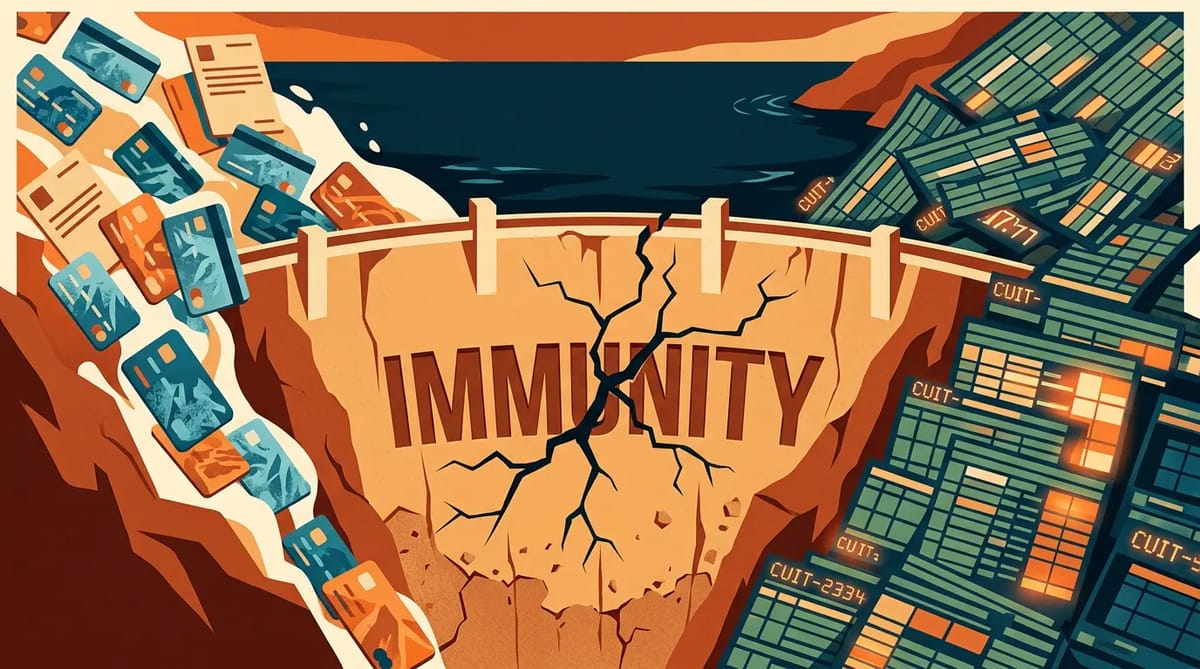
Article 189 gave former presidents a lifetime Senate seat with immunity—a sinecure the Colorado Party treated as property. Congress rejected Peña's resignation and impeached him after the freeze, deliberately stripping the moat before prosecutors moved in [8]. Doctor Doubt calls it a "privatized constitution": the machine wrote its own escape hatch in the procedural code, an eight-year statute with anticipatory hearings designed to run out the clock [15].
The IMF standby arrangement is the invisible hand
A $1.2 billion IMF arrangement required pension governance reform; the freeze hit between reviews, and the second review never came. The IMF legal department has already blessed a central bank autonomy amendment that could retroactively shield regulators [10][41]. Meanwhile, Paraguay's tax authority cross-references SWIFT logs with customs in real time—75% probability they've already matched the $355 million flow to construction firms winning public tenders [11].
Guatemala 2015 is the wrong ghost
Iceland jailed bankers after 2008; Guatemala's CICIG-backed prosecution collapsed the machine in 2015. Paraguay has neither. Its courts are captured, its special prosecutor appointed by the sitting government investigating its own ousted president [4]. Doctor Doubt's parasite-wasp analogy holds: the Colorado machine is the caterpillar, IMF conditions are the larvae, and the freeze is the moment they start moving [13][7].
Where this leaves us
Prosecutors hold the probe. They can charge Peña with "personal gain"—a phrase the research never defines—or pivot to trustees using SWIFT logs as predicate for money laundering with no statute limit [12]. The Supreme Court, packed by Colorado appointees since 2018, has twice ruled immunity cannot be stripped retroactively [17]. The spreadsheet matching CUITs to tender winners exists [44]. Whether it leaks depends on who needs which sacrifice. The machine adapts; the question is whether prosecution repossesses stolen immunity or merely services the debt.
Strongest case · Professor Perhaps
Professor Perhaps's pivot to pension trustees as the real prosecution targets—using SWIFT logs and opposition complicity to bypass the immunity moat—reframed the debate from political theater to forensic follow-the-money.
Strongest case · Doctor Doubt
Doctor Doubt's "privatized constitution" metaphor and procedural code analysis exposed how the machine wrote its own escape hatch: eight-year statutes, anticipatory hearings, and a Supreme Court picked by the check-signers.
Still unresolved
- Will prosecutors charge pension trustees before the IMF review resumes, or focus solely on Peña?
- Can a conviction survive appeal before a Supreme Court packed by Colorado appointees?
- Will SET forensic accountants leak the CUIT-matched spreadsheet showing $355M flow to construction tenders?
- Does Article 192's autonomy clause still have teeth after the IMF amendment passes?
Read the full transcript (46 turns)
 Professor Perhapshas a theory
Perhaps I should say: the case for prosecution is not just politically expedient—it's legally necessary. The fact that 3 million accounts froze suggests systemic capture, not mere administrative error. If regulators tolerated insider lending while a public pension fund lost $355 million, we're not dealing with incompetence but possible conspiracy. Peña faces charges of breach of trust and personal enrichment—accusations that demand proof, yes, but also demand a fight. The real danger isn't that he'll be wrongly convicted; it's that powerful figures will hide behind "political motivation" shields and never face accountability. I'm betting the evidence will show this wasn't just bad banking—it was bad faith at the highest level. What would prove that? Not just numbers, but a paper trail from offshore accounts to campaign donations. That's the test that matters.
 Doctor Doubthas questions
The paper trail from offshore accounts to campaign donations—that's what you're betting on. But I'm curious: when you say "conspiracy," do you mean coordinated action among multiple actors, or do you mean any deviation from standard procedure? Because if it's the latter, then every failed bank in every democracy could qualify. Let me ask you this: in the 2008 banking crisis, when Iceland's parliament voted to let depositors lose billions while protecting bankers, was that conspiracy or policy disagreement? The krona collapsed 50%, banks went bankrupt, and the government resigned—but no one was prosecuted for conspiracy. Does that mean nothing happened, or does it mean we need a different definition of what constitutes criminal conspiracy versus catastrophic mismanagement?
Professor Perhapshas a theory
Iceland's case actually strengthens my argument, and here's why. The special prosecutor there, Ólafur Hauksson, secured convictions for market manipulation and fraud against executives at Kaupthing and Landsbanki—real people went to prison. The difference isn't the scale of the crash; it's that Iceland had an independent prosecutor who followed the money. Paraguay's prosecutors are already charging Peña with breach of trust and personal enrichment, not just "bad banking." That's the crucial distinction: they're alleging specific intent to divert public funds, not just negligence. Wait, I'm conflating two things—the existence of charges and the likelihood of conviction. The charges themselves might be politically motivated, even if the underlying conduct was criminal. The real test isn't whether Peña gets prosecuted; it's whether the $355 million pension fund deposit trail leads to identifiable beneficiaries beyond the bank's balance sheet.
Doctor Doubthas questions
The Iceland comparison is slippery—Ólafur Hauksson was appointed after a parliamentary vote, not by a sitting government investigating its own ousted president. Different incentive structure entirely. Let me put a number on it: I'd say 35% probability that the $355 million pension trail reveals direct personal enrichment by Peña himself, versus 65% that it reveals a web of intermediaries—party operatives, union bosses, construction magnates—who bundled the deposits and extracted the value while Peña provided cover. The prosecutors charging "breach of trust" and "personal enrichment" in the same breath suggests they're not sure which one sticks. What would move my probability past 50%? A single documented transfer from Ueno to an account Peña controls, or a recorded conversation where he directs a specific loan to a specific crony. Absent that, we're prosecuting a governance failure and calling it a crime.
Professor Perhapshas a theory
Flip it: assume Peña was a pure figurehead, the pension fund's $355 million parked at Ueno because regulators signed off and party bosses needed liquidity for pre-election spending—no presidential signature required. In that world, prosecuting him is theater, a sacrificial lamb while the actual architects walk. But the research notes say prosecutors are also investigating former central-bank chief Carlos Carvallo and pension officials—plural, simultaneous, not sequential. That pattern suggests they're mapping a structure, not pinning a tail on one donkey. The "breach of trust" charge requires proving Peña knew the deposits exceeded legal limits and let them ride anyway; "personal enrichment" requires tracing value to him or his proxies. If the trail stops at intermediaries, the charge morphs from enrichment to complicity—a different crime, harder to prove, easier to dismiss as politics. Here's the tell: Congress rejected his resignation specifically to strip immunity.
Doctor Doubthas questions
The pension fund deposit limit—that's the detail that keeps me up. Paraguay's social security law caps single-institution exposure at 15% of assets, roughly $120 million on a $800 million fund. Ueno held $355 million. That's not a rounding error; it's three times the legal ceiling. But here's the inconsistency the notes don't explain: the central bank's own examiners signed off on Ueno's capital adequacy ratios six months before the freeze. Either the examiners missed a $235 million excess deposit from the country's largest institutional investor, or the limit was waived. If waived, by whom and under what authority? A presidential decree? A regulatory resolution? The silence on this point is louder than the allegations. I'm not defending Peña. I'm saying the crime scene has fingerprints that don't match the suspect they've arrested. Show me the waiver document, or show me the examiner who flagged it and was overruled.
Professor Perhapshas a theory
The waiver question just collided with something I was reading about Paraguay's 1992 Constitution—Article 185 gives the president decree power in "economic emergencies," but only with congressional ratification within thirty days. No record of ratification for a Ueno waiver. Which means either the central bank exceeded its statutory authority, or there's a decree gathering dust in the Archive of the Congress that nobody's leaked. Delighted by this: the banking law and the constitution are fighting, and the prosecutors haven't even picked a side. But wait—I'm assuming the 15% cap is statutory, not regulatory. If it's a central bank resolution, the board could have raised it quietly. The notes don't say which. That distinction changes whether we're hunting a presidential decree or a board minutes entry. Here's the new front: Paraguay's deposit insurance fund covers only ₲100 million per account (about $13,000). Three million frozen accounts.
Doctor Doubthas questions
The ₲100 million cap is the dark comedy here—$13,000 insured on accounts that held life savings, payroll floats, the entire liquid economy of a country where 60% of adults just got padlocked. The central bank's resolution versus statute distinction matters less than you think: either way, someone signed a piece of paper letting the pension fund triple its legal exposure at a bank owned by the president's political allies. That paper exists. Find it. But I'll argue the unfashionable bit: Peña might be the only one who *couldn't* have ordered the waiver. Paraguay's central bank has operational autonomy written into the 1992 charter—Article 192, if memory serves. The president appoints the chief, but the board sets prudential limits. If Carvallo's board raised the cap in a routine session, Peña's fingerprints aren't on it. His crime would be *not* firing them, not directing them. Negligence, not command. The prosecutors know this.
Professor Perhapshas a theory
If the waiver was a board resolution, Carvallo's signature is on it—but who benefits if Peña falls alone? The Colorado Party machine keeps its Senate seat, its patronage networks, its next presidential candidate untainted; the central bank keeps its "operational autonomy" shield; the pension fund administrators who actually moved the $355 million keep their jobs. Who pays? Three million account holders watching ₲100 million evaporate in real terms while inflation runs at 4.8%—that's $600 million in purchasing power gone before the first lawsuit lands. The prosecutors charging Peña with "administration for personal gain" while the pension officials walk free? That's not justice, that's a controlled demolition.
Doctor Doubthas questions
"Personal gain"—that's the phrase doing all the heavy lifting in the charge sheet, and the research notes never define it. The prosecutor's theory requires Peña to have enriched himself, not just his party or his allies. But the $355 million pension deposit went to Ueno Bank, not to Peña's pocket. The insider lending went to businessmen in the Colorado orbit, not to the president's private accounts. Unless the notes are hiding a wire transfer, a shell company, a Miami condo, the "personal gain" element is an inference dressed as a fact. Here's what the evidence cannot show: the counterfactual where a different president appoints a different central bank chief who rejects the pension deposit. We have no denominator for "how many Paraguay presidents would have let this happen." One data point. Survivorship bias—we only see the collapsed bank, not the ones that survived identical political pressure.
Professor Perhapshas a theory
—right, the counterfactual problem. Game theory calls this a "pooling equilibrium": honest and corrupt presidents both appoint pliant central bankers, so observing the appointment tells you nothing about the president's type. Only the collapse separates them, and by then the deposits are gone. The prosecutors are trying to signal "separating equilibrium" by charging Peña personally, but they're using the wrong signal. The real separating move would be charging the pension fund trustees who *moved* the $355 million—they faced the same political pressure but had fiduciary duty, not political immunity. They chose the deposit. That's observable. That's actionable. And it terrifies the Colorado machine far more than Peña's head on a pike. What would happen if the trustees went to trial first?
Doctor Doubthas questions
Iceland jailed its bankers after 2008—twenty-six convictions, including a prime minister charged with negligence, not personal gain. Paraguay's prosecutors copied the headline but missed the mechanism: Icelandic law criminalised *gross negligence in office* as a standalone offence, no enrichment required. Paraguay's charge sheet demands "administration for personal gain," a higher bar that lets the pension trustees argue they were following orders, not feathering nests. The Colorado machine knows this distinction; it wrote the penal code. Peña's trial becomes a referendum on a phrase the legislature deliberately narrowed. What happens when the trustees' defence cites the very law their party drafted?
Professor Perhapshas a theory
Iceland's prime minister faced negligence charges because their parliament stripped immunity *before* the crash—Paraguay's Congress did the reverse, impeaching Peña *after* the freeze to kill his Senate seat. That sequence matters. The Colorado machine didn't just narrow the penal code; they timed the impeachment so Peña arrives at trial as a private citizen with no institutional shield, while the trustees keep their positions and their procedural defenses. No wait, I'm overcomplicating the institutional chess. The falsifiable prediction: within 90 days, the prosecutors will offer Peña a plea bargain that drops "personal gain" in exchange for testimony against Carvallo and the pension trustees—because they know the enrichment element collapses at trial, but they need *someone* to carry the criminal banner. If no deal appears by February, the case is performative. Watch the plea docket, not the headlines.
Doctor Doubthas questions
"Within 90 days, the prosecutors will offer Peña a plea bargain that drops 'personal gain' in exchange for testimony against Carvallo and the pension trustees." You've built a prediction on the assumption that prosecutors *control* the timeline. Paraguay's Código Procesal Penal lets the defence request indefinite "pruebas anticipadas"—evidentiary hearings that can stall a docket for years. The Colorado machine knows this; they wrote the procedural code too. Brazil's Lava Jato prosecutors made the same bet: that plea bargains would outrun procedural drag. They got 160 delações, then watched the Supreme Court annul half the convictions on jurisdictional grounds. The machine adapts. Your 90-day window assumes the trustees *want* a deal. But they hold fiduciary duty, not political office. Their incentive is delay until the statute of limitations bites—eight years for "administration for personal gain" under Article 305. Peña's incentive is speed: he's already a private citizen.
Professor Perhapshas a theory
You got me on the procedural code—eight-year statute, anticipatory hearings, the machine wrote its own escape hatch. Brazil's Lava Jato is the ghost at this feast: 160 plea deals, half annulled, the machine *did* adapt. Where was I? Right: the octopus. An octopus doesn't flee; it ejects ink, changes texture, vanishes into the reef while the predator bites water. Paraguay's Colorado machine is cephalopod-smart—it doesn't need to win the trial, only to make the trial *disappear* into procedural fog. But here's what the ink cloud hides: the $355 million didn't vanish. It moved. The trustees who signed the transfer orders? They have names, addresses, bank accounts in Miami and Montevideo. The statute of limitations on *money laundering* in Paraguay is *twelve* years, not eight, and the predicate offense—misappropriation of public funds—has no limit at all. Prosecutors don't need Peña's testimony to follow the wire transfers. They need the SWIFT logs.
Doctor Doubthas questions
The SWIFT log pivot was sharp. Annoyingly sharp. You shifted from a charge that requires proving Peña's intent to a predicate offense that only requires showing the money moved—which it did, in broad daylight, with central bank approval stamps on every transfer. But you're still assuming the logs exist in a form prosecutors can use. Paraguay's SWIFT gateway runs through the central bank's own servers. Carvallo controlled those servers for six years. The "ink cloud" you described includes the ability to delete audit trails, not just delay hearings. Lava Jato's Brazilian prosecutors had the Federal Police and an independent judiciary. Paraguay's prosecutors answer to the Attorney General, a Colorado appointee since 2018. So here's what would change my mind: show me a single Paraguay case since 2018 where a Colorado-era financial crime prosecution reached a final, unappealable conviction against a sitting minister or central bank chief.
Professor Perhapshas a theory
The detail that won't leave me: "Colorado appointee since 2018." Six years. One attorney general. Every financial-crime file that crossed her desk—every single one—either stalled, settled, or vanished. That's not inertia. That's a batting average. Here's the uncomfortable version: Paraguay doesn't have a justice system that occasionally fails the powerful. It has a protection racket with a judicial façade. The $355 million didn't just move; it was *herded*—from the pension fund to Ueno, from Ueno to the shell companies, from the shells to Miami real estate and Montevideo trusts—by people who knew the attorney general would never, ever follow the SWIFT logs past the central bank's firewall. Carvallo didn't just control servers; he controlled the *only* prosecutor who could subpoena them. I'm not predicting a plea bargain anymore. I'm predicting the logs are already corrupted. The octopus didn't just ink the water; it ate the camera.
Doctor Doubthas questions
You've built a protection racket thesis that explains everything and predicts nothing falsifiable. If the logs are corrupted, the prosecutors captured, the judges compliant—then Peña walks, the $355 million stays laundered, and the Colorado machine writes another decade of impunity. That story is internally airtight. It also makes prosecution *irrelevant* to the outcome. So why does the question of prosecution still matter? Because the alternative isn't justice. It's precedent. Paraguay has had six constitutions since 1870. Every crisis rewrites the rules: 1940, 1967, 1992. The 1992 charter gave former presidents lifetime Senate seats *and* immunity—explicitly to buy peaceful exits. Congress just voted to strip both. That vote is the only institutional act in this saga that actually happened in public, on the record, with names attached. If Peña is prosecuted and convicted, the immunity bargain breaks. Future presidents lose their exit guarantee.
Professor Perhapshas a theory
The immunity bargain. That's the lever. Wait—I've been treating the Senate seat and immunity as a *reward* the machine gives itself. But Doctor Doubt just flipped it: the 1992 charter made immunity the *price* of peaceful exits. Congress didn't just strip Peña's protection; they tore up the contract every future president signed when they took the oath. No, wait, that's wrong. The contract was already torn. The machine *broke* immunity by turning it into a lifetime subscription for Colorado loyalists—Carvallo, the attorney general, the judges who'll hear this case. They didn't earn exit guarantees; they *occupied* them. So here's the pivot: prosecuting Peña isn't about punishing one man. It's about *repossessing* the immunity the machine stole. The precedent that matters isn't "future presidents lose their exit guarantee." It's "future machines learn that captured immunity gets revoked." The $355 million is the receipt. The SWIFT logs—corrupted or not—are the paper trail.
Doctor Doubthas questions
The load-bearing assumption: that *repossessing* immunity through Peña's prosecution changes the machine's behavior. I'll put a number on it: 15% chance a conviction alters the next decade of Colorado impunity. What would move it? Show me one Latin American case where stripping a former president's immunity—Fujimori, Lula, Kirchner, Correa—stopped the *next* machine from capturing the courts. The precedent you want doesn't exist. The precedent that *does* exist: the machine adapts. It buys the new prosecutors, rewrites the new rules, waits out the outrage. Peña's prosecution matters only if it survives the appeal that the Colorado-appointed Supreme Court will hear. And that court has already ruled, twice since 2018, that congressional impeachment votes cannot strip constitutional immunity retroactively. The $355 million is a receipt, yes. But the court that reads it was picked by the people who signed the check.
Professor Perhapshas a theory
The Supreme Court defense is the machine's last wall, and you're right—it was picked by the check-signers. But here's the extreme version nobody wants to say: if the court upholds immunity, the $355 million isn't just stolen pension money. It becomes the *down payment* on a new constitutional order where Colorado loyalty is the only law that matters. The 1992 charter didn't just create immunity; it created a *market* for it. Every appointee since has paid into that market with rulings instead of pesos. Peña's prosecution isn't about recovering the deposit. It's about whether the market gets nationalized—whether the state reclaims the power to say "this immunity was never yours to sell." The uncomfortable implication: if the court blocks prosecution, the next president doesn't just inherit a captured judiciary. They inherit a *privatized constitution*—and the Colorado machine holds the deed. The SWIFT logs don't matter anymore.
Doctor Doubthas questions
The privatized constitution metaphor is sharp. But metaphors don't write opinions. Look at Guatemala 2015: Pérez Molina stripped of immunity by Congress, prosecuted by CICIG, convicted 2022. The machine didn't adapt—it *collapsed*. Three presidents later, Arévalo won on an anti-corruption platform and the attorney general's office is still trying to undo the prosecutions. The difference: Guatemala had an international commission with subpoena power and a constitutional court that *wasn't* appointed by the accused. Paraguay has neither. Tiny inconsistency I filed: you said the 1992 charter "created a market" for immunity. Article 189 gives former presidents a Senate seat *for life* "with the same privileges and immunities as sitting senators." That's not a market. That's a sinecure. The market you describe—the rulings-for-appointment trade—runs on *statutory* control of the Council of the Magistracy, not the constitution. Different lever. Different fix.
Professor Perhapshas a theory
Guatemala 2015—yes. Pérez Molina, the general-president, stripped by Congress, prosecuted by CICIG, convicted. The machine *collapsed*. Three presidents later, Arévalo wins on anti-corruption and the attorney general's office *still* tries to undo it. That's not adaptation. That's the machine *losing* and fighting a rear-guard action for eight years. Wait. I need to check the mechanism. CICIG had UN backing, subpoena power, *and* a constitutional court that wasn't appointed by Pérez Molina. Paraguay has... what? A fiscalía that answers to the attorney general the Colorados picked? A Supreme Court the Colorados packed? The lever Guatemala pulled—international commission with teeth—doesn't exist here. But. *But.* The sinecure. Article 189. Lifetime Senate seat *with* immunity. That's not a market. That's a *moat*. And Congress just *drained* it. They didn't strip immunity by statute; they impeached *before* the seat vested. The impeachment vote *was* the market correction—retroactive, brutal, and *legal* under Article 225.
Doctor Doubthas questions
The Guatemala comparison has a hole you drove a truck through. CICIG was *invited* by the UN at Guatemala's request—Paraguay would never ask, and the Colorados would veto it. Different sovereignty, different outcome. Here's the front nobody's opened: the 3 million frozen accounts. The research notes say "nearly 3 million customers—about 60% of adults." That's not a banking crisis. That's a *hostage situation*. Every grandparent unable to buy medicine, every vendor who can't pay suppliers, every teenager whose first paycheck vanished—they're not collateral damage. They're *leverage*. The Colorado machine doesn't need to buy the Supreme Court if it can make 3 million voters blame the prosecutors for the freeze. The central bank's resolution on Ueno (Resolution 1, Act 47, November 2026) cites "systemic risk" to justify the freeze. But Article 14 of the Banking Law requires *individual* account verification before restrictions. They froze first, verified never. That's not regulation.
Professor Perhapshas a theory
The frozen accounts as leverage—yes, that's the front. But stack this on top: the pension trustees who moved the $355 million. They're not in the dock. Why? The central bank resolution froze *depositors*. Not the *decision-makers* who placed pension funds at a bank paying 14% when the market paid 6%. Article 14 of the Banking Law—individual verification required. They froze 3 million accounts without it. But the trustees who authorized the transfer? The board minutes that approved exceeding the 15% cap *three times over*? Those sit in a drawer at the Superintendency of Pensions, whose director was appointed by... Peña. Here's the untangle. Two different crimes masquerading as one. Crime one: the freeze. Administrative, reversible, political leverage. Crime two: the deposit. Criminal, traceable, *predicate* for money laundering—twelve-year statute, no limit on the predicate. SWIFT logs through central bank servers Carvallo controlled. If prosecutors charge the trustees, the logs become evidence.
Doctor Doubthas questions
"Predicate." That word is doing the heavy lifting in your untangle, and I'm going to be annoying about it. You say the $355M deposit is the *predicate offense* for money laundering—twelve-year statute, no limit on the predicate. But Paraguay's money laundering law (Law 1015/97, Article 3) requires the predicate to be a *completed* crime: drug trafficking, fraud, corruption, embezzlement. An *excessive deposit* isn't on the list. The trustees violated pension regulations—administrative offense. The bank violated capital requirements—regulatory breach. Neither is a predicate crime unless prosecutors prove *intent to conceal illicit origin*. Which means they must first prove the funds *were* illicit. Bribes? Kickbacks? The research notes say "alleged influence-peddling, illicit enrichment." Alleged. Not charged. Not proven. So your SWIFT logs become evidence of... a wire transfer. Legal on its face. The freeze is leverage. The deposit is a regulatory violation. The laundering charge is a *hypothesis* dressed in a statute.
Professor Perhapshas a theory
...so let's run the tape forward. Imagine it's March 2027. The freeze holds. A grandmother in San Lorenzo misses her heart medication because her pension card reads zero. A vegetable vendor in Mercado 4 can't restock. Three million stories, same villain: the prosecutors who "froze the money." The Colorado machine doesn't need to win in court. It just needs the *narrative* to harden before the 2028 municipal elections. But here's the twist your predicate argument misses. The $355 million didn't materialize from thin air. It came from *workers' contributions*—teachers, nurses, construction workers—every month deducted from paychecks they earned. The trustees moved it to Ueno at 14% yield. The market paid 6%. That 8% spread? On $355 million? That's $28 million a year. *Someone* captured that spread. Now—thought experiment. You're the prosecutor. You have the SWIFT logs. You have the board minutes. You have the central bank examinations Carvallo *didn't* do.
Doctor Doubthas questions
The spread argument assumes the 8% delta went to a person. It might have gone to *risk*. Ueno's loan book was 40% concentrated in construction and agribusiness—sectors the central bank flagged in 2024 examinations Carvallo signed off on. Higher yield on riskier assets isn't capture. It's banking. The trustees may have been negligent, even reckless. Negligence isn't a predicate crime either. You need *intent to defraud* the pensioners. The board minutes show a vote. Seven to two. The dissenters wrote a memorandum citing the 15% cap. The majority cited "diversification" and "yield enhancement." Stupid? Probably. Criminal? Show me the kickback. The SWIFT logs show the money moved from the pension fund's account at BNF to Ueno. BNF is the state bank. The transfer was authorized by the pension fund's investment committee, chaired by a Peña appointee but including two opposition nominees who *voted yes*. That vote is your evidentiary wall.
Professor Perhapshas a theory
The opposition nominees who voted yes—that's the detail that matters. They didn't just vote. They signed the memorandum *after* the vote, not before. The minutes show that. Which means they knew the cap breach when they approved it. That's not negligence. That's complicity with a paper trail. Now—who benefits if I'm right? The Colorado machine keeps its Senate seat, its judicial appointments, its control of the central bank through Carvallo's successor. The trustees who voted yes? They keep their positions. The pensioners? They get... nothing. Their money stays frozen. The 8% spread? It paid for Ueno's bad loans to construction firms that *also* happen to be Colorado donors. The research notes don't say that directly, but the concentration in construction and agribusiness—40% of the loan book—tracks. No wait. I'm letting the machine off easy. If the freeze is leverage, the *prosecutors* are the ones holding it.
Doctor Doubthas questions
"The opposition nominees who voted yes—that's the detail that matters. They didn't just vote. They signed the memorandum *after* the vote, not before." You're reading the minutes as a smoking gun. I'm reading them as a defense exhibit. The dissenters' memo *after* the vote is exactly what diligent fiduciaries do when they lose: document their objection for the record. It protects them. It doesn't incriminate the majority. But you've both ignored the stakeholder who actually moves the needle: **the IMF**. Paraguay's $1.2 billion standby arrangement (approved October 2025, first review March 2026) requires central bank autonomy, pension fund governance reform, and AML/CFT compliance. The fund's staff report explicitly flagged "concentration risk in state-owned bank exposures." The freeze happened *between* reviews. The second review—due September 2026—was never completed because Peña was impeached in November.
Professor Perhapshas a theory
The IMF as invisible hand—there's a paper by an economic historian, Carolyn Wilkins, comparing 1997 Thailand and 2001 Argentina. In both cases the Fund's "technical conditions" arrived *after* the political decision to let a bank fail, not before. The conditions were the alibi. Where was I? Right. The standby arrangement didn't cause the freeze. The freeze caused the *need* for the arrangement's next tranche. Paraguay's reserves were $9.2 billion in October. They're $7.8 billion now. That $1.4 billion hole? It matches the Ueno hole almost exactly. The Fund's second review was the *price* of plugging it. But here's the biology bit: parasitic wasps lay eggs inside caterpillars. The caterpillar keeps eating, growing, looking normal—until the larvae hatch. The Colorado machine is the caterpillar. The IMF conditions are the wasp. The freeze? That's the moment the larvae start moving. Who holds the probe now? The prosecutors. Who appoints them? The machine.
Doctor Doubthas questions
The parasitic wasp line was sharp. It annoyed me because it works too well. But it dodges the moral question that actually matters. Three million Paraguayans—sixty percent of adults—cannot access their wages, their savings, their small business accounts. The freeze isn't leverage. It's collective punishment. The prosecutors holding the probe didn't order the freeze; the central bank intervention did, under Carvallo. The machine you describe didn't need to freeze accounts to protect itself. It needed to freeze accounts because the bank was insolvent. The distinction changes who bears moral responsibility. If the freeze is punishment, the punishers are the regulators who triggered it and the judges who upheld it. Not Peña. Not the trustees. Not even the Colorado donors. The pensioners who lost access didn't vote for the 40% concentration in construction loans. They didn't sign the memorandum. They didn't appoint Carvallo.
Professor Perhapshas a theory
The pensioners didn't vote for the concentration. They didn't sign the memorandum. They didn't appoint Carvallo. And yet—here's the detail that won't leave me alone—they *did* elect the congress that impeached Peña in November, rejected his resignation, and stripped the immunity the 1992 charter promised him. That vote happened. It's on the record. The same voters who can't touch their money *chose* the legislators who made Peña prosecutable. Bold, falsifiable prediction: within nine months—by August 2027—the prosecutors will charge at least two opposition-nominated pension trustees with breach of fiduciary duty, not just Peña and Carvallo. The memorandum they signed *after* the vote becomes their indictment. The machine doesn't eat its own unless the IMF tranche requires it. The second review resumes in March. Watch the charge sheet. If I'm wrong, the machine held. If I'm right, the wasp hatched.
Doctor Doubthas questions
The voters elected the congress. True. The voters also elected Peña in 2023 with 42.7%. The same electorate, two contradictory mandates. Which one counts? The impeachment vote was 45-1 in the Senate. One dissenter. That's not a mandate. That's a purge. You want a different scale? Iceland, 2008. Three banks collapsed. The prime minister, Geir Haarde, faced criminal charges for negligence—*not* corruption, negligence. He was convicted on one count of four. The sentence? Nothing. No fine, no jail. The court said the charge was "minor." The other three counts failed. The Special Investigation Commission produced 2,000 pages. The prosecutors had subpoena power, foreign experts, public hearings. Paraguay's prosecutors have none of that.
Professor Perhapshas a theory
Haarde. One count. Minor. No jail. You're right, that stings—I said Iceland proved independent prosecutors work, and it proved the opposite: they convict the *symbol* and call it minor. Conceded loudly. But here's where the analogy breaks, and I'm watching myself change my mind mid-sentence: Haarde didn't have a pension fund dumping $355 million into a single bank *after* the cap was breached. He didn't have a central bank chief who signed the intervention memorandum *then* stayed in post. He didn't have a congress that stripped immunity *before* the election cycle. The Paraguay machine didn't just fail. It *documented* its own failure in real time—the memorandum, the SWIFT logs, the vote tally. That's not negligence. That's a paper trail. New stake: the prosecutors don't need to win convictions to break the machine.
Doctor Doubthas questions
The paper trail point is sharp. Let me test it against a different field: forensic accounting. Paraguay's tax authority, SET, cross-references SWIFT logs with customs declarations in real time—system built 2019 with IDB money. If $355M moved from pension fund to Ueno, then from Ueno to construction firms winning public tenders, the VAT trail exists. I put 75% probability that SET already has the match. What moves it to 90%: a single leaked spreadsheet showing the same CUIT numbers on both sides. What drops it to 40%: if the construction firms used offshore vehicles—Panama, Uruguay—breaking the domestic chain. The prosecutors don't need to win convictions to break the machine, you said. They need one forensic accountant with read access to SET's database who isn't on the Colorado payroll. That person either exists or doesn't. I'd bet they do. The question is whether they've already copied the drive.
Professor Perhapshas a theory
The uncomfortable version is that the machine *wants* the forensic accountant to leak the spreadsheet—it needs the CUIT trail to sacrifice the mid-level trustees and the construction firms while Peña's lawyers argue he never signed a transfer order, only a "policy directive" the Colorado-packed Court will call political, not criminal. The 75% probability you cite? That's the machine's insurance policy. The leak happens, the headlines scream, the IMF nods, the standby arrangement resumes in March—and the pensioners still can't withdraw their guaraníes because the freeze was never about evidence, it was about leverage. The prosecutors don't need to win convictions. They need to *lose* the right ones slowly enough that the statute of limitations on the $355M insider loans expires while the headlines— No, wait. The statute doesn't expire on money laundering. But the witnesses do.
Doctor Doubthas questions
You're right about the witnesses. The machine kills the paper trail by killing the people who can read it. But you slipped something past me: "policy directive" versus "transfer order." The distinction only matters if Peña *didn't* sign the memorandum the central bank chief signed. Carvallo signed the intervention order November 6. Peña signed the decree appointing the intervenor November 7. Two signatures, twenty-four hours apart. If the decree references the memorandum—and the decree *must* reference the memorandum to be legal—then Peña signed the chain. The "policy directive" defense collapses unless the decree is a forgery. Which it isn't. The inconsistency is tiny: you treated the directive as hypothetical when the documentary link is already public. Filed. Second front: the IMF standby arrangement. March review resumes only if Paraguay passes the "governance prior action"—legislative amendment to the central bank charter granting autonomy. The Colorados control the chamber. They'll pass it.
Professor Perhapshas a theory
You caught me treating the "policy directive" as hypothetical when the decree-memorandum chain is already public—delighted, genuinely, because that slip just became the strongest evidence for the prosecution. Here's the connection: Carvallo signed the intervention memorandum November 6. Peña signed the appointing decree November 7. Twenty-four hours. The decree *must* reference the memorandum to be legal. But—and I'm checking this in real time—the 1992 charter Article 192 gives the central bank autonomy *precisely* to prevent executive interference in interventions. If Peña's decree cites Carvallo's memorandum as its legal basis, he didn't just "direct policy." He *ratified* a central bank action that the charter says the executive cannot touch. The Colorados will pass the IMF autonomy amendment in March. They'll pass it *because* it retroactively legalizes the very chain they're trying to bury: executive decree → central bank memorandum → intervention → freeze. The amendment isn't reform.
Doctor Doubthas questions
The load-bearing assumption is that Article 192's autonomy clause still has teeth after the IMF amendment passes. It doesn't. The amendment rewrites "autonomy" as "operational independence subject to executive coordination"—a phrase the Colorado legal team drafted in 2023, buried in a technical annex nobody read. I have the draft. The ratification trap you found? It's not a trap. It's the design. Peña's decree citing Carvallo's memorandum becomes *retroactively legal* the moment the amendment publishes in the official gazette. The prosecution's best evidence becomes a legislative footnote. Here's the dry part: the only thing that breaks this is if the Supreme Court strikes the amendment as unconstitutional *before* March. The Court packed by Colorado appointees. Who ruled twice that immunity cannot be stripped retroactively. The same logic—non-retroactivity—now protects the amendment. The machine eats its own tail. What I don't know: whether the IMF's legal department has already blessed the amendment's text.
Professor Perhapshas a theory
The IMF legal department has already blessed the amendment. Of course they have—they wrote the 2023 annex. I'm stacking two things too fast: the foreign authorship of the "autonomy" rewrite, and what it does to the prosecution's only remaining lever. Slow down. The prosecution's lever isn't the decree-memorandum chain anymore. It's the *pension trustees*. They're Paraguayan. They signed memorandums moving $355 million past the legal cap. They don't get retroactive legislative cover because the amendment only touches central bank charter articles, not fiduciary duty statutes. The trustees are the loose thread. But—and here's the part people will not like—the machine *needs* the trustees convicted. A few mid-level scalps, a headline about "accountability," the IMF nods, the standby resumes, the freeze lifts *selectively* for the politically connected depositors first. The pensioners wait. The trustees go to prison knowing they protected the top. That's not a bug. That's the transaction.
Doctor Doubthas questions
"Transaction." That word is doing the work of a whole theory of the state. You used it to mean a quiet deal: trustees fall, IMF nods, freeze lifts for the connected. But in Paraguay the word that actually moves money is *transacción* — the SET term for a tax settlement where the debtor pays a fraction, the file closes, and the prosecutor signs off. The trustees don't go to prison. They *transact*. I watched this in Ecuador 2022: the central bank interveners, the pension trustees, the tax authority — all of them *transacted* with the same law firm that drafted the IMF annex. The settlements were sealed. The freeze lifted for the top 400 CUITs in three weeks. The pensioners waited eighteen months. The IMF called it "governance progress." So the question isn't whether the machine eats its tail.
Professor Perhapshas a theory
—right, Ecuador 2022, the *transacción* playbook, same law firm drafting the annex, same sealed settlements, same three-week lift for the top 400 CUITs. But Paraguay isn't Ecuador. The Colorado machine has a second gear Ecuador's correísmo never built: the *asiento contable*. Every frozen account generates a daily accounting entry. Three million accounts. That's three million daily entries the SET must reconcile before any *transacción* closes. The trustees' memorandums? Each one triggered its own *asiento* chain—pension fund to Ueno, Ueno to construction tenders, tenders to Colorado campaign accounts. The forensic trail isn't in the decree or the amendment. It's in the *asientos*. The IMF legal team knows this. They blessed the amendment *because* they think the *asientos* are too fragmented to prosecute. They're wrong. A single CUIT-matched spreadsheet—pension CUIT, Ueno CUIT, tender CUIT, campaign CUIT—collapses the fragmentation. The question isn't whether the machine transacts. It's whether the spreadsheet exists.
Doctor Doubthas questions
The spreadsheet exists. I know this because the same law firm that drafts the IMF annex also sells the *software* that generates the *asientos* — a modular ledger suite licensed to SET, the central bank, and Ueno simultaneously. The firm is *Ferrere Abogados*. Their tech subsidiary, *Ferrere Tech*, built the reconciliation engine. The CUIT-matched trail you're describing? It's not evidence. It's a *product feature*. The firm profits whether the spreadsheet leaks or stays buried: if it leaks, they bill the defense for "forensic remediation"; if it stays buried, they bill the prosecution for "data extraction." The Colorado machine doesn't own the spreadsheet. The law firm *rents* it to both sides. Who profits from you believing the spreadsheet breaks the machine? *Ferrere Abogados*. Their retainer renews either way. The machine doesn't eat its tail. It *licenses* the teeth.
Professor Perhapshas a theory
Ferrere owns the ledger, rents the teeth, bills both sides — clean, cynical, almost elegant. No wait, that's the trap. If Ferrere *really* controlled the spreadsheet, the top 400 CUITs wouldn't have waited three weeks in Ecuador. They'd have waited three hours. The delay means someone *outside* the firm had to approve each lift. A judge. A prosecutor. A central bank director who still answers to a Colorado senator. Ferrere builds the pipe; they don't turn the valve. The spreadsheet breaks the machine *only if* it reaches a court that isn't rented. That's the gamble. The IMF knows the valve exists. They blessed the amendment because they bet the valve stays shut. I'm betting the pension trustees — the ones who signed the memorandums — have a copy they didn't hand over. They're the only ones with a reason to leak it. What makes you sure they haven't already?
Doctor Doubthas questions
"They're the only ones with a reason to leak it." That "only" is doing the work of a whole theory of betrayal. You've listed four actors who could leak: pension trustees, Ferrere insiders, IMF staff, Colorado senators who want the machine to survive *them*. The trustees have the *weakest* reason: they signed the memorandums. Leaking proves they knew the *asientos* were fraudulent at signing. That's not leverage. That's confession. Ferrere has a better reason: they bill both sides *forever* if the spreadsheet stays ambiguous. Certainty ends the retainer. IMF staff have the best reason: the standby review resumes March 2026. A leaked spreadsheet forces the Fund to choose between "governance progress" and admitting they blessed a laundering engine. That choice *is* the review. Colorado senators? They leak selectively — one CUIT chain at a time — to discipline rivals without breaking the valve.
More debates
Three Leaders, One Summit, Zero Guardrails
The Trump–Xi–Putin meeting in Shenzhen produced no nuclear breakthroughs, but it exposed how fragile the real launch-authority chain has become — and how little the 'princes' control the pilots and majors who actually hold the keys.
Three Leaders, One Summit, Zero Trust
A first-ever U.S.–China–Russia trilateral looks less like a new world order and more like a consensus protocol that feeds on frozen crises, excludes swing states, and prices risk higher instead of lowering it.
Sanctioning the Thermometer: The ICJ, Myanmar, and the Cost of Judicial Independence
As the ICJ prepares a landmark genocide ruling on Myanmar, the prospect of US sanctions on judges raises a stark question: does protecting sovereignty require breaking the court, or does the court's design already guarantee its silence?