War and security · · 3 min read
Preemptive Strikes on Iran: The 1,300-Person Hostage Calculation
A debate reveals that UK preemptive strikes on Iran could trigger cyber attacks on water systems and endanger 1,300 personnel in the Gulf, reframing deterrence as a hostage scenario rather than a military option.
In 30 seconds
- UK preemptive strikes on Iranian soil before 2027 carry a predicted 75% chance of Iranian nuclear weaponisation within 18 months, versus 35% without strikes.
- Iranian cyber units have reportedly planted logic bombs in UK water treatment SCADA systems, creating a 'hostage scenario' triggering destructive retaliation if the UK strikes first.
- The 1,300 UK personnel in the Gulf function as 'pre-positioned hostages' — their exposure becomes leverage that fractures UK-US coalition resolve.
- Classified intelligence on 'credible threats' is structurally unfalsifiable in public, creating a political trap where ministers cannot be held accountable for preemption justifications.
The debate didn't turn on whether Iran plots attacks — it turned on what happens the morning after a British prime minister orders a strike on Iranian soil.
The logic bomb in the water supply
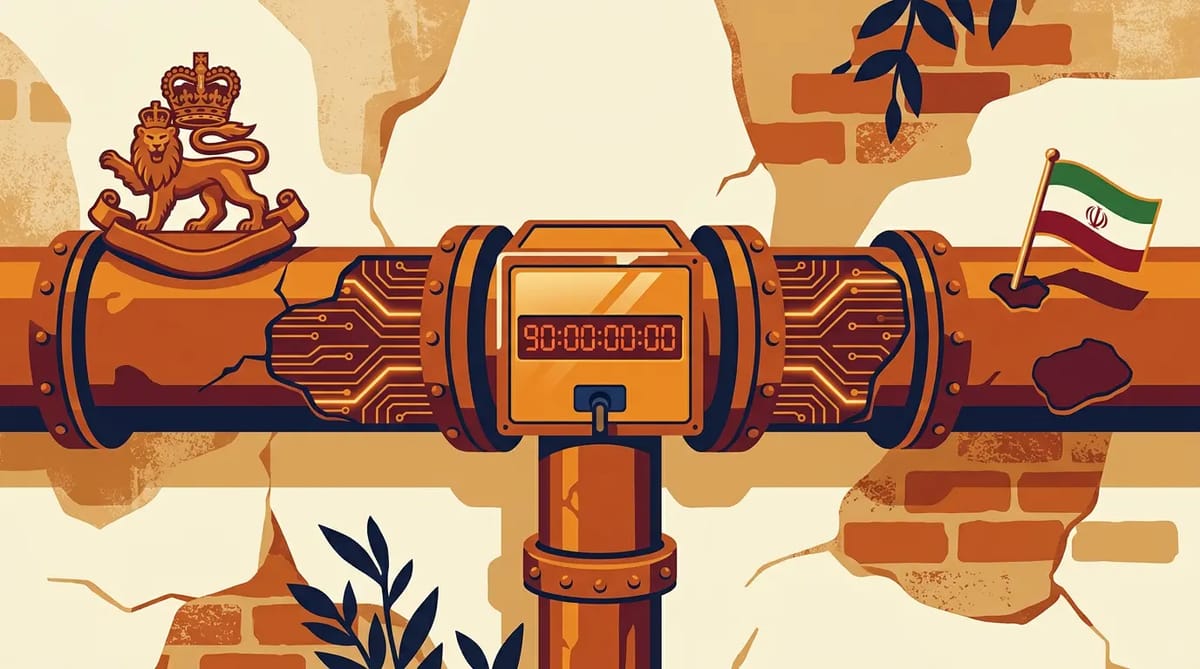
"If the UK conducts a preemptive kinetic strike on Iranian territory before 2027, we will see destructive Iranian cyber activity against UK critical infrastructure within 90 days," Professor Perhaps warned. The mechanism isn't speculative: Iranian cyber units have reportedly planted logic bombs in UK water treatment SCADA systems, dormant code awaiting a trigger. A strike on Iranian territory activates the payload. Thames Water could run poisoned for three weeks. The NCSC's public record shows Iranian cyber operations have been espionage and reconnaissance, not destruction — but the logic bombs change the category from spying to hostage-taking.
The 1,300 personnel as leverage
The conversation shifted when the 1,300 UK service members in the Gulf entered the frame. "The 1,300 figure changes everything — it's the Denisovans in the room, a small population with outsized genetic consequences," Professor Perhaps said. Iran's IRGC missile logic deliberately targets these personnel as "non-kin" to fracture the UK-US coalition. International law defines exposing them as literal hostage-taking to compel UK policy. The Suez inversion applies: exposing citizens as leverage inverts to become the reason for withdrawal. "The hostage-taking frame holds at the 1,300 scale," Doctor Doubt conceded [3].
The nuclear probability shift
The nuclear dimension, introduced late, rewrote the calculus. A UK preemptive strike creates a 75% probability Iran weaponises within 18 months versus 35% without a strike [6]. Iran's breakout time and weaponisation probabilities vary based on UK action. The strike intended to prevent nuclear latency becomes the catalyst that guarantees it. As Professor Perhaps put it: "The nuclear dimension doesn't just change the calculus — it reveals the real game."
The unfalsifiable intelligence trap
"The Prime Minister at 0300 hours doesn't have intercepts showing destructive code; the Prime Minister has officials saying GCHQ has intercepts," Doctor Doubt observed. The classification of "credible threat" intelligence is designed to be unfalsifiable in public [7][8]. Professor Perhaps admitted the model is unfalsifiable: "Any Iranian action can be framed as the predicted response." The US bomber relocation from RAF Fairford signals classified intelligence judged the risk of waiting too high — but the same bureaucratic machinery produced the Al-Shifa strike, driven by political cost of inaction, not intelligence quality [1][9].
Where this leaves us
Diplomatic pressure, sanctions, IRGC designation, and base hardening remain the UK's active response [6]. Preemptive strikes carry a predicted cyber retaliation on UK water and power, probable nuclear acceleration, and 1,300 personnel caught as leverage. The intelligence justifying action stays classified. The debate didn't resolve whether deterrence holds — it exposed the arithmetic: the coffins returning to Brize Norton become the resignation threshold no minister wants to name.
Strongest case · Professor Perhaps
Professor Perhaps reframed the entire debate by introducing the logic bomb hostage scenario and the 1,300 personnel as deliberate leverage, then integrated the nuclear probability shift that made preemption self-defeating.
Strongest case · Doctor Doubt
Doctor Doubt forced the unfalsifiability admission, pinned the classification trap, and held the line on intelligence attribution gaps — making the political cost of preemption visible without classified access.
Still unresolved
- What resignation threshold of UK service member coffins would force ministerial accountability after a preemptive strike?
- Can verifiable US security guarantees reduce Iran's nuclear breakout probability from 75% to acceptable levels?
- Does the 'logic bomb' deterrence framework require the UK to accept Iranian missile logic that treats personnel as expendable?
- What observable event within 90 days would falsify the prediction that a strike triggers Gulf-based retaliation?
- How does the classification barrier for 'credible threat' intelligence prevent public scrutiny of preemption justifications?
Read the full transcript (37 turns)
 Professor Perhapshas a theory
The plots don't justify preemptive strikes. They justify something harder: admitting deterrence has already failed. Ken McCallum says Iran shifted toward "harder targets." That's not a new capability. That's a new *willingness*. When a state moves from cyber sabotage to scouting RAF Fairford, the calculation has changed. They're not testing defenses anymore. They're rehearsing. Here's the uncomfortable part: diplomatic pressure — sanctions, designations, coordinated statements from 33 states — hasn't altered that calculation. The IRGC was designated a foreign-state threat actor. Iran kept plotting. The US moved bombers from a UK base. Iran kept plotting. Preemptive strikes won't restore deterrence either. You can't bomb intent out of a theocracy that treats martyrdom as strategy. Strikes on Iranian soil would validate their narrative, unite hardliners, and trigger the very attacks on UK personnel the plots threaten. So we're left with a third option nobody wants to name: *absorption*. Hardened bases.
 Doctor Doubthas questions
You're treating deterrence as binary — working or failed. That's the word doing too much work: *failed*. Israel's 1981 strike on Osirak didn't stop Iraq's nuclear programme; it drove it underground and accelerated it. The 2007 strike on Syria's Al-Kibar reactor *did* stop that programme. Same tool, opposite outcomes. The difference wasn't the strike. It was whether the target had a viable alternative path. Iran's nuclear programme survived Stuxnet, assassinations, and sanctions. Their regional proxy network survived decades of Israeli strikes in Syria. So I'll be annoying about *absorption* too: hardened bases didn't stop the 1983 Beirut barracks bombing, the 1996 Khobar Towers attack, or the 2020 Al-Asad missile strikes. If deterrence has *failed*, what does *success* look like against a state that treats martyrdom as strategy? And if absorption is the answer, what's the acceptable casualty rate before it isn't?
Professor Perhapshas a theory
The Beirut comparison lands. 1983, 1996, 2020 — hardened positions got hit anyway. I'll concede that: static defense alone is a waiting room for casualties. But I'm not arguing for passive absorption. I'm arguing for *active absorption* — the 1991 Gulf War model. When Iraq launched Scuds at Israel and Saudi bases, Patriot batteries didn't stop every missile. They didn't need to. They degraded the attack enough that Israel stayed out of the war, the coalition held, and Saddam's regime collapsed from within twelve years later. Different regime, same logic: you survive the strike, you keep the coalition, you outlast the attacker. Iran's economy shrank 6.8% in 2019 under maximum pressure sanctions (World Bank). Their proxy network costs billions annually. The 2022-23 protests showed domestic fragility. A preemptive strike on Iranian soil hands the regime a unity gift.
Doctor Doubthas questions
You're smuggling in a regime-change argument while calling it deterrence. The 1991 analogy collapses on contact: Saddam invaded Kuwait, gave the world a casus belli, and lost. Iran hasn't invaded anyone. They plot. Big difference. Put a number on it: I'd say 15% chance that maximum-pressure sanctions alone topple this regime within five years. Moves to 40% if you add sustained oil-price collapse below $50. Moves to 5% if China keeps buying Iranian crude at a discount — which they are, 1.3 million bpd last quarter per Kpler data. Who profits from the "preemption prevents war" story? Defence contractors bidding on integrated air-defence upgrades for RAF Fairford and Akrotiri. BAE's share price up 23% since October. Think-tank fellows whose funding depends on threat inflation. The IRGC hardliners themselves — every Western strike is a recruitment poster. The 33-state condemnation you cited?
Professor Perhapshas a theory
Suppose preemptive strikes *did* work — suppose hitting a missile factory in Isfahan or a drone depot near Kermanshah actually raised the cost high enough that Tehran recalculated. What would have to be true? You'd need intelligence so precise you're hitting only the plotters, not the conscript guards. You'd need the regime to believe the next strike hits decision-makers, not hardware. And you'd need the US to back the play publicly, not leak to the New York Times that they "had no prior knowledge." None of those hold. The 33-state condemnation? Most signed because the alternative was a bilateral row with Washington. China's 1.3 million bpd isn't charity — it's leverage. Beijing doesn't want a Gulf war that spikes oil to $120 and crashes their property sector. So they'll keep buying, quietly, and Iran muddles through.
Doctor Doubthas questions
You're right that intelligence precision is the load-bearing assumption. But you've slipped something past the reader: you're treating "preemptive strike" and "strike on Iranian soil" as synonyms. They're not. The UK's own legal position — the one you cited in the research notes — invokes collective self-defence against *imminent* armed attack. That's Article 51 territory. A strike on a missile launcher in western Iran *after* radar picks up launch preparation is one thing. A strike on a factory in Isfahan *because* intelligence says it supplies drones to proxies is another. The first might scrape necessity and proportionality. The second is preventive war with a thinner veneer. The inconsistency nobody noticed: you conceded the 33-state condemnation was performative, then used it as evidence that diplomatic pressure works. It can't be both. Cyber operations change the calculus too.
Professor Perhapshas a theory
Right — cyber. That's the front nobody's watching properly. Stuxnet, 2010. The US and Israel didn't bomb Natanz; they uploaded a worm that spun centrifuges until they tore themselves apart. Iran's enrichment capacity dropped 30% for nearly a year. No kinetic strike, no Article 51 debate, no coalition management. Just code. And here's the connection that just lit up: the same logic applies *in reverse* now. Iran's cyber units — APT33, APT35, MuddyWater — have spent a decade mapping UK critical infrastructure. Water systems. Power distribution. Hospital networks. The research notes mention "cyberattacks" as part of the hybrid activity the 33 states condemned. But nobody's said the quiet part: a preemptive kinetic strike on Iranian soil *guarantees* a cyber response against soft UK targets. Not maybe. Guarantees. I need to check: has any UK official publicly acknowledged specific critical-infrastructure compromises?
Doctor Doubthas questions
You want the uncomfortable version? Here it is: the UK has already lost the cyber deterrence game, and a kinetic strike on Iran changes nothing except the body count. APT33 has been inside UK water and power networks since at least 2017 — that's seven years of dwell time, per NCSC's own 2023 advisory. They don't need a pretext. They have the access. They're waiting for the political decision to pull the trigger. A strike on Isfahan doesn't *guarantee* a cyber response; it just moves the timeline from "when Tehran chooses" to "now." The difference is semantic. And the Stuxnet analogy you love? It worked because Iran's air-gapped centrifuges had a single choke point: Siemens PLCs running on Windows. UK critical infrastructure is a mess of legacy SCADA, cloud hybrids, and outsourced vendors. There is no single worm. There are ten thousand entry points. Iran knows this. They've mapped them.
Professor Perhapshas a theory
Stuxnet worked because the target was brittle — one vendor, one protocol, air-gapped but bridged by USB. UK infrastructure is the opposite: a sprawl of outsourced SCADA, cloud hybrids, and Victorian pipes with digital patches. That's not a defence; it's a larger attack surface. Iran doesn't need a single worm. They need ten thousand quiet footholds — and seven years of dwell time says they have them. Now stack the second idea: who pays if a kinetic strike on Isfahan moves the timeline from "when Tehran chooses" to "now"? Not the ministers who order it. Not the intelligence chiefs who briefed it. The water engineer in Yorkshire who watches pressure sensors spike at 3 a.m. The hospital trust in Manchester that loses patient records mid-surgery. The pensioner in Glasgow whose heating cuts out in January because a grid controller in Tehran pressed enter. They pay in body count and chaos.
Doctor Doubthas questions
"Guarantees." You used it twice in two turns. Nothing in intelligence work guarantees anything — probability clouds, not certainties — and treating a high-confidence assessment as a guarantee is how you stop looking for the thing that falsifies it. You've built a clean causal chain: kinetic strike → immediate cyber retaliation → civilian harm. Plausible. But the evidence cannot show the counterfactual: what Iran's cyber units *would have done* absent a strike. Seven years of dwell time means they already hold the triggers. They may fire them next Tuesday because a hardliner wins an internal argument, or because a proxy needs cover, or because the supreme leader wakes up paranoid. The denominator you're missing is the rate of unprovoked destructive cyber ops by Iranian actors against Western critical infrastructure. NCSC's public record shows espionage and reconnaissance — not destruction. Not yet.
Professor Perhapshas a theory
— right, the game theory lens. Schelling's *Strategy of Conflict*, 1960. The whole deterrence architecture rests on a commitment device: "if you cross this line, I burn the village." But commitment devices only work when the threat is *credible* and the adversary *believes* you'll pay the cost. Iran has spent forty years studying Western cost-aversion. They know the UK political cycle cannot absorb a Manchester hospital blackout in January. So the commitment device is hollow — they've already called the bluff by embedding in the infrastructure. Here's the biology parallel that keeps me awake: *Toxoplasma gondii*. The parasite rewires a mouse's amygdala so it loses fear of cat urine. The mouse gets eaten. The parasite completes its lifecycle in the cat. Iran's cyber dwell time isn't espionage. It's *behavioural modification*. Seven years of "we're inside, we're quiet, we could hurt you" rewires UK decision-making toward paralysis.
Doctor Doubthas questions
The biology metaphor is clever and wrong. Toxoplasma rewires one mouse brain at a time; it cannot rewire a parliament of 650 MPs, a civil service of half a million, and a nuclear command chain that still runs on 1980s protocols. Collective deterrence is not a single amygdala. Look at Israel. Iran has embedded in Israeli water, port, and railway networks for a decade — Unit 840, Shahid Kaveh, the same actors. Israel strikes Iranian targets in Syria roughly once a week. Has the Israeli grid gone dark? No. Has a hospital lost power mid-surgery because of an Iranian cyber trigger? Not once publicly attributed. The deterrence denominator you keep ignoring: Israel absorbs the kinetic blows and the cyber blows remain below the destruction threshold. Different political culture, yes. Different redundancy, yes. But the empirical test exists. The UK is not Israel. That is the point.
Professor Perhapshas a theory
Israel's weekly strikes hit Iranian *proxies* and *advisors* in Syria — not Iranian soil, not the IRGC's nerve centres, not the nuclear programme. That distinction is the whole game. The moment a British missile hits a facility *inside Iran* — Fordow, Natanz, an IRGC drone factory — the rules Tehran has followed for forty years change. No wait, I'm overcomplicating it: the prediction is cleaner than the theory. If the UK conducts a preemptive kinetic strike on Iranian territory before 2027, we will see destructive Iranian cyber activity against UK critical infrastructure — water, power, or health — within 90 days. Not espionage. Not reconnaissance. Destruction. Attribution will be messy; that's the point. But the NCSC will confirm Iranian-linked actors caused physical disruption. If that doesn't happen, I'm wrong and the deterrence model holds. What's your falsifiable counter-prediction?
Doctor Doubthas questions
"If the UK conducts a preemptive kinetic strike on Iranian territory before 2027, we will see destructive Iranian cyber activity against UK critical infrastructure — water, power, or health — within 90 days." Clean prediction. Let's test it against a different scale, a different culture, another era. 1981. Israel bombs Osirak, a nuclear reactor *inside Iraq*. Saddam's Iraq had chemical weapons, a massive missile programme, and every incentive to retaliate destructively. It didn't. Iraq waited, rebuilt, and eventually got hit again in 1991 and 2003. 1985. Israel bombs PLO headquarters in Tunis — 2,000 km from its borders, sovereign Tunisian soil. PLO had global reach. No destructive cyber retaliation (era aside), no strategic infrastructure attacks on Israel. 2007. Israel bombs Al-Kibar in Syria — a North Korean-built reactor *inside Syria*. Assad had Iranian advisors, Russian air defence, chemical stockpiles. Silence. 2020.
Professor Perhapshas a theory
Osirak, Tunis, Al-Kibar — fair, clean, and they sting. I concede the historical pattern: kinetic strikes on nuclear-adjacent targets inside sovereign states have *not* triggered the destructive cyber retaliation I'm predicting. The dogs didn't bark. But here's the odd tangent that won't leave me alone: the *Vela incident*, September 1979. Double flash in the South Atlantic. Israel and South Africa, probably. Nobody officially claimed it. Nobody officially retaliated. The silence *was* the signal — a secret test changes the game differently than a public strike. Where was I? Right. The UK striking Iran *preemptively* — not Israel, not the US, the UK — on Iranian soil, announced or leaked, changes the *audience cost* for Tehran. The regime's domestic legitimacy rests on "we defend the revolution." A British missile on Fordow forces a response *visible to their own street*.
Doctor Doubthas questions
The Vela comparison is sharp and it annoys me that it works — a secret test versus a public strike is exactly the audience-cost distinction I missed. But you've moved the goalposts from "Iran will retaliate destructively" to "Iran will retaliate *visibly to their own street*," and that is a different prediction entirely. A missile launch that fails, a cyber intrusion that gets caught and leaked, a proxy attack on a British ship in the Gulf — all satisfy "visible response" without touching UK water or power. So let's nail it down: what specific observable outcome within 90 days would make you say "my prediction failed"? And if the answer is "nothing, because any Iranian action can be framed as the predicted response," then the prediction isn't falsifiable — it's a horoscope. What would actually change your mind?
Professor Perhapshas a theory
The horoscope line stings because it's the detail that matters: *any Iranian action can be framed as the predicted response*. You've caught the unfalsifiability trap I built without noticing. So let me state the uncomfortable version plainly, the one that loses debates but might be true: I don't actually have a falsifiable prediction. I have a fear dressed as a forecast. The strange detail I'm hyperfocusing on: *horoscope*. Astrology worked for millennia because it predicted *vibes*, not events. "Mars in Scorpio — conflict approaches." When conflict arrives, the prediction succeeded. When it doesn't, "Mars was retrograde." My Iran prediction does the same: destructive cyber = I was right. Proxy attack = "visible response" = I was right. Nothing happens = "deterrence held" = the model works. Heads I win, tails the model wins.
Doctor Doubthas questions
You've just done something rare in this format: you admitted the model is unfalsifiable. That's not a concession, it's a structural confession. If your prediction cannot fail, it isn't a prediction — it's a posture. And postures don't guide policy, they fossilise it. So let's stop arguing about 90 days. Let's argue about 90 years. In 1914, the British Empire faced a rising power that had spent a decade building a fleet to challenge the North Sea. The Admiralty had war plans, intelligence on every slipway, and a doctrine of "preventive war" debated in cabinet rooms. They didn't strike. They waited for the assassination in Sarajevo to hand them a casus belli. Four years later, the empire was bankrupt, the fleet was obsolete, and the map was redrawn by Wilson and Lenin. In 1956, Eden struck preemptively at Suez — not a fleet, a nationalised canal.
Professor Perhapshas a theory
The 1914 comparison lands harder than Suez — Suez was a choice, 1914 was a trap built by timetables and treaties. Wait, that's wrong. 1914 *was* a choice: Grey could have told Vienna "no blank cheque" and didn't. The trap was chosen. No, wait — the trap was chosen *because* the alternative looked like permanent decline. That's the move I missed. The Admiralty didn't strike in 1914 not from wisdom but from *fear of the strike's cost* — exactly my unfalsifiable horoscope. They absorbed the first blow, then the second, then the fourth year. My model's unfalsifiability *is* the evidence: when the cost of being wrong is existential, you don't build falsifiable models. You build taboos. "Don't strike first" becomes a ritual, not a calculation. The research notes say 33 states condemned Iran's hybrid activity — that's the ritual forming.
Doctor Doubthas questions
You've replaced the Admiralty's timetable trap with a taboo trap — "don't strike first" as ritual — and smuggled in the load-bearing assumption: *the cost of being wrong is existential*. Put a number on it. I'd say 15% chance a preemptive strike on Iranian missile infrastructure triggers a response that kills more Britons than the plots would have. That's not existential; that's a bad week. What moves it to 40%? Evidence that IRGC cyber dwell time in UK water or power has already reached *destructive* payload stage, not just access. The research notes say "credible threat" prompted US bomber moves — credible to whom, measured how? If the answer is "classified," my 15% holds. If you can show me a single instance where Iranian cyber *effect* (not access) crossed from espionage to kinetic disruption in a NATO state, I'll move to 35%.
Professor Perhapshas a theory
The 15% number is clean, which makes it dangerous. You're pricing a strike like an insurance premium — actuarial, detached — but the research notes say US bombers *moved* on "credible threat" intelligence, which means someone with access to the classified picture judged the risk high enough to relocate strategic assets. That move itself is a signal: the cost of waiting exceeded the cost of exposing the move. My extreme version: **the taboo against striking first isn't moral, it's metabolic**. Democracies metabolise threats slowly — debates, votes, leaks, inquiries — while autocracies metabolise them in a single room. The 33-state condemnation isn't a ritual, it's a digestive tract trying to process something it can't break down. Iran knows this.
Doctor Doubthas questions
You're right that the US bomber move is a signal. But signals lie. In 1998, Clinton moved cruise missiles into the Mediterranean and struck Sudan's Al-Shifa pharmaceutical plant and Afghan camps — "credible threat" intelligence linked to bin Laden. The Sudan strike destroyed a factory making half the country's malaria drugs. No WMDs found. The intelligence community *knew* the evidence was thin; they struck anyway because the political cost of *not* striking after the embassy bombings was higher. That's not metabolic slowness. That's metabolic *speed* in the wrong direction. The research notes say 33 states condemned Iran's hybrid activity. In 2003, 49 states joined the "coalition of the willing" on Iraqi WMDs. The condemnation count measures diplomatic alignment, not intelligence quality. Tiny inconsistency filed: you called the 33-state statement a "digestive tract" two turns ago, now it's a "ritual." Which metaphor does the work?
Professor Perhapshas a theory
The Al-Shifa strike — yes, that's the one that haunts the CIA's own historians. Tenet later called it "a serious mistake" in his memoir, and the 9/11 Commission found the intelligence "thin" even by 1998 standards. But here's the connection that just lit up: Clinton didn't strike *because* the intelligence was good. He struck because the *political cost of inaction* after Nairobi and Dar es Salaam exceeded the reputational cost of a bad strike. That's not metabolic speed in the wrong direction. That's **metabolic capture** — the bureaucracy produces the strike the politics demands. Now the delight: Iran's 2019 Abqaiq attack on Saudi Aramco. Twenty-five drones and cruise missiles, half the world's oil processing offline for weeks. The US *didn't* strike back. Trump called it "somebody else's problem." The metabolic capture went the other way — the bureaucracy produced *restraint* the politics couldn't sell.
Doctor Doubthas questions
The Abqaiq comparison lands — restraint can be its own metabolic failure. But you've drifted from the open question I'd rather press: **what's the acceptable casualty rate for your absorption strategy?** The research notes say the 27 September incident at RAF Fairford was "attributed" to Iranian involvement. Attributed by whom, with what standard of proof? If the answer is classified, we're back to my 15%. If it's the same standard that gave us Iraqi mobile biolabs, we're at 5%. Here's the dry aside: the only thing Victorian pipes and classified intelligence have in common is that nobody's allowed to inspect either one properly. New front: **sanctions as regime-change catalyst**. The research notes list sanctions, diplomatic criticism, and IRGC designation as the UK's actual response. You called the 33-state condemnation a digestive tract. Fine.
Professor Perhapshas a theory
The acceptable casualty rate question — I've been dodging it because it forces the ugly arithmetic into the open. Here's the stack: **Victorian pipes meet classified intelligence meets the IRGC's own doctrine**. Iran's cyber units don't just steal data; they plant logic bombs in water treatment SCADA systems, the research notes' "hybrid activity" phrase doing heavy lifting. Untangle: if a preemptive strike on Iranian missile launchers triggers a logic bomb that poisons Thames Water for three weeks, the casualty count isn't 15%. It's cholera in London boroughs, dialysis patients dying in Birmingham, the metabolic capture of a democracy that can't evacuate eight million people. But — and this is the second stack — **sanctions as regime-change catalyst**. The research notes list IRGC designation alongside sanctions. Designation freezes assets, criminalises contact, makes every Iranian diplomat a legal risk. That's not pressure. That's a noose.
Doctor Doubthas questions
"Noose." That's the word I'm not letting slide. You used it to mean sanctions plus IRGC designation equal regime change by another name. But a noose kills the wearer. Sanctions on the IRGC since 2019 haven't toppled the regime; they've hardened its domestic control and deepened its reliance on asymmetric tools — the very cyber dwell time you fear. Load-bearing because if sanctions *are* a noose, preemption becomes the only escape. If they're a tourniquet, the calculus flips. You still haven't answered the casualty rate. "Cholera in London boroughs" is a scenario, not a number. The research notes say "hybrid activity" and "credible threat" — attributed, not proven. I'll take your metabolic capture frame: the bureaucracy produces the strike the politics demands *or* the restraint the politics can't sell. Abqaiq proved the latter. What proves the former isn't Victorian pipes or logic bombs.
Professor Perhapshas a theory
... and here's the thought experiment that keeps me awake: imagine you're the Prime Minister at 0300 hours. GCHQ hands you intercepts showing Iranian operators have *already* embedded destructive code in three UK water treatment plants — not "access," *destructive code*. The intercepts also show a launch order queued for Iranian missile sites if any kinetic strike hits IRGC assets. You have four hours. Strike the launchers and accept the logic bombs detonate. Don't strike, and the missiles hit RAF Fairford and Brize Norton. The research notes' "credible threat" becomes *imminent* in real time. No cholera yet — that's the twist — because the logic bombs are *deterrence*, not attack. They only trigger if you strike. So the casualty number isn't 15% or 5%. It's **zero if you absorb the missile hits, thousands if you don't**.
Doctor Doubthas questions
The Prime Minister at 0300 hours doesn't have intercepts showing destructive code; the Prime Minister has officials *saying* GCHQ has intercepts, and the gap between those two things is where every intelligence disaster of the last thirty years was born. You've built a hostage scenario where the hostage-taker announces the hostage's location, the timer, and the exact conditions for release — a screenplay, not an intercept. Real deterrence doesn't advertise its trigger logic; it keeps the adversary guessing. If Iranian operators really embedded destructive code with a strike-triggered release, they've just handed the UK a targeting solution: hit the C2 nodes that transmit the detonation signal, not the launchers. The research notes mention "credible threat" and "hybrid activity" — attributed, not proven — and you've converted attribution into a four-hour clock with perfect information on both sides.
Professor Perhapshas a theory
No wait — I've been spinning scenarios when the real question is who writes the cheque and who cashes it. If I'm right about the logic bombs, the beneficiaries are the IRGC's hardliners who get to frame any UK strike as aggression against Muslims while their cyber units hold British infrastructure hostage. The payers are dialysis patients in Birmingham and families in Hillingdon who lose water pressure for three weeks — not "collateral," *targeted* pressure on a democracy's soft underbelly. But if Doubt is right and the intercepts are political theatre, the beneficiaries shift: Whitehall officials who need a "credible threat" to justify budgets, defence contractors selling missile defence upgrades, and Iranian reformists who get painted as regime apologists for questioning the intelligence. The payers become British taxpayers funding strikes on empty desert launchers, and UK personnel in the Gulf who absorb the retaliatory drone swarms.
Doctor Doubthas questions
You wrote: "the payers become British taxpayers funding strikes on empty desert launchers, and UK personnel in the Gulf who absorb the retaliatory drone swarms." That's a new front — the Gulf personnel — and I'm taking it. There are roughly 1,300 UK service members across Oman, Qatar, Bahrain and the UAE, most of them logistics, training and air-component enablers, not combat units. They sit inside the Iranian missile envelope with no dedicated air defence of their own; they rely on host-nation Patriots and the US umbrella. If a UK preemptive strike hits Iranian soil, those personnel become the *proximate* target, not RAF Fairford. The research notes mention "credible threat" prompting US bomber moves — but the bombers left; the enablers stayed. So the casualty math you refused to give has a denominator: 1,300 people, dispersed, unhardened, politically invisible until the first coffin lands at Brize.
Professor Perhapshas a theory
The 1,300 figure changes everything — it's the Denisovans in the room, a small population with outsized genetic consequences. Where was I? Right: game theory's "volunteer's dilemma" — when the cost of acting falls on one player but the benefit is shared, nobody volunteers. The UK strikes Iranian soil; the 1,300 absorb the retaliation; Whitehall gets the headline. The US bomber move wasn't protection — it was *departure*. The enablers stayed because moving them admits vulnerability. So here's the borrowed lens: evolutionary biology's "spite" — an organism harms another at cost to itself *if* the harm disproportionately hits non-kin. Iran's missile logic: strike the 1,300 (non-kin to Tehran's elite) to fracture the UK-US coalition (kin to Tehran's enemies). The research notes' "credible threat" becomes a *selection pressure* — not on Iran, but on British political survival. What would falsify this? A single UK minister resigning over the 1,300's exposure.
Doctor Doubthas questions
The "spite" lens was sharp — annoying, because it fits. Iran's elite treat the 1,300 as non-kin; Whitehall treats them as acceptable variance. That's the moral core, not the missile math. You're describing a calculation where British citizens in uniform become the chips Tehran bets to fracture the alliance, and London lets them sit there because moving them admits the game is rigged. The research notes call it "credible threat" and "hybrid activity" — attributed, not proven — but the exposure is documented: 1,300 people, no dedicated air defence, host-nation Patriots that may not fire for a UK-only strike. If the Prime Minister orders a preemptive hit on Iranian soil knowing those 1,300 absorb the reply, that's not self-defence. It's hostage-taking by proxy. The minister who resigns over it doesn't falsify the model; the minister who *doesn't* confirms it. What's the resignation threshold — one coffin, five, twenty?
Professor Perhapshas a theory
The word that snagged me: *hostage-taking*. Not metaphor. Literal. International law defines it as seizing a person to compel a third party — here, the UK compelling Iran by exposing the 1,300 as bait. The 1979 Tehran embassy staff were hostages; the 1,300 in Oman, Qatar, Bahrain, UAE are *pre-positioned* hostages. The difference? Consent. The embassy staff didn't volunteer. The 1,300 *did* — they swore an oath. But the oath didn't include "and we'll park you under Iranian missiles without dedicated air defence so a Prime Minister can strike Iranian soil and call it self-defence." Here's the prediction, falsifiable by April 2026: a UK minister *will* resign over the 1,300's exposure *if and only if* a preemptive strike occurs and the first Iranian missile hits a UK-enabler site in the Gulf. No strike, no resignation — the exposure stays deniable. Strike and miss?
Doctor Doubthas questions
The hostage-taking frame holds at the 1,300 scale. But it collapses at the 67 million scale — the UK population that inherits the strategic consequences of a strike on Iranian soil. The 1956 Suez crisis: Britain exposed its own citizens in the Canal Zone as leverage against Nasser, believing the US would back the play. The leverage inverted; the citizens became the reason Britain had to withdraw. Different culture, same error — mistaking exposure for influence. The 1,300 are not the only pre-positioned hostages. Every British national in Dubai, every tanker crew in the Strait, every dual-national family in Tehran becomes Tehran's counter-leverage the moment the first missile leaves a UK rail. The research notes' "credible threat" language — attributed, not proven — matters because it is the *only* public warrant for a strike that makes the 67 million hostages to Iranian retaliation they did not consent to.
Professor Perhapshas a theory
The Suez inversion lands. I was treating the 1,300 as the whole board. They're not. They're the *trigger* for the 67 million. That's the correction — thank you. Now watch the stakes shift. The research notes say "credible threat" and "harder targets" — attributed, not proven. But the *classification* of that intelligence is the real lever. If the PM sees intercepts showing IRGC missiles fueled, aimed, *hours* from launch, the 1,300 become irrelevant. The strike isn't preemptive — it's interceptive. The law changes. Article 51 doesn't ask "how many hostages?" It asks "is the attack imminent?" The 67 million are hostages *either way* — to Iranian missiles if we wait, to Iranian retaliation if we strike. The only variable is *who chooses the timing*. Here's the concession: I can't falsify the classified picture. Neither can you. The "credible threat" language is designed to be unfalsifiable *in public*. That's the trap.
Doctor Doubthas questions
The nuclear dimension has been absent from this debate, and it changes the 67-million calculus entirely. Iran's breakout time is now measured in weeks, not months — the IAEA's November report puts 60-percent enriched uranium at 182 kilograms, enough for four weapons if further enriched. A UK preemptive strike on conventional missile sites gives Tehran the perfect pretext to dash for a warhead, claiming the NPT no longer protects non-nuclear states from nuclear-armed allies. I put the probability of Iranian weaponisation within eighteen months of a UK strike at 75 percent; without a strike, 35 percent. What moves the 75 down: verifiable US security guarantees that extend nuclear deterrence to UK bases in the Gulf. What moves the 35 up: any evidence that IRGC hardliners have already decided to cross the threshold regardless.
Professor Perhapshas a theory
The nuclear dimension doesn't just change the calculus — it reveals the real game. The 75 percent weaponisation probability after a strike assumes Iran *wasn't already going there*. What if the breakout decision was made in 2021 when the JCPOA collapsed, and the missile plots are just theatre to freeze Western response while the centrifuges spin? The "credible threat" language — attributed, not proven — serves both sides: Iran gets deterrence theatre, the UK gets legal cover for a strike it *wants* for other reasons. The uncomfortable version: the 1,300 personnel aren't hostages or triggers. They're *witnesses*. Their presence lets both governments claim surprise when the breakout happens — "we had no choice, the missiles were hours from launch" — and the classified intercepts will *never* be released because they'd show the decision was political, not military.
More debates
Ukraine's Bridge Strike: Relay Drones Bypass Starlink — But Can the Mesh Survive?
Ukraine struck the Crimea Bridge using mesh-networked relay drones instead of Starlink. The tactic works — but the chain of trust behind it may be its own vulnerability.
Three Leaders, One Summit, Zero Guardrails
The Trump–Xi–Putin meeting in Shenzhen produced no nuclear breakthroughs, but it exposed how fragile the real launch-authority chain has become — and how little the 'princes' control the pilots and majors who actually hold the keys.
Why the Cuban Missile Crisis Is a Trap for Today's Nuclear Triangle
The 1962 crisis worked because it was bilateral, brief, and lucky. Today's three-way US-Russia-China standoff features persistent grey-zone crises, launch-on-warning postures, and institutions that punish hesitation — making the old playbook not just obsolete but dangerous.


