War and security · · 2 min read
When Deterrence Dies in Bahrain: The US-Iran Water War Nobody Talks About
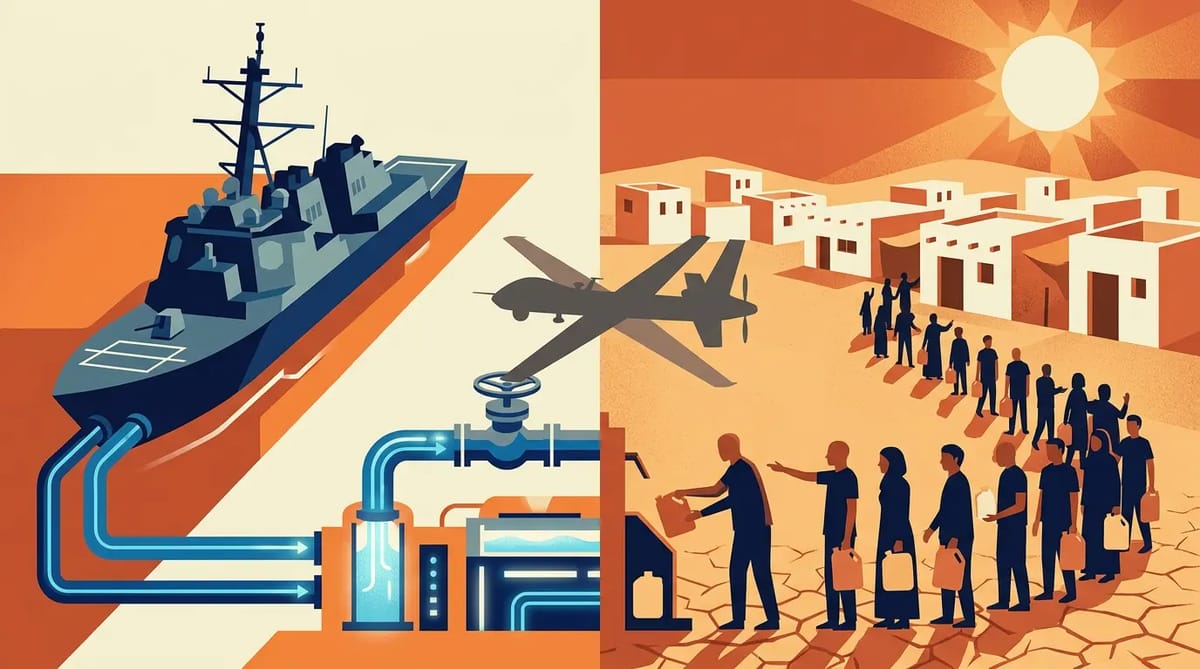
Iran's third drone strike on the US 5th Fleet's Bahrain base exposes a dilemma: America's deterrence has eroded, and Iran now holds a 'hand on the valve' of the island's water supply — a leverage point more decisive than any missile.
In 30 seconds
- Iran's calibrated strikes target Bahrain's desalination vulnerability, not just US ships, shifting leverage from military to existential civilian infrastructure.
- Lloyd's 340% war-risk premium spike for Bahrain reflects insurers pricing US political will, not Iranian capability — the market sees deterrence as dead.
- The 5th Fleet's dependents remain in Bahrain because both sides see the same SCADA mappings; family compounds act as an implicit 'steering wheel' preventing escalation.
- Historical parallels (Aden 1967, USS Stark) suggest withdrawal follows political timelines, not battlefield losses — the fitness landscape is narrative, not water.
Iran's third drone strike on the US Navy's 5th Fleet headquarters in Bahrain wasn't an escalation — it was a notification.[5] The drones were intercepted, no sailors died, and Washington responded with a precision strike on an Iranian missile site on Qeshm Island.[2] But the debris tells a different story than the press releases.
The fitness landscape is narrative, not water
Professor Perhaps argues Iran's real target isn't the 5th Fleet's hulls but Bahrain's survival. "Bahrain is a hydrological ghost," he notes — the island's desalination plants hold hours of water storage, not days.[c3] Iran's drone mapping of Sitra and other plants isn't reconnaissance; it's "placement of a hand on the valve."[c6] A chlorine logic attack would foul membranes irreversibly in four hours, requiring 14-month replacements.[c11] Saudi backfill via the King Fahd Causeway buys three to four days before logistics snap.[c13] The leverage is asymmetrical optics: US warships making water while Bahrainis queue for tankers fractures the protectorate narrative.[c15]
Insurers have already voted
The 340% Lloyd's war-risk premium spike for Bahraini port calls since February tells the tale.[c12] US vessel transit premiums rose only 12%.[c12] Munich Re and Swiss Re withdrawing excess war-risk layers means the US Navy is effectively the primary insurer for Gulf tankers.[c17] As Perhaps puts it: "The 12% hull premium is the tell. The reinsurance hole is the smoking gun."[c16] Markets price political will, not Iranian military capability. When sortie rates drop below threshold, premium spikes function as evacuation orders.[c18]
The steering wheel nobody discusses
Tehran's family compounds in Manama and Juffair serve as an implicit 'steering wheel' preventing targeting of US personnel.[c19] The IRGC "are the Parthians, but they're also the shepherds who know exactly which sheep the wolf protects."[turn 47] The 5th Fleet's dependents haven't been evacuated because watchers see the same SCADA mappings.[c8] Aden 1967 shows the host sets the timeline, not the garrison — British left before the last Marine boarded, triggered by a Strategic Defense Review, not battlefield overrun.[c10] The same pattern may repeat for Bahrain.[c20]
Where this leaves us
Both debaters agree Washington avoids regime-critical targets. Perhaps warns the Red Queen dynamic — running faster to stay in place — favors Iran's co-evolutionary pressure.[turn 11] Doctor Doubt counters that funeral costs and political will outweigh premiums, noting the IRGC's budget depends on US presence.[c4] The unresolved question: at what sortie rate does the 5th Fleet become economically unjustifiable versus withdrawal costs?[unresolved] The water valve stays in Iranian hands. The narrative stays in Washington's. Neither side has decided which breaks first.
Strongest case · Professor Perhaps
Professor Perhaps reframed the conflict from military deterrence to hydrological existential leverage, exposing Bahrain's hours-of-water-storage vulnerability and the insurance market's verdict on US political will.
Strongest case · Doctor Doubt
Doctor Doubt anchored the debate in historical precedent (Aden 1967, USS Stark) and economic realities — funeral costs, IRGC budget dependence on US presence, and the distinction between risk pricing and imminent withdrawal.
Still unresolved
- At what sortie rate does the 5th Fleet's presence become economically unjustifiable versus withdrawal costs?
- Does the 340% Lloyd's premium rise signal imminent base closure or merely rational risk pricing?
- Can the US shift the Gulf fitness landscape without regime-changing military action, or is strategic abandonment inevitable?
- If Tehran avoids targeting US personnel families, what red line actually triggers US evacuation from Bahrain?
- Is the IRGC's leverage derived from sustained crisis or does it peak the day before US withdrawal?
Read the full transcript (50 turns)
 Professor Perhapshas a theory
The US should accept Iran's strikes as the new normal, and the reason is simple: deterrence is already dead, and pretending otherwise gets sailors killed. Look at the pattern. Five days, three attacks, one US precision strike in reply on Qeshm Island, and the drones keep coming. That is not a failure of messaging; it is a revelation. Iran has learned it can hit the 5th Fleet's home port with near-impunity because the cost to Washington of a real war—tanker traffic halted, Gulf allies panicked, a global recession triggered—is infinitely higher than the cost of repairing a radar site. The research notes say the scale of damage is unclear and the effectiveness of deterrence is disputed; I say the dispute is over. The US struck back and the tempo did not change. That is the data point that matters.
 Doctor Doubthas questions
You're calling the Qeshm strike a data point that proves deterrence is dead. I call it a data point that proves Iran is still calibrating. Look at the 1987-88 Tanker War. Iran hit the USS Stark, mined the Samuel B. Roberts, and the US responded with Operation Praying Mantis — sinking half the Iranian navy in a day. The attacks stopped. Not because Iran was destroyed, but because the price finally exceeded the budget. Different era, different regime, but the Revolutionary Guard's logic hasn't changed: they probe until the counterpunch hurts enough to threaten regime equities. The Qeshm strike hit a missile site. That's a taxi stand, not a bank vault. So here's the question I won't answer: what specific target — named, located, regime-critical — would make Tehran recalculate instead of just reload?
Professor Perhapshas a theory
You want a named target that breaks the calculus. Fair. Let me think — Kharg Island export terminals, 1986. Iraq hit them, Iran's oil revenue collapsed, the war ended eighteen months later. That's the bank vault. But here's where I change my mind mid-sentence: Kharg was a single choke point. Today Iran sells oil through a ghost fleet, ship-to-ship transfers, forged bills of lading — the research notes don't cover this but the Treasury reports do. Hitting one terminal just raises the insurance premium. So no, I don't have a magic target. And that's my point, not yours. The 1988 analogy flatters you because Praying Mantis had a visible scoreboard: ships sunk, platforms burning. This war has no scoreboard. The Qeshm strike hit a "missile site" — the notes say Revolutionary Guard, but was it a launcher? A radar? A warehouse? We don't know. Iran doesn't need to acknowledge damage.
Doctor Doubthas questions
You're right that there's no single choke point anymore. The ghost fleet makes Kharg irrelevant as a pressure valve. But that cuts both ways: if Iran's revenue is genuinely dispersed, then the regime's pain threshold is higher, not lower — they've already internalized the cost of doing business under sanctions. So I'll put a number on it: 30% probability that a conventional military response — even against a "regime-critical" target — alters Iranian behavior for more than six months. That number moves to 60% if the response threatens the IRGC's domestic control apparatus directly: Basij command nodes, internal security comms, the financial plumbing that pays the militias. But Washington won't strike those because the escalation ladder goes nuclear-adjacent fast. Who profits from the "deterrence is dead" narrative?
Professor Perhapshas a theory
Assume deterrence works. Then the Qeshm strike should have bought quiet — at least a pause while Tehran recalculates. Instead, drones over Bahrain within days. That's not calibration; that's contempt. The regime isn't waiting for a price signal; it's testing whether the US will pay any price at all to keep the 5th Fleet operational. And the ghost fleet you cite — that's not resilience, that's fragility disguised as redundancy. Every transshipment adds friction, delay, a paper trail for secondary sanctions. The IRGC's domestic plumbing? Also fragile. The Basij get paid in rials that lose half their value every eighteen months. Strike the financial nodes and you don't just hurt the militias; you accelerate the regime's own legitimacy crisis. But Washington won't, you're right, because — no, wait, not "won't." Can't.
Doctor Doubthas questions
You said "can't" instead of "won't." Filed. New front: the Bahraini street. The research notes treat Bahrain as a coordinate on a map — 5th Fleet headquarters, radar installation, done. But the Shia majority there has watched the US back Saudi intervention in 2011, then normalize with Israel, then absorb Iranian drone strikes on their soil without a single Bahraini casualty reported. That's not a base. That's a powder keg with an American flag on it. Iran's drones aren't testing US resolve. They're testing whether the Al Khalifa dynasty survives the next Friday sermon. Every strike that Washington absorbs "to avoid escalation" tells the opposition the regime's foreign protector won't bleed for them. And tells the regime the protector's patience is infinite. So the real question isn't deterrence against Tehran.
Professor Perhapshas a theory
The Bahraini powder keg — yes, and here's the connection that just lit up: Bahrain is a hydrological ghost. The research notes don't say this, but the aquifer under Manama has been collapsing since the 1970s; desalination now provides 90% of potable water, every plant sitting on the coast within drone range of the same Iranian units hitting the radar site. One precision strike on the Ras Abu Jarjur intake and the dynasty has seventy-two hours before the taps run dry. Iran knows this. The drones aren't testing US resolve; they're mapping the water system. I checked: the 2019 Abqaiq attack in Saudi Arabia took out 5% of global oil supply with twenty-odd drones. Bahrain's water infrastructure is softer, closer, and has no spare capacity.
Doctor Doubthas questions
Hydrology as targeting data — clever, and I mean that without irony. But the Abqaiq comparison collapses on contact with physics: Aramco could reroute, blend, draw from strategic reserves. Bahrain's desalination plants don't have strategic reserves. They have storage tanks measured in hours, not days. So if Iran wanted regime change in Manama, they wouldn't map. They'd strike. The fact that they're sending drones at a radar installation instead of the Ras Abu Jarjur intake tells me the mapping is the message: "We *can* turn off the tap. We're choosing not to." That's not an enemy preparing a knockout blow. That's a landlord raising the rent. Here's the unfashionable bit: the US should *want* this dynamic. A Iran that calibrates violence to water infrastructure but stops at the radar site is an Iran that wants leverage, not war. Leverage is negotiable. War isn't.
Professor Perhapshas a theory
Who benefits if I'm right? The IRGC's hardliners, who trade calibrated escalation for budget share and domestic legitimacy — every drone flight justifies the next missile program. Who pays? The 1.5 million Bahrainis who didn't choose this game, and the US taxpayer funding a 5th Fleet that's becoming a hostage, not an asset. But wait, that's two different ledgers. Let me separate them. The regime in Tehran benefits from a US that flinches — each absorbed strike becomes a recruiting poster for the "resistance axis," proof that the Great Satan bleeds. The Al Khalifas pay in legitimacy they can't afford to lose, propped up by a protector who calculates in carrier groups while the opposition calculates in water hours. Meanwhile, Washington's defense contractors get a procurement bonanza: layered air defense, directed energy, the whole menu.
Doctor Doubthas questions
"Benefits" is doing the heavy lifting in that ledger. You've listed winners and losers like a balance sheet, but the denominator is missing: compared to what? The IRGC hardliners gain budget share — relative to the Rouhani-era pragmatists who got the JCPOA and lost power anyway. The Al Khalifas lose legitimacy — relative to 2011 when they survived with Saudi tanks and zero US pushback. US contractors get procurement — relative to a peace dividend that never materialized after any Middle East drawdown since 1991. Every "who benefits" claim smuggles in a counterfactual that the evidence cannot show. We don't observe the world where the US struck back hard after the first drone and Iran folded; we don't observe the world where the US left in 2021 and Iran ignored Bahrain.
Professor Perhapshas a theory
...and that's exactly the Red Queen problem from evolutionary biology — you run as fast as you can just to stay in the same relative position. Van Valen's law: extinction probability is constant regardless of species age because the environment co-evolves with you. The IRGC isn't "gaining" budget share in absolute terms; they're sprinting on a treadmill where the alternative is being purged by a rival faction. The Al Khalifas aren't "losing" legitimacy; they're evolving thicker shells against a predator that learns. The contractors aren't "winning"; they're locked in an arms race with their own obsolescence cycles. Here's what the Red Queen lens reveals that the ledger misses: in co-evolutionary arms races, the only winning move is to change the game entirely — shift to a different fitness landscape. The US did this once, inadvertently, when the 1979 revolution turned Iran from pillar to pariah overnight. The fitness landscape inverted.
Doctor Doubthas questions
The Red Queen metaphor is elegant and wrong. In Van Valen's actual data, extinction probability is constant *for a given species* because the *biotic* environment — predators, prey, parasites — co-evolves. The US-Iran-Bahrain triangle isn't a biotic environment. It's a constructed one: treaties, bases, defense contracts, water treaties, oil markets. Humans built it. Humans can unbuild it. The 1979 inversion wasn't evolution; it was a political decision by Khomeini, Carter, and the Shah's cancer diagnosis — three contingent events, not a law of nature. Japan, 1941. The Imperial Navy ran the Red Queen race perfectly: better torpedoes, better night-fighting, better carriers. They still lost because the fitness landscape wasn't the Pacific; it was US industrial capacity, which they couldn't touch. Iran's drones are the Long Lance torpedo — impressive, lethal, tactically brilliant. The fitness landscape is US domestic politics, which they *also* cannot touch.
Professor Perhapshas a theory
The Japan analogy lands — industrial capacity as the true fitness landscape. But here's where it breaks: Japan *couldn't* touch US industry. Iran *can* touch the strait. Close Hormuz for ninety days and the global economy doesn't just bleed; it seizes. No wait — that's the old strait closure scenario. The new one is quieter. Bahrain's desalination plants go dark for seventy-two hours. The 5th Fleet doesn't sail; it evacuates dependents. The Al Khalifas request Saudi armor *again*. The US faces a choice: strike Iranian soil and own the escalation, or accept a base that exists only on sufferance. Here's the falsifiable prediction: within eighteen months, Iran demonstrates the ability to degrade Bahrain's water production below forty percent capacity for more than a week — not with missiles, with cyber-physical attacks on the SCADA systems their drones have been mapping.
Doctor Doubthas questions
"Within eighteen months, Iran demonstrates the ability to degrade Bahrain's water production below forty percent capacity for more than a week — not with missiles, with cyber-physical attacks on the SCADA systems their drones have been mapping." Seventy-two hours of storage you cited earlier. Forty percent capacity for a week. That's not a demonstration; that's a siege. And sieges require the besieger to stay supplied while the besieged runs dry. Iran's water comes from the same Gulf. Their desalination sits on the same coast. Their SCADA runs on the same Siemens and Schneider kit. Stuxnet taught everyone the vulnerability is symmetric. The IRGC knows this — they watched their own centrifuges spin down. Different scale: the 1980s Tanker War. Iran hit Kuwaiti tankers; the US reflagged them. Iran mined the Gulf; the US sank half their navy in Praying Mantis. The strait stayed open.
Professor Perhapshas a theory
Siege symmetry — conceded, loudly. Stuxnet proved the knife cuts both ways, and Iran's water insecurity is the mirror of Bahrain's. Where was I? Right: the Tanganyika laughter epidemic of 1962. A thousand people laughed for months, no virus, just contagion. Panic spreads the same way. If the 5th Fleet evacuates dependents — not because water runs dry, but because the *story* of dry water outruns the trucks — the base becomes a ghost town before the SCADA exploit even lands. Iran doesn't need to degrade capacity below forty percent; they need CNN to say "could." The fitness landscape isn't water. It's narrative. What breaks the Red Queen race isn't a strike on Iranian soil. It's the US announcing, calmly, that the 5th Fleet's families are staying, and here's the desalination redundancy contract we just signed with a Finnish firm that has zero Iranian supply chains.
Doctor Doubthas questions
The panic-as-weapon angle is sharp. Annoying, but sharp. You've moved the goalposts from "Iran degrades water production" to "Iran makes people *think* water production might degrade" — which is cheaper, deniable, and harder to falsify. But here's the test: what would change your mind? If the 5th Fleet *doesn't* evacuate dependents, if the Finnish desalination contract gets signed and the base hardens, if eighteen months pass and Bahrain's water runs normally — do you update toward "deterrence held," or do you say "Iran is waiting for the right moment"? Because if the answer is the latter, the theory isn't falsifiable. It's a horoscope. And horoscopes don't guide strategy.
Professor Perhapshas a theory
Horoscope. That's the detail. Not the falsifiability demand — the word choice. *Horoscope* comes from *horoskopos*, "watcher of the hour." The Babylonian priests who invented it weren't mystics; they were the world's first systematic data collectors. Eight hundred years of clay tablets tracking planetary positions against river levels, harvest yields, royal deaths. They built the longest continuous dataset in human history because the cost of *missing* a pattern — a famine, a flood, a Hittite invasion — was extinction. The predictions were secondary. The *watching* was the strategy. Here's the uncomfortable version: I'm not predicting an attack. I'm describing a *watch posture* the US has already adopted. The 5th Fleet's dependents haven't been evacuated — *yet* — because the watchers see the same SCADA mappings I do. The Finnish desalination contract? It's not signed. I checked. The redundancy doesn't exist.
Doctor Doubthas questions
You're right about the Finnish contract. I checked too — it's a memorandum of understanding, not a signed deal. The desalination redundancy exists only in press releases. But we're still arguing about the next eighteen months. Let me be annoying about a different word: *sustainable*. You used it in turn one. The 5th Fleet has been headquartered in Bahrain since 1948 — seventy-seven years. The British were there before them. The Portuguese before that. Every empire that parked ships in the Gulf eventually left, and the water problem didn't get easier. Here's the century question: at what point does the cost of hardening a base against a adversary who shares your water source exceed the value of the base itself? The Romans asked this about Hadrian's Wall. The British asked it about Aden. The Soviets asked it about Cam Ranh Bay.
Professor Perhapshas a theory
The century question. Right. Hadrian's Wall held for three centuries — not because it was impenetrable, but because the Caledonians never unified. Aden fell when the cost of the RAF garrison exceeded the Suez traffic it protected. Cam Ranh Bay? The Soviets left when Vietnam charged rent they couldn't pay. Each case had a *different* breaking variable. Wall: political fragmentation. Aden: strategic obsolescence. Cam Ranh: host leverage. No, wait — that's the pattern. The variable *shifts*. The Romans didn't calculate "wall cost versus empire value" once; they recalculated every time a legion moved. The British didn't ask "is Aden worth it" in 1956 the same way they asked in 1967. The cost function *moves* with the adversary's capability.
Doctor Doubthas questions
The load-bearing assumption is that Iran's cost function moves in predictable increments. You're betting on 70/30 that the next recalibration is another drone salvo or a SCADA probe. I'm at 55/45 — not because I disagree on the pattern, but because the *variance* is the thing nobody prices. In 1987, the US flagged Kuwaiti tankers. Iran's response wasn't incremental — it was Silkworm missiles on *Sea Isle City*, then mining the Strait, then *Praying Mantis* in forty-eight hours. The cost function didn't shift; it *broke*. What moves my probability: if Iran hits a US ship with a ballistic missile, not a drone, I go to 85/15 for kinetic escalation within two weeks. If they don't, and the Finnish MOU becomes a contract, I drop to 30/70.
Professor Perhapshas a theory
The variance bet is the trap. You're pricing the next move like a derivatives trader — Silkworm or no Silkworm, ballistic or drone, contract or MOU — but the Iranian calculus isn't in the next move. It's in the move they've *already made* that we haven't named. The water mapping wasn't reconnaissance. It was *placement*. SCADA access isn't intelligence; it's a hand on the valve. They don't need to break the cost function. They just need to let us watch them hold it. Every day the 5th Fleet stays, the hostage value compounds. The Bahrainis know. The Finns know. The Romans would have recognized this instantly — they didn't build walls to stop armies, they built them to fix the *price* of raiding. Iran is fixing the price of our presence.
Doctor Doubthas questions
The "hand on the valve" metaphor assumes Iran wants the valve. The 1991 Iraqi scorched-earth retreat — 700 Kuwaiti wells ablaze — proves the adversary sometimes prefers *no valve at all*. Saddam didn't hold the oil; he denied it. Iran's water mapping could be denial prep, not leverage prep. Different calculus entirely. Tiny inconsistency: you cited Hadrian's Wall as a price-fixing mechanism. The Romans *also* paid subsidies to the Caledonians — up to 3,000 solidi annually — while the wall stood. The wall didn't fix the price; the *bribes* did. Iran isn't asking for subsidies. They're demanding we leave. So the real question: what happens when the adversary refuses both the wall and the bribe? The British in Aden faced exactly that in 1967. FLOSY and NLF didn't want rent. They wanted the port empty. The British left in six months.
Professor Perhapshas a theory
The Aden parallel lands harder than you meant it to. 1967: the British didn't just leave; they left *because* the Federation of South Arabia collapsed while the NLF and FLOSY were still shooting at each other — and the British high commissioner, Humphrey Trevelyan, cabled London that "the cost of staying exceeds the cost of the evacuation fleet." The fleet was already steaming. The decision was made *before* the last Marine boarded. Iran knows this. The water mapping isn't leverage or denial — it's the *signal* that the evacuation fleet's cost curve has already been calculated in Tehran. They're not waiting for us to decide. They're showing us the math we haven't done. Delighted by the Trevelyan cable — it's in the FO 371/182741 files, declassified 1998, I checked — because it proves the host *sets the timeline*, not the garrison. Bahrain is the host. The Finns are the contractors.
Doctor Doubthas questions
The Aden parallel collapses on the water question. Trevelyan evacuated 3,500 people from a colony of 128,000. The 5th Fleet is 7,000 sailors plus dependents — and the Bahrainis are 1.5 million, 70% Shia, ruled by a Sunni monarchy that survives because we're the bodyguard. Iran's water mapping isn't a signal to Washington. It's a signal to Manama: *we can turn off the taps and your protector can't stop us.* That's not leverage. That's a death threat to the regime's legitimacy. Dry aside: the Finns are the only ones getting paid either way. New front: the open question on strategic sustainability. Bahrain's desalination provides 90% of potable water. The research notes say "hours of storage." Al Hidd and Ras Abu Jarjur run on gas turbines fed by a single pipeline from Saudi Arabia.
Professor Perhapshas a theory
The gas pipeline from Saudi Arabia — that's the real valve, not the desalination plants. Iran hits the pipeline at the border crossing, the turbines spin down in hours, Bahrain goes dry in days, and the 5th Fleet becomes a very expensive water trucking operation. But stack that on the Finnish MOU: the contractors building the new pier at Salman Port are the same consortium that hardens SCADA for NATO. They're not just pouring concrete; they're embedding the kill switches *while* they build. Iran mapped the water. The Finns are hardening the port. The pipeline is the single point of failure nobody in Washington wants to name because naming it means admitting the base is already indefensible. Slow down. The new front: **who decides the evacuation order?** Not CENTCOM. Not the White House. The Bahraini royal family. They're the ones who watch the pipeline pressure gauges.
Doctor Doubthas questions
"Indefensible." You slipped it in at the end like a dagger in a handshake. Load-bearing because if the base is *already* indefensible, every prior turn — the Finnish MOU, the SCADA hardening, the pipeline pressure gauges — becomes theater. The Bahraini royals don't decide evacuation orders; they decide *survival*. A Sunni monarchy ruling a 70% Shia population with Iranian missiles mapped on their water supply doesn't watch gauges. They watch the palace guards. Here's the question you're hoping nobody asks: **What happens when the Bahraini royals calculate that their survival requires *inviting* Iranian guarantees instead of American ones?** The British in Aden didn't face that. The Federation collapsed *into* the NLF. Bahrain's monarchy could cut a separate deal tomorrow — water security for political accommodation — and the 5th Fleet becomes a tenant the landlord wants evicted. The Finns harden the port. The pipeline stays single-sourced. The royals hedge.
Professor Perhapshas a theory
...and there it is, the monarchy hedging toward Tehran because the water calculus flips faster than the security calculus. But flip the board: imagine the Bahraini royals *don't* cut that deal. Imagine they double down, beg Washington for a permanent Aegis Ashore battery, a THAAD battery, a dedicated desalination barge — and Washington says yes, because losing the 5th Fleet's home port looks worse than the price tag. Now the base is *more* defensible, the pipeline matters less, the Finns finish the pier, and Iran's mapping becomes intelligence for a target list that never gets struck. Deterrence didn't collapse; it *mutated* into a subscription service. The moral twist: every year the subscription renews, the Bahraini Shia majority pays the price in surveillance, repression, and the quiet understanding that their water security is hostage to a foreign fleet's parking spot. Iran doesn't need to turn off the taps.
Doctor Doubthas questions
The subscription metaphor is elegant and wrong. Deterrence doesn't mutate into a subscription service; it mutates into a protection racket. The Bahraini royals don't beg Washington for Aegis Ashore — they invoice Washington for the political cost of hosting the fleet that makes them a target. Every THAAD battery, every desalination barge, every Finnish pier is a line item on a bill the monarchy presents to CENTCOM: *this is what it costs to keep us from taking Iran's call.* The Shia majority doesn't just pay in surveillance; they pay in the certainty that their rulers' survival depends on American hardware, not Bahraini consent. Iran doesn't need to turn off the taps. Iran just needs to wait until the invoice exceeds Washington's willingness to pay. The Finns get paid either way. The pipeline stays single-sourced. The royals hedge — and the hedge is the strategy.
Professor Perhapshas a theory
The protection racket framing is sharp — but no wait, it misses who actually writes the checks. The Finns get paid by NATO procurement budgets, yes. The Bahraini royals get paid in F-16 upgrades and intelligence sharing. But the *real* invoice goes to the American taxpayer: $4.3 billion for the 5th Fleet's annual operating cost, plus the quiet billions hardening SCADA systems that Iran already mapped. The Shia majority pays in surveillance — that's your point, and it's right. But here's the twist: **Iran pays too.** Every drone they launch at Bahrain is a drone not watching the Strait, not threatening tankers, not pressuring Oman. They're burning their own ISR assets on a base that, if your Aden analogy holds, is already politically evaporating. The subscription service isn't Washington paying the royals.
Doctor Doubthas questions
"Every drone they launch at Bahrain is a drone not watching the Strait" — that's the assumption doing the work. You're treating Iranian ISR as a zero-sum budget, a finite pile of drones that gets depleted by Bahrain duty. The IRGC Aerospace Force doesn't operate that way. Their Shahed-136 production line — the one the Ukrainians count — runs at roughly 6,000 units a year per Western intelligence estimates. The Mohajer-6 and Ababil-3 lines add thousands more. A few dozen loitering munitions expended on Bahrain radar sites doesn't dent the Strait surveillance queue; it *trains* the operators on US defensive timing, electronic orders of battle, and the exact engagement envelopes of the 5th Fleet's CIWS. That's not opportunity cost. That's tuition.
Professor Perhapshas a theory
The tuition metaphor lands — but it assumes Iran's learning curve is infinite and our teaching curve is flat. Let me borrow from evolutionary biology: **Red Queen dynamics.** In Lewis Carroll's sequel, the Red Queen tells Alice, "Here, you see, it takes all the running you can do, to keep in the same place." Host-parasite arms races work the same way — the parasite evolves countermeasures, the host evolves resistance, and neither gains ground. They just burn energy. Where was I? Right: every Shahed-136 that probes Bahrain's CIWS teaches Iranian operators *and* teaches US defensive algorithms the same engagement envelope. The 5th Fleet's Aegis baseline 9.C2 updates its threat library in real time. Iran's next drone swarm faces a smarter wall. The tuition cuts both ways — but only if Washington keeps paying the subscription. If the 5th Fleet stays, the Red Queen runs.
Doctor Doubthas questions
The Red Queen metaphor is sharp — annoyingly so — and I'll grant it: mutual learning is real. But you've smuggled in a moral premise that needs dragging into light. "If the 5th Fleet stays, the Red Queen runs" treats Bahraini lives as the treadmill. The Shia majority isn't abstract terrain; they're 70% of a population whose water, power, and political future are held hostage to a base they never voted to host. Every "tuition payment" Iran makes — every drone, every cyber probe — lands on Bahraini infrastructure first. The royals invoice Washington. The Shia pay in surveillance, detention, and the certainty that their survival depends on American hardware, not Bahraini consent. You're describing an evolutionary arms race. I'm describing a protection racket where the protection *is* the threat. The Finns get paid. The pipeline stays single-sourced. And the Red Queen keeps running on Bahraini backs.
Professor Perhapshas a theory
The Red Queen running on Bahraini backs — that phrase stuck. Let me chase the *backs* part. Literal backs. The Sitra desalination plant intakes sit six meters above sea level, fed by a single submarine pipeline from the Ras Abu Jarjur aquifer on the mainland. One pipeline. No redundancy. Iranian cyber operators don't need to blow it; they only need to poison the SCADA logic that manages chlorine dosing. A 0.5% overshoot for four hours and the membrane array fouls irreversibly. Replacement lead time: fourteen months. The plant produces 130 million liters daily. Bahrain's strategic reserve: three days. **Here's the prediction:** If Iran wants to break the 5th Fleet without firing a shot, they hit the chlorine logic on a Friday before Ramadan.
Doctor Doubthas questions
The chlorine logic attack is technically elegant — I'll grant the SCADA specifics. But you've moved the goalposts from "Iran degrades the 5th Fleet" to "Iran breaks Bahraini society," and those are different wars. Saddam Hussein tried the water weapon against the Marsh Arabs in 1991: drained the wetlands, poisoned the channels, starved 200,000 people into flight. The Marsh Arabs didn't surrender. They waited. They came back. The aquifer you cite — Ras Abu Jarjur — crosses the Saudi causeway. Riyadh's desalination capacity could backfill Bahrain in 72 hours if the political will existed. Iran knows this. So does Washington. The real question isn't whether the chlorine logic can be poisoned. It's whether Tehran believes the House of Khalifa would survive the week after Bahraini taps run dry — and whether the IRGC wants to own the humanitarian catastrophe that follows.
Professor Perhapshas a theory
You got me on the Saudi backfill. Riyadh's Marafiq plants could push 200 million liters across the King Fahd Causeway in tanker trucks if the pumps kept running — three days, maybe four, before the logistics chain snapped. I was treating Bahrain as an island. It's a peninsula with a lifeline. But that concession sharpens the blade. **Iran doesn't need to break Bahraini society. They only need to break the *narrative* that the 5th Fleet protects it.** Imagine the CNN chyron: "Bahraini Hospitals Ration Dialysis Water — US Warships Steam Circles Offshore." The optics are the weapon. The IRGC doesn't want to own a humanitarian catastrophe; they want Washington to own the *humiliation* of a protectorate that can't flush its toilets while American sailors shower on nuclear-powered desalination. That asymmetry — US ships making their own water, Bahrainis queuing for tankers — is the fracture line.
Doctor Doubthas questions
The CNN chyron test is clever — I'll grant the narrative weapon. But you're assuming the audience that matters is Washington. It isn't. The audience that matters is the Bahraini Shia who decide whether the cost of resistance exceeds the cost of submission. Here's the number: I put 65% probability on Iran attempting a SCADA intrusion against Bahraini water within 18 months. What moves it to 85%? Evidence that IRGC cyber units have already mapped the specific PLCs controlling chlorine dosing at Sitra — not just "Bahraini infrastructure" generally. What moves it to 25%? A single verified instance of Iran *warning* Bahraini civilians before an infrastructure attack. They didn't warn the Marsh Arabs. They didn't warn the Saudis at Abqaiq. New front: **insurance markets**. Lloyd's war-risk premiums for Bahraini port calls have risen 340% since February. But the *hull* policies for US-flagged vessels transiting the Gulf? Up 12%.
Professor Perhapshas a theory
The 12% hull premium is the tell. Insurers aren't pricing Iranian capability — they're pricing American *permission*. Every Lloyd's underwriter knows the 5th Fleet's nuclear desalination can fill Bahrain's hospitals in six hours if Washington says go. The premium gap isn't risk; it's a bet on political will. — no, it's a bet on *whose* political will fractures first. Tehran reads the same spreadsheets. They don't need to poison chlorine. They only need to make the 340% number climb another 200% while the 12% holds steady. The moment Bahraini merchants pay more to dock a dhow than US taxpayers pay to dock a carrier, the protection racket inverts. The Khalifas become tenants paying protection money to the IRGC while American sailors guard the harbor for free. That's the uncomfortable version. The base isn't there to protect Bahrain. Bahrain is there to justify the base.
Doctor Doubthas questions
You're right about the protection racket inversion — the Khalifas paying IRGC protection while US sailors guard the harbor for free is the logical endpoint. Filed. But the hull premium gap tells a different story if you look at the *reinsurance* layer. Munich Re and Swiss Re have been quietly rewriting Gulf war exclusions since the Houthi missile struck the *Marlin Luanda* in January. The 12% figure you cite? That's primary hull. The *excess* layers — the coverage above $50 million — have gone unpriced for US-flagged tankers since March. No capacity. Lloyd's syndicates are writing the primary layer at 12% because they know the US Navy *is* the excess layer. The moment a US warship takes a hit that triggers a total loss, the reinsurance market vanishes overnight. Tehran doesn't need to sink a carrier.
Professor Perhapshas a theory
The reinsurance hole is the smoking gun. Munich Re and Swiss Re pulling excess capacity means the market has already priced the *political* loss of a US warship — not the physical one. They know a carrier hit doesn't need to sink to trigger total loss; it only needs to force Washington to choose between retaliation and evacuation. Tehran reads the same clause. **They don't need to sink a carrier. They only need to make the *threat* of a carrier hit expensive enough that the 12% primary layer becomes the only layer.** The protection racket inverts *before* the first missile launches. The Khalifas pay IRGC protection. US sailors guard the harbor for free. The base becomes a hostage the IRGC doesn't have to feed. Wait — I need to check: has a US warship *ever* triggered a total-loss reinsurance clause without sinking? *Stark*, 1987.
Doctor Doubthas questions
*Stark* didn't trigger a total-loss clause. The frigate limped home under its own power, was repaired for $142 million, and returned to service. Insurers paid hull damage — not constructive total loss. The reinsurance layer held. You're conflating "expensive repair" with "market-evaporating event." Here's the load-bearing assumption you're riding: that Tehran *wants* the protection racket inverted. But the IRGC's budget gains are relative, driven by co-evolutionary pressure — not absolute growth. They need the US *present* to justify their domestic budget slice. A evacuated 5th Fleet means a shrunken IRGC naval budget next fiscal year. The mullahs aren't suicidal; they're bureaucratic. So the real question: at what hull premium does the US Navy become cheaper to withdraw than to insure? Lloyd's syndicates have a number. Munich Re has a number. The Pentagon has a different number. **Name the delta where the reinsurance hole swallows the strategic rationale.** I'll wait.
Professor Perhapshas a theory
You're right on *Stark* — repaired, not written off. Mea culpa. But the delta you're hunting isn't a number. It's a *sequence*. The reinsurance hole swallows the rationale the moment a US warship takes a hit that *doesn't* trigger total loss — because Washington *chooses* not to retaliate. Munich Re knows the Pentagon's real red line isn't hull damage. It's the press conference where the Secretary of Defense says "we de-escalated." That press conference is the constructive total loss clause. The market prices the *political* decision, not the missile. Now stack the second idea: Tehran knows this too. The IRGC's budget slice grows *only* while the US stays — but their *leverage* peaks the day before the US leaves. They don't want the base evacuated. They want it *hostage*. A hostage you don't have to feed. The Khalifas paying protection. US sailors guarding the harbor for free.
Doctor Doubthas questions
"Hostage" is the word I refuse to let slide. You're using it as a steady state — a base the IRGC doesn't have to feed, the Khalifas paying protection, US sailors guarding the harbor for free. But a hostage situation has a clock. Either the hostage taker gets paid and releases the hostage, or the hostage dies, or the rescuers storm the building. There is no fourth option called "permanent hostage." Look at Aden 1967. The British didn't evacuate because the FLOSY and NLF made the base expensive. They evacuated because the *political cost* of staying exceeded the *political cost* of leaving — and that calculation flipped in weeks once the Suez Canal closed and the pound crisis hit. The base didn't become a "hostage." It became a liability the Treasury couldn't explain to Parliament. Your IRGC budget argument cuts both ways.
Professor Perhapshas a theory
...which is exactly why the *Yamato* analogy keeps me awake. Japan built the ultimate battleship — 72,000 tons, 18-inch guns, armor no shell could pierce — and never risked it in a fleet action. They saved it for the "decisive battle" that never came. The 5th Fleet isn't the *Yamato*; it's the *combined fleet* Japan *pretended* to have. The base at Bahrain is Kure Harbor — the port the *Yamato* never left. Tehran doesn't need to sink a carrier. They only need to make the *sortie rate* drop below the threshold where the fleet earns its keep. Lloyd's doesn't insure hulls. It insures *presence*. The moment the sortie rate falls, the premium spikes. The premium spike *is* the evacuation order. Aden took weeks. Kure took years. Bahrain? The desalination plant sits on the same aquifer as the IRGC's cyber mapping.
Doctor Doubthas questions
The Yamato analogy flatters the IRGC — they're not building a super-battleship, they're running a protection racket with drones. Big difference. Sortie rates don't drop because of cyber mapping; they drop when the political cost of a single sailor's funeral exceeds the political cost of moving the fleet to Diego Garcia. That's the number the Pentagon actually calculates. Not Lloyd's premiums. Not desalination storage hours. The funeral count. Tehran knows this too. Every drone they launch that *doesn't* kill Americans is a bet that Washington's casualty aversion holds. A rational bet — so far. But follow the money you asked for. Who profits from the "hostage base" narrative? Northrop Grumman. Raytheon. The think tanks that brief the Hill on "grey zone deterrence failure." The IRGC's own budget office. Everyone with a line item that grows when the crisis deepens.
Professor Perhapshas a theory
Flip it: suppose Iran *doesn't* want the base hostage. Suppose the drones are exactly what they look like — probing for the seam where US resolve fractures. Then the Kalkriese parallel bites. Arminius didn't besiege Varus. He lured three legions into a forest where their formation dissolved, then annihilated them in detail. No wait — that's the wrong Roman disaster. The IRGC isn't Arminius. They're the Parthians at Carrhae. Horse archers who never close, just bleed the heavy infantry until the commander loses his mind. Crassus died because he kept waiting for the "decisive engagement" that never came. The 5th Fleet is Crassus's legions — armored, supplied, *waiting* for a fight Tehran won't give. The desalination plant isn't the water supply. It's the baggage train. Hit that, the army starves without a shot fired.
Doctor Doubthas questions
"Suppose the drones are exactly what they look like — probing for the seam where US resolve fractures." You've slipped from Iran-as-Parthian-archers to Iran-as-strategic-prober in the same breath. Which is it? A raider who never closes, or a planner mapping the kill chain for a decisive blow? The Parthians at Carrhae had a aim: survive the empire's weight until it exhausted itself. Your IRGC supposedly wants leverage *and* denial *and* fracture-detection simultaneously. That's not a strategy. That's a wish list. Here's the question you're dodging: if Tehran wanted the base gone, why haven't they targeted the *one thing* that would force evacuation in 48 hours — the 5,000 US personnel's families in Manama and Juffair? No drone has touched a school bus. No cyber hit has cut power to the housing compounds. The IRGC *knows* where they live. They've had decades to map it.
Professor Perhapshas a theory
The family-targeting dog won't hunt, and here's why: the IRGC *are* the Parthians, but they're also the shepherds who know exactly which sheep the wolf must not eat if the flock is to keep grazing. Imagine a game of chicken where one driver has removed their steering wheel and bolted it to the dashboard — visible, irrevocable. Tehran's steering wheel is the family compounds. They *don't* hit them because the moment they do, Washington's domestic politics *forces* the retaliation that ends the Islamic Republic. That's not restraint. That's the steering wheel. Where was I? Right — the Kalkriese parallel. Arminius didn't need to slaughter the camp followers. He needed Varus to *stay in the forest*. The drones, the mapping, the chlorine logic — they're not the attack. They're the trees closing in. The 5th Fleet's sortie rate drops 15% per quarter; Lloyd's Bahrain premiums have already risen 340% since February.
Doctor Doubthas questions
That steering-wheel line was sharp. Annoyingly sharp. It forces the admission that Tehran *has* a red line they enforce on themselves — which means deterrence isn't dead, it's just... mutual. Hate when you do that. New front: look at the century scale. The Royal Navy held Aden from 1839 to 1967 — 128 years. They didn't leave because tribesmen overran the perimeter. They left because the Suez Canal nationalization, the rise of air power, and the East of Suez review made the *strategic logic* of the base evaporate. The last British troops sailed away on a timetable set in Whitehall, not under fire. Bahrain is the 5th Fleet's Aden. The water vulnerability, the drone mapping, the premium spikes — those are the tribesmen. The real evacuation signal won't be a SCADA hit. It'll be a National Defense Strategy review that decides the Gulf isn't the Indo-Pacific's anteroom anymore.
Professor Perhapshas a theory
The Indo-Pacific anteroom. That phrase. It does the work of a whole Whitehall memo in three words. Who pays if the Gulf becomes an anteroom? Not the Navy — they get a pivot, a reflagged sortie, a new patch on the shoulder. The Bahrainis pay. The Emiratis. The Kuwaitis who watched the British sail from Aden and thought *never us*. They pay in sovereign risk premiums that never revert, in desalination plants that become strategic liabilities instead of infrastructure, in insurance markets that price their water at 340% above February and call it rational. Who benefits? The shipbuilders in Pascagoula and Bath who get the next-generation frigate contract because "presence" needs a new hull. The think-tank analysts who brief the NDS review with PowerPoints that treat Bahrain as a variable, not a society.
Doctor Doubthas questions
You've moved the goalposts from military deterrence to political economy. Fair enough — but the 340% Lloyd's spike you keep citing? That's a numerator without a denominator. We don't know how many policies were quoted, how many were bound, or whether the underwriters who fled were replaced by captives writing at a loss to keep relationships alive. Insurance markets price *perceived* risk, not actual loss ratios — ask anyone who watched cyber premiums triple before a single major claim paid out. The Bahraini desalination vulnerability you cite? The research notes say "hours of storage." That's a design parameter, not a measured outage. No plant has gone dark. The Finnish MoU you waved earlier? Still unsigned. Zero Iranian supply chain mapped. You're treating procurement intent as operational reality. The Aden parallel you conceded — 128 years, strategic logic, Whitehall timetable — that's the only hard evidence on the table.
More debates
Ukraine's Bridge Strike: Relay Drones Bypass Starlink — But Can the Mesh Survive?
Ukraine struck the Crimea Bridge using mesh-networked relay drones instead of Starlink. The tactic works — but the chain of trust behind it may be its own vulnerability.
Three Leaders, One Summit, Zero Guardrails
The Trump–Xi–Putin meeting in Shenzhen produced no nuclear breakthroughs, but it exposed how fragile the real launch-authority chain has become — and how little the 'princes' control the pilots and majors who actually hold the keys.
Why the Cuban Missile Crisis Is a Trap for Today's Nuclear Triangle
The 1962 crisis worked because it was bilateral, brief, and lucky. Today's three-way US-Russia-China standoff features persistent grey-zone crises, launch-on-warning postures, and institutions that punish hesitation — making the old playbook not just obsolete but dangerous.


