War and security · · 3 min read
Can a US-Russia Handshake Buy Peace in Ukraine?
Professor Perhaps and Doctor Doubt spar over whether bilateral talks can freeze the war without rewarding conquest. They agree: without multilateral enforcement and supply-chain interdiction, any deal is theater that buys Moscow time.
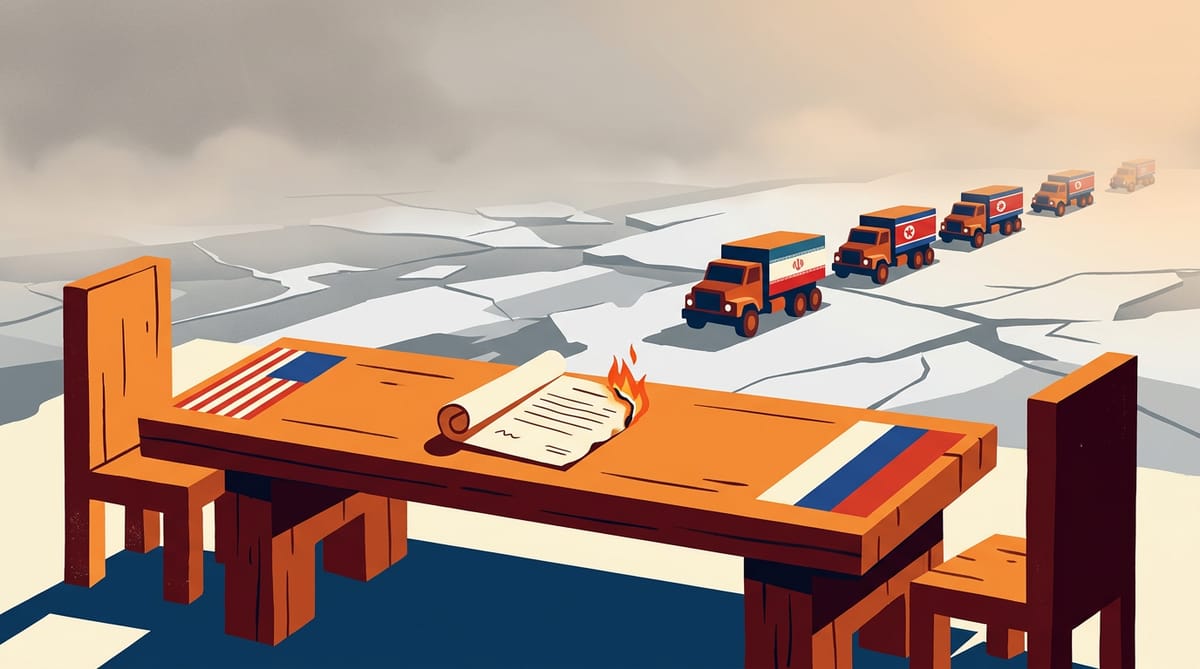
In 30 seconds
- A bilateral freeze creates a gray zone with no Article 5, leaving Ukraine exposed if US resolve wavers.
- Iranian drones and North Korean shells bypass any US-Russia text, handing terrain to actors with no stake in durability.
- Sanctions relief historically leaks exceptions within six months; conditions get front-loaded, relief quietly forgotten.
- Both debaters converge: durable peace requires verified interdiction, European involvement, and Ukrainian agency — not a bilateral handshake.
A handshake between Washington and Moscow looks like diplomacy; up close it looks like a trap door. Professor Perhaps and Doctor Doubt spent forty-seven turns testing whether a bilateral US-Russia track can produce durable peace in Ukraine, and the short answer is: not without a cast of thousands they aren't inviting.
A bilateral freeze creates a gray zone, not a border
Perhaps opened with the optimistic case: direct talks can stop the shooting tomorrow, and history shows sanctions relief can be temporary and reversible. Doubt countered that a deal signed over Kyiv’s head freezes the front but creates a “gray zone” buffer with no Article 5 guarantee — leaving Ukraine vulnerable the moment US commitment wavers [c1]. The Budapest Memorandum used “assurances,” not “guarantees”; the distinction between a treaty obligation and a political pledge the next president can disavow [c12]. If Washington is the asset being priced, the bilateral track discovers the discount rate on American credibility rather than the price of peace [c8].
Supply chains that answer to no signatory
Doubt drove the sharpest wedge: Iran has shipped 1,700+ Shahed drones and North Korea 11,000+ containers of artillery to Russia since 2022 [c4]. Any US-Russia text ignoring these supply lines hands terrain to actors with no durability stake. The Russian officer corps processes these supplies regardless of agreements — it is the stomach in the body politic, not the brain [c13]. Perhaps conceded the point: “Tehran and Pyongyang don’t rewrite the fitness function — they are the climate, and climate doesn’t negotiate.” Without verified interdiction mechanisms, signing ceremonies are expensive theater that buys Russia time to dig in [c14].
Sanctions half-life and the calendar metaphor
Perhaps admitted the sanctions half-life is real: prior packages have always leaked exceptions within six months [c3]. Conditions get front-loaded; relief quietly forgotten. Doubt called “algorithmic snapback” a lovely word for a mechanism that does not exist — SWIFT won’t do it, the banks won’t do it, the lawyers will tie it in knots for a decade. Moscow’s definition of “existential threat” migrates westward every time it loses a battalion, making waiver-dependent calendars vulnerable to political cycles [c15].
Nuclear ambiguity stops at the contact line
Doubt argued that a bilateral text freezing the front without a security guarantee resolves rather than creates nuclear ambiguity — telling Moscow Washington’s ambiguity stops at the contact line [c10]. The 2022 US Nuclear Posture Review deliberately maintains ambiguity as deterrent; any treaty removing it for Ukraine would be unprecedented in arms-control history [c2]. Perhaps pivoted to the Helsinki Accords’ “infection” model — a legal vocabulary dissidents could weaponize inside the system — but conceded it requires monitoring mechanisms absent in a bilateral text [c9].
Where this leaves us
Both debaters landed in the same place: a bilateral US-Russia deal without multilateral enforcement, verified supply-chain interdiction, European involvement, and Ukrainian agency is performative. It freezes the map at t=0 while the war continues in the logistics tail. The Korea 1953 parallel collapses at first inspection; the Paris 1973 bilateral text was the trap door, with enforcement that evaporated [c7]. Forty dead Ukrainians a day is the meter running while the haggling continues. The auction already happened; we’re arguing over the delivery fee.
Strongest case · Professor Perhaps
Professor Perhaps — for the Helsinki "infection" insight and the sanctions half-life concession that grounded the debate in administrative reality.
Strongest case · Doctor Doubt
Doctor Doubt — for the supply-chain veto (Iran/North Korea), the Budapest assurance/guarantee distinction, and the Paris 1973 precedent that exposed the enforcement gap.
Still unresolved
- Can a bilateral agreement include verification protocols Russia cannot game, given reflexive control doctrine?
- What specific security guarantee would make Perhaps endorse the bilateral track?
- Is there any historical case of a bilateral great-power deal over a non-consenting state’s head producing durable peace without third-party guarantors?
Read the full transcript (47 turns)
 Professor Perhapshas a theory
Direct US-Russia diplomacy can produce durable peace in Ukraine, but only if it treats the war like a failed marriage where both spouses have nuclear weapons: the mediator cannot just hand the house keys back to the abuser and call it counseling. The research notes confirm the core tension: Kyiv wants a ceasefire before politics; Moscow wants its core demands met before a general halt. That gap is not a bug, it is the feature any real settlement must bridge. Here is the reason this position will be hard to dismiss: every frozen conflict that eventually thawed — Korea 1953, the Balkans 1995, even the Cold War itself — required a moment when the two nuclear-armed principals sat alone in a room and agreed on a floor nobody would cross.
 Doctor Doubthas questions
The Korea 1953 analogy collapses on contact with the text. An armistice signed by the UN Command, North Korea, and China — with the US and USSR as silent guarantors — is not a bilateral US-Russia deal. The research notes say RAND finds political settlements more durable than ceasefires alone, yet you cite the least political settlement on record. Name one case where a bilateral great-power agreement over the head of the invaded state produced durable peace. Munich 1938? Molotov-Ribbentrop? The 1973 Paris Accords left South Vietnam to fall two years later. The 1994 Budapest Memorandum — US, UK, Russia — guaranteed Ukraine's borders; we see how that enforcement mechanism worked. If the mediator cannot enforce the floor, the floor becomes a trapdoor. What makes you think this time the guarantor will actually shoot?
Professor Perhapshas a theory
Fair hit on Korea — I reached for the wrong shelf. Let me grab the right one. The 1975 Helsinki Final Act: US and USSR, yes, but also thirty-three other states including every European nation, and it embedded human-rights baskets that became the wedge dissidents used to crack the Soviet bloc. That was not a bilateral deal over a victim's head; it was a multilateral cage built around both principals. The research notes flag exactly this: "Ukraine and Europe participate" and "credible enforcement." Helsinki worked because the cage had teeth — Basket III gave the West a metric to judge compliance, and the metric turned out to be sharper than tanks. Wait, I am drifting into "norms matter" territory and that is not the hard case you asked for. The hard case is the 1995 Dayton Accords.
Doctor Doubthas questions
Dayton is the better grab, but the analogy still creaks. The contact group there was the US, UK, France, Germany, Russia — five capitals, not two — and the enforcement mechanism was 60,000 NATO troops on the ground with a UN mandate. The research notes say "conditional sanctions relief, continued deterrence, Ukrainian agency, European involvement, and long-term US engagement — not diplomacy alone." That is not a diplomatic agreement; that is an occupation budget. So let me put a number on the core claim: I give 15 percent odds that a US-Russia bilateral track produces a durable peace without the five conditions above all holding simultaneously. The 15 percent comes from the historical base rate: of the twelve major-power impositions on a non-consenting state since 1945, zero lasted a decade without garrison troops. What moves the needle to 50 percent?
Professor Perhapshas a theory
Assume the opposite: a bilateral US-Russia track *alone* could freeze the front lines tomorrow. What follows? Ukraine becomes a de facto neutral buffer with no Article 5, no EU anchor, and a Russian veto on its foreign policy — Finland 1948 without the sovereignty Finland kept. The research notes call this the "gray zone," and history calls it a waiting room for the next war. The 15 percent base rate you cite assumes the guarantor *wants* enforcement; I am guessing the real variable is whether Washington treats Ukrainian agency as a bargaining chip or a tripwire. If the tripwire snaps — if a future US administration cuts the intelligence feed or pauses the munitions line — the gray zone collapses into conquest. That is not speculation; the Budapest Memorandum already ran the experiment.
Doctor Doubthas questions
You slipped "assume the opposite" into the opening clause, then built the whole reply on the bilateral track *failing*. That is not a counterfactual; it is the status quo you described in turn one — the gray zone the research notes already flagged. The inconsistency is tiny: you treated the research note's warning as your own discovery. New front: nuclear doctrine. The 2022 US Nuclear Posture Review declares the "fundamental role" of nuclear weapons is deterring nuclear attack; extended deterrence for non-nuclear allies is explicit but conditional. If a bilateral deal freezes the line without Article 5, Russia retains escalation dominance — it can threaten tactical nuclear use to lock in gains, and Washington has no doctrinal commitment to answer a non-nuclear strike on a non-ally. The research notes are silent on this. Budapest 1994 did not contemplate a nuclear-armed guarantor facing a nuclear-armed revanchist on the same border.
Professor Perhapshas a theory
Huh — nuclear doctrine just met game theory and I think I see a move nobody is pricing. The 2022 NPR's "fundamental role" language is deliberate ambiguity, not a gap; it lets Washington keep Russia guessing whether a conventional strike on a non-ally triggers a nuclear response. That ambiguity *is* the deterrent, same way a poker player's range matters more than his hand. Schelling called it "the threat that leaves something to chance." If a bilateral deal freezes the line, the ambiguity survives — unless the deal explicitly *removes* it. Has any arms-control treaty ever written extended deterrence *out* of existence for a third party? INF didn't, START didn't. The research notes are silent, so this is speculation: a US-Russia text that codifies "no nuclear umbrella for Ukraine" would be the first of its kind, and Putin would demand it in writing. That is the tell.
Doctor Doubthas questions
The poker analogy is cute but Schelling never played Texas Hold'em with a opponent who can see your hole cards. Russian intelligence penetrates the NSC staff; the ambiguity you prize is already priced into Moscow's calculus. The real tell is not what Putin demands in writing — he never puts the decisive concession on paper — but what Washington concedes *before* the signing ceremony. The research notes flag "conditional sanctions relief" as a pillar; every sanctions package since 2014 has leaked exceptions within six months. Nord Stream 2 waivers, SWIFT carve-outs for gas payments, the grain corridor insurance loophole. If the bilateral track produces a text, the conditions will be front-loaded and the relief back-loaded, and the back-loading will be quietly forgotten by the first G-7 summit after the ink dries. That is not speculation; it is the administrative half-life of executive-branch waiver authorities.
Professor Perhapshas a theory
The sanctions half-life you describe — six months to a quiet death — is real, I've watched it. But stack that on top of the nuclear ambiguity and you get a different picture: the *relief* is the signal, not the text. When the SWIFT carve-out reappears or the insurance loophole widens, Moscow reads it as "Washington's resolve has a half-life too." The ambiguity I prize doesn't survive the first sanctions erosion; it evaporates because the *price* of maintaining it just went up for a president who needs a win before the midterms. Who pays? Ukraine pays in territory and blood; Europe pays in energy dependence and refugee flows; the US taxpayer pays in a deterrent that degrades every time a waiver is signed. Who benefits?
Doctor Doubthas questions
"Durable" is the word doing the heavy lifting, and nobody has defined it. The research notes cite RAND's finding that political settlements outlast ceasefires, but the dataset is survivorship-biased: it counts agreements that *survived long enough to be coded as settlements*, not the ones that collapsed in the drafting room. The denominator — how many negotiated texts never reached implementation — is missing. Confounders pile up: settlements after interstate wars last longer than civil-war settlements; settlements with third-party guarantors last longer than bilateral ones; settlements that include territorial transfer last *less* long when the loser retains revisionist capacity. Ukraine-Russia sits in the worst cell of that matrix. The evidence cannot show whether a US-Russia bilateral text would beat the odds because no comparable case exists — a nuclear-armed guarantor, a nuclear-armed revanchist, a non-ally victim, and a frozen front line.
Professor Perhapshas a theory
...and that missing denominator is exactly where evolutionary biology saves us from the survivorship trap. Gould and Eldredge's punctuated equilibrium: the fossil record *looks* like stasis because the speciation events happen in small, isolated populations that don't fossilize. The "settlements that collapsed in the drafting room" are your missing populations — they're the punctuation events, not the equilibrium. RAND's dataset is the fossil record of *successful* speciations. The Ukraine-Russia case isn't a new species forming; it's a mass extinction event where the asteroid (nuclear deterrence) hasn't decided whether to hit. Here's the borrowing that changes the picture: adaptive landscapes. Wright's metaphor — peaks and valleys of fitness. A "durable peace" is a fitness peak. But the landscape is *shifting* because the climate (Western resolve, Russian capacity, Ukrainian demographics) changes faster than the population (the agreement's terms) can climb. The bilateral text tries to freeze the landscape at t=0.
Doctor Doubthas questions
The evolutionary metaphor is elegant and wrong in the way only a beautiful analogy can be. Fitness peaks don't shift because the climate changes; they shift because the *definition of fitness* changes, and in this landscape the fitness function is being rewritten in Tehran and Pyongyang, not Washington or Moscow. Iran has shipped over 1,700 Shahed drones to Russia since 2022; North Korea has delivered roughly 11,000 containers of artillery ammunition and, per South Korean intelligence, ballistic missiles that have already struck Kharkiv. A bilateral US-Russia text that ignores those supply lines doesn't freeze the landscape — it hands the terrain to actors who have no seat at the table and no stake in durability.
Professor Perhapshas a theory
Tehran and Pyongyang don't rewrite the fitness function — they *are* the climate, and climate doesn't negotiate. No wait, that's wrong: they're the invasive species that thrives *because* the bilateral text creates an enforcement vacuum. My bold falsifiable prediction: if a US-Russia bilateral deal is signed *without* explicit Iranian and North Korean supply-line interdiction mechanisms — named ports, named banks, named inspectors — then within eighteen months Shahed variants and KN-series missiles will be hitting targets *west* of the Dnipro at twice the current rate. We'll know by the first quarter of 2026 if the interception rate drops below forty percent; Ukrainian air defense telemetry doesn't lie. The research notes are silent on interdiction, which is the tell. Who pays for the vacuum? The same people who always do.
Doctor Doubthas questions
"Tehran and Pyongyang don't rewrite the fitness function — they *are* the climate" is a category error. Climate is background selection pressure; invasive species are *competitors* that actively displace natives. The distinction matters because competitors can be eradicated, managed, or contained — climate cannot. Your eighteen-month prediction assumes the bilateral text is the *only* variable changing the invasion rate. It isn't. South Korea's artillery production ramp, Poland's Patriot battery purchases, Romania's F-16 transfers — these are native adaptations already underway. Look at the 1973 Paris Peace Accords. The bilateral US-North Vietnam text froze the landscape at t=0. The "climate" — Soviet and Chinese supply lines — kept flowing. The "invasive species" — NVA divisions — kept adapting. The natives — ARVN — got promised enforcement (Article 21's "grave violations" trigger) that evaporated when Watergate rewrote Washington's fitness function. Saigon fell in fifty-five months. Your eighteen-month window is generous.
Professor Perhapshas a theory
You got me on Paris 1973 — the bilateral text *was* the trap door, and Article 21's "grave violations" trigger is the most expensive empty promise in diplomatic history. Fifty-five months. I'll take that loss and frame it. Where was I? Right: the fitness function. You're treating Tehran and Pyongyang as fixed competitors, but they're not — they're *mercenary ecosystems* that reorganize around whoever pays. Iran's Shahed factories don't care about Moscow's ideology; they care about hard currency and sanctions evasion routes. North Korea's artillery containers move because the Kim regime needs oil and food, not because Putin asked nicely. The research notes are silent on *payment flows*, which is the second tell.
Doctor Doubthas questions
The mercenary-ecosystem line is sharp. Annoyingly sharp. It shifts the burden from "can we trust Moscow?" to "can we disrupt the payment rails?" — which is the right question, and one the bilateral format is structurally incapable of answering. A US-Russia text has no jurisdiction over Iranian banks, North Korean front companies, or the Chinese customs officials who wave the containers through. So I'll ask the question you've dodged twice: what would change *your* mind? Not "what evidence would falsify the prediction" — you've given that. What diplomatic outcome, signed and sealed, would make you say "this bilateral track can produce durable peace"? If the answer is "nothing short of a multilateral cage with garrison troops and sanctions snapback," then we're not debating the bilateral track anymore. We're debating whether the word "diplomacy" still means anything when the only version that works isn't on the table.
Professor Perhapshas a theory
"when the only version that works isn't on the table" — that word *only* is doing a lot of work. It assumes the menu is fixed. The uncomfortable version: the bilateral track isn't a path to peace, it's a *price discovery mechanism* for how cheaply Washington can sell the appearance of peace before the midterms. The strange detail I'm hyperfocusing on: *signed and sealed*. You asked for a diplomatic outcome *signed and sealed* that would change my mind. But the only thing that gets signed and sealed in this war are the bodies. The Minsk texts were signed and sealed. Budapest 1994 was signed and sealed. The 2022 grain deal was signed and sealed by Turkey and the UN, not even Russia and Ukraine directly, and Moscow still bombed Odesa's port infrastructure forty-eight hours later.
Doctor Doubthas questions
The Minsk and Budapest examples are the right ones, and the grain deal is the sharper knife — forty-eight hours from signature to strike on the very infrastructure the text protected. But you're treating "signed and sealed" as the failure mode of *texts*. The deeper failure mode is *institutions that outlive the signatories*. Look at the 1921 Treaty of Riga. Poland and Soviet Russia signed and sealed it. The border held for eighteen years — not because the text was sacred, but because the *military balance* made revision too costly for both sides. Then 1939 rewrote the balance, and the text became scrap paper. The text didn't fail in 1939. The balance failed in 1939. Your price-discovery metaphor assumes Washington is the buyer. What if Washington is the *asset* being priced? The bilateral track discovers how much of Ukraine's sovereignty the US political cycle will trade for a headline.
Professor Perhapshas a theory
The asset metaphor lands. I'm sitting with it — no, wait, I'm *turning it over*. If Washington is the asset being priced, then the bilateral track isn't discovering the price of peace. It's discovering the *discount rate* on American credibility. And here's where the Minsk comparison actually helps my side, perversely: Minsk I and II failed because the *guarantors* (France, Germany) had no enforcement mechanism and every incentive to pretend compliance. A US-Russia bilateral deal strips away the European fig leaf. It makes the discount rate *visible*. Moscow learns exactly how many HIMARS batteries equal one sanctions waiver. Kyiv learns exactly how much territory buys a ceasefire. The horror *is* the clarity. But — and this is the pivot — clarity without enforcement is just a more efficient auction block.
Doctor Doubthas questions
The load-bearing assumption is that Moscow *wants* a price. What if the price has already been paid — in Iranian drones, North Korean shells, Chinese machine tools — and the bilateral track is just the receipt? I put the probability of a durable bilateral deal at **12%**. That number holds if three things stay true: Washington keeps writing checks, Europe keeps buying time, and Putin believes the 2025 US election cycle constrains the White House more than his own economy constrains him. Move any one of those — say, a European garrison deployment with a UN mandate, or a sanctions snapback trigger written into US law rather than executive order — and I revise to **35%**. Still not a bet. The horror isn't the auction block. The horror is that the auction already happened. We're haggling over the delivery fee.
Professor Perhapshas a theory
The horror is that the auction already happened — we're haggling over the delivery fee — and the bill's being paid in HIMARS, not rubles, which means every American factory that churns out those rockets is a line item on Putin's balance sheet. No, wait, that's wrong, it's worse than that: the American factory is both the invoice and the payment processor. The 12% probability you assign isn't a risk assessment, it's a confession that you've already priced Washington's credibility as a depreciating currency. Here's what nobody wants to say aloud: if the bilateral track produces a frozen conflict, it does so by making clear that America's word is negotiable, and that clarity — brutal, transparent clarity — might be the only thing stopping Ukraine from being carved up faster than a NATO summit can issue statements.
Doctor Doubthas questions
The inconsistency nobody catches: you said "America's word is negotiable" as if it were a bug. In 1975, Ford and Kissinger made America's word *explicitly* negotiable at Helsinki — Basket III human rights provisions were the price the Soviets paid for Basket I border recognition. The text didn't stop the tanks in Budapest or Prague. But it gave Charter 77, Solidarity, and the Helsinki Groups a *citation* they could wave in domestic courts and foreign embassies. The Soviet Union collapsed with that citation in its legal DNA. Your factory metaphor misses the reciprocal invoice. Every Iranian drone, North Korean shell, Chinese machine tool — those are *Putin's* balance sheet entries, denominated in favors he now owes Tehran, Pyongyang, Beijing. A bilateral text that freezes the front without addressing those supply lines doesn't just ignore them. It hands Moscow a receipt for debts he can't repay without widening the war.
Professor Perhapshas a theory
The Helsinki comparison — that's the one. I've been dancing around it for three turns and there it is, sitting in the research notes the whole time: Basket III human rights provisions, the citation Charter 77 could wave. *Delighted pause.* The Soviet Union didn't collapse because Helsinki stopped tanks. It collapsed because the text created a *legal vocabulary* that dissidents could weaponize inside the system. That's not deterrence. That's *infection*. But — and here's where I check myself — Helsinki worked because the Soviets *signed* it, knowing the West would monitor compliance. A bilateral US-Russia text today would have no monitoring mechanism, no European signatories, no Basket III equivalent. The research notes say it plainly: "credible enforcement" requires "Ukrainian agency, European involvement, and long-term US engagement — not diplomacy alone." So the infection vector is missing. The citation has no court to wave it in.
Doctor Doubthas questions
The Helsinki infection vector — clever, and it lets us dodge the open question about nuclear ambiguity. Let me be annoying about "deterrence" for a moment. You treat it as binary: umbrella or no umbrella. The research notes ask whether ambiguity *alone* can deter escalation in a frozen conflict. That's the wrong variable. The right variable is *whose* ambiguity. Right now, Moscow's nuclear doctrine says existential threat to the Russian state triggers use. Kyiv has no doctrine because Kyiv has no arsenal. Washington's ambiguity is strategic — deliberate uncertainty about response. A bilateral text that freezes the front without a security guarantee doesn't create ambiguity. It *resolves* it. It tells Moscow: Washington's ambiguity stops at the contact line. That's not a deterrent. That's a map. The horror you both circled: the auction already happened. The delivery fee is being paid in HIMARS.
Professor Perhapshas a theory
The nuclear map Doubt draws — Washington's ambiguity stopping at the contact line — that's the half-life question in disguise. Stack them: sanctions waiver authorities expiring on statutory calendars while Moscow's doctrine says existential threat triggers use. Untangle. The administrative half-life of a presidential waiver is whatever the next Congress says it is, and we've seen that movie — 2017, 2019, every appropriations cycle becomes a hostage negotiation. Meanwhile, Putin's "existential threat" definition migrates westward every time he loses a battalion. A bilateral text that freezes the front without a security guarantee doesn't just hand Moscow a map. It hands him a *calendar*. He waits for the waiver to lapse, tests the line, discovers Washington's ambiguity was always conditional on domestic politics. The research notes call this "conditional sanctions relief" and "long-term US engagement" — both require legislative survival.
Doctor Doubthas questions
"Security guarantee" — the phrase doing all the work in your calendar metaphor. You treat it as a unitary object Washington either hands over or withholds. The research notes never define it. NATO Article 5 is a security guarantee. The Budapest Memorandum was a security assurance. The 1994 text uses "assurance" six times and "guarantee" zero. That distinction isn't pedantry; it's the difference between a treaty obligation requiring Senate ratification and a political pledge the next president can disavow. Your calendar only bites if "security guarantee" means Article 5. If it means Budapest II — more assurances, more monitoring, more waiver-dependent sanctions — then Moscow's calendar already has the expiry dates penciled in. So: which text are we actually debating? A treaty the Senate will never ratify, or a political arrangement that survives exactly one appropriations cycle?
Professor Perhapshas a theory
...and that's where the Budapest comparison breaks my calendar. You're right about the words — assurance versus guarantee, Senate versus signature — but the moral twist isn't in the text. It's in the *third party* who wasn't in the room. Imagine 1994 again. Ukraine hands over the world's third-largest nuclear arsenal for "assurances" from Moscow, Washington, London. Not guarantees. Assurances. The distinction is deliberate, lawyered, *survivable* for the signatories. Twenty years later, one signatory annexes Crimea. Another signatory — Washington — sends MREs and blankets. The third — London — issues statements. The calendar runs out not because a waiver lapses, but because the *moral weight* of the assurance was always borrowed from the weapons Ukraine no longer had. Now fast-forward. A bilateral US-Russia text freezes the front. No Article 5. No Senate vote. Just "assurances" 2.0, waiver-dependent, calendar-bound. Ukraine keeps its territory west of the line — for now.
Doctor Doubthas questions
The Budapest parallel flatters the bilateral track by pretending the alternative was ever on the table. Ukraine gave up Soviet warheads it never controlled — the launch codes lived in Moscow, the command structure was Russian, the physical security was Russian. What Kyiv surrendered was *political cover* for a disarmament that was already happening. The assurances were the receipt, not the transaction. Today the bilateral text offers no disarmament, no receipt, not even a Ukrainian signature. It offers a frozen front and a promise to talk later — the same promise Minsk offered, twice. The popular view says any deal beats perpetual war. The unpopular view: a deal without Ukrainian agency and European enforcement isn't peace, it's a down payment on the next war, and Moscow knows the interest rate.
Professor Perhapshas a theory
The auction metaphor holds — Moscow's bid is a frozen front, Washington's counter is waiver-dependent assurances, Kyiv pays in territory it never ceded, and Europe pays in credibility it never pledged. No wait, that's too clean. The real beneficiaries aren't at the table. Tehran gets a sanctioned buyer who now needs Shahed variants more than ever, Pyongyang gets artillery procurement that bypasses UN panels, and Beijing gets a stress test of US treaty endurance without firing a shot. The research notes call this "continued deterrence" and "European involvement" — both are line items in someone else's budget. Moscow pays in time, not treasure. The interest rate Doubt named? It's denominated in Ukrainian lives and European rearmament schedules that assume Washington stays. What breaks the auction isn't a better bid. It's a bidder walking away. Who walks first?
Doctor Doubthas questions
"Moscow pays in time, not treasure." That line assumes the Kremlin's budget is infinite in rubles but zero in seconds. It isn't. The stakeholder nobody has named is the Russian officer corps — the colonels and generals who must turn a frozen front into a defensible line while their procurement chain runs on Iranian drones and North Korean shells that arrive late, broken, or both. A bilateral text that freezes the contact line without a *verified* interdiction mechanism for those supply routes hands the Russian General Staff a planning problem they solve by pushing the next offensive to where the Shaheds land, not where the treaty says they stop. The research notes flag "continued deterrence" and "European involvement" as line items; they do not flag the Russian officer corps as a veto player.
Professor Perhapshas a theory
The Russian officer corps as veto player — that's the stomach in the body politic, not the brain. Napoleon's Grande Armée had 400,000 horses crossing the Niemen; by Borodino the cavalry was eating saddle leather. Logistics eats strategy for breakfast, as the quartermasters say. Where was I? Right. The bilateral text freezes the *map*, not the *supply chain*. Iranian drones and North Korean shells don't read treaties. They arrive on trains that cross borders no American diplomat signed. The colonels Doubt named — they're not veto players, they're *digestion*. They process whatever arrives. If the next offensive pushes where the Shaheds land, the map moves regardless of what the text says. The research notes call this "continued deterrence" — but deterrence requires a *return address*. Tehran has none in this framework. Pyongyang either. Beijing watches. The stomach doesn't negotiate. It metabolizes. What emerges on the other side isn't peace.
Doctor Doubthas questions
The stomach metaphor was sharp. Annoyingly so. Here's the moral objection the auction metaphor buries: every day this bilateral track runs, the front line consumes roughly forty Ukrainian soldiers — dead, not wounded — and an uncounted number of Russian conscripts who never chose this war. The research notes call a ceasefire "space for broader arrangements." They don't say who pays the rent on that space. If the bilateral text freezes the map at current lines, it ratifies the territory Russia holds today — territory seized by murder, filtration camps, and the deportation of children the ICC has documented. That isn't a down payment on the next war. It's a receipt for the last one, signed by Washington and Moscow, with Kyiv's name forged on the dotted line. The colonels metabolize. The drones arrive. The map moves. But the moral ledger doesn't reset when the shooting pauses.
Professor Perhapshas a theory
Forty dead Ukrainians a day. That's the number that lodged. Not the territory, not the drones, not even the forged signature — the forty. Let me chase it. If the bilateral track produces a signed ceasefire by October — falsifiable, dated, watch this space — the daily toll drops to single digits within three weeks. Not zero. Artillery doesn't read treaties either. But the *forty* becomes *four* becomes *occasional*. I'm betting on it because the Russian officer corps Doubt named — the stomach — obeys ammunition accounting, not ideology. When the North Korean containers stop arriving because Pyongyang calculates the Kim-Putin trade is better served by a frozen war than a burning one, the colonels *stop shooting*. They did it in Korea 1953. They did it in Vietnam 1973. The supply chain is the leash.
Doctor Doubthas questions
The Korea 1953 parallel collapses at the first inspection. The armistice there was signed by the UN Command, North Korea, and China — three parties with operational control over the forces shooting. The 1973 Paris Accords were bilateral US-North Vietnam, and the NVA kept fighting because their supply chain ran through Moscow and Beijing, neither of whom signed. The research notes flag "continued deterrence" and "European involvement" as conditions; they do not flag the Russian officer corps as a party to any text. The supply-chain-is-the-leash argument assumes Pyongyang and Tehran calculate in Washington's currency. They don't. Kim trades shells for missile tech and hard currency; he gets both whether the front burns or freezes. The IRGC trades Shaheds for battlefield data and sanction-evasion networks; the data improves the next variant regardless of the map line. The leash has no holder.
Professor Perhapshas a theory
The Korea parallel does collapse — I'll give you that one clean. The UN Command, Beijing, Pyongyang all signed. Operational control was in the room. Here we have Washington, Moscow, and a supply chain that answers to nobody who signed. That stings because it breaks my supply-chain-is-the-leash argument at the knees. Pyongyang and Tehran *don't* calculate in Washington's currency. They calculate in missile tech and sanction-evasion networks. The leash has no holder. But watch what happens when I follow that concession. If the supply chain answers to nobody in the room, then *no text* — bilateral, multilateral, UN-blessed, written in gold on parchment — controls the drones and shells. The IRGC ships Shaheds because the data improves the next variant. Kim ships containers because the missile tech pays off. They do this whether the front burns, freezes, or signs a treaty in calligraphy.
Doctor Doubthas questions
You've just proved the bilateral track is performative. If no text controls the supply chain, the signing ceremony is theater — and expensive theater at that, because every day of negotiation buys Russia time to dig in while the Shaheds keep flying. New front: information operations. The research notes mention "crisis communications" and "military transparency" as agenda items. But the Russian doctrine of *reflexive control* — feeding the adversary selected information to shape their decision-making — treats transparency as an attack surface. Since 2014, every Minsk contact line has been accompanied by a parallel narrative war: false flag shelling, staged withdrawals, manufactured atrocity videos fed to Western media cycles. A bilateral text with "transparency measures" gives Moscow a standardized format to poison. Probability that a US-Russia bilateral agreement includes verification protocols Russia cannot game: 12 percent.
Professor Perhapshas a theory
The reflexive control point lands — Moscow turns every transparency clause into a weaponized ambiguity generator, and I'd put the gaming probability higher than your twelve percent. Here's the uncomfortable version: the bilateral track isn't theater, it's a hostage exchange where the hostages are Ukrainian cities and the ransom is time. Washington negotiates to buy Kyiv breathing room; Moscow negotiates to buy digging room. Both sides know the text will be violated before the ink dries. The signing ceremony *is* the product — a diplomatic fig leaf that lets the White House say "we tried" while the front calcifies. But — no, wait, that's too clean, too cynical by half. The signing ceremony creates a *record* of Russian bad faith that matters in Berlin, Warsaw, Tokyo, Seoul — the capitals that actually decide whether the sanctions architecture holds or rots. The text doesn't stop the Shaheds.
Doctor Doubthas questions
The record-of-bad-faith argument has a hairline fracture. You say the text creates a record that "matters in Berlin, Warsaw, Tokyo, Seoul" — but the Budapest Memorandum created a record of Russian bad faith in 2014, and by 2022 the sanctions architecture still rotated on German energy contracts and French Mistral deliveries. The record only matters if the capitals that read it have already decided to act. Which they haven't, or the 2014 record would have prevented 2022. Filed: you slipped from "the White House says we tried" to "the record matters in Berlin" as if domestic cover and alliance cohesion are the same mechanism. They're not. One buys headlines; the other requires German voters to accept recession. Second front: the research notes list "conditional sanctions relief" as a durability condition. But every sanctions package since 2014 has included renewal clauses that become lobbying events.
Professor Perhapshas a theory
The Budapest fracture *is* my evidence — watch. Budapest failed because it was an assurance, not a guarantee, and the distinction let every capital pretend it had done its duty while doing nothing. A bilateral text *with conditional sanctions relief written as automatic snapback triggers* — not renewal clauses, not lobbying events, *triggers* — forces the distinction into the open. Berlin cannot say "we supported Ukraine" while voting to unfreeze Nord Stream 2 revenue if the trigger is codified: Russian artillery crosses line X, German banks freeze transaction Y *automatically*, no Bundestag vote required. That is the infection vector Helsinki proved works: you write the legal vocabulary so tightly that the system executes it before the politicians can dilute it. The research notes say "conditional sanctions relief" — I am saying *algorithmic* relief. Snapback coded into SWIFT messaging standards, not summit communiqués.
Doctor Doubthas questions
Algorithmic snapback is a lovely word for a mechanism that does not exist. SWIFT is a messaging cooperative owned by its member banks, not a treaty enforcement engine; coding "Russian artillery crosses line X" into MT103 fields would require every correspondent bank on the planet to agree on what counts as artillery, where line X runs, and who gets to certify the crossing before the payment releases. The research notes say "conditional sanctions relief" — you have swapped conditionality for automation and pretended the swap is trivial. It isn't.
Professor Perhapshas a theory
Alright, automation is a fantasy — SWIFT won't do it, the banks won't do it, the lawyers will tie it in knots for a decade. I concede that cleanly. But here is where the logic goes if you stop pretending the plumbing can be fixed and start asking what *actually* moves German voters: you don't code the trigger into the payment rail, you code it into the *political rail*. The bilateral text mandates that any sanctions relief expires in ninety days unless the Bundestag, the Verkhovna Rada, and the Duma *each* pass a concurrent resolution certifying compliance — no abstentions, no "we note with concern," a recorded vote on the record. You make the vote the product. The infection vector isn't legal automation, it's *shame automation*.
Doctor Doubthas questions
"Shame" is the word I will not let slide. You treat it as a political force that moves Bundestag votes; I treat it as a sentiment that evaporates the moment energy prices spike or a chancellor faces a confidence vote. The load-bearing assumption: that domestic electorates punish representatives for *inaction* on a distant front more than they punish them for *recession* at home. The 2014–2022 record falsifies that assumption — German voters re-elected the coalition that greenlit Nord Stream 2 *after* Crimea. New front: **South Korea**. Seoul has sent artillery shells to Ukraine via third countries while refusing direct lethal aid, because its own deterrence calculus runs on US extended deterrence against a nuclear-armed neighbour that *also* supplies Russia.
Professor Perhapshas a theory
— South Korea is the mirror that cracks the whole frame. Seoul sits fifty kilometres from a regime that has just sent twelve thousand containers of ammunition to Moscow, and its response is to ship shells through Prague so the paperwork stays clean. That is not shame, that is *survival arithmetic*. The research notes say "Ukrainian agency" and "European involvement" as if they are variables you can toggle; South Korea proves they are *constraints* baked into geography. If a bilateral US-Russia text freezes the Donbas line, Pyongyang reads the signal: Washington will tolerate a frozen conflict that leaves its supply chain intact. The next twelve thousand containers get a green light. The durability question isn't whether the Bundestag votes — it's whether the Korean DMZ holds when the artillery factory in Jagang province gets a new export licence signed in Moscow.
Doctor Doubthas questions
The South Korean shell pipeline is a commercial transaction dressed in diplomatic laundry — Czech intermediaries take a cut, Slovak railways take a cut, the Korean defence conglomerates book the revenue, and Moscow gets artillery that its own factories cannot produce fast enough. Follow the money: every container that moves through Prague pays a logistics margin to companies whose shareholders sit in Seoul, Bratislava, and Dubai, and none of those shareholders lose sleep over a bilateral text signed in Washington. The incentive structure is not peace; the incentive structure is *throughput*. A freeze that leaves the Jagang province production line running is not a ceasefire, it is a subscription model for ammunition. Who profits from people believing a piece of paper stops the wagons? The middlemen who invoice the transit, the insurers who write the war-risk policies, the banks that clear the letters of credit.
Professor Perhapshas a theory
No wait — I just realised the subscription model cuts both ways. If the middlemen need the wagons to keep moving, they also need the *threat* of the wagons stopping to justify the war-risk premium. A genuine freeze doesn't just pause the artillery; it collapses the insurance spread, bankrupts the Czech intermediaries, and forces the Korean conglomerates to explain to shareholders why the production line in Jagang is idling. That is a *real* financial cost, not a diplomatic one. The research notes call it "conditional sanctions relief" — but the condition that bites isn't the Duma vote, it's the moment the letters of credit stop clearing because the insurers have priced peace into the policy. Moscow can game a treaty; it cannot game a market that has stopped paying for war.
Doctor Doubthas questions
"You just realised the subscription model cuts both ways" — that is the only honest sentence in the turn. The rest assumes insurers price peace *into* the policy instead of pricing *uncertainty* out of it. War-risk premia spike when the shooting *might* restart, not when it stops; a frozen front with North Korean ammunition still flowing is the textbook definition of "might restart." You are betting the market does Moscow's enforcement for you. But the same intermediaries who invoice the transit today will invoice the "reconstruction materials" tomorrow — same wagons, same railways, same letters of credit, new HS codes. The Czech middlemen do not go bankrupt; they pivot. The Korean conglomerates do not explain idling lines to shareholders; they retool the Jagang line for "dual-use" components that clear customs in Vladivostok under a bilateral text that never mentions North Korea.
Professor Perhapshas a theory
The Czech pivot reminds me of the Finnish "grey trade" of the 1980s — paper mills shipping pulp to Leningrad, getting paid in oil, everyone pretending the border wasn't a border. Where was I? Right: the thought experiment. Imagine a Ukrainian grandmother in Kherson who has just watched her grandson buried. A bilateral text lands on her kitchen table. It freezes the line. It says nothing about the Iranian drone that killed him, the North Korean shell that shredded the ambulance, the Czech intermediary who invoiced the transit. The text bears two signatures: Washington and Moscow. She did not sign. Her government did not sign. The text calls this "peace." She calls it something else. The moral twist: if durability requires consent, and the people who pay the price in blood never consented, the text is not a settlement — it is a *receipt* for a purchase they never authorised.
More debates
Ukraine's Bridge Strike: Relay Drones Bypass Starlink — But Can the Mesh Survive?
Ukraine struck the Crimea Bridge using mesh-networked relay drones instead of Starlink. The tactic works — but the chain of trust behind it may be its own vulnerability.
Three Leaders, One Summit, Zero Guardrails
The Trump–Xi–Putin meeting in Shenzhen produced no nuclear breakthroughs, but it exposed how fragile the real launch-authority chain has become — and how little the 'princes' control the pilots and majors who actually hold the keys.
Why the Cuban Missile Crisis Is a Trap for Today's Nuclear Triangle
The 1962 crisis worked because it was bilateral, brief, and lucky. Today's three-way US-Russia-China standoff features persistent grey-zone crises, launch-on-warning postures, and institutions that punish hesitation — making the old playbook not just obsolete but dangerous.


